• 검색 결과가 없습니다.

Use of Molecular Detection Technique for Red Tide Warning of Cochlodinium polykrikoides

N/A
N/A
Protected

Academic year: 2021

Share "Use of Molecular Detection Technique for Red Tide Warning of Cochlodinium polykrikoides"

Copied!
4
0
0

로드 중.... (전체 텍스트 보기)

전체 글

(1)

44

「The Sea」 Journal of the Korean Society of Oceanography Vol. 21, No. 1, pp. 44 ─ 47, February 2016

http://dx.doi.org/10.7850/jkso.2016.21.1.44 Free Access [Note]

Cochlodinium polykrikoides 적조출현주의보 발령에 분자탐침기법의 활용

박태규* · 원경미 · 김원진

국립수산과학원 남동해수산연구소

Use of Molecular Detection Technique for Red Tide Warning of Cochlodinium polykrikoides

T AE G YU P ARK *, K YOUNG M I W ON AND W ON J IN K IM

Southeast Sea Fisheries Research Institute, National Institute of Fisheries Science (NIFS), Tongyeong 650-943, Korea

Real-time PCR을 적조출현주의보 발령에 활용하였다. Cochlodinium polykrikoides 적조예보를 위해 10 cells mL

-1

이상 에서 적조출현주의보를 발령하였는데 현미경 검경은 저밀도에서 정확도가 낮기 때문에 이를 보완하기 위해 C. polykrikoides 특이적 real-time PCR을 사용하였다. 6월 말경에 C. polykrikoides이 통영, 남해 해역에 저밀도로 광범위하게 출현 하였고 2015년 8월 2일 적조출현주의보를 발령하였다.

Real-time PCR was applied to early warning of red tide. For early warning of red tide at 10 cells mL

-1

, Cochlodinium polykrikoides specific real-time PCR was used as a complement of microscopy that has a lower detection sensitivity. C. polykrikoides appeared extensively in Tongyeong, Namhae waters at low densities in the end of June, and early warning of C. polyrkrikoides blooms was issued on 2 August 2015.

Key words: Cochlodinium, Harmful algae, Red tide, Real-time PCR

서 론

1995 년 이후 남해안에서 매년 발생하고 있는 어류폐사 원인 적 조생물인 Cochlodinium polykrikoides 적조 피해 최소화를 위해 국 립수산과학원에서는 적조특보를 매년 발령하고 있다(Park et al., 2013, Lee et al., 2013). 1996년 12월 17일 “적조예찰·예보 및 피 해방지에 관한 요령”이 해양수산부훈령(수산청 훈령 제655호)으로 재정된 이후 몇 번의 개정을 거쳤으며 최근에는 2014년 3월 18일에 일부 개정되었다(해양수산부 훈령 제163호). 적조특보 발령기준은 2013 년 훈령까지 2단계였으나, 2014년 훈령 이후 3단계로 세분화 되어 C. polykrikoides가 10 cells mL

-1

이상 출현할 때 적조출현 주의보가 발령이 된다. 2013년 까지는 300 cells mL

-1

이상일 때 특보가 발령 되었지만, 2014년 이후에는 10 cells mL

-1

의 저밀도 적조에서부터 특보가 발령됨으로써 황토살포준비, 양식어류 절식 준비, 가두리이동 준비 등 적조피해대응을 위한 사전준비를 할 수 있는 장점이 있다.

적조출현주의보 발령을 위해서는 C. polykrikoides가 매우 저밀

도(1 cell mL

-1

이하)로 출현할 때부터 출현량을 파악해야 된다. 기 존의 적조생물 정량조사는 현미경 검경법을 사용하는데 1 cell mL

-1

이하의 저밀도에서는 정확한 정량조사가 어려운 단점이 있다. 이를 보완하기 위해 국립수산과학원에서는 C. polykrikoides 특이적 real-time PCR 탐침자(Park et al., 2009a, 2010)를 적조출현주의보 발령에 활용하고 있다. 본 연구에서는 real-time PCR의 적조출현주의보 발령에 활용된 방법과 결과를 기술하였다.

재료 및 방법

적조가 빈번히 발생하는 통영~남해 해역 10개 정점에서(통영 학 림도 1개, 오비도 1개, 욕지도 1개, 연화도 1개, 사량도 2개, 수우도 1 개, 두미도 1개, 남해 미조 2개) 표층해수를 6~8월 사이에 8회 채 집하였다. 표층해수 10 L를 선박에서 식물플랑크톤 넷(망목 10 µm) 으로 50 mL로 농축한 후 25 mL은 25 mm GF/C 필터지(Whatman, England) 를 이용하여 여과하고 나머지 25 mL는 광학현미경 검경에 사용하였다. GF/C 필터지로부터 DNA 추출은 DNeasy Tissue Kit (Qiagen, USA) 을 사용하였다. Real-time PCR 정량분석을 위한 검 량선은 상관계수(R

2

) 값이 0.99인 검량선을(Fig. 1) 이용하여 C.

Received October 2, 2015; Revised November 24, 2015; Accepted December 23, 2015

*Corresponding author: [email protected]

(2)

Cochlodinium polykrikoides 적조출현주의보 발령에 분자탐침기법의 활용 45

polykrikoides를 정량분석 하였고 Rotor-Gene RG-6000 (Qiagen)을 사용하여 분석하였다. 검량선 제작은 C. polykrikoides 배양주를 사용하여 35,000 세포를 수확한 후 DNA를 추출하였다. 추출된 DNA 를 10배수로(10

-1

~10

-5

) 희석한 후 real-time PCR로 정량분석 하였다. Real-time PCR 분석시약은 qPCR premix Ex Taq (TaKaRa, Japan) 을 사용하였고 분석 조건은 50

o

C 2 분, 95

o

C 2 분 후 40 반 복으로 95

o

C 10 초 그리고 60

o

C 45 초 반응시켰다. C. polykrikoides 특이적 탐침자 정보는 Table 1과 같으며, 최종농도는 primers 0.3 µM, probe 0.15 µM 를 사용하였다(Park et al., 2009a).

결과 및 고찰

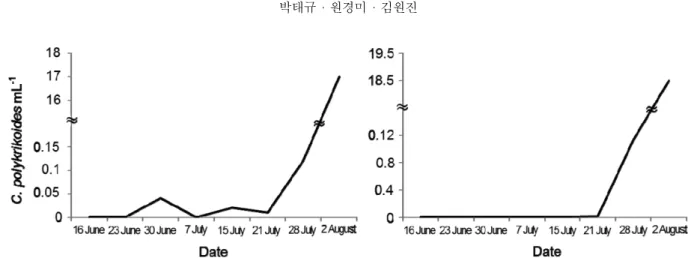
2015 년 적조출현주의보는 8월 2일 발령되어 8월 5일 주의보, 8월 13 일 경보, 9월 26일 해제되었다. 6월 16일부터 8월 2일까지 저밀도 적조조사 결과 7월 28일 까지는 C. polykrikoides 밀도가 1cell mL

-1

이하 저밀도로 출현하다가 8월 2일부터 10cells mL

-1

이상으로 출 현하였으며, 현미경 검경과 real-time PCR 결과를 바탕으로 적조 출현주의보가 발령되었다(국립수산과학원 적조속보 홈페이지 참조 http://www.nfrdi.re.kr/redtideInfo). 현미경 검경과 real-time PCR 분석결과 모두 C. polykrikoides 밀도가 8월 2일 이후 급격히 증 가하는 결과를 보였다(Table 2, Fig. 2). 하지만 1cell mL

-1

이하의 저밀도에서는 real-time PCR(평균 0.17 cell mL

-1

±0.37) 과 현미경 검경 결과(평균 0.04 cell mL

-1

±0.04) 에 차이를 보였다(Table 2).

검량선(Fig. 1)에서의 real-time PCR의 검출감도는 0.35 cell mL

-1

로 매우 높은 정량검출 결과를 보였으며, 배양된 세포를 이용한 실내 실험에서도 1세포 이하(0.6 cell mL

-1

) 의 높은 검출감도가 보고되어 있다(Bowers et al., 2000). 또한 Real-time PCR를 현장적용시 현 미경 검경결과와 비슷한 정량결과(R

2

=0.735) 를 보인다고 보고되었 다(Park et al. 2009b). 하지만 매우 저밀도 적조에서는 시료채집, 여과, 시료운반 등의 전처리 과정에서 유실되는 세포량이 많기 때 문에 정량분석시 오차가 생기는 것으로 보인다.

Fig. 1. Linear relationship between the Ct values and the cell numbers for C. polykrikoides (R

2

=0.99). The standard errors from three mea- surements are shown as error bars.

Table 1. Primers and a probe for C. polykrikoides specific real-time PCR

Forward/Reverse/Probe Code Sequence (5' →3') Reference

Forward CPITSF CGGCAACCTTTGTCAAACA

Park et al. (2009a) Reverse CPITSR2 GGTTTGCTGATCTAACTTCATGTCT

Probe CPITSP FAM-CAACCGTGATACCCGCTAGCTTTGC-BHQ1

Table 2. C. polykrikoides abundances measured by light microscope and real-time PCR. Water samples were collected from 10 stations in Tongyeong to Namhae. Average cell numbers of positive detections are shown (n=1 to 10; triplicate measurements). Brackets show numbers of positive detection of C. polykrikoides

Sampling date C. polykrikoides cells mL

-1

Microscope Real-time PCR

16 June 2015 0 0

23 June 2015 0 0.0002(2)

30 June 2015 0.04(1) 0.0002(10)

07 July 2015 0 0.0002(2)

15 July 2015 0.02(3) 0.003(10)

21 July 2015 0.01(7) 0.008(10)

28 July 2015 0.12(9) 0.85(9)

02 August 2015 16.72(10) 18.53(10)

(3)

46 박태규 · 원경미 · 김원진

현미경과 real-time PCR의 시공간적 출현분포 결과를 비교해 보 면(Fig. 3), real-time PCR 결과는 6월 23일 C. polykrikoides가 첫 출현해서 6월 30일에는 광범위하게 분포함을 파악할 수 있는 반 면, 현미경으로는 6월 30일 첫 출현해서 7월 28일에서야 광범위 하게 분포함을 파악 할 수 있다. 이는 real-time PCR을 이용하면 조기에 출현분포를 파악할 수 있고, 출현주의보 발령을 위한 사전 준비가 가능해진다. 2015년의 경우 적조조기 예찰결과를 바탕으로 6 월 말경부터 출현주의보 발령을 위한 유관기관과의 협조, 적조구 제장비 확보, 적조예찰 준비 등의 적조대비 사전준비를 하였다.

Real-time PCR 이 적조생물 조기검출에 유용하다는 보고는 여러

적조생물을 대상으로 보고되어있다(Park et al., 2007, 2009a, 2010;

Coyne et al., 2005; Handy et al., 2008). 본 연구에서는 real-time PCR 이 적조예보를 위해 현장에서 활용된 사례를 보여주고 있으 며, 분자탐침기법이 적조출현주의보와 같이 저밀도 적조의 조기검 출에 유용하게 활용될 수 있음을 보여준다.

사 사

현장 해수채집에 도움을 주신 박재영 연구원님께 감사 드립니다.

이 논문은 2015년도 국립수산과학원 수산과학연구사업(R2015050)의 Fig. 2. Abundances of C. polykrikoides measured by light microscope (left) and real-time PCR (right). Water samples were collected from Tongyeong to Namhae in 2015. The cell numbers are also shown in Table 2.

Fig. 3. Spatial distribution of C. polykrikoides in Tongyeong to Namhae in June to July 2015 measured by microscope (top) and real-time PCR

(bottom). Black spots indicate positive detection of C. polykrikoides.

(4)

Cochlodinium polykrikoides 적조출현주의보 발령에 분자탐침기법의 활용 47

지원으로 수행된 연구이며 연구비 지원에 감사드립니다.

참고문헌(References)

Bower, H.A., Tengs, T., Glasgow, H.B., Burkholder, J.M., Rublee, P.A. and Oldach, D.W., 2000. Development of real-time PCR assays for rapid detection of Pfiesteria piscicida and related dino- flagellates. Appl. Environ. Microbiol. 66: 4641−4648.

Coyne, K., Handy, S.H., Demir, E., Whereat, E.B., Hutchins, D.A., Portune, K.J., Doblin, M.A. and Craig, C.S., 2005. Improved quantitative real-time PCR assays for enumeration of harmful algal species in field samples using an exogenous DNA reference standard. Limnol. Oceanogr. Meth. 3: 381−391.

Handy, S.M., Demir, E., Hutchins, D.A., Portune, K.J., Whereat, E.B., Hare, C., Rose, J., Warner, M., Farestad, M. and Cary, S.C., 2008. Using quantitative real-time PCR to study competition and community dynamics among Delaware Inland Bays harmful algae in field and laboratory studies. Harmful Algae 7: 599−613.

Lee, C.K., Park, T.G., Park Y.T. and Lim, W.A. 2013. Monitoring and trends in red-tide events in Korea with emphasis on Cochlodin- ium polykrikoides. Harmful Algae 30S: 3−14.

Park, T.G., de Salas, M.F., Bolch, C.J.S. and Hallegraeff, G.M., 2007.

Development of a real-time PCR probe for quantification of the

heterotrophic dinoflagellate Cryptoperidiniopsis brodyi (Dino- phyceae) in environmental samples. Appl. Environ. Microbiol.

73: 2552−2560.

Park, T.G., Park, G.H., Park, Y.T., Kang, Y.S., Bae, H.M., Kim, C.H., Jeong, H.J. and Lee, Y., 2009a. Identification of the dinoflagellate community during Cochlodinium polykrikoides (Dinophyceae) blooms using amplified rDNA melting curve analysis and real- time PCR probes. Harmful Algae 8: 430−440.

Park, T.G., Park, Y.T. and Lee Y., 2009b. Development of a SYTO9 based real-time PCR probe for detection and quantification of toxic dinoflagellate Karlodinium veneficum (Dinophyceae) in environ- mental samples. Phycologia 48: 32−43.

Park, T.G. and Park, Y.T., 2010. Detection of Cochlodinium polykrikoi- des and Gymnodinium impudicum (Dinophyceae) in sediment sam- ples from Korea using real-time PCR. Harmful Algae 9: 59−65.

Park, T.G., Lim, W.A., Park, Y.T., Lee, C.K. and Jeong, H.J., 2013.

Economic impact, management and mitigation of red tides in Korea.

Harmful Algae 30S: 131−143.

2015년 10월 2일 원고접수

2015년 11월 24일 수정본 접수

2015년 12월 23일 수정본 채택

담당편집위원: 이윤호

수치

Table 1. Primers and a probe for C. polykrikoides specific real-time PCR
Fig. 3. Spatial distribution of C. polykrikoides in Tongyeong to Namhae in June to July 2015 measured by microscope (top) and real-time PCR (bottom)

참조

관련 문서

In this paper, we propose that acquire texture information to use GLCM(Gray Level Co-occurrence Matrix) in red tide area of artificial satellite remote

Specific isolation and detection of hepatitis A virus from fecal samples containing hepatitis A and E virus using immunomagnetic separation (IMS) and nested RT-PCR.. P,

Specific isolation and detection of hepatitis A virus from fecal samples containing hepatitis A and E virus using immunomagnetic separation (IMS) and nested RT-PCR.. P, positive