Copyright ⓒ 2013, The Microbiological Society of Korea
Trichloroethylene으로 오염된 지하수 제거공정의 미생물 다양성 및 분리균주 Pseudomonas sp. DHC8의 특성
남지현1,2․신지혜2․권기욱3․배우근3․이동훈2*
1경성대학교 생물학과, 2충북대학교 미생물학과, 3한양대학교 건설환경플랜트공학과
Microbial Diversity of the Trichloroethylene Contaminated Groundwater Treatment System and Characterization of Pseudomonas sp. DHC8
Ji-Hyun Nam1,2, Ji-Hye Shin2, Kiwook Kwon3, Wookeun Bae3, and Dong-Hun Lee2*
1Department of Biology, Kyungsung University, Busan 608-736, Republic of Korea
2Department of Microbiology, Chungbuk National University, Cheongju 361-763, Republic of Korea
3Department of Civil and Environmental System Engineering, Hanyang University, Ansan 425-791, Republic of Korea
(Received September 23, 2013 / Accepted October 21, 2013)
Trichloroethylene (TCE) is a widely used substance in commercial and industrial applications, yet it must be removed from the contaminated soil and groundwater environment due to its toxic and carcinogenic nature. We investigated bacterial community structure, dominant bacterial strain, and removal efficiency in a TCE contaminated groundwater treatment system using immobilized carrier. The microbial diversity was determined by the nucleotide sequences of 16S rRNA gene library. The major bacterial population of the contaminated groundwater treatment system was belonging to BTEX degradation bacteria. The bacterial community consisted mainly of one genus of Pseudomonas (Pseudomonas putida group). The domination of Pseudomonas putida group may be caused by high concentration of toluene and TCE. Furthermore, we isolated a toluene and TCE degrading bacterium, named Pseudomonas sp. DHC8, from the immobilized carrier in bioreactor which was designed to remove TCE from the contaminated ground water. Based on the results of morphological and physiological characteristics, and 16S rRNA gene sequence analysis, strain DHC8 was identified as a member of Pseudomonas putida group. When TCE (0.83 mg/L) and toluene (60.61 mg/L) were degraded by this strain, removal efficiencies were 72.3% and 100% for 12.5 h, respectively. Toluene removal rate was 2.89 μmol/g-DCW/h and TCE removal rate was 0.02 μmol/g-DCW/h. These findings will be helpful for maintaining maximum TCE removal efficiency of a reactor for bioremediation of TCE.
Keywords: Pseudomonas sp. DHC8, immobilized bacterial carrier, microbial diversity, TCE contaminated groundwater
*For correspondence. E-mail: [email protected]; Tel.: +82-43-261- 3261; Fax: +82-43-264-9600
Trichloroethylene (TCE)은 산업활동에서 용매와 세척제로 광범위하게 사용되며 토양과 지하수의 오염을 초래하는 것으로 알려져 있다(Squillace et al., 1999). TCE는 발암성과 독성으로 말미암아 BTEX (Benzene, Toluene, Ethyl benzene, Xylene)와 함께 미국 EPA가 지정한 최우선 감시물질이며(Jahng and Wood, 1994), 현재 국내의 먹는 물 수질기준의 경우 0.03 mg/L로 규제 되고 있다.
TCE에 대한 생물학적 제거방법은 크게 혐기적 처리방법과 호기적 처리방법으로 구분할 수 있으며(Rittmann and McCarty, 2001), TCE의 혐기적 분해방법은 환원적 탈염소화를 거쳐 염소 이온이 수소로 대체되고 최종적으로 ethane이 생성되는 방법으로 이 과정에서 dichloroethylene, vinyl chloride (monochloroethene)
가 축적될 수 있는 것으로 알려져 있다(McCarty, 1997; Chambon et al., 2013). 중간 대사산물인 vinyl chloride는 TCE와 같이 강 한 독성과 발암성을 가지고 있어 TCE 제거공정의 사용에 제약 이 된다(Kielhorn et al., 2000; Gennaro et al., 2008).
호기적 미생물을 이용한 TCE 분해의 경우, TCE 자체의 독성 으로 인해 성장 기질로 사용하지 못하고 toluene, phenol, benzene, methane, butane, ammonia 등을 탄소원과 에너지원으로 하는 공 동대사(cometabolism)에 의해 분해된다(Arp et al., 2001; Kim et al., 2002; Elango et al., 2011; Powell et al., 2011). TCE 분해 미생물은 특정 성장기질을 이용할 때 산화효소(oxygenase)를 발 현하며, 이들 효소에 의한 공동대사로 TCE를 제거한다. Toluene 과 TCE를 모두 분해할 수 있는 미생물에는 toluene dioxygenase를 발현하는 Pseudomonas putida F1 (Morono et al., 2004), toluene- 2-monooxygenase를 생산하는 Burkholderia vietnamiensis G4 (Yeager et al., 2001), toluene-3-monooxygenase와 toluene-4-
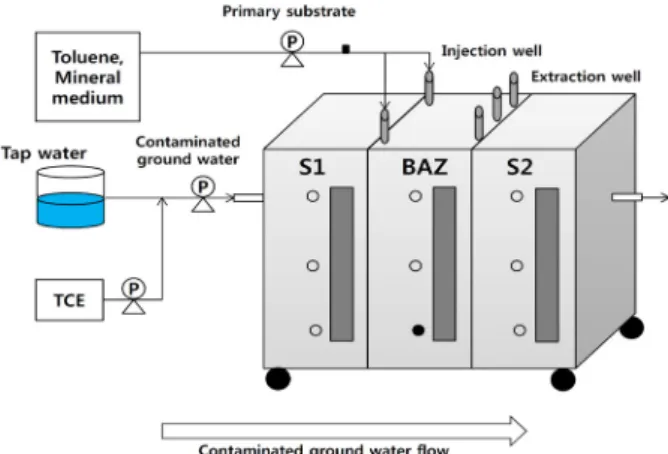
Fig. 1. Schematic diagram of the TCE-contaminated groundwater treatment system. S1, soil; BAZ, Bioactive zone (including immobilized bacterial carrier); S2, soil; P, pump; ○, sampling port;
●, sampling site.
monooxygenase를 각각 생산하는 Pseudomonas pickettii PKO1 과 Pseudomonas mendocina KR1 등이 알려져 있다(Arp et al., 2001; Yeager et al., 2004). 위의 미생물들은 BTEX 성분과 TCE를 모두 분해할 수 있어 다양한 오염물질의 처리에 적합하 고, P. pickettii PKO1을 제외한 나머지 균주의 경우 toluene 또 는 phenol의 성장기질에서 배양이 용이하고 성장속도가 빠르기 때문에 오염현장의 적용이 기대되는 미생물이다(Lee et al., 1998).
본 연구에서는 미생물 고정화담체를 이용한 TCE로 오염된 지하수 처리공정의 효율적인 운전을 위한 미생물학적 정보를 확 보하고, 반응기에서 우점하는 세균을 분리·동정하였으며, 분리 세균의 toluene 및 TCE 분해특성을 평가함으로써 염소계 유기 화합물로 오염된 지하수의 처리공정 연구에 기여하고자 한다.
재료 및 방법
TCE로 오염된 지하수 제거공정의 시료 채취 및 DNA 추출 Trichloroethylene (TCE)으로 오염된 지하수 주변의 환경을 모사하고, 실제 복원현장에서 예상되는 처리조건들을 반영하여 총 450 L의 pilot plant의 반응기를 설계하였으며, 오염된 지하수 의 in situ 처리를 위해 지하수 흐름을 가로질러 bioactive zone (BAZ)을 설치하였다(Fig. 1). 오염된 지하수가 토양을 통과하도 록 첫 번째 반응기를 설치하고(S1), 토양을 통과한 지하수가 미 생물 고정화담체를 통과하도록 두 번째 반응기를 설치하였으며 (BAZ), 마지막으로 미생물 고정화담체에 의하여 TCE가 제거된 지하수가 토양을 통과하도록 설치하였다(S2).
TCE 제거가 이루어지는 bioactive zone (BAZ) 반응기에는 polyethylene glycol diacrylate (PEG)를 주성분으로 하고, 개시 제로 potassium persulfate (K2S2O8), 가교제로 sorbitol과 borax, 촉매제로 TEMED (N,N,N’,N’-tetramethylethylenediamine) 등 을 혼합하여 Kim 등(2010)의 방법으로 합성한 4 mm (L) × 4
mm (W) × 4 mm (H)의 고정화담체 90 L를 충진하였다. 또한, pilot plant 운전 전까지 BAZ 반응기에서 toluene의 농도가 약 10 mg/L가 되도록 1일 1회 기질로 주입하여 두 달 동안 고정화 담체에 toluene 분해미생물을 농화시켰다.
Pilot plant는 BAZ 반응기에서 TCE와 1차 성장 기질인 toluene의 농도가 각각 0.5 mg/L와 18 mg/L이 되도록 정량펌프 를 이용하여 주입하며 5개월 이상 운전하였고, TCE와 toluene의 제거가 잘 이루어지는 시점의 BAZ 반응기에서 담체시료 50 ml 을 채취하였다.
멸균된 phosphate buffered saline (PBS; NaCl 8.1 g/L, Na2HPO4
2.3 g/L, NaH2PO4 0.19 g/L) 용액에 담체 외부를 3회 세척하고, 파쇄하였다. Rochelle 등(1992)의 freezing-thawing 방법으로 미 생물 담체 1 ml (cm3)에서 핵산을 직접 추출하였다. 추출된 핵산 은 QIAamp DNA Micro Kit (QIAGEN, Germany)로 정제하였 으며, genomic DNA 시료는 -20℃에 보관하였다.
미생물 고정화담체의 세균군집 구조분석
세균군집의 16S rRNA 유전자를 증폭하기 위하여 27F (5′- AGAGTTTGATCMTGGCTCAG-3′)와 1492R (5′-GGYTACC TTGTTACGACTT-3′) 프라이머쌍을 사용하였다(Lane, 1991).
PCR 반응물은 1X 반응용액(100 mM Tris-HCl, 400 mM KCl, 1.5 mM MgCl2, 500 μg/ml BSA, pH 8.3), 160 μM dNTPs, 0.3 μM primer, 정제된 DNA (10–15 ng/μl)와 1 unit의 Taq polymerase (HanTaq, Genenmed, Korea)를 첨가하여 총 50 μl의 혼합물을 만들었다. PCR 반응조건은 95℃에서 3분간 초기 열처리한 후, 95℃에서 30초, 49℃에서 30초, 72℃에서 1분씩 30회 반복하고, 마지막에는 72℃에서 10분간 처리한 후 반응을 중단시켰다.
PCR 산물은 1.0% 아가로스젤에서 전기영동 한 후 PureLink™
Quick Gel Extraction Kit (Life Technology, USA)로 정제하였 으며, pGEM-T vector (Promega, USA)를 이용하여 16S rRNA 유전자의 클론라이브러리를 구축하였다. T-vector의 염기서열 에 상보적인 prGTf (5′-TACGACTCACTATAGGGCGA-3′)와 16S rRNA의 1492R 프라이머쌍을 사용하여 direct amplified PCR을 수행하고(Chun et al., 1999), 전기영동으로 PCR 산물의 크기를 확인하여 5′에서 3′ 방향으로 삽입된 재조합 클론을 2차 선별하였다. 선별된 클론들은 T7 (5′-TAATACGACTCACTAT AGGG-3′) 프라이머를 이용하여 ABI 3730XL DNA Analyzer (Applied Biosystems, USA)로 염기서열을 분석하였다(Solgent, Korea).
시료에서 확인된 16S rRNA 유전자의 염기서열과 Ribosomal Database Project (RDP; http://rdp.cme.msu.edu), GenBank (http://ncbi.nlm.nih.gov)의 database로부터 확인된 비교균주의 염기서열을 CLUSTAL X (version 1.83) 프로그램을 이용하여 정렬하였다. 정렬된 염기서열은 PHYLIP package (version 3.6a3)를 이용하여 Jukes and Cantor distance model (Jukes and Cantor, 1969)과 neighbor-joining method (Saitou and Nei, 1987)로 염기서열간의 진화적 거리와 계통도를 추론하였다. 또 한, 계통도의 bootstrap값은 1,000회의 resampled data로부터 계 산하였다(Felsenstein, 1985). 본 연구에서 분석된 16S rRNA 유전
(A)
(B)
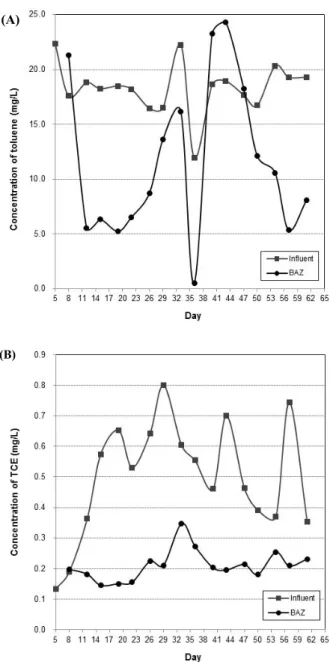
Fig. 2. Time course of toluene and TCE degradation of the Pilot-plant including re-injection. (A) The concentrations of toluene, (B) The concentrations of TCE (symbols: ■, Influent; ●, BAZ).
자의 염기서열은 DDBJ (DNA Data Bank of Japan; http://www.
ddbj.nig.ac.jp)에 등록하였다(accession no.: AB849299- AB849324).
고정화담체 미생물의 분리 및 동정
고정화담체의 미생물을 분리, 배양하기 위하여 멸균된 0.85%
NaCl 용액으로 담체 외부를 3회 세척하고, 파쇄하였다. 파쇄한 담체 내 미생물은 멸균된 0.85% NaCl에 용출시켰으며, toluene 이 100 mg/L 함유된 0.01X Nutrient Agar (Bacto-peptone 0.05 g/L, Bacto-beef extract 0.03 g/L, Bacto-agar powder 20 g/L)에 서 접종하여 30℃에서 2일간 배양하였다. Toluene이 첨가된 배 지에서 분리된 세균의 16S rRNA 유전자 염기서열을 분석하여 우점 세균을 확인하였다. 형태학적 특징을 관찰하기 위하여 그 람염색 후 광학현미경(X1500, Nikon ECLIPSE 80i, Nikon, Japan)으로 검경하였으며, API 20NE Kit (bioMérieux, France) 를 사용하여 생리·생화학적 특성을 조사하였다.
Toluene 및 TCE의 분해능 평가
분리균주를 이용하여 toluene (60.61 mg/L)과 TCE (0.83 mg/L)의 분해실험을 실시하였다. 120 ml amber serum bottle에 50 ml의 phosphate buffered mineral medium [(NH4)2HCO3
1.23 g/L, K2HPO4 0.85 g/L, KH2PO4 0.69 g/L, MgSO4·H2O 1.82 mg/L, CaCl2·2H2O 1.13 mg/L, FeSO4·7H2O 1 mg/L, ZnSO4·7H2O 20 mg/L, H3BO3 60 mg/L, CuCl2·2H2O 2 mg/L, CoCl2·6H2O 40 mg/L, MnCl2·4H2O 6 mg/L, NiCl2·6H2O 4 mg/L, NaMoO4·2H2O 6 mg/L, pH 7.2]을 넣고 1.9 mg (dry weight)/ml의 농도로 분리균주를 접종하였다. 분리균주는 nutrient broth에서 30℃, 2일간 배양하고, 원심분리하여 얻은 균 체를 PBS 용액에 현탁하여 사용하였다. 배양용기의 호기성조건 을 유지하기 위하여 산소로 purging (용존산소 30 mg/L) 하였으 며, teflon-coated silicon septum과 aluminum cap으로 밀봉하고 28℃, 150 rpm으로 회분 배양하였다.
TEC 및 toluene의 농도 측정을 위해 gas tight syringe를 이용 하여 headspace 가스를 시간별로 100 μl씩 채취하였고, FID (Flame Ionization Detector)가 부착된 STAR 3400CX Varian Gas Chromatography (Varian, USA)를 이용하여 분석하였다.
가스크로마토그래피 컬럼은 DB-5 (30 m × 0.53 mm × 0.25 μm, J&W scientific, USA)를 사용하였고, 시험온도는 오븐이 120℃, 주입부와 검출부가 각각 200℃와 230℃이었다. 균주의 건조균 체중량당(dry cell weight, DCW) toluene, TCE의 분해속도 (mol/g-DCW/h)를 확인하였다. 실험에 사용된 TCE와 toluene 용액은 sigma aldrich chemical company (USA)에서 구입하여 사용하였으며, 순도는 TCE≥99.5%, Toluene 99.8%이었다.
결과 및 고찰
Pilot plant의 운전
Pilot plant는 유입유량 0.9 L/h, pilot plant 전체의 공탁체류시 간(Empty Bed Contact Time; EBCT)과 담체의 공탁체류시간은 각각 500시간과 100시간이 되도록 운전하였다. BAZ 반응기의
toluene과 TCE 농도는 각각 17.14±3.48 mg/L와 0.50±0.19 mg/L가 되도록 주기적으로 주입하여 운전하였으며, 미생물 고 정화담체에 의한 BAZ 반응기의 toluene과 TCE의 제거 특성을 확인하였다(Fig. 2). BAZ 반응기의 운전결과 두 달 동안 toluene 의 경우 75.69% (4.17±2.44 mg/L) 분해하였으며, TCE의 경우 58.24% (0.21±0.05 mg/L)를 분해하였다.
Phenol을 성장기질로 사용하는 경우 높은 TCE 분해 효율을 나타내지만 염소가 수중에 존재할 때 chlorinated phenol을 형성 하여 악취를 유발하는 문제가 있다. Toluene을 성장기질로 사용 할 경우 24 µg/L 이상의 농도에서 냄새가 나거나 120–160 µg/L 이상의 농도에서 맛의 문제가 있을 수 있다(World Health
Phylum Class Genus Composition (%) Acidobacteria Acidobacteria_Gp1 Acidobacterium 3.8
Proteobacteria Beta
Acidovorax 7.7
Comamonas 3.8
Cupriavidus 3.8
Dechloromonas 3.8 Ferribacterium 3.8 Methylobacillus 3.8 Methylophilus 3.8 Methylotenera 11.5
Pelomonas 3.8
Gamma Pseudomonas 42.3
Stenotrophomonas 3.8 Bacteroidetes Sphingobacteria Terrimonas 3.8 Table 1. Phylogenetic affiliations and compositions of bacterial 16S rRNA gene clone library
Characteristic Pseudomonas sp.
DHC8 Pseudomonas
putida
Gram-stain - -
Shape Rod Rod
Nitrate reduction - -
Denitrification - -
Hydrolysis of:
Aesculin -
Gelatin - -
Assimilation of:
Glucose + +
Arabinose - d
Mannose + d
Mannitol - d
N-Acetyl-glucosamine -
Maltose - d
Potassium gluconate + +
Caprate + +
Adipate - -
Malate + d
Citrate + +
Phenylacetate + d
Production of indole -
Fermantation of D-glucose - +
Arginine dihydrolase - +
Urease -
β-Galactosidase -
Oxidase + +
Catalase +
Table 2. Phenotypic characteristics of Pseudomonas sp. DHC8 Substrate hydrolysis, utilization of carbon source, and physiological characteristics were determined in this study using API 20NE test.
+, Positive; -, negative; d, differs among strains. The data of Pseudomonas putida were obtained from Choi et al. (2008).
Organization, 1984). Kim 등(2005)은 오염현장 토착미생물의 toluene 분해능을 평가한 결과 5 µg/L 이하의 농도까지 toluene 의 분해가 가능하고, 현장 적용시 잔류 toluene에 의한 지하수의 2차 오염에 대한 문제가 없는 것을 확인하였다. 따라서 본 연구 에서는 TCE로 오염된 지하수의 제거공정에 일차성장기질로 toluene을 사용하였다.
미생물 고정화담체 내 세균군집구조 분석
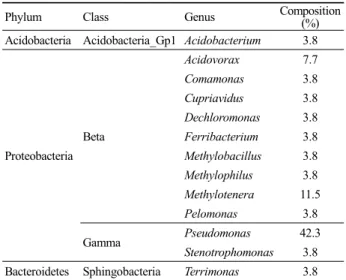
Toluene과 TCE의 분해가 이루어지는 pilot plant BAZ 반응 조의 운전후기 고정화담체의 세균군집 분석결과 Proteobacteria 문의 γ-Proteobacteria 강과 β-Proteobacteria 강에 속하는 세균의 염 기서열이 각각 46.1%와 45.8%로 매우 우점하였고, Acidobacteria 와 Bacteroidetes의 세균 군집도 확인되었다(Table 1). 속(genus) 수준에서 미생물 고정화담체의 세균군집은 γ-Proteobacteria의 Pseudomonas 속이 42.3%, β-Proteobacteria의 Methylotenera 속이 11.5%로 우점하는 단순한 군집구조가 관찰되었다.
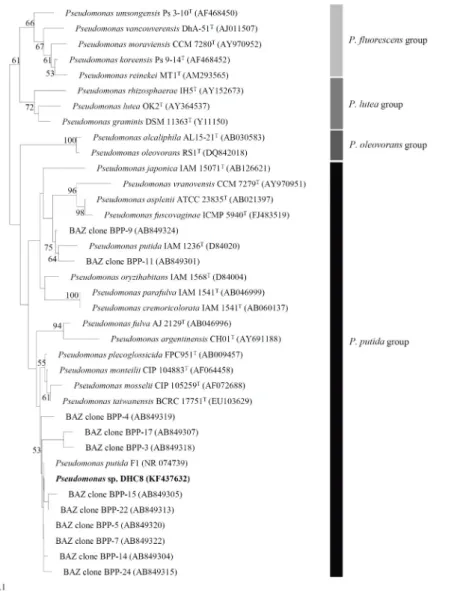
고정화담체에서 확인된 Pseudomonas 속과 유연관계가 가까 운 클론의 염기서열을 이용한 계통분류학적 분석 결과 대부분 Pseudomonas putida 그룹 (Mulet et al., 2013)에 속하였다(Fig.
3). Pseudomonas 속과 유연관계가 가까운 클론의 81.8%가 P.
putida F1과 가장 유사한 것으로 확인되었다.
Pseudomonas putida F1은 TCE와 toluene의 제거 속도가 빠 르고 toluene을 호기적으로 산화하여 탄소원과 에너지원으로 사 용하며, TCE의 공동대사를 위하여 toluene dioxygenase 효소를 생성한다(Wackett and Gibson, 1988; Bordel et al., 2007; Liu et al., 2012). P. putida F1은 벤젠고리의 ortho와 meta 위치에 산소 분자를 삽입하여 첫 단계의 toluene 산화를 시작한다. 이 단계는 toluene dioxygenase 효소에 의하여 반응이 진행되며, 이 효소의 기질에 대한 비특이성으로 인하여 TCE를 포함한 여러 종류의 염소화합물을 분해한다고 알려져 있다(Zylstra and Gibson, 1989;
Heald and Jenkins, 1994). Pseudomonas putida F1과 유사한 그 룹이 매우 높은 우점도로 관찰된 것은 toluene을 단일 기질로 공
급함으로써 종다양성이 감소하고, toluene과 TCE 분해세균만 농화되어 나타난 결과로 생각된다.
본 연구의 경우, TCE가 수중에 잘 용해되지 않는 점을 감안하 여 미량의 methanol에 희석하여 TCE로 오염된 지하수를 모방하 였다. 세균군집 분석결과 11.5%를 차지한 Methylotenera 속과 각각 3.8%를 차지한 Methylobacillus, Methylophilus 속은 β -proteobacteria의 methylotroph 그룹에 속하는 미생물로 methanol 과 methylamine을 탄소원으로 이용한다고 알려져 있다(Kalyuzhnaya et al., 2006, 2012). 미량의 methanol 유입은 외부 탄소원으로서 의 이용가능성을 배제할 수 없으며, 세균군집구조에 대한 영향 이 있을 수 있다.
고정화 담체 미생물의 분리 및 동정
Toluene과 TCE가 제거되고 있는 Pilot-plant BAZ 반응기의 고정화담체 내 미생물을 분리 및 배양하였다. Toluene이 첨가된 배지에서 성장한 다양한 형태의 콜로니를 10개 이상 분리하였
Fig. 3. Phylogenetic tree based on the partial sequence of 16S rRNA genes of library clones and Pseudomonas sp. DHC8 isolated from the TCE-contaminated groundwater treatment system. The sequence of Escherichia coli (X80725) was used as an outgroup. The tree was constructed by using the Jukes & Cantor distance model and the neighbor-joining method. The bootstrap values above 50% are shown for internal nodes.
고, 16S rRNA 유전자 염기서열을 분석한 결과 Pseudomonas 속 및 Microbacterium 속과 높은 유사성을 나타내었다. 분리된 균 주 중 군집분석결과에서 관찰된 Pseudomonas 속과 가장 유연관 계가 가까운 균주 Pseudomonas sp. DHC8를 선정하였다.
Pseudomonas sp. DHC8의 경우 그람음성 간균으로 확인되었으 며, 16S rRNA 유전자 염기서열 분석결과 고정화담체의 세균군 집 구조에서 42.3%로 가장 우점한 P. putida 그룹의 염기서열과 매우 높은 유사성을 나타내었다(Fig. 3). Pseudomonas sp. DHC8 균주의 염기서열은 GenBank (http://ncbi.nlm.nih.gov)에 등록하 였다(accession no.: KF437632).
생리·생화학적 특징은 Table 2에 표시하였으며, bioMérieux 회사에서 제공하는 apiweb (https://apiweb.biomerieux.com)을 통 하여 분석한 결과 P. putida와 83%로 가장 유사하였다. Pseudomonas sp. DHC8 균주는 P. putida와 glucose, mannose, potassium gluconate,
caprate, malate, citrate, phenylacetate 등을 탄소원으로 이용할 수 있다는 공통점과 arginine dihydrolase가 없는 포도당 비발효 그람음성 간균이라는 차이점을 가지고 있다.
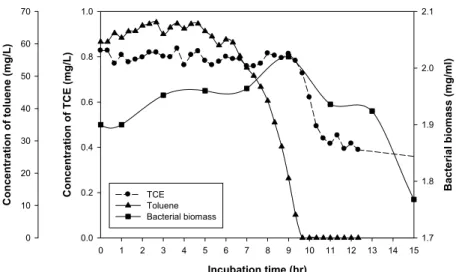
분리 균주 Pseudomonas sp. DHC8의 toluene과 TCE 분해 특성 건조균체중량(dry cell weight, DCW) 1.9 mg/ml의 Pseudomonas sp. DHC8 균체를 이용하여 toluene (60.61 mg/L)과 TCE (0.83 mg/L) 분해 특성을 확인하였다. Toluene의 경우 9.5시간 동안 100% 분해하였으며, TCE의 경우 12.5시간 동안 72.3%를 분해 하였다(Fig. 4). TCE는 12시간이 경과한 이후부터(0.4 mg/L 이 하 농도) 분해가 제대로 이루어지지 않았으며, 잔류농도는 0.2 mg/L였다. DHC8 균주의 toluene 분해속도는 2.89 μmol/g- DCW/h이며, TCE의 분해속도는 0.02 μmol/g-DCW/h로 나타났다.
Uchiyama 등(1994)은 methanotroph 그룹에 속하는 Methylocystis
Incubation time (hr)
0 1 2 3 4 5 6 7 8 9 10 11 12 13 14 15
Concentration of TCE (mg/L)
0.0 0.2 0.4 0.6 0.8 1.0
Concentration of toluene (mg/L)
0 10 20 30 40 50 60 70
Bacterial biomass (mg/ml)
1.7 1.8 1.9 2.0 2.1
TCE Toluene Bacterial biomass
Fig. 4. Time course of toluene and TCE degradation by Pseudomonas sp. DHC8. The initial concentrations of toluene and TCE were 60.61 mg/L and 0.83 mg/L, respectively (symbols: ●, TCE; ▲, toluene; ■, Bacterial biomass).
sp. strain M을 Ca-alginate, κ-carrageenan, agarose에 각각 고정 화하여 TCE 분해율을 비교한 결과, 부유상태의 미생물보다 고 정화된 미생물이 더 높은 농도의 TCE를 처리할 수 있다고 보고 하였다. 또한, chitosan bead에 P. putida를 고정화하고, 성장기 질로 phenol을 이용한 TCE 제거 실험에서 부유상태의 미생물보 다 고정화된 미생물이 고농도의 TCE의 처리에 안정적임을 알 수 있었다(Chen et al., 2007). 선행 연구결과를 토대로 Pseudomonas sp. DHC8 균주를 이용하여 PEG 담체에 고정화 한다면, TCE의 처리효율을 증가시킬 뿐만 아니라 미생물 균체가 상대적으로 안 정화되어 0.2 mg/L 농도 이하의 TCE 제거가 가능할 것으로 사 료된다.
TCE로 오염된 지하수를 정화하기 위해서는 TCE 분해 능력 이 빠른 미생물을 이용해야 할 것이다. 그러나 TCE 분해 속도가 빠른 미생물이라도 배양이 용이하고, 자연환경에 순응하여 성장 할 수 없다면 현장에 적용하기에는 무리가 있다. 실제 현장에는 고정화담체의 미생물이 토착 미생물과 경쟁해야 하고 다양한 농 도의 TCE가 존재할 수 있는데, 이러한 환경에 적응하고 TCE가 미치는 독성에 어느 정도 내성을 가지고 있는 미생물이어야 할 것이다. 공동대사(Cometabolism)에 의해 TCE가 분해되므로 가 장 중요한 고려사항은 미생물 성장기질의 종류와 분해율이다.
성장기질이 모두 사용되지 않고 잔류할 경우 오히려 2차 오염물 질로 작용할 수 있기 때문이다. 분리균주 Pseudomonas sp.
DHC8은 배양이 용이하고, 성장기질로 toluene을 완전히 분해하 여 2차 오염에 대한 문제가 없으며, TCE의 독성에 내성을 가진 미생물로 TCE로 오염된 지하수 제거공정에 적합하다고 판단된다.
적 요
산업에서 널리 사용되고 있는 Trichloroethylene (TCE)은 토 양 및 지하수의 오염을 일으키며, 암 유발물질로 환경에서 반드 시 제거해야 하는 물질이다. 본 연구에서는 미생물 고정화 담체
를 이용한 TCE로 오염된 지하수 처리 시스템의 세균 군집구조 를 조사하고, 우점종을 분리 및 동정하고 TCE 제거특성을 확인 하였다. TCE로 오염된 지하수 처리공정의 세균군집을 16S rRNA 유전자 라이브러리의 염기서열 분석방법을 이용하여 조사 한 결과, 주요 개체군은 BTEX 분해세균으로 알려진 Pseudomonas 속이었으며 Pseudomonas putida 그룹이 가장 우점하였다.
Pseudomonas putida 그룹의 우점은 높은 toluene과 TCE의 농 도에서 기인한 것으로 생각된다. TCE로 오염을 제거하기 위한 미생물 반응기에서 toluene과 TCE 분해 세균을 분리 배양하였으 며 Pseudomonas sp. DHC8로 명명하였다. 형태학적 특징, 생리·
생화학적 특징, 16S rRNA 유전자 염기서열분석 결과 DHC8 균 주는 P. putida 그룹에 속하는 것으로 확인되었다. Pseudomonas sp. DHC8을 이용하여 TCE (0.83 mg/L)와 toluene (60.61 mg/L) 에 대해 분해실험을 실시하였을 때 12.5시간 동안 TCE는 72.3%, toluene은 100.0% 제거되었다. 또한, TCE와 toluene의 제거속도는 각각 0.02 μmol/g-DCW/h와 2.89 μmol/g-DCW/h 였다. 본 연구 결과는 TCE의 생물정화를 위한 반응기의 최대 효 율을 유지하기 위한 노력에 도움이 될 것이다.
감사의 말
이 논문은 2011년도 충북대학교 학술연구지원사업의 연구비 지원에 의하여 연구되었습니다.
참고문헌
Arp, D.J., Yeager, C.M., and Hyman, M.R. 2001. Molecular and cellular fundamentals of aerobic cometabolism of trichloroethylene.
Biodegradation 12, 81–103.
Bordel, S., Diaz, L.F., Munoz, R., and Villaverde, S. 2007. New insights on toluene biodegradation by Pseudomonas putida F1: influence of pollutant concentration and excreted metabolites. Appl. Microbiol.
Biotechnol. 74, 857–866.
Chambon, J.C., Bjerg, P.L., Scheutz, C., Baelum, J., Jakobsen, R., and Binning, P.J. 2013. Review of reactive kinetic models describing reductive dechlorination of chlorinated ethenes in soil and groundwater. Biotechnol. Bioeng. 110, 1–23.
Chen, Y., Lin, T., Huang, C., Lin, J., and Hsieh, F. 2007. Degradation of phenol and TCE using suspended and chitosan-bead immobilized Pseudomonas putida. J. Hazard. Mater. 148, 660–670.
Choi, M.H., Kim, J., and Lee, S.S. 2008. The characteristics of tetrachloroethylene (PCE) degradation by Pseudomonas putida BJ10. Kor. J. Microbiol. 44, 311–316.
Chun, J., Huq, A., and Colwell, R.R. 1999. Analysis of 16S-23S rRNA intergenic spacer regions of Vibrio cholerae and Vibrio mimicus.
Appl. Environ. Microbiol. 65, 2202–2208.
Elango, V., Kurtz, H.D., and Freedman, D.L. 2011. Aerobic cometabolism of trichloroethene and cis-dichloroethene with benzene and chlorinated benzenes as growth substrates. Chemosphere 84, 247–253.
Felsenstein, J. 1985. Confidence limits on phylogenies: an approach using the bootstrap. Evolution 39, 783–791.
Gennaro, V., Ceppi, M., Crosignani, P., and Montanaro, F. 2008.
Reanalysis of updated mortality among vinyl and polyvinyl chloride workers: confirmation of historical evidence and new findings. BMC Public Health 8, 21.
Heald, S. and Jenkins, R.O. 1994. Trichloroethylene removal and oxidation toxicity mediated by toluene dioxygenase of Pseudomonas putida. Appl. Environ. Microbiol. 60, 4634–4637.
Jahng, D. and Wood, T.K. 1994. Trichloroethylene and chloroform degradation by a recombinant pseudomonad expressing soluble methane monooxygenase from Methylosinus trichosporium OB3b.
Appl. Environ. Microbiol. 60, 2473–2482.
Jukes, T.H. and Cantor, C.R. 1969. Evolution of protein molecules, pp.
21–132. In Munro, H.N. (ed.), Mammalian Protein Metabolism.
Academic Press, New York, N.Y., USA.
Kalyuzhnaya, M.G., Bowerman, S., Lara, J.C., Lidstrom, M.E., and Chistoserdova, L. 2006. Methylotenera mobilis gen. nov., sp. nov., an obligately methylamine-utilizing bacterium within the family Methylophilaceae. Int. J. Syst. Evol. Microbiol. 56, 2819–2823.
Kalyuzhnaya, M.G., Beck, D.A.C., Vorobev, N., Smalley, D.D., Lidstrom, M.E., and Chistoserdova, L. 2012. Novel methylotrophic isolates from lake sediment, description of Methylotenera versatilis sp. nov. and emended description of the genus Methylotenera. Int.
J. Syst. Evol. Microbiol. 62, 106–111.
Kielhorn, J., Melber, C., Wahnschaffe, U., Aitio, A., and Mangelsdorf, I. 2000.Vinyl chloride: still a cause for concern. Environ. Health Perspect. 108, 579–588.
Kim, Y., Arp, D.J., and Semprini, L. 2002. Kinetic and inhibition studies for the aerobic cometabolism of 1,1,1-trichloroethane, 1,1-dichloroethylene, and 1,1-dichloroethane by a butane-grown mixed culture. Biotechnol. Bioeng. 80, 498–508.
Kim, S., Bae, W., Hwang, J., and Park, J. 2010. Aerobic TCE degradation by encapsulated toluene-oxidizing bacteria, Pseudomonas putida and Bacillus spp. Water Sci. Technol. 62, 1991–1997.
Kim, Y., Kim, J., Ha, C., Kim, N., Hong, K., Kwon, S.Y., Ahn, Y.H., Ha,
J., and Park, H. 2005. Field tests for assessing the bioremediation feasibility of a trichloroethylene-contaminated aquifer. J. KoSSGE.
10, 38–45.
Lane, D.J. 1991. 16S/23S rRNA sequencing, pp. 115–175. In Stackebrandt, E. and Goodfellow, M. (ed.), Nucleic Acid Techniques in Bacterial Systematics. John Wiley & Sons, Chichester, England.
Lee, S., Lee, J., and Jahng, D. 1998. Degradation of BTEX and trichloroethylene by Pseudomonas putida F1 and Burkholderia cepacia G4. Kor. J. Biotechnol. Bioeng. 13, 561–568.
Liu, J., Amemiya, T., Chang, Q., Qian, Y., and Itoh, K. 2012. Toluene dioxygenase expression correlates with trichloroethylene degradation capacity in Pseudomonas putida F1 cultures. Biodegradation 23, 683–691.
McCarty, P.L. 1997. Microbiology-breathing with chlorinated solvents.
Science 276, 1521–1522.
Morono, Y., Unno, H., Tanji, Y., and Hori, K. 2004. Addition of aromatic substrates restores trichloroethylene degradation activity in Pseudomonas putida F1. Appl. Environ. Microbiol. 70, 2830–2835.
Mulet, M., García-Valdés, E., and Lalucat, J. 2013. Phylogenetic affiliation of Pseudomonas putida biovar A and B strains. Res.
Microbiol. 164, 351–359.
Powell, C.L., Nogaro, G., and Agrawal, A. 2011. Aerobic cometabolic degradation of trichloroethene by methane and ammonia oxidizing microorganisms naturally associated with Carex comosa roots.
Biodegradation 22, 527–538.
Rittmann, B.E. and McCarty, P.L. 2001. Environmental Biotechnology:
Principles and Applications, McGraw-Hill.
Rochelle, P.A., Fry, J.C., Parkes, R.J., and Weightman, A.J. 1992. DNA extraction for 16S rRNA gene analysis to determine genetic diversity in deep sediment communities. FEMS Microbiol. Lett. 79, 59–65.
Saitou, N. and Nei, M. 1987. The neighbor-joining method: A new method for reconstructing phylogenetic trees. Mol. Biol. Evol. 4, 406–425.
Squillace, P.J., Moran, M.J., Lapham, W.W., Price, C.V., Clawges, R.M., and Zogorski, J.S. 1999. Volatile organic compounds in untreated ambient groundwater of the United States, 1985–1995. Environ. Sci.
Technol. 33, 4176–4187.
Uchiyama, H., Yagi, O., Oguri, K., and Kokufuta, E. 1994. Immobilization of trichloroethylene-degrading bacterium, Methylocystis sp. strain M in different matrices. J. Ferment. Bioeng. 77, 173–177.
Wackett, L.P. and Gibson, D.T. 1988. Degradation of trichloroethylene by toluene dioxygenase in whole-cell studies with Pseudomonas putida F1. Appl. Environ. Microbiol. 54, 1703–1708.
World Health Organization. 1984. Guidelines for drinking water quality WHO. Geneva.
Yeager, C.M., Arthur, K.M., Bottomley, P.J., and Arp, D.J. 2004.
Trichloroethylene degradation by toluene-oxidizing bacteria grown on non-aromatic substrates. Biodegradation 15, 19–28.
Yeager, C.M., Bottomley, P.J., and Arp, D.J. 2001. Cytotoxicity associated with trichloroethylene oxidation in Burkholderia cepacia G4. Appl. Environ. Microbiol. 67, 2107–2115.
Zylstra, G.J. and Gibson, D.T. 1989. Toluene degradation by Pseudomonas putida F1. J. Biological. Chem. 264, 1940–1946.