• 검색 결과가 없습니다.

High Temperature Reliability Study of Anisotropic Conductive Adhesive for Electronic Components

N/A
N/A
Protected

Academic year: 2021

Share "High Temperature Reliability Study of Anisotropic Conductive Adhesive for Electronic Components"

Copied!
4
0
0

로드 중.... (전체 텍스트 보기)

전체 글

(1)

ISSN:1226-7244 (Print)

ISSN:2288-243X (Online) j.inst.Korean.electr.electron.eng.Vol.22,No.1,193∼196,March 2018

논문번호 18-01-30 http://dx.doi.org/10.7471/ikeee.2018.22.1.193

193

(193)

* JIANGXI HOLITECH KOREA BRANCH

Corresponding author

E-mail:[email protected], Tel: +82-2-783-8322

※ Acknowledgment

Manuscript received Mar. 7, 2018; revised Mar. 19, 2018; accepted Mar. 20, 2018

This is an Open-Access article distributed under the terms of the Creative Commons Attribution Non-Commercial License

(http://creativecommons.org/licenses/by-nc/3.0 ) which permits unrestricted non-commercial use, distribution, and reproduction in any medium, provided the original work is properly cited.

I. Introduction

The automobile usually takes several years to be released as a new model after the concept car is presented. The parts required for these cars are also determined before the release,

and linkage and cooperation with the automobile industry is very important to expand display market dominance.

Centered on automobile electrical products manufacturing companies, products are

High Temperature Reliability Study of Anisotropic Conductive Adhesive for Electronic Components

Eun-Ju Woo * , Yu-Sung Moon * , Jung-Won Kim *

Abstract

In this study, we investigated the reliability of anisotropic conductive paste (ACP) and anisotropic conductive films (ACF), which are anisotropic conductive adhesives, applied to automotive touch panels. Adhesive material is also important as a key factor in assembling the touch panel. In order to measure the resistance change of the parts in two kinds of high temperature test, the reliability of the two types of anisotropic conductive adhesives was compared and evaluated through the results of the resistance change. For 615 hours of reliability testing, the anisotropic conductive film exhibited a higher stability in a high temperature environment than the anisotropic conductive paste.

Key words: Touch panel, ACP, ACF, FPC, High temp, CTE

---

(2)

194 j.inst.Korean.electr.electron.eng.Vol.22,No.1,193∼196,March 2018

(194) developed under the environmental condition of -40 ~ 85 ℃ for indoor electrical equipment, and under the environment of -40 ~ 125 ℃ for engine room for being able to operate normally. In addition to the vibration conditions, high temperature and low temperature variations act as a major stress factor for touch panel junctions. Also, it can be seen from the previous study that the cause of breakage of the touch panel junction is due to the thermo-mechanical fatigue breakage from high and low temperature variations. [1]

Accordingly, importance of securing trust for the durability of touch panel joints to automobile electric products is increasing. In addition, it takes a long time to verify the durability reliability of the electrical parts using the conductive adhesive of the touch panel, and it is required to improve the test time and cost.

II. Main Subject 1. Experiment

We conducted reliability tests using two types of anisotropic conductive pastes and anisotropic conductive films; these two kinds of products are anisotropic conductive adhesives commonly used in touch products in the field.

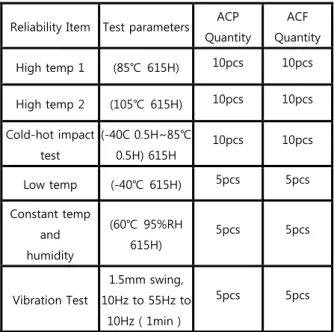
For comparison durability of each adhesive, through cold-hot impact test, high temp test and low temp test, which are test items for touch panel reliability test items for electric field according to Table 1, we select for suitable electronic components and develop products. Considering that the adhesive is vulnerable to high temperatures, the high temperature test is divided into two conditions:

+ 85 ° C and + 105 ° C. All the tests except

the vibration test proceeded for 615 hours.

The defective sample resistance is shown in Table 2.

Table 1. Touch panel reliability test items for electric field

Reliability Item Test parameters ACP Quantity

ACF Quantity High temp 1 (85℃ 615H) 10pcs 10pcs

High temp 2 (105℃ 615H) 10pcs 10pcs Cold-hot impact

test

(-40C 0.5H~85℃

0.5H) 615H

10pcs 10pcs

Low temp (-40℃ 615H) 5pcs 5pcs Constant temp

and humidity

(60℃ 95%RH 615H)

5pcs 5pcs

Vibration Test

1.5mm swing, 10Hz to 55Hz to

10Hz(1min)

5pcs 5pcs

Pin 1-3 (ITO Glass: Indium Tin Oxcide Glass)'s normal resistance is 400 ~ 1150 Ω, and Pin 2-4 (ITO Film: Indium Tin Oxcide Film)'s normal resistance is 100 ~ 500 Ω.

During the high temperature test, the touch operation is checked with the resistance value every 24 hours.

During the test for 24 hours at high temperature (+105 ℃), the sample with anisotropic conductive paste had touch insensitivity.

Table 2. Defect sample resistance value (High Temp +85℃)

Terminal Defect #1 Defect #2 Spec (Ω) Pin 1-3

(ITO Glass) Open Open Ry: 400 ~1150 Pin 2-4

(ITO Film) 261Ω 245Ω Rx : 100~500

The defective sample resistance is shown in

(3)

High Temperature Reliability Study of Anisotropic 195 Conductive Adhesive for Electronic Components

(195) Table 3. At higher temperatures, the anisotropic conductive paste appears to have failed to adhere completely due to the lowered viscosity of the adhesive component.

Table 3. Defect sample resistance value (High Temp +105℃)

Terminal Defect#1 Defect#2 Defect#3 Defect#4 Pin 1-3

(ITO Glass) Open 825Ω Open Open Pin 2-4

(ITO Film) 209Ω Open 209Ω 213Ω

2. Anisotropic Conductive Paste Oxidation Phenomena

Fig. 1 is a confirming and analyzing photograph of the sample after disassembling of the Flexible Printed Circuit from the touch panel before and after the high temperature test. It was confirmed that the cracks of the anisotropic conductive paste junction between the Flexible Printed Circuit and the touch panel progressed more. In addition, oxidation phenomena were observed on both the front and rear surfaces as compared with before the high temperature test.

Fig. 1 Sample Check Result after disassembling the FPC

It was confirmed that cracks occurred due to thermal expansion at the anisotropic conductive paste junction. It can be seen that the oxidation phenomenon occurred after the crack occurred in

the anisotropic conductive paste junction due to the stress because of the thermal expansion in the high temperature test. [2], [3]

The occurrence of problem such junction is caused by the difference in coefficient of thermal expansion (CTE) between parts, adhesives, and substrates in a high-temperature and low- temperature environment, such as electrical products. And then it is considered that this occurrence proceeded following bonding interface. [4] The cracks generated in the oxidation phenomenon are different from each other in the degree of severity according to the test, and it can be seen that the high temperature test is a test method for quickly confirming the problem phenomenon due to the thermal expansion. [5], [6]

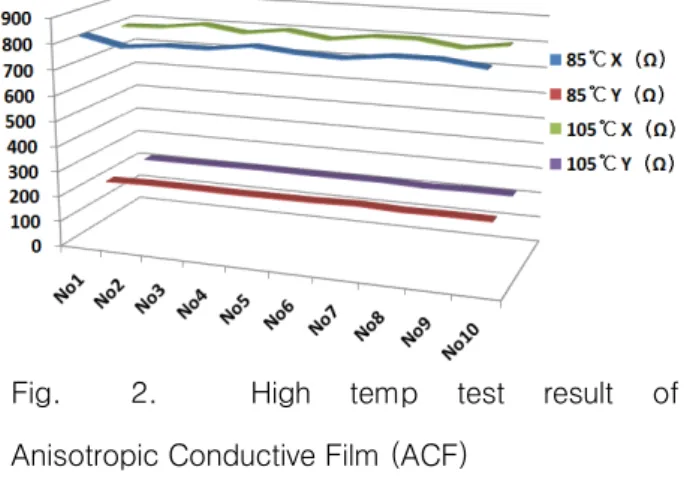
3. Anisotropic Conductive Film Test Results Fig. 2 shows the results of the high temperature test at two temperature conditions. Unlike the sample with the anisotropic conductive paste, all the products using the anisotropic conductive film did not cause any problems as a result of the 615 hours high temperature test.

Fig. 2. High temp test result of Anisotropic Conductive Film (ACF)

Thermoplastic resin was used for the

anisotropic conductive paste. From the viewpoint

of improving the connection reliability, the

(4)

196 j.inst.Korean.electr.electron.eng.Vol.22,No.1,193∼196,March 2018

(196) anisotropic conductive film uses a thermosetting resin such as an epoxy resin, and in particular, a thermosetting resin is used as the adhesive in which a cross-linkable polymer material dispersed for relieving stress and giving re- workability.

The electrically conductive filler is a metal particle having a diameter of about 5 ㎛, and a thermosetting epoxy binder is used. In the anisotropic conductive paste, a polymer such as gold-plated polystyrene having a diameter of about 30 ㎛ is used as a conductive filler, and synthetic rubber is used as a binder.

Ⅲ. Conclusion

In this paper, we analyzed the result of high temperature test using two kinds of anisotropic conductive adhesives: anisotropic conductive paste and anisotropic conductive film. For this purpose, two kinds of high temperature test conditions were selected by the experimental design method and the resistance value was observed and analyzed by making samples. As a result of the test, there occurred two and four problems in each test during the high temperature test of 85 ° C and 105 ° C in the samples using the anisotropic conductive paste. Products with anisotropic conductive films did not experience problems in the two high temperature tests. The use of anisotropic conductive pastes used a lot in mobile products caused touch insensitivity in high temperature test, which is an automotive reliability test condition.

During the high temperature test, as a result of analyzing the cause of this study, it was found that in the product using the anisotropic conductive paste adhesive connecting the touch panel and the flexible printed circuit, the touch recognition was not properly performed due to lifting of the junction, which was not glued completely. Despite

operating normally at a low temperature and a normal temperature, touch-insensibility at a high temperature is a phenomenon in which the adhesive resin is inflated by thermal expansion and the anisotropic conductive paste adhesive resin is oxidized in a crack portion generated on the bonding surface. Good connection reliability of the anisotropic conductive film can be obtained by using a thermosetting resin which is resistant to high temperature as an adhesive and by optimizing conductive particle's kind, diameter, and amount of addition. Anisotropic conductive films with good reliability are more suitable as adhesives for product touch module junction than for anisotropic conductive pastes. In the future, it is important to review and use adhesives suitable for various automotive display products.

References

[1] R. W. Johnson, J. L. Evans, J. J.

Thompson, and M. Christopher, "The Changing Automotive Environment, High- Temperature Electronics," IEEE Trans. on Electronics Packaging Manufacturing, 27(3), pp. 164-176, 2004.

DOI:10.1109/TEPM.2004.843109

[2] M. G. Gwak, "Semiconductor Insight," 39, 2, 2010.

[3] J. W. Park, S. W. Lee, Y. M. Yoo, H. W.

Chung, W. B. Jang, and H. J. Kim,

“J. Photopolym,” Sci, Technol., 24, 553, 2011.

[4] G. Leen and D. Heffernan, "Expanding automotive electronic systems," IEEE Computer, 35(1), pp. 88-93, 2002. DOI:

10.1109/2.976923

[5] U.S. Patent, "US20090087629," 2009.

[6] Y. Yonekawa, "12th adhesive technology

courses, The Society of Adhesion and

Interface, Korea, Seoul," 2011.

수치

Table 1. Touch panel reliability test items for  electric field
Fig. 1 is a confirming and analyzing photograph  of the sample after disassembling of the Flexible  Printed Circuit from the touch panel before and  after the high temperature test

참조

관련 문서