DOI: 10.5532/KJAFM.2012.14.4.170
ⓒ Author(s) 2012. CC Attribution 3.0 License.
치악산 국립공원의 야생버섯 발생과 기상요소의 상관관계
심교문1
*
·김용석1·김건엽1·이덕배1·강기경1·소규호1·이강효21국립농업과학원
,
2국립원예특작과학원(2008
년11
월16
일접수; 2012
년11
월2
일수정; 2012
년11
월13
일수락)
Relationshps between Wild Mushroom Appearance and Meteorological Elements in Chiak National Park, Korea
Kyo-Moon Shim
1* , Yong-Seok Kim1, Gun-Yeob Kim
1, Deog-Bae Lee
1, Ki-Keong Kang
1, Kyu-Ho So
1 and Kang-Hyo Lee
2
1
National Academy of Agricultural Science, RDA, Suwon, Korea
2
National Institute of Horticultural & Herbal Science, RDA, Suwon, Korea
(Received November 16, 2008; Revised November 2, 2012; Accepted November 13, 2012) ABSTRACT
In this study, in order to provide an information for artificial cultivation of wild mushroom, the meteorological effects on wild mushroom appearance were examined using daily meteorological observations in Chiak National Park. The survey of wild mushroom appearance was carried out once a month from June to October. Under high temperature and humidity conditions in July and August, the appearance of wild mushroom was frequent. In contrast, lower number of wild mushroom appeared in October. Wild mushroom appearance was affected by solar radiation, relative humidity, precipitation, and soil water content whereas the impact of air and soil temperature was lower than that of other meteorological elements.
Key words
: Wild mushroom, Appearance, Relationship, Meteorological influence
I. 서 론
버섯등유용미생물은유기물을흡수·분해하여살 아가므로생태계의물질순환과정에서아주중요한역 할을 하고 있다
.
그리고지표에 부착하여생활하므로근접지층의기상환경조건이이들의개체증식이나발생 량에매우중요한요인이된다
(Kim
et al., 2004).
현재지구에는약
140,000
종의버섯이생존하고이중
14,000
종정도가조사연구되어알려져있고(Kirk
et al.
, 2001),
자연에서 발생하는야생버섯중식용할 수있는버섯은약2,000
여종으로보고되었다(Park
etal
., 1978).
이들중 대부분은산야에서 자생되는 것을채취하여식용으로하고있으며인공으로재배하여식용
하고 있는버섯은 몇 종에지나지 않는다
(Noh
et al.,
2009).
야생식용버섯중인공으로재배되고있는버섯은주로목재부후균인표고
,
느타리,
팽이,
맛버섯등이다(Kim and Kim, 1981).
따라서야생버섯발생지의토양(
물리/
화학성),
유기물,
식생,
기상조건등발생환경조건 을조사하여유용한야생버섯의발생에관련된환경요인 을규명하는연구는매우중요하다고할수있다.
산림내지상에는식물또는동물의고사체
,
배설물 특히낙엽,
낙지 등의엄청난양이 매년퇴적되고있 다.
이와같은퇴적물은균류에의하여분해되며온도 와습도에따라 분해속도가다르게나타나고,
온도와* Corresponding Author : Kyo-Moon Shim
([email protected])
습도가높을수록분해력이높다
. Kendrick(1959)
은식 물조직이분해되어유기물이되기까지약10
년이걸리고
,
유기물이 완전히 분해되어 무기물화 되기까지는 약50
년의기간이소요되는 것으로보고하였다.
또한산림내의 식생·토양·기후조건에따라 미생물의종 다양성이 다르게 나타나며
,
온도와 습도는 미생물의 개체증식이나 발생량에 매우 중요한 요인이다(
古川, 1992).
따라서
,
본 연구에서는이러한미생물특히 기주와 공생하는균근성버섯류와목재나낙엽등을분해하는 부후균에 대한 발생지토양의물리·화학성,
유기물,
식생
,
기상조건등발생환경조건을조사하여버섯자원 의 발생과 환경요인 중기상요인과의 상관성 분석에 의해향후야생버섯의인위적재배관리를위한기상환 경분야의기초자료로활용하고자한다.
II. 재료 및 방법
2.1.연구대상지역개요
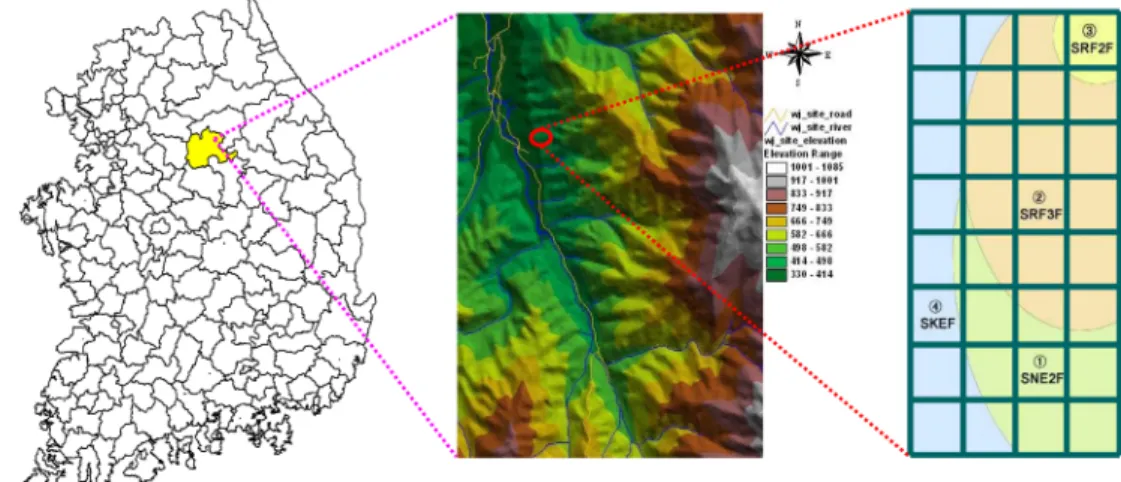
연구대상지역은강원도원주시소초면학곡리치악
산 국립공원 야영장 관리소 동쪽
150m
에 위치하며(Fig. 1),
야생버섯발생량의 정점조사를 위해32
개의소형방형구
(5×5m)
를선정하였다.
방형구의토양통분포는
Fig. 1(
오른쪽)
에 표시하였는데,
송산SNE2,
송산
SRF3,
송산SRF2,
수암SKE
등이다.
각각의토양특성을살펴보면
, SNE2
는송산자갈이있는사양토로침식이 있는
30~60%
의 경사도를 보였고, SRF3
과SRF2
는 송산 바위가 있는 사양토로 침식이 있는60~100%
정도의경사를보였다.
반면에SKE
는수암둥근바위가있는사양토로
30~60%
의경사도를보였다.
조사지역의 토양
pH
는4.5~4.7
정도이었으며, EC
는0.2~0.4ds m
−1,
유기물함량은20~40.3g kg
−1, T-N
함 량은0.14~1.18g kg
−1, Av. P
2O
4 함량은11.1~17.4mg kg
−1정도이었다.
송산SRF2
는유기물,
유효인산등의 함량이다른토양통에비해대체적으로높은경향이었 다(Table 1).
조사지역 토양의물리적특성은Table 2
와같은데
, SRF2
의고상이상대적으로낮았다.
본조사지역의식물군락은신갈나무
-
생강나무군의전 형하위군락,
국수나무하위군락,
병꽃나무하위군락,
산 딸기나무하위군락,
신갈나무-
산벗나무군락,
신갈나무-
졸Fig. 1.
The study area with the location of wild mushroom survey.
Table 1.
Chemical characteristics of soil at the wild mushroom site in Mt. Chiak Soil series pH
(1:5) EC
aO.M.
b(g kg
−1) T-N
(g kg
−1) Av.P
2O
5(mg kg
−1) Ex. Cation
c(cmol
+kg
−1)
K Ca Mg
SNE2 4.6 0.2 20.0 0.15 11.1 0.30 0.16 0.07
SRF3 4.7 0.3 26.9 0.14 12.4 0.36 0.31 0.13
SRF2 4.5 0.4 40.3 0.18 17.1 0.35 0.26 0.19
SKE 4.7 0.3 30.9 0.14 14.0 0.41 0.42 0.20
a
EC : Electrical conductivity,
bO.M. : Organic matters,
cEx. Cations : Exchangeable cations
참나무군락
,
낙엽송식재림군락의1
개군단, 3
개군락, 4
개하위군락으로구성되어있다
(Kim
et al., 2004).
2.2. 조사방법
야생버섯발생량 조사는
2002
년부터2004
년까지약3
년에 걸쳐매년6
월부터10
월까지월1
회실시하였으며
,
야생버섯종별로발생한방형구수를기록하였다.
그리고조사지의국지미기상은자동기상관측시스템을 설치하여관측하였다
(Fig. 2).
즉,
자료수집기(CR10X, Campbell Scientific Inc, USA)
를이용하여 온·습도(HMP45C, Campbell Scientific Inc, USA),
지온(107,
Campbell Scientific Inc, USA),
일사량(LI200X, Li- COR, USA),
토양수분(CS615, Campbell Scientific Inc, USA),
강우량(TE525, Campbell Scientific Inc, USA)
등다양한기상요소들을
1
분간격으로측정하여1
시간및
1
일간격으로기록하였으며기록된기상자료는1
개월마다수집하여분석에이용하였다.
2.3. 분석방법
관측된기상요소별일기상자료는야생버섯조사일
로부터역으로
1~20
일간 평균기상값으로각각 재계산하였다
.
각기간별평균기상요소와야생버섯발생의상관관계는
Pearson
상관계수를이용하여파악하였다.
III. 결과 및 고찰
3.1. 조사지의경과기상
지난
3
년간(2002~2004
년)
야생버섯 조사지역에서관측한기상요소중기온
(
지상150cm)
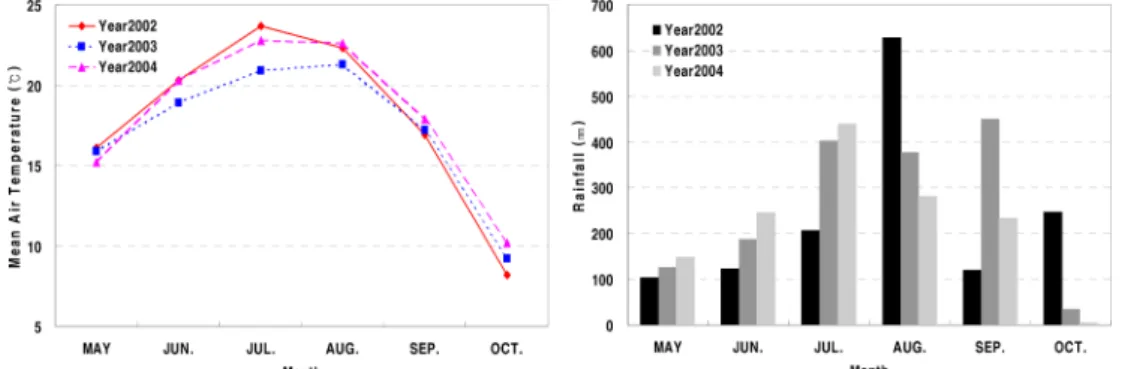
과강수량의연간변화를살펴보면
Fig. 3
과같다.
야생버섯발생기간(5~10
월)
의평균기온은2004
년(18.2
oC)
이가장높았으며, 2003
년(17.2
oC)
이가장 낮게경과하여1
oC
정도의차 이를 보였다.
반면에 같은 기간 동안의 누적강수량은2004
년이1,352.5mm
로 가장 적었으며2003
년은1,578.0mm
로가장많았다.
3.2. 조사지의야생버섯발생량
야생버섯자생지에서조사된주요야생버섯의발생
빈도를월별로나타내면
Table 3
과 같다.
야생버섯은종별로조금은차이가있지만
,
대체로8
월에가장많이 발생하였고다음으로
7
월이 발생빈도가높았으며 조사기간 중에서는10
월이 가장낮았다.
즉,
고온다Table 2.
Physical characteristics of soil at the wild mushroom site in Mt. Chiak
Soil
series Three-phase (v/v, %) Porosity (%) Bulk
density Soil Water Air
SNE2 48.2 25.6 26.3 51.8 1.3
SRF3 50.1 31.9 18.0 49.9 1.3
SRF2 44.8 28.9 26.3 55.2 1.2
SKE 49.8 28.8 21.5 50.2 1.3
Fig. 2.
Automated weather system at the survey site in Mt.
Chiak.
Fig. 3.
Monthly mean air temperature (left) and rainfall (right) from 2002 to 2004 at the wild mushroom site in Mt. Chiak.
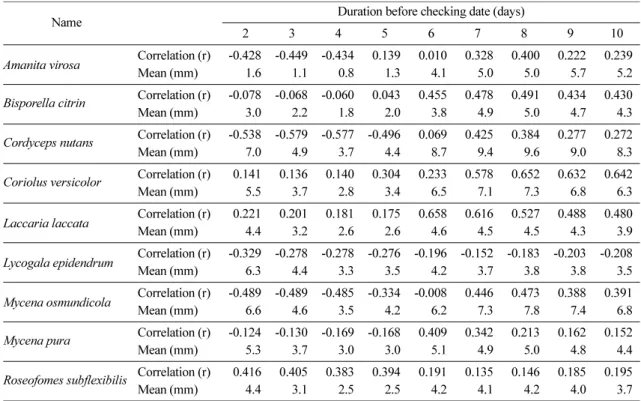
습한 시기인 7~8월에 야생버섯의 발생빈도가 높은 것 으로 판명되었다. 연도별로 살펴보면, 2002년과 2003 년은 발생빈도가 비슷한 반면에 2004년에는 상당히 낮게 조사되었다. 이는 2004년의 높은 기온과 적은 강수량이 야생버섯 발생에 좋지 않은 영향을 끼친 것 으로 추정되었다.
지난 3년간 연간 발생빈도가 높은 상위 4종의 야생 버섯을 월별로 나타내면, Fig. 4와 같다. 조사된 야생 버섯 중
Bisporella citrina
(황색고무버섯)가 연간 발생 빈도가 가장 높았으며, 연간차이도 적었다. 다음으로Laccaria laccata
(졸각버섯), Mycena pura
(맑은애주름 버섯), Amanita virosa
(독우산광대버섯) 순으로 발생빈Table 3.
Monthly number of quadrates for nine main wild mushroom species collected at wild mushroom site from 2002 to 2004
Name Year Number of quadrates collected
Jun. Jul. Aug. Sep. Oct. Subtotal Total
Amanita virosa 2002 0 0 11 0 0 11
2003 0 2 0 1 0 3 18
2004 0 0 2 2 0 4
Bisporella citrina 2002 0 0 14 0 1 15
2003 4 7 4 4 0 19 50
2004 0 3 8 4 1 16
Cordyceps nutans 2002 0 0 9 0 0 9
2003 1 2 0 0 0 3 15
2004 0 1 2 0 0 3
Coriolus versicolor 2002 0 0 3 0 0 3
2003 0 1 0 0 0 1 12
2004 0 2 3 1 2 8
Laccaria laccata 2002 0 0 16 0 0 16
45
2003 2 11 3 5 0 21
2004 0 6 0 2 0 8
Lycogala epidendrum 2002 0 0 2 0 0 2
12
2003 7 0 0 1 0 8
2004 0 1 0 0 1 2
Mycena osmundicola 2002 0 0 3 0 0 3
2003 2 0 0 1 0 3 10
2004 0 1 3 0 0 4
Mycena pura 2002 0 0 9 0 0 9
2003 0 7 1 3 0 11 23
2004 0 2 0 1 0 3
Roseofomes subflexibilis 2002 0 1 1 1 0 3
2003 0 0 0 0 0 0 11
2004 0 3 0 1 4 8
Total 16 50 94 27 9 196 196
Fig. 4.
Monthly number of quadrates for four main wild
mushroom species collected at the wild mushroom site
from 2002 to 2004.
도가 높은 것으로 조사되었는데
, L. laccata
와M.
pura
는식용이가능한버섯이다.
3.4. 야생버섯의발생과기상요소의관계 3.4.1. 기온
치악산 국립공원의 야생버섯조사지의 기온은 지상
50cm
와150cm
높이에온·습도센서를설치하여관측하였다
.
이들두 높이에서관측한기온과야생버섯발 생의 상관관계는서로비슷한양상을 보였다.
따라서 본논문에서는좀더근접지층인지상50cm
높이의 기온과 야생버섯발생의 상관분석결과만 나타내었다.
지난
3
년동안A. virosa
등9
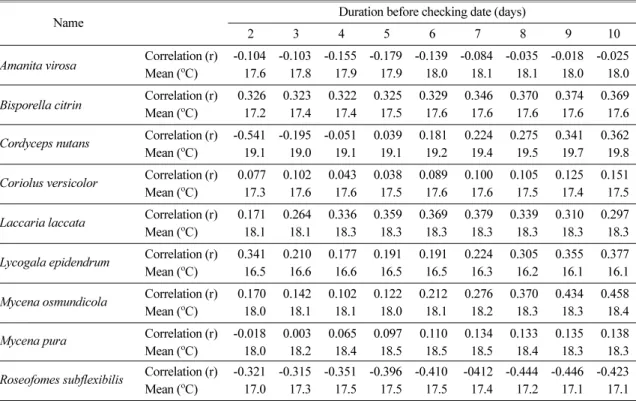
종의 야생버섯들이 발 생된방형구수와발생일로부터역으로2~10
일간평균기온의상관관계를분석하면
Table 4
와같다. B. citrina , Cordyceps nutans (
노린재 동충하초), L.
laccata , Lycogala epidendrum (
분홍콩 점균), Mycena osmundicola (
흰애주름버섯)
등은발생일로부터역으로7~10
일간평균한기온과가장높은정의상관을보인반면에
, Roseofomes subflexibilis (
청장미구멍버섯)
는9
일간평균한기온과가장높은부의상관을나타내었 다
.
조사된야생버섯 중C. nutans
와L. epidendrum
의발생은조사일로부터역으로
10
일간평균한기온 과가장높은상관을보였는데,
이때각각의평균기온은
19.8
oC
와16.1
oC
로3.7
oC
의 기온차이를 나타내었 다.
하지만A. virosa
와Coriolus versicolor (
운지버섯)
의발생은발생전기온과는뚜렷한상관을나타내지않 았다
.
3.4.2. 상대습도
상대습도도기온과마찬가지로 지상
50cm
와150cm
높이에서각각관측하였는데
,
두높이에서관측된상대 습도또한야생버섯발생과상관양상이서로비슷하였다.
따라서좀더근접지층인지상50cm
높이의상대습도와야생버섯발생의상관분석결과만
Table 5
에나타내었다
.
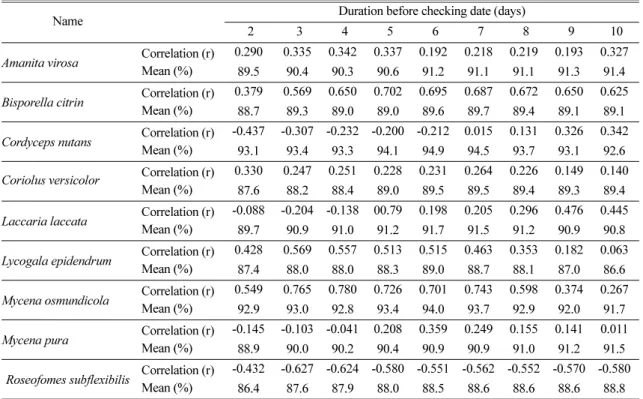
전반적으로야생버섯의발생은발생일로부터가까 운날짜의상대습도와밀접한상관을나타내었고(2~6
일간평균
),
상관정도는기온보다훨씬높았다.
하지만, L.
laccata
는발생일로부터상대적으로먼날짜인9
일간평 균한상대습도와가장높은정의상관을나타내었고,
이 때상대습도는90.9%
로조사되었다.
특히C. nutans
와R. subflexibilis
는발생 전2
일과4
일간평균한 상대습도와 부의상관을나타내었으며
,
이때 평균상대습도Table 4.
Correlation coefficient between wild mushrooms and mean air temperature for each duration before checking date
Name Duration before checking date (days)
2 3 4 5 6 7 8 9 10
Amanita virosa Correlation (r) -0.104 -0.103 -0.155 -0.179 -0.139 -0.084 -0.035 -0.018 -0.025
Mean (
oC) 17.6 17.8 17.9 17.9 18.0 18.1 18.1 18.0 18.0
Bisporella citrin Correlation (r) 0.326 0.323 0.322 0.325 0.329 0.346 0.370 0.374 0.369
Mean (
oC) 17.2 17.4 17.4 17.5 17.6 17.6 17.6 17.6 17.6
Cordyceps nutans Correlation (r) -0.541 -0.195 -0.051 0.039 0.181 0.224 0.275 0.341 0.362
Mean (
oC) 19.1 19.0 19.1 19.1 19.2 19.4 19.5 19.7 19.8
Coriolus versicolor Correlation (r) 0.077 0.102 0.043 0.038 0.089 0.100 0.105 0.125 0.151
Mean (
oC) 17.3 17.6 17.6 17.5 17.6 17.6 17.5 17.4 17.5
Laccaria laccata Correlation (r) 0.171 0.264 0.336 0.359 0.369 0.379 0.339 0.310 0.297
Mean (
oC) 18.1 18.1 18.3 18.3 18.3 18.3 18.3 18.3 18.3
Lycogala epidendrum Correlation (r) 0.341 0.210 0.177 0.191 0.191 0.224 0.305 0.355 0.377
Mean (
oC) 16.5 16.6 16.6 16.5 16.5 16.3 16.2 16.1 16.1
Mycena osmundicola Correlation (r) 0.170 0.142 0.102 0.122 0.212 0.276 0.370 0.434 0.458
Mean (
oC) 18.0 18.1 18.1 18.0 18.1 18.2 18.3 18.3 18.4
Mycena pura Correlation (r) -0.018 0.003 0.065 0.097 0.110 0.134 0.133 0.135 0.138
Mean (
oC) 18.0 18.2 18.4 18.5 18.5 18.5 18.4 18.3 18.3
Roseofomes subflexibilis Correlation (r) -0.321 -0.315 -0.351 -0.396 -0.410 -0412 -0.444 -0.446 -0.423
Mean (
oC) 17.0 17.3 17.5 17.5 17.5 17.4 17.2 17.1 17.1
Table 5.
Correlation coefficient between wild mushrooms and relative humidity for each duration before checking date.
Name Duration before checking date (days)
2 3 4 5 6 7 8 9 10
Amanita virosa Correlation (r) 0.290 0.335 0.342 0.337 0.192 0.218 0.219 0.193 0.327 Mean (%) 89.5 90.4 90.3 90.6 91.2 91.1 91.1 91.3 91.4 Bisporella citrin Correlation (r) 0.379 0.569 0.650 0.702 0.695 0.687 0.672 0.650 0.625
Mean (%) 88.7 89.3 89.0 89.0 89.6 89.7 89.4 89.1 89.1 Cordyceps nutans Correlation (r) -0.437 -0.307 -0.232 -0.200 -0.212 0.015 0.131 0.326 0.342
Mean (%) 93.1 93.4 93.3 94.1 94.9 94.5 93.7 93.1 92.6 Coriolus versicolor Correlation (r) 0.330 0.247 0.251 0.228 0.231 0.264 0.226 0.149 0.140
Mean (%) 87.6 88.2 88.4 89.0 89.5 89.5 89.4 89.3 89.4 Laccaria laccata Correlation (r) -0.088 -0.204 -0.138 00.79 0.198 0.205 0.296 0.476 0.445
Mean (%) 89.7 90.9 91.0 91.2 91.7 91.5 91.2 90.9 90.8 Lycogala epidendrum Correlation (r) 0.428 0.569 0.557 0.513 0.515 0.463 0.353 0.182 0.063
Mean (%) 87.4 88.0 88.0 88.3 89.0 88.7 88.1 87.0 86.6 Mycena osmundicola Correlation (r) 0.549 0.765 0.780 0.726 0.701 0.743 0.598 0.374 0.267
Mean (%) 92.9 93.0 92.8 93.4 94.0 93.7 92.9 92.0 91.7 Mycena pura Correlation (r) -0.145 -0.103 -0.041 0.208 0.359 0.249 0.155 0.141 0.011
Mean (%) 88.9 90.0 90.2 90.4 90.9 90.9 91.0 91.2 91.5 Roseofomes subflexibilis Correlation (r) -0.432 -0.627 -0.624 -0.580 -0.551 -0.562 -0.552 -0.570 -0.580
Mean (%) 86.4 87.6 87.9 88.0 88.5 88.6 88.6 88.6 88.8
Table 6.
Correlation coefficient between wild mushrooms and soil temperature for each duration before checking date
Name Duration before checking date (days)
2 3 4 5 6 7 8 9 10
Amanita virosa Correlation (r) 0.196 0.209 0.177 0.142 0.176 0.197 0.218 0.221 0.225
Mean (
oC) 17.88 18.05 18.08 18.10 18.16 18.19 18.20 18.17 18.17
Bisporella citrin Correlation (r) 0.333 0.338 0.336 0.343 0.340 0.345 0.354 0.355 0.348
Mean (
oC) 17.48 17.61 17.67 17.69 17.75 17.75 17.73 17.73 17.79
Cordyceps nutans Correlation (r) 0.016 0.143 0.201 0.265 0.322 0.331 0.367 0.413 0.416
Mean (
oC) 18.99 19.05 19.08 19.11 19.16 19.25 19.29 19.32 19.36
Coriolus versicolor Correlation (r) 0.182 0.188 0.150 0.141 0.180 0.183 0.187 0.204 0.236
Mean (
oC) 17.63 17.86 17.90 17.83 17.85 17.84 17.78 17.73 17.78
Laccaria laccata Correlation (r) 0.206 0.273 0.318 0.350 0.347 0.340 0.314 0.307 0.295
Mean (
oC) 18.05 18.19 18.27 18.28 18.24 18.23 18.20 18.17 18.16
Lycogala epidendrum Correlation (r) 0.150 0.062 0.049 0.074 0.080 0.104 0.148 0.172 0.163
Mean (
oC) 16.41 16.56 16.56 16.48 16.44 16.32 16.18 16.09 16.12
Mycena osmundicola Correlation (r) 0.261 0.236 0.216 0.244 0.308 0.339 0.396 0.442 0.456
Mean (
oC) 18.19 18.29 18.26 18.27 18.33 18.36 18.35 18.34 18.38
Mycena pura Correlation (r) -0.111 -0.082 -0.035 0.010 0.009 0.009 0.002 0.010 -0.001
Mean (
oC) 18.22 18.45 18.56 18.57 18.52 18.50 18.45 18.39 18.39
Roseofomes subflexibilis Correlation (r) -0.360 -0.370 -0.395 -0.428 -0.434 -0.437 -0.455 -0.459 -0.440
Mean (
oC) 17.27 17.53 17.62 17.58 17.53 17.45 17.35 17.27 17.30
는각각
93.1, 87.9%
로조사되었다.
3.4.3. 지온
야생버섯조사지의 지온은지하
5cm, 10cm, 20cm
깊이에서수평으로지온센서를설치하여측정하였는데
,
깊이별지온과야생버섯발생의상관양상은서로비슷 하여 본논문에서는지하
5cm
깊이에서 측정한지온 과야생버섯발생의상관분석결과만나타내었다(Table 6).
전체적으로기온과비슷한상관관계를나타냈으며,
기온과마찬가지로지온도야생버섯발생과상관정도 는상당히낮게조사되었다
. C. nutans
와C. versicolor
는발생일로부터역으로
10
일간평균한지온과상대적으로높은상관을나타냈지만
(
그외야생버섯보다),
상 관계수(r)
가0.4
정도로상당히낮았다.
3.4.4. 강우량
야생버섯조사일부터역으로평균한강우량과야생 버섯발생의상관계수를나타내면
Table 7
과 같다.
야 생버섯발생과강우량의상관은기온(
혹은지온)
보다높 았으며,
발생(
조사)
일로부터역으로6~8
일간평균한강 우량이가장 높은정의상관을 나타내었다.
이때평균강우량은
4.6~9.4mm
범위이었고,
상관정도는L.
laccata
가 가장높았다(r=0.658).
반면에L. epidendrum
와
M. osmundicola
는발생 전2
일간 평균한 강우량과가장 높은부의 상관을나타내었고
,
이때 평균강 우량은6.3
과6.6mm
이었다.
3.4.5. 토양수분
토양수분은토양수분센서를 지하
5cm
깊이에서수 평으로설치하여 측정하였다.
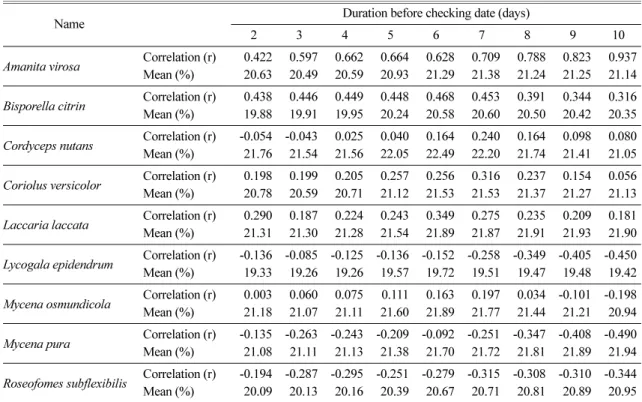
조사된야생버섯 중A.
virosa
가발생 전의 토양수분과아주 높은 정의 상관 을 나타내었다(Table 8).
즉, A. virosa
의 발생량은 발생일전10
일간 평균한 토양수분과가장 높은 정의상관을나타내었는데
(r=0.937),
이때평균 토양수분은21.14%
이었다.
반면에L. epidendrum , M. pura , R.
subflexibili s
등의발생량은발생일로부터역으로10
일 간평균한토양수분과부의 상관을나타내었고,
이때평균토양수분은
19.4~21.9%
의범위로조사되었다.
3.4.6. 일사량
야생버섯조사지의일사량은일사센서를수관내지 상
2m
높이에서 수평으로 설치한 후, 1
분 간격으로측정하여시간과일단위로기록하였다
.
야생버섯의발Table 7.
Correlation coefficient between wild mushrooms and precipitation for each duration before checking date
Name Duration before checking date (days)
2 3 4 5 6 7 8 9 10
Amanita virosa Correlation (r) -0.428 -0.449 -0.434 0.139 0.010 0.328 0.400 0.222 0.239
Mean (mm) 1.6 1.1 0.8 1.3 4.1 5.0 5.0 5.7 5.2
Bisporella citrin Correlation (r) -0.078 -0.068 -0.060 0.043 0.455 0.478 0.491 0.434 0.430
Mean (mm) 3.0 2.2 1.8 2.0 3.8 4.9 5.0 4.7 4.3
Cordyceps nutans Correlation (r) -0.538 -0.579 -0.577 -0.496 0.069 0.425 0.384 0.277 0.272
Mean (mm) 7.0 4.9 3.7 4.4 8.7 9.4 9.6 9.0 8.3
Coriolus versicolor Correlation (r) 0.141 0.136 0.140 0.304 0.233 0.578 0.652 0.632 0.642
Mean (mm) 5.5 3.7 2.8 3.4 6.5 7.1 7.3 6.8 6.3
Laccaria laccata Correlation (r) 0.221 0.201 0.181 0.175 0.658 0.616 0.527 0.488 0.480
Mean (mm) 4.4 3.2 2.6 2.6 4.6 4.5 4.5 4.3 3.9
Lycogala epidendrum Correlation (r) -0.329 -0.278 -0.278 -0.276 -0.196 -0.152 -0.183 -0.203 -0.208
Mean (mm) 6.3 4.4 3.3 3.5 4.2 3.7 3.8 3.8 3.5
Mycena osmundicola Correlation (r) -0.489 -0.489 -0.485 -0.334 -0.008 0.446 0.473 0.388 0.391
Mean (mm) 6.6 4.6 3.5 4.2 6.2 7.3 7.8 7.4 6.8
Mycena pura Correlation (r) -0.124 -0.130 -0.169 -0.168 0.409 0.342 0.213 0.162 0.152
Mean (mm) 5.3 3.7 3.0 3.0 5.1 4.9 5.0 4.8 4.4
Roseofomes subflexibilis Correlation (r) 0.416 0.405 0.383 0.394 0.191 0.135 0.146 0.185 0.195
Mean (mm) 4.4 3.1 2.5 2.5 4.2 4.1 4.2 4.0 3.7
Table 8.
Correlation coefficient between wild mushrooms and soil water content for each duration before checking date
Name Duration before checking date (days)
2 3 4 5 6 7 8 9 10
Amanita virosa Correlation (r) 0.422 0.597 0.662 0.664 0.628 0.709 0.788 0.823 0.937 Mean (%) 20.63 20.49 20.59 20.93 21.29 21.38 21.24 21.25 21.14 Bisporella citrin Correlation (r) 0.438 0.446 0.449 0.448 0.468 0.453 0.391 0.344 0.316 Mean (%) 19.88 19.91 19.95 20.24 20.58 20.60 20.50 20.42 20.35 Cordyceps nutans Correlation (r) -0.054 -0.043 0.025 0.040 0.164 0.240 0.164 0.098 0.080 Mean (%) 21.76 21.54 21.56 22.05 22.49 22.20 21.74 21.41 21.05 Coriolus versicolor Correlation (r) 0.198 0.199 0.205 0.257 0.256 0.316 0.237 0.154 0.056 Mean (%) 20.78 20.59 20.71 21.12 21.53 21.53 21.37 21.27 21.13 Laccaria laccata Correlation (r) 0.290 0.187 0.224 0.243 0.349 0.275 0.235 0.209 0.181 Mean (%) 21.31 21.30 21.28 21.54 21.89 21.87 21.91 21.93 21.90 Lycogala epidendrum Correlation (r) -0.136 -0.085 -0.125 -0.136 -0.152 -0.258 -0.349 -0.405 -0.450 Mean (%) 19.33 19.26 19.26 19.57 19.72 19.51 19.47 19.48 19.42 Mycena osmundicola Correlation (r) 0.003 0.060 0.075 0.111 0.163 0.197 0.034 -0.101 -0.198 Mean (%) 21.18 21.07 21.11 21.60 21.89 21.77 21.44 21.21 20.94 Mycena pura Correlation (r) -0.135 -0.263 -0.243 -0.209 -0.092 -0.251 -0.347 -0.408 -0.490 Mean (%) 21.08 21.11 21.13 21.38 21.70 21.72 21.81 21.89 21.94 Roseofomes subflexibilis Correlation (r) -0.194 -0.287 -0.295 -0.251 -0.279 -0.315 -0.308 -0.310 -0.344 Mean (%) 20.09 20.13 20.16 20.39 20.67 20.71 20.81 20.89 20.95
Table 9.
Correlation coefficient between wild mushrooms and solar radiation for each duration before checking date
Name Duration before checking date (days)
2 3 4 5 6 7 8 9 10
Amanita virosa Correlation (r) -0.594 -0.640 -0.652 -0.766 -0.716 -0.645 -0.660 -0.648 -0.692
Mean (MJm
−2) 1.57 1.47 1.58 1.50 1.40 1.39 1.36 1.33 1.34
Bisporella citrin Correlation (r) 0.299 0.135 0.289 -0.071 -0.252 -0.279 -0.324 -0.278 -0.219
Mean (MJm
−2) 1.50 1.47 1.51 1.47 1.42 1.39 1.38 1.39 1.41
Cordyceps nutans Correlation (r) 0.197 -0.002 0.037 -0.298 -0.398 -0.382 -0.124 -0.201 -0.183
Mean (MJm
−2) 1.52 1.52 1.64 1.45 1.29 1.26 1.23 1.27 1.33
Coriolus versicolor Correlation (r) -0.772 -0.776 -0.635 -0.748 -0.824 -0.839 -0.850 -0.762 -0.778
Mean (MJm
−2) 1.38 1.45 1.56 1.40 1.31 1.30 1.30 1.29 1.30
Laccaria laccata Correlation (r) 0.266 0.669 0.859 0.379 -0.114 -0.070 0.068 -0.191 -0.058
Mean (MJm
−2) 1.68 1.58 1.63 1.55 1.48 1.44 1.40 1.40 1.43
Lycogala epidendrum Correlation (r) 0.882 0.625 0.013 0.657 0.285 -0.085 -0.302 0.504 0.764
Mean (MJm
−2) 1.33 1.41 1.48 1.46 1.39 1.36 1.32 1.35 1.38
Mycena osmundicola Correlation (r) -0.010 -0.658 -0.701 -0.764 -0.822 -0.843 -0.855 -0.373 -0.211
Mean (MJm
−2) 1.22 1.33 1.45 1.38 1.27 1.22 1.19 1.23 1.26
Mycena pura Correlation (r) 0.531 0.665 0.750 0.324 -0.197 -0.186 -1.010 -0.006 0.285
Mean (MJm
−2) 1.63 1.59 1.66 1.55 1.50 1.46 1.43 1.38 1.39
Roseofomes subflexibilis Correlation (r) -0.598 -0.396 -0.277 -0.376 -0.322 -0.271 -0.290 -0.230 -0.275
Mean (MJm
−2) 1.57 1.55 1.60 1.52 1.48 1.46 1.43 1.40 1.40
생은 발생 전 기상요소중 일사량과 가장높은 상관 을 나타내었다
(Table 9).
조사된 야생버섯 중C.
versicolor
와M. osmundicola
의발생은 발생 전일사 량과상당히높은부의상관을나타내었는데,
발생일로부터역으로
8
일간평균한일사량이이들의발생량에 가장 큰 영향을 미치는 것으로 조사되었다(r=-0.850, -0.855).
이때 평균일사량은 각각1.30
과1.19 MJ m
−2 이었다.
반면에L. laccata
와M. pura
의 발생은 발생(
조사)
일로부터역으로4
일간평균한일사량과가 장 높은 정의 상관을 나타내었으며(r=0.859, 0.750),
평균일사량은다른야생버섯보다상대적으로높은것 으로 조사되었다
.
즉,
이때평균일사량은각각1.63
과1.66 MJ m
−2 이었다.
일사량과 가장 높은 상관을 나타낸 야생버섯은
L. epidendrum
으로 발생 전2
일간 평균일사량과r=0.882
의상관을 나타냈으며, 2
일간의평균일사량은
1.33 MJ m
−2로조사되었다.
적 요
야생버섯의인위적재배를위한기초기상환경을평 가하고자
, 2002
년부터2004
년까지3
년 동안 강원도 원주시소초면학곡리치악산국립공원야영장관리소동쪽
150m
에위치한정점연구대상지에서국지미기상과야생버섯발생량을조사하고이들의상관관계를분 석하였다
.
야생버섯발생 조사는
6
월부터10
월까지 월1
회씩 실시하였는데,
고온다습한7~8
월에야생버섯의발생 빈도가높았으며조사기간중에서는10
월이가장낮았 다.
그리고 발생빈도가 높은B. citrina
등9
개종을선발하여야생버섯발생에 영향을미치는국지미기상 을 평가하였다
.
야생버섯의발생에영향을많이주는버섯발생전기상요소는일사량으로조사되었다
.
다음으로습도관련기상요소인상대습도
,
강우량,
토양수분 순이었으며기온과 지온의 영향이가장 적은 것으로 분석되었다.
감사의 글
본연구는농촌진흥청국립농업과학원농업과학기술 연구개발사업
(
과제번호: PJ00852201)
의 지원에 의해 이루어진것임.
REFERENCES
Kendrick, W. B., 1959. The time factor in the decomposition of coniferous leaf litter. Canadian Journal of Botany
37, 907-912
Kim, S. S., and K. J. Kim, 1981: Selection of Some Species for Artificial Cultivation from the Wild Mushrooms. Korean Journal of Microbiology and Biotechnology
9(3), 109- 116 (in Korean with English abstract).
Kim, Y. S., S. J. Seok, K. H. Lee, W. K. Kim, H. Y. Won, G. S. Hyeon, S. G. Ha, S. P. Kim, K. M. Shim, and Y. S.
Lee, 2004: Synthetic Management of Wild Mushroom Resources. Agricultural Environment Research. National Institute of Agricultural Sciences and Technology. 551- Kirk, P. M., P. F. Cannon, J. C. David, and J. A. Stalpers, 596.
2001: Ainsworth and Bisby’s Dictionary of the Fungi (9
thed.) CABI Publishing, 650pp.
Noh, J. G., J. S. Park, J. S. Choi, I. G. Song, T. Yun, and K.
B. Min, 2009: A Study of Useful Wild Mushrooms by Segregation and Identification Native in Middle Area.
Korean Journal of Mushrooms Science
7(2), 49-56 (in Korean with English abstract).
Park, Y. H., S. K. Yang, and D. Y. Cha, 1978: Investigation on Artificial Culture for New Edible Wild Mushrooms.
Korean Journal of Mycology
6(2), 25-28 (in Korean with English abstract).
古川久彦, 1992: きのこ學. 公立出版株式會社. 東京, 450pp.