http://dx.doi.org/10.6110/KJACR.2015.27.6.328
주거공간 내 광선반 곡률 형태에 따른 채광성능평가 연구
Research on Lighting Performance Evaluation for Different Curvature Reflection Rate in Residential Space
오상원(Sangwon Oh), 이행우(Heangwoo Lee), 김용성(Yongseong Kim)†, 서장후(Janghoo Seo)
국민대학교 테크노디자인전문대학원
The Graduate School of Techno Design, Kookmin University, Seoul, 136-702, Korea (Received April 10, 2015; revision received May 9, 2015; Accepted: May 14, 2015)
Abstract Currently, 22% of the total energy consumption of buildings in Korea is used for lighting. Light-shelves have garnered attention as a way to reduce consumption, but there are few studies on the types of curve and curvature, which limits the improvement of light-shelf performance and its design. This study constructed a test bed of actual residential types to evaluate the performance. Outcomes of light usage, according to variables of light-shelves, were used as indicators of performance evaluation. The results are as follows:1) Performance evaluation was conducted on flat-type light-shelves to verify performance of curvature-shelves, which are movable with a width of 200 mm, and the most ideal angle and specification per solar term are calculated. 2) The (-) shaped curvature contributed to a reduction in energy consumption and an improvement of evenness. 3) In case of light-shelves with (-) shaped curvature, an increased angle not exceeding 80° of the arc contributed to an improvement of light penetration. 4) Appropriate specifications of curved light-shelves include movable types with widths of 200 mm, and angle ranges of 20˚~60˚. 5) Light energy consumption of a movable light-shelf with curvature and width of 200 mm were reduced by 17% and 7.8% compared to a 0˚ fixed and a movable light-shelf, respectively.
Key words Light-shelf(광선반), Curvature(곡률), Performance evaluation(성능평가), Energy saving(에너지저감)
†Corresponding author, E-mail: [email protected]
1. 서 론
1.1 연구의 배경 및 목적
IEA가 발표한 World Energy Outlook 2011에 의하면 건물이 소비하는 에너지량은 전체 에너지소비량의 34%
로 나타나고 있으며, 건물에너지 사용량은 지속적으로 증가할 것이라고 예측하고 있다. 또한, 2010 LUTRON Lighting Control System Seminar의 자료에 의하면 조명 에너지 사용량은 한국의 경우 22%로 높게 나타나고 있 다. 이에 조명에너지 저감을 위한 다양한 연구가 진행 중에 있다. 광선반은 외부 자연광을 반사를 통하여 실 내 깊숙이 유입시키는 자연채광 시스템으로써 그 효율 성을 인정받아서 다양한 연구가 진행되었다 .
(11)그러나 기존 광선반에 대한 연구는 평판형의 반사판을 적용한 연구가 주를 이루고 있다 . 이러한 평판형의 반사판을 적용한 광선반의 경우에는 거울 반사가 이루어져 광선 반의 채광성능 및 실내 빛환경 개선의 한계로 작용되 고 있다 .
(13)최근 제조업 및 산업의 발전은 다양한 분야에 변화를 유도하고 있으며 ,
(12)광선반을 포함한 자연채광 관련 사업 분야에서도 단순한 형태에서 벗어나 곡면과 곡률 을 통한 채광성능 개선과 더불어 미적 효과를 거두고 있다. 그러나 광선반에 적용된 곡면 형태나 곡률에 따 른 성능평가 연구는 진행된 바 없으며 , 에너지 문제에 직면하고 있는 현시점에서 곡률 적용 광선반의 조명에 너지 저감 성능과 설계를 위한 기초 자료 구축은 반드 시 필요한 연구로 사료된다.
(14)이에 본 연구의 목적은 곡면 형태 및 곡률에 따라서 주거공간 내에 미치는 광 선반의 채광을 통하여 성능검증을 위한
(16)기초자료 구축과 그 유효성 검증이다.
1.2 연구 방법 및 범위
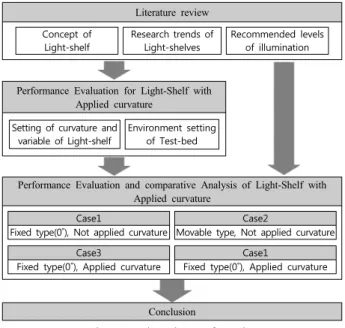
본 연구는 주거공간 내 광선반의 곡면형태 및 곡률 에 따른 광선반의 성능평가를 도출하기 위하여 Fig. 1 에서 나타나듯이 다음 절차에 의하여 진행되었다.
첫 번째 , 곡률 적용 광선반의 성능평가를 진행하기
Ⓐ:Angle of Light-Shelf, Ⓗ:Height of Light-Shelf +Ⓐ
-Ⓐ Light Shelf Ⓗ
(a) Flat Light-Shelf (-) curvature (+) curvature
Fig. 2 Concept and curvature type of light-shelf.
Literature review Concept of
Light-shelf
Research trends of Light-shelves
Recommended levels of illumination
Performance Evaluation for Light-Shelf with Applied curvature
Setting of curvature and
variable of Light-shelf Environment setting of Test-bed
Performance Evaluation and comparative Analysis of Light-Shelf with Applied curvature
Case1
Fixed type(0˚), Not applied curvature
Case2
Movable type, Not applied curvature Case3
Fixed type(0˚), Applied curvature
Case1
Fixed type(0˚), Applied curvature
Conclusion
Fig. 1 Flowchart of study.
Table 1 Performance evaluation research on shape of reflection board used for light shelves
Title of Study years Light-shelf type Visual Performance Evaluation Study of a
Scaled Light-Shelf Model(1) 2003 flat type Design and Performance of Horizontal
Light-Redirecting Devices in Offices(2) 2003 flat type Development and Performance Evaluation
of a Sloped Lightshelf Daylighting System(3)
2004 flat type
A Design and Performance Evaluation of
Differentiated Daylight-Glazing Systems(4) 2005 flat type A Study on the Performance Evaluation
of Lightshelf Daylighting system for Educational building(5)
2006 flat type
Daylighting Performance Evaluation of
window Integrated Light Shelf System(6) 2007 flat type A Study on the Characteristics of
Daylighting Environment in Classroom of an School Building Due to the External
Shading Devices(7)
2008 flat type
Architectural Implementation for the Daylight-Performance in the Elementary
School(8)
2010 flat type
Evaluation of Daylighting Performance and Design of a Curved-Lightshelf by the
Ray Tracing Method(9)
2011 curvature of specific shape
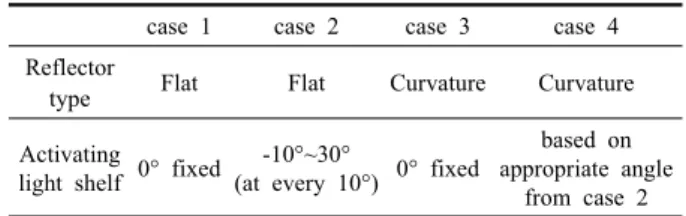
위하여 광선반의 개념 및 연구동향과 주거 내 조도 기 준에 대하여 문헌 고찰을 실시하였다 . 두 번째, 성능평 가를 위한 환경 설정 단계로 광선반의 곡률 및 변인에 대한 설정과 테스트베드의 실내외 공간의 환경설정을 실시하였다. 세 번째, 곡률적용 광선반의 성능 검증을 위하여 곡률 적용 및 가동 여부에 따라서 4가지의 case 를 설정하여 성능평가 및 비교 분석을 진행하였으며 , 그에 따른 곡률적용 광선반의 유효성과 곡률적용 광선 반의 적정안을 도출하였다.
본 연구의 성능평가는 광선반에 의한 실내 조도 분포 를 근거로 디밍조명과 연동
(10)하였으며 , 이후 전력사용 량을 산출하여 실거주 기반의 성능평가를 진행하였다 .
2. 광선반의 개념 및 사례2.1 광선반의 개념
광선반은 Fig. 2에서 나타나듯이 외부 자연광을 반 사를 통하여 실내 깊숙이 유입하는 자연채광 시스템으 로 제 1 반사가 이루어지는 광선반 반사판의 형태는 광
선반의 채광성능을 결정하는 중요한 광선반의 변인 중 하나이다 .
(19)이후 본 연구는 곡률 적용 광선반의 성능 평가 및 적정 변인 도출을 목적으로 평판형 광선반의 단면을 기준으로 좌우측 대칭된 형태로 위로 볼록한 형태 및 아래로 볼록한 형태를 각각 (+) 곡률과 (-) 곡 률로 정의하여 연구를 진행하였다 .
2.2 광선반 반사판의 형태에 따른 기존연구 고찰
기존 광선반의 성능평가에 관련한 연구는 Table 1에 서 나타나듯이 평판형 광선반에 국한하여 진행되었으며, 곡면이 적용된 ‘광선추적기법을 활용한 곡면형 광선반 시스템 채광성능 평가 ’ 연구는 특정 형태의 곡면에 의 하여 진행되어 형태 및 곡률에 따른 광선반 성능 및 설 계의 기초자료로는 부적합 한 것으로 판단된다 .
2.3 성능평가를 위한 주거공간 내 조도 기준주거공간에서의 조도는 실내 빛 환경 관련 쾌적도
및 조명에너지 저감과 밀접한 관계를 가지며, 이에 따
라서 주거 공간은 공간의 성격에 따른 권장 조도 기준
을 설정하고 있다 . 국내의 경우에는 조도기준을 KS A
Table 2 Recommended illuminance(KS A 3011)
Division Measurement Location Illumination Scope [lx]Living room
General Above the floor 40±5(cm)
150 - 200 - 300
Work 300 - 400 - 600
Light-shelf range
width 200 mm, 400 mm, 600 mm
type External type flat, Curvature(+, -) Angle of arc 0°, 20°, 40°, 60°, 80°, 100°
Angle -10°, 0°, 10°, 20°, 30°
height 1800 mm
reflectivity specular reflection film(reflexibility 85%)
Light-Shelf
w:width of Light-Shelf A:angle of arc r:radious of curvature
Fig. 3 Curvature calculation method per width of light shelf and arc angle.
Table 4 Curvature calculation per width of light shelf and arc angle
Width (mm)
Angle
of arc Curvature Width (mm)
Angle
of arc Curvature
200
0 0 400
60 0.00249
20 0.00349 80 0.00321
40 0.00343 100 0.00384
60 0.00500
600
0 0
80 0.00647 20 0.00059
100 0.00768 40 0.00115
400
0 0 60 0.00167
20 0.00088 80 0.00214
40 0.00173 100 0.00255
Table 5 Setting of test-bed
Room size, Material
4.9 m(W)×6.6 m(D), 2.5 m(Celling height) Wall:reflexibility 46%
Window size, Material
2.2 m(W)×1.8 m(H) Pair glass 12 mm(3 mm×6 mm×3 mm)
Direction South
Overview of test-bed and
artificial sunlight
3011으로 명시하고 있으며,
(20)본 연구는 Table 2에서 나타나듯이 거실에서 작업시의 표준 조도를 근거로 이 후 성능평가를 위한 조명제어의 기준 조도로 400 lx를 설정하였다.
3. 곡률적용 광선반 성능평가 설정 및 분석 방법
3.1 광선반 변인설정 및 반사판 곡률설정
본 연구의 광선반 변인설정은 Table 3과 같으며, 광 선반의 높이는 재실자의 눈높이 및 성능이 우수하다고 평가된 1.8 m
(19)로 통제하였다. 또한 본 연구의 광선반 곡률 설정은 광선반 폭에 따른 호의 각도를 기준으로 설정하였으며 , 호의 각도는 20°, 40°, 60°, 80°, 100°으 로 설정하였다. 곡률 산출하는 방법은 Fig. 3과 같다.
Table 4는 본 연구에서 설정한 광선반 폭과 호의 각도 에 따른 곡률값이다 . 이후 본 연구에서는 곡률적용 광 선반의 성능평가 결과에 대한 이해도를 높이기 위하여 곡률로 표기하기보다 호의 각도로 명시하였다 .
3.2 성능평가 Test-bed 개요 및 조도 센서 위치
본 연구의 성능평가를 진행한 테스트베드는 Table 5 에서 나타나듯이 폭 4.9 m, 깊이 6.6 m, 높이2.5 m의 크
기이며, 창의 크기는 폭은 2.2 m, 높이는 1.8 m로 채광 성능을 위한 외부환경은 정남향으로 설정하였다.
(17)곡률적용 광선반의 성능평가를 위한 조도 측정 위치 는 Fig. 4와 Fig. 5에서 나타나듯이 총 8개이며, 조도 측 정높이는 앞서서 고찰한 KS A 3011를 근거하여 바닥으 로부터 450 mm지점에서 실내 조도값을 설정하였다.
3.3 곡률적용 광선반의 성능 평가 방법
곡률 적용 광선반의 성능평가를 위한 방법은 다음
과 같다. 첫 번째, 광선반의 변인에 따른 실내 조도 값
을 측정하였으며 , 이후 최소 조도, 최대 조도, 평균 조도,
평균조도를 도출하여 성능평가 지표로 활용하였다 .
(18)균제도는 평균 조도에 대한 최소 조도의 값으로 산출
하였다. 두 번째, 본 연구는 가동형 광선반 설정을 위
하여 동지 , 하지, 춘추분에 대한 적정 광선반 각도를
도출하였다 . 적정 광선반 각도는 에너지 저감에 근거
하여 측정되는 8개의 조도 값이 400 lx 만족여부를 1
차적으로 고려하였으며, 400 lx 이하인 지점이 발생한
경우에는 최소 조도 값이 400 lx에 가장 근접한 각도
를 적정각도로 도출하였다 . 세 번째, 본 연구는 실내
◎ ◎ ◎ ◎
◎ ◎ ◎ ◎
L1 L2
L3 L4
S1 S2 S3 S4
S5 S6 S7 S8
L:Lighting, S:Illumination Sensor
Fig. 4 Floor plan of test-bed and location of illumination sensors.
Lighting
◎ ◎ ◎ ◎
Light-Shelf
◎:Illumination Sensor
Fig. 5 Section view of test-bed and location of illumination sensors.
Table 6 Experiment case
case 1 case 2 case 3 case 4
Reflector
type Flat Flat Curvature Curvature
Activating
light shelf 0° fixed -10°~30°
(at every 10°) 0° fixed
based on appropriate angle
from case 2
Table 7 Calculation method of lighting energy consumption in performance evaluation of light shelf
Light-shelf Dimming control
Light Number(dimming Level)
lighting energy consumption
ratio of artificial light×Time(1H)×Solar term(15days) Width Angle
200 0° fixed
(Winter solstice)Light1(1) (Winter solstice)12.33×1×15 = 184.95 W
sum: 5.173 kWh (Summer solstice)Light1(8) → Light3(8) → Light2(4) (Summer solstice)129.27×1×15 = 1939.05 W
(Spring and Fall solstice)Light1(8) → Light3(8) (Spring and Fall solstice)101.62×1×30 = 3048.6 W
조도 값에 근거하여 조명 디밍제어를 실시하였으며 , 조명 디밍제어 간 발생하는 조명에너지 사용량을 도출 하여
(15)광선반 성능평가를 위한 지표로 활용하였다.
조명 디밍제어는 측정되는 조도 값 중 최저값으로 측 정되는 센서와 근접한 조명부터 디밍제어를 순차적으
로 실시하도록 하였으며 , 400 lx를 만족할 경우에 조명 제어를 종료하도록 하였다 . 본 연구의 디밍 조명제어 는 8단계로 제어되도록 구축하였으며, 조명에너지 전 력사용량은 정남향의 1시간 및 절기 당 약 15일을 근 거하여 Table 6에서와 같은 방법으로 산출하였다.
4. 곡률적용 광선반 성능평가 결과 및 논의 4.1 곡률적용 광선반 성능분석을 위한 대조군 설정
본 연구는 곡률적용 광선반의 성능평가를 위하여 Table 6에서 나타나듯이 4가지의 Case로 설정하여 진 행하였다 . Case 1과 Case 2는 곡률이 미적용된 평판형 광선반으로 0˚ 고정형과 -10˚~30˚의 가동형으로 설정하 였다 . Case 3과 Case 4는 곡률적용 광선반으로 각각 0˚
고정형과 가동형 타입이며, 가동형의 경우 case 2의 적 정각도를 근거하였다 .
4.2 곡률미적용 광선반 성능평가 결과
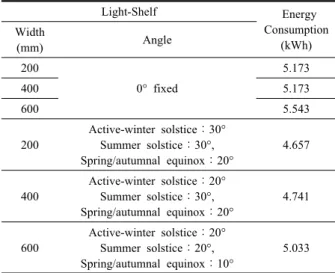
곡률미적용 광선반의 폭과 각도에 따른 성능평가 결 과는 Table 8과 같으며, Table 8을 근거로 도출되는 절 기별 적정 각도와 조명에너지 사용량은 각각 Table 9, Table 10과 같다. 도출된 결과를 통하여 분석된 결과는 다음과 같다.
첫 번째 , 평판형 광선반의 각도 증가는 외부 자연광 의 유입량을 증가하여 에너지 저감에 적합하나 하지의 경우 각도 증가는 균제도를 저하시키므로 적정각도를 도출하여야 한다. 두 번째, 광선반 폭에 따른 적정각도 는 상이하게 나타나고 있으나 동지 20˚, 하지 30˚, 춘추 분 10˚~20˚로 도출된다. 세 번째, 곡률 미적용 광선반 의 조명에너지 사용량 산출에 따른 성능평가 결과 폭 200 mm의 가동형 광선반이 적정안으로 판단된다.
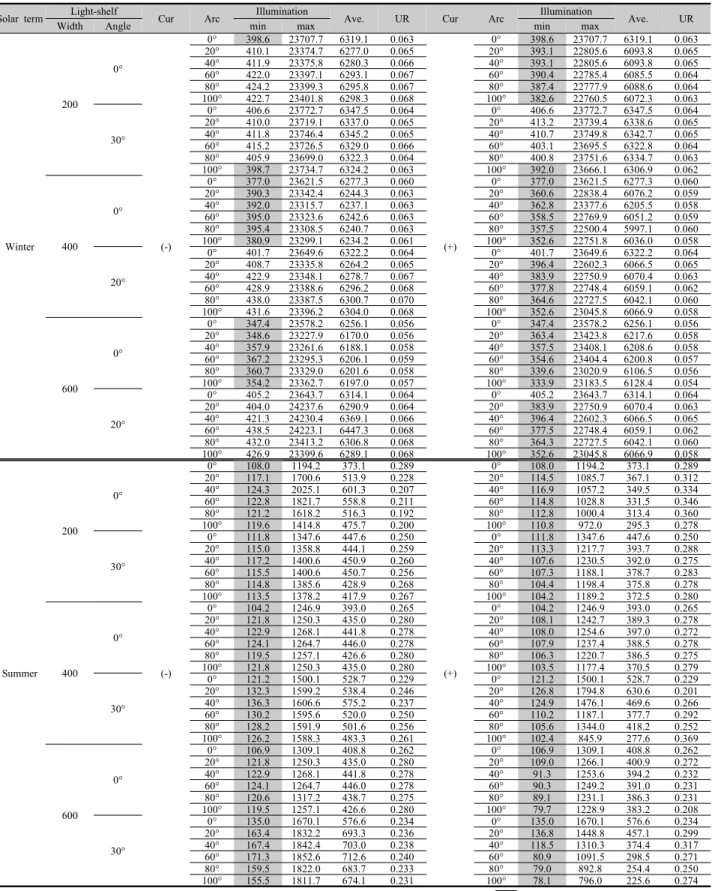
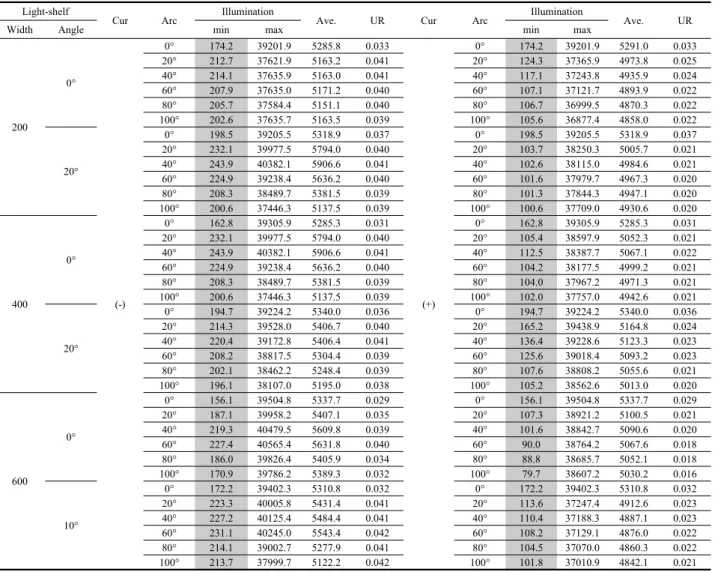
곡률미적용 광선반의 성능평가 결과는 Table 11~
Table 13과 같으며, 분석 내용은 다음과 같다.
첫 번째 , 광선반의 곡면형태는 (-)형태의 곡률적용 광선반이 (+)형태의 곡률적용 광선반에 대비하여 높은 조도가 형성되어 에너지 저감 및 균제도 개선에 적합 하며 , 또한 균제도 개선에도 유리하게 나타난다.
두 번째 , (-)형태의 곡률적용 광선반의 경우에는 호
Table 8 Performance evaluation result of flat light-shelf
Light-shelf Season
Winter Summer Spring and Fall
Width Angle Illumination
Ave. UR Illumination
Ave. UR Illumination
Ave. UR
min max min max min max
200
-10 390.0 23779.4 6316.9 0.062 100.1 1141.3 358.8 0.279 174.3 39263.1 5305.1 0.033 0 398.6 23707.7 6319.1 0.063 108.0 1194.2 373.1 0.289 174.2 39201.9 5285.8 0.033 10 399.8 23697.9 6320.0 0.063 102.6 1221.4 377.5 0.272 173.7 39198.5 5293.3 0.033 20 409.0 23733.3 6337.8 0.065 107.0 1275.9 407.2 0.263 198.5 39205.5 5318.9 0.037 30 406.6 23772.7 6347.5 0.064 111.8 1347.6 447.6 0.250 181.4 39200.7 5311.7 0.034
400
-10 371.5 23682.7 6259.0 0.059 100.4 1176.3 363.8 0.276 155.2 39265.9 5275.1 0.029 0 377.0 23621.5 6277.3 0.060 104.2 1246.9 393.0 0.265 162.8 39305.9 5285.3 0.031 10 397.7 23631.2 6302.1 0.063 121.4 1747.7 510.9 0.238 164.4 39290.1 5289.0 0.031 20 401.7 23649.6 6322.2 0.064 106.7 1699.6 504.8 0.211 194.7 39224.2 5340.0 0.036 30 402.2 23771.1 6345.2 0.063 121.2 1500.1 528.7 0.229 174.9 39172.2 5284.7 0.033
600
-10 353.6 23777.9 6261.7 0.056 100.2 1197.9 373.5 0.268 145.2 39114.4 5219.5 0.028 0 347.4 23578.2 6256.1 0.056 106.9 1309.1 408.8 0.262 156.1 39504.8 5337.7 0.029 10 387.8 23588.9 6286.8 0.062 110.7 2006.3 569.1 0.195 172.2 39402.3 5310.8 0.032 20 405.2 23643.7 6314.1 0.064 116.8 1943.7 570.9 0.205 159.6 39115.7 5257.9 0.030 30 383.5 23773.3 6325.1 0.061 135.0 1670.1 576.6 0.234 163.9 39106.8 5258.2 0.031
Ave.:Average, UR:uniformity ratio, :This indicates lower score than 400 lx.
Table 9 Optimum angle of flat light-shelf
solar term Light-shelf width(mm) appropriate angle
Winter
200 30°
400 20°
600 20°
Summer
200 30°
400 30°
600 30°
Spring and Fall
200 20°
400 20°
600 10°
Table 10 Energy consumption of flat light-shelf
Light-Shelf Energy
Consumption (kWh) Width
(mm) Angle
200
0° fixed
5.173
400 5.173
600 5.543
200
Active-winter solstice:30°
Summer solstice:30°, Spring/autumnal equinox:20°
4.657
400
Active-winter solstice:20°
Summer solstice:30°, Spring/autumnal equinox:20°
4.741
600
Active-winter solstice:20°
Summer solstice:20°, Spring/autumnal equinox:10°
5.033
의 각도가 20˚, 40˚, 60˚로 증가함에 따라서 채광성능이 개선되고 있으나, 80˚ 이상인 경우에는 채광성능이 저 하되어 광선반 설계시 고려해야 한다.
세 번째, 곡률 적용 광선반은 호의 각도에 따라서 성능차이를 보이고 있으나, 에너지 저감 측면에서 폭 200 mm, 호의 각도 20˚~60˚인 가동형 광선반이 가장 우 수하게 나타나고 있다 .
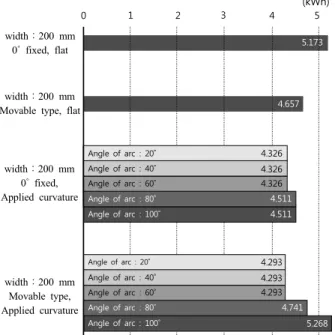
네 번째 , 폭 200 mm, 호의 각도 0˚인 각도 0˚ 고정형 곡률적용 광선반은 각도 0˚ 고정형 평판 광선반과 가 동형 평판 타입의 광선반에 대비하여 각각 16.4%, 7.1%
의 조명에너지 저감이 가능하다. 또한, 폭 200 mm, 호의 각도 20˚~60˚인 가동형 곡률적용 광선반은 각도 0˚ 고 정형 평판형 광선반과 가동형 평판타입의 광선반에 대 비하여 각각 17%, 7.8%의 조명에너지 저감이 가능하다.
4.3 곡률미적용 광선반 성능평가 논의
본 연구는 곡률적용 광선반의 성능평가를 진행하였 으며 , 그에 대한 적정안으로 폭 200 mm, 호의 각도 20
˚~60˚인 가동형 광선반을 도출하였다. 또한, Fig. 6에서 나타나듯이 각도 0˚ 고정형 곡률적용 광선반의 경우에 는 가동형 평판타입의 광선반에 대비하여 에너지 저감 이 가능함을 확인하였다. 이는 광선반의 가동이라는 복잡한 메카니즘이 아닌 단순 광선반의 형태 변화를 통한 에너지 저감이라는 측면에서 유의미하다 .
5. 결 론
본 연구는 에너지 저감을 위한 곡률적용 광선반의
Table 11 Performance evaluation results of light-shelf with applied curvature light shelf during winter and summer solstice
Solar term Light-shelf
Cur Arc Illumination
Ave. UR Cur Arc Illumination
Ave. UR
Width Angle min max min max
Winter 200
0°
(-)
0° 398.6 23707.7 6319.1 0.063
(+)
0° 398.6 23707.7 6319.1 0.063
20° 410.1 23374.7 6277.0 0.065 20° 393.1 22805.6 6093.8 0.065
40° 411.9 23375.8 6280.3 0.066 40° 393.1 22805.6 6093.8 0.065
60° 422.0 23397.1 6293.1 0.067 60° 390.4 22785.4 6085.5 0.064
80° 424.2 23399.3 6295.8 0.067 80° 387.4 22777.9 6088.6 0.064
100° 422.7 23401.8 6298.3 0.068 100° 382.6 22760.5 6072.3 0.063
30°
0° 406.6 23772.7 6347.5 0.064 0° 406.6 23772.7 6347.5 0.064
20° 410.0 23719.1 6337.0 0.065 20° 413.2 23739.4 6338.6 0.065
40° 411.8 23746.4 6345.2 0.065 40° 410.7 23749.8 6342.7 0.065
60° 415.2 23726.5 6329.0 0.066 60° 403.1 23695.5 6322.8 0.064
80° 405.9 23699.0 6322.3 0.064 80° 400.8 23751.6 6334.7 0.063
100° 398.7 23734.7 6324.2 0.063 100° 392.0 23666.1 6306.9 0.062
400 0°
0° 377.0 23621.5 6277.3 0.060 0° 377.0 23621.5 6277.3 0.060
20° 390.3 23342.4 6244.3 0.063 20° 360.6 22838.4 6076.2 0.059
40° 392.0 23315.7 6237.1 0.063 40° 362.8 23377.6 6205.5 0.058
60° 395.0 23323.6 6242.6 0.063 60° 358.5 22769.9 6051.2 0.059
80° 395.4 23308.5 6240.7 0.063 80° 357.5 22500.4 5997.1 0.060
100° 380.9 23299.1 6234.2 0.061 100° 352.6 22751.8 6036.0 0.058
20°
0° 401.7 23649.6 6322.2 0.064 0° 401.7 23649.6 6322.2 0.064
20° 408.7 23335.8 6264.2 0.065 20° 396.4 22602.3 6066.5 0.065
40° 422.9 23348.1 6278.7 0.067 40° 383.9 22750.9 6070.4 0.063
60° 428.9 23388.6 6296.2 0.068 60° 377.8 22748.4 6059.1 0.062
80° 438.0 23387.5 6300.7 0.070 80° 364.6 22727.5 6042.1 0.060
100° 431.6 23396.2 6304.0 0.068 100° 352.6 23045.8 6066.9 0.058
600 0°
0° 347.4 23578.2 6256.1 0.056 0° 347.4 23578.2 6256.1 0.056
20° 348.6 23227.9 6170.0 0.056 20° 363.4 23423.8 6217.6 0.058
40° 357.9 23261.6 6188.1 0.058 40° 357.5 23408.1 6208.6 0.058
60° 367.2 23295.3 6206.1 0.059 60° 354.6 23404.4 6200.8 0.057
80° 360.7 23329.0 6201.6 0.058 80° 339.6 23020.9 6106.5 0.056
100° 354.2 23362.7 6197.0 0.057 100° 333.9 23183.5 6128.4 0.054
20°
0° 405.2 23643.7 6314.1 0.064 0° 405.2 23643.7 6314.1 0.064
20° 404.0 24237.6 6290.9 0.064 20° 383.9 22750.9 6070.4 0.063
40° 421.3 24230.4 6369.1 0.066 40° 396.4 22602.3 6066.5 0.065
60° 438.5 24223.1 6447.3 0.068 60° 377.5 22748.4 6059.1 0.062
80° 432.0 23413.2 6306.8 0.068 80° 364.3 22727.5 6042.1 0.060
100° 426.9 23399.6 6289.1 0.068 100° 352.6 23045.8 6066.9 0.058
Summer 200
0°
(-)
0° 108.0 1194.2 373.1 0.289
(+)
0° 108.0 1194.2 373.1 0.289
20° 117.1 1700.6 513.9 0.228 20° 114.5 1085.7 367.1 0.312
40° 124.3 2025.1 601.3 0.207 40° 116.9 1057.2 349.5 0.334
60° 122.8 1821.7 558.8 0.211 60° 114.8 1028.8 331.5 0.346
80° 121.2 1618.2 516.3 0.192 80° 112.8 1000.4 313.4 0.360
100° 119.6 1414.8 475.7 0.200 100° 110.8 972.0 295.3 0.278
30°
0° 111.8 1347.6 447.6 0.250 0° 111.8 1347.6 447.6 0.250
20° 115.0 1358.8 444.1 0.259 20° 113.3 1217.7 393.7 0.288
40° 117.2 1400.6 450.9 0.260 40° 107.6 1230.5 392.0 0.275
60° 115.5 1400.6 450.7 0.256 60° 107.3 1188.1 378.7 0.283
80° 114.8 1385.6 428.9 0.268 80° 104.4 1198.4 375.8 0.278
100° 113.5 1378.2 417.9 0.267 100° 104.2 1189.2 372.5 0.280
400 0°
0° 104.2 1246.9 393.0 0.265 0° 104.2 1246.9 393.0 0.265
20° 121.8 1250.3 435.0 0.280 20° 108.1 1242.7 389.3 0.278
40° 122.9 1268.1 441.8 0.278 40° 108.0 1254.6 397.0 0.272
60° 124.1 1264.7 446.0 0.278 60° 107.9 1237.4 388.5 0.278
80° 119.5 1257.1 426.6 0.280 80° 106.3 1220.7 386.5 0.275
100° 121.8 1250.3 435.0 0.280 100° 103.5 1177.4 370.5 0.279
30°
0° 121.2 1500.1 528.7 0.229 0° 121.2 1500.1 528.7 0.229
20° 132.3 1599.2 538.4 0.246 20° 126.8 1794.8 630.6 0.201
40° 136.3 1606.6 575.2 0.237 40° 124.9 1476.1 469.6 0.266
60° 130.2 1595.6 520.0 0.250 60° 110.2 1187.1 377.7 0.292
80° 128.2 1591.9 501.6 0.256 80° 105.6 1344.0 418.2 0.252
100° 126.2 1588.3 483.3 0.261 100° 102.4 845.9 277.6 0.369
600 0°
0° 106.9 1309.1 408.8 0.262 0° 106.9 1309.1 408.8 0.262
20° 121.8 1250.3 435.0 0.280 20° 109.0 1266.1 400.9 0.272
40° 122.9 1268.1 441.8 0.278 40° 91.3 1253.6 394.2 0.232
60° 124.1 1264.7 446.0 0.278 60° 90.3 1249.2 391.0 0.231
80° 120.6 1317.2 438.7 0.275 80° 89.1 1231.1 386.3 0.231
100° 119.5 1257.1 426.6 0.280 100° 79.7 1228.9 383.2 0.208
30°
0° 135.0 1670.1 576.6 0.234 0° 135.0 1670.1 576.6 0.234
20° 163.4 1832.2 693.3 0.236 20° 136.8 1448.8 457.1 0.299
40° 167.4 1842.4 703.0 0.238 40° 118.5 1310.3 374.4 0.317
60° 171.3 1852.6 712.6 0.240 60° 80.9 1091.5 298.5 0.271
80° 159.5 1822.0 683.7 0.233 80° 79.0 892.8 254.4 0.250
100° 155.5 1811.7 674.1 0.231 100° 78.1 796.0 225.6 0.274
Cur:Curvature type, Arc:Angle of arc, Ave.:Average, UR:uniformity ratio, :This indicates lower score than 400 lx.
Table 12 Performance evaluation result of light-shelf with applied curvature light shelf during spring and fall equinox
Light-shelf
Cur Arc Illumination
Ave. UR Cur Arc Illumination
Ave. UR
Width Angle min max min max
200 0°
(-)
0° 174.2 39201.9 5285.8 0.033
(+)
0° 174.2 39201.9 5291.0 0.033
20° 212.7 37621.9 5163.2 0.041 20° 124.3 37365.9 4973.8 0.025
40° 214.1 37635.9 5163.0 0.041 40° 117.1 37243.8 4935.9 0.024
60° 207.9 37635.0 5171.2 0.040 60° 107.1 37121.7 4893.9 0.022
80° 205.7 37584.4 5151.1 0.040 80° 106.7 36999.5 4870.3 0.022
100° 202.6 37635.7 5163.5 0.039 100° 105.6 36877.4 4858.0 0.022
20°
0° 198.5 39205.5 5318.9 0.037 0° 198.5 39205.5 5318.9 0.037
20° 232.1 39977.5 5794.0 0.040 20° 103.7 38250.3 5005.7 0.021
40° 243.9 40382.1 5906.6 0.041 40° 102.6 38115.0 4984.6 0.021
60° 224.9 39238.4 5636.2 0.040 60° 101.6 37979.7 4967.3 0.020
80° 208.3 38489.7 5381.5 0.039 80° 101.3 37844.3 4947.1 0.020
100° 200.6 37446.3 5137.5 0.039 100° 100.6 37709.0 4930.6 0.020
400 0°
0° 162.8 39305.9 5285.3 0.031 0° 162.8 39305.9 5285.3 0.031
20° 232.1 39977.5 5794.0 0.040 20° 105.4 38597.9 5052.3 0.021
40° 243.9 40382.1 5906.6 0.041 40° 112.5 38387.7 5067.1 0.022
60° 224.9 39238.4 5636.2 0.040 60° 104.2 38177.5 4999.2 0.021
80° 208.3 38489.7 5381.5 0.039 80° 104.0 37967.2 4971.3 0.021
100° 200.6 37446.3 5137.5 0.039 100° 102.0 37757.0 4942.6 0.021
20°
0° 194.7 39224.2 5340.0 0.036 0° 194.7 39224.2 5340.0 0.036
20° 214.3 39528.0 5406.7 0.040 20° 165.2 39438.9 5164.8 0.024
40° 220.4 39172.8 5406.4 0.041 40° 136.4 39228.6 5123.3 0.023
60° 208.2 38817.5 5304.4 0.039 60° 125.6 39018.4 5093.2 0.023
80° 202.1 38462.2 5248.4 0.039 80° 107.6 38808.2 5055.6 0.021
100° 196.1 38107.0 5195.0 0.038 100° 105.2 38562.6 5013.0 0.020
600 0°
0° 156.1 39504.8 5337.7 0.029 0° 156.1 39504.8 5337.7 0.029
20° 187.1 39958.2 5407.1 0.035 20° 107.3 38921.2 5100.5 0.021
40° 219.3 40479.5 5609.8 0.039 40° 101.6 38842.7 5090.6 0.020
60° 227.4 40565.4 5631.8 0.040 60° 90.0 38764.2 5067.6 0.018
80° 186.0 39826.4 5405.9 0.034 80° 88.8 38685.7 5052.1 0.018
100° 170.9 39786.2 5389.3 0.032 100° 79.7 38607.2 5030.2 0.016
10°
0° 172.2 39402.3 5310.8 0.032 0° 172.2 39402.3 5310.8 0.032
20° 223.3 40005.8 5431.4 0.041 20° 113.6 37247.4 4912.6 0.023
40° 227.2 40125.4 5484.4 0.041 40° 110.4 37188.3 4887.1 0.023
60° 231.1 40245.0 5543.4 0.042 60° 108.2 37129.1 4876.0 0.022
80° 214.1 39002.7 5277.9 0.041 80° 104.5 37070.0 4860.3 0.022
100° 213.7 37999.7 5122.2 0.042 100° 101.8 37010.9 4842.1 0.021
Cur:Curvature type, A:Angle of arc, Ave.:Average, UR:uniformity ratio, :This indicates lower score than 400 lx.
Table 13 Energy consumption of light-shelf applied with curvature
Light-shelf Energy
Consumption (kWh)
Light-shelf Energy
Consumption (kWh)
Angle Width Angle of arc Angle Width Angle of arc
0° fixed
200
20° 4.236
Active-winter solstice:30°
Summer:solstice 30°, Spring/autumnal equinox:20°
200
20° 4.293
40° 4.236 40° 4.293
60° 4.236 60° 4.293
80° 4.511 80° 4.741
100° 4.511 100° 5.268
400
20° 4.063
Active-winter solstice:20°
Summer:solstice 30°, Spring/autumnal equinox:20°
400
20° 4.657
40° 4.248 40° 4.657
60° 4.248 60° 4.657
80° 4.511 80° 4.657
100° 4.758 100° 4.903
600
20° 4.758
Active-winter solstice:20°
Summer:solstice 20°, Spring/autumnal equinox:10°
600
20° 5.082
40° 4.943 40° 4.988
60° 4.943 60° 4.533
80° 4.758 80° 4.533
100° 4.758 100° 4.533
width:200 mm 0˚ fixed, flat
width:200 mm Movable type, flat
width:200 mm 0˚ fixed, Applied curvature
width:200 mm Movable type, Applied curvature
0 1 2 3 4 (kWh)5
5.173
4.657
Angle of arc : 20˚
Angle of arc : 40˚
Angle of arc : 60˚
Angle of arc : 80˚
Angle of arc : 100˚
Angle of arc : 20˚
Angle of arc : 40˚
Angle of arc : 60˚
Angle of arc : 80˚
Angle of arc : 100˚
4.326 4.326 4.326 4.511 4.511
4.293 4.293 4.293
4.741 5.268
Fig. 6 Energy consumption of curved light-shelf.
유효성 및 적정안을 도출하기 위하여 테스트베드를 통 한 성능평가를 진행하였으며, 그에 대한 결론은 다음 과 같다.
(1) 본 연구는 곡률적용 광선반의 성능평가를 진행하기 위하여 평판형 광선반의 성능평가를 진행하였으며, 절기에 따른 적정 각도 도출 및 적정안을 도출하 였다 . 본 연구에서의 평판형 광선반 적정안은 폭 200 mm의 가동형 광선반이다.
(2) 광선반의 곡면형태는 (-)형태의 곡률이 에너지 저감 및 균제도 개선에 유리하게 나타나고 있다.
(3) (-)형태의 곡률적용 광선반의 경우에는 호의 각도 증가에 따라서 채광성능이 개선되나 80˚ 이상인 경 우에는 채광성능이 저하되어 광선반 설계시 고려 해야 한다.
(4) 에너지 저감 측면에서의 곡률적용 광선반의 적정 안은 폭 200 mm, 호의 각도 20˚~60˚인 가동형 광선 반이다 .
(5) 폭 200 mm 곡률적용 가동형 광선반은 0˚ 고정형 및 가동형 평판 광선반에 대비하여 각각 17%, 7.8%의 조명에너지 저감이 가능하다 .
곡률적용 광선반에 대한 성능평가는 에너지 저감의 중요성이 부각되고 있는 현 시점에서 유의미하나, 본 연구는 곡률의 형태를 설정함에 있어서 호의 각도로 제한하였다는 한계가 있다 . 이후 연구에서는 복합적인 형태가 적용된 광선반의 성능평가가 필요할 것이라 판 단된다.
References
![Table 2 Recommended illuminance(KS A 3011) Division Measurement Location Illumination Scope [lx]](https://thumb-ap.123doks.com/thumbv2/123dokinfo/5615537.495070/3.892.470.806.178.403/table-recommended-illuminance-division-measurement-location-illumination-scope.webp)