• 검색 결과가 없습니다.

A Case Report of Migraine with Typical Aura on Korean Medical Treatments

N/A
N/A
Protected

Academic year: 2021

Share "A Case Report of Migraine with Typical Aura on Korean Medical Treatments"

Copied!
10
0
0

로드 중.... (전체 텍스트 보기)

전체 글

(1)

A Case Report of Migraine with Typical Aura on Korean Medical Treatments

Myoung-Ui Cho, Su-Yeon Lim, Hyun-A Jeon*, Ji-Yeon Lee*, Young-Joo Moon*, Kwang-Chan Song , Young-Tak Koh

Department of Oriental Neuropsychiatry, Jaseng Hospital of Korean Medicine, *Department of Oriental Rehabilitation, Jaseng Hospital of Korean Medicine,

Department of Clinical Korean Medicine, Graduate School, Kyung Hee University

Received: November 7, 2018 Revised: November 30, 2018 Accepted: December 17, 2018

Objectives: The objective of this case report was to investigate the effect of Korean medicine therapy on migraine patients with typical aura.

Methods: Acupuncture and chuna manual therapy were applied to outpatients once in 1 to 2 weeks, a total of 9 times, for about 11 weeks. A patient was diagnosed with ganyang-toutong and taeeumin dry-heat symptomatic pattern. Herbal medicine (Chongsanggeontong-tang Gagambang (淸上蠲痛 湯加減方)) was prescribed for 15 days up to the 3rd visit, then another herbal medicine (Yeoldahanso-tang (熱多寒少湯)) prescribed for 15 days up to the 6th visit. MSQol and MIDAS were used as a tool at the start and after 9th treatment. The intensity and frequency of headache, frequency of aura and neck pain were examined on every visit.

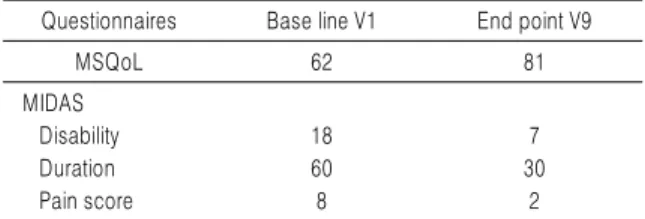
Results: According to the results, Korean traditional medicine described above had effect on the in- tensity and frequency of headache, frequency of aura and neck pain as well as an increase in the figure of MSQoL from 62 to 81 and decrease of MIDAS Disability from 18 to 7, Duration from 60 to 30, Pain score from 8 to 2.

Conclusions: Migraine with typical aura classified as ganyang-toutong and taeeumin dry-heat symp- tomatic pattern can be alleviated by Korean traditional medicine.

Key Words: Ganyang-TouTong, Chongsanggeontong-tang (淸上蠲痛湯), Taeeumin, Dry-Heat Symptomatic pattern, Yeoldahanso-tang (熱多寒少湯).

Correspondence to Young-Tak Koh Department of Oriental Neuropsychiatry, Jaseng Hospital of Korean Medicine, 17 Buil-ro, 191 beon-gil, Bucheon, Korea.

Tel: +82-32-320-8834 Fax: +82-32-320-8712 E-mail: [email protected]

Copyright © 2018 by The Korean Society of Oriental Neuropsychiatry. All rights reserved.

CC
This is an open access article distributed under the terms of the Creative Commons Attribution Non-Commercial License (http://creativecommons.org/licenses/by-nc/4.0) which

permits unrestricted non-commercial use, distribution, and reproduction in any medium, provided the original work is properly cited.

(2)

Ⅰ. INTRODUCTION

Migraine is the third most common disease in the world and the sixth most common disease caused by diverse disorders

1)

. The highest prevalence is shown at the age between 20 and 50 years who are exposed to high social and productive activities. Migraine not only limits or decreases work force, but also affects in- dividuals and social economy due to increase in rate of absence at work

2,3)

.

Migraine with typical aura occurs in approximately one third of migraineurs

4)

. The International Headache Society (IHS), categorizes the aura symptoms of mi- graine with aura in ICHD-3 as reversible visual, sen- sory, and linguistic symptoms

5)

. According to Michele Viana, migraine accompanies 98% of visual, 36% of sensory and 10% of linguistic aura symptoms while the percentage of only one of them to be observed is 62%, two is 31% and all three to appear simultaneously is just 6%

6)

.

About 140 thousand migraine patients received Korean medicine treatments in 2017

7)

. Compared to Korean clinical medicine treatments that are actively taking in place with the total of 12.7 billion won of medical care benefit cost

7)

, researches on migraine have limitations

8)

. There are no any randomized con- trol studies and only 1 to 2 case studies in Korea

8)

. Under the category of migraine with aura, there is a case study on visual symptom by Sun

9)

and Jeon

10)

.

There were no reports of migraine with aura ac- companying visual and sensory symptoms using Korean medical treatments. This study uses Korean medical treatments for migraine with aura accom- panying visual and sensory symptoms and intends to report them because they have obtained valid effects.

Ⅱ. CASE

1. Patient

201○. ○. ○ - 201○. ○. ○ (total of 9 visits in 78 days) Outpatient Choi ○○ (F/37) in department of oriental neuropsychiatry, Bucheon Jaseng hospital of Korean medicine.

This retrospective case study was approved and progressed by the Institutional Review Board of Jaseng Hospital of Korean Medicine (JASENG 2018-10-002).

2. Chief Complaint

1) Migraine

Patterns of pulsatile or throbbing pain are shown in left, right or both sides of the head.

- Occurring 5 times a day lasting for 5∼10 minutes is low intensity migraine (VAS 1 or more and under 4, mild)

- Occurring 1∼2 times a day lasting for 30 minutes is moderate intensity migraine (VAS 4 or more and un- der 7, moderate)

- Occurring once a week (usually on weekends) lasting over 3 hours is strong intensity migraine (VAS 7 or more, severe)

Migraine occurs without any particular cause, but stress could sometimes be a motivating factor.

2) Neck Pain

Stiff pain pattern in post neck and both upper tra- pezius muscle all day long (VAS 4).

3) Aura

(1) Visual symptoms (V)

It usually appears before any head attack taking in

place, but a glittering light, silver-colored or a black

spot could be seen on one side during or without

attack.

(3)

(2) Sensory symptoms (S)

It usually appears before any head attack taking in place, but numbness or tingling pain could occur on one side during attack.

3. Onset Date and Motivation of the Onset Occurred on February 2017, during daily life.

4. Past Illness, Family History None

5. Present Illness

The patient was hospitalized in the department of neurology at general hospital in Bucheon for 2 days via ER in February 2017, diagnosed as no abnormality after image and neural examination of Brain CT, Brain MRI and EEG and diagnosed as migraine with aura.

The patient took the medication after being dis- charged, but the symptom continued. Then the patient desired Korean medical treatment after receiving treat- ments in ER at general hospital in Bucheon when se- vere intensity of migraine (VAS 9) occurred intermittently.

6. Social History

1) Smoke (+, half a pack/day), drink (+, 1∼2 times/

week, soju 1∼2 bottles/time)

2) Occupation: Designer (night overtime 3∼4 days/

week), high usage of computers, overseas business trip 2∼3 times/year

3) Single, solitude

7. Medication

Mypol Cap. 1 Cap., Zomig Tab. 2.5 mg 1 T. Tridol Cap. 1 Cap., Imigran Tab. 50 mg 1 T.

Taking the medication only when severe migraine occurred.

8. 4 Examinations and Opinion on the Examine

1) Inspection

Yellow skin color, shining eyes, thin hair, 162 cm in height, weighing 63 kg with plump body type.

2) Listening Examination

Thoughts and words come out simultaneously, talk- ative, but not loud

3) Questioning Examination

Likes iced coffee, sensitive personality, irritable mood, usually having a dry mouth

4) Touch and Pulse Examination String pulse, red tongue, thin coating

5) Digestion and Appetite

2 times (1 bowl)/day, no appetite with satisfactory digestive power

6) Stool

1 time/1∼2 day, slight aspect of constipation

7) Urine

5∼6 times/day

8) Sleep

5∼6 hours/day, taking about 1 hour to fall in sleep, but a can of beer could help to shorten the time, feel- ing fatigue in the morning

9) Perspiration

Tends to sweat all over the body 10) Menstruation

Irregular cycle, small amount of bleeding, mild men-

(4)

strual pain, frequent occurrence of vaginitis 9. Diagnosis

1) Oriental medical diagnosis

Ganyang tou tong (肝陽頭痛), Taeeumin, Dry-Heat Symptomatic Pattern (燥熱症).

2) Diagnosis

Categorized as migraine with aura in accordance with the classification system of ICHD-3 enacted at International Headache Society, HIS.

10. Assessment Method

1) MSQoL (Migraine-Specific Quality of Life), MIDAS (Migraine Disability Assessment)

2) Frequency of Migraine Depending on the Intensity

VAS of migraine was checked on every visit as the figures under 4 being ‘mild’, 4 to 7 as ‘moderate’ and 7 or more as ‘severe’. According to each category, how many migraine a week had occurrd.

3) Frequency of aura

Frequency of visual and sensory symptoms before, during or without an attack in a week was recorded on every visit before the treatment.

4) Intensity of Neck Pain (VAS)

The intensity of neck pain was recorded on every visit before the treatment with VAS ruler.

11. Treatment

1) Acupuncture treatment

Acupuncture was performed by a licensed Oriental medical doctor with 3 years of clinical experience ob-

tained after a 6-year Oriental medical college course.

Disposable stainless-steel acupuncture needles (0.25×30 mm; Dongbang Acupuncture, Korea) were used. No specific needle stimulation technique were used and no specific response was obtained, such as de qi. In order to minimize pain, needles were inserted at a ver- tical or oblique angle to a depth of 3±2 mm at each acupuncture point. The following 7 classical acu- puncture points were treated: LI1 (Shangyang), GB44 (Zuqiaoyin), GB38 (Yangfu), SI5 (Yanggu), GB21 (Jianjing), GB20 (Fengchi), GB8 (Shuaigu). Reinforcement method (補法) at LI1 (Shangyang), GB44 (Zuqiaoyin) and reduc- tion method (瀉法) at GB38 (Yangfu), SI5 (Yanggu) of directional supplementation and draining treatment under Sa-am acupuncture treatment was performed in the opposite direction in which migraine attack were most severe before the visit. Acupuncture treatment bilaterally at GB21 (Jianjing), GB20 (Fengchi), GB8 (Shuaigu) as retained for 15 minutes. These points were selected based on textbook of acupuncture and moxibustion (Jibmundang).

2) Herbal Medicine Treatment (1) On the third visit

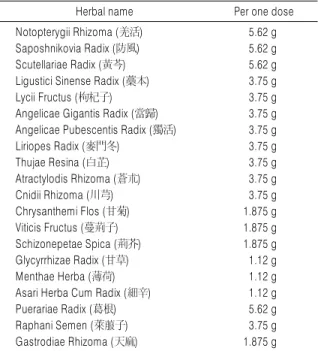
Chungsanggyuntong-tang Gagambang (淸上蠲痛湯加 減方; Table 1) <<Jaseng Hospital Prescription>> It was prescribed to take a pack twice a day for 15 days. One pack is two-dose divided into three-portions.

(2) On the 6th visit

Yeoldahanso-tang (熱多寒少湯; Table 2) <<Dongeuisuse- bowon (東醫壽世保元)>> It was prescribed to take a pack twice a day for 15 days. One pack is two-dose divided into three-portions.

3) Chuna Manual Therapy

Simple 1 region- joint operation and epifascial (ce-

phalus) simultaneously, cervical spine distraction tech-

nique on supination posture- JS1, 2, 3 techniques,

muscle energy techniques (MET) of both upper tra-

(5)

Table 1. The Composition of Chungsanggyuntong-tang Gagambang (淸上蠲痛湯加減方)

Herbal name Per one dose

Notopterygii Rhizoma (羌活) 5.62 g

Saposhnikovia Radix (防風) 5.62 g

Scutellariae Radix (黃芩) 5.62 g

Ligustici Sinense Radix (藁本) 3.75 g

Lycii Fructus (枸杞子) 3.75 g

Angelicae Gigantis Radix (當歸) 3.75 g Angelicae Pubescentis Radix (獨活) 3.75 g

Liriopes Radix (麥門冬) 3.75 g

Thujae Resina (白芷) 3.75 g

Atractylodis Rhizoma (蒼朮) 3.75 g

Cnidii Rhizoma (川芎) 3.75 g

Chrysanthemi Flos (甘菊) 1.875 g

Viticis Fructus (蔓荊子) 1.875 g

Schizonepetae Spica (荊芥) 1.875 g

Glycyrrhizae Radix (甘草) 1.12 g

Menthae Herba (薄荷) 1.12 g

Asari Herba Cum Radix (細辛) 1.12 g

Puerariae Radix (葛根) 5.62 g

Raphani Semen (萊菔子) 3.75 g

Gastrodiae Rhizoma (天麻) 1.875 g

Table 2. The Composition of Yeoldahanso-tang (熱多寒少湯)

Herbal name Per one dose

Puerariae Radix (葛根) 15 g

Scutellariae Radix (黃芩) 7.5 g

Ligustici Sinense Radix (藁本) 7.5 g

Raphani Semen (萊菔子) 3.75 g

Platycodi Radix (桔梗) 3.75 g

Cimicifugae Rhizoma (升麻) 3.75 g

Thujae Resina (白芷) 3.75 g

peziuses was used.

(1) JS1, 2, 3 techniques

The patient lies on supine position and the doctor sits above the patient's head. It supports the patient's temporal lobe with the palm of the hand and pushes the patient's articulation face to the left and right with the middle fingers of the doctor. Then, the palm comes into contact with the temporal lobe, and the surgeon uses the second finger to return the patient's articu- lation plane to the left and right. Finally, using the doctor's second finger, lift the back of the patient's ar- ticulation from the second to sixth cervical vertebrae and tow them with a light pull on both sides at the same time. Perform the three actions one after the other from the second to the sixth and repeat them two to three times.

(2) Muscle energy techniques for upper trapezius The patient lies on supine position and laterally bend the neck to the opposite side of the upper tra- pezius muscle. Doctors sit on top of the patient's head, fix the patient's shoulders with one hand, holds the

mastoid process in the direction of treatment on the other hand, and extends it to the restrictive barrier of the cervical spine. The patient tries to move the shoulder toward the ear, causing an isometric contraction. With 7∼10 seconds of contraction and a full force loss, the doctor extends the muscle by later- ally bending the cervical spine in the opposite direc- tion to the new restrctive barrier. Repeat the above procedure three times.

12. Clinical progress

1) Progress on 1st visit (V1)∼3rd visit (V3) Before Treatment

(1) Frequency of Head attack Depending on the Intensity

There was minimal alleviation of pain after the 1st treatment, but the pain increased to the same level as the first visit on the third visit (Table 3). It is worth the reference that the patient took oral analgesic west- ern medicine on STAT after the 2nd treatment when VAS of migraine elevated up to 9.

(2) Frequency of Aura

Head attack was mostly followed after visual symp-

toms such as shining light and silver-colored or black

spot in some cases. The symptom appeared neither on

the left nor right, but they were focused on one side

and usually outside or below the visual field. Visual

symptoms appeared 50 times a week on the 1st visit

with a slight decrease in the 2nd visit, but it was the

(6)

Table 3. Frequency of Head Attack Depending on the Intensity

Date of Visit

V1 V2 V3 V4 V5 V6 V7 V8 V9

Base line After 7 days

After 14 days

After 21 days

After 42 days

After 52 days

After 55 days

After 63 days

After 77 days

After 9 month

Frequency Mild 35 0 35 10 5 10 6 4 2 14

Moderate 10 7 10 5 2 5 3 0 0 4

Severe 1 1 0 0 0 0 0 0 0

Table 4. Frequency of Aura

Date of Visit

V1 V2 V3 V4 V5 V6 V7 V8 V9

Base line After 7 days

After 14 days

After 21 days

After 42 days

After 52 days

After 55 days

After 63 days

After 77 days

After 9 month

Visual 50 45 50 20 10 20 10 5 5 20

Sensory 3 2 3 0 0 0 0 0 0 0

Table 5. Intensity of Post Neck Pain


Date of Visit

V1 V2 V3 V4 V5 V6 V7 V8 V9

Base line After 7 days

After 14 days

After 21 days

After 42 days

After 52 days

After 55 days

After 63 days

After 77 days

After 9 month

VAS 4 3.5 3.5 2.5 2.5 2.5 2.5 2 2 3

same as 1st visit on the 3rd visit (Table 4). Visual symp- toms were also seen in the absence of head attack and it was found to be proportional to the frequency of migraine. Sensory symptoms as hand tingling and numbness were seen only on one side and they were usually followed by visual symptoms. There were no significant change from the 1st to 3rd visit (Table 4).

When sensory symptoms co-existed, the intensity of migraine was moderate or higher.

(3) Intensity of Post Neck Pain

Small decrease in pain intensity as seen as VAS 4 on 1st, VAS 3.5 on 2nd visit, and VAS 3.5 on 3rd visit (Table 5).

2) Progress on 4th (V4)∼5th (V5) visit

(1) Frequency of Head attack Depending on the Intensity

There were no severe intensity attacks between 3rd

and 5th visit while moderate intensity attack occurred 5 times/week on the 4th visit and the frequency de- creased to 2 times/week on the 5th visit. Mild intensity attack decreased drastically from 10 times/week on the 4th visit to 5 times/week on the 5th visit (Table 3).

(2) Frequency of Aura

While frequency of visual symptom decreased from 50 times/week on visit 3, 20 times/week on visit 4 to 10 times/week on visit 5, sensory symptom did not oc- cur (Table 4).

(3) Intensity of Post Neck Pain

VAS decreased from 2.5 on visit 4 to 2 on visit 5 (Table 5).

3) Progress on 6th Visit (V6)

(1) Frequency of Head attack Depending on the Intensity

There were no severe intensity attacks, but moder-

(7)

Table 6. Change of MSQoL, MIDAS Questionnaire Scores Questionnaires Base line V1 End point V9

MSQoL 62 81

MIDAS

Disability 18 7

Duration 60 30

Pain score 8 2

ate and mild intensity attacks increased to 5 times/

week and 10 times/week (Table 3). After the 5th treat- ment, the patient went on a business trip to Japan for 5 days and it caused more stress than usual.

(2) Frequency of Aura

There were no senso ry symptoms, but the fre- quency of visual symptom increased to 20 times/week (Table 4).

(3) Intensity of Post Neck Pain VAS was similar to before as 2.5.

4) Progress on 7th∼9th Visit (V6)

(1) Frequency of Head attack Depending on the Intensity

The frequency of moderate and mild intensity at- tacks decreased on each visit and from the 8th visit, mild intensity attack did not appear anymore (Table 3).

(2) Frequency of Aura

There were only visual symptoms and the frequency decreased from 10 times/week on 7 th visit to 5 times/week on 8 th and 9 th visit (Table 4).

(3) Intensity of Post Neck Pain

It was similar or decreased in a small value, and VAS on the 9th visit was half the value of the first visit (VAS 4→2 Table 5).

5) MSQol and MIDAS grades after visit 9 (V9) The quality of life of patients with migraine was evaluated by filling out the survey of MSQol and MIDAS before and at the end stage of the treatment.

The quality of life evaluated by MSQol increased from 62 to 81. The scores increased drastically especially in the area of the limitations of everyday life. The scores in the area of activity evaluated by MIDAS increased from 18 by 7 points. Since the questionnaire asks the number of days of migraine for past 3 months, it could suggest that there are a lot of improvements consider- ing the period of treatments. The scores on pain de- creased from 8 to 2 as well (Table 6).

6) Tracking Investigation 6 Months After the Last Visit

It was checked by telephoning the patient directly.

(1) Frequency of Migraine Depending on the Intensity

The patient did not take any analgesic western med- icine due to no sign of severe intensity migraine, but moderate and mild intensity migraine increased to 4 times/week and 14 times/week.

(2) Frequency of Aura

The state of no sensory symptom was maintained, but the frequency of visual symptoms increased to 20 times/week.

(3) Intensity of Post Neck Pain It increased to VAS 3.

Ⅲ. DISCUSSION

The patient on this case study visited after going

through the process of excluding organic disease after

various examinations and diagnosed as migraine with

aura at general hospital. Mild or severe intensity of

pulsatile attack usually occurs on one side of the head,

but severe intensity attack could occur all over the

head. Visual symptoms such as glittering light, sil-

ver-colored or a dim spot could be seen as foreboding

symptoms as well as numbness or tingling pain on one

side of the hand usually occurring before, but some-

times simultaneously with the attack. The frequency of

sensory symptom was less than visual symptom, but

when sensory symptoms occurred, the intensity was

moderate or higher. The duration of migraine was pro-

(8)

portional to the intensity of migraine and the clinical features were reported to vary by individuals

11)

.

On the first visit, the patient was examined and found to have a dry mouth, like cold drinks and have sensitive personality and shining eyes with string pulse and red tongue. Therefore, the patient was diagnosed with Ganyang-tou-tong

12)

. Acupuncture treatment with chuna manual therapy was planned for once a week and the progress was observed. As the region of migraine and post neck pain is on the meridian flow of Gallbladder, Soyang-meridian is the place where energy opposite of liver ascends, and as mentioned in Si-sheng-xin-yuan pathologic sanghwa is related to the qi of gallbladder, acupuncture treatment was proc- essed on gallbladder Seunggyeok under Sa-am acu- puncture treatment

13)

. Also, acupuncture point on the gallbladder meridian GB21 (Jianjing), GB20 (Fengchi), GB8 (Shuaigu) was used to treat sore points. GB21 (Jianjing) reflects on mental and physical stress as be- ing the exchange point of Jok-So-yang meridian and Su-So-yang meridian

14)

. Depending on the severity of migraine, gallbladder Seunggyeok and acupuncture points on gallbladder meridian acupunctured on the opposite side. Joint operation and epifascial (cephalus) chuna manual therapy were proceeded simultaneously with cervical spine distraction technique on supination posture- JS1, 2, 3 technique and MET of both tra- peziuses

15)

. There was a slight improvement on the 2nd visit, but as it was the same as 1st visit on the 3rd visit, decision of herbal medicine treatment was made. Chungsanggyuntong-tang (淸上蠲痛湯) was used as herbal medicine because as first mentioned in Dongeuisusebowon of Gong

16)

, Chungsanggyuntong-tang (淸上蠲痛湯) is the main prescription of all kinds of headache and restores not only the circulation of gag- ged energy and blood in the head, but also removes the heat

17)

. The prescription on Jaseng Hospital in- creases in quantity of Notopterygii Rhizoma (羌活) and Saposhnikovia Radix (防風) to 5.62 g and 3.75 g of

Ligustici Sinense Radix (藁本), Lycii Fructus (枸杞子), 1.875 g of Schizonepetae Spica (荊芥) 1.12 g of Menthae Herba (薄荷) was added and excluded 3 pieces of Zingiber officinale (生薑) from original composition of prescription. Increase in quantity of Notopterygii Rhizoma and Saposhnikovia Radix and Ligustici Sinense Radix, Schizonepetae Spica, Menthae Herba removes wind-damp sources around head and face while in- crease in Lycii Fructus lowers the liver-heat eventually helping out migraine as well as dry-mouth. Removing Zingiber officinale allows to reduce the effect of mid- dle-jiao (溫中) which encourages heat of liver-heat. In addition to this prescription, 5.62 g of Puerariae Radix (葛根), 3.75 g Raphani Semen (萊菔子) and 1.875 g of Gastrodiae Rhizoma (天麻) was added as Puerariae Radix releases sa-gi and removes heat in the outer lay- er, engenders fluid to treat pain in post neck and back and dry mouth, Raphani Semen helps digestion and lower the qi, Gastrodiae Rhizoma has an effect of anti- convulsive, sedation eventually lowering liver-heat.

The frequency and intensity of migraine and the fre- quency of aura decreased significantly on the 4th visit.

After taking the all the medicine by the 5th visit, the

pain decreased continuously, therefore only acu-

puncture treatment and chuna manual therapy were

applied without any herbal medicine. There was a

slight increase in pain on the 6th visit, leading to

change in herbal medicine to Yeoldahansotang (熱多寒

少湯). Even though Chungsanggyuntong-tang Gagambang

(淸上蠲痛湯加減方) was noted by its effect, the compo-

sition of the medicine was mainly on releasing outer

layer and lowering heat. Consequently the damages on

body fluid had to be taken into consideration and as

mentioned in Bangyakhappyeon, Chungsanggyuntong-

tang (淸上蠲痛湯) is restricted on the weak, the elderly

and people without real energy thus burdening addi-

tional prescription. Therefore, the prescription was

changed after reassessment. The patient was 162cm in

height, weighing 63kg, with plump body type, round

(9)

yellow face, talkative and sensitive personality. The patient was concluded as taeeumin after diagnosing the patient by the outer form and the chief complaints.

The liver-heat symptoms such as slight aspect of con- stipation, delayed sleep at night and a dry mouth were noticeable to conclude as dry-heat symptomatic pattern. Dry-heat symptomatic pattern is pathology where liver-heat and a dry lung are mainly shown and treated with Yeoldahanso-tang (熱多寒少湯) and Cheongsimyeonja-tang (淸心蓮子湯)

18)

. Due to the fact that the patient showed more symptoms of liver-heat than a dry lung, Yeoldahanso-tang was prescribed and the patient showed improvement in migraine from the 7th visit to the end and there was no moderate in- tensity migraine on the 8th visit. Inconveniences and daily living disability due to migraine were minimal therefore the treatment was terminated. The state of the patient was checked by track investigation on phone after 6 months. The intensity and the frequency of migraine frequency of aura increased a little, but it was half the amount compared to state before the treatment and the western analgesic medicine was not in use as severe intensity migraine did not appear anymore.

A similar case study by Sun

9)

on migraine with aura prescribed with Zhuapiandutongbang (左偏頭痛方) was reported to have a significant effect. However, on Seon's study, migraine only occurred on the left side while migraines on this study occurred alternatively.

Also, there was a difference in the aura where only visual symptoms such as twinkling star sights appeared in Seon's while numbness or tingling pain were ac- companied as well on this study. In addition, prior re- searches only focused on migraine on the left side without any idenfication of symptomes which makes this case report unique. The case study reported on Migraine with aura by Jeon

10)

showed a significant ef- fect with acupuncture treatment and guibitanggami- bang (歸脾湯加味方). The patient had migraine on both

sides with darkness in sight as visual symptom and categorized as nosangsimbi (excess thoughts hurts bi-gi energy) because symptoms such as chest dis- comfort, palpation and light-sleep after having con- cerns were observed. The difference to this study was that the patient accompanied with both visual and sensory symptoms and was categorized as Ganyangtou- tong, taeeumin and dry-heat symptomatic pattern due to the pathology liver-heat. Therefore, there was a dif- ference in prescription according to identification of symptoms.

Acupuncture, Chuna treatment and herbal medicine was used on this reasearch. According to Korean med- icine theory, acupuncture treatment and herbal medi- cine alleviates migraine due to liver-heat and Chuna therapy, one of hand therapy, is thought to have an effect on relaxing local muscle around post neck and improves flow of blood around head and facial parts.

Among these multiple treatment methods, the intensity and frequency of migraine and the incidence of aura decreased significantly after taking herbal medicine, so it can be considered that the herbal medicines were effective in improving the symptoms of the patients.

This case reports Korean medical treatment is effec- tive on migraine with visual and sensory symptoms, but as it only deals with one case, it is difficult to generalize. Also, because multiple treatment methods were used, it is difficult to determine the precise mechanism of treatment. Likewise, because of the na- ture of the outpatient clinic, I could not check the symptoms every day and had to ask the patient every 1∼2 weeks which could lead to memory bias.

Therefore, further studies with such cases are required.

Korea medicine treatment such as acupuncture,

herbal medicine and chuna manual therapy could be

effective and showed significant improvement in mi-

graine patients with aura accompanying visual and

sensory symptoms.

(10)

REFERENCES

1. Vos T, Barber R, Bell B, Bertozzi-Villa A, Biryukov S, Bolliger I et al. Global, regional, and national incidence, prevalence, and years lived with disability for 301 acute and chronic diseases and injuries in 188 countries, 1990-2013: a systematic analysis for the global burden of disease study 2013. Lancet. 2015;386:743-800.

2. Lipton RB, Stewart WF, Diamond S, Diamond ML, Reed M. Prevalence and burden of migraine in United States:

Data from the American Migraine Study II. Headache:

The Journal of Head and Face Pain. 2001;41(7):646-57.

3. Hamelsky SW, Lipton RB, Stewart WF. An assessment of the burden of migraine using the willingness to pay model. Cephalalgia: an international journal of headache.

2005;25:87-100.

4. Quintana S, Genovese A, Rausa F, Manzoni G, Torelli P.

Migraine with typical aura: clinical features and their rela- tionship with sex and age of onset. Results from the anal- ysis of a large case series. Neurological Sciences. 2018;

39(1):135-6.

5. Headache Classification Committee of the International Headache Society (IHS). The international Classification of Headache Disorders, 3rd edition (beta version).

Cephalalgia 2013;33(9):629-808.

6. Viana M, Sances G, Linde M, Ghiotto N, Guaschino E, Allena M et al. Clinical features of migraine aura: results from a prospective diary-aided study. Cephalalgia:an in- ternational journal of headache. 2017;37(10):979-89.

7. Healthcare Bigdata Hub by Health Insurance Review &

Assesment Service. Classification of Disease (three - stage disease: G43 code) Statistics. Available from: URL:

http://opendata.hira.or.kr/op/opc/olap3thDsInfo.do 8. Choi YY. 2018. Systematic Review of Hyeolbuchukeo-

tang (Xuefu Zhuyu Decoction) in the Treatment of Migraine. Unpublished master’s thesis, Department of Korean Medicine, Graduate School of Wonkwang University.

9. Sun SH. Two Cases Report of the Patients with Left Migraine Improved with Zhuapiandutongbang. Korean journal of Oriental Physiology & Pathology. 2008;22(9):

1594-9.

10. Jeon WJ, Kim MS, Shin GJ, Lee WC. The Clinical Observation on 1 Case of Patient with Migraine. The Journal of. oriental. Chronic Diseases. 2000;6(1):39-44.

11. Hansen JM, Goadsby PJ, Charles AC. Variability of clin- ical features in attacks of migraine with aura.

Cephalalgia:an international journal of headache.

2016;36(3):216-24.

12. The Korean Society Of Oriental Neuropsychiatry. Oriental Neuropsychiatry. Jipmundang. 2016:264.

13. Kim KW. Disease pattern of Sa-am Acupuncture. Chorak- dang. 2009:466.

14. Kim KW. Disease pattern of Sa-am Acupuncture.

Chorakdang. 2009:622.

15. Won JH, Ahn HD, Woo CH. A Case Report on Chronic Tension-type Headache Improved by Korean Medicine with Chuna Manual Therapy. The Journal of Korea CHUNA Manual Medicine for Spine & Nerves. 2013;

8(2):105-11.

16. Gong JH. Dongeuisusebowon(sang). Taipei International Book Co. 1986:389-90.

17. Hwang DW. Compilation of Formulas and Medicinals Addendum. Seoul:namsandang. 1985:229.

18. Kim Sang-Hyuk. The Study on the Formative Process of

Taeumin's Dry-febrile Symptom. Dept. of Oriental

Medicine, Graduate School, Kyung-Hee University,

Korea. 2008;20(1):1-14.

수치

Table 2. The Composition of Yeoldahanso-tang (熱多寒少湯)
Table 5. Intensity of Post Neck Pain
Table 6. Change of MSQoL, MIDAS Questionnaire Scores  Questionnaires Base line V1 End point V9

참조

관련 문서