2006, Vol. 17, No. 3, pp. 843 850 2006, Vol. 17, No. 3, pp. 843 850 2006, Vol. 17, No. 3, pp. 843 850 2006, Vol. 17, No. 3, pp. 843 850~~~~
Bayesian Multiple Comparison of Bivariate Bayesian Multiple Comparison of Bivariate Bayesian Multiple Comparison of Bivariate Bayesian Multiple Comparison of Bivariate Exponential Populations based on Fractional Bayes Exponential Populations based on Fractional BayesExponential Populations based on Fractional Bayes Exponential Populations based on Fractional Bayes
Factor Factor Factor Factor
Jang Sik Cho Jang Sik ChoJang Sik Cho
Jang Sik Cho1)1)1)1) ․․․․ Kil Ho ChoKil Ho ChoKil Ho ChoKil Ho Cho2)2)2)2) ․․․․ Seung Bae ChoiSeung Bae ChoiSeung Bae ChoiSeung Bae Choi3)3)3)3)
Abstract Abstract Abstract Abstract
In this paper, we consider the Bayesian multiple comparisons problem for K bivariate exponential populations to make inferences on the relationships among the parameters based on observations. And we suggest the Bayesian procedure based on fractional Bayes factor when noninformative priors are applied for the parameters. Also, we give a numerical examples to illustrate our procedure.
Keywords Keywords Keywords
Keywords : Bayesian multiple comparison, Fractional Bayes factor, Noninformative priors, Posterior probability
1. Introduction 1. Introduction 1. Introduction 1. Introduction
In many cases of two components system, the lifetimes of the components are assumed independent for convenience of computation. However it is more realistic to assume some form of dependence among components in many life testing situations. Let's consider a system which functions only as long as at least one of two identical or very similar components functions. Initially let the two components be independently on test with life distributions that are exponential with parameters λ. Failure of one changes the life distribution of the other to
1) (Corresponding Author) Associate Professor, Department of Informational Statistics, Kyungsung University, Busan, 608-736, Korea.
E-Mail : [email protected]
2) Professor, Department of Statistics, Kyungpook National University, Daegu, 702-701, Korea
E-mail : [email protected]
3) Assistant Professor, Department of Information Statistics, Dongeui University, Busan, 614-714, Korea
E-mail : [email protected]
exponential with parameter λζ > 0, where ζ= 1 implies the independence of the two components lives. For ζ > 1 the workload of the remaining component is increased, thereby decreasing the mean life. We call ζ as dependence parameter. For this bivariate exponential model, Weier(1981) and Lee et.al.(1998) obtained Bayes estimators of parameters and reliability.
For testing equality of dependence parameters in two independent bivariate exponential populations, classical tests such as approximate test are widely used.
But the test of equality of dependence parameters more than three populations relies on likelihood ratio test statistic which is distributed as approximately χ2 -distribution. And classical tests only decide whether the null hypothesis, commonly the equality of the parameters, will be rejected or not. When the null hypothesis is rejected, we don't know which hypothesis is best for describing the equality of parameters. But Bayesian approach to resolve the multiple comparisons problem selects the model with the highest posterior probability. And we can compute all the posterior probabilities of the hypotheses under consideration.
In this paper, we focus on Bayesian multiple comparisons for K bivariate exponential populations based on Bayes factor. In many cases, noninformative priors for the parameters are used. Since noninformative priors are typically improper, the priors are only up to arbitrary constants which affects the values of Bayes factors.
Berger and Pericchi(1996) introduced the intrinsic Bayes factor(IBF) using a data splitting idea, which would eliminate the arbitrariness of improper priors.
O'Hagan(1995) proposed the fractional Bayes factor(FBF) to remove the arbitrariness. These approaches have shown to be quite useful in several statistical areas. Cho(2006) proposed the Bayesian procedure for independence test based on FBF in bivariate exponentail model.
In this paper, we extend the results of Cho(2006) and consider Bayesian multiple comparisons for K bivariate exponential populations based on FBF. Also we propose the procedure for Bayesian multiple comparisons of dependence parameters based on FBF when improper priors are applied for the parameters. Finally, we give some numerical examples to illustrate our procedure.
2. Preliminaries 2. Preliminaries 2. Preliminaries 2. Preliminaries
Let M1,⋯,MN be models under consideration. And let random sample (XXXX,YYYY)=( (X1,Y1),⋯,(Xn,Yn)) have probability density function f((xxxx,yyyy)∣θi) under model Mi,i= 1,⋯,N. The parameter vectors θi are unknown. Let πi(θi) be the prior distribution of model Mi, and let pi be the prior probabilities of model Mi. Then the posterior probability that the model Mi is true is given as
P(Mi∣xxxx,yyyy)=(j∑=1N
pj
pi Bji)-1,
where Bij is the Bayes factor of model Mj to model Mi defined by
Bji= mj(xxxx,yyyy) mi(xxxx,yyyy) =
⌠⌡Θ
j
f(xxxx,yyyy∣θj)πj(θj)dθj
⌠⌡Θ
i
f(xxxx,yyyy∣θi)πi(θi)dθi
. (1)
The Bji interpreted as the comparative support of the data for the model j to i . The computation of Bji needs specification of the prior distribution πi(θi) and πj(θj). Usually, one can use the noninformative prior which is improper. Let πNi be the noninformative prior for model Mi. Then the use of improper priors πNi(⋅) in (1) causes the Bji to contain arbitrary constants.
To solve this problem, O'Hagan(1995) proposed the procedure for Bayesian testing and model selection problem based on FBF as follow. Bij based on noninformative prior πNi(⋅) is given as
BNji= mNj(xxxx,yyyy) mNi(xxxx,yyyy)=
⌠⌡Θ
j
f(xxxx,yyyy∣θj)πNj(θj)dθj
⌠⌡Θ
i
f(xxxx,yyyy∣θi)πNi(θi)dθi
. (2)
Hence the FBF of model Mj versus model Mi is given as
BFji=qj(b,xxxx,yyyy)
qi(b,xxxx,yyyy), (3)
where qi(b,xxxx,yyyy)=
⌠⌡Θ
i
fi(xxxx,yyyy∣θi)πNi(θi)dθi
⌠⌡Θ
i
fbi(xxxx,yyyy∣θi)πNi(θi)dθi
and b specifies a fraction of the
likelihood which is to be used as a prior density. One frequently suggested choice is b = m/n, where m is the size of the minimal training sample.
Let's consider K populations with parameters Θ=(θ1,θ2,⋯,θK). Let
(XXXXiiii,YYYYiiii)=( (Xi1,Yi1),⋯,(X∈i,Y∈i)) be a ni×1 vector of independent observations on θi with density f(xij,yij∣θi), i= 1,⋯,K, j= 1,⋯,ni. Then the likelihood function for Θ given (XXXX,YYYY)=( (X1,Y1),⋯,(Xn,Yn)) is
L(Θ∣xxxx,yyyy)=∏K
i= 1∏
ni
j=1f(xij,yij∣θi). (4)
The multiple comparisons of K populations is to make inferences concerning relationships among the θi's based on (XXXX,YYYY).
Let Ω= { (θ1,θ2,⋯,θK): θi∈R, i= 1,2,⋯,K} be the K-dimensional parameter space. Equality and inequality relationships among the θi's induce statistical hypotheses such that subsets of Θ, i.e., M1: Ω1= {θi:θ1= θ2=⋯=θK}, M1: Ω1= { θi:θ1≠θ2=⋯= θK} and so on up to MN: ΩN= { θi:θ1≠θ2≠⋯≠θK} . The hypotheses M r:Ω r,r= 1,2,⋯,N, are disjoint, and ∪Nr= 1Ωr= Ω .
Each hypothesis can classified r(r= 1,⋯,K) distinct groups. Let θ*1,⋯,θ*r denote the set of distinct θi's, where r is the number of distinct elements in the vector Ω. We need to define the configuration notation.
Definition 1 Definition 1 Definition 1
Definition 1 (Configuration)(Configuration)(Configuration)(Configuration). The configuration S={S1,⋯,SK} determines a classification of θ into r distinct groups or clusters. Write Kj for the set of indices of parameters in group j, K j= {i:S i=j} . Let nK
j= {ni∣i∈Kj} be the index set of observations and θ*j be the common parameter value for Kj.
There is a one to one correspondence between hypotheses and configurations.
Therefore the Bayes factor for multiple comparisons can easily compute by this configuration notation.
Suppose that a model is classified r distinct groups. Then the likelihood function is given by
L(θ*1,⋯,θ*r∣xxxx,yyyy)= ∏
r
t=1 ∏
{i:i∈Kt}∏
ni j=1
f(xij,yij∣θt). (5) Since the noninformative prior for the model is πNr(θ*1,⋯,θ*r), the FBF is given by
q(b,xxxx,yyyy)=
⌠⌡
∞ -∞⋯⌠
⌡
∞ -∞
L(θ*1,⋯,θ*r∣xxxx,yyyy)⋅πNr(θ*1,⋯,θ*r)dθ*1⋯dθ*r
⌠⌡
∞ -∞⋯⌠
⌡
∞ -∞
Lb(θ*1,⋯,θ*r∣xxxx,yyyy)⋅πNr(θ*1,⋯,θ*r)dθ*1⋯dθ*r. (6)
Thus if a model Mi is classified ri distinct groups and a model Mj is classified rj distinct groups then the FBF of Mj versus Mi is given by
BFji=qj(b,xxxx,yyyy) qi(b,xxxx,yyyy),
where qi(b,xxxx,yyyy)=
⌠
⌡
∞ -∞⋯⌠
⌡
∞ -∞
L(θ*1,⋯,θ*ri∣xxxx,yyyy)⋅πNri(θ*1,⋯,θ*ri)dθ*1⋯dθ*ri
⌠⌡
∞ -∞⋯⌠
⌡
∞ -∞
Lb(θ*1,⋯,θ*ri∣xxxx,yyyy)⋅πNri(θ*1,⋯,θ*ri)dθ*1⋯dθ*ri.
Hence the FBF for all comparisons can computed by equation (2). Using these FBF's, we can calculate the posterior probability for model Mi, i= 1,⋯,K. Thus, we can select the hypothesis with highest posterior probability in Bayesian multiple comparisons based on FBF.
3. Bayesian Multiple Comparisons 3. Bayesian Multiple Comparisons 3. Bayesian Multiple Comparisons 3. Bayesian Multiple Comparisons
Let (XXXXiiii,YYYYiiii)=( (Xi1,Yi1),⋯,(X∈i,Y∈i)) be a random sample from a bivariate exponential population with parameter vector θi= (λi,ζi). Then the joint probability density function for (Xij,Yij) is given as
f(xij,yij:λi,ζi) = 2ζiλ2iexp(-2λixij-λiζiyij), xij,yil>0, λi,ζi>0.
Suppose that a model Mi classified r distinct groups. Then the noninformative prior for (θ*1,⋯,θ*r) is
πNr( θ*1,⋯,θ*r)= 1
c , 0 < θ*1< ∞,⋯,0<θ*r< ∞ , (7) where c is a fixed constant.
And likelihood function is
L(θ*1,⋯,θ*r∣xxxx,yyyy)
=∏r
t=1{(2⋅λ2t⋅ζt)∣Kt∣⋅exp(-i∈∑Ktj∑=1ni(2⋅λi⋅xij+λi⋅ζi⋅yij))}, (8)
where ∣Kt∣ is the number of the set of indices Kt. Then the element of the FBF is computed as follows;
⌠⌡
∞
0 ⋯⌠⌡0∞L(θ*1,⋯,θ*r∣xxxx,yyyy)πNr(θ*1,⋯,θ*r)dθ*1⋯dθ*r
=c⋅∏r
t= 1
Γ(∣Kt∣)⋅Γ(∣Kt∣+1)⋅(i∈∑Kt∑
ni
j=1xij)-∣Kt∣⋅(i∈∑Kt∑
ni
j=1yij)-∣Kt∣ -1
and
⌠⌡
∞
0 ⋯⌠
⌡
∞
0 Lb(θ*1,⋯,θ*r∣xxxx,yyyy)πNr(θ*1,⋯,θ*r)dθ*1⋯dθ*r
=c⋅∏
r t=1
Γ(b⋅∣Kt∣)⋅Γ(b⋅∣Kt∣+1)⋅(bi∈∑Kt∑
ni j=1
xij)-b⋅∣Kt∣⋅(bi∈∑Kt∑
ni j=1
yij)-b⋅∣Kt∣-1.
Hence, q(b,xxxx,yyyy) is given as
q(b,xxxx,yyyy)=∏
r t=1
Γ(∣Kt∣)⋅Γ(∣Kt∣+1)⋅(bi∑∈Kt∑
ni j=1
xij)b⋅∣Kt∣⋅(bi∈∑Kt∑
ni j=1
yij)b⋅∣Kt∣+1
Γ(b⋅∣Kt∣)⋅Γ(b⋅∣Kt∣+1)⋅(i∈∑Kt∑
ni j=1
xij)∣Kt∣⋅(i∑∈Kt∑
ni j=1
yij)∣Kt∣+1 . (9)
Thus if a model Mi is classified ri distinct groups and a model Mj is classified rj distinct groups then the FBF of Mj versus Mi is given by
BFji(xxxx,yyyy)=qj(b,xxxx,yyyy) qi(b,xxxx,yyyy), where
qi(b,xxxx,yyyy)= ∏
ri Mi:t=1
Γ(∣Kt∣)⋅Γ(∣Kt∣+1)⋅(bi∈∑Kt∑
ni j=1
xij)b⋅∣Kt∣⋅(bi∈∑Kt∑
ni j=1
yij)b⋅∣Kt∣+1
Γ(b⋅∣Kt∣)⋅Γ(b⋅∣Kt∣+1)⋅(i∑∈Kt∑
ni j=1
xij)∣Kt∣⋅(i∈∑Kt∑
ni j=1
yij)∣Kt∣+1
and
qj(b,xxxx,yyyy)= ∏
rj Mj:t=1
Γ(∣Kt∣)⋅Γ(∣Kt∣+1)⋅(bi∑∈Kt∑
ni j=1
xij)b⋅∣Kt∣⋅(bi∈∑Kt∑
ni j=1
yij)b⋅∣Kt∣+1
Γ(b⋅∣Kt∣)⋅Γ(b⋅∣Kt∣+1)⋅(i∑∈Kt∑
ni j=1
xij)∣Kt∣⋅(i∈∑Kt∑
ni j=1
yij)∣Kt∣+1 .
(10)
4. Numerical Examples 4. Numerical Examples 4. Numerical Examples 4. Numerical Examples
In this section, we use a numerical data to illustrate the multiple comparisons for the dependence parameters of bivariate exponential populations based on FBF.
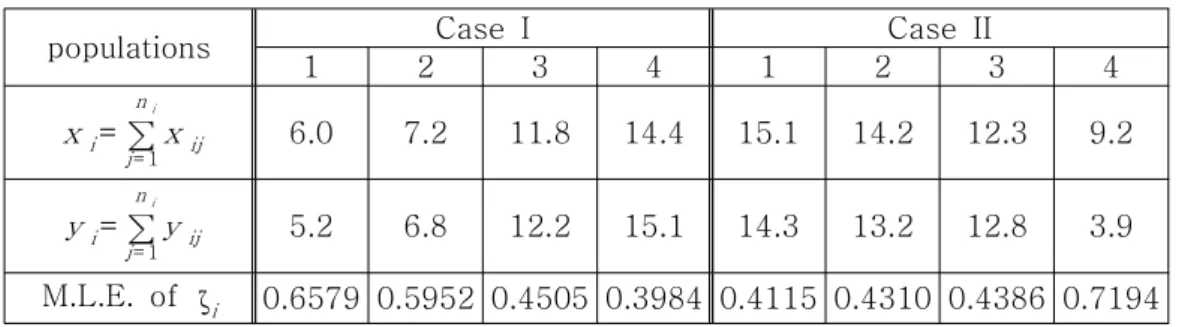
Here, we consider 4 bivariate exponential populations and sample size of 10 from each populations. In this paper, we consider multiple comparisons for two cases, so that true hypothesis are H true:ζ1= ζ2≠ζ3= ζ4 for case I and
H true:ζ1= ζ2= ζ3≠ζ4 for case II, respectively.
The observed summary statistics for each case are given as Table 1. And the numbers of possible hypothesis are 15 for each cases.
<Table 1> The observed summary statistics for each populations
populations Case I Case II
1 2 3 4 1 2 3 4
xi= ∑
ni
j= 1xij 6.0 7.2 11.8 14.4 15.1 14.2 12.3 9.2
yi=∑
ni j= 1
yij 5.2 6.8 12.2 15.1 14.3 13.2 12.8 3.9 M.L.E. of ζi 0.6579 0.5952 0.4505 0.3984 0.4115 0.4310 0.4386 0.7194
Table 2 gives the calculated posterior probabilities for all possible hypotheses based on FBF of case I and case II, respectively.
<Table 2> Calculated posterior probabilities for each cases based on FBF Hypothesis
Hypothesis Hypothesis
Hypothesis Case ICase ICase ICase I Case IICase IICase IICase II ζ1= ζ2= ζ3= ζ4 0.0617 0.0460 ζ1= ζ2= ζ3≠ζ4 0.1054 0.46830.46830.46830.4683 ζ1= ζ2= ζ4≠ζ3 0.0111 0.0091 ζ1= ζ2≠ζ3= ζ4 0.58650.58650.58650.5865 0.0429 ζ1= ζ2≠ζ3≠ζ4 0.1014 0.0945 ζ1= ζ3= ζ4≠ζ2 0.0102 0.0134 ζ1= ζ3≠ζ2= ζ4 0.0077 0.0281 ζ1= ζ3≠ζ2≠ζ4 0.0069 0.1035 ζ1= ζ4≠ζ2= ζ3 0.0055 0.0181 ζ1= ζ4≠ζ2≠ζ3 0.0013 0.0028 ζ1≠ζ2= ζ3= ζ4 0.0433 0.0216 ζ1≠ζ2= ζ3≠ζ4 0.0202 0.1196 ζ1≠ζ2= ζ4≠ζ3 0.0054 0.0050 ζ1≠ζ2≠ζ3= ζ4 0.0284 0.0084 ζ1≠ζ2≠ζ3≠ζ4 0.0049 0.0186
For case I, it is evident that the hypotheses for ζ1= ζ2≠ζ3= ζ4 has the most large posterior probabilities 0.5865. This suggests that the data lend
greatest support to equalities for ζ1=ζ2 and ζ3=ζ4 being different from the others. Thus this example shows good performance of the Bayesian multiple comparisons method based on FBF.
For case II, it is evident that the hypotheses for ζ1= ζ2= ζ3≠ζ4 has the most large posterior probabilities 0.4683. This suggests that the data lend greatest support to equalities for ζ1= ζ2= ζ3 and ζ4 being different from the others. Also this example shows good performance of the Bayesian multiple comparisons method based on FBF.
Up to this point, we have considered the problem of developing a Bayesian multiple comparisons for dependence parameter in K bivariate exponential populations. Extension of the above approach to the multiple comparison problems for the another population is straightforward. The research topics pertaining to the extension of the method and the examination of its performance are worthy to study and are left as a future subject of research.
References References References References
1. Ali, M.M., Cho, J.S. and Begum, M.(2005), Nonparametric Bayesian Multiple Comparisons for Geometric Populations, Journal of the Korean Data & Information Science Society, Vol. 16(4), 1129-1140.
2. Berge, C.(1971), Principle of Combinatorics , New York: Academic Press.
3. Berger, J. O. and Pericchi, L. R.(1996), The Intrinsic Bayes Factor for Model Selection and Prediction, Journal of the American Statistical Association, 91, 109-122.
4. Consonni, G. and Veronese, P.(1995), A Bayesian Method for Combining Results from Several Binomial Experiments, Journal of the American Statistical Association, 90, 935-944.
5. Fienberg, S. E.(1980). The Analysis of Cross-Classified Categrical Data, Cambridge, MA: The MIT Press.
6. Lee, I.S., Cho, J.S., Kang, S.G. and Ko, J.H.(1998), Bayes Computations for the Reliability in a Bivariate Expnential Model, The Korean
Communications in Statistics, 5(1), 145-153.
7. O' Hagan, A.(1995), Fractional Bayes Factors for Model Comparison(with discussion), Journal of Royal Statistical Society, 56, 99-118.
[ received date : Apr. 2006, accepted date : May. 2006 ]