*Corresponding author: Kyung-Taek Rim, Tel: +82-42-869-0345, E-mail: [email protected], Chemicals Safety and Health Center, Occupational Safety and Health Research Institute, Korea Occupational Safety and Health Agency, #339-30 Expo-ro, Yuseong-gu, Daejeon, 305-380, Korea Received: February 17, 2014, Revised: June 2, 2014, Accepted: June 11, 2014
This is an Open-Access article distributed under the terms of the Creative Commons Attribution Non-Commercial License (http://creativecommons.org/licenses/by-nc/3.0) which permits unrestricted non-commercial use, distribution, and reproduction in any medium, provided the original work is properly cited.
http://dx.doi.org/10.15269/JKSOEH.2014.24.2.160
근로자의 건강보호를 위한
알릴 염화물의 포유류 배양세포 염색체이상시험
임경택*․김수진
한국산업안전보건공단 산업안전보건연구원
In Vitro Mammalian Chromosomal Aberration Test of Allyl Chloride for Workers’ Health
Kyung-Taek Rim*․Soo-Jin Kim Occupational Safety and Health Research Institute, Korea Occupational Safety and Health Agency, Daejeon, Korea
ABSTRACT
Objectives: Chemical hazard evaluations are important for workers’ health and working environments. Allyl chloride (CAS No.
107-05-1) is used in many industries, leading to concerns about the possibility of threats to the health of workers. Since only insufficient or controversial information is available about potential related hazards, an in vitro mammalian chromosomal aberration (CA) assay was conducted in order to gain additional information concerning any such hazards. Moreover, toxicological information from this study could be applied for workers’ rights to know, and to prepare or update the Materials Safety Data Sheet (MSDS) for a number of industries.
Methods and Results: The assay was performed using the Chinese hamster lung fibroblast cell (ATCC, CRL-1935), by the direct method (-S9) and by the metabolic activated method (+S9 mix). Using the direct method, the seven dosages in the 48-hour treatment group did not show that the frequency of CA is proportionate to the dosage. The frequency of CA is not proportionate to the dosage addition for a six-hour treatment using the metabolic activated method.
Conclusions: From these findings, it was decided that this chemical does not induce chromosomal aberrations under the tested conditions.
Key words : Allyl chloride, Chromosomal aberration, in vitro, Chinese hamster lung fibroblast
Ⅰ. Introduction
The necessity of chemical hazard evaluation has increased, because the frequency of chemical exposure for workers is increasing as the chemical related industries have been developed. Many chemicals that are used in industry represent current concerns since they may pose genotoxicity for humans, and also have become widespread as environmental pollutants, thus
leading to concerns about a variety of chemicals that possibly threaten the health of workers. In this respect, the evaluation and regulation of chemical hazards are important to workers’ health and their working environment.
The major use of allyl chloride(CAS No. 107-05-1) is in the synthesis of allyl compounds(O’Neil, 2001), synthesis of intermediates for manufacture of polymers, resins, and plastics(ILO, 1983), thermosetting resins for
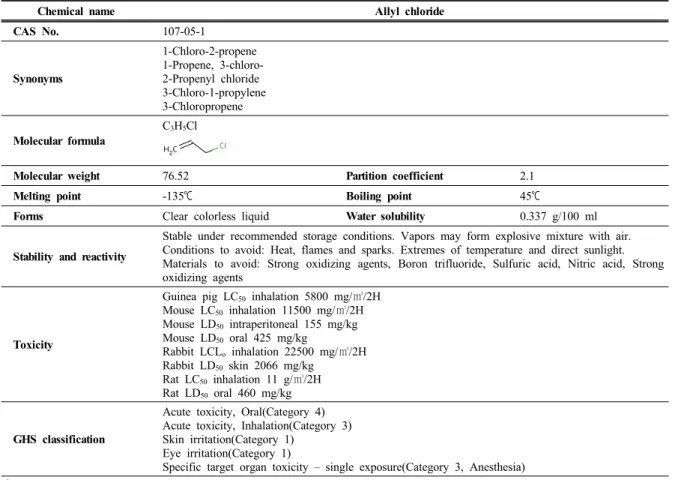
Chemical name Allyl chloride
CAS No. 107-05-1
Synonyms
1-Chloro-2-propene 1-Propene, 3-chloro- 2-Propenyl chloride 3-Chloro-1-propylene 3-Chloropropene
Molecular formula
C3H5Cl
Molecular weight 76.52 Partition coefficient 2.1
Melting point -135℃ Boiling point 45℃
Forms Clear colorless liquid Water solubility 0.337 g/100 ml
Stability and reactivity
Stable under recommended storage conditions. Vapors may form explosive mixture with air.
Conditions to avoid: Heat, flames and sparks. Extremes of temperature and direct sunlight.
Materials to avoid: Strong oxidizing agents, Boron trifluoride, Sulfuric acid, Nitric acid, Strong oxidizing agents
Toxicity
Guinea pig LC50 inhalation 5800 mg/㎥/2H Mouse LC50 inhalation 11500 mg/㎥/2H Mouse LD50 intraperitoneal 155 mg/kg Mouse LD50 oral 425 mg/kg
Rabbit LCLo inhalation 22500 mg/㎥/2H Rabbit LD50 skin 2066 mg/kg
Rat LC50 inhalation 11 g/㎥/2H Rat LD50 oral 460 mg/kg
GHS classification
Acute toxicity, Oral(Category 4) Acute toxicity, Inhalation(Category 3) Skin irritation(Category 1)
Eye irritation(Category 1)
Specific target organ toxicity – single exposure(Category 3, Anesthesia)
*Mostly referred from the information in ChemIDplus Advanced(http://chem.sis.nlm.nih.gov/chemidplus/rn/107-05-1) and material safety data sheet information in the webpage of Sigma-Aldrich(http://www.sigmaaldrich.com/MSDS/MSDS).
†Searches were conducted using keywords chemical name AND/OR CAS number.
Table 1. Physicochemical and toxicological information of allyl chloride
varnishes, plastics, adhesives; synthesis of pharmaceuticals & insecticides(Hawley, 1977). This chemical is listed as a High Production Volume(HPV) chemical(65FR81686). Chemicals listed as HPV were produced in or imported into the U.S. in >1 million pounds in 1990 and/or 1994. The HPV list is based on the 1990 Inventory Update Rule(IUR)(40 CFR part 710 subpart B; 51FR21438)(EPA, 2005).
With probable routes of human exposure, the National Institute for Occupational Safety and Health (NIOSH; NOES Survey 1981-1983) has statistically estimated that 3,195 workers(325 of these are female) are potentially exposed to allyl chloride in the US.
The occupational exposure to allyl chloride may occur through inhalation and dermal contact with this
compound at workplaces where allyl chloride is produced or used(NIOSH, 2005).
With references, the genotoxic results have been reported for studies on rat dominant lethal; mouse sperm head morphology; drosophila sex-linked recessive lethal; in vitro unscheduled DNA synthesis (UDS) in human fibroblasts; and rat bone marrow cytology studies, all of which were negative(ACGIH, 2001). Investigators tested this chemical for its ability to induce gene mutations in prokaryotic and eukaryotic microorganisms. The Salmonella reversion test with strains TA1535 and TA100(with and without activation), a forward and back mutation system in Streptomyces coelicolor and two forward mutation systems in Aspergillus nidulans were used. The spot
and plate incorporation assay techniques were employed. It was active in S. typhimurium and S.
coelicolor and negative in A. nidulans(ACGIH, 2001).
This chemical caused DNA damage in bacteria, was mutagenic to bacteria and fungi and induced gene conversion in yeast. It can bind to isolated DNA, although it is a weak alkylating agent. Five alkylated bases have been identified: N3-allyladenine, N6- allyladenine, N2-allylguanine, N7-allylguanine and O6-allylguanine(IARC, 1999). This chemical was investigated for its ability to induce UDS in HeLa cells and mutations in the Ames test. The effective dose range of UDS induction was rated according to the lowest dose at which UDS occurred. It required a relatively high dose of 0.001 mol/L to induce UDS(ACGIH, 2001).
The intensive physicochemical and toxicological information of allyl chloride are shown in table 1.
In this report, the chromosomal aberration assay, conducted using mammalian cells, is frequently used to evaluate the genotoxicity of chemicals and has been adopted as an index of genotoxicity worldwide. It is also utilized as a screening probe for the detection of possible carcinogenic substances. Despite increased use of this chemical, the available gentoxicity data for this chemical is still controversial, so this study is believed to be the first one in which chromosomal aberration test with cultured Chinese hamster lung fibroblast cell line. It should also help to investigate the underlying mechanism and the carcinogenicity on this chemical, could applicative for workers’ health.
Ⅱ. Materials and Methods
1. Cells and chemicals
The cultivated CHL/IU(Chinese hamster lung fibroblast) cells used in this test were obtained from the American type culture collection(CRL-1935, Koram Biotech Corp., Seoul, Korea). Cells were cultured in MEM medium(GIBCO BRL, NY, USA, Lot No.
1031725) with 5% CO2 at 37℃, and sub-cultured every
2~4 days.
Dimethylsulfoxide(DMSO, Sigma-Aldrich, 99.5%, MO, USA, Lot No. SHBC6530V) was used as a negative control for allyl chloride(Sigma-Aldrich, MO, USA, Lot No. STBB8008V) as a solvent according to the result of solubility test. Mitomycin C(MMC)(Sigma-Aldrich, MO, USA, Lot No. 049K0788) and cyclophosphamide (CPA)(Sigma-Aldrich, MO, USA, 98.2%, Lot No.
120M1253V) were used as positive controls. For the metabolic activated system, the S9(MOLTOXTM, Maryland, USA, Lot No. 3015) was used within 6 months after manufacture.
2. In vitro mammalian chromosomal aberration test This study was performed according to OECD guidelines for the testing of chemicals(OECD, 1997) and Ishidate(1985)’s report. For the cell proliferation suppression test, 7 dosages of test chemical(0.039, 0.078, 0.15, 0.3125, 0.625, 1.25 and 2.5 mM allyl chloride) were used.
The direct method(24 and 48 hour treatment) without a co-factor supplemented post-mitochondrial fraction(S9), the CHL/IU cells were cultured for 3 days from aliquot of 2x10⁴~4x10⁴ cells, in a 60 mm diameter plate. With metabolic activated method(6 hour treatment), the most commonly used system is a co-factor supplemented post-mitochondrial fraction(S9) prepared from the livers of rodents treated with enzyme-inducing agents such as Aroclor 1254, or a combination of phenobarbitone and β-naphthoflavone.
In the metabolic activated method, the cells were cultured using conditions identical to the direct method. Slides for observation of chromosomal samples were made from 5 mL media aliquots, with 18 hour supplementary culture, after removal and washing of the cell layer with 5 mL fresh media.
The main test was performed using dosages established by the cell proliferation suppression/
preliminary test. After 24 and 48 hours of exposure to test chemicals, plates were treated with 0.2 μg/mL Colcemid®(GIBCO BRL, NY, USA, Lot No.
Direct(-S9)
Dose(mM) Growth rate(%)
24 hr treat 48 hr treat
0(control solvent) 100.00 100.00
0.039 71.65 108.00
0.078 76.32 69.87
0.15 83.51 81.08
0.3125 71.07 69.51
0.625 70.09 91.18
1.25 75.47 76.34
2.5 102.06 78.97
5 - -
10 - -
Metabolic activated(+S9)
Dose(mM) Growth rate(%) with 6 hr treat
0(control solvent) 100.00
0.039 98.86
0.078 140.67
0.15 88.11
0.3125 86.20
0.625 87.63
1.25 105.07
2.5 85.93
5 -
10 -
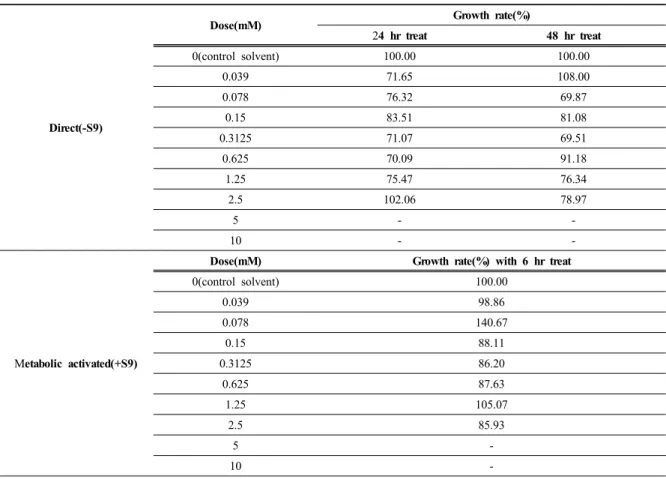
Table 2. Summary of growth inhibition study
15212-012). After 2 hours, the metaphase cells were separated and centrifuged at 1,000 rpm for 5 min.
The chromosome samples were produced by fixing(3x) with the Carnoy’s solution(acetic acid:
ethanol = 1:3) and abnormalities were counted after 5 min of staining with 5% Giemsa solution(Merck, NJ, USA, Lot No. 1.09204.0100). Two samples were made from each plate.
Two hundred metaphase cells(1,000 cells/plate) were observed per plate and classified according to structural abnormalities(gap of chromatid or chromosome;g, cutting of chromatid;ctb, exchange of chromatid; cte, cutting of chromosome; csb, exchange of chromosome;
cse and others) and numerical abnormalities(pol).
According the OECD test guideline and governmental GLP notice(NIER, 2013) for chemical hazard assessment, it evaluated as “positive” only when the
percentage of chromosomal aberrations was >10%.
However, the retest was performed in case that it was not confirmed the dosage dependency and the ratio of chromosomal aberration was unusually high in control solvent.
Ⅲ. Results
1. Test for suppression of cell proliferation
The ratios of cell proliferation for the dosages of allyl chloride were 71.65%, 76.32%, 83.51%, 71.07%, 70.09%, 75.47% and 10.06% at 0.039 mM, 0.078 mM, 0.15 mM, 0.3125 mM, 0.625 mM, 1.25 mM and 2.5 mM respectively, for a 24 hour treatment using the direct method. Moreover cell proliferation ratios were 108.00%, 69.87%, 81.08%, 69.51%, 91.18%, 76.34% and 78.97% at 0.039 mM, 0.078 mM, 0.15
Treatment Time of treatment(hr)
Conc. of treatment(mM)
Obs.
Cell No.
No. of diploid
No. of chromosomal structure abnormality
Decision Gap Chromatid Chromosome
Etc. Total
g ctb cte csb cse -g +g
Control solvent
(DMSO) 24 0 200 0 0 0 0 0 0 0 0 0 Negative
Test material 24
0.04 200 0 0 0 0.5 0 0 0 0.5 0.5 Negative
0.09 200 0 0 0 0 0 0 0 0 0 Negative
0.18 200 0 1 0 0 0 0 0 0 1.0 Negative
0.37 200 0 0 0 0 0 0 0 0 0 Negative
0.75 200 0 0.5 0 0.5 0 0 0 0.5 1.0 Negative
1.5 200 0 1.5 0 0 0 1.0 0 1.0 2.5 Negative
3 200 0 1.5 0 2.5 0 0.5 0 3.0 4.5 Negative
Positive control
(MMC) 24 0.0004
(mg/mL) 200 0 9.5 5 39.5 0 1.0 0 45.5 55.0 Positive
*Conc.: concentration, Obs.: observed, No.: number, g: gap, ctb: chromatid break, cte: chromatid exchange, csb: chromosome break, cse: chromosome exchange, DMSO: dimethyl sulfoxide, MMC: mitomycin C.
†-: negative, +: positive, -g: without gap, +g: with gap.
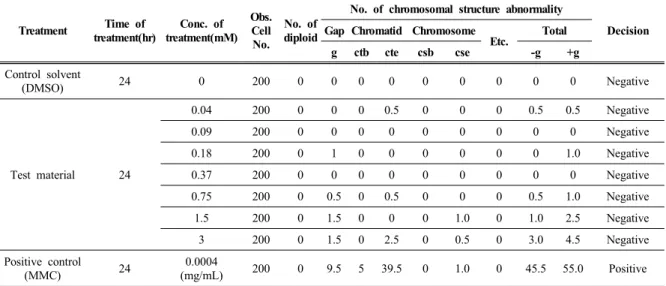
Table 3. Chromosomal aberration test(direct method, 24 hr treatment) with allyl chloride
mM, 0.3125 mM, 0.625 mM, 1.25 mM and 2.5 mM respectively, for a 48 hour treatment. For the direct method, it was conformed to the guideline of GLP(NIER, 2013) that the maximum concentration is 3 mM in case of the cellular toxicity not being recognized.
Cell proliferation ratios were 98.86%, 140.67%, 88.11%, 86.20%, 87.63%, 105.07%, 85.93% at 0.039 mM, 0.078 mM, 0.15 mM, 0.3125 mM, 0.625 mM, 1.25 mM, and 2.5 mM for a 6 hour treatment using the metabolic activated method.
Summary of these tests are shown in table 2.
2. Chromosomal aberration test
Duplicate samples of 100 cells per plate were observed in metaphase and classified for structural abnormalities(gap of chromatid or chromosome;g, cutting of chromatid; ctb, exchange of chromatid;cte, cutting of chromosome; csb, exchange of chromosome; cse, etc) and numerical abnormalities (pol). Results were evaluated as being positive only when the percentage of chromosomal aberrations was
≥ 10%(≥ 20 abnormalities in 200 cells observed). A
statistical analysis of the results was not performed.
The ratios of chromosomal aberration using the direct method are shown in table 3 and 4. No diploid presence was observed at any concentration both 24 and 48 hour treatment. The structural chromosomal aberrations were < 5.0% in both without gap(-gap) and with gap(+gap) groups. No dependency between chromosomal aberrations and dosages was observed.
The ratios of chromosomal aberration using the metabolic activated method are shown in table 5. All results were the same as the direct method. It was shown that this chemical does not induce any chromosomal aberrations, using either the direct method(24 hour and 48 hour treatment) or the metabolic activated method(6 hour treatment) in CHL cells.
Ⅳ. Discussion
Since insufficient or controversial information was available about the potential hazards of allyl chloride, this in vitro chromosomal aberration assay with CHL fibroblast cells was conducted. Moreover, toxicological
Treatment Time of treatment(hr)
Conc. of treatment(mM)
Obs.
Cell No.
No. of diploid
No. of chromosomal structure abnormality
Decision Gap Chromatid Chromosome
Etc. Total
g ctb cte csb cse -g +g
Control solvent
(DMSO) 48 0 200 0 1.5 0 0 1.0 0 0 1.0 2.5 Negative
Test material 48
0.04 200 0 0 0 1.0 0 0 0 1.0 1.0 Negative
0.09 200 0 0 0 0 0 0 0 0 0 Negative
0.18 200 0 1.0 0 1.0 0 0 0 0.5 1.0 Negative
0.37 200 0 0 0 1.0 0 0 0 1.0 1.0 Negative
0.75 200 0 0 0 0 0 0 0 0 0 Negative
1.5 200 0 1.5 0 0 0 0 0 1.0 1.5 Negative
3 200 0 1.0 0.5 0.5 0 0 0 1.0 2.0 Negative
Positive control
(MMC) 48 0.0004
(mg/mL) 200 0 13.5 17.0 24.5 0 0 0 41.5 55.0 Positive
*Conc.: concentration, Obs.: observed, No.: number, g: gap, ctb: chromatid break, cte: chromatid exchange, csb: chromosome break, cse: chromosome exchange, DMSO: dimethyl sulfoxide, MMC: mitomycin C.
†-: negative, +: positive, -g: without gap, +g: with gap.
Table 5. Chromosomal aberration test(metabolic activated method, 6 hr treatment) with allyl chloride
Treatment Time of treatment(hr)
Conc. of treatment(mM)
Obs.
Cell No.
No. of diploid
No. of chromosomal structure abnormality
Decision Gap Chromatid Chromosome
Etc. Total
g ctb cte csb cse -g +g
Control solvent
(DMSO) 24
(6+18) 0 200 0 0 0 0 0 0 0 0 0 Negative
Test material 24 (6+18)
0.04 200 0 0 0 0 0 0 0 0 0 Negative
0.09 200 0 0 0 0 0 0 0 0 0 Negative
0.18 200 0 0 0 0 0 0 0 0 0 Negative
0.37 200 0 0 0 0 0 0 0 0 0 Negative
0.75 200 0 0 0 0 0 0 0 0 0 Negative
1.5 200 0 0 0 0 0 0 0 0 0 Negative
3 200 0 0 0 1.5 0 1.0 0 2.5 2.5 Negative
Positive control
(CPA) 24
(6+18) 0.0004
(mg/mL) 200 0 10.0 12.0 28.5 0 0 0 40.5 50.5 Positive
*Conc.: concentration, Obs.: observed, No.: number, g: gap, ctb: chromatid break, cte: chromatid exchange, csb: chromosome break, cse: chromosome exchange, DMSO: dimethyl sulfoxide, CPA: cyclophosphamide.
†-: negative, +: positive, -g: without gap, +g: with gap.
Table 4. Chromosomal aberration test(direct method, 48 hr treatment) with allyl chloride
information from this study could be used for workers’ right to know, and to prepare or update the Materials Safety Data Sheet(MSDS) in many chemical related industries.
In epidemiological studies, twenty-six subjects in one factory were exposed to allyl chloride at levels of
2.6 to 6650 mg/㎥(0.83 to 2127 ppm) for 2.5 months to 6 years; in another factory, twenty-seven subjects were exposed at 0.2 to 25.13 mg/㎥(0.06 to 8.03 ppm) for periods of 1 to 4.5 years. Most workers in the first factory had weakness, paresthesia, and numbness in the extremities. Similar symptom of workers in the
second factory were much milder; there were few abnormal neurological signs. Evidence obtained indicated chronic allyl chloride exposure caused toxic polyneuropathy(ACGIH, 2001).
This study was conducted because insufficient information was available about the potential hazards of allyl chloride. We are performed in vitro chromosomal aberration study with direct method and metabolic activated method, and it is concluded that the allyl chloride is not a mutagen with these test conditions. This chromosomal aberration test is used to screen for possible mammalian mutagens or carcinogens. Most of chemicals that are positive in this test are mammalian carcinogens; however, there is not a perfect correlation between this test and carcinogenicity. Correlation is dependent on chemical class and there is increasing evidence that there are carcinogens that are not detected by this test, because they appear to act through mechanisms other than direct DNA damage.
According to OECD GLP guideline, the Chinese hamster lung(CHL/IU) cell line is routinely used, and performed the cell proliferation test, pre-test and main test with both direct and metabolic activated method.
For the justification of dose level, we judged according to the results of cell proliferation study, if cytotoxicity is evident, the high dose in the main study for short time treatment with and without metabolic activation, and continuous treatment without metabolic activation are selected as calculated inhibitory concentration(IC50) and sequentially diluted by a geometric ratio of 2 to produce 3 additional lower dose levels. The positive and negative control groups are also used. If cytotoxicity is not evident, the high dose in the main study for short time treatment with and without metabolic activation and continuous treatment without metabolic activation are selected and sequentially diluted by a geometric ratio of 2 to produce the additional lower dose levels.
Allyl chloride is classified with possible human carcinogen. This classification is based on a low(but
biologically important) incidence of forestomach tumors in female mice and positive results in a variety of genetic toxicity tests. None has the human carcinogenicity data, limited animal carcinogenicity data(EPA, 2000). Since there is inadequate evidence in humans for the carcinogenicity, and inadequate evidence in experimental animals for the carcinogenicity, so it is not classifiable as to its carcinogenicity to humans(Group 3)(IARC, 1999). It is also classified to A3, a confirmed animal carcinogen with unknown relevance to humans(ACGIH, 2008).
A bioassay for possible carcinogenicity of technical grade allyl chloride was conducted using Osborne-Mendel rats and B6C3F1 mice(NIH, 1978).
Under the conditions of this bioassay, no evidence of carcinogenicity was noted for allyl chloride in Osborne-Mendel rats of either sex. The results are suggestive that allyl chloride is carcinogenic in male and female B6C3F1 mice since the chemical when administered by gavage, caused a low incidence of neoplastic and nonneoplastic lesions of the forestomach.
With chronic toxicity or carcinogenicity, in course of 8 months repeated oral doses of 0.015 mg/kg/day did not lead to morphological changes or other effects in rats(Bingham et al., 2001). Allyl chloride was tested for carcinogenicity by gavage in mice and rats, by skin application in mice, both by repeated application and in a two-stage assay, and by intraperitoneal injection in mice. Following its oral administration to mice in an experiment that was compromised by high mortality in males, a nonsignificant increase in the incidence of squamous cell papillomas and carcinomas of the forestomach was observed in both sexes. No skin tumours were observed in mice following repeated skin applications. Following intraperitoneal injection in strain A mice, there was a marginal increase in the multiplicity of lung adenomas(IARC, 1999).
To summarize the results of the above, for protect the workers’ health, it must maintain good ventilation, working in fume hood or with closed system if possible;
otherwise, use enough ventilation so that the odor of allyl
chloride does not persist(Lewis, 1996). Also it must wear appropriate personal protective clothing and eye protection. Facilities for quickly drenching the body should be provided within the immediate work area for emergency use where there is a possibility of exposure.
Respirator is recommended up to 50 ppm, with any self-contained breathing apparatus with a full facepiece, any supplied-air respirator with a full facepiece(NIOSH, 2003).
Workers should immediately wash the skin when it becomes contaminated, and work clothing that becomes wet should be immediately removed due to its flammability(NIOSH, 2003). If in eyes, first rinse with plenty of water for several minutes(remove contact lenses if easily possible), then take to a doctor, and if also ingested, it must rinse mouth, give a slurry of activated charcoal in water to drink, give plenty of water to drink, refer for medical attention(IPCS, 2005). For the protection from physical damage, it must store in cool, dry, well-ventilated location away from any area where fire hazard may be acute. Outside or detached storage is preferred, and it must separate from oxidizing materials(NFPA, 2002).
Ⅴ. Conclusion
Despite large amounts of allyl chloride being used, the available genotoxicity data for this chemical remains controversial. This study is believed to be the first involving a chromosomal aberration test with a cultured Chinese hamster lung fibroblast cell line. In conclusion, the test substance allyl chloride did not show any evidence of inducing chromosomal aberrations in Chinese hamster lung (CHL/IU) cells under the conditions of this study.
This study should help to improve the testing of this chemical by commonly-used genotoxicity testing methods as well as investigations on the underlying mechanisms and the interpretation of genotoxicity data on this hazardous chemical and could be applicable for workers’ health.
References
American Conference of Governmental Industrial Hygienists(ACGIH). Documentation of threshold limit values for chemical substances and physical agents and biological exposure indices. Ohio: 2001, p. 4
American Conference of Governmental Industrial Hygienists(ACGIH). TLVs and BEIs. Threshold limit values for chemical substances and physical agents and biological exposure indices. Ohio: 2008, p. 11
Bingham E, Cohrssen B, Powell CH. Patty's Toxicology Volumes 1-9 5th ed. New York: John Wiley & Sons.
Inc.; 2001. p. 225
Environmental Protection Agency(EPA). U.S.
Environmental Protection Agency's Integrated Risk Information System(IRIS). Summary on allyl chloride(107-05-1) [serial online] 2000 March [cited 2014 Feb]; Available from: URL:http://www.
epa.gov/iris/
Environmental Protection Agency(EPA). Office of Pollution Prevention and Toxics; High Production Volume(HPV) challenge program. 1-Propene, 3- chloro-(107-05-1). [serial online] 2005 Dec [cited 2014 Feb]; Available from: URL:http://www.epa.gov/
hpv/pubs/general/opptsrch.htm
Hawley GG. The condensed chemical dictionary. 9th ed.
New York: Van Nostrand Reinhold Co.; 1977. p. 29 International Agency for Research on Cancer(IARC).
Monographs on the evaluation of the carcinogenic risk of chemicals to man. Geneva: World Health Organization, International Agency for Research on Cancer, 1972-PRESENT.(Multivolume work). [serial online] 1999 [cited 2014 Feb]; Available from:
URL:http://monographs.iarc.fr/index.php p. V71 1236 (1999)
International Labour Office(ILO). Encyclopedia of occupational health and safety. Vols. I&II. Geneva, Switzerland: 1983. p. 128
International Programme on Chemical Safety(IPCS), CEC; International chemical safety card on allyl chloride. [serial online] 2005 July [cited 2014 Feb];
Available from: URL:http://www.inchem.org/
documents/icsc/icsc/eics0010.htm
Ishidate M Jr, Sofuni T. The in vitro chromosomal aberration test using Chinese hamster lung(CHL) fibroblast cells in culture. In: Ashby J, editor.
Progress in mutation research. 1985;5:427-32
Lewis RJ. Sax's Dangerous properties of industrial materials, 9th ed. Volumes 1-3. New York: Van Nostrand Reinhold Co.; 1996. p. 96
National Institute of Environmental Research(NIER). GLP notice No. 2013-1 for hazard assessment with chemicals in environment. Incheon, Korea: Ministry of Environment; 2013
National Institutes of Health(NIH). Bioassay of allyl chloride for possible carcinogenicity(Date) technical report series No. 73 DHEW Pub No. 78-1323.
Maryland: U.S. Department of Health Education and Welfare, National Cancer Institute; 1978
National Fire Protection Association(NFPA). Fire protection guide to hazardous materials. 13 ed.
Quincy, MA:, 2002. p. 49-15
National Institute for Occupational Safety and Health (NIOSH). International safety cards. Allyl chloride.
107-05-1. [serial online] 2005 July [cited 2014 Feb]; Available from: URL:http//www.cdc.gov/
niosh/ipcs/nicstart.html
National Institute for Occupational Safety and Health(NIOSH). NIOSH Pocket guide to chemical hazards & other databases CD-ROM. Department of Health & Human Services, Centers for Disease Prevention & Control. DHHS(NIOSH) Publication No. 2004-103.; 2003.
O'Neil MJ. The Merck index - An encyclopedia of chemicals, drugs, and biologicals. 13th Edition, Whitehouse Station, Merck and Co. Inc., New Jersey: 2001. p. 54
Organization for Economic Co-operation and Development (OECD). Test No. 473: In vitro mammalian chromosome aberration test. OECD Guidelines for the testing of chemicals. Paris, France: 1997;
1:1-10.