• 검색 결과가 없습니다.

Gender differences in the relationship between adiposity and systolic inter-arm blood pressure difference in Korea adults

N/A
N/A
Protected

Academic year: 2021

Share "Gender differences in the relationship between adiposity and systolic inter-arm blood pressure difference in Korea adults"

Copied!
8
0
0

로드 중.... (전체 텍스트 보기)

전체 글

(1)

Gender differences in the relationship between adiposity and systolic inter-arm blood pressure difference in Korea adults

1)ㅎㅎㅈㅎ

Gwang-Seok Kim*

Abstract

The present study was conducted to assess gender differences in the relationship between adiposity and systolic inter-arm blood pressure difference (sIAD) in Korean adults. In this paper, we propose a 410 adults (235 men and 175 women) who were over 30 years old and had undergone a health check participated from June to November 2013. The incidences of high sIAD (sIAD ≥10 mmHg) in males and females were 24.6% and 15.3%, respectively. We conducted a logistic regression analysis after adjusting for variables such as age, smoking, drinking, exercising, TC, TG, HDL-C, and FPG. Key study results were as follows: First, in men, the odds ratio (OR) of high sIAD of the obesity group was significantly higher than that of the normal weight group [2.25 (95% confidence interval (CI), 1.19–4.25)], but abdominal obesity was not associated with high sIAD. Second, in women, the OR of high sIAD of the abdominal obesity group was significantly higher than that of the non-abdominal obesity group [2.52 (95% CI, 1.03–6.13)], but obesity status was not associated with high sIAD. In conclusion, Obesity is associated with the incidence of high sIAD in Korean men, and abdominal obesity is associated with the incidence of high sIAD in Korean women.

▸Keyword : inter-arm blood pressure difference,adiposity,obesity,abdominal obesity,gender differences

I. Introduction

Obesity is one of the most important public health problems due to its association with many chronic diseases, such as cardiovascular disease, hypertension,

diabetes mellitus, and dyslipidemia[1-4]. In addition, abdominal obesity has consistently been shown to be

related to the increased risk of cardiovascular disease, such as peripheral vascular disease, hypertension, and insulin resistance[5-8].

The systolic inter-arm blood pressure difference (sIAD) is found in normal people by examining the

∙First Author: Gwang-Seok Kim, Corresponding Author: Gwang-Seok Kim

*Gwang-Seok Kim([email protected]), Dept. of Emergency Medical Technology, Chungbuk Health & Science University

∙Received: 2016. 10. 25, Revised: 2016. 11. 02, Accepted: 2016. 11. 11.

(2)

anatomical and hemodynamic structure of the aorta[9,10].

In healthy adults, the sIAD is usually less than 10 mmHg[11]. However, if the sIAD measures more than 10 mmHg, the arteries beneath the clavicle might be narrow or blocked, and due to this, the risks of peripheral arterial disease, cerebrovascular disease, and cardiovascular disease are increased[12,13]. Recently, research on sIAD and risk factors of cardiovascular disease has been conducted all over the world. However, the majority of the research has been conducted in subjects with diseases such as diabetes mellitus, and little research has been conducted on Korean adults.

Therefore, the present study aimed to investigate the gender differences in the relationship between sIAD and adiposity (obesity and abdominal obesity) in Korean adults.

II. Materials and methods

1. Study population

In this study, 532 adults who were over 30 years old and had underwent check-up at health check center of Gwangju between June to November in 2013. We excluded 122 subjects whose data were missing important analytic variables, such as various blood chemistry tests (85 subjects) or both blood pressures (37 subjects). 410 subjects (235 men and 175 women) included in the analyses.

2. Data collection

The participants were given a written consent form explaining that they could autonomously participate in the study, they could withdraw from it anytime, the results from questionnaire and health check would be used for research only and anonymity was guaranteed. The personal information was removed from the data to prevent identification of any individual in accordance with the privacy policy. Additionally, the Institutional Review Board (IRB) of Chosun University Hospital gave their approval for this study (IRB No. 2013-07-017-001).

General characteristics [gender, age, drinking, smoking, and exercise], physical measurements [height, weight,

body mass index (BMI), and waist circumstance measurement (WM)], blood chemistry test [total cholesterol (TC), triglycerides (TGs), high density lipoprotein cholesterol (HDL-C), and fasting plasma glucose (FPG)], and blood pressure (both systolic and diastolic blood pressures).

3. General characteristics of research subjects The health categories of the participants were classified into three parts: drinking, smoking and exercising. In the drinking category, the drinking group was classified that drink more than a glass of liquor per week, and the non-drinking group was classified that drink less than a glass of liquor per week. In the smoking category, participants who smoked more than one cigarette a day, those who previously smoked but do not presently smoke, and those who never smoked were classified into the current-smoking group, ex-smoking group and non-smoking group, respectively. In the exercising category, the exercising group was classified that exercising sweated more than 30 minutes per day, and the non-exercising group was classified that exercising sweated less than 30 minutes per day.

4. Blood test

The participants fasted from 10 PM before the test day. Blood sampling was performed after blood pressure measurement. Blood was collected from the right brachial veins and was analyzed for TC, TGs, HDL-C, and FPG using an automatic chemistry analyzer (Hitachi, Hitachi 7170, Japan).

5. Blood pressure measurement and sIAD The systolic and diastolic blood pressure were measured by a nurse using an automatic sphygmomanometer (AND, TM-2655P, Japan) after the participants rested for over 20 minutes. Blood pressures was measured twice on the right and left arm, and the average of the two values was calculated. To calculate the sIAD in SBP, we expressed it as the relative difference (right-arm SBP [R] minus left-arm SBP [L]:

R-L) and the absolute difference (|R-L|). High sIAD

group and normal sIAD group was classified sIAD ≥10

mmHg and sIAD <10 mmHg, respectively[13].

(3)

Variables Category Total (n=410) Males (n=235) Females (n=175) p

Age (years) 54.04±12.02 52.31±11.37 56.37±12.51 0.001

Smoking Non-smoker 294(71.7) 131(55.7) 163(93.1) <0.001

Ex-smoker 42(10.2) 39(16.6) 3(1.7)

Non-smoker 74(18.0) 65(27.7) 9(5.2)

Drinking Non-drinker 310(75.6) 166(70.6) 144(82.3) 0.007

Drinker 100(24.4) 69(29.4) 31(17.7)

Exercise No 319(77.8) 169(71.9) 150(85.7) 0.001

Yes 91(22.2) 66(28.1) 25(14.3)

BMI(㎏/㎡) < 25.0 232(56.6) 126(53.6) 106(60.6) 0.190

≥ 25.0 178(43.4) 109(46.4) 69(39.4)

WM(cm) Males <90 or

Females <80 cm 313(76.3) 193(82.1) 120(68.6) 0.001

Males ≥ 90 or

Females ≥ 80 cm 97(23.7) 42(17.9) 55(31.7)

High sIAD (mmHg) sIAD < 10 314(76.6) 171(72.8) 143(81.7) 0.034

sIAD ≥ 10 96(23.4) 64(27.2) 32(18.3)

sIAD (mmHg) 6.50±6.01 6.85±5.90 6.02±6.13 0.168

Rt-SBP (mmHg) 124.37±16.72 126.96±16.23 120.90±16.79 <0.001

Lt-SBP (mmHg) 122.06±16.65 125.00±16.04 118.12±16.68 <0.001

Rt-DBP (mmHg) 77.35±9.91 78.59±10.54 75.70±8.77 0.003

Lt-DBP (mmHg) 76.81±10.46 78.10±11.16 75.07±9.19 0.004

TC (㎎/㎗) 201.56±31.10 200.03±32.16 203.62±29.59 0.249

TGs (㎎/㎗) 129.95±77.70 138.13±80.16 119.97±73.06 0.013

HDL-C (㎎/㎗) 54.84±11.76 53.40±11.84 56.77±11.39 0.004

FPG (㎎/㎗) 106.22±27.22 107.25±26.22 104.84±28.52 0.376

Table 1 General characteristics of research subjects

n(%), Mean ± SD (n=410)

6. Adiposity

Participants removed their shoes and wore only the test gown while their height and weight were measured using height measuring instruments (CAS, RS-232C, Korea). The formula used for determining the BMI was:

BMI (kg/m

2

) = weight (kg)/height(m)

2

. Obesity status was classified as normal weight group [BMI <25.0 kg/m

2

]and obesity group [BMI ≥25.0 kg/m

2

][14]. The WM by a trained nurse using a tape measure with the patient in a vertical position of the participant. Abdominal obesity status was classified as non-abdominal obesity group (WM <90 cm in men or WM <80 cm in women) and abdominal obesity group (WM ≥90 cm in men or WM ≥ 80 cm in women)[15].

7. Data analysis

The collected data were statistically analyzed using SPSS WIN (ver. 18.0). The distributions of the participant characteristics were converted into percentages, and thsuccessive data were presented as averages with standard deviations. In men and women,

the differences of categorical and successive variables according to normal sIAD group (sIAD <10 mmHg) and high sIAD group (sIAD ≥10 mmHg) were analyzed using chi-squared and independent t-test. The average difference of the sIAD according to the abdominal obesity and obesity were calculated using independent t-test and an analysis of covariance (ANCOVA). In addition, a logistic regression analysis was performed on the odds ratio (OR) values of the high sIAD. The significance level for all of the statistical data was set as p<0.05.

III. Results

1. General characteristics of research subjects without diabetes mellitus

General characteristics of the research subjects are

(4)

Variables High sIAD (sIAD >10mmHg)

Non-adjusted OR (95%, CI) p High sIAD (sIAD >10mmHg)

* Adjusted OR (95%,CI) p

α Normal 1.00 1.00

β Obesity 2.06 (1.15-3.69) 0.015 2.25 (1.19-4.25) 0.012

γ Normal 1.00 1.00

δ Abdominal obesity 1.25 (0.60-2.59) 0.551 1.20 (0.56-2.59) 0.640

Variables High sIAD (sIAD >10mmHg)

Non-adjusted OR (95%, CI) p High sIAD (sIAD >10mmHg)

* Adjusted OR (95%,CI) p

α Normal 1.00 1.00

β Obesity 1.98 (0.92-4.30) 0.083 1.43 (0.61-3.38) 0.415

γ Normal 1.00 1.00

δ Abdominal obesity 3.68 (1.67-8.14) 0.001 2.52 (1.03-6.13) 0.043

Variables Category

sIAD

p Normal (n=143)

(< 10 mmHg)

High (n=32) (> 10 mmHg)

Age (years) 55.84±12.66 58.72±11.72 0.240

Smoking Non-smoker 136(95.1) 25(78.1) 0.009

Ex-smoker 3(2.1) 2(6.3)

Non-smoker 4(2.8) 5(15.6)

Drinking Non-drinker 118(82.5) 26(81.3) 0.865

Drinker 25(17.5) 6(18.7)

Exercise No 125(87.4) 25(78.1) 0.175

Yes 18(12.6) 7(21.9)

BMI (㎏/㎡) < 25.0 91(63.6) 15(46.9) 0.079

≥ 25.0 52(36.4) 17(53.1)

WM (cm) Males < 90 or Females

< 80 cm 106(74.1) 145(43.8) 0.001

Males ≥ 90 or Females

≥ 80 cm 37(25.9) 18(56.2)

sIAD (mmHg) 3.63±2.66 16.72±5.82 <0.001

Rt-SBP (mmHg) 118.18±14.72 133.03±20.11 <0.006

Lt-SBP (mmHg) 116.97±15.68 123.25±20.25 0.105

Rt-DBP (mmHg) 74.72±8.31 80.06±9.57 0.002

Lt-DBP (mmHg) 74.26±8.58 78.69±10.97 0.013

TC (㎎/㎗) 204.21±29.24 200.97±31.47 0.577

TGs (㎎/㎗) 112.80±65.16 146.53±97.73 0.018

HDL-C (㎎/㎗) 57.34±11.39 54.22±11.24 0.161

FPG (㎎/㎗) 102.50±29.12 115.31±23.32 0.021

Table 2. Characteristics of subjects according to normal and high sIAD in females

n (%), Mean±SD (n=175)

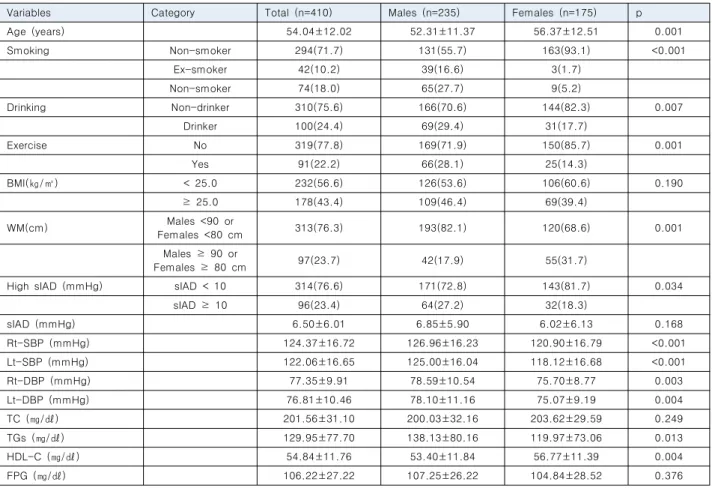
shown in Table 1. The mean value of sIAD was 6.50±6.01 mmHg, and the prevalence rate of high sIAD (sIAD ≥10 mmHg) was 96 (23.4%) of the 410 subjects (males, 235; females, 175). In men, the mean of age was 52.31±11.37 years. The prevalence rate of obesity and

abdominal obesity were 109 (46.4%) and 42 (17.9%), respectively. The mean value of sIAD was 6.85±5.90 mmHg, and the prevalence rate of high sIAD was 64 (27.2%). In women, the mean of age was 56.37±12.51 years.

Table 4 Comparison on ORs of highsIAD according to abdominal obesity andobesity status in males

(n=235)

* Adjusted for age, smoking, drinking, exercising, TC, TGs, HDL-C, and FPG

α Normal is defined asBMI < 25.0 ㎏/㎡, β Obesity is defined as BMI ≥ 25.0 ㎏/㎡, γ Normal is defined as WM<80 cm, δAbdominal obesity is defined as WM ≥ 80.

Table 5 Comparison on ORs of highsIAD according to abdominal obesity andobesity status in females

(n=175)

* Adjusted for age, smoking, drinking, exercising, TC, TGs, HDL-C, and FPG

α Normal is defined asBMI < 25.0 ㎏/㎡, β Obesity is defined as BMI ≥ 25.0 ㎏/㎡, γ Normal is defined as WM<80 cm,

δAbdominal obesity is defined as WM ≥ 80.

(5)

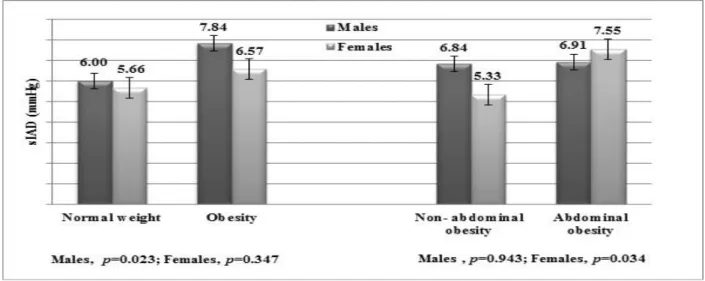
Fig. 1 Comparison on the mean of sIAD levels according to abdominal obesity and obesity status Comparison on the mean of sIAD levels according to obesity and abdominal obesity adjusted forage, smoking, drinking, exercising, TC, TGs, HDL-C, and FPG. ANCOVA was used to determine adjusted means.Normal weight: BMI

< 25.0 ㎏/㎡ ; Obesity: BMI ≥ 25.0 ㎏/㎡ ; Non-abdominal obesity: WM < 90 in malesor < 80 cmin females;

Abdominal obesity: WM ≥ 90 in males or ≥ 80 cmin females.

The prevalence rate of obesity and abdominal obesity were 69 (39.4%) and 55 (31.7%), respectively. The mean value of sIAD was 6.02±6.13 mmHg, and the prevalence rate of high sIAD was 32 (18.3%).

2. Characteristics of subjects according to normal and high sIAD

The results of comparison on characteristics of subjects according to normal and high sIAD are shown in Table 2 and 3. In men, the obesity status (p=0.051) and abdominal obesity (p=0.550) were not significant differences between high sIAD group and normal sIADgroup. In women, the abdominal obesity (p=0.001) was significant in differences between high sIAD group and normal sIAD group, but the obesity status (p=0.095) was not.

3. Comparison of sIAD levels according to obesity and abdominal obesity

Comparisons of sIAD levels according to abdominal obesity and obesity are shown in Figure 1. In males, after adjusting for age, smoking, drinking, exercising, TC, TGs, HDL-C, and FPG, sIAD levels was significantly higher (p=0.007) in obesity group (8.54±0.65 mmHg) and overweight group (5.78±0.77 mmHg) than the normal weight group (5.04±0.86 mmHg). However, sIAD levels was not significantly average difference (p=0.943) in abdominal obesity (6.86±0.93 mmHg) than the non-abdominal obesity group (6.85±0.43 mmHg). In

females, after adjusting for related variables, sIAD levels was significantly higher (p=0.034) in abdominal obesity (7.55±0.84 mmHg) than the non-abdominal obesity group (5.33±0.56 mmHg). However, sIAD levels was not significantly average difference (p=0.822) in obesity group (6.23±0.83 mmHg) and overweight group (6.36±0.96 mmHg) than the normal weight group (5.60±0.84 mmHg).

4. Comparisons of odds ratio of high sIAD according to adiposity

Comparisons of odds ratio (OR) of high sIAD according

to abdominal obesity and obesity status are shown in

Table 4. In men, after adjusting for age, smoking,

drinking, exercising, TC, TGs, HDL-C, and FPG, the OR

of high sIAD of the obesity group [2.395 (95% confidence

interval (CI), 1.088-5.269)] compared to the normal

weight group was significantly higher. However, the OR of

high sIAD of the abdominal obesity group [1.201 (95% CI,

0.558-2.585)] compared to the non-abdominal obesity

group was not significant. In women, after adjusting for

related variables, the OR of high sIAD of the abdominal

obesity group compared to the non-abdominal obesity

group [2.515 (95% CI, 1.032-6.132)] was significantly

higher. However, the OR of high sIAD of the overweight

[2.088 (95% CI, 0.627-6.960)] and obesity group [2.067

(95% CI, 0.714-5.983)] compared to the normal weight

group was not significant.

(6)

IV. Discussion

This study was performed to determine the gender differences in the relationship between adiposity and sIAD in Korean adults. There were several key findings of this study after adjustment for variables relevant to sIAD levels. In men, obesity was associated with increases in sIAD levels and the OR of high sIAD. On the other hand, in women, abdominal obesity was associated with increases in sIAD levels and the OR of high sIAD (Figure 1 and Table 4).

The prevalence of high sIAD (sIAD ≥10 mmHg) varies across ethnic groups and countries, and it tends to be higher in patients with diabetes mellitus and hypertension[16,17]. Inaddition, sIAD levels have been found to be associated with a significantly increased risk of future cardiovascular events[18]. The prevalence of of high sIAD (23.4%) in our result is higher than those reported by Su and colleagues[19] and Kim and colleagues[20], and is lower than that reported by Clark and colleagues[21], but is similar to that reported by Tak and colleagues[22]. In addition, it was similar to the result of a meta-analysis performed by Clack and colleagues[23]. In these results, the pooled prevalence of high sIAD from four studies was 19.6%. In their other study, they proposed that IAD might be caused by peripheral vascular disease, which is a strong predictor of cardiovascular disease[24]. The hypothesis that high sIAD reflects peripheral vascular disease and atherosclerosis has significant clinical implications[19,25].

It has been shown that high sIAD is associated with an increase of cardiovascular mortality[26,27]. Previous study suggested that high sIAD might represent hemodynamic differences caused by ongoing endothelial dysfunction and arterial stiffness[12]. Obesity and abdominal obesity are associated with the risk of cardiovascular disease directly or indirectly related to hypertension, hyperglycemia, and lipid metabolism disorders[28,29], and are consistent risk factors of metabolic syndrome that is an independent predictor of arterial stiffness and endothelial dysfunction[30-33].

The findings on the relationship between adiposity (obesity and abdominal obesity) and sIAD vary across ethnic groups, countries, and studies. Some studies reported that sIAD was not associated with obesity.

Espeland and colleagues reported that obesity was not

significantly associated with sIAD in subjects with diabetes (p=0.070)[34] and Seethalakshmi and colleagues reported that obesity was not significantly associated with high sIAD in healthy medical students (p=0.078)[35].

However, some studies reported that sIAD was associated with obesity.In the Framingham Heart Study, Weinberg and colleagues reported that an increased BMI level was significantly associated with high sIAD[20]. In a Chinese study with 1,120 subjects, Su and colleagues reported that BMI (per 1 kg/m

2

) was independently associated with high sIAD (OR, 1.112; 95%CI, 1.054–1.174; p<0.001)[21].

In the sample from the Baltimore Longitudinal Study of Aging, Canepa and colleagues reported that obesity (p<0.001) and abdominal obesity (p<0.001) were significantly associated with highs IAD[12]. On the other hand, Clack and colleagues reported that BMI was not significantly associated with high sIAD (p=0.23) but that the waist–hip ratio was significantly associated with high sIAD in subjects with diabetes (p=0.003)[36].

Currently, little research exists on the relationship between abdominal obesity and obesity status and sIAD in men and women. Kim and colleagues reported that obesity status (men, p=0.757; women, p=0.185) was not significantly related to sIAD levels[22]. However, in their study, the mean sIAD level (men, 3.19±2.38 mmHg;

women, 2.61±2.18 mmHg) and the prevalence of high sIAD (men, 1.9%; women, 0%) were lower than those in our study. In the present study, obesity was positively associated with sIAD levels and the OR of high sIAD in men but not in women. On the other hand, abdominal obesity was positively associated with the sIAD levels and the OR of high sIAD in women but not in men. The mechanisms underlying the gender difference in relationship between obesity and abdominal obesity and sIAD have not yet been defined. It may consider that this association is due to sexual hormones such as estrogens.

Ⅴ. Conclusion

The present study was conducted to assess gender

differences in the relationship between adiposity and sIAD

in Korean adults. Obesity is associated with the incidence

of high sIAD in Korean men, and abdominal obesity is

associated with the incidence of high sIAD in Korean

(7)

women.

However, there are several potential explanations.

Firstly, the effects of the interactions of gender in gene expression with environmental variables, such as diet composition and exercise/activity, on fatness and fat distribution are different[37]. Secondly, physiological differences between the two sexes may affect arterial stiffness and endothelial dysfunction, including fatty acid metabolism, such as systemic free fatty acid release, visceral fatty acid storage, and fatty acid oxidation[38].

REFERENCES

[1] Kaidar-Person O, Bar-Sela G, Person B. The two major epidemics of the twenty-first century: obesity and cancer.

Obes Surg. Vol. 21, pp. 1792–1797, 2011.

[2] Stefan N, Kantartzis K, Machann J, et al. Identification and characterization of metabolically benign obesity in humans. Arch Intern Med. Vol. 168, pp. 1609–1616, 2008.

[3] Spence-Jones G. Overview of obesity. Crit Care Nurs Q. Vol. 26, pp. 83–88, 2003.

[4] James PT, Leach R, Kalamara E, Shayeghi M. The worldwide obesity epidemic. Obes Res. Vol. 9, pp. 228S–

233S, 2001.

[5] Ross R, Hudson R, Stotz PJ, Lam M. Effects of exercise amount and intensity on abdominal obesity and glucose tolerance in obese adults: a randomized trial. Ann intern med. Vol. 162, pp. 325–334, 2015.

[6] Lu B, Zhou J, Waring ME, Parker DR, Eaton CB. Abdominal obesity and peripheral vascular disease in men and women: a comparison of waist-to-thigh ratio and waist circumference as measures of abdominal obesity.

Atherosclerosis. Vol. 208, pp. 253–257, 2010.

[7] Hoefle G, Saely CH, Aczel S, et al. Impact of total and central obesity on vascular mortality in patients undergoing coronary angiography. Int J Obes (Lond). Vol.

29, pp. 785–791, 2005.

[8] Poirier P, Lemieux I, Mauriège P, et al. Impact of waist circumference on the relationship between blood pressure and insulin: the Quebec Health Survey.

Hypertension. Vol. 45, pp. 363–367, 2005.

[9] Amsterdam B, Amsterdam AL. Disparity in blood and hypertensive and its clinical significance. New York State J Med. Vol. 43, pp. 2294–2300, 1973.

[10] Singer AJ, Hollander JE. Blood pressure. Assessment of interarm differences. Arch Intern Med. Vol. 156, pp.

2005–2008, 1996.

[11] Zhang Z, Ma J, Tao X, et al. The Prevalence and Influence Factors of Inter-Ankle Systolic Blood Pressure Difference in Community Population. PLoS One. Vol. 8, pp. e70777, 2013. doi:10.1371/journal.pone.0070777.

[12] Canepa M, Milaneschi Y, Ameri P, et al. Relationship between inter-Arm difference in systolic blood pressure and arterial stiffness in community dwelling older adults.

J Clin Hypertens (Greenwich). Vol. 15, pp. 880–887, 2013.

[13] Cassidy P, Jones K. A study of interarm blood pressure differences in primary care. J Hum Hypertens. Vol. 15, pp. 519–522, 2001.

[14] WHO Expert Consultation. Appropriate body-mass index for Asian populations and its implications for policy and intervention strategies. Lancet. Vol. 363, pp. 157–163, 2004.

[15] WHO. Western Pacific Region. International Association for the Study of Obesity Task Force, The Asia-Pacific Perspective: Redefining Obesity and its Treatment, Health Communications Australia, Sydney, Australia, 2000; pp. 15–21.

[16] Kristensen BO, Kornerup HJ. Which arm to measure the blood pressure? Acta Med Scand Suppl. Vol. 670, pp. 69–73, 1982.

[17] Clark CE, Steele AM, Taylor RS, et al. Interarm Blood Pressure Difference in People With Diabetes:

Measurement and Vascular and Mortality Implications.

Diabetes Care. Vol. 37, pp. 1613–1620, 2014.

[18] Weinberg I, Gona P, O'Donnell CJ, Jaff MR, Murabito JM. The Systolic Blood Pressure Difference Between Arms and Cardiovascular Disease in the Framingham Heart Study. Am J Med. Vol. 127, pp. 209–215, 2014.

[19] Su HM, Lin TH, Hsu PC, et al. Association of interarm systolic blood pressure difference with atherosclerosis and left ventricular hypertrophy. PLoS One.

2012;7:e41173. Vol. 7, pp. e41173, 2012.

doi:10.1371/journal.pone.0041173.

[20] Kim KB, Oh MK, Kim HG, et al. -arm Differences in Simultaneous Blood Pressure Measurements in Ambulatory Patients without Cardiovascular Diseases.

Korean J Fam Med. Vol. 34, pp. 98–106, 2013.

[21] Clark CE, Powell RJ. The differential blood pressure

sign in general practice: prevalence and prognostic

value. Family Pract. Vol. 19, pp. 439–441, 2002.

(8)

[22] Tak YJ, Kim YJ, Lee SY, et al. Association of Inter-arm Blood Pressure Difference with Atherosclerosis in Patients without Cardiovascular Diseases. J Korean Soc Hypertens. Vol. 19, pp. 71–80, 2003.

[23] Clark CE, Campbell JL, Evans PH, Millward A. Prevalence and clinical implications of the inter-arm blood pressure difference: A systematic review. J Hum Hypertens. Vol.

20, pp. 923–931, 2006.

[24] Clark CE, Campbell JL, Powell RJ, Thompson JF. The inter-arm blood pressure difference and peripheral vascular disease: cross-sectional study. Fam Pract. Vol.

24, pp. 420–426, 2007.

[25] Clark CE. Difference in blood pressure between arms might reflect peripheral vascular disease. BMJ. Vol. 323, pp. 399–400, 2001.

[26] Clark CE, Taylor RS, Shore AC, Campbell JL. The difference in blood pressure readings between arms and survival: primary care cohort study. BMJ. Vol. 344, pp. e1327, 2012.

[27] Clark CE, Taylor RS, Shore AC, Ukoumunne OC, Campbell JN. Association of a difference in systolic blood pressure between arms with vascular disease and mortality: a systematic review and meta-analysis. Lancet. Vol. 379, pp. 905–914, 2012.

[28] Kim S, Popkin BM. Commentary: understanding the epidemiology of overweight and obesity-a real global health concern. Int J Epidemiol. Vol. 35, pp. 60–67, 2006.

[29] Hubert HB, Holford TR, Kannel WB. Clinical characteristics and cigarette smoking in relation to prognosis of angina pectoris in Framingham. Am J Epidemiol. Vol. 115, pp. 231–242, 1982.

[30] Jonk AM, Houben AJ, de Jongh RT, et al. Microvascular dysfunction in obesity: a potential mechanism in the pathogenesis of obesity-associated insulin resistance and hypertension. Physiology. Vol. 22, pp. 252–260, 2007.

[31] Rastelli VM, Akamine EH, Oliveira MA, et al. Influence of insulin on the microvascular response to inflammatory mediators in neonatal streptozotocin diabetic rats.

Inflamm Res. Vol. 54, pp. 173–179, 2005.

[32] Steinberg HO, Chaker H, Leaming R, et al. Obesity/insulin resistance is associated with endothelial dysfunction.

Implications for the syndrome of insulin resistance. J Clin Invest. Vol. 97, pp. 2601–2610, 1996.

[33] Espeland MA, Lewis CE, Bahnson J, et al. Impact of Weight Loss on Ankle-Brachial Index and Inter-Artery Blood Pressures in Overweight and Obese Adults with Diabetes. Obesity. Vol. 22, pp. 1032–1041, 2014. doi:

10.1002/oby.20658.

[34] Seethalakshmi K, Biju Bahuleyan. Inter arm blood pressure difference: an indicator of cardiovascular risk.

Int J Res Med Sci. Vol. 3, pp. 3782–3785, 2015.

[35] Levey AS, Stevens LA, Schmid CH, et al. A New Equation to Estimate Glomerular Filtration Rate. Ann Intern Med.

Vol. 150, pp. 604–612, 2009.

[36] Aboyans V, Kamineni A, Allison MA, et al. The epidemiology of subclavian stenosis and its association with markers of subclinical atherosclerosis: The multi-ethnic study of atherosclerosis (mesa).

Atherosclerosis. Vol. 211, pp. 266–270, 2010.

Authors

Kwang Seok Kim received the Ph.D. degrees in Dept. of Health Science from Chosun University, Korea, in 2009 respectively.

Dr. Kim joined the faculty of the

Department of Emergency Medical

Technology Chungbuk Health & Science

University, Chungcheongbuk-do, Korea, in 2011. He is

interested in EMSS, CPR and metabolic syndrome and

vitamin D

수치

Table  1  General  characteristics  of  research  subjects
Table  5  Comparison  on  ORs  of  highsIAD  according  to  abdominal  obesity  andobesity  status  in  females
Fig.  1  Comparison  on  the  mean  of  sIAD  levels  according  to  abdominal  obesity  and  obesity  status Comparison  on  the  mean  of  sIAD  levels  according  to  obesity  and  abdominal  obesity  adjusted  forage,  smoking,  drinking,  exercising,

참조

관련 문서

Objective: This study was conducted to identify the association between vitamin D and osteosarcopenia among all adults in Korea using data from the Korea National Health

First, in the difference in Taekwondo image, Taekwondo loyalty, and memorial intention according to the general characteristics (gender, nationality,

This study was to do a comparative analysis on kinematic differences and differences in muscle activity between the skilled and the unskilled in windsurfing

The Relationship between Physical Activities and Health-related Quality of Life in Korean Adults with Diabetes

The study was conducted to find out the relationship between teacher passion and intrinsic motivation and class attitude that was perceived by participants in physical

The study aims to compare the differences between the six basi c textbooks in Korea's 15th curriculum to analyze differences in descr iptions for each

Objective: This study was conducted to identify the association between vitamin D and Sarcopenia among all adults in Korea using data from the National Health and

relationships to changing gender differences in behaviour and other causal factors.  Gender inequalities in health, 150-181.. World