• 검색 결과가 없습니다.

A Study on the Setting of Breast Measurement Points on 3D Scan Data

N/A
N/A
Protected

Academic year: 2021

Share "A Study on the Setting of Breast Measurement Points on 3D Scan Data"

Copied!
10
0
0

로드 중.... (전체 텍스트 보기)

전체 글

(1)

JKSCI

A Study on the Setting of Breast Measurement Points on 3D Scan Data

1)

Boo-Hyun Sohn*, Hyun-Suk Han*

*Lecturer, Dept. of Clothing & Textiles, Chungbuk National University, Chungbuk, Korea

*Professor, Dept. of Clothing & Textiles, Chungbuk National University, Chungbuk, Korea

[Abstract]

In this paper, we propose setting measurement point in the 3D scan data based on the manual measurement data. The optimal 3D body scan postures and measurement points for automatic measurement of breast were set up. The outer breast point may be different depending on the body shape or standing posture as it is on the line connected from the bisecting point of the lateral waist thickness to front armpit point. Therefore, it is necessary to consider the breast-related outer point proposed in this study. And many researches need to reduce the differences between MAM and 3D dimension items associated with the upper breast point. When measuring depth, the difference by pressing in MAM should be taken into account. And the differences in flexion depending on breast type can make a difference in the 3D measurement. So the measurement method in 3D scan should be further studied depending on the types of breast and verified by multiple subjects.

▸Key words: MAM(manual measurement), 3D scan, Measurement point, Breast type, Automatic measurement

[요 약]

직접 측정방법을 기반으로 3차원 스캔 데이터에서 유방의 자동측정을 위한 유방과 관련된 측정 점 설정과 이상적인 3차원 스캔 자세를 제안하였다. 특히 직접 측정법에서의 유방 바깥쪽점은 체 형과 자세에 따라 변동되기 쉬우므로 3차원 측정법에서는 유방에서 찾는 새로운 방법을 제안하였 다. 유방의 윤곽선이 뚜렷하지 않은 유방 위쪽의 유방 위쪽점은 겨드랑접힘점을 기준으로 설정되

는데 직접측정법에서의 유방 위쪽점이 3차원 스캔데이터에서 측정된 유방위쪽점보다 높게 설정됨

을 알 수 있었다 . 그러므로 직접 측정치와 3차원 측정치 간의 오차를 줄이기 위해서는 유방 위쪽 점 설정에 관여되는 겨드랑앞접힘점 위치가 명확해야 할 것이다. 유방과 관련된 깊이 항목에서는 유방 바깥쪽점을 제외한 모든 깊이에서 직접 측정치가 높게 나타났는데 이는 피부 눌림에 의한 것으로 판단된다 . 또 유방의 굴곡이 심한 유방아래길이와 유방아래 접힘선길이, 유방 안쪽점사이 간격은 굴곡에 의해 3차원 측정치가 직접 측정치보다 높게 나타나 유방에 대한 3차원 측정법이 일반화되기 위해서는 다양한 유방유형에 따른 측정치의 변화를 연구할 필요가 있다.

▸주제어: 직접측정법, 3차원 스캔, 측정점, 유방유형, 자동측정

∙First Author: Boo-Hyun Sohn, Corresponding Author: Hyun-Suk Han

*Boo-Hyun Sohn ([email protected]), Dept. of Clothing & Textiles, Chungbuk National University *Hyun-Suk Han ([email protected]), Dept. of Clothing & Textiles, Chungbuk National University

∙Received: 2020. 03. 25, Revised: 2020. 05. 04, Accepted: 2020. 05. 04.

Copyright ⓒ 2020 The Korea Society of Computer and Information http://www.ksci.re.kr pISSN:1598-849X | eISSN:2383-9945
(2)

I. Introduction

As there has been an increasing requirement for emotional aspects in the expression of personality, the clothes and apparel industry is shifting its focus from mass production to the production tailored to individual needs in an attempt to ensure swift response to various individual needs related to body size, physical dimension, design, preference, etc. As a result, we have recently seen a fierce competition for the acquisition of data and information associated with human body shape, as well as anthropometric data, in various fields including the design, production, sale, distribution, etc.

Many countries worldwide have already started the large-scale three-dimensional anthropometry and are proceeding with various studies that apply such anthropometry[1]. The parts of human body, necessary for the production, are analyzed in detail based on anthropometry with the trunk, for example, divided into several groups to create the ligaments and categorized into a few groups of feet/face types.

Despite such external development, the engineering design of clothing has not applied the three-dimensional human body shape very extensively, which is considered attributable to the fact that the human body shape consists of complex and curved surfaces and that the clothes require the size tolerances in addition to the simple fit[2]. Particularly, the breast of women is the part with the most complex and curved surface in human body.

There are preceding studies[2][3][4], which presented the brassiere design applying the three-dimensional measurement, but most of such preceding studies focused only on the breast volume measurement or wire design, and creation of three-dimensional effect based on the two-dimensional development with the brassiere line setting in the dummy. In a study on breast types of adult women over C cups, to measure the upper

and lower parts of the breast and the inner and outer parts of the breast using RapidForm in three-dimensional human form, four reference points were set on the contour of the user vertically and horizontally around the nipple point, including breast, breast, internal, and external breast[5]. The meaning of each measurement length depends on the location of the nipple point. Meanwhile, in a prior study, the satisfaction level of wearing bras was found to be more affected by breast size than body shape, so an in-depth study of breast shape and size was needed[6]. Although three-dimensional techniques were applied, they used 3D body scan data of size Korea[7]. In particular, research on setting a reference point for breast measurement in 3D is insufficient. To design and manufacture optimal brassieres suitable for wearers, it is necessary to conduct the study on detailed measurement for the 3D scan data of breast.

This study proposes methods that can set easily the measurement point based on the manual measurement for breast measurement in 3D scan data and problems by analyzing the difference between the 3D measurement(3D) and the manual measurement(MAM).

II. Methods

1. Measurement posture for the 3D scan of breast According to preceding studies[8] on manual measurement, after installing guidelines and auxiliary measurement points in the state of wearing a bra to 4 subjects, setting the posture and the measurement points for 3D scan(Bodyline from Hamamatsu Co., Japan) were devised. In the previous study, the four subjects were selected by type among 182 subjects who participated in the human body measurement for breast type classification. They were female college students in their early 20s, with an average age of 21.

The manual measurements using Martin’s

Anthropometer of 4 subjects were compared with

(3)

a. Front posture for arms b. Lateral posture for arms c. Lateral posture of upper body

Fig. 1. Posture for 3D scan

those measured by a 3D Automatic Breast Measurement Program(ABMP) developed.

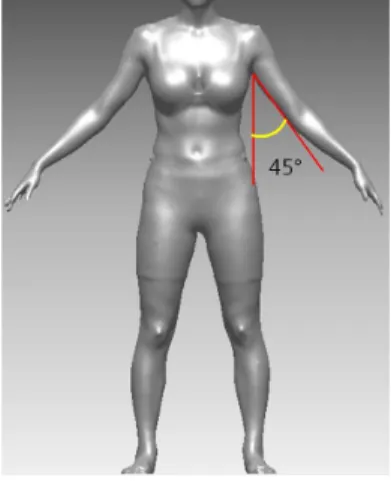
The optimal three-dimensional human body scan posture for automatic measurement of breast was set as described below. The vertical line drawn from the armpit and the arm inner line form a 45-degree angle when it is viewed from the front, and the palm faces the trunk. At this time,

the arm inner line extends from the armpit to the elbow(Fig. 3a). The line that extends from the shoulder edge point to the bisection point of elbow thickness form a vertical line when it is viewed from the side(Fig. 3b). In addition, the line extending from the lateral neck point to the bisection point of hip thickness form a vertical line(Fig. 3c).

2. Location for attaching the auxiliary measurement points

The types and location of measurement point were selected which needed to be attached to the human body prior to the scan for automatic measurement of breast. The breast shape may be distorted if the measurement point related directly to with the breast is attached. Therefore, we selected the point that vertically raised breast inner point to the mid height of armpit folding point and anterior neck point as the auxiliary measurement point, the point located slightly more outward than the breast outer point, along with the shoulder point and armpit folding point (see Fig. 4). For the landmark which is the three-dimensional hemispherical shape, a radius of 1-1.5cm is suitable for shoulder point and armpit folding point while a radius of 0.5-0.8cm is suitable for breast inner point.

a: Shoulder point b: Armpit point

c: The point that vertically raised the breast inner point to the mid height of frontal armpit point and anterior neck point

Fig. 2. Location for attaching the auxiliary measurement points

3. Method of manual measurements(MAM)

4-subjects were measured manual, and then, after

setting a reference point for measuring

breast-related dimensions in 3D scan data, 3D

dimensions were extracted to analyze the differences

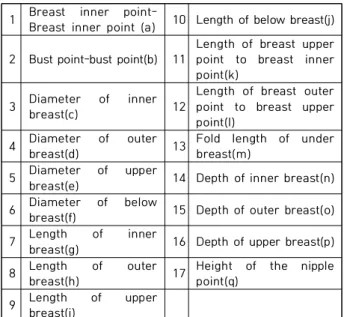
from the direct dimensions. The Breast-related

items(Table 1) are presented in Fig. 3.

(4)

1 Breast inner point-

Breast inner point (a) 10 Length of below breast(j)

2 Bust point-bust point(b) 11

Length of breast upper point to breast inner point(k)

3 Diameter of inner

breast(c) 12 Length of breast outer point to breast upper point(l)

4 Diameter of outer

breast(d) 13 Fold length of under

breast(m) 5 Diameter of upper

breast(e) 14 Depth of inner breast(n) 6 Diameter of below

breast(f) 15 Depth of outer breast(o) 7 Length of inner

breast(g) 16 Depth of upper breast(p) 8 Length of outer

breast(h) 17 Height of the nipple point(q) 9 Length of upper

breast(i)

( ) : These alphabet symbolize in fig.3

Table 1. Measurement on Breast-related items

* The symbol in () means the length

Fig. 3. Method of manual measurement items breast-related

III. Results and Discussion

The automatic setting of measurement points in 3D scan data were developed based on the manual measurement method for the upper body and breast.

1. Measurement points for automatic setting To develop the reference point and line for automatic breast measurement on the three-dimensional scan were based on the manual measurement method. And a new method for automatically setting the measurement points breast-related were developed based on the 3D anthropometric automatic recognition technology for body [9].

1.1 Bust point

The bust point has the noticeable morphological characteristics in terms of shape, and therefore, the measurement setting method is relatively simple.

① Prepare the lateral silhouette.

② Move down from the lateral silhouette, and set the point, where the slope changes to +, as the bust point.

1.2 Upper breast point

As the definition of upper breast point can be applied during the manual measurement, it needs to be ensured that the front armpit point, shoulder edge point, lateral neck point, and shoulder bisection point are set first. After those points are recognized, the upper breast point should be set Fig. 4.

① The cross-section point of frontal armpit folding point height is obtained and arranged.

② The upper breast point is the frontal point among the points that pass through the shoulder midpoint and bust point and intersects the plane parallel to the z-axis and the cross-section above such plane.

a. Frontal armpit folding point b. Upper breast point

c. Cross-section of height of frontal armpit folding point d. Bust point

e. Shoulder midpoint

Fig. 4. Method for setting the breast upper point

1.3 Lower breast point

To identify the lower breast point, create a

sagittal plane in the bust point and find the lower

breast point from the slice based on such sagittal

plane(Fig. 5). This point is determined according

(5)

A B C a. Frontal armpit folding point b. Lower point in the outer area of breast

c. Outer breast point d. Horizontal section of the mid height of upper breast point and lower point in the outer area of breast

Fig. 7. Method of setting outer breast point

to the preceding studies[10].

① Create the sagittal cross-section plane that passes through the bust point.

② Create a line passing the point that is moved down along cross-section as much as ‘the average of (height of nipple point-height of lower breast point)+3σ’ from the bust point.

③ Identify the point of the farthest vertical distance from the line among the cross-sections, and define this point as the lower breast point.

Sagittal section at bust point

Fig. 5. Method for setting the lower breast point

1.4 Outer Breast point

The breast contour line can be relatively easily on the three-dimensional data because the lower part of breast can be clearly distinguished from the part intersecting the breast and trunk.

However, it is not easy to find the contour line on the upper part that connects the breast tissue and trunk smoothly.

The anatomical observation provides the clue that the breast tissue is covered along the deltoid muscle as shown in Fig. 6 and gradually disappears near the front armpit point.

Thus, in this study, the one point was identified

in the lower contour of breast, and the breast outer point was identified on the line connecting the front armpit point and such point on the lower contour of breast.

Fig. 6. Anatomical position of breast tissue

In manual measurement, after drawing a line from the waist bisector on the side to the front axillary point, outer breast point defines as the bisector point of the upper breast point and lower breast point on this line. But the waist bisector is set differently depending on the body shape or posture, is located far from the breast. Therefore, in this study outer breast point is set after defining lower point in the outer area of breast

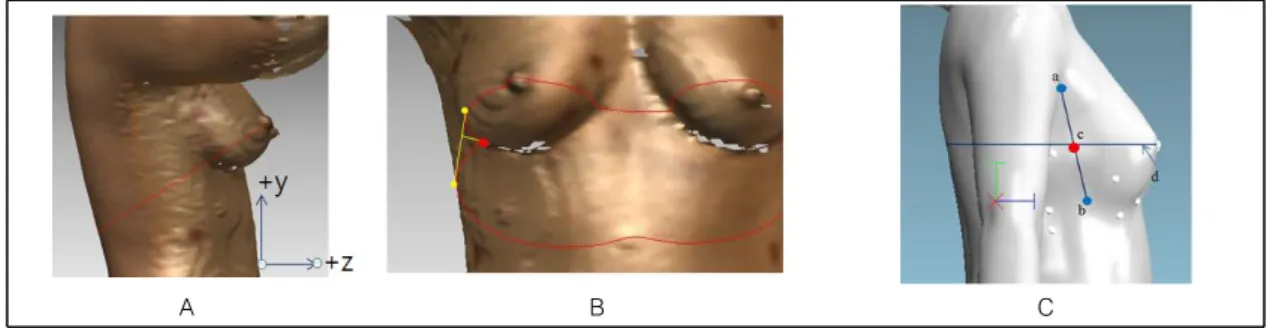
①Set the lower point in the outer area of breast. Create a cross-section that clearly reveals the contour point below the outer area of breast.

The results of analysis on various cross-sections showed that the contour revealed well in the plane cross-section(Fig. 7A) which passes the bust point, runs parallel to x-axis, and forms a 45 ̊ angle with –y axis.

② The frontal view of such cross-section is

presented in Fig. 7B. In the line connecting two

extruded points on the cross-section shown in Fig.

(6)

Subject item

measurement

A B C D

3D MAM

3D-MA M Differe

nce

3D MAM

3D-MA M Differe

nce

3D MAM

3D-MA M Differe

nce

3D MAM

3D-MA M Differe

nce Breast inner point-

Breast inner point (a) 1.59 1.4 0.19 1.94 0.4 1.54 1.66 0.9 0.76 0.27 1.3 -1.03

Bust point-bust

point(b) 19.27 18.5 0.77 18.89 18 0.89 18.94 18.6 0.34 16.73 17.2 -0.47

Diameter of inner

breast(c) 8.75 7.9 0.85 8.36 7.9 0.46 8.83 8.6 0.23 8.13 7.7 0.43

Diameter of outer

breast(d) 3.15 3.5 -0.35 5.19 6.2 -1.01 5.77 9 -3.23 5.13 6.4 -1.27

Diameter of upper

breast(e) 5.63 7.4 -1.77 7.73 10.3 -2.57 6.16 6.6 -0.44 7.56 7.7 -0.14

Diameter of below

breast(f) 5.72 5.5 0.22 6.76 5.8 0.96 6.15 7.7 -1.55 5.47 5 0.47

Length of inner

breast(g) 8.94 8.5 0.44 9.56 10.4 -0.84 9.54 10 -0.46 8.59 8.5 0.09

Length of outer

breast(h) 8.44 7.4 1.04 13.6 13 0.6 12.21 13 -0.79 10.63 10.5 0.13

Length of upper

breast(i) 6.42 8 -1.58 10.42 11.9 -1.48 8.64 10.8 -2.16 9.07 10 -0.93

Table 2. Measurement cm 7B, define the point which is the farthest from the

line connecting the two dots among the two points as lower point in the outer area of breast.

③ Define point crossed a horizontal section(d) of the mid height of upper breast point and lower point(b) in the outer area of breast with section which passes the frontal armpit folding point(a) and lower point(b) in the outer area of breast, as the outer breast point(c)(Fig. 7C).

1.5 Breast inner point

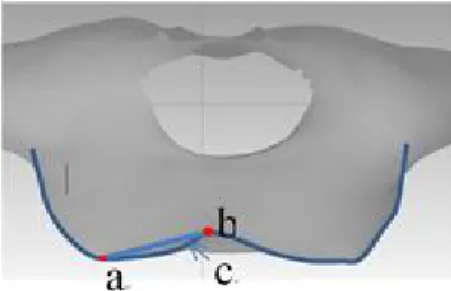
The breast inner point was identified in the following way based on the observation of the three-dimensional shape(Fig. 8).

① Create the horizontal cross-section of the mid height of upper breast point and lower breast point of front center line.

② Set a point(a) protruding forward which is positioned on the cross-section.

③ Set the breast inner point(b) as point at the farthest distance to the inside of the line(c).

a. Bust point position on cross-section

b. Point at the farthest distance to the inside of the line c. Line of the farthest distance to the inside of the cross-section

Fig. 8. Method for setting the breast inner point

2. Comparision between scan measurement(3D) and manual measurement(MAM)

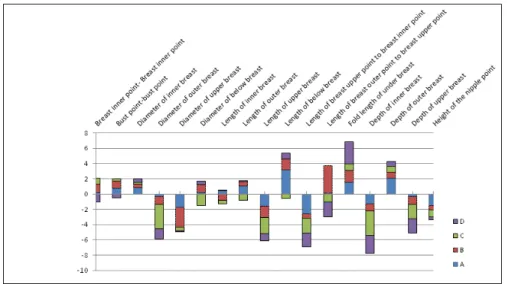
Setting measurement points in 3D scan data, the 3D dimension breast-related measurements were measured for 4 subjects, and the result was compared with the direct measurement. Table 2 shows the individual dimensions and differences of 3D scan measurement and

manual measurement. Figure 9 shows that the

differences between 3D and MAM measurements

seem to be similar, but looking closely, they are

positive and negative depending on the subject.

(7)

Length of below

breast(j) 8.93 5.8 3.13 9.23 7.8 1.43 7.65 8.2 -0.55 6.6 5.8 0.8

Length of breast upper point to breast inner point(k)

11.08 13.7 -2.62 14.23 14.8 -0.57 13.36 15.3 -1.94 13.24 15 -1.76

Length of breast outer point to breast

upper point(l) 9.11 9 0.11 14.81 11.2 3.61 10.72 11.8 -1.08 8.86 10.8 -1.94

Fold length of

under breast(m) 23.64 22.1 1.54 25.55 24 1.55 25.15 24.3 0.85 25.73 22.8 2.93

Breast depth inner(n) 5.70 7.00 -1.3 7.4 8.3 -0.9 3.38 6.6 -3.22 2.45 4.8 -2.35

Breast depth outer(o) 7.6 7.0 0.6 11.57 10.8 0.77 10.2 9.4 0.8 8.67 8.1 0.57

Breast depth upper(p) 2.96 3.3 -0.34 6.89 7.9 -1.01 5.88 7.8 -1.92 4.85 6.7 -1.85

Height of the

nipple point(q) 14.4 15.9 -1.50 5.86 6.4 -0.54 4.33 5.3 -0.97 3.41 3.8 -0.39

Fig. 10. Total difference by items(cm)

Fig. 9. Differences between 3D and MAM by individual(cm)

(8)

Fig. 11. Individual difference rate by item(%)

Figure 10 shows the cumulative difference between 3D and MAM dimensions for each item, and you can see the differences according to the measurement method at a glance. A positive value based on the X-axis means that the 3D dimension is largely measured, and a negative value means that the MAM dimension is measured larger. There were a large difference between 3D dimension and MAM dimension in items of diameter of outer and of upper breast, length of upper, below, upper point to inner point, outer point to upper point, and fold length of under breast point, and depth of inner, outer, and upper. Simply, the cumulative values of the difference in the outer diameter and upper diameter, upper length, length of upper to inner point, inner depth, upper depth, and height of nipple point(below depth) of MAM are measured greater than those of 3D dimension.

According to a prior study[11], there were a greater difference between 3D dimensions and MAM dimensions due to skin pressure. When measuring the depth of the breast's protrusion in two dimensions, the MAM was greater than the 3D dimension in inner depth, upper depth, and height

of nipple point(below depth) because the skin face was pressed. But, the outer depth were different trend because the outer point in MAM was set differently from the outer point in 3D measurement. In addition, the upper diameter, upper length, and the upper to inner point length of the MAM were larger than the 3D dimension. It is assumed that setting the upper point on a horizontal line passing the forward folding point, the upper point in MAM is higher than that in 3D measurement.

On the other hand, the Fold Length of under

breast showed 3D greater than MAM, which can be

inferred from a prior study that 3D dimension was

larger because the lower breast region was not

scanned due to age-increasing droop in the under

bust circumference. According to a prior study[11],

in three-dimensional measurements, the greater

curvature, the larger size. It can be inferred that

the length of below breast in 3D measurements is

larger than in MAM, although it may vary

depending on breast type, due to the sagging of the

breast, resulting in a larger flexion.

(9)

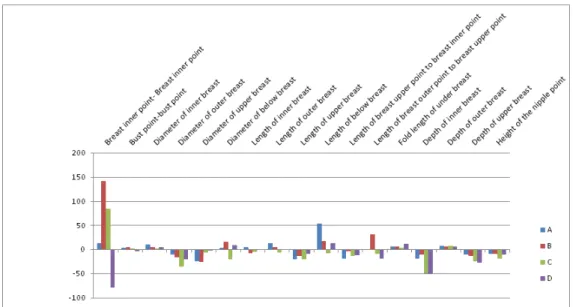
Next, in order to obtain the difference ratio between the 3D dimension and the MAM dimension, the difference ratio for each subject was determined by the following equation.

Difference ratio(%)=(3D-MAM)/MAM*100

A positive value means that the 3D measurement is larger than MAM, and a negative value means that the MAM is larger than 3D measurement(Fig. 11). In addition, items with small measurements, for example, breast inner-breast inner point items, it shows a high difference rate despite the small differences.

In terms of ratio, there is a big difference between the MAM and the 3D dimension of the breast inner point-breast inner point. The large MAM or large 3D dimensions depending on subjects can be attributed to differences in flexion according to breast type, and more research is required depending on breast type. Depending on the subjects, MAM or 3D dimensions appear to be large, which can be attributed to differences in flexion depending on breast type.

IV. Conclusion and suggestion

In this study, we developed the algorithm that enabled automatic measurement point setting and dimensional measurement for the 3D scan data based on the manual measurement. The conclusion is as follows.

In the optimal 3D body scan posture for automatic measurement of breast, the vertical line drawn from the armpit with the arm inner line form 45-degree angle based on the frontal view while the palm faces the trunk. Based on the side view, the line extending from the shoulder edge point to the bisection point of elbow thickness should be a vertical line. In addition, the line that extends from the lateral neck point to the bisection point of hip thickness should be a vertical line.

It's easy to find inner breast point if the breast contour is clear. But the outer breast point is on the line connected from the bisecting point of the lateral waist thickness to the axillary point, so it may be different depending on the body shape or standing posture. Therefore, it is necessary to consider the outer point setting method proposed in this study. And It is needed researches on the setting of upper breast point determined by the forearm point in order to reduce the differences between MAM and 3D dimensions associated with the upper breast point.

When measuring depth, the difference by pressing in MAM should be taken into account.

The differences in flexion depending on breast type can make a difference in the 3D measurement. So the measurement method in 3D scan should be further studied depending on the type of breast. The effects of breast type need to be further verified by multiple subjects.

REFERENCES

[1] Cable, D., Daanen, H.A.M., “The design and fit evaluation of a biological protective half.” Report TM-02-A012, Journal of the Human-Environment System, Vol. 6, No. 1, pp. 31-37, Jan. 2002.

[2] Lee, H. Y., Hong, K. H., “A Study on the Methodology for the Analysis of Three-dimensional Breast Shape of Middle-aged Women.” Journal of the Korean Society of Clothing and Textiles, Vol. 26, No. 5, pp. 703-714, Oct. 2002, DOI: 10.5850.

[3] Lee, H. Y., Jeong, S. K., Hong, K. H., “Brassiere Selection Program Based on Breast Type.” Korean Association of Human Ecology, Vol. 14, No. 3, pp. 467-473, Jun. 2005, DOI: 10.5934.

[4] Lee, Y. J., Hong, K. H., “Brassiere Pattern Design Using the 3D Information –Application of Ruled Surface-, Journal of the Korean Society of Clothing and Textiles, Vol. 28, No. 11, pp.

1536-1543, Nov. 2004, DOI: 10.5850.

[5] Kim, N. S., Do, W. H., “A Classification of the Breast Shape from the 3D Body Scan Data -Focused on Bigger than C Cup Size-.” Journal of Korean Society of Design Culture Vol. 16, No. 3, pp. 38-48, Sept. 2010, DOI: 10.18208.

[6] Kwon, J., “A Satisfaction Survey on Brassiere Wearing by the

Body Shape and Breast Size to Develop Woman Wear

Customized to Female College Student.” Journal of Korean

(10)

Society of Design Culture Vol. 20, No. 1, pp. 55-69, Mar. 2014, DOI: 10.18208.

[7] Han, T. T., Song, H. K., Lee, K. S., “Classification of Breast Shape of Women Aged 11~15 Using 3D Body Scan Data.”

Fashion & Textile Research Journal, Vol. 19, No. 6, pp.786-794, Dec. 2017, DOI:10.5805.

[8] Sohn, B. H., Kweon, S. A., “A Study on Desirable Breast Type of Women in Their Twenties Based on the Ratio of Breast in Works of Art and Cup Design According to Breast Type.” Journal of the Korean Society of Clothing Industry, Vol. 37, No. 3, pp.

280-291, Apr. 2013, DOI: 10.5850.

[9] Han, H. S., Nam, Y, J., “Automatic body landmark identification for various body figures.” International Journal of Industrial Ergonomics, Vol. 41, No. 6, pp. 592-606, 2011, DOI: 10.5143.

[10] Han, H. S., Nam, Y. J., Hwang, S. J., “Algorithms of the Automatic Landmark Identification for Various Torso Shapes.”

International Journal of Clothing Science and Technology, Vol.

22, No. 5, pp. 343-357, Sept. 2010, DOI: 10.1108.

[11] Han, H. S. & Nam, W. J., “A Comparative Analysis of the Difference between 3D Body Scan Measurements and Physical Measurements by Gender-5th Size Korea Adult Data-.” Journal of the Korean Society of Clothing and Textiles Vol. 33, No.

8, pp. 1190-1202, Aug. 2009, DOI: 10.5850.

Authors

Boo-Hyun Sohn received the B.S. in Clothing and Textiles from Chungnam National University, and M.S., Ph.D. degrees in Clothing and Textiles from Ewha Womans University, Korea, in 1994 and 2000, respectively. Dr. Sohn has been teaching at Chungbuk National University and several other universities on clothing composition, and is interested in body type research, smart clothing development, and 3D pattern research.

Hyun-Suk Han received the B.S., M.S. and Ph.D. degrees in Clothing and Textiles from Seoul National University, Korea, in 1999, 2002 and 2007, respectively. Dr. Han joined the faculty of the Department of Clothing &

Textiles at Chungbuk National University, Cheongju, Korea,

in 2018. She is currently a Assistant professor in the

Department of Clothing and Textiles, Chungbuk National

University. She is interested in intelligent clothing

manufacturing and 3D body measurement.

수치

Fig.  1.  Posture  for  3D  scan
Table  1.  Measurement  on  Breast-related  items
Fig.  6.  Anatomical  position  of  breast  tissue
Fig.  8.  Method  for  setting  the  breast  inner  point
+3

참조

관련 문서