A Study on Korean EFL Collegians' Approach to L2 Writing Based on Metacognition and Affectivity
Mi-Jeong Kang * , Chi-Woon Joo **
상위인지와 정서에 기반한 외국어 학습방법에 대한 연구
1)
강 미 정 * , 주 치 운 **
Abstract
The present study attempted to identify the metacognitive strategies used by L2 writers at the university level as well as their particular aspects which might influence the use of these strategies. Twenty-seven participants, all of whom were enrolled in an English course, were asked to write an expository essay and then complete a questionnaire which includes their beliefs and attitudes toward L2 writing experience and the metacognitive strategies during the writing process. It was found that even though inexpert writers knew and employed as many strategies as the expert counterparts did, they were unsuccessful in the quality of their texts. Simply possessing a repertoire of metacognitive strategies was not enough for successful L2 writing. The failure of the inexpert writers to apply these metacognitive strategies in an effective manner was influenced by affective factors such as anxiety, self-confidence, self-concept, etc. As a result of this study, a pedagogical implication is suggested.
요 약
본 연구는 대학 재학생들의 상위인지 전략에 대한 파악과 이 인지 전략에 영향을 미칠 수 있는 특별한 요인들이 무엇인지 알 아보기 위하여 시도되었다. 대학 영어 과목을 수강하는 27명의 대학생을 대상으로 한 편의 에세이를 쓰게 하고 그 후 설문 조사 를 하였다. 설문에는 영어 작문 경험에 대한 피 실험자들의 태도를 알아보고, 그들이 에세이를 쓸 때 주로 이용하는 상위 인지 전략에 관한 문항을 포함하였다. 설문조사에 대한 통계분석결과에 의하면, 비숙련 학생들은 숙련된 학생들과 마찬가지로 영어 에세이 쓰기에 관한 지식과 전략들을 많이 알고 있었다. 그러나 비숙련 학생들은 상위인지 전략에 대한 지식은 풍부했으나 에세 이 작성 시에 문장의 정확도 및 세련됨 같은 질적인 면이 부족했음이 드러났다. 결론적으로 본 연구에서는 비숙련 학생들의 상 위인지 전략의 적절한 사용의 실패가 그들의 성공적인 영어에세이 작성의 장애가 됨을 통계적 수치를 통해 그 원인을 파악했으 며, 이는 학생들의 불안, 자신감의 결여와 같은 정서적인 요인에 영향을 받았음을 입증했다.
▸Keyword : 과정중심쓰기(process writing), 상위인지전략(metacognitive strategy), 정서적 전략 (affective strategy), 제2언어 습득(second language acquisition)
∙제1저자 : 강미정 교신저자 : 주치운
∙투고일 : 2010. 09. 06, 심사일 : 2010. 09. 14, 게재확정일 : 2010. 09. 17.
* 한국외국대학교 영어통번역학부 강사 ** 인하공업전문대학 호텔경영과 교수
I. Introduction
Over the past several decades there have been numerous studies on composing processes of ESL (EFL) student writers. Research on second language writing has primarily focused on the identification of strategies that may account for success in L2 writing.
i.e., cognitive, metacognitive, social, and affective strategies and strategic knowledge. Rubin (1987) supports the idea that the use of strategies, whether they are cognitive or metacognitive, determines the success that students encounter and argues that
"making strategies conscious may enable (students) to use their strategies more effectively and efficiently"
(p.16). Wenden (1987) contends that metacognitive knowledge can influence the students' approach toward a learning task and the learning task may also influence their approach.
In academic composing contexts, one of the significant roles of the teacher is expected to provide students with all the possible strategies to complete a specific task successfully. By giving them the proper tools, teachers are expected to enable them to select the strategy that best matches their individual style.
This, in turn, creates a self-directed student who is capable of bringing these effective strategies to writing experiences both in and outside of classroom environment.
However, those who teach the writing process and incorporate learner strategies have noted there are still students that continue to be unsuccessful in L2 writing, and not all successful writers use the same strategies to achieve success in L2 writing performance. It appears that there are L2 writers who know what strategies to use, but there exists something that inhibits them from applying these strategies. In this regard, some factors except cognitive and metacognitive strategies should be considered for effective L2 writing and teaching effectiveness in classrooms.
In the field of second language acquisition, researchers have begun to address affective factors.
Many studies and teaching methods have concluded that language ability could no longer be regarded as
the exclusive factor in second language acquisition, and that affective factors such as attitudes, motivation, and language learning goals played an integral part to enhance second language acquisition. There should be some consideration that "while all the optimal cognitive factors may be operating in the attempted solution of a given task, the learner can fail because of an affective block" (Brown, 1973: 234).
Even though these affective factors have emerged prominently in the learning strategy research, they recently seem to receive less attention than cognitive and metacognitive strategies. Thus, there's the need to consider how greatly affective factors influence metacognitive strategy use when performing the writing task.
This research attempts to identify the strategies of academic writing students in a university setting and find how their affectivity has an influence on the application of these strategies. The investigation is guided by the following research questions: (1) What are the students' beliefs and attitudes toward their writing experience? (2) What cognitive and metacognitive strategies do L2 writers say they use when they organize and reformulate their ideas through recursive activities?
II. Literature Review
1. Metacognitive Strategies
In an effort to explore composing processes in second language learning, many researchers conducted their research studies based on first language composition theory. Many studies have found cross- linguistic influence, i.e., writing behaviors and strategies acquired in the first language would also seem to be operative in second language writing when writers attempt to generate ideas, plan, organize, rehearse, rescan, revise, and edit, and suggested that L1 writing skills transfer to L2 writing in different ways (Jones and Tetroe, 1987; Cumming, 1989; Uzawa, 1996).
Planning can occur both before writing begins and
throughout the writing task. It plays an important
role in the production of meaningful discourse, and
deliberate instruction in planning appears to result in improved writing. Some studies have suggested that as they write successful writers generate new ideas, plan, and adjust goal accordingly. Zamel (1982), for example, observed skilled and unskilled writers as they wrote and found that unlike the less skilled writer who never attempted meaning-level changes, skilled writers who planned little in L2 planned little in L1 as well. In the investigation of six Spanish-speaking ESL students' texts written in their first and second language, Jones and Tetroe (1987) found that whatever writing skill learners possessed in their first language, whether weak or strong, it was transferred to L2 writing regardless of the proficiency in the L2, which signifies that the poor quality of the texts in English is attributed to the inability to use relevant writing strategies from the first language.
Rescanning is the process of rereading part or all of the sentence or sentences the writer has just completed. Planning, rehearsing, or writing mostly follow the reading over written text. The writer also rereads the assigned topic to stay on task and generate more ideas. Many studies support that successful writers frequently pause for revisions during writing.
Stallard (1974) observed "good" and "average" high school writers and revealed significant differences in the number of rereading activities in each group, where the "good" 12th grade writers "stopped writing more frequently to read what they had written"
(p.215) than the average writers did. Thus good student writers were able to make many of the revisions at intervals in the writing task. Similarly, Pianko (1979) found that "traditional" college writers paused twice as many times and re-scanned three times as often as her "remedial" group (p.10). In this regard the reflective activity implied by such pauses is presumed to be the parameter which distinguishes good from poor writers, and the developing text may serve as a type of local writing prompt as writers reread portions of their recently written text to generate additional phrases or sentences.
Perl (1979) made think-aloud study on college-level writers' planning activities. In discussing the role that rereading plays on a global planning (thinking
about the text as a whole), Perl argued that "seeing ideas on paper enables students to reflect on, change, and develop those ideas further" (p.330).
Many other within-subject compositions in their first and second language have been compared and revealed the transfer of knowledge about first language (Edelsky, 1982), thinking and revising strategies (Cumming, 1989), educational experience (Carson &
Kuehn, 1992; Leki, 1995), and positive effects of first language writing expertise on L2 writing text quality (Uzawa, 1996). Edelsky (1982) found from elementary school writers that a certain level of L1 knowledge and hypotheses influenced the writer's proficiency in L2 writing and that L1 is not interference in second language literacy.
Carson and Kuehn (1992), in a study of Chinese students' writing essays in their first language and in ESL, examined the relationship between the development of writing skills in L1 and L2 within the same subjects to see whether second language proficiency is associated with their formal academic experiences. They found that good L1 writers maintained their advantage in L2, whereas poor L1 writers tended to be poor L2 writers. Another study on the issue of transfer of educational training (Leki, 1995) demonstrated that international students who were able to pursue successful academic perfor mance in U.S. had excellent reading and writing skills in their L1 which established a strong foundation for strong L2 abilities.
Cumming (1989) conducted three composition tasks with 23 bilingual young adults and revealed that participants with greater writing expertise in French and greater ESL proficiency received substantially higher ratings on three aspects of their compositions rather than those with lower levels of writing expertise or ESL proficiency.
Some data have shown that when L2 writers have
a limited amount of cognitive resources in the process
of writing, they are likely to resort to translation,
switching back and forth between first and second
language. Thus, when confronted with cognitively
complex tasks, second language writers might choose
a native language in order to "compensate for the
limitations imposed by their imperfect knowledge of
the language" (Jones & Tetroe, 1987, p. 36) and get
"retrieval of information from memory" (Friedlander, 1990, p. 111) for idea generations. Friedlander (1990) hypothesized that if writers utilized brainstorming techniques to plan their writing and then translated it into English, the content and organization would be superior to those both planned and written in English. The result demonstrated that when students were allowed to use their L1 to explore and develop their ideas that had been acquired and stored in memory in pre-writing activities, their L2 writing was significantly enhanced in terms of length, details, and overall quality. A study of Uzawa (1996) supports this finding. He employed think-aloud protocols for an investigation concerning the characteristics of L1, L2, and translation writing processes. He found not only a transfer of level of writing skills between L1 and L2 writing, but also that the process of writing was also transferred.
That is, subjects who used successful planning strategies in L1 also used them in L2 and those who were inexpert in L1 were also in L2. It appears that L2 writers transfer both their L1 writing skills and strategies and methods of learning to write.
In composing performance, metacognitive knowledge aids L2 writers to focus their attention, strategically plan the structure of their essays, activate prior knowledge, and monitor and refine the written text during its production.
2. Affective Strategies
Many studies on metacognitive strategies by L2 writers have shown that successful writers are believed to spend more time thinking and planning (Zamel, 1982); in contrast, unsuccessful writers tend to avoid any revisions having to do with content once they have completed one draft (Cumming, 1989).
Another strategy that contributes to the quality of composing is affectivity which is potentially linked with metacognitive strategies.
Research indicates that learners' beliefs about how language operates (Abraham & Vann, 1987) or their view of what the language task involves (Wenden, 1987) guide the learners' approach to language learning. These beliefs, in turn, influence their strategy choice. In their
study, Abraham & Vann (1987) were able to tap learners' beliefs and subsequent strategy choice through think-aloud procedures. They provided documentation on strategy choice which linked back to their background characteristics and belief systems.
Wenden (1987) observed that learners' beliefs affected their approach to the language task and their strategy use. Learners who stressed the importance of practicing the language in a natural setting attended to meaning and the purpose in social interaction and were more apt to use communication strategies.
Those who emphasized learning the mechanics of the language seemed to attended to form, using compre hension and memory strategies more often. Those who stressed personal factors in second language learning focused on the importance of feelings and affective components in language learning activities.
Horowitz (1987, 1988) conducted several studies on student beliefs about language learning. She reported the beliefs of ESL learners (1987) and university students of beginning Spanish, German, and French (1988). She found that many of the respondents recognized the importance of inference and practice in second language. However, many students considered vocabulary and grammar as the key to language learning. Horowitz concluded that students' restricted view of language learning would have a negative effect on their use of strategies, thus limiting their potential for succeeding in their L2 learning task.
III. Methodology
This paper is designed to make sure there are relationships between L2 writers' writing proficiency and their writing strategies. The specific focus is on how affective variables influence their writing goals and beliefs about success in writing. Writing samples were collected from 27 undergraduates enrolled in the Media English course at a university in Korea.
Twenty-three out of a total of 50 course takers were
excluded from this study because they had never
undergone process writing sessions throughout academic
years. Participants in this study consisted of four
sophomores, twelve juniors, and eleven seniors with humanities majors including English. They had considerably high levels of overall English competence (Toeic Mean = 874), with twelve males and fifteen females.
Individual composition and its ensuing self-professed questionnaire were administered in the 4th week of November in 2008. To begin with, participants were encouraged to review the writing process and techniques for getting ideas, planning, and organizing their writing. They were also trained for grammatical and syntactic elements such as punctuation, transitional phrases, etc. and how to revise and edit the first draft effectively. And then, they were required to write one expository essay entitled "We all work or will work in our jobs with many different kinds of people. In your opinion, what are some important characteristics of a co-worker (someone you work closely with)?" They were assured that their work would never be graded.
On top of that, they were asked to answer a 7-item questionnaire designed to evaluate writers' use of different strategies. The first part of the questionnaire was designed to access information on the students' beliefs and feelings about writing; the second part was on what students perceived themselves doing when writing by eliciting information about the degree of ease or difficulty they approached these tasks.
Participants' writing samples were divided into two levels (expert and less-expert) based on the holistic ratings of the essay they wrote. High level was defined as having scores above the mean and less-expert level was below the mean. The quality of the essay was rated from the rating scale of the School of Inter national Studies at Saint Michael's College using a five-point scale, with 1 = poor and 5 = excellent for each component. The inter-rater reliability measured by Cronbach's alpha coefficient for judging the essay quality was quite high (r=.78).
Yet, this study has some limitation: it is based on a fairly small sample, and thus there should be some careful consideration about the generalization of the findings.
IV. Results
The analysis of data from questionnaires was made to identify the student writers' attitudes and beliefs about writing process in L2 and their metacognitive strategies they use. Among 27 respondents, 11 expert students were found to have gone abroad for academics for more than one year, with only one less-expert writer having the same experience.
Figure 1 indicates that the time spent studying the English language seems to affect writing competence in one way or another.
Figure 1 Significant Effect of Academic Background: Studying abroad
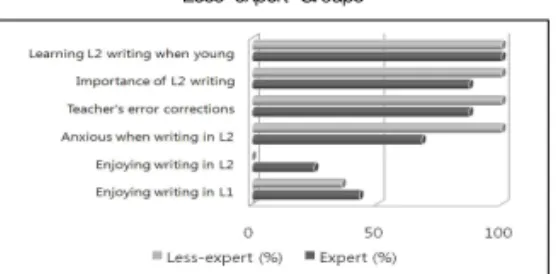
Concerning students' attitudes toward writing behavior shown in Figure 2, a relatively small percentage of the expert writers were identified to enjoy writing both in L1 and in L2 (43% and 25%
respectively), though larger than the inexperienced counterparts (36% and 0% respectively). Since the expert writers usually have much more knowledge than less-experienced counterparts, they may have more chances of noticing their own errors in the process of writing performance, which makes them feel less fearful about the writing task. In contrast, the less-experienced writers did not seem to believe that they are excellent L1 writers, nor did they see themselves as good writers of L2. Coupled with the lack of ease with the language, their unwillingness to try writing in L2 may come from high level of anxiety that their writing skills are compared to those of other students in class and evaluated, reducing their motivation for writing tasks.
Contributing are other affective blocks such as personality, uneasiness about poor vocabulary and synonyms, or uncertainty about different word-order.
This study shows that both groups feel anxious
about writing tasks in L2. Even expert students
with more sophisticated and authentic writing skills seemed pressured by the magnitude of the writing task. Particularly, the less-expert writers who have a self-perceived low composing ability level were more vulnerable to these feelings (68% for the expert group vs. 100% for the less-expert group).
Their expectations are to write as well in English as they do in Korean, and the inability to write with ease makes them feel disappointed. On top of that, the fear that the teacher will view them as poor writers seemed to intensify their frustration.
Another important finding is that higher proportion of students welcomed teacher's error corrections irrespective of their academic composing level. For those with poor writing skills, the instructor was the crucial instrument for them to rely on in monitoring their writing products. Further, almost all of the writers were identified to think that individuals who learn a second language at an early age can have a weaker fear of the language than those who do so later in their developmental stages. This study also found that all the respondents recognized the importance of writing in language learning. They asserted that excellent reading and writing knowledge and strategies in their L2 can establish a strong foundation for strong L2 abilities.
As shown in Figure 2, the less-expert writers showed no interest in writing both in L1 and in L2.
Such affective factors as personality and anxiety seem to keep them from actively engaging in the writing task and applying appropriate strategies in place. Thus it is necessary that teachers make every effort to find and respond appropriately to student attitudes toward L2 writing, that is, which students have a strong fear of writing behavior and consider supportive ways of treating them in and outside of the classroom.
Figure 2 Attitudes Toward L2 Writing Between Expert and Less-expert Groups
Understanding the nature of the students' writing task and their willingness to actively apply strategies to reach their goals can be important to successful writing. The findings from questionnaires regarding the use of self-perceived megacognitive strategies evidenced that participants have payed more attention to pre-writing processes in L2 writing rather than reviewing and editing steps.
Being rigid in their planning, most of the writers started off with brainstorming by thinking of the subject and considering the purpose of the essay.
They also engaged in making an outline and retrieving information from their long term memory for developing ideas and organizing the whole essay, willing to change original plan as new ideas emerged. Interestingly, when their ideas were lost or cognitively blocked, they were highly dependent on the translation method from L1 to L2 (in case they were able to use a dictionary, they preferred it). A fairly high proportion of student writers were also found to apply such cognitive strategies as inferencing and summarizing to provide detailed descriptions.
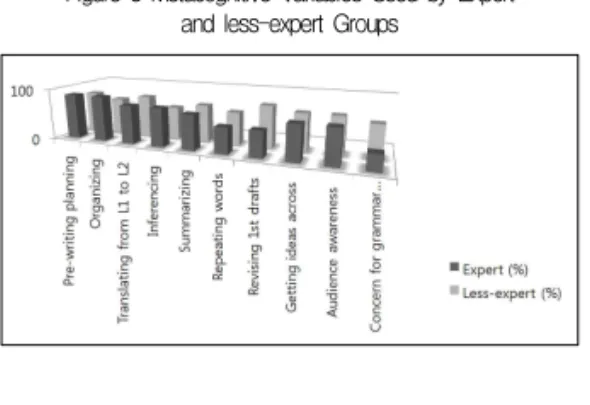
One of the striking differences between two groups is that the expert writers put the least effort on grammar and mechanics (31% for the expert, and 63% for the less-expert), and they did not invest a lot of time and effort in revising the written text (50% for the expert, and 81% for the less-expert).
More proficient writers see writing as a non-linear process whereby they discover new ideas, explore, and formulate those ideas while writing (Perl, 1979;
Zamel, 1982). But in this study, many expert
writers did not tend to proceed in the non-linear
manner. It appears that they already have the
ability to use relevant writing strategies effectively
and do not necessarily need to move back and forth
on the paper during the writing task. For that
reason, expert writers could keep their thoughts
flowing without interruption and maintaining the
coherent text. In contrast, for the less-expert
writers, an affective variable, the high anxiety about
grammatical mistakes, seemed contributing to the
revision process. It was apparent that the less-expert
writers more frequently paused to observe and
correct surface errors of grammar and spellings (63%). When they stopped to correct these surface errors rather than meaning, they seemed to lose the flow of thoughts. As a result, they would reread the sentence so that they could move forward.
In regard to audience awareness, approximately three quarters of the participants responded that they were concerned with purpose and audience, but did seem to imply that they were considering the instructor as their audience.
Figure 3 Metacognitive Variables Used by Expert and less-expert Groups