• 검색 결과가 없습니다.

Endobronchial Metastases from Extrathoracic Malignancies: Recent 10 Years' Experience in a Single University Hospital

N/A
N/A
Protected

Academic year: 2021

Share "Endobronchial Metastases from Extrathoracic Malignancies: Recent 10 Years' Experience in a Single University Hospital"

Copied!
8
0
0

로드 중.... (전체 텍스트 보기)

전체 글

(1)

Tuberc Respir Dis 2013;74:169-176

CopyrightⒸ2013. The Korean Academy of Tuberculosis and Respiratory Diseases. All rights reserved.

Endobronchial Metastases from Extrathoracic Malignancies: Recent 10 Years' Experience in a Single University Hospital

Jung-Hyun Kim, M.D., Daniel Min, M.D., Sang-Hee Song, M.D., Ji-Hyun Lee, M.D., Hye-Cheol Jeong, M.D., Eun-Kyung Kim, M.D.

Department of Internal Medicine, Bundang CHA Medical Center, CHA University College of Medicine, Seongnam, Korea

Background: Although the lung is a common site of metastasis, endobronchial metastases (EBM) from extrathoracic malignancies are rare. Previous studies were retrospective reviews of the cases from each single institute, and the last one was performed between 1992 and 2002. We evaluated the characteristics of patients with EBM who had been diagnosed in recent 10 years in our hospital.

Methods: We retrospectively reviewed 1,275 patients who had undergone diagnostic bronchoscopic procedures between 2001 and 2011. An EBM was defined as bronchoscopically notable lesion, which was histopathologically identical to the primary tumor.

Results: A total of 18 cases of EBM were identified. The mean age was 53 years, and 12 cases of the 18 patients were female. The most common primary malignancies were colorectal cancer and breast cancer (4 cases each), followed by cervix cancer (3 cases) and renal cell carcinoma (2 cases). Cough was the most common symptom.

The most common radiologic finding was atelectasis, which was identified in 27.7% of the cases. The median interval from the diagnosis of primary malignancy to the diagnosis of EBM was 14 months (range, 0–112 months).

The median survival time from the diagnosis of EBM was 10 months (range, 1–39 months).

Conclusion: EBM from extrathoracic malignancies were rare. Colorectal cancer and breast cancer were common as primary malignancies. Fiberoptic bronchoscopy should be performed in all patients, who are suspected of having EBM. If atypical clinical and pathological features are present, appropriate diagnostic studies should be undertaken.

Key Words: Bronchi; Neoplasm Metastasis; Neoplasms

Address for correspondence: Eun-Kyung Kim, M.D.

Department of Internal Medicine, CHA Bundang Medical Center, CHA University College of Medicine, 59 Yatap-ro, Bundang-gu, Seongnam 463-712, Korea

Phone: 82-31-780-5205, Fax: 82-31-780-6143 E-mail: [email protected]

Received: Jan. 7, 2013 Revised: Feb. 22, 2013 Accepted: Mar. 18, 2013

CCIt is identical to the Creative Commons Attribution Non-Commercial License (http://creativecommons.org/licenses/by-nc/3.0/).

Introduction

Although the lung is a common site for metastases from various extrapulmonary malignancies, endotra- cheal or endobronchial metastases (EBM) are rare. The frequency of EBM varies according to the definition (range, 2–28%)

1,2

. Rosenblatt et al.

1

reported that the in- cidence of EBM was as high as 50% in their postmortem

examination of pulmonary metastatic disease. Braman

and Whitcomb

2

reviewed the autopsies of patients who

had died with solid tumors and reported that the in-

cidence of EBM was as low as 2%. They counted only

grossly notable endobronchial lesions. Various tumors

have been associated with EBM. Treatment and man-

agement should be planned, according to the histology

of the primary tumor, anatomic location, evidence of

other metastasis, and the performance status of the

patient. We have identified 13 studies in the literature

that reviewed the prevalence and characteristics of

EBM

2-14

. Because of low incidence of the EBM, as well

as the different characteristics of each institute and the

difference in time decades, the results vary from study

to study. Since the last study

14

, which was performed

between 1992 and 2002, there was no further study

published in the literature. Therefore, we evaluated the

(2)

Table 1. Patients characteristics

Patient No. Sex Age (yr) Primary site Stage* Time interval

(mo) Symptoms Treatment Survival (mo)

1 F 53 Breast III 13 D, C, S CT 3

2 F 45 Colon II 23 N OP 18

3 M 53 Renal IV 0 H OP 39

4 M 33 Rectum IV 0 C CT Unknown

5 F 79 Cervix II 29 D, C, S NT Unknown

6 M 58 Esophagus I 32 C, S NT 1

7 M 57 Renal II 7 H IT 37

8 F 59 Uterus endometrium I 20 D CT 20

9 F 63 Common bile duct IV 0 C, S NT Unknown

10 F 44 Cervix II 19 N OP, CT 10

11 M 56 Skin (melanoma) IV 0 C NT Unknown

12 F 65 Breast I 112 C CT Unknown

13 F 79 Stomach IV 0 D NT Unknown

14 M 59 Rectum III 14 D OP 3

15 F 43 Colon IV 0 D CT 6

16 F 34 Breast II 34 C, S CT Unknown

17 F 42 Breast III 39 C, S CT 12

18 F 46 Cervix II 15 C, P RT 2

*TNM stage at initial diagnosis of primary malignancy. Time interval from initial diagnosis to endobronchial metastasis.

F: female; M: male; D: dyspnea; C: cough; S: sputum; N: no symptom; H: hemoptysis; P: pain; CT: chemotherapy; OP: operation;

NT: no treatment; IT: immunotherapy; RT: radiotherapy.

clinical, radiographic and bronchoscopic aspects of pa- tients with EBM, who had been diagnosed in recent 10 years in our hospital. We reviewed the literature and compared our cases with the previously reported series.

Materials and Methods

Between Jan 1, 2001 and Dec 31, 2011, we retro- spectively reviewed the patients who had undergone di- agnostic procedures using fiberoptic bronchoscopy at Bundang CHA Medical Center (Seongnam, Korea). In the study period, a total of 1,271 biopsy procedures were performed using fiberoptic bronchoscopy. The procedures were diagnostic in 641 cases. Among them, 438 cases of malignancies were identified. An EBM was defined as bronchoscopically notable lesion, which was histopathologically identical to the primary tumor.

Slides and reports of biopsy of the primary tumor and endobronchial biopsy material were compared to con- firm the diagnosis of EBM. We investigated the estro-

gen/progesterone receptor status if the primary malig- nancy was breast cancer, and the human papillomavirus (HPV)-DNA pattern in case of uterine cervix cancer. If the histological differentiation of the endobronchial tis- sue is still unclear, we compared the immunohisto- chemical staining, HPV-DNA pattern for cervix cancer, or estrogen/progesterone receptor status for breast cancer. Data regarding the patients' clinical character- istics, symptoms, radiographic and bronchoscopic find- ings were evaluated.

Results

A total of eighteen patients were identified as having

EBM from extrapulmonary malignancies. Among them,

twelve patients were women (66.7%). The range of age

was from 34 to 79 years with the median age of 53

years. The primary malignancies were 4 breast cancers,

4 colorectal cancers, 3 uterine cervix cancers, 2 renal

cell carcinomas, 1 esophageal cancer, 1 cholangiocar-

(3)

Table 2. Radiologic findings

Chest X-ray findings No. (%) CT findings No. (%)

Atelectasis 5 (27.8) Mass or nodules 10 (55.6)

Diffuse infiltration 4 (22.2) Increased peribronchial densities 8 (44.4)

Solitary nodule 3 (16.7) Bronchial obstruction 5 (27.8)

Consolidation 2 (11.1) Consolidation 4 (22.2)

Multiple nodules 2 (11.1) Hilar lymphadenopathy 2 (11.1)

Pleural effusion 1 (5.6) Pleural effusion 2 (11.1)

No abnormalities 2 (11.1)

CT: computed tomography.

Table 3. Location of lesions

Location No. of cases

Right bronchus Right main bronchus 0

Right upper lobar bronchus 1

Segmental bronchus 4

Right middle lobar bronchus 2

Segmental bronchus 1

Right lower lobar bronchus 2

Segmental bronchus 2

Right main and right lower lobe segmental 1

Total (%) 13 (72.2)

Left bronchus Left main bronchus 1

Left upper lobar bronchus 1

Left lower lobar bronchus 0

Segmental bronchus 3

Total (%) 5 (27.8)

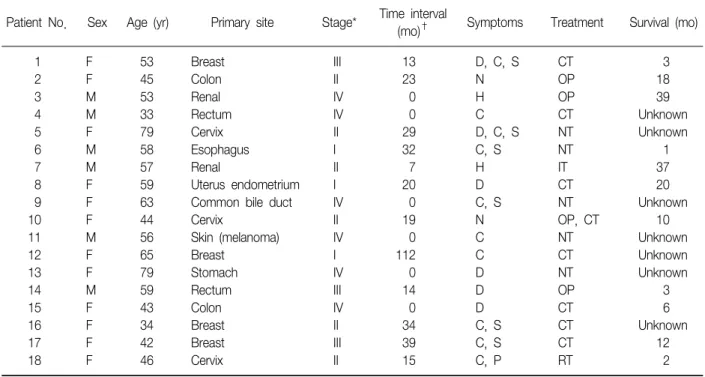
cinoma, 1 melanoma, 1 uterine endometrial cancer, and 1 advanced gastric cancer. Table 1 shows clinical char- acteristics of the patients.

Cough was the most frequent symptom (10 patients, 55.6%), followed by dyspnea (6 patients, 33.3%), puru- lent sputum (6 patients, 33.3%), and hemoptysis (2 pa- tients, 11.1%).

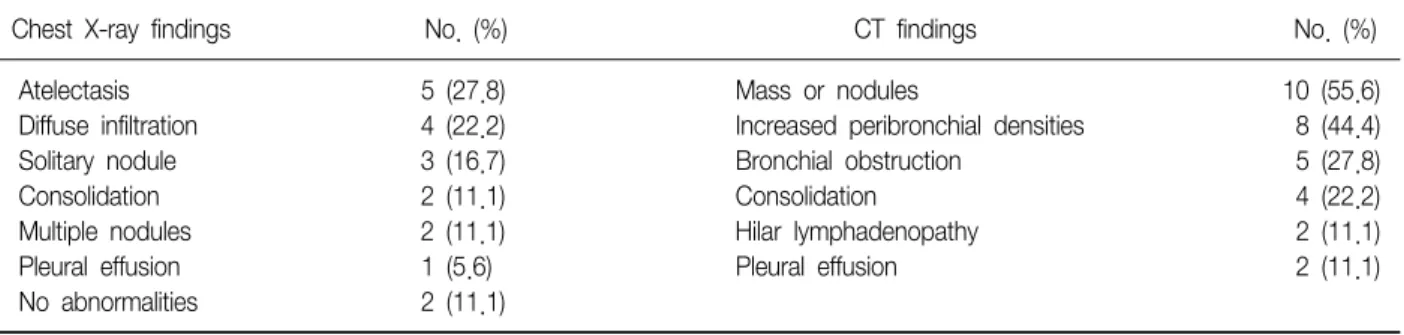
The most frequent chest radiographic findings were obstructive atelectasis (5 cases) and diffuse infiltration (4 cases), followed by solitary nodule (3 cases), con- solidation (2 cases), and multiple nodules (2 cases). In two cases, chest radiograph showed no abnormalities at all. The computed tomography scan of the chest was performed on all of the patients. It revealed lung mass or nodules (10 cases), increased peribronchial densities (8 cases), bronchial obstruction (5 cases), and con-

solidations (4 cases) (Table 2).

On bronchoscopic examination, all of the cases showed single lesion, except one case. The lesions were located in the segmental bronchus (10 cases), lo- bar bronchus (6 cases), and main bronchus (1 case).

In one case, the lesions were found in multiple loca- tions (right main bronchus and right lower lobe basal segmental bronchus) (Table 3).

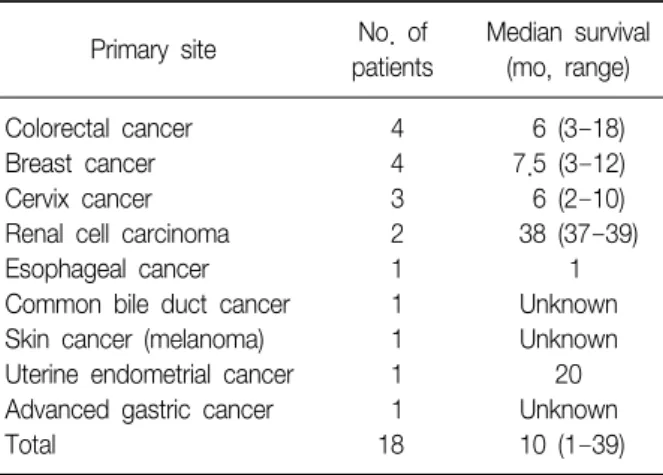
The median time from the diagnosis of the primary

malignancy to the diagnosis of EBM was 14.5 months

(range, 0–112 months). Six patients were found to have

EBM at the initial evaluation. The median time from the

diagnosis of EBM to death or following loss was 3

months (range, 1–39 months). When we excluded the

patients who were not followed after diagnosis, the me-

dian survival time was 10 months (range, 1–39 months)

(4)

Table 4. Survival times according to primary sites

Primary site No. of

patients

Median survival (mo, range)

Colorectal cancer 4 6 (3–18)

Breast cancer 4 7.5 (3–12)

Cervix cancer 3 6 (2–10)

Renal cell carcinoma 2 38 (37–39)

Esophageal cancer 1 1

Common bile duct cancer 1 Unknown

Skin cancer (melanoma) 1 Unknown

Uterine endometrial cancer 1 20

Advanced gastric cancer 1 Unknown

Total 18 10 (1–39)

Table 5. Summary of previous studies

Author Year Nation Study

period

No. of patients

Time interval (mo)

Most common primary sites (No.)

Median survival (mo, range) Braman and Whitcomb2 1975 US 1968–1971 5 36 (median) No dominant primary site Unavailable

Fitzgerald3 1977 US 1954–1972 17 58.5 Breast (6) 10 (2–58)

Sarcoma (3)

Baumgartner and Mark4 1980 US 1974–1979 8 60 (median) Breast (4) 13 (8–150)

Colorectal (2)

Shepherd5 1982 UK 1969–1979 25 36 (median) Colorectal (5) 11 (2–120)

Cervix (5) Breast (5)

Bourke et al.6 1989 UK Unavailable 10 48 (median) Breast (6) Unavailable

Kidney (2)

Lee et al.7 1992 Korea 1985–1992 17 40.6 (mean) Breast (4) 8.5

Cervix (3) Thyroid (2)

Heitmiller et al.8 1993 US 1971–1993 23 59.9 (mean) Breast (12) 12.5 (mean)

Kidney (4) Colorectal (3)

Salud et al.9 1996 Spain Mid 1980s 32 50.4 (median) Breast (20) 7

to 1996 Colorectal (3)

Melanoma (2)

Wang et al.10 1999 Taiwan Unavailable 40 Unavailable Head and neck (16) 12 (6–18) Katsimbri et al.11 2000 Greece 1990–2000 8 34 (9–106.5) Kidney (3) 9 (1.5–42)

Colorectal (2)

Kiryu et al.12 2001 Japan 1990–2001 16 65.3 (mean) Colorectal (6) 15.5 (mean)

Breast (3)

Kim et al.13 2002 Korea 1991–2001 27 43.8 (mean) Colorectal (7) 10 (3–49)

Uterus (4) Breast (3) Stomach (3)

Akoglu et al.14 2005 Turkey 1992–2002 15 32.8 (mean) Colorectal (3) 18 (4–84) Breast (3)

Kidney (2)

Present study 2012 Korea 2001–2011 18 14 (0–112) Colorectal (4) 10 (1–39)

Breast (4) Cervix (3)
(Table 4).

Discussion

Excluding sporadic case reports of EBM, we have

identified 13 single-institute studies that systematically

reviewed EBM from extrapulmonary malignancies

2-14

(Table 5). Among them, we could not acquire patient

data of the study performed in Taiwan

10

, although we

had tried to contact the authors. When we put all the

available data together, there were a total of 219 pa-

(5)

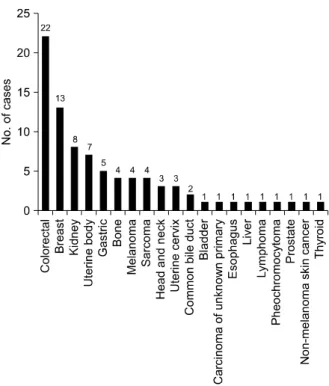
Figure 1. Primary malignancies from the results of pre- vious studies including ours.

Figure 2. Primary malignancies from the results of pre- vious studies that were published before 2000.

Figure 3. Primary malignancies from the results of pre- vious studies that were published after 2000 including ours.

tients and the most common primary malignancy was breast cancer, followed by colorectal cancer and renal cell carcinoma (Figure 1). Because the cancer incidence is different over decades, we divided the studies into two time periods, according to the publication year; be- fore and after 2000.

When we analyzed the studies published before 2000, the most common primary malignancy was breast cancer, followed by colorectal cancer, renal cell carcino- ma, and uterine cervix cancer. There were six cases of thyroid cancer, while there was only one case of gastric cancer (Figure 2). However, in the studies published af- ter 2000, the most common primary cancer was color- ectal cancer, followed by breast cancer, renal cell carci- noma, and uterine body cancer. There were five cases of gastric cancer, while there was only one case of thy- roid cancer (Figure 3).

The international trends of increasing incidence of

colorectal cancer may explain the change in the pro-

portion of colorectal cancer, between the two study pe-

riods

15,16

. However, we should pay attention to the dif-

ference in the ethnic background of each study. Among

(6)

the eight studies published before 2000, except Taiwan study, four studies (53 patients, 39%) were performed in the Unites States, three studies (67 patients, 49%) were performed in Europe and one study (17 patients, 12%) was performed in East Asia. In contrast, among the five studies published after 2000, three studies (61 patients, 73%) were performed in East Asia, one study (15 patients, 18%) was performed in Turkey, and one study (8 patients, 9%) was performed in Greece. In the United States, the incidence of colorectal cancer is de- creasing, while the international incidence of colorectal cancer is increasing

15

, and there is no study performed in the Unites States among the later studies. Therefore, these studies cannot be generalized to other parts of the world, which have different ethnic backgrounds. Also, the difference in the ethnic background can explain the increased proportion of gastric cancer, which is more prevalent in East Asia

16

, in the later studies.

The incidence of breast cancer is high in Western and Northern Europe, Australia, and North America; and low in Asia

16

. According to the Statistics Korea (http://www.

kosis.kr/abroad/abroad_01List.jsp), the incidence of breast cancer in Korea is rising, however, the incidence of colorectal cancer is rising faster than that of breast cancer

17

. These trends can explain the change of pro- portion of breast cancer and colorectal cancer in the three Korean studies (including current one)

7,13

. Howev- er, the data about the incidence of cancer in Korea can't explain why gastric cancer is not the most common pri- mary malignancy in the Korean studies. Perhaps gastric cancer can be assumed to have lower potential of meta- stasis to the trachea or bronchus than colorectal cancer or breast cancer. Although there has been a substantial improvement in the understatng of tumor metastasis, it is still unclear why each cancer type has different meta- static potential and metastatic sites. The anatomical rela- tionship of the lymph-vascular systems, tumor-induced angiogenesis or lymphangiogenesis, and different che- mokines may explain the discrepancies between the cancer prevalence and endobronchial metastasis

18,19

. The mean time from the initial diagnosis of primary malignancy to the diagnosis of endobronchial metastasis

varies from 32.8 months

14

to 65.3 months

12

in other studies. In this study, the median time interval of 14.5 months is relatively shorter than that of the previous reports. However, in six patients, the EBM were found at the time of the initial diagnosis of primary malig- nancies. When we exclude these six patients, the me- dian time interval was 21.5 months, which is similar to the previous studies.

Among the six patients who were diagnosed primary malignancies and EBM at the same time, two patients were considered to have primary bronchogenic carcino- ma at first. However, the the result of immunohisto- chemical staining showed unusual patterns as a primary bronchogenic carcinoma, and further diagnostic work- up revealed extrapulmonary malignancies: renal cell carcinoma and cholangiocarcinoma. In most of the cas- es, we could make the diagnoses of EBM by comparing the histologic and immunostaining patterns. In one case, the diagnosis of EBM was made after surgical re- section of the primary cancer and pulmonary meta- stasectomy. In three cases of breast cancers, estro- gen/progesterone receptor status further helped the diagnoses. Two cases of EBM from uterine cervix can- cer were further confirmed by HPV-DNA analysis.

Management of EBM should be based on the histol- ogy of the primary tumor, anatomic location of EBM, other metastatic sites, and the performance status of the patients. In our series, 8 patients were treated with che- motherapy agents. If there was no other metastatic le- sion and the primary lesion was expected to be control- lable, surgical resection was performed (in 4 patients).

The median survival of the patients who underwent sur- gical resection was 14 months (range, 3–39 months).

Among them, one patient (cervix cancer) died from dis- ease progression 10 months after surgical resection. A patient with colon cancer died from pneumonia 3 months after surgical resection. Other two patients (colon cancer and renal cell carcinoma) showed fairly long-term survival of 18 and 39 months, respectively.

However, we could not analyze the benefit of surgical resection because the patient number was too small.

Interventional bronchoscopy, such as neodymium dop-

(7)

ed-yttrium aluminum garnet (Nd-Yag) laser debulking or intraluminal radiotherapy can be used for palliation of symptoms

20-23

. The median survival from the diag- nosis of EBM was 10 months in our study, and this is also similar to the survival data of the previous studies (range, 7–18 months)

9,14

. The reason why renal cell car- cinoma showed relatively long term survival compared to the other cancers in our study is unclear. Generally, the survival is dependent to a great degree on biologic behavior of the particular tumor and its responsiveness to the treatments. EBM is generally a manifestation of far advanced disease state. Therefore, survival after the diagnosis of EBM is poor.

In about 72% of the cases, the lesions were found in the right bronchial tree in our study. Lee et al.

7

re- ported 56% of EBM were found in the right bronchial tree. Heitmiller et al.

8

also reported 54%, Salud et al.

9

reported 56%, Kiryu et al.

12

reported 80%, Kim et al.

13

reported 70%, and Akoglu et al.

14

reported 56.5% of the lesions were found in the right bronchus. It is unclear why endobronchial metastasis is more frequently found in the right bronchial tree.

Cough was the most common symptom in our series (10 cases, 56%), followed by dyspnea (6 cases, 33%) and sputum (6 cases, 33%). Although there were some variations, cough and dyspnea were the most common symptoms in other studies

8,9,12-14

. Radiologic findings of this study were also similar to the results of the previous studies.

In conclusion, EBM from extrathoracic malignancies were rare. Reviewing a total of 18 cases of EBM of ex- trathoracic malignancies, we found colorectal cancer and breast cancer were the most common primary ma- lignancies, followed by uterine cervix cancer. The cases we have reported are similar to those found in the pre- vious studies, regarding their symptoms, radiological findings, and clinical outcomes. Fiberoptic broncho- scopy should be performed in all patients with ex- trapulmonary tumor, who are suspected to have endo- bronchial metastasis to differentiate it from the primary lung cancer. If atypical clinical features are present or atypical cell type is discovered by bronchoscopy, appro-

priate diagnostic studies should be undertaken.

References

1. Rosenblatt MB, Lisa JR, Trinidad S. Pitfalls in the clin- ical histologic diagnosis of bronchogenic carcinoma.

Dis Chest 1966;49:396-404.

2. Braman SS, Whitcomb ME. Endobronchial metastasis.

Arch Intern Med 1975;135:543-7.

3. Fitzgerald RH Jr. Endobronchial metastases. South Med J 1977;70:440-1.

4. Baumgartner WA, Mark JB. Metastatic malignancies from distant sites to the tracheobronchial tree. J Thorac Cardiovasc Surg 1980;79:499-503.

5. Shepherd MP. Endobronchial metastatic disease.

Thorax 1982;37:362-5.

6. Bourke SJ, Henderson AF, Stevenson RD, Banham SW.

Endobronchial metastases simulating primary carcino- ma of the lung. Respir Med 1989;83:151-2.

7. Lee HL, Kwak SM, Chang JH, Kim SK, Kim SK, Lee WY, et al. Endobronchial metastasis of extrapulmonary malignancies. Korean J Intern Med 1992;43:806-13.

8. Heitmiller RF, Marasco WJ, Hruban RH, Marsh BR.

Endobronchial metastasis. J Thorac Cardiovasc Surg 1993;106:537-42.

9. Salud A, Porcel JM, Rovirosa A, Bellmunt J. Endobron- chial metastatic disease: analysis of 32 cases. J Surg Oncol 1996;62:249-52.

10. Wang YH, Wong SL, Lai YF, Lin AS, Chang HW.

Endobronchial metastatic disease. Changgeng Yi Xue Za Zhi 1999;22:240-5.

11. Katsimbri PP, Bamias AT, Froudarakis ME, Peponis IA, Constantopoulos SH, Pavlidis NA. Endobronchial meta- stases secondary to solid tumors: report of eight cases and review of the literature. Lung Cancer 2000;28:163- 70.

12. Kiryu T, Hoshi H, Matsui E, Iwata H, Kokubo M, Shimokawa K, et al. Endotracheal/endobronchial meta- stases: clinicopathologic study with special reference to developmental modes. Chest 2001;119:768-75.

13. Kim DH, Park MS, Chung JH, Cheong JH, Kim SK, Chang J, et al. Endobronchial metastasis of extra- pulmonary malignancies. Tuberc Respir Dis 2002;53:

285-93.

14. Akoglu S, Ucan ES, Celik G, Sener G, Sevinc C, Kilinc O, et al. Endobronchial metastases from extrathoracic malignancies. Clin Exp Metastasis 2005;22:587-91.

15. Center MM, Jemal A, Ward E. International trends in

colorectal cancer incidence rates. Cancer Epidemiol

(8)

Biomarkers Prev 2009;18:1688-94.

16. Jemal A, Bray F, Center MM, Ferlay J, Ward E, Forman D. Global cancer statistics. CA Cancer J Clin 2011;61:

69-90.

17. Statistics Korea [Internet]. Daejeon: Korean Statistical Information Service; c1999-2009 [cited 2012 Sep 12].

Available from: http://www.kosis.kr/abroad/abroad_

01List.jsp.

18. Sleeman JP, Thiele W. Tumor metastasis and the lym- phatic vasculature. Int J Cancer 2009;125:2747-56.

19. Sleeman JP, Cady B, Pantel K. The connectivity of lym- phogenous and hematogenous tumor cell dissem- ination: biological insights and clinical implications.

Clin Exp Metastasis 2012;29:737-46.

20. Carlin BW, Harrell JH 2nd, Olson LK, Moser KM.

Endobronchial metastases due to colorectal carcinoma.

Chest 1989;96:1110-4.

21. Pisch J, Villamena PC, Harvey JC, Rosenblatt E, Mishra S, Beattie EJ. High dose-rate endobronchial irradiation in malignant airway obstruction. Chest 1993;104:721-5.

22. Quantrill SJ, Burt PA, Barber PV, Stout R. Treatment of endobronchial metastases with intraluminal radio- therapy. Respir Med 2000;94:369-72.

23. Solomonov A, Rosenblatt E, Ben-Izhak O, Goralnik L,

Yigla M. High-dose-rate endobronchial brachytherapy

in endobronchial metastatic malignant chondroid syrin-

goma. Respiration 2001;68:406-10.

수치

Table  1.  Patients  characteristics
Table  2.  Radiologic  findings
Table  4.  Survival  times  according  to  primary  sites Primary  site No.  of
Figure  3.  Primary  malignancies  from  the  results  of  pre- pre-vious  studies  that  were  published  after  2000  including  ours.

참조

관련 문서