• 검색 결과가 없습니다.

A Case of Successful Management of Lung Cancer Pain Using Ultrahigh-dose Fentanyl Patch

N/A
N/A
Protected

Academic year: 2021

Share "A Case of Successful Management of Lung Cancer Pain Using Ultrahigh-dose Fentanyl Patch"

Copied!
4
0
0

로드 중.... (전체 텍스트 보기)

전체 글

(1)

286

DOI: 10.4046/trd.2010.68.5.286

ISSN: 1738-3536(Print)/2005-6184(Online) Tuberc Respir Dis 2010;68:286-289

CopyrightⒸ2010. The Korean Academy of Tuberculosis and Respiratory Diseases. All rights reserved.

A Case of Successful Management of Lung Cancer Pain Using Ultrahigh-dose Fentanyl Patch

Soo-Ok Kim, M.D.

1

, Min-Jee Kim, M.D.

2

, Yong-Soo Kwon, M.D.

2

, Sung-Chul Lim, M.D.

2

, Hee-Jung Ban, M.D.

2,3

, In-Jae Oh, M.D.

2,3

, Kyu-Sik Kim, M.D.

2,3

, Young-Chul Kim, M.D.

2,3

Department of Internal Medicine,

1

Seonam University Medical School,

2

Chonnam National University Medical School, Gwangju,

3
Lung and Esophageal Cancer Clinic, Chonnam National University Hwasun Hospital, Hwasun, Korea

A 55-year old woman with advanced stage non-small cell lung cancer was admitted to hospital for the management of severe chest pain, which measured 7 out of 10 on a numerical rating scale (NRS). Despite palliative radiation and the application of multiple epidural blocks, she continued to experience severe cancer pain. We gradually increased the dose of transdermal fentanyl patches from 500 μg/hr to 3,650 μg/hr, for 3 months without any significant side effects. Concomitantly, adjuvant therapy with antidepressants and anticonvulsants were added, decreasing the patient’s pain to NRS 3∼4 down from 7. After being transferred to a hospice clinic, her chest pain was well-controlled below NRS 4 by means of strong opioid medications, including the highest dose of trans- dermal fentanyl 4,050 μg/hr for more than 16 months.

Key Words: Lung Neoplasms; Chest Pain; Analgesics, Opioid

Address for correspondence: In-Jae Oh, M.D.

Lung and Esophageal Cancer Clinic, Chonnam National University Hwasun Hospital, Chonnam National University Medical School, 160, Ilsim-ri, Hwasun 519-809, Korea Phone: 82-61-379-7617, Fax: 82-61-379-7619

E-mail: [email protected] Received: Feb. 19, 2010 Accepted: Mar. 2, 2010

Introduction

Cancer pain, which occurs in three quarters of pa- tients with advanced malignancy, is a common symp- tom that must be resolved

1

. Although many guidelines about the management of cancer pain have been cre- ated, finding a satisfactory pain control without compli- cations of strong opioid analgesics is very hard. We herein report on a patient who used very high-dose fen- tanyl patches without any significant side effects.

Case Report

A 55-year-old woman with advanced non-small cell lung cancer (NSCLC) presented with complaints of her right chest and flank pains. Since her initial diagnosis

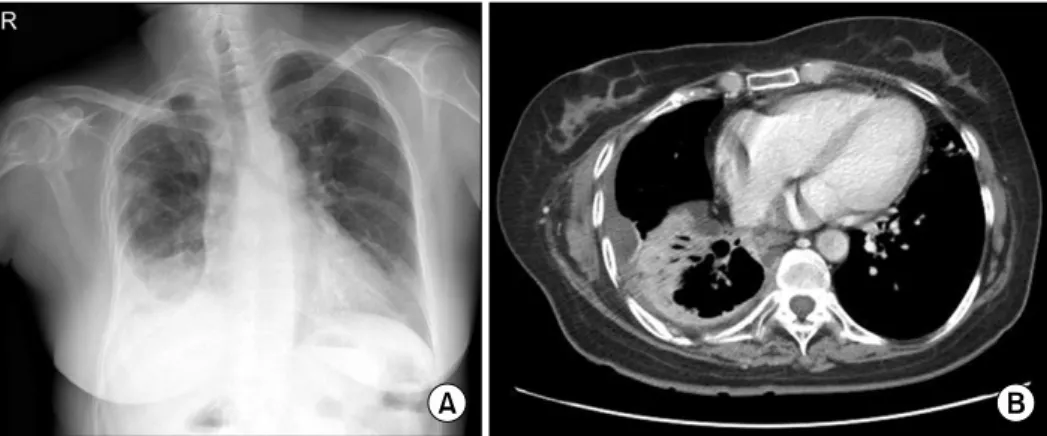
of stage IV NSCLC with malignant pleural effusion 18 months earlier, she had undergone multiple chemo- therapies (four cycles of paclitaxel and carboplatin as the 1st line drugs, followed by gefitinib medication for 8 months). However, her chest and flank pains were worse probably due to aggravated pleural metastasis and loculated effusion (Figure 1). She complained of se- vere, constant, sharp chest and flank pains and rated her background pain intensity at 7 out of 10 on numer- ical rating scale (numerical rating scale [NRS]: 0, no pain; 10, worst possible pain), with intermittent break- through exacerbation. In order to relieve her pains, many medications had been gradually increased from the baseline dosage (fentanyl patches 500 μg/hr, oxy- codone 180 mg/day, tramadol/acetaminophen 150/

1,500 mg/day, gabapentin 2,400 mg/day, alprazolam 0.5 mg/day. At the same time, 4 times of epidural nerve blockage and palliative radiation (3,000 Gy) were applied. Furthermore, additional palliative chemo- therapy with two cycles of pemetrexed and weekly gemcitabine monotherapy were applied. During the hospitalization her pains were gradually decreased by

Case Report

(2)

Tuberculosis and Respiratory Diseases Vol. 68. No. 5, May 2010

287 Figure 1. (A) Chest X-ray shows haziness and pleural effusion in right lower lung field. (B) Chest CT scan shows an increased amount of multiloculated pleural effusion along right pleural space with nodular pleural thickening and enhance- ment, considered as aggravated pleural metastasis.

Figure 2. The simplified graph of the course of increasing fentanyl patch doses according to the patient’s pain scale. IV morphine converted dose means all the oral and parenteral opioid equivalences, including fentanyl patch.

NRS: numerical rating scale.

Figure 3. (A) At her discharge, over 36 patches of trans- dermal fentanyl 100 μg/hr were applied her skin from her trunk to both legs. (B) The patient could be enjoying light exercise such as ringtoss with applying multiple patches.

the mentioned-above treatments from NRS 7/10 to 3/10, in spite of her mild somnolent depressed mood and tol- erable constipation.

Several weeks later, her pains became worse and reached to NRS 9/10 and the increased tumor size was shown on the chest computed tomography imaging.

She did not want further interventions, such as chemo- therapy, radiotherapy, or nerve blockage, and she just

wanted to increase the opioid analgecis as long as she

could stand the side effects. We gradually increased fen-

tanly patches from 500 μg/hr to 1,575 μg/hr for the

first month, to 2,750 μg/hr for the second month, and

finally to 3,650 μg/hr for the third month. In other

words, this treatment was given for 3 months (Figure

2). By addition of other analgesics and anticonvulsant-

including oxycodone 960 mg/day and gabapentin 270

mg/day, she could discharge with improved chest pain

(NRS 4/10). Because total number of patches on her

(3)

SO Kim et al: Ultrahigh-dose opioids for lung cancer pain

288

body was more than thirty six of transdermal fentanyl 100 μg/hr, they were placed over her chest, back, ab- domen, and lower extremities (Figure 3).

Three months after discharging from our hospital, de- spite the current total doses of fentanyl patches were 4,050 μg/hr, she was carrying on her end of life sat- isfactorily with only mild somlolence and constipation.

Finally, she had been doing daily activities for more than 16 months of her last lifetime.

Discussion

Pain is the frequent symptom associated with malig- nancy, and lung cancer is one of the commonest can- cers to cause pain. Pain occurs in about three quarters of patients with advanced malignancy, and this is one of the symptoms patients fear the most

1

. Nociceptive pain was the major pathophysiological subtype in lung cancer pains, but neuropathic pain accounted for 30%

of cases

2

.

The most widely accepted guidelines for the treat- ment of cancer pain were developed by the World Health Organization (WHO)

3

and the National Compre- hensive Cancer Network (NCCN) Adult Cancer Pain Panel

1

. Opioid analgesics have no ceiling effect, and the dosage could be increased according to the pain in- tensity. For chronic cancer pain control, oral opioid ad- ministration is the easiest and safest method. However, the high dose opioids can cause gastrointestinal trou- bles, such as severe constipation and gastric ulcer. On the other hand, transdermal fentanyl patches have less gastrointestinal toxicity due to bypass the first-pass metabolism. We prescribed matrix patch (Durogesic

D-trans; Janssen Cilag, Beerse, Belgium) for this patient.

This patch is the second generation with matrix design in which fentanyl is dissolved in a semisolid formation of a polyacrylate adhesive

4

. There are several published data about maximal dose of fentanyl patches

5-8

. Most patients could use the patch in a range of 1,000 to 3,000 μg/hr, but it was hard to increase higher dose because of severe side effects. However, our case reported pa- tient could increase to the very high dose fentanyl patch

(4,050 μg/hr) with other opioid and non-opioid an- algesics according to her subjective pain scale for more than seven months. Fortunately, the patient could be carrying her daily activities without severe opioids com- plications for the last 16 months of her life. By using WHO ladder, medical treatment has been found effec- tive in relieving pain in approximately 90% of patients with cancer and in over 75% of cancer patients who are terminally ill

4

.

In summary, this case illustrates that cancer pain can be successfully controlled by appropriate opioid an- algesics with tolerable side effects. And we think this reported dose of transdermal fentanly patch is the high- est dose in the published literatures until present.

Acknowledgements

The authors are grateful to the medical team of Mokpo Christian Hospital, for the dedicated patient care.

References

1. National Comprehensive Cancer Network. NCCN clin- ical practice guidelines in oncology: adult cancer pain V.1.2009 [Internet]. Fort Washington: National Compre- hensive Cancer Network; 2009 [cited 2010 Feb 16].

Available from: http://www.nccn.org/professionals/phy- sician_gls/PDF/pain.pdf.

2. Potter J, Higginson IJ. Pain experienced by lung cancer patients: a review of prevalence, causes and patho- physiology. Lung Cancer 2004;43:247-57.

3. Stjernswärd J, Colleau SM, Ventafridda V. The World Health Organization Cancer Pain and Palliative Care Program: past, present, and future. J Pain Symptom Manage 1996;12:65-72.

4. Kress HG, Von der Laage D, Hoerauf KH, Nolte T, Heiskanen T, Petersen R, et al. A randomized, open, parallel group, multicenter trial to investigate analgesic efficacy and safety of a new transdermal fentanyl patch compared to standard opioid treatment in cancer pain.

J Pain Symptom Manage 2008;36:268-79.

5. Menahem S, Shvartzman P. High-dose fentanyl patch for cancer pain. J Am Board Fam Pract 2004;17:388-90.

6. Radbruch L, Elsner F. Clinical experience with trans-

dermal fentanyl for the treatment of cancer pain in

(4)

Tuberculosis and Respiratory Diseases Vol. 68. No. 5, May 2010

289 Germany. Keio J Med 2004;53:23-9.

7. Seamans DP, Wong GY, Wilson JL. Interventional pain therapy for intractable abdominal cancer pain. J Clin Oncol 2000;18:1598-600.

8. Ryu JS, Kim SH, Um UH, Cho JH, Kwak SM, Lee HL.

Successful treatment with high dose transdermal fentan-

yl patch for severe cancer pain in a patient with lung

cancer. Tuberc Respir Dis 2007;62:140-3.

수치

Figure 2. The simplified graph of the course of increasing fentanyl  patch  doses  according  to  the  patient’s  pain  scale

참조

관련 문서

Treatment of severe pain in a patient with complex regional pain syndrome undergoing dental treatment under general anesthesia: A case report.. Seung-Hyun Rhee 1 *, Sang-Hun Park 2

Successful Treatment of Mycobacterium fortuitum Lung Disease with Oral Antibiotic Therapy: a Case Report.. Sunghoon Park, M.D., Gee Young Suh, M.D., Man Pyo Chung,

Successful Treatment of Mycobacterium fortuitum Lung Disease with Oral Antibiotic Therapy: a Case Report.. Sunghoon Park, M.D., Gee Young Suh, M.D., Man Pyo

Case Report of Unresectable Pancreatic Carcinoma Patient for Relieving Cancer Related Pain and Improving Quality of Life by Korean Medical Treatment. Cancer Pain

Successful blind lung isolation with the use of a novel double-lumen endobronchial tube in a patient undergoing lung transplantation with massive pulmonary secretion.. A

Response and resistance in a non-small-cell lung cancer patient with an epidermal growth factor receptor mutation and leptomeningeal metastases treated with high-

Pulmonary paragonimiasis must be considered in the differential diagnosis of lung cancer especially in the appropriate clinical setting because effective

We examined the case of a patient who experienced excruciating pain caused by bone metastasis of breast cancer and who became pain-free, experienced amne- sia, and recovered