S.-I. Lee, Y. -H. Kim and D.-H. Lee should be considered as co-first authors.
S. I. Lee ・ Y. H. Kim ・ Y. M. Lee ・ J. B. Kim ( ) 건국대학교 자연과학대학 생명자원환경과학부
(Faculty of Life Resources and Environmental Science, Konkuk University, Choong-Ju, 380-701, Korea)
e-mail: [email protected] D. H. Lee
제노마인(주) 첨단생명공학연구소
(Genomine Advanced Biotechnology Research Institute, Genomine Inc., Po-hang 790-834, Korea)
S. J. Park
국립원예특작과학원 과수과
(Fruit Research Division, National Institute of Horticultural &
Herbal Science, RDA, Suwon 441-706, Korea)
유채 조직배양 및 형질전환 연구동향
이상일 ・ 김윤혜 ・ 이동희 ・ 이유미 ・ 박서준 ・ 김종보
Current status of tissue culture and genetic transformation systems in oilseed rape plants (Brassica napus L.)
Sang-Il Lee ・ Yun-Hye Kim ・ Dong-Hee Lee・ Yu-Mi Lee ・ Seo-Jun Park ・ Jong-Bo Kim
Received: 4 October 2010 / Accepted: 10 November 2010
ⓒKorean Society for Plant Biotechnology
Abstract Oilseed rape (Brassica napus L.) is an important crop due to its high oil content in the seed. Recently, the demand for the improvement of crop for biodisel energy source is increased as oil prices in the world has increased dramatically. Until now, oilseed rape breeding was carried out by cross-hybridization between different varieties and related germplasms. However, like as many other crops, the application of tissue culture and gene transformation systems has been introduced into oilseed rape breeding program including the development of transgenic canola plants.
In this study, we reviewed a history of tissue culture and genetic transformation research in oilseed rape plants and indicated some important aspects for the production of transgenic oilseed rape plants.
Keywords Agrobacterium, Bio-diesel, Oilseed rape, Particle bombardment, Transformation
서 론
무분별한 화석연료의 사용에 따른 지구온난화와 이로 인 해 발생하는 이상기후, 환경문제, 국제유가의 불안정 등 으로 최근 대체에너지에 대한 관심이 급증하고 있다 (Chung et al. 2008). 유엔기후협약과 온실가스 감축을 위 한 교토의정서가 발효됨에 따라 선진 각국은 온실가스 감축의무를 준수하고 지속가능한 경제 발전을 위해 바이 오에너지 개발 및 보급 목표를 정해 중점 투자하고 있다 (Chung et al. 2008; Kim and Lee 2006). 화석연료 의존도 감 소와 이산화탄소 배출을 줄이기 위해 대체에너지 개발에 박차를 가하고 있으며 세계에너지기구에서는 2005년 대 체에너지 개발에 투자된 비용은 전 세계적으로 약 380억 달러에 이른다고 보고하였다 (http://www.iea.org). 수송용 원료를 100% 수입에 의존하고 이산화탄소 배출 세계 10 위인 우리나라에서도 이산화탄소 감축과 고유가에 대비 하여 대체에너지 개발이 진행 중에 있다 (배정환 2006;
원두환 2008). 각국에서 개발 중인 대체에너지에는 원자 력, 수력, 풍력, 지열, 태양열, 바이오연료 등이 있으며 최 근 수송용 연료를 대체할 수 있는 바이오연료에 대한 관 심이 증가하고 있다 (Hill et al. 2006; Chung et al. 2008). 바 이오연료로는 바이오 에탄올과 바이오디젤이 있으며 최 근 유럽, 미국, 브라질, 중국 등 각국에서는 보급 활성화 를 위해 연구와 개발에 박차를 가하고 있다 (Chung et al.
2008; 배정환 2006). 바이오연료 중 바이오디젤은 식물성 및 동물성 지방, 폐식용유 등 재생 가능한 자원을 이용하여 경유를 대체하는 연료를 말하며 경유와 혼합하거나 대체 하여 사용가능하다 (Kim and Lee 2006). 바이오디젤은 바 DOI:10.5010/JPB.2010.37.4.379
Review
Table 1 Characteristic of cultivars of oilseed rape plants (Brassica napus L.) Cultivars Breeding Year Height
(cm)
Output (kg/10a)
Oil (%)
Oleic acid (%)
Erucic acid (%)
Glucosinolate (%)
Yodal 1969 148 242 45.0 10 56 11.12
Neahan 1980 146 275 43.0 59 0 1.03
Youngsan 1980 143 289 43.9 69 0 0.42
Chungpoong 1983 183 412 44.5 65 0 1.79
Halla 1985 157 279 45.0 65 0 1.51
Tamla 1991 156 300 45.6 56 0 2.69
Tammi 1996 125 287 45.2 62 0 2.30
국립식량과학원 작물정보센터 (http://www.nics.go.kr/CropWebzine/main.asp?m=8&s1=52&s2=233) 이오매스를 이용하여 생산하므로 에너지 자원의 고갈문
제가 없으며 수송용 연료로 이용시 발생하는 CO2는 작물 성장과정에서 회수되므로 CO2 배출량이 대단히 적다. 또 한 황이 포함되어있지 않아 산성비의 원인인 유황산화물 (Sox)의 배출이 거의 없으며 높은 산소 함유량 (10~12%) 으로 보다 완전한 연소가 이루어져 발암물질인 미세물질 의 배출량이 70%가량 줄어드는 등 여러 환경적 이점이 있다 (Kim and Lee 2006; Lee and Kim 2002). 국내에서는 바이오연료 중 바이오디젤을 중심으로 보급이 진행 중이 며 2006년 경유에 바이오디젤을 5% 첨가한 BD5를 보급 하기 시작하여 현재 BD10연료를 보급하고 있다. 국내바 이오 디젤 산업은 시범 보급 단계를 거쳐 상용화 단계에 있으나 생산량이 충분치 않은 실정이며 원료작물을 거의 전량 수입에 의존하고 있어 낮은 원료 자립도와 국제 곡 물가격 상승은 국내 바이오디젤의 개발 보급에 부담이 되고 있다 (원두환 2008). 국내 바이오디젤 생산원료는 주 로 대두유를 이용하고 있으나 2007년부터 유휴농지 및 겨울철 이모작 지역을 이용하여 국내 농업환경에 적합한 유채를 시범재배하고 있다 (배정환 2006).
본 논문에서는 형질전환 유채의 개발을 위해 국내외에 서 보고된 유채 조직배양과 형질전환 연구의 결과와 특 성을 살펴보고자 한다.
바이오디젤 원료작물로써의 유채와 국내재배 현황
바이오디젤 원료용 작물 중 유채는 다른 작물에 비해 바 이오디젤 생산량과 밀접한 관계가 있는 올레인산의 함량 이 높으며 기름을 추출하고 남은 산물인 유채박은 양질 의 동물사료나 유기질 비료로 사용이 가능한 특징이 있 다 (Table 1). 일반적으로 종실에 35~45%의 유지를 함유 하고 있으며 종실 수량은 1 ha당 약 1~4 톤이다 (Kim and Lee 2006). 바이오디젤 주요 생산국인 독일에서는 유채재
배를 통해 바이오디젤을 생산하고 있으며 국내에서는 이 모작이 가능하고 새로운 농가수입 창출과 석유수입 대체 를 목적으로 제주도를 비롯하여 남부지역에서 시범 재배 되고 있다. 국내에서는 주로 ‘한라’ 품종을 재배하지만 생산성이 ha당 1톤에 불과한 단점이 있어 다수성 품종 개 발 연구가 이뤄지고 있으며 농촌진흥청 ‘친환경·바이오 에너지연구사업단’에서는 10 a당 450 kg으로 생산성이 증가된 품종 (청풍, 선망, 청람)과 바이오디젤 품질을 결 정짓는 올레인산 함량이 60~65%까지 증대된 고 올레인 산 품종 (용당, 한라, 영산, 내한, 탐라, 탐미 등)을 개발하 였다 (Kim and Lee 2006; http://www.rda.go.kr/board/board.d o?mode=view&prgId=day_ctbtcolumnEntry&dataNo=10000043 9910). 세계 각국에서는 생산량 향상을 위해 유지함량과 생산성이 증대된 품종개발에 박차를 가하고 있으나 전통 육종을 이용한 방법은 유전자의 직접 도입이 불가능하고 원하는 형질을 도입하는데 많은 시간이 걸리는 단점이 있어 최근 식물생명공학기술을 이용한 식물형질전환 연 구가 시도되고 있다.
조직배양기술의 연구현황
형질전환 기술을 이용한 신품종 유채를 개발하기 위해서 는 우선적으로 효율적인 조직배양체계가 확립되어 있어 야 한다. 식물조직배양기술은 유용물질 생산, 유용유전 자 도입을 통한 새로운 기능을 갖춘 신품종 개발 및 우량 종묘 생산 등의 목적을 위해 이용되고 있다. 조직배양 기 술에 의한 식물체의 재분화의 효율은 식물의 종에 따라 큰 차이를 보이고 동일한 종에서도 품종, 배양조직, 식물 생장조절물질의 종류와 농도, 배양 배지에 첨가되는 물 질에 따라서 달라진다. Brassica 속의 조직배양에 관한 연 구는 cotyledons (Sharma et al. 1990; Hachey et al. 1991; Ono et al. 1994), hypocotyls (Yang et al. 1991), peduncle (Eapen and George 1997), leaves (Radke et al. 1988), roots (Xu et al.
1982) 그리고 protoplasts (Glimelius 1984; Spangenberg et al.
Table 2 A wide range of regeneration efficiency in Brassica napus L.
Explants Cultivar R.E.*(%) References
Hypocotyl Canola 96.0 Khan et al.
(2002) Hypocotyl SLM 460 32.8 Jonoubi et al.
(2004) Hypocotyl, cotyledon Cyclone 78.0 Ali et al.
(2007)
Star 82.0
Westar 67.0 Hypocotyl, cotyledon,
root
Sarigol 51.6 Kamal et al.
(2007) Quantum 68.8
Option 500 62.5
Hypocotyl, cotyledon NL-611 21.2 Burbulis et al. (2008) NL-662 25.6
NL-685 13.1
Thin cell layer Jumbo 46.7 Ghnaya et al.
(2008) (derived hypocotyl and
cotyledon)
Drakkar 32.2 Pactol 11.0 Cossair 6.0
Microspore PF704 68.0 Haddadi et
al. (2008) Hypocotyls Dunkeld 41.7 Munir et al.
(2008) Oscar 70.8
Rainbow 45.8
Cotyledon PF 79.0 Uliaie et al.
(2008) Cobra 18.0
Okpi 7.0
Stem Siska 87.3 Burbulis et
al. (2009) Insider 86.7
Casina 28.0 JW celsius 24.0 Liprima 40.7
Hypocotyls Cyclone 5.0 Khan et al.
(2010)
Star 29.0
Westar 8.7
Cotyledons Cyclone 20.0 Khan et al.
(2010)
Star 15.5
Westar 3.2
*Regeneration efficiency (%) 1986; Hu et al. 1999) 등의 다양한 조직을 통해서 식물체
재분화에 관한 연구가 보고된 바 있다. 그 결과를 살펴보 면 ‘Brassica. oleracea subsp. italica’에서 재분화율이 96.7%
로 나타났으며 (Ravanfar et al. 2009), ‘Brassica. campestris cv. M81’에서 재분화율이 16%로 보고된 바 있다 (Miyasaka and Fujii 1999). Brassica. juncea에서는 7.1%의 재분화율을 보였다 (Bano et al. 2010). 그러나 Miyasaka and Fujii (1999) 에 의하면 Brassica. campestris에서 재분화 빈도가 70~100%
로 보고된 바 있는데 ‘Brassica. campestris cv. M81’과 ‘CR shinrei’를 이용하여 연구하여 본 결과 그것은 재분화 초 기 상태의 유묘 상태를 말하는 것으로 추측된다고 보고 하였다. 그러므로 shoot 재분화 뿐만 아니라 증식체계를 위 한 방법의 개발이 필요하다 (Hachev et al. 1991; Takasaki etal. 1996).
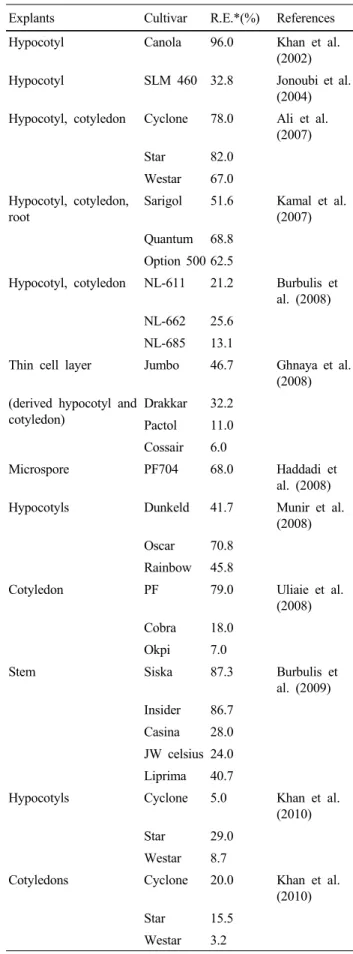
최근 보고된 유채의 조직배양 연구 결과는 Table 2에 간략히 정리하였다. 절편체로는 주로 배축 (hypocotyl)과 자엽 (cotyledon), 소포자 (microspore)에서 유도한 배를 이 용하며 캘러스생성을 거치거나 직접 신초를 유도하는 방 법을 이용한다. 유채의 성공적인 조직배양체계를 확립하 기 위해서는 먼저 품종별 그리고 적합한 절편체의 선택이 중요하다. 현재까지는 주로 자엽과 배축을 이용하여 캘러 스발생과 재분화율에 관한 연구가 진행되었으며 canola 의 ‘Sarigol’, ‘Quantum’, ‘Option 500’의 재분화 효율 비교 실험 결과 각 품종의 자엽을 이용하는 것이 배축을 이용 하는 것보다 재분화 효율이 높았고, ‘Quantum’에서의 경 우 배축을 이용할 경우 재분화율이 31.3% 였지만 자엽을 이용할 경우 68.8% 로서 배축을 이용한 경우보다 높게 나타났다 (Kamal et al. 2007). 그리고 Khan et al. (2010)은
‘Star’, ‘Westar’, ‘Cyclone’ 품종에서도 자엽을 이용하는 것 이 캘러스 발생에 더욱 효과적이라고 보고하였으며 Uliaie et al. (2008)도 겨울 유채품종인 ‘PF’, ‘Orient’, ‘SLM’, ‘Cobra’,
‘Okpi’의 자엽을 이용하여 재분화 효율이 ‘PF’에서 최고 79%
까지 나타났다고 보고하였다. 그러나 Burbulis et al. (2008) 은 봄 품종인 ‘NL-611’, ‘NL-685’의 조직배양시 캘러스 형 성률은 배축에서 최고 100%, 자엽의 경우 84.4%를 보여 배축이 자엽보다 캘러스 형성률이 좋았지만 발생한 캘러 스의 타입에는 차이가 없었으며 재분화율은 자엽에서 37.5%로 배축 (25.7%)보다 높은 효율을 보였다고 보고하 였다.
이외에도 유채의 재분화율을 높이기 위해 품종과 절편 체에 적합한 호르몬의 사용에 관한 연구들이 진행되었으 며 주로 옥신류 (auxin)와 사이토키닌 (cytokinin)의 혼용처 리를 이용하였다. Khan et al. (2002)은 카놀라 품종의 배 축에 NAA와 BA, GA3을 혼용 처리하여 96%의 높은 재분 화율을 보고하였다. 또한 BA가 재분화에 미치는 영향을 확인하기 위해 ‘Tori-7’, ‘Sampad’, ‘Kallyania’, ‘BARI Sarisha -7’, ‘BARI Sarisha-8’, ‘MM 20-3’의 배발생캘러스를 유도
Table 3 Genetic transformation of oilseed rape plants (Brassica napus L.)
Explants Transgenes Method T.E.*(%) References
Hypocotyl gfp Agrobacterium 25.0 Cardoza and Stewart(2003)
Hypocotyl nptⅡ, gusA Agrobacterium 11.8 Jonoubi et al.(2005)
Protoplast nptⅡ, KCS Agrobacterium 3.9 Wang et al.(2005)
Hypocotyl nptⅡ, gusA Agrobacterium 31.0 Moghaieb et al.(2006)
Microspore bar,gusA Agrobacterium 4.5 Cegielska-Taras et al.(2008)
Petiole nptⅡ, gusA Agrobacterium 1.7 Khan et al. (2009a)
Seed nptⅡ, gusA, ChIFN-α Agrobacterium 16.0 Li et al.(2009)
Embryogenesis bar, gusA Biolistics - Abdollahi et al.(2009a)
Microspore bar, gusA Biolistics 15.5 Abdollahi et al.(2010)
Cotyledon aadA, TrnI-TrnA Biolistics 23.0 Cheng et al.(2010)
Embryogenesis gusA Agrobacterium, Biolistics - Abdollahi et al.(2009b)
*Transformation efficiency
한 후 BA 농도별 재분화 효율을 비교한 결과 ‘Tori-7’이 91.4%로 가장 높은 캘러스 형성율을 나타냈고 발생한 캘 러스들은 BA 농도가 증가함에 따라 재분화효율도 증가 하는 모습을 보여 BA 처리가 캘러스와 신초형성에 영향 을 미친다고 보고하였다 (Khan et al. 2009a). 이외에도 TDZ (thidiazuron)와 BA의 혼용처리의 효과를 확인하기위 해 ‘SLM 640’ 품종의 배축을 이용하여 실험을 진행한 결 과 32.8%의 재분화 효율을 보였다고 보고하였다 (Jonoubi et al. 2004). 재분화 효율을 높이기 위해 ABA 처리에 관 한 연구도 진행되었으며 Kamal et al. (2007)은 'Quantum' 품종의 자엽을 이용한 재분화시 ABA를 첨가하였을 경우 재분화율이 68.8%에서 100%로 향상되었다고 보고하였 다. 이전 연구결과에서도 확인할 수 있듯이 유채의 조직 배양은 품종에 따른 절편체와 호르몬 조성 등의 최적화 된 조직배양 체계가 필요하다고 판단된다.
형질전환방법
형질전환법은 주로 particle bombardment를 이용한 유전자 를 직접적으로 도입하는 방법이나 Agrobacterium을 이용 한 형질전환법등을 토대로 하여 형질전환의 효율을 극 대화시키는 방법을 개발하는 방향으로 이루어져 왔다 (Table 3). 그 중 Agrobacterium을 매개로 한 형질전환방법 이 많이 이용되며, 절편체의 종류에 따라서 다양하게 연 구가 진행되었다. 하배축을 이용한 형질전환에서 ‘Brassica napus cv. westar’ 를 사용하여 두 가지의 GFP 유전자와 nptⅡ를 도입한 형질전환체를 제작하여 GFP 유전자에서 각각 17%, 25%의 형질전환효율을 보였으며 (Cardoza and Stewart 2003), 또 다른 연구결과에서는 ‘Brassica napus cv.
PF7045/91‘을 사용하여 GUS 유전자와 nptⅡ를 도입한 형 질전환체를 생산하고 11.8%의 형질전환 효율을 보고하
였다 (Jonoubi et al. 2005). ‘Brassica napus cv. Sarow-4’,
‘Semu-249’에 GUS 유전자와 nptⅡ가 도입된 형질전환체 제작이 이루어졌으며 이 두 가지 품종에서 각각 31%, 27%
의 형질전환효율을 보였다 (Moghaieb et al. 2006). Wang et al. (2005)의 연구에서는 엽육조직에서 원형질체를 분리 하여 ‘Brassica napus cv. maplus’ 품종에서 nptⅡ와 KCS 유 전자를 도입하였고, 3개의 independent 형질전환 계통을 확인하였다. 식물의 형질전환 선발마커로 다양한 항생제 저항성 유전자를 이용하는데 위의 논문 결과들을 분석해 보면 kanamycin에 저항성을 갖게 하는 neomycin phospho- tranferase Ⅱ (nptⅡ)를 주로 사용하였다. 그 외에도 다른 절편체를 이용한 형질전환효율을 증대시키기 위한 여러 연구그룹에서 보고가 있었으나, 형질전환 방법의 기본조 건은 비슷하였다. 그러나, 세부적으로는 유채의 품종이 나 selection marker, 배양조건 및 배지조성 등에서 차이가 있었다 (Damgaard et al. 1997; Haddad et al. 2002; Khan et al. 2009b; Kong et al. 2009).
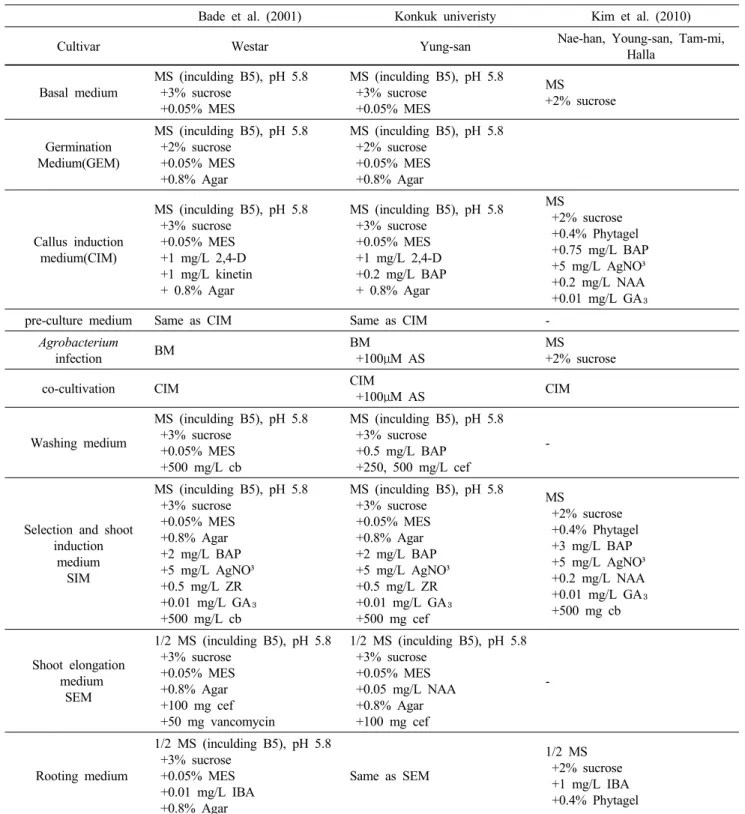
현재까지 보고된 유채의 hypocotyls을 이용하여 Agroba- cterium을 이용한 형질전환 과정을 간단히 살펴보면, 소 독된 성숙 종자로부터 호르몬을 첨가한 callus 유도 배지 에서 전처리 기간을 통해 callus를 유도한다. 그리고 일정 한 전처리 기간이 진행된 후에 Agrobacterium 용액에 접 종하여 공동배양 시킨다. 이후 항생제가 함유된 배지에 서 배양하여 재분화를 유도한다. 유도된 shoot는 발근배 지로 옮겨 생육시킨다 (Cardoza and Stewart 2003; Jonoubi et al. 2005; Khan et al. 2009a). 상기 내용들을 토대로 형질 전환 과정에서 중요하다고 여겨지는 과정들을 보면, 첫 번째로 캘러스를 유도하기 위한 호르몬 처리방식에 따른 배지조성의 비율이다. 다른 논문에서 배지조성을 보면 2,4-D의 단독처리 (Cardoza and Stewart 2003), 2,4-D와 BA 의 혼용처리 (Moghaieb et al. 2006) 등을 이용하고 있으며
Table 4 Comparison of Agarobacterium-mediated transformation conditions for rapeseed plant
Bade et al. (2001) Konkuk univeristy Kim et al. (2010)
Cultivar Westar Yung-san Nae-han, Young-san, Tam-mi,
Halla
Basal medium
MS (inculding B5), pH 5.8 +3% sucrose
+0.05% MES
MS (inculding B5), pH 5.8 +3% sucrose
+0.05% MES
MS
+2% sucrose
Germination Medium(GEM)
MS (inculding B5), pH 5.8 +2% sucrose
+0.05% MES +0.8% Agar
MS (inculding B5), pH 5.8 +2% sucrose
+0.05% MES +0.8% Agar
Callus induction medium(CIM)
MS (inculding B5), pH 5.8 +3% sucrose
+0.05% MES +1 mg/L 2,4-D +1 mg/L kinetin + 0.8% Agar
MS (inculding B5), pH 5.8 +3% sucrose
+0.05% MES +1 mg/L 2,4-D +0.2 mg/L BAP + 0.8% Agar
MS
+2% sucrose +0.4% Phytagel +0.75 mg/L BAP +5 mg/L AgNO³ +0.2 mg/L NAA +0.01 mg/L GA₃
pre-culture medium Same as CIM Same as CIM -
Agrobacterium
infection BM BM
+100μM AS
MS
+2% sucrose
co-cultivation CIM CIM
+100μM AS CIM
Washing medium
MS (inculding B5), pH 5.8 +3% sucrose
+0.05% MES +500 mg/L cb
MS (inculding B5), pH 5.8 +3% sucrose
+0.5 mg/L BAP +250, 500 mg/L cef
-
Selection and shoot induction
medium SIM
MS (inculding B5), pH 5.8 +3% sucrose
+0.05% MES +0.8% Agar +2 mg/L BAP +5 mg/L AgNO³ +0.5 mg/L ZR +0.01 mg/L GA₃ +500 mg/L cb
MS (inculding B5), pH 5.8 +3% sucrose
+0.05% MES +0.8% Agar +2 mg/L BAP +5 mg/L AgNO³ +0.5 mg/L ZR +0.01 mg/L GA₃ +500 mg cef
MS
+2% sucrose +0.4% Phytagel +3 mg/L BAP +5 mg/L AgNO³ +0.2 mg/L NAA +0.01 mg/L GA₃ +500 mg cb
Shoot elongation medium
SEM
1/2 MS (inculding B5), pH 5.8 +3% sucrose
+0.05% MES +0.8% Agar +100 mg cef +50 mg vancomycin
1/2 MS (inculding B5), pH 5.8 +3% sucrose
+0.05% MES +0.05 mg/L NAA +0.8% Agar +100 mg cef
-
Rooting medium
1/2 MS (inculding B5), pH 5.8 +3% sucrose
+0.05% MES +0.01 mg/L IBA +0.8% Agar
Same as SEM
1/2 MS +2% sucrose +1 mg/L IBA +0.4% Phytagel
MES: 2-(n-morpholino) ethaneslfonic acid; IBA: Indole-3-butyric acid; AgNO3: Silver nitrate, BAP: 6-benzylaminopurine, 2,4-D:
2,4-dichlorophenoxyacetic acid, GA3: Gilberellic acid,
Cb: Carbenicillin, Cef: Cefotaxime, NAA: α-Naphthaleneaceic acid, ZR: Zeatin 각각 다른 호르몬 조성에 의해 유도된 캘러스와 재분화
율은 조직배양에서 품종에 따라서 효율이 달라지는 것으 로 보고되어 그 품종에 맞게 사용해야 할 것으로 여겨진다 (Ali et al. 2007). 두 번째로 Agrobacterium 접종 전의 전처
리 단계와 접종 후 공동배양 단계가 형질전환에 중요한 영향을 미치는 것으로 여겨진다. Cardoza and Stewart (2003) 은 전처리 기간과 공동배양의 기간에 따라서 형질 전환 효율이 달라졌음이 보고하였다. 마지막으로 공동배
A B
C D
E F
G H
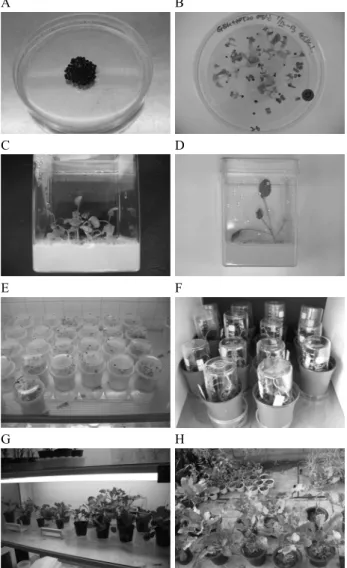
Fig. 1 Process of transgenic plants in ‘Young-san’ seeds using PDS-1000/He
A. Preparation of explants for bombardment (diameter 2cm), B. Survived plants on PPT 20mg/L after 4 weeks,
C. Survived plants on selection medium after 6 weeks, D. Putative transgenic plants growth on PPT 5mg/L medium, E. Rooting of transgenic plants,
F. Acclimatization of transgenic plants,
G. Growth of transgenic plants after acclimatization, H. Growth of transgenic plants in the green house 양 후 유전자가 도입된 캘러스를 선별하는 과정에 중요
한 것으로 파악되었다. 이 과정은 형질전환된 캘러스에 서 저항성유전자가 들어간 shoot의 재분화를 유도하기 위해서 제초제나 항생제가 포함된 배지에서 선발하는 것 으로 여러 항생제 농도를 사용하였을 때 형질전환체 효 율이 달라지는 결과를 보였다. 따라서 이러한 조건들이 각각의 품종에 맞게 최적화되면 유채의 형질전환의 효율 이 증가할 것으로 여겨진다. 이렇게 형질전환방법의 확 립이 이루어지면서 다양한 유용한 유전자들이 도입된 유 채 형질전환체가 Agrobacterium 형질전환법을 이용하여 개발되었다 (Wang et al. 2005). 개발된 형질전환 시스템 식물체의 형질전환법의 확립과 형질전환체 생산을 위한 시간의 단축 이렇게 두 가지 기능의 향상을 목적으로 두 고 실험되었다. 그렇기 때문에 형질전환체 제작을 위한 기간 또한 중요하게 봐야할 필요가 있다. Jonoubi et al.
(2005)의 연구에서는 형질전환체를 얻어내기까지 절편체 를 기점으로 하여 온실로 보내기까지 약 3개월이 소요되 었으며, Moghaieb et al. (2006)는 절편체를 기점으로 하여 shoot가 재분화가 발생할때까지 약 1.5 개월의 기간이 필 요하였다. Wang et al. (2005)의 연구에서는 약 3.5개월 걸 려 형질전환체가 생산되었다. 앞의 연구를 토대로 유채 의 형질전환체를 제작하기 위한 기간으로 대략 shoot의 재분화까지는 1.5개월 그리고 온실까지는 3개월 정도 걸 리는 것으로 판단된다.
국내 제초제 저항성 유채 연구 현황
대두와 팜에 버금가는 유지작물인 유채는 종자에 약 40%의 기름을 함유하고 착유율은 35~38% 이상으로 매우 높은 편으로 바이오디젤 원료용 작물로 국내에서 그 관 심이 증가하고 있다. 국내 유채 형질전환 연구현황은 Kim et al. (2010)이 제초제 저항성을 가지는 유채를 개발 한 것을 처음 보고하였으며 그 내용을 간략히 보면 먼저 바이오에너지 작물로 적합한 품종을 선정하기 위하여 내 한, 영산, 탐미, 한라의 4가지 품종별 종자의 올레인산 함 량을 측정한 결과 한라 품종에서 가장 높은 함유율을 보 였다. 형질전환을 위해 종자에서 발아한 자엽을 이용하 여 Phosphinothricin acetyltranferase (PAT) 유전자를 포함 하 는 pCAMBIA3301 벡터가 도입된 Agrobacterium tumefaciens GV3101 균주를 이용하였다. A.tumefaciens 접종 후 Phos- phinothricin (PPT)을 첨가하지 않고 500 mg/L carbenicillin 만 첨가한 배지에서 캘러스를 유도한 후 4 mg/L PPT가 첨가된 배지에서 shoot를 유도하였다. 발생한 shoot만을 절단하여 8 mg/L PPT가 첨가된 배지에서 뿌리를 유도한 후 발근한 개체는 순화를 실시하였다. 실험결과 품종별 전체 발생한 캘러스 중 PPT 저항성을 가지는 캘러스 형 성률은 한라 품종에서 68.8%로 가장 높았으며 PPT 저항
성과 GUS 발현을 통하여 확인된 한라품종의 형질전환 효율은 약 10.4%로 나타났다. 국내에서 보고된 이전 연구 에서는 유채의 자엽을 이용한 형질전환 실험 시 절편체 당 shoot 발생효율이 17.5%이며 (Kim et al. 1997) 이전연구 와 서로 다른 형질전환 효율이 나타난 이유는 사용한 품 종 (내한, 한라)과 선발마커 (NPTⅡ, PAT)의 차이에서 비 롯된 것이라고 보고하였다.
본 연구진은 particle bombardment와 Agrobacterium 매개 형질전환법을 이용하여 생산성증대 유채 식물체를 획득 하였다. Particle bombardment를 이용한 형질전환법은 Fig.
1과 같으며 절편체를 직경 2cm의 원으로 치상한 후 수량
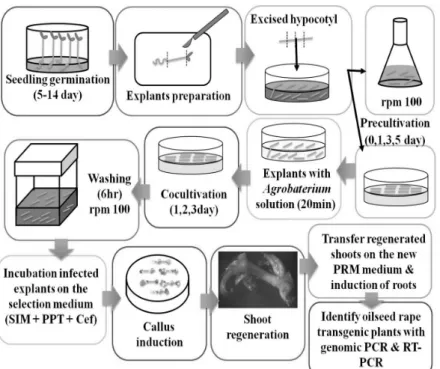
Fig. 2 General process of Agrobacterium-mediated transformation system for oilseed rape plants (Brassica napus L. “Young-san”)
증대유전자가 도입된 골드입자를 이용하여 PDS-1000/He (Bio-Rad, Hercules. USA)을 이용하여 형질전환을 실시하 였다. 1일간 휴식처리 후 선발배지로 옮겨 선발을 실시하 였다. Agrobacterium을 이용한 형질전환은 절편체를 Agro- bacterium 접종액에 20분간 처리 후 3일간 공동배양을 실 시하였다. 이후 cefotaxime을 첨가한 액체 MS배지에 2회 수세 후 선발배지로 옮겨 선발하였다. 선발에서 생존한 개체들은 순화를 실시하였다. 본 연구진에서는 절편체의 종류에 따라 형질전환을 획득하는 기간에서 차이를 보였 는데 종자의 경우 순화한 형질전환체를 획득하기까지 약 3개월의 기간이 소요되었다. 그러나 배축을 이용한 실험 의 경우 절편체의 준비 (5~14일), 전처리 (5~8일)와 shoot 유도 (4~8주) 및 신장 (4주), 발근 (4주) 등 여러 단계를 거 쳐 순화 식물체를 획득하기까지 약 5개월의 기간이 소요 되어 종자를 절편체로 이용한 경우보다 오랜 기간이 소 요되었다 (Fig. 2). 향후 보다 효율적인 형질전환 체계 확 립을 통하여 생산성 및 유지함량 증대 또는 복합환경저 항성 등의 유용 형질을 가지는 유채 품종개발이 가까운 미래에 이루어질 것으로 판단된다.
사 사
본 연구는 농림수산식품기술기획평가원 농림기술개발사 업 (과제번호: 109166-03-2-HD120) 지원에 의하여 이루어 졌으며, 이에 감사드립니다.
인용문헌
배정환 (2006) 바이오연료의 보급전망과 사회적 비용·편 익 분석. 에너지경제연구원 수시연구보고서 06-04 원두환 (2008) 바이오에너지산업 육성을 통한 FTA 대응
전략 연구-바이오연료의 비시장가치 평가-. 에너지경 제연구원 기술연구보고서 08-16
Abdollahi MR, Moieni A, Mousavi A, Salmanian AH (2010) High frequency production of rapeseed transgenic plants via combination of microprojectile bombardment and secondary embryogenesis of microspore-derived embryos.
Mol Biol Rep 10.1007/s11033-010-0158-3
Abdollahi MR, Moieni A, Salmanian AH, Mousavi A (2009a) Secondary embryogenesis and transient expression of the β-glucuronidase gene in hypocotyls of rapeseed microspore-derived embryos. Biologia Plantarum 53(3):
573-577
Abdollahi MR, Corral-Martìnez P, Mousavi A, Salmanian AH, Moieni A, Seguì-Simarro JM (2009b) An efficient methods for transformation of pre-androgenic, isolated Brassica napus microspores involving microprojectile bombardment and Agrobacterium-mediated transformation.
Acta Physiol Plant 31:1313-1317
Ali H, Ali Z, Ali H, Mehmood S, Ali W (2007) In vitro regeneration of Brassica napus L. cultivars (Star, Cyclo- neand Westar) from hypocotyls and cotyledonary leaves.
Pak J Bot 39(4):1251-1256
Bade JB (2001) Agrobacterium tumefaciens-mediated transf- ormation of Brassica napus. Ph. d thesis, Leiden Unive- rsity, The Netherlands
Bano R, Khan MH, Khan RS, Hamid Rashid, Zahoor A Swati (2010) Development of an efficient regeneration protocol for three genotypes of Brassica Juncea L. Pak J Bot 42(2):963-969
Burbulis N, Kupriene R, Blistrubiene A (2008) Callus induction and plant regeneration from somatic tissue in spring rapeseed (Brassica napus L.). Biologia Plantarum 54(4) 258-263
Burbulis N, Blinstrubiene A, Kupriene R, Jonytiene V, Rugienius R, Staninen G (2009) In vitro regeneration of Brassica napus L. shoots from hypocotyls and stem segments. Zemdirbyste Agri 96(3):176-185
Cardoza V, Stewart CN (2003) Increased Agrobacterium- mediated transformation and rooting efficiencies in canola (Brassica napus L.) from hypocotyl segment explants.
Plant Cell Rep 21:599-604
Cegielska-Taras T, Pniewski T, Szala L (2008) Transformation of microspore-derived embryos of winter oilseed rape (Brassica napus L.) by using Agrobacterium tumefaciens.
J Appl Genet 49(4):343-347
Cheng L, Li HP, Qu B, Huang T, Tu JX, Fu TD, Liao YC (2010) Chloroplast transformation of rapeseed (Brassica napus) by particle bombardment of cotyledons. Plant Cell Rep 29(4):371-381
Chung JH, Kwon KS, Jang HS (2008) Development of transportation bio-energy and its future. Kor J Microbiol Biotechnol 36(1)1-5
Damgaard O, Jensen LH, Rasmussen OS (1997) Agrobacterium tumefaciens-mediated transformation of Brassica napus winter cultivars. Transgenic Res 6:279–288
Eapen S and George L (1997) Plant regeneration from peduncle segments of oil seed Brassica species: influence of silver nitrate and sliver thiosulfate. Plant Cell Tiss Org Cult 51:229-232
Ghnaya AB, G Charles, M Branchard (2008) Rapid shoot regeneration from thin cell layer explants excised from prtioles and hypocotyls in four cultivars of Brassica napus L. Plant Cell Tiss Org Cult 92:25-30
Glimelius K (1984) High growth rate and regeneration capacity of hypocotyls protoplasts in some Brassicaceae. Physiol Plant 61:38-44
Hachey JE, Sharma KK, Moloney MM (1991) Efficient shoot regeneration of Brassica campestris using cotyledon explants cultured in vitro. Plant Cell Rep 9:549-554 Haddad R, Morris K, Wollaston VB (2002) Regeneration and
transformation of oilseed (Brassica napus) using CaMV35S promoter-β-glucuronidase gene. J Agric Sci Technol 4:
151-160
Haddadi P, A Moieni, G Karimzadeh, MR Abdollahi (2008) Effect of gibberellin, abscisic acid and embryo desiccation on normal plantlet regeneration, secondary embryogenesis and callogenesis in microspore culture of Brassica napus L. cv. PF704. Intl J of Plant Prod 2:153-162
Hill, J, Nelson E, Tillman D, Polasky S, Tiffany D (2006) Environmental, economic, and energetic costs and benefits
of biodiesel and ethanol biofuels. Proc Natl Acad Soc USA 103:11206-11210.
Hu Q, Anderson SB, Hansen LN (1999) Plant regeneration capacity of mesophyll protoplasts from Brassica napus and related species. Plant Cell Tiss Organ Cult 59:189- 196
Jonoubi P, Mousavi A, Majd A, Daneshian J (2004) Improved Brassica napus L. regeneration from hypocotyls using thidiazuron and benzyladenine as cytokinin sources. Pak J Bot 36(2):321-329
Jonoubi P, Mousavi A, Majd A, Salmanian AH, Javaran MJ, Daneshian J (2005) Efficient regeneration of Brassica napus L. hypocotyls and genetic transformation by Agr- obacterium tumefaciens. Biologia Plantarum 49(2):175-180 Kamal GB, Lllich KG, Asadollah A (2007) Effect of genotype,
explant type nutrient medium components on canola (Brassica napus L.) shoot in vitro organogenesis. Afr J of Biotechnol 6(7):861-867
Khan MR, Rashid H, Quraishi A (2002) High frequency shoot regeneration from hypocotyl of Canola(Brassica napus L.) cv. Dunkled. Plant Tiss Cult 12(2):131-138 Khan I, Ali W, Takar ZA, Frooqi A, Sikandar, Akhtar W
(2010) Increased regeneration efficiency of Brassica napus L. cultivars Star, Westar and Cyclone from hypo- cotyle and cotyledonary explants. Nature Precedings:
hdl:10101/npre.2010.4781.1:Posted 17 Aug 2010 Khan MMA, Hassan L, Ahmad SD, Shah AH, Batool F
(2009a) In vitro regeneration potentiality of oil seed Brassica genotypes with differential BAP concentration.
Pak J Bot 41(3):1233-1239
Khan MA, Arif Hasan Khan Robin ABM, Nazim-Ud-Dowla MAN, Talukder SK, Hassan L (2009b) Agrobacterium- mediated genetic transformation of two varieties of Brassica: Optimization of protocol. Bangladesh J Agril Res 34(2):287-301
Kim CS and Lee SH (2006) Economic analysis of a Rape production for Biodiesel. Kor J of Org Agri 14(3):237- 249
Kim HJ, Lee HJ, Go YS, Roh KH, Lee, YH, Jang YS, Suh MC (2010) Development of herbicide-tolerant Korean rapeseed(Brassica napus L.) cultivars. J Plant Biotechnol 37:319-326
Kim KM, Shon JK, Chung JD (1997) Transformation Brassica napus via Agrobacterium vector : plant regeneration and progeny analysis. Kor Plant Tissue Culture 24:269-272 Kong F, Li J, Tan X, Zhang L, Zhang Z, Qi C, Ma X (2009)
A new time-saving transformation system for Brassica napus. Afr. J. Biotechnol. 8(11):2497-2502
Lee YJ and Kim GC (2002) The state of the art of biodiesel as a clean diesel alternative. KIER
Li S, Zhao D, Wu YJ, Tian X (2009) A simplified seed tran- sformation methods for obtaining transgenic Brassica napus plants. Agri Sci in China 8(6):658-663
Miyasaka Y, Fujii T (1999) Shoot regeneration from explants of seedstalk developed in vitro in Chinese cabbage.
Plant Biotechnol 16(2):163-166
Moghaieb REA, El-Awady MA, El Mergawy RG, Youssef SS, El-Sharkawy AM (2006) A reproducible protocol for regeneration and transformation in canola(Barssica napus L.). Afr J Biotechnol 5(2):143-148
Munir M, Rashid H, Rauf M, Chaudhry Z, Bukhari MS (2008) Callus formation and plantlets regeneration from hypocotyl of Brassica napus by using different media combinations. Pak J Bot 40(1):309-315
Ono Y, Takahata Y, Kaizuma N (1994) Effect of genetype on shoot regeneration from cotyledonary explants of rapeseed(Brassica napus L.). Plant Cell Rep 14:13-17 Radke SE, Andrews BM, Moloney MM, Crouch ML, Krid
JC, Knauf VC (1988) Transformation of Brassica napus L. using Agrobacterium tumefactiens: developmentally regulated expression of are introduced naping ene. Theor Appl Genet 75:685-694
Ravanfar SA, Aziz MA, Kadir MA, Rashid AA, Sirchi MHT (2009) Plant regeneration of Brassica oleracea subsp.
italica(Broccoli)CV Green Marvelas affected by plant growth regulator. Afr J Biotechnol 8(11):2523-2528 Sharma KK, Bhojwani SS, Thorpe TA (1990) Factors affecting
high frequency differentiation of shoots from cotyledon
explants of Brassica juncea (L.) Czern. Plant Sci 66:247-253 Spangenberg, Koop GHU, Lichter R, Schweiger HG (1986)
Microculture of single protoplasts of Brassica napus.
Physiol Plant 66:1-8
Takasaki T, Hatakeyama K, Ojima K, Watanabe M, Toriyama K, Hinata K (1996) Effects of various factors (hormone combinations, genotypes and antibiotics) on shoot rege- neration from cotyledon explants in Brassica rapa L.
Plant Tiss Cult Lett 13:177-180
Uliaie ED, Farsi M, Ghreyazie B, Imani J (2008) Effect of genotype and AgNO3 on shoot regeneration in winter cultivars of rapeseed (Brassica napus). Pak J Biol Sci 11(16):2040-2043
Wang YP, Sonntag K, Rudloff E, Han J (2005) Production of fertile transformation Brassica napus by Agrobacte- rium-mediated transformation of protoplasts. Plant Breed 124:1-4
Xu ZH, Davey MR, Cocking EC (1982) Plant regeneration from root protoplasts of Brassica. Plant Sci Lett 24:117-121 Yang MZ, Jia SR, Pua EC (1991) High frequency of plant
regeneration from hypocotyl explants of Brassica carinata A. Br. Plant Cell Tiss Org Cult 24:79-82