항암화학요법으로 인한 증상에 대한 반하사심탕의 효과 : 체계적 문헌고찰
안수빈1, 이가영1, 황현호1, 정민정2, 장인수3
1우석대학교 한의과대학 한의학과, 2우석대학교 한의과대학 소아과학교실
3우석대학교 한의과대학 한방내과학교실
The Effect of Banhasasim-tang in the Treatment of Chemotherapy-induced Symptoms:
A Systematic Review
Su-bin Ahn1, Ga-young Lee1, Hyeon-ho Hwang1, Min-jeong Jeong2, In-soo Jang3
1Dept. of Korean Medicine, College of Korean Medicine, Woosuk University
2Dept. of Pediatrics, College of Korean Medicine, Woosuk University
3Dept. of Internal Medicine, College of Korean Medicine, Woosuk University
ABSTRACT
Objective:The purpose of this study was to investigate (using a systematic review) the effect ofBanhasasim-tang in the treatment of chemotherapy-induced symptoms.
Method:A systematic review was conducted to identify the effect ofBanhasasim-tang for chemotherapy-induced symptoms.
Electronic databases were used, including such as PubMed, Cochrane, CNKI, Wanfang, CiNii, J-STAGE, NDSL, and OASIS.
Among others, the main search terms included “cancer”, “Banhasasim-tang”, “Banxia Xiexin Tang”, and “Hangeshashin-to”.
This study only included randomized controlled trials (RCTs).
Results:A total of 14 RCTs were selected. They all identified the effect ofBanhasasim-tang in the treatment of chemotherapy- induced symptoms such as nausea, vomiting, and diarrhea. In addition, five of the studies evaluated the preventive effect of Banhasasim-tang on the symptoms.
Conclusion:An analysis of 14 RCTs showed thatBanhasasim-tang for chemotherapy-induced symptoms might be effective not only for treatment but also for prevention. However, due to the low quality and number of the selected original articles, the significance of this conclusion is somewhat limited. It is hoped that more systematic and rigorous clinical trials will be conducted.
Key words:cancer,Banhasasim-tang, chemotherapy, systematic review
Ⅰ. 서 론
암은 전 세계적으로 사망의 주요 원인 중 하나
이며, WHO에서 제시하는 Globocan 2018에 따르면 2018년에는 약 960만 명이 암으로 인해 사망하였다
1. 암이 전 세계 사망률의 16%를 차지하는 가운데
2, 우리나라의 경우 2017년 기준 전체 사망자의 약 27.6%가 암으로 인한 사망으로 보고되었다
3. 이에 따라 암을 치료하기 위해 방사선치료, 수술 치료 등 많은 치료법이 개발되었고, 그 중 약물을 이용한
․투고일: 2019.09.09, 심사일: 2019.10.04, 게재확정일: 2019.10.04
․교신저자: 장인수 전북 전주시 완산구 중화산동 2-5 우석대부속한방병원
TEL: 063-220-8608 FAX: 063-220-8616 E-mail: [email protected]
항암화학요법은 20세기 초반부터 개발되기 시작하 여
4현재에도 널리 활용되고 있는 항암요법이다.
항암화학요법은 높은 치료율을 나타내고 있지 만, 이에 수반되는 부작용은 심각한 문제를 야기한 다. 항암화학요법의 가장 대표적인 부작용에는 오 심, 구토, 빈혈, 백혈구 및 혈소판 수 감소, 구내염, 설사, 탈모, 생식기능의 장애 등이 있다
5. 이러한 부작용은 암환자의 건강 및 생활의 질, 그리고 항 암화학요법의 순응도 등에 부정적인 영향을 주어
6, 항암치료와 함께 부작용을 제어하는 것이 중요 과 제로 대두되었다.
한편, 반하사심탕은 ≪傷寒論≫
7<辯太陽病脈證 辨治下>편 149번 조문에 최초로 기록된 처방으로, 結胸, 心下滿, 痞의 증상이 진단의 핵심이다. ≪金 匱要略≫
8에도 ‘嘔而腸鳴 心下痞者 半夏瀉心湯主之’
로 기록되어 있으며, 이는 반하사심탕을 오심, 구 토, 위하수, 위궤양, 설사 등 현대 소화기 질환에 응용하는 주요 문헌적 근거이다
9. 또한 반하사심탕 은 和胃降逆, 開結除痞, 鎭吐, 解熱, 消炎 및 鎭痛 등의 작용이 있는 것으로 알려져 있다
10.
이에 본 연구에서는 암환자의 삶의 질 등에 큰 영향을 미치는 항암화학요법으로 인한 증상에 대 한 반하사심탕의 효과를 파악하기 위해 항암화학 요법으로 인한 증상을 반하사심탕으로 치료한 무 작위 임상연구를 대상으로 체계적 고찰하여 그 결 과를 보고하고자 한다.
Ⅱ. 연구방법
1. 검색 엔진 및 문헌 검색 전략
검색 엔진은 영미권에서는 PubMed(https://www.
ncbi.nlm.nih.gov/pubmed/), Cochrane library(https://
www.cochranelibrary.com)를 사용하였다. 국내 논 문 검색은 NDSL(National Digital Science Links, www.ndsl.kr)과 OASIS(Oriental medicine Advanced Searching Integrated System, https://oasis.kiom.re.kr), 중국에서는 CNKI(China National Knowledge
Infrastructure, https://www.cnki.net/)와 Wanfang (http://www.wanfangdata.com.cn), 일본에서는 J-STAGE (Japan Science and Technology Agency, https://
www.jstage.jst.go.jp)와 CiNii(https://ci.nii.ac.jp) 검 색 엔진을 사용하였다.
영미권 검색 엔진 키워드는 ‘Cancer’, ‘Banhasasim-tang’,
‘Banxiaxiexintang’, ‘Banxiaxiexin-tang’, ‘Banxiaxiexin tang’, ‘Banxia xiexin tang’, ‘Banxiaxiexin’, ‘Banxia xiexin’, ‘pinellia heart-draining’, ‘DBXX’, ‘hange (shashinto)’, ‘TJ-14’ 등이었고, 국내 검색 엔진 키 워드는 ‘암’, ‘반하사심탕’, ‘반하사심’이었다. 중국 검색 엔진 키워드는 ‘半夏 泻心汤’, ‘癌’, ‘随机’이었
고, 일본 검색 엔진 키워드로는 ‘癌’, ‘半夏瀉心湯’,
‘TJ-14’, ‘hange(shashinto)’를 사용하였다. 각 국가 별 검색 엔진의 특성에 따라 검색 키워드를 조합 하여 검색을 진행하였다.
검색은 2019년 8월 22일에 시행하였고, 검색 기 간은 검색 엔진이 지원하는 개시 시점부터를 범위 로 하였다. 언어에 대한 제한은 없었다.
2. 문헌 선정 및 자료 추출
일차적으로 선정된 문헌을 대상으로 선정 및 제 외기준에 따라 문헌의 전문을 검토하여 최종 선정 을 하였다. 최종 선정된 문헌에 관하여 미리 검토 된 자료 추출 서식에 따라 자료를 추출하였다. 자 료 추출 서식에는 환자의 질환, 성별 및 인원 수, 항암화학요법의 종류, 시험군의 중재(투여약물, 복 용방법), 대조군의 중재(투여약물, 복용방법), 시험 군과 대조군의 중재기간, 결과변수, 결과값, 이상반 응 여부를 포함하였다.
3. 비뚤림 위험 평가
비뚤림 위험평가는 Cochrane group이 제작한 Risk of Bias(RoB)
11도구를 사용하여 수행되었다.
선택 비뚤림, 실행 비뚤림, 결과 확인 비뚤림, 탈락
비뚤림, 보고 비뚤림, 기타 비뚤림 등 각 항목에 대
해 평가하여 low risk of bias(L), high risk of bias
(H), unclear risk of bias(U)로 표기하였다.
Ⅲ. 결 과
1. 문헌 선별
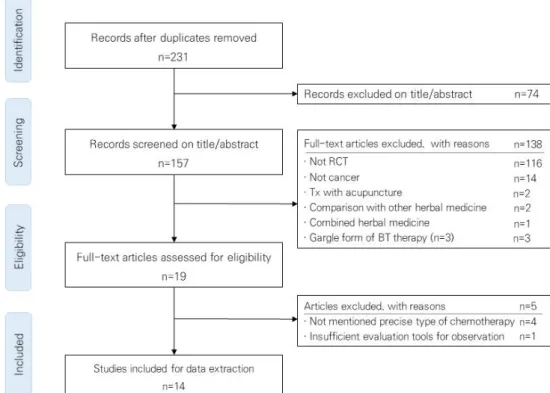
최초 246편의 문헌이 검색(PubMed 45편, Cochrane 61편, CNKI 63편, Wanfang 44편, CiNii 22편, J-STAGE 10편, NDSL 1편, OASIS 0편)되었으며, 15편의 중복 문헌을 제외하여 1차적으로 231편의 문헌이 선정되었다. 문헌의 제목과 초록을 검토하 여 74편의 문헌이 본 연구 주제와 일치하지 않는
것으로 확인하여 배제하고, 2차적으로 157편의 문 헌이 선정되었다. 이후 전문 검토를 통해 138편의 문헌을 배제(Non-RCT 문헌 116편, 암을 대상으로 하지 않은 문헌 14편, 반하사심탕 복합처방 문헌 3 편, 반하사심탕을 경구로 복용하지 않은 문헌 3편, 대조군이 양약이 아닌 문헌 2편)하고 2차적으로 19 편의 문헌이 선정되었다. 이 중 정확한 항암화학요 법 종류를 밝히지 않은 문헌 4편, 증상의 변화를 관찰하기에 평가도구가 부족한 문헌 1편을 배제하여, 최종적으로 14편의 RCT 문헌이 선정되었다(Fig. 1).
Fig. 1. PRISMA flow diagram for process of literature.
2. 문헌 분석 1) 연구 대상 특성
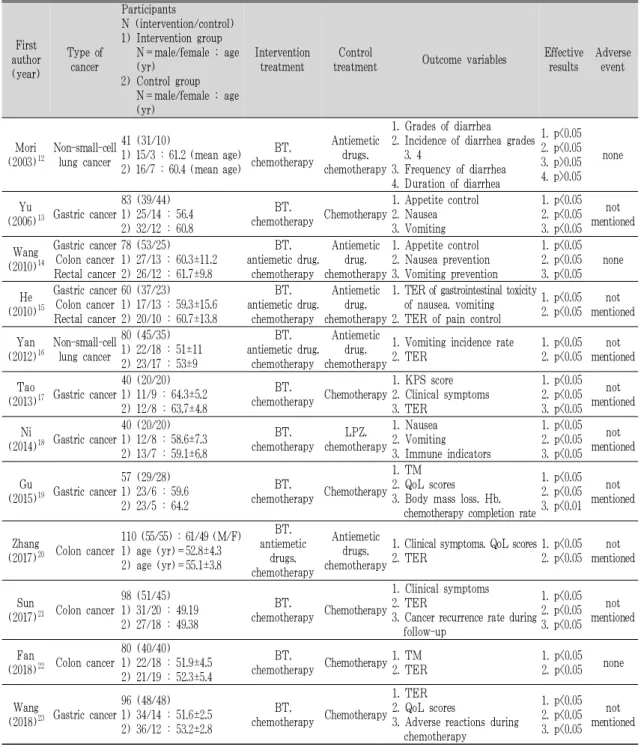
최종 선정된 14편의 문헌을 분석한 결과 암 종 류 중에서는 비소세포폐암이 2편
12,16, 위암이 5편
13,17,18,23
, 결장(직장)암이 5편
20-22,24,25이었고, 위암과
결장(직장)암 환자를 동시에 모집하여 연구를 진
행한 문헌이 2편
14,15이었다. 변증을 같이 진단에 사
용한 문헌은 5편으로, 변증은 脾胃濕熱 1편
17, 寒熱
錯雜 4편
20-22,24이었다. 한편, 항암화학요법으로 인한 증상에는 식욕저하 4편
13,14,16,18, 오심 구토 3편
13-15,
설사 1편
12, 암성 통증
151편 등이 있었다(Table 1).
First author (year)
Type of cancer
Participants
N (intervention/control) 1) Intervention group
N=male/female ; age (yr)
2) Control group N=male/female ; age (yr)
Intervention treatment
Control
treatment Outcome variables Effective results
Adverse event
Mori (2003)12
Non-small-cell lung cancer
41 (31/10)
1) 15/3 : 61.2 (mean age) 2) 16/7 : 60.4 (mean age)
BT, chemotherapy
Antiemetic drugs, chemotherapy
1. Grades of diarrhea 2. Incidence of diarrhea grades
3, 4
3. Frequency of diarrhea 4. Duration of diarrhea
1. p<0.05 2. p<0.05 3. p>0.05 4. p>0.05
none
Yu
(2006)13 Gastric cancer
83 (39/44) 1) 25/14 : 56.4 2) 32/12 : 60.8
BT,
chemotherapy Chemotherapy
1. Appetite control 2. Nausea 3. Vomiting
1. p<0.05 2. p<0.05 3. p<0.05
not mentioned
Wang (2010)14
Gastric cancer Colon cancer Rectal cancer
78 (53/25) 1) 27/13 : 60.3±11.2 2) 26/12 : 61.7±9.8
BT, antiemetic drug,
chemotherapy
Antiemetic drug, chemotherapy
1. Appetite control 2. Nausea prevention 3. Vomiting prevention
1. p<0.05 2. p<0.05 3. p<0.05
none
He (2010)15
Gastric cancer Colon cancer Rectal cancer
60 (37/23) 1) 17/13 : 59.3±15.6 2) 20/10 : 60.7±13.8
BT, antiemetic drug,
chemotherapy
Antiemetic drug, chemotherapy
1. TER of gastrointestinal toxicity of nausea, vomiting 2. TER of pain control
1. p<0.05 2. p<0.05
not mentioned
Yan (2012)16
Non-small-cell lung cancer
80 (45/35) 1) 22/18 : 51±11 2) 23/17 : 53±9
BT, antiemetic drug,
chemotherapy
Antiemetic drug, chemotherapy
1. Vomiting incidence rate 2. TER
1. p<0.05 2. p<0.05
not mentioned
Tao
(2013)17 Gastric cancer
40 (20/20) 1) 11/9 : 64.3±5.2 2) 12/8 : 63.7±4.8
BT,
chemotherapy Chemotherapy
1. KPS score 2. Clinical symptoms 3. TER
1. p<0.05 2. p<0.05 3. p<0.05
not mentioned
Ni
(2014)18 Gastric cancer
40 (20/20) 1) 12/8 : 58.6±7.3 2) 13/7 : 59.1±6.8
BT, chemotherapy
LPZ, chemotherapy
1. Nausea 2. Vomiting 3. Immune indicators
1. p<0.05 2. p<0.05 3. p<0.05
not mentioned
Gu
(2015)19 Gastric cancer
57 (29/28) 1) 23/6 : 59.6 2) 23/5 : 64.2
BT,
chemotherapy Chemotherapy 1. TM 2. QoL scores 3. Body mass loss, Hb,
chemotherapy completion rate 1. p<0.05 2. p<0.05 3. p<0.01
not mentioned
Zhang
(2017)20 Colon cancer
110 (55/55) : 61/49 (M/F) 1) age (yr)=52.8±4.3 2) age (yr)=55.1±3.8
BT, antiemetic
drugs, chemotherapy
Antiemetic drugs, chemotherapy
1. Clinical symptoms, QoL scores 2. TER
1. p<0.05 2. p<0.05
not mentioned
Sun
(2017)21 Colon cancer
98 (51/45) 1) 31/20 : 49.19 2) 27/18 : 49.38
BT,
chemotherapy Chemotherapy
1. Clinical symptoms 2. TER
3. Cancer recurrence rate during follow-up
1. p<0.05 2. p<0.05 3. p<0.05
not mentioned
Fan
(2018)22 Colon cancer
80 (40/40) 1) 22/18 : 51.9±4.5 2) 21/19 : 52.3±5.4
BT,
chemotherapy Chemotherapy1. TM 2. TER
1. p<0.05 2. p<0.05 none
Wang
(2018)23 Gastric cancer
96 (48/48) 1) 34/14 : 51.6±2.5 2) 36/12 : 53.2±2.8
BT,
chemotherapy Chemotherapy 1. TER 2. QoL scores
3. Adverse reactions during chemotherapy
1. p<0.05 2. p<0.05 3. p<0.05
not mentioned
Table 1. Characteristics of Included Studies
2) 치료 기간
항암화학요법 치료 기간은 5일
14,15, 8일
16, 10일
17, 2주
19,25, 3주
23, 4주
13,18, 6주
20,22,24, 9.6주
12, 12주
21순으
로 길었고 6주가 3편, 5일과 2주, 4주가 각 2편순으 로 많았다(Table 2).
Wang
(2019)24 Colon cancer
100 (48/52)
1) 26/22 : 51.82±10.33 2) 31/21 : 53.15±9.87
BT,
chemotherapy Chemotherapy
1. Short-term efficacy : clinical efficacy, objective remission rate
2. TM and its TER 3. KPS, QoL scores
4. Adverse reactions : influences to AST/ALT, WBC 5. Other adverse reactions
1. p>0.05 2. p<0.05 3. p<0.05 4. p<0.05 5. p>0.05
not mentioned
Yamazaki (2019)25
Colorectal cancer
30 (14/15)
1) 8/6 : 56.5 (mean age) 2) 8/7 : 57 (mean age)
BT, chemotherapy
Sodium bicarbonate, ursodeoxycholic
acid, magnesium
oxide, chemotherapy
1. Incidence and severity of adverse reactions 2. Neutropenia 3. Effects in response to
FOLFIRI.3 therapy 4. Effects on medianduration
of FOLFIRI.3 therapy 5. Survival curves of PFS
1. p>0.05 2. p>0.05 3. p>0.05 4. p>0.05 5. p>0.05
not mentioned
CPT-11 : irinotecanhydrocholoride, CDDP : cisplatinCDDP, rG-CSF : recombinanthumangranulocytecolony-stimulatingfactor, MCP : metoclopramide, MPS : methylprednisolone, DPH : diphenhydramine, ALP : alprazolam, 5-FU : 5-fluorouracil, DXR : doxorubicin, MMC : mitomycin, LV : calcium folinate, GEM : gemcitabine, NVB : navelbine, DTX : docetaxel, PTX : paclitaxel, DEX : dexamethasone, DIPHEN : diphen hydramine hydrochloride, OXA : oxaliplatin, ETO : etoposide, BT : Banhasasim-tang, BanXiaXieXinTang, TJ-14,
TNM : tumor, node & metastasis, TER : total effective rate, TM : traditional medicine, KPS : Karnofsky performance status, QOL : quality of life, Hb : hemoglobin, PFS : progression-free survival, LPZ : Lansoprazole
First author
(year) Type of chemotherapy Treatment duration Mori
(2003)
12Chemotherapy ; CPT-11, CDDP, rG-CSF Antiemetic drugs ;
MCP, MPS, DPH, ALP
Intervention group : 9.6 weeks (mean), 3 days before the start of chemotherapy
Control group : 10 weeks (mean) Yu
(2006)
13Chemotherapy (FAM) ; 5-FU, DXR, MMC
Start of medication : within 10-15 days after op 1 course of chemotherapy : 4 weeks
1 course of BT therapy : 1 week
Wang (2010)
14Chemotherapy ; LV, 5-FU, Antiemetic drug ; MCP
Start of medication : after the op wound recovered, and the oral diet resumed
1 course of chemotherapy : 5 days
BT therapy : 3 days before chemotherapy to 7 days after the end of chemotherapy
He (2010)
15Chemotherapy ; LV, 5-FU, Antiemetic drug; MCP
Start of medication : after the op wound recovered, and the oral diet resumed
1 course of chemotherapy : 5 days
BT therapy : from 3 days before chemotherapy to 6 days after the end of chemotherapy
Table 2. Type and Duration of Treatment
3) 시험군 및 대조군 설계
14편 문헌 모두 시험군과 대조군에 항암화학요 법을 동시에 시행한 연구였다. 이 중 대조군에만 항구토제를 투여하여 비교한 문헌은 2편
12,15, 위장 약을 투여한 문헌은 2편
18,25, 항암화학요법만 단독 시행한 문헌은 7편
13,17,19,21-24이었다.
항암화학요법 조합 중 FAM regimen(5-FU, DXR, MMC)은 2편
13,17, mFOLFOX6 regimen(LV, 5-FU, OXA)은 5편
19-22,24, mFOLFOX4 regimen(OXA, 5-FU, LV)은 2편
20,22, DF regimen(5-FU, CDDP)은 1편
23,
ELF regimen(LV, 5-FU, ETO)은 1편
23, FOLFIRI.3 regimen(CPT-11, LV, 5-FU)은 1편
25이었다. 나머 지는 항암화학요법 조합에 대해 별도로 언급하지 않았다.
4) 평가도구
선정 문헌에서는 평가도구로 총유효율(Total effective rate, TER), 항암화학요법 기간 중의 부작용, 변증 증후(Traditional medicine, TM), 임상 증상, 삶의 질(Quality of Life, QoL) 등을 사용하였다. 6편의
문헌
16,17,20-23에서 총유효율을 보았고, 3편의 문헌
23-25Yan (2012)
16Chemotherapy ;
GEM, NVB, DTX, PTX, CDDP Antiemetic drug ; tropisetron mesylate
1 course of chemotherapy : 8 days
BT therapy : from 1 day before chemotherapy to 2 days after the end of chemotherapy
Tao (2013)
17Chemotherapy (FAM) ;
5-FU, DXR, MMC 10 days
Ni (2014)
18Chemotherapy ; CDDP, PTX, DEX, famotidine, DIPHEN, 5-FU, LV
Start of medication : the day after op 4 weeks
Gu (2015)
19Chemotherapy (mFOLFOX6) ; LV, 5-FU, OXA
Start of medication : within one month after op 1 course of chemotherapy : 2 weeks
BT therapy : 6 months Zhang
(2017)
20Chemotherapy (mFOLFOX4/6) ; OXA, 5-FU, LV
Antiemetic drugs ; ondansetron, tropisetron
Chemotherapy : 6 weeks BT therapy : 8 weeks Sun
(2017)
21Chemotherapy (mFOLFOX6) ; OXA, LV, 5-FU
Chemotherapy : 12 weeks BT therapy : 3 weeks Fan
(2018)
22Chemotherapy (mFOLFOX4/6) ; OXA, 5-FU, LV
Chemotherapy : 6 weeks BT therapy : 8 weeks Wang
(2018)
231) for 60≤KPS<70 patients : DF ; 5-FU, CDDP 2) for KPS>70 patients :
ELF; LV, 5-FU, ETO
3 weeks
BT therapy : over 4 weeks Wang
(2019)
24Chemotherapy (mFOLFOX6) ; LV, OXA, 5-FU
Chemotherapy : 6 weeks BT therapy : 8 weeks Yamazaki
(2019)
25Chemotherapy (FOIFIRI.3) ; CPT-11, LV, 5-FU
BT therapy : 3 days before the start of chemotherapy 1 course of chemotherapy : 2 weeks
CPT-11 : irinotecanhydrocholoride, CDDP : cisplatinCDDP, rG-CSF : recombinanthumangranulocytecolony-stimulatingfactor, MCP : metoclopramide, MPS : methylprednisolone, DPH : diphenhydramine, ALP : alprazolam, 5-FU : 5-fluorouracil, DXR : doxorubicin, MMC : mitomycin, LV : calcium folinate, GEM : gemcitabine, NVB : navelbine, DTX : docetaxel, PTX : paclitaxel, DEX : dexamethasone, DIPHEN : diphen hydramine hydrochloride, OXA : oxaliplatin, ETO : etoposide, BT : Banhasasim-tang
에서 항암요법기간 중의 부작용을 보았으며, 3편의
문헌
19,22,24에서 변증 증후를 관찰하였고, 3편의 문헌
17,20,21
에서 임상 증상을 관찰하였다. 또한, 4편의 문
헌
19,20,23,24에서 삶의 질에 대한 관찰을 진행하였다.
5) 안전성
반하사심탕의 이상반응과 관련하여 특별한 이상 이 없었다고 한 문헌은 3편
12,14,22이었고, 나머지는 언급하지 않았다.
6) 치료 결과
오심 구토를 평가한 연구는 3편
13-15이었고, 모두 통계적으로 유의성이 있다고 나타났다(p<0.05). 특 히 He
15의 연구에서는 항암화학요법과 항구토제를 투여한 대조군에 비해 항암화학요법과 반하사심탕을 투여한 시험군에서 현저한 유효율을 보였다(p<0.05).
반하사심탕을 항암화학요법 시행 전에 투여한 연구는 총 5편이었다
12,14-16,25. 그 중 Wang(2010)
14, He
15, Yan 등
16의 연구에서는 오심 구토의 예방 효 과를 평가하였으며, 모두 통계적으로 유의성이 있 음이 확인되었다(p<0.05).
한편, Mori 등
12의 연구에서는 설사의 발생률, 정 도, 빈도 및 기간을 평가하였는데, 설사의 빈도 및 기간은 통계적으로 유의성이 없었고 (p>0.05), 3도
와 4도의 설사의 발생률과 정도에서는 통계적 유 의성이 나타났다(p<0.05).
반면, Wang 등(2019)
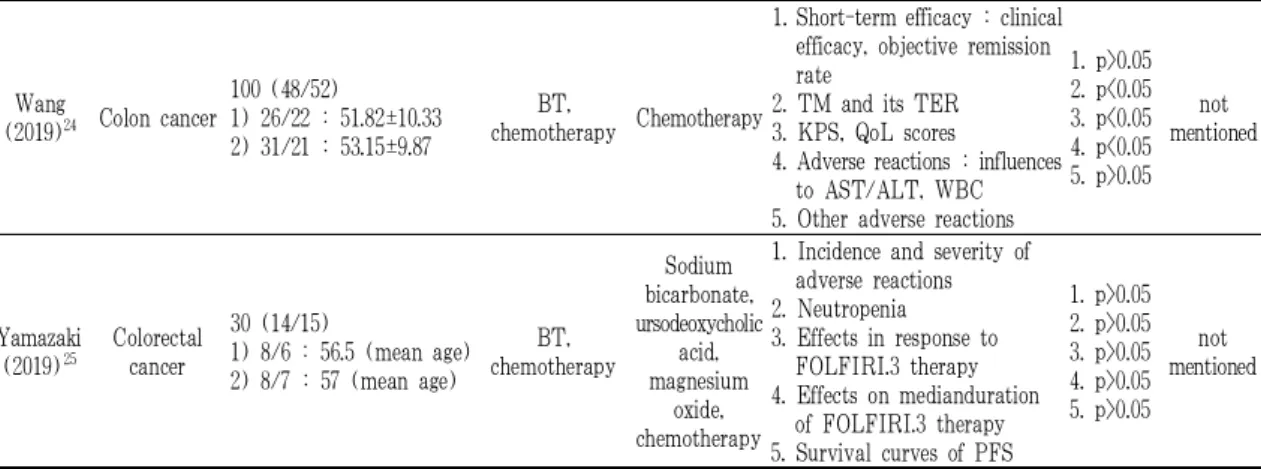
24의 연구에서는 전체적인 임상 증후는 완화되었지만, 반응률(treatment response) 을 조사하여 Complete response(CR), Partial response (PR), Stable disease(SD), Progressive disease(PD), Overall response rate(ORR) 등을 비교한 결과 대 조군과 유의한 차이를 보이지 못했다(p>0.05).
7) 연구의 비뚤림 위험 평가
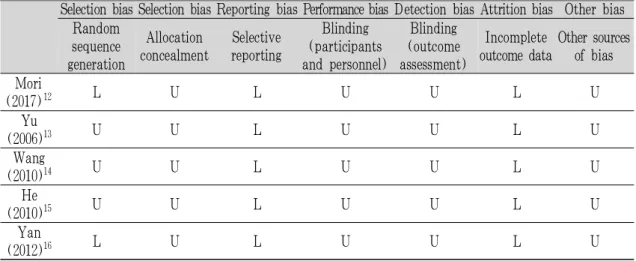
Cochrane의 RoB 도구를 활용하여 최종 선정된 14편의 문헌을 평가하였다. 선택 비뚤림에서 4편의
문헌
12,16,17,23이 무작위 배정순서 생성에서 ‘낮음’에
해당하였고, 그 외 10편
13-15,18-22,24,25이 ‘불확실’에 해 당하였으며, 배정순서 은폐에서 14편 모두 ‘불확실’
에 해당하였다. 보고 비뚤림에서는 14편 모두 ‘낮 음’에 해당하였다. 실행 비뚤림에서 문헌 1편
15이
‘높음’에, 13편은 ‘불확실’에 해당하였다. 결과 확인 비뚤림은 14편 모두 ‘불확실’에 해당하였으며, 탈락 비뚤림은 1편
21이 ‘높음’, 13편이 ‘낮음’에 해당하였 다. 기타 비뚤림은 14편 모두 ‘불확실’에 해당하였 다(Table 3).
Selection bias Selection bias Reporting bias Performance bias Detection bias Attrition bias Other bias Random
sequence generation
Allocation concealment
Selective reporting
Blinding (participants and personnel)
Blinding (outcome assessment)
Incomplete outcome data
Other sources of bias Mori
(2017)
12L U L U U L U
Yu
(2006)
13U U L U U L U
Wang
(2010)
14U U L U U L U
He
(2010)
15U U L U U L U
Yan
(2012)
16L U L U U L U
Table 3. Risk of Bias Summary
Ⅳ. 고찰 및 결론
항암화학요법을 받고 있는 암환자의 대부분이 다양한 부작용을 겪고 있지만, 아직까지 뚜렷한 효 과를 보이는 예방법이나 치료법은 없는 실정이다.
한의학에서도 항암화학요법으로 유발되는 다양한 증상을 완화하기 위한 연구들이 보고되었다
29-32. 하 지만 대부분의 연구가 항암화학요법으로 인한 증 상 중 한 두 가지만을 고찰한 것에 비해 본 연구는 항암화학요법으로 인한 부작용 증상을 포괄적으로 살펴보고자 하였다.
한편, 반하사심탕은 임상에서 급성위장염, 만성 위염, 소화불량, 위궤양 등의 질환에 사용할 수 있 는데
33, Jeon 등
34의 연구에서 반하사심탕의 소화기 계통 증상만이 아닌 다양한 임상분야에 적용될 가 능성을 시사했다.
이에 본 연구는 항암화학요법으로 인한 증상에 대한 반하사심탕의 효과를 확인하기 위하여 문헌 검색을 토대로 체계적 문헌고찰을 진행하였다. 항 암화학요법에 반하사심탕을 병용 투여한 RCT 연
구는 총 14편 확인되었으며, 이를 토대로 문헌 분 석을 진행하였다.
그 중 2편
12,16이 비소세포암 환자를 대상으로 한 연구였다. Mori 등
12의 연구는 시험군에 항암화학 요법과 반하사심탕을 병용하였고, Yan 등
16의 연구 는 시험군에 항암화학요법, 반하사심탕과 함께 항 구토제를 투여하였다.
Wang(2010)
14과 He
15의 연구는 위암과 결장(직 장)암 환자를 동시 모집한 연구이고, 항암화학요 법, 반하사심탕, 항구토제를 병용 투여했다는 점에 서 치료방법이 동일했다. 하지만 Wang(2010)
14의 연구는 반하사심탕을 식욕저하와 오심 구토의 예 방을, He
15의 연구는 항암화학요법 후의 오심 구토 와 암성 통증 억제에 대한 총유효율을 평가도구로 설정했다는 점에서 차이를 보였다.
위암 환자를 대상으로 한 문헌은 5편
13,17-19,23이었 다. 그 중 Yu 등
13의 연구는 항암화학요법에 반하 사심탕을 투여한 연구이고, Ni
18의 연구는 항암화 학요법에 반하사심탕과 위장약인 Lansoprazole을 병용 투여하여 비교한 연구이다. 한편, Yu 등
13, Tao
(2013)
17L U L U U L U
Ni
(2014)
18U U L U U L U
Gu
(2015)
19U U L U U L U
Zhang
(2017)
20U U L U U L U
Sun
(2017)
21U U L U U H U
Fan
(2018)
22U U L U U L U
Wang
(2018)
23L U L U U L U
Wang
(2019)
24U U L U U L U
Yamazaki
(2019)
25U U L H U L U
L : low, U : unclear, H : high