Media Coverage of Archival Profession, Institutions and Collections in Korea between 2003 and 2004
*대중 매체에 비친 아카이브의 공공 인식:
아카이브와 관련된 직업군, 기관, 기록물에 대한 2003-2004년간의 국내보도
1)
이 주 현(Joohyun Lee)**
목 차 1. Introduction
2. History of Mass Media in Korea 3. Former Research
4. Methodology
5. Archival Customs in Korea
6. Findings from the Relevant News Stories 6. 1 Archival Culture
6. 2 Value of Records 6. 3 Business archives
6. 4 Government records and civil rights movement
6. 5 Archivists and archival advocacy 7. Patterns
8. Conclusion
<ABSTRACT>
Public image on the Archives is investigated through media coverage of archival profession, institutions and collections in Korea between 2003 and 2004 in this research. News stories under the subject of archives are collected and categorized into archival culture, value of records, business archives, government records and civil rights movement, and archivists and archival advocacy. The patterns of the media coverage are discovered and analyzed from various viewpoints. As a result, ongoing proactive public relations with mass media are necessary in order to enhance currently low public image of archives of Korea.
Key words: Public image, news on archives and archivists, archival advocacy, promoting archives
<초 록>
대중 매체의 보도는 보도 대상에 대한 사회의 인식을 반영하는 동시에, 그 보도 대상에 대한 공공의 이미지에 영향을 끼친다. 이는 아카이브 관련 직업군, 기관, 장서에 대해서도 적용된다. 이 연구에서는 아카이브에 대한 공공의 이미지를 파악하기 위하여 2003-2004년간의 국내 주요 일간 신문 보도 내용을 수집하여 그 결과를 기록관리 문화, 기록물의 가치, 기업 및 병원기록관리, 정부기록관리, 아키비스트 직종의 다섯 범주로 나누어 각 범주에 해당하는 기사 내용을 분석하고, 총체적인 보도 유형과 동향을 파악하였다. 그 결과 우리나라에서는 아카이브에 대한 공공 이미지가 아직 충분히 형성되지 않은 상태이며, 단편적인 관심의 대상으로 다루어지고 있음을 알 수 있었다. 아키비스트의 사기 진작과 기록관리 정착을 위하여 기록관리에 대한 공공의 이미지를 증진하여야 하며, 이를 위해 아카이브와 아키비스트의 홍보 활동이 더욱 적극적으로 이루어져야 할 것이다.
주제어: 아카이브공공인식, 아키비스트공공인식, 기록관리진흥, 언론보도, 자료관홍보
***By ‘Korea', I mean South Korea only.
***PhD student, Department of Library and Information Science, School of Information, University of Pittsburgh
1. Introduction
Archivists keep a self-image on their job as well as staffs of other occupations. They find their vocational self-image unsatisfactory when they find their job's minor profile in society, even if they deeply acknowledge the significance of their job. Archivists' may well be disheartenment by the indifference of society toward their job as practical problems such as heavy workload, restricted funding, and limited authority.
An investigation into current public image of archives and archivists is necessary in a sense that public opinion on a job group has relationship with the morale of its staffs. The news coverage on records, archives, and archivists is one of the good measures of their public awareness as media coverage is regarded as an intuitive barometer of public image on a certain subject or a group of people. It is common that organizations collect news articles featuring them to represent their public awareness, whether commercial or nonprofit. To take two Korean companies for examples, Samsung accumulates ‘featured articles' under the
‘Press Center' section of their website, and LG keeps a similar section named ‘LG in the News' on their websiteas well. Non-profit organizations also commonly utilize their media coverage as an indicator of public's perception onto themselves. Even the National Archives and Records Service(NARS), the National Archives of Korea, has released two newsletter issues in 1998 and 2000, respectively carrying reports about significant events and related news stories, focusing on the activities of the institution. The reports in these two separate years briefly summarized media coverage and the depth of news articles on selected archival matters in representing the activities of the archival community in Korea(I-Hyeon Jo 1998.
256 Gang-soo Lee 2000. 42-43).
As stated above, mass media coverage works both as a looking glass into a certain group's public image and as a method of promoting that image at the same time. According to Joseph T. Klapper(1991. 53-61), the acknowledge leader in media research, the basis of media is capable to create opinions to newly arisen or newly evoked issues. Therefore, it is also an effective way for the archival community to attain closer public relations and promote its public image.
Today, the power of the media is widely acknowledged and not doubted. In dealing with the media, public relations involve putting out press releases to publicize an institution's activities. It is not surprising, therefore, that archivists and librarians find their public image through the media in Korea. However, is Korean mass media unbiased and ripe enough to reflect the public image on archives and archivists?
2. History of Mass Media in Korea
‘The Unfolding Lotus: East Asia's Media,' an inclusive collection of reports and an essential fact book on the subject, provides a discerning report on the South Korean media. According to the report, mass media in Korea has kept rising both in its numbers and its rate of liberation in a steady manner. Establishment of ‘The Liberalization of Press' law in 1987, economic boom, and high education level propelled the quality of journalism in Korea to win a high valuation(Heuvel and Everette 1993. 20).
According to Heuvel and Everette, there are eleven ‘central daily' newspapers located in Seoul. Two biggest central dailies are theChosun Daily and Dong-A Daily, both founded in 1920. Hankook Daily, established on June 9, 1954, and Joong-ang Daily, established on September 22, 1965, are the next largest two. Kyunghyang Shinmun, Seoul Shinmun, Hankyoreh Shinmun, Kookmin Daily, Segye Times, Munhwa Daily, and Naeil Shinmun entered into the central market for dailies subsequently between the year of 1946 and 2000.
Other than those listed above, twenty-seven daily newspapers fall under the category of local press. Province-based or metropolitan city-based local papers have better represent issues and interests of their own areas by conveying more local news to the primary audience. The six metropolitan cities of Inchon, Daejeon, Daegu, Gwangju, Busan and Ulsan hold one or more local-oriented newspapers. The Provinces of Gyeonggi, Gangwon, Chungbuk, Chungnam, Gyeongbuk, Gyeongnam, Jeonbuk, Jeonnam, and Jeju have one or more local dailies as well.
The Korea Broadcasting System(KBS), Munhwa Broadcasting Corporation(MBC) and Seoul Broadcasting System(SBS) are big three ground-wave broadcasting companies in Korea. KBS is a government-run broadcasting company and acknowledges itself as the leading television network in Korea. MBC, established in 1961, works as a private equal of KBS. According to TNS Media Korea, a national television audience research company, each night news program airing at nine o'clock on KBS and MBC secures a 20 percent audience rating. Seoul Broadcasting System(SBS), another privately-owned broadcaster, began broadcasting in 1990 and has grown to air entertainment-oriented programs.
Yonhap News Agency is a news wire service in Korea. Launched in 1981, Yonhap News' role is important as the single news feeder to all newspapers, broadcasting firms, major Internet portals andother on-line organizations. It has expanded its border toward the public by providing its articles through its website since 1998. Yonhap News assured its exclusive status when the government designated it as the key national wire service in 2003. All these
mass media companies are more independent from government control, trying to stand on their own and raise popularity in a free competitive market.
Thus, coverage of Korean media on specific subjects is believed to be a trustworthy source of investigation on the public image on the Korean archives and archivists.
3. Former Research
The news reporting on records, archives and archivists serves as a mirror into which archivists note the public awareness towards their vocation. Nonetheless, there is no direct research on the archival image in the Korean media. The two newsletter issues in 1998 and 2000 that I mentioned in the Introduction are rare looks at the media coverage on archives and archivists. However, they do not provide any analysis of the news stories(I-Hyeon Jo 1998. 256 Gang-soo Lee 2000. 42-43).
David B. Gracy quoted a July 9, 1984 New York Times editorial where archivists were compared to squirrels with a mocking nuance. His witty reference to this editorial is intended to illustrate the public image of archivists. The initial use of media as writing materials provoked archivists to ponder their own image as well as the public image of them(Dave B.
Gracy 1985. 17-23).
Richard J. Cox investigated the image of archivists and archives from articles in the New York Times. Cox performed a broad investigation into the images of archivists and archives through solid methodology and insightful analysis. His well-structured probe verified the initial hypothesis that “there will be little attention to the archivist or archival institutions, but there will be some interest in manuscripts and archival records as curiosities and as authorities for news stories on other topics such as national and international politics and events(Richard J. Cox 1993. 196)." This research was the first in-depth articulation of the media as a research methodology for measuring archival public image.
Media research like that above proceeds into public relations, as groups work with the media in order to improve their publicimage. Eveleigh(1999) evaluated the annual statutory reports from large and national bodies, local government record offices, and the annual reviews of more specialized record repositories. These reports were submitted according to the British government's law enforcement. She was impressed by the “added value" on the annual reports that “[...] have fully grasped the marketing opportunity to put across their
view and to improve their public image." To assure better literacy, she illustrated findings such asthe use of glossy paper and good quality photographs that would attract readership at first sight. She also advised on avoiding archival jargons and in-house abbreviations as the reports suggested. She picked reports with outstanding aspects to promote the public image of archives, giving a practical lesson to the archival community.
4. Methodology
While there is not a representative newspaper but rather a number of comparable central and regional papers in Korea, it is reasonable to choose multiple newspapers as resource of data collecting. Ample data is also needed in obtaining enough number of news stories to sort out and develop categories and discover patterns when there is not a previous research of this kind. Period of search spans between January 1, 2003 and February 29, 2004 on a yearly base.
Korean Integrated News Database System(KINDS) is chosen to search and gather news stories related with archival matters effectively for the reason that it supports searching the entire daily newspapers of Koreaat once. Keywords such as ‘archive,' ‘record,' ‘archivist' and each word in plural form were used for title search in order to cover linguistic variation. All eleven central and twenty-seven local daily newspapers provided by KINDS database were initially searched with those keywords to exclude newspapers that have published no news articles about archives. As a result, every central daily and seven out of twenty-seven local dailies, which are Daejeon Daily, Daejeon Maeil, Gyeong-In Daily, Gyeongsang Daily, Kookje Shinmun, Moodeung Daily, and Yeongnam Daily, were found to have featured topics related with archives. Subsequent search with the same keywords was performed to the eighteen central and local dailies in order to get in hand and analyze relevant news items.
Each collected news stories were labeled by its main theme in the procedure of quantitative analysis. As a consequence, five major categories came forward, which are archival culture, value of records, business archives, government records and civil rights movement and archivists and archival advocacy.
After briefing archival customs in Korea to help understand the historical background of Korean archival culture in the next chapter, a chapter of quantitative analysis of each issue falling under the designated category by means of examining pertinent news stories follows.
5. Archival Customs in Korea
Before looking at the analysis, a brief historical background of Korean Archival customs would help understanding the results. The NARS was established under the Ministry of Government Administration in 1969 and was re-organized under the Ministry of Government Administration and Home Affairs in 1998. Even though it has kept working as the only national archive in Korea, a matter of the utmost concern and the most empowering event in the NARS in the modern archival history of Korea was the promulgation of ‘The Public Records Management Act(Act number 5709)' on January 29, 1999. It has duty-bound administrative offices all over the nation to control every administrative record from creation, and to transfer selected record of permanent value to the NARS after a designated period.
In December 2002, Roh, Moo-Hyun was elected to the Presidency of the Republic of Korea.
According to his pledge to open and clear administration, governmental endeavor has been made to settle down strict recordkeeping practices in all public offices. This entitled the NARS to the authority to lead and guide archival practice, and therefore threw a bright light on the entire archival community of Korea with legal support. However, there happens a number of misconduct in government recordkeeping. For example, illicit delay in entrusting documents and artifacts of the former president, Kim, Dae-Jung, raised worries not only by the archival community, but also by the public. News stories and columns on this mismanagement of presidential records during the change of power have created noticeable warning voices.
Detailed stories will follow in the findings.
Following is a reviewof the media coverage on archival records and institutions in Korea between January 2003 and March 2004. Focus is on illustrating the public image of archives and archivists, with more on covering issues than offering profound analysis of each cause and effect.
6. Findings from the Relevant News Stories
6. 1 Archival Culture
Articles that urge for promoting archival culture were noticeable for the accusing tone of argument. Seok-woo Hong, columnist of Hankook Daily, emphasized the necessity for an archival culture in order to guarantee the accountability of Korean society in one of his serial
editorials. Other than news stories, there are abundant opinions contributed by the public through readers' letters to the editor. By expressing the need for sound archival practice, these opinions attract a fair amount of attention compared to the indirect public image echoed in news stories and editorials.
Law professor Geung-sik Jeong regarded ‘Chosun Wangjo Shillok(or ‘the court record of the Chosun Dynasty')' as the very symbol of the Korean archival tradition and criticized the current government for neglecting its responsibility for archiving administrative records.
Current Director General of the NARS, Han-wuk Kim, also argued that we should inherit archival tradition including records, while a researcher at the Research Institute for Korean Archives and Records(RIKAR) expressed her opinion that records should be managed, not merely preserved. It is at least a piece of good news that the movement of building a regional archive for Gyeunggi Province proves that Korean archival practice is expanding itself from the centralized to the local bases.
Occasionally, one can read a story that commends a person for his or her contribution to archival culture. Three scholars made news by making donations. Mun-young Lee, honorary professor of Korea University, donated ten thousand democratization movement documents to his school's archive to build its own collection. Jong-woo Lee, former dean of Korea University, has also bequeathed his books and university administration documents to his alma mater.
Meanwhile, Doo-hyun Lee, honorary professor of Seoul National University, presented thirty thousand folk materials in hopes of building a cornerstone for the folk archives.
Recordkeeping is described as a virtue of society and individuals alike. Yonhap News reported that the NARS solicited privately-owned archival materials from 1200 individuals and institutions, including former presidential secretaries, ministers, vice ministers, Hyang-gyo (local schools annexed to the Confucian shrine), Suh-won(memorial halls for the great scholars and loyal subjects of the past), and so on. Mass media also plays a role in encouraging individuals' recordkeeping habits. Three media companies, Munhwa Daily, SBS, and Jisik-sanup Publishing, jointly awarded to three winners the ‘Korean archival culture prizes,' complete with ten thousand dollars each, which surely made news. Overseas Koreans won prizes by having sending in memoir essays of their early years. A book derived from their manuscripts came out later on.
The sudden popularity of digital cameras worldwide in the early twenty-first century encourages individual recordkeeping habits and even contributes to newspapers from time to time. Jae-mun Byonand Ju-won Suh respectively analyzed that digital cameras have spurred
many of our contemporaries to keep a diary with digital pictures and eventually build a personal autobiography, particularly on the Internet. It has raised special interest in personal
“web blogs," an online personal magazine on which anybody with Internet access could publish articles easily. Reporters consider that this trend has made an impact in cultivating archival culture amongst the whole society.1)
As part of promoting the archival trend, introductions to foreign archives have become news stories. One example is the Peace Archive in Nagasaki, Japan, where the second atomic bomb was dropped at the end of World War II.
6. 2 Value of Records
As an expanded theme on the importance of archives, the value of records presented in the mass media is also one of the major issues. An attention-grabbing television documentary series using the historical materials at the NARS has attracted the public and created strong anticipation that long-hidden secrets below the large pile of archival materials would be open to public. News stories brought out an archival reference service featuring those, including that of the NARS and its abundant administrative archival collections.
There is an educational and entertaining series of television documentaries entitled ‘History Special.' This series narrates and thoroughly investigates critical events of various historical sources in Korean history. It was not surprising that the producers decided toutilize the NARS as their depository as its documentary topics shift toward the events of more modern, and thus, more controversial, history. Newspapers introduced this program as a way of breaking the ice, in the sense that a presumably authoritative governmental agency has opened up to the public to share what they have preserved. It was a good chance for the NARS to improve its public image.
Jae-seok Suh, producer of the KBS ‘History Special,' having launched it in October 1998, announced in April 2003 that he shifted the focus of his program from ancient times to modern history. One news wire service and every newspaper immediately covered this story, giving it enormous significance. Even previews of ‘Excavation of the NARS' on May 10, 2003 were introduced in two major newspapers and one wire service. However, its grand initial plan to investigate Chosun Wangjo Shil-rok, 1,800,000 government documents, 210,000 1) Three news stories on the web blogs and digital camera boom were carried in Joongang Daily, September
9 2003, p. 9; Kookmin Daily, October 14 2003, p. 27; and Hankook Daily, October 24 2003, p. 51.
presidential documents and 1,300,000 pictures at the NARS has abruptly ceased due to the reorganization at KBS. Voices of despair were high as the amount of expectation had been so great. This episode served as a catalyst for the improving of NARS' image as holder of a treasury of national history, even though the NARS did not play an active role.
To turn potential users into the actual, archives' reason for existence is to serve citizens with documents that have something to do with their benefit and knowledge. Newspapers often refer to the value of record, though not archives. Exhibition of archival materials is a way to accomplish this. A wood-block printing exhibition held by the Korean Studies Advancement Center was a reminder of strong archival tradition in Korea. Researchers with new perspectives keep discovering meaningful archival materials out of the archives. As well, historical records of the time when Korea went through hardship under the rule of Japanese imperialism have been discovered from foreign archives with historians' efforts now and then. A research team of the sociologist Jin-sung Jeong, and an anthropologist Tae-han Jang examined the U.S.
National Archives and Records Administration(NARA) to find the most critical evidence of so-called ‘Comfort Women' levied by Japanese Troops. This made news stories of all central dailies, amongst which the story Chosun Daily remarkably placed it on the front page. The Ministry of Gender Equality then announced the following discovery of a Japanese POW (Prisoners of War) Interrogation Report, which showed evidence of thirty-six Korean comfort women, at the NARA on February 27 2004.
6. 3 Business archives
Business archivesoften appear in news stories and columns. Reporter Hyo-chan Choi wrote a news story on POSCO archive's celebration of the thirtieth anniversary of steel production.
In it, history professor Byong-woo Ahn, argued that every company should settle its archive to ensure continuity of business operations and to develop a core of the company's collective memory as those of capitalist countries worldwide do. It is obvious that not only the records at the NARS, but also various archives around the country can produce news items, despite the low occurrence so far.
6. 4 Government records and civil rights movement
The Freedom of Information at Public Offices Act(Act No. 5242, drafted on December 31,
1996) was promulgated on January 1, 1998. It has given a legal background to the inevitability of sound archiving practice in administration and jurisdiction. The right to request administrative records upon the regulatory process is open to citizens who care about the justice of society and fair use of information as well as their own welfare and benefits. There are plentiful news stories on the enforcement of this Act.
News articles of the Freedom of Information Act fall into two major groups, one about the provisions and system of opening records itself, and the other about the case reports of applying the act, particularly on opening investigation records.
The government's Freedom of Information policy has been the target of the civil rights movement against the government's deep-rooted secrecy. An interview with a lawyer Geum-ja Bae, who has filed a lawsuit against the Korean Government to retract declination of information release, was found in Munhwa Daily in March 2003. She said that she learned about the inconsistency in administering the Freedom of Information Act during her previous litigation against the Government and KT&G, an agency of the Korean Imperial Household for tobacco and ginseng. Information on grass roots movements aimedat clearness and accountability through the Freedom of Information Act are being carried in newspapers almost monthly. News stories concerning the call for systematic archival policy and strategy of the Government by approximately two hundred historians and one hundred history teachers at middle schools and high schools gathered the attention of newspapers' eyes in March 2003.
Civil movement bodies such as Cham-yeh-yeun-dae(meaning participation and solidarity) clamored for the revision of not only the Freedom of Information Act, but also The Public Records Management Act because archival records should be secured to be open later at the time of creation. Newspapers kept publishing reports on the disputes between the legislators and civil organizations while each act was criticized as ambiguous and missing settled criteria, classes, sorts, reasons, and classification and release period. A special three-day feature in Segye Daily is worth a glance as it investigated the actual condition of the enforcement, problems, issues and countermeasures through an experiment of requesting classified administrative information from the Government by the Freedom of Information Act.
Case reports of the opening of classified records are of particular significance because they became news when the civil right for open information precedes national security or diplomatic delicacy. One of the most disputable lawsuits related with releasing confidential investigation records involved the contentious case of Mi-sun Shim and Hyo-soon Shin, two middle school girls who were fatally run over by a U.S. armored vehicle during training
operation on June 13, 2002.
According to the news featured in eight newspapers, including Yonhap News on December 4, 2003, Min-Byon, lawyers for the democratic society, brought a lawsuit and won to gain access to the investigation records through the court of justice. Successively, two bereaved fathers of the deceased girls, Hyun-soo Shin and Su-bo Shim, together with the ‘Pan-Korean Committee for the Two Girls Killed by a U.S. Armored Vehicle' have even gained access to the investigation records of the U.S. Army Forces by filing and winning a lawsuit against the Korean prosecution in February 2004. The investigation records of the U.S. Army used to be close in the previous lawsuits. This judgment drew more ongoing attention than others did because it could have borne diplomatic troubles related to the sovereignty of both the U.S.
and Korea.
Another important case is the lawsuit against opening the Korean Airline(KAL)858 crash investigation. The Seoul Administrative Court ordered the Seoul District Prosecutor's Office to disclose the majority of its some five thousand and two hundred pages of investigation records regarding the KAL Flight 858 bombing that claimed ninety-five passengers and twenty crewmembers' lives in November 1987. With the court decision, questions consistently raised by bereaved families regarding the incident over the last sixteen years might finally be brought to light. The files to bereleased included the interrogation and trial records of Hyon-hee Kim, one of the two alleged North Korean terrorists who caused the crash. Kim was initially sentenced to death but was given special amnesty in March 1990. Civic groups and bereaved families have long demanded the re-investigation, claiming that many aspects point to a disguise of the case. A bereaved family member filed a suit in July 2002 after the prosecution turned down demands from the victims' families to release the files.
The court said in its ruling that “the release of the information may cause national damage by affecting the country's security or diplomatic relations, but relieving people's suspicions and doubts surrounding the incident will serve a far greater common good." The prosecution said it only refused to disclose the files due to concerns of national interest and public security.
This also raised a heated controversy on the power of information and all newspapers covered this story.
Another noticeable judgment was the order to release the investigation and trial records of the Coup on December 12, 1979 by the Korean army and violent suppression of civil demonstrations against the military government on May 18, 1980.
The presidential records were big issue around the society. Cheong-wa-dae, meaning the
Blue House, is the official residence and office of the Korean President. Cheong-wa-dae was supposed to transfer the administrative records and artifacts of the former president Kim, Dae-Jung, up to one hundred and fifth thousand pages, to the NARS on January 10, 2003.
Cheong-wa-dae proudly put out a press release on this historic event, emphasizing that this transfer of presidential records was taking place for the first time in the administrative and archival history of Korea. Newspapers and television news reports all wrote news stories, indicating that it was more meaningful in being the first enactment of ‘The Public Records Management Act'.
On January 10, 2003, newspapers reported the first transfer of presidential records to the NARS as a historic event. News reports focused on the event as a bright moment in the epoch of Korean democracy, while Won-gyu Lee, a researcher at the RIKAR, spotlighted the meaning of the transfer in the archival history of Korea. Lee, however, found out that the Roh administration lacked systematic efforts to manage these administrative records and planned only to publish a white paper out of the former president records. He argued that archival professionals should get involved in the process of governmental archival management.
Cheong-wa-dae ended up postponing the initial transfer of presidential records due to a listing of up to 16,241 classified records. Newspapers brought up this issue, including an interview with seven researchers at the RIKAR and history and archival professors. They were anxious about Cheong-wa-dae's passive attitude in archiving presidential records and the possibility of hiding up of any wrongdoings. They demanded that law-abiding archival transfer went forth with an announcement of a signature-collecting campaign. Newspapers agreed on the need for this law-abiding records transfer in their editorials. These reports led to Cheong-wa-dae's prompt reaction of proceeding and transferring classified documents of the former president.
In the meanwhile, the Kim Dae-Jung library was open as an affiliated research institute under Yonsei University in November 2003. This raised a big controversy regarding presidential records management because it could interfere with the further establishment of the yet immature practice of presidential records management between the NARS and Cheong-wa-dae, leaving a bad precedent. Newspapers carried objective news stories, including opinions from many sides. The opinions against the presidential library's potential threat to sound presidential records management and the expectations on its advantages, taking the presidential libraries in the United States as an example, stand against each other in these newspaper accounts. The NARS announced that there would be an exhibition of
more than eight hundred items from eight former presidents' records on its website by January 2004. This was a counteraction to the Kim, Dae-Jung presidential library reminding the public of the fact that the NARS is the one and only institution legally authorized to own, manage, and serve presidential records as a part of its administrative records.
News stories display what they consider evidentially valuable, especially in administrative records. Thus, it becomes a target of attention whether or not the creation and management of administrative records abide by the record schedule as provided in the statute. Improper practices in Government agency's recordkeeping received criticism for severely violating accountability standards. Scholars majoring in history or politics, and researchers in the archival field submit a number of warning opinions and columns when there is any misbehavior.
Government records management has always been the object of interest. Concerns also relate to the enforcement of ‘The Public Records Management Act' and related problems.
Electronic records at the Government are another major issue. The former Kim, Dae-Jung administration employed ‘Electronic Government' policy, which aimed to make computerized and networked communication gradually supersede paper document transactions. The Roh, Moo-hymn administration has assumed this policy and taken steps to establish good practice in electronic documentation management. The mass media's emphasis on this ‘non-paper government' strategy focused on its transparency and ecological aspects as well.
6. 5 Archivists and archival advocacy
Archivists occasionally appear in the mass media as a promising or praise-worthy job.
There is also enough positive evidence for listing the archival profession in the category of promising occupations. In January 18, 2003, the Korean Women's Development Institute (KWDI) chose archivists along with librarians, writers, translators, visual and multimedia designers, and multimedia producers in culture, art and sports fields as a promising job for Korean women. Young-ok Kim, researcher at the KWDI and participant in the selection, said that she “selected occupations if they guaranteed fairly high wage level and great possibilities of job offers."
It also makes news when an archival institution celebrates its anniversary or an archival culture prize is awarded to a scholar who has spent all his life collecting archival materials or archivists who are assiduous in multimedia record keeping.
Archival Advocacy related to outreach and press releases make consistent appearance in
the mass media. Press release distribution of an archive's event always bears the chance of a media appearance. Even if public relations is not formerly assigned asone of the principle duties of archival affairs due to lack of staff and resources, an archivist still has to pay extra attention to expanding the public's awareness of their institutions and themselves by maintaining strong public relations.
7. Patterns
All two hundred-twenty-twoarticles related to archival matters, three graphs and one table are presented, relying on the technique of categorization that Richard J. Cox(1993) employed.
0 5 10 15 20 25 30 35 40 45
Jan 200 3
Feb 2003 Ma
r 2003 Apr
2003 May 2
003 Jun 2003
Jul 2003 Aug
2003 Sep 200
3
Oct 20 03
Nov 2003 Dec 200
3
Jan 2004
Feb 2004
number of articles
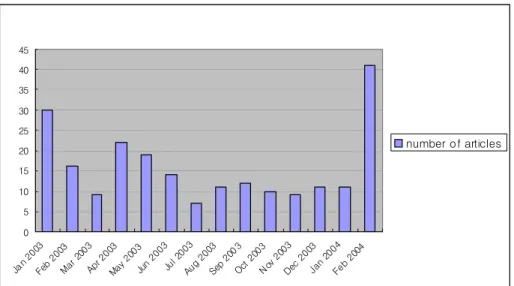
Figure 1. Number of articles on Archives, Jan. 2003 - Feb. 2004.
Figure 1 shows the frequency of articles on archives. Three notable high points represent times there were huge archival issues such as the transfer of the former president's records in January 2003 and the introduction of the television documentary on the NARS in April 2003. In February 2004, the court orders to open previously classified investigation files of the KAL crash and the two middle school girls run over by the U.S. Army vehicle also drew enormous media attention along with the discovery of documents from the NARA that proved the existence during World War II of Korean Comfort Women. Among the total of
two hundred and twenty-two articles on archival matters, most of them were covered as a part of narrative on certain political or international issues as shown in Figure 2.
archival culture 14%
value of rec ord 25%
IT (including Business arc hives
and multimedia) 5%
Government records and civil rights movement
22%
Freedom of Information
24%
Archivists and arc hival advoc acy
10%
Figure 2. Percentage of articles on archives by categories, Jan. 2003- Feb. 2004
Government-related categories such as presidentialand government records, and the Freedom of Information Act account for a half of the graph that represents the percentage of articles on archives by categories. I separately present the category of Freedom of Information category and of Government records and civil rights movement in the graph to reveal a quarter of the whole news stories are mainly discussed about the enactment of the Freedom of Information Act in contrast to the other quarter whose primary topic was government records and civil rights movement as such. Overall, the issues about or related with Government records occupy a significant half of the whole news stories about archives.
The value of records that occupies a considerable share of twenty-five percent is almost all about the discovery of rare or formerly classified records. Still, public relations and archivists' image conjointly engage a significant percentage of ten out of the total news coverage. More efforts in consistent public relations and outreach will promote the public image of archives and archivists.
Archives-related news stories appeared on the first page of newspapers five times, as
shown in table 2. It is apparent that archivists, however, have not appeared on the front pages yet, while the values of presidential records and freedom of information drew attention. Therefore, more proactive research activities outreach and public relations of archivists are required.
Media Subject Category
Chosun Daily Japanese companies also ran the Comfort House Value of Record Hankyoreh
Shinmun Presidential libraries would not get financial aid from the government Presidential Record Segye Daily The Public Records Management Act was not working Freedom of Information Segye Daily The Public Records Management Act lacks backing materials Freedom of Information Kyunghyang
Shinmun The Court ordered to release “KAL 858 investigation records" Freedom of Information Table 1. Front page articles on archives and records, Jan. 2003- Feb. 2004.
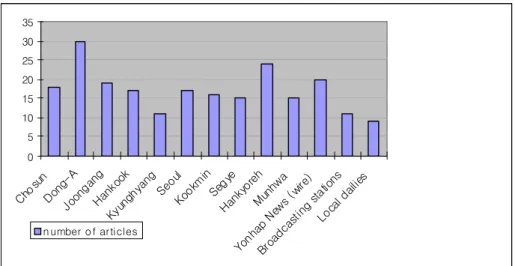
Figure 3 shows each news media's number of articles on archival matters. Dong-A Daily leads other media by double, while the Yonhap news and Hankyoreh Shinmun follow. It would be meaningful to conduct a content analysis of news stories in Dong-A Daily as a following study in order to find out a more profound awareness of the media concerning the archival public image. It would also bear interesting facts to compare and contrast tendencies of news coverage from Dong-A Daily and Hankyoreh Shinmun.
0 5 10 15 20 25 30 35
Chosun Dong
-A Joon
gang Hankook
Kyunghyang Seoul
Kookmin Segye
Hankyoreh Munhwa
Yonhap News (wire) Broadcasting stations
Local dailies n umber of articles
Figure 3. Number of articles by media formats, Jan. 2003- Feb. 2004
8. Conclusion
Browsing and categorizing news coverage of archives, record management and archivists, I discovered the various archivists' grievances related to public image of archives had merit.
Among two hundred and twenty-twonews stories related to archival issues found in newspapers between January 2003 and February 2004, the number of news that featured archivists as the main theme was eight only; four of them were about model archivists, each of whom had been awarded honorary prizes for their lifetime service in archives.
Reward-awarding can make beneficial source of news and encourage archivists to build the best practice in their institutions at the same time. As well, one news article introduced the archivist as one of the promising jobs for women. Even though it is only one piece of news, this will lead archivists into being encouraging.
The push toward archivists and archival institutions to keep effective public relationswith the mass media is strong in order to reinforce its public image in the Korean society.
Archivists have to speak out to improve their public image proactively. For example, they can draw up an official announcement whenever there are controversial topics concerned with archives and record management. Preferred issues of news stories such as the Freedom of Information Act as well as Presidential and Governmental record management can also be advantageous direction to move forward.
Bibliography
Cox, Richard J. 1993. “International Perspectives on the Image of Archivists and Archives:
Coverage by the New York Times, 1992-1993." International Information and Library Review 25(1993), 195-231.
Eveleigh, Alexandra. 1999. “Recent Annual Reports: the Public Image of Archives." Journal of the Society of Archivists 20, no. 1(1999): 105-108.
Gracy II., David B. 1985. “What's Your Totem? Archival Images In The Public Mind," Midwestern Archivists 10, no. 1(1985): 17-23.
Heuvel, Jon Vanden and Everette, E. Dennis. 1993. The Unfolding Lotus: East Asia's Changing Media(New York: Columbia University, 1993), 6-21.
Jo, I-Hyeon.(1998) “‘98Nyeon Eonroneh Bichin Girok-Bojon(Archival image on the media in
1998)." Archival Preservation 11(1998): 265-70.(in Korean).
Klapper, Joseph T. 1991. The Effects of Mass Communication. Glencoe: The Free Press.
Lee, Gang-soo. 2000. “2000 Nyeondo Eonroneh Bichin Girok-Bojon(Archival image on the media in 2000)." Archival Preservation Newsletter 1(2000): 42-43.(in Korean).