Journal of the Korean Chemical Society 2011, Vol. 55, No. 3
Printed in the Republic of Korea DOI 10.5012/jkcs.2011.55.3.486
-486-
무 용매 조건에서 potassium dihydrogen phosphate를 촉매로 사용하는 쿠마린의 마이크로파-유도 단일 용기 내 합성
Kirti S. Niralwad, Bapurao B. Shingate, and Murlidhar S. Shingare*
Department of Chemistry, Dr. Babasaheb Ambedkar Marathwada University, Aurangabad-431 004, M.S. India (접수 2011. 2. 28; 수정 2011. 3. 25; 게재확정 2011. 4. 4)
Microwave-induced one-pot Synthesis of Coumarins Using Potassium Dihydrogen Phosphate as a Catalyst Under Solvent-free Condition
Kirti S. Niralwad, Bapurao B. Shingate, and Murlidhar S. Shingare*
Department of Chemistry, Dr. Babasaheb Ambedkar Marathwada University, Aurangabad-431 004, M.S. India.
*E-mail: [email protected]
(Received February 28, 2011; Revised March 25, 2011; Accepted April 4, 2011)
요 약. Potassium dihydrogen phosphate는 마이크로파 조사조건에서 용매 없이 페놀과 아세토아세트산 에틸의 Pechmann 축합반응에 의하여 쿠마린을 합성하는 효과적인 촉매로 밝혀졌다. 이 방법은 쿠마린 합성에 있어서 소량의 촉매를 필요 로 하며 수율이 높고, 반응이 깨끗할 뿐만 아니라 반응 시간이 짧은 장점들을 가지고 있다.
주제어: Pechmann 축합, 쿠마린, Potassium dihydrogen phosphate,무 용매, 마이크로파
ABSTRACT. Potassium dihydrogen phosphate was found to be an efficient catalyst for the Pechmann condensation of phe- nols with ethyl acetoacetate, leading to the formation of coumarins under microwave-irradiation and solvent-free condition.
This procedure offers several advantages, including the low loading of catalysts, high yields, clean reactions, short reaction time for the synthesis of coumarins.
Keywords: Pechmann condensation, Coumarins, Potassium dihydrogen phosphate, Solvent-free, Microwave
INTRODUCTION
Coumarins, the most important classes of fluorescent molecules, constitute important structural features present in a number of bioactive natural products. The heterocy- cles derived from these intermediates have also been tested for their potential as anti-HIV,1 anti-inflammatory,2 anticonvulsant,3 anti-viral,4 anti-coagulant,5 antioxidant,6 antibacterial,7 antifungal,8 anti-carcinogenic material9 and antihistamine.10
Coumarins are an important group of organic com- pounds and can be used for the preparation of coumarino- α-pyrones, coumarino-g-pyrones, furocoumarins, chromenes, coumarones and 2-acylresorcinols. 7-Hydroxy-4-methyl- coumarin acts as a starting material for the preparation of the insecticide Hymecromone. 6-Bromocoumarins are use- ful synthetic intermediates for various pharmaceuticals and active compounds.11-13
Coumarins have been synthesized by several routes including Pechmann,14 Perkin,15 Knoevenagel,16 Reformatsky17
and Wittig18 reactions.
The Pechmann reaction is simple and straight forward employing β-keto esters and substituted phenols together with an acid catalyst. In the past, strong acids like H2SO4,14 P2O5,19 AlCl3, ZnCl2,20 TFA,21 ionic liquids,22 sulfated zir- con,23 indium halides,24 CuPy2Cl2,25 palladium26 and ammo- nium metavanadate27 have been used. However, many of these methodologies suffer from the drawback of green chemistry and have been associated with several short comings such as long reaction times, expensive reagents, low product yields and difficulty in recovery and reus- ability of the catalysts. These shortcomings certainly demand the search for a safe, more convenient and efficient method.
Now a day, it is shown that the use of solid acidic cat- alysts has gained importance in organic synthesis due to several advantages such as, operational simplicity, no tox- icity and ease of isolation after completion of the reaction.
In the current study, the commercially available catalyst potassium dihydrogen phosphate having pH 4.2-4.7 is used as a catalyst but its scope has not been fully explored.
2011, Vol. 55, No. 3
무 용매 조건에서 potassium dihydrogen phosphate를 촉매로 사용하는 쿠마린의 마이크로파 -유도 단일 용기 내 합성 487
Potassium dihydrogen phosphate can be used as buffer, neutralizing agent, sequestrate, yeast food and also as an efficient heterogeneous acid catalyst.28 Recently, Gill &
his co-workers have reported the synthesis of á-hydrox- yphosphonates using potassium dihydrogen phosphate29 under solvent-free condition. Owing to the numerous advantages associated with this cheap and non hazardous catalyst, we have considered Potassium dihydrogen phos- phate to be an ideal heterogeneous acid catalyst for the synthesis of coumarins. Herein, we would like to report the facile and eco-friendly methodology for the synthesis of coumarins under solvent-free condition and microwave- irradiation.
Organic synthesis in dry media, eventually under micro- wave (MW) irradiation is presently under extensive examination. The relatively low cost of modern domestic microwave ovens makes them readily available to aca- demic and industrial chemists and the use of such non- conventional reaction conditions reveals several features such as: a short reaction time compared to conventional heating, reduction of the usual thermal degradation and better selectivity.30 Furthermore, microwave-assisted reac- tions under solvent-free conditions provide access to work with open vessels and to scale up reactions.31
In this communication, we report for the first time a facile and efficient synthetic strategy for preparing coumarins in very short reaction time with excellent yield using potas- sium dihydrogen phosphate as a catalyst under solvent- free condition and microwave-irradiation.
EXPERIMENTAL
All starting materials and reagents were commercially available and used without further purification. All the melting points were taken in an open capillary and are uncorrected. The progress of the reactions was monitored by thin layer chromatography (TLC). IR spectra were recorded on Perkin-Elmer FT-IR spectrophotometer in KBr disc. 1H NMR spectra were recorded on mercury plus Varian spectrometer at 400 MHz in DMSO-d6 as a solvent and chemical shift values are recorded in units δ (ppm) rel- ative to tetramethylsilane (Me4Si) as an internal standard.
General procedure
Synthesis of compounds (3a-j): A mixture of substi- tuted phenol (1 mmol), ethyl acetoacetate (1 mmol) and potassium dihydrogen phosphate (KH2PO4) (10 mol%) were placed in a beaker. The mixture was irradiated under microwave-irradiation, the progress of the reaction was
monitored by TLC. After completion, the reaction mix- ture was poured into ice cold water (50 mL) and extracted with ethyl acetate (25 × 2 mL), which was then dried over Na2SO4 and the solvent was evaporated under reduced pressure to obtain the pure coumarins (Table 3). The prod- ucts 3(a-j) were confirmed by comparisons with authentic samples, IR, 1H NMR, mass spectra and melting point.
Spectral data of principal compounds.27 RESULTS AND DISCUSSION
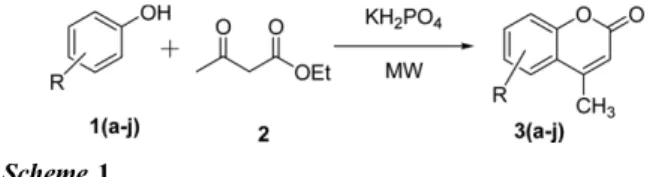
As a part of our ongoing research devoted to the devel- opment of useful synthetic methodologies,32-34 using solid acid catalyst and microwave irradiation techniques, herein we report an efficient and practical method for the syn- thesis of coumarins using potassium dihydrogen phos- phate which makes use of mild catalyst under solvent-free condition and microwave-irradiation (Scheme 1).
In the first examination, we have performed the different reaction conditions on model reaction. The result revealed that, when the reaction was carried out at stirring and heat- ing condition it gave lower yield of product even after pro- longed reaction time. But at the same time when the reaction was carried out under microwave-irradiation we got the excellent yields of product in short span (Table 1).
We have also carried out the model reaction in micro- wave at different powers, it was found that if reaction car- ried out without microwave irradiation it takes more reaction time (30 min) with negligible yield (20%). As increase in the power (100, 200, 300, 400 W), there is increase in yield with decrease in reaction time still at 400 W, but future that there is no significant change observed at 600 W. Hence, we satisfied over 400W and done all derivatization at 400 W.
After optimizing the various powers of microwave, the
Table 1. Optimization of model reaction 3a at different reaction conditiona
Entry Reaction condition Time Yield (%)b
1 Stirring 12 (h) 40
2 Heating 8 (h) 65
3 Microwave 3 (min) 95
aReaction condition: 1 (1 mmol), 2 (1 mmol) and KH2PO4 (10 mol%). bIsolated yields
Scheme 1.
488 Kirti S. Niralwad, Bapurao B. Shingate, and Murlidhar S. Shingare
Journal of the Korean Chemical Society
generality of this method was examined by the reaction of substituted phenols and ethyl acetoacetate using potas- sium dihydrogen phosphate as a catalyst under micro-
wave-irradiation, the results are shown in Table 3. Here, we have found that many phenols, such as resorcinol, 4- hydrxy phenol, 3-methoxy phenol, 3-aminophenol could be converted to corresponding coumarins in good yields (entries 3a-3c & 3f-3j). The reactivities of 3-methylphe- nol and 1-naphthol seem to be inferior as compared with that of the former (entries 3d, 3e), only 82% and 85% of the yields were obtained, respectively.
The synthesized compounds were compared (MS, NMR, and IR) with compounds that were prepared by using the literature method.27 This comparison revealed that the compounds synthesized by this newly developed method were exactly similar in all aspects to the reference compounds. The developed methodology is simple with good to excellent yields.
Table 2. Effect of microwave-irradiation powers for the synthesis of coumarinsa
Entry MW (Watts) Time(min.) Yield(%)b
1 - 30 20
2 100 30 42
3 200 30 55
4 300 30 60
5 400 3 95
6 600 3 95
aReaction conditions: 1 (1 mmol), 2 (1 mmol) and KH2PO4 (10 mol%). bIsolated yields
Table 3. Synthesis of coumarins catalyzed by potassium dihydrogen phosphate under microwave-irradiationa
Entry Reactant Product Time(min) Yield(%) M.P(ïC)
3a 3 95 78-80
3b 3 94 180-182
3c 5 92 241-243
3d 10 82 129-131
3e 12 85 153-155
3f 7 89 160-162
3g 5 90 220-222
3h 5 89 180-183
3i 7 91 281-283
3j 8 88 137-138
aReaction conditions: 1 (1 mmol), 2 (a-j)(1 mmol), catalyst (10 mol%). bIsolated yield. All the compounds characterised by their spectros- copy method 1H NMR, Mass, IR and melting point and compare to their authentic sample
2011, Vol. 55, No. 3
무 용매 조건에서 potassium dihydrogen phosphate를 촉매로 사용하는 쿠마린의 마이크로파 -유도 단일 용기 내 합성 489
Spectral Data for representative compounds:
4-methyl-2H-chromen-2-one(3a): IR (KBr) 1056, 1240, 1547, 1720, 3015 cm-1; 1H NMR (400MHz, CDCl3) δ 2.43 (s, 3H), 6.30 (s, 1H), 7.22-7.44 (m, 3H), 7.46 (d, J = 6.0 Hz, 1H); MS: m/z 160.9 (M+1).
4-methyl-2H-benzo[h]chromen-2-one (3e): IR (KBr) 1044, 1230, 1565, 1715, 3010 cm-1; 1H NMR (400MHz, CDCl3) δ 2.40 (s, 3H), 6.37 (s, 1H), 7.30-7.65 (m, 4H), 8.2 (d, J
= 9.0 Hz, 1H), 8.50 (d, J = 9.0Hz, 1H); MS: m/z 211.1 (M+1).
7-methoxy-4-methyl-2H-chromen-2-one(3f): IR (KBr) 1080, 1223, 1542, 1710, 3055 cm-1; 1H NMR (400 MHz, CDCl3) δ 2.30 (s, 3H), 3.70 (s, 3H), 6.22 (s, 1H), 6.79 (s, 2H), 7.65 (d, J = 8.7 Hz, 1H); MS: m/z 191.1 (M+1).
7-hydroxy-4,8-dimethyl-2H-chromen-2-one(3j): IR (KBr) 1465, 1609, 1682, 3146, 3464 cm-1; 1H NMR (400 MHz, CDCl3) δ 2.16 (s, 3H), 2.36 (d, J = 1.2 Hz, 3H), 6.15 (d, J = 1.2 Hz, 1H), 6.87 (d, J = 8.8 Hz, 1H),7.45 (d, J = 8.5 Hz, 1H), 10.2 (s, 1H); MS: m/z 191.0 (M+1).
CONCLUSION
In conclusion, the present method is very simple, mild and efficient for the synthesis of coumarin. This method offers several advantages, including the low loading of catalysts, high yields, clean reactions, short reaction time for the synthesis of coumarins. We believed that, micro- wave-assisted synthesis of coumarins using potassium dihydrogen phosphate as a catalyst promoted methodol- ogy will be a valuable contribution in the field of chem- istry as compare to the existing processes.
Acknowledgement. The authors are thankful to Uni- versity Grant Commission, New Delhi, for awarding the fellowship and to The Head, Department of Chemistry, Dr.
Babasaheb Ambedkar Marathwada University, Aurangabad- 431 004, MS, India for providing the laboratory facility.
REFERENCES
1. Huang, L.; Yuon, X.; Yu, D.; Lee, K. H.; Chin, H. C.
Virology 2005, 332, 623.
2. Lin, C. M.; Huang, S. T.; Lee, F. W.; Sawkuo, H.; Lin, M.
H. Bioorganic. Med. Chem. 2006, 14, 4402.
3. Bhat, M. A.; Siddiqu, N.; Khan, S. A. Indian J. Pharm.
Sci. 2006, 68, 120.
4. Massimo, C.; Francesco, E.; Federica, M.; Carla, M. M.;
Prieto, G. S.; Carlos, R. J. Aust. J. Chem. 2003, 56, 59.
5. Ruszat, R.; Wyler, S.; Forster, T.; Reich, O.; Christian, G. S.;
Thomas, C. G.; Sulser, T.; Bachmann, A. Eur. Assoc. Urol. 2006.
6. Tyagi, A.K.; Raj, H. G.; Vohra, P.; Gupta, G.; Kumari, R.;
Kumar, P.; Gupta R. K Eur. J. Med. Chem. 2003, 40, 413.
7. Modrana, J. N.; Nawrot, E.; Graczy, K. Eur J. Med.
Chem. 2006, 41, 1301.
8. Sardari, S.; Mori, Y.; Horita, K.; Micetich, R. G.; Nishibe, S.; Daneshtalab, M. Bioorg. Med. Chem. 1999, 7, 1933.
9. Elinos-Baez, C.; Leon, M. F.; Santos, E. Cell. Biol. Int.
2005, 29, 703.
10. Mohanty, N.; Rath, P. C.; Rout, M. K. Indian Chem. Soc.
1967, 44, 1001.
11. Shivashankar, K.; Kulkarni, M. V.; Shastri, L. A.; Rasal, V. P.; Rajendra, S. V. Phosphorus Sulfur Silicon Relat.
Elem. 2006, 181, 2187.
12. Ghate, M. D.; Jadhav, V. B.; Shastri, A.; Kulkarni, M. V.;
Kulkarni, G. M.; Chen, C. H. Sun, C. M. Tetrahedron Lett.
2008, 49, 4394.
13. (a) Kumar, S.; Joshi, S. S. Indian J. Appl. Chem. 1963, 26, 149; (b) Furuta, T.; Watanabe, T.; Tanabe, S.; Sakyo, J.; Matsuba, C. Org. Lett. 2007, 9, 4717.
14. Von Pechmann, H. C.; Duisberg, C. Ber. Dtsch. Chem.
Ges. 1884, 17, 929.
15. Johnson, J. R.; Org. React. 1942, 1, 210.
16. Jones, G. Org. React. 1967, 15, 204.
17. Brafola, G.; Fringuelli, F.; Piermatti, O.; Pizzo, F. Heterocy- cles 1996, 43, 1257.
18. Von Pechmann, H.; Duisberg, C. Ber. Dtsch. Chem. Ges.
1883, 16, 2119.
19. Robertson, A.; Sandrock, W. F.; Hendry, C. B. J. Chem.
Soc. 1931, 24, 26.
20. Sethna, S. M.; Shah, N. M.; Shah, R. C. J. Chem. Soc.
1938, 228.
21. Woods, L. L.; Sapp, J. J.Org. Chem. 1962, 27, 3703.
22. Potdar, M. K.; Mohile, S. S.; Salunkhe M. M. Tetrahe- dron Lett. 2001, 42, 9285.
23. Selvakumar, S.; Chidambaram, M.; Singh, A. P. Catal.
Commun. 2007, 8, 777.
24. Bose, D. S.; Rudradas,A. P.; Babu, M. H. Tetrahedron Lett. 2002, 43, 9195.
25. Rajitha, B.; Naveen Kumar, V.; Someshwar, P.; Venu Madhav, J.; Narsimha Reddy, P.; Thirupathi Reddy, Y.
Arkivoc 2006, xii, 23.
26. Kadnikov, D. V.; Larock R. C. Org. Lett. 2000, 2, 3643.
27. Mandhane, P. G.; Joshi, R. S.; Ghawalkar, A. R.; Jadhav, G. R.; Gill, C. H. Bull. Korean Chem. Soc. 2009, 30, 2969.
28. Feng, X.; Hong-Xia, L.; Jin-Ping, W.; You-Ping, T.; Jian- Jun, W. J. Chem. Res. 2008, 12, 707.
29. Mandhane, P. G.; Joshi, R. S.; Nagargoje, D. R.; Gill, C.
H. Tetrahedron Lett. 2010, 51, 1490.
30. Bogdal, D.; Pielichowski, J.; Jaskot K. Heterocycles 1997, 45,15.
31. Abehaim, D.; Diez-Barra, E.; de la Hoz, A.; Loupy, A.;
Sanchez-Migallon, A. Heterocycles 1194, 38, 793.
32. Niralwad, K. S.; Shingate, B. B.; Shingare, M. S. Ultra- son. Sonochem. 2010, 17, 760.
33. Niralwad, K. S.; Shingate, B. B.; Shingare, M. S. Bull.
Korean Chem. Soc. 2010, 31, 981.
34. Niralwad, K. S.; Shingate, B. B.; Shingare, M. S. Tetra- hedron Lett. 2010, 51, 3616.