A Study on the Food Hygiene Attitude and Personal Hygiene Management of Students by high school type in Chungcheongnam-do
Suk Hee Kim
Department of Food and Nutrition, Hyejeon College
충남지역 고등학교 유형별 학생들의 식품위생 태도와 개인 위생관리에 관한 연구
김숙희
혜전대학교 식품영양과
Abstract This study aimed to provide basic data for the development of education programs on food hygiene attitude and personal hygiene management of high school students by type of school. From July 16 to October 15, 2015, questionnaires were distributed to 30 students per grade at 16 high schools in Chungcheongnam-do, and a total of 1214 questionnaires (excluding unrecurring and insufficient questionnaires) were processed using SPSS (ver 18.0). As a result, academic high school students answered more checking food’s shelf life when they bought it in the store(3.79, 3.60), not eating the cooked and heated food after keeping without heating(2.85, 2.98), and storing food in the refrigerator in accordance with its characteristics(3.90, 3.76) than specialized high school students. Academic high school students were found to be more careful than specialized high school students, to wash hands before meals(3.66, 3.52), after went to toilet(4.30, 3.95), in the right way(3.63 and 3.45), and to go around less during meal time(2.19, 2.43) and to go to the toilet less often during meal time(2.28, 2.47). In this study, academic and specialized high school students showed significant differences in food hygiene attitude and personal hygiene management, and academic high school students had significantly better food hygiene attitude and personal hygiene control than specialized high school students. but still need to be improved. Therefore, it is suggested that education on food hygiene attitude and personal hygiene management should be strengthened according to the type of school.
요 약 본 연구의 목적은 학교 유형별 고등학교 학생들의 식품위생 태도와 개인위생 관리에 관한 교육 프로그램의 개발을 위한 기초 자료를 제공하는 것이다. 2015년 7월 16일부터 10월 15일 까지 충남지역 16개 고등학교의 학년 당 30명씩에게 설문지를 배포하였고, 미회수 및 불충분한 설문지를 제외한, 총 1214 부(인문고등학생 473명과 특성화고 741)에 대해 SPSS (ver 18.0)을 사용하여 통계처리하였다. 연구 결과, 인문계 고등학생은 특성화 고등학생보다 식품을 살 때 유통기한을 더 확인 하고(3.79, 3.60), 조리·가열된 식품을 보관 후 그대로 먹는다는 응답이 낮았고(2.85, 2.98), 식품의 특성에 맞게 냉장 냉동 보관 저장한다(3.90, 3.76)고 하였다. 인문계 고등학생이 특성화 고등학생보다 식사 전 손씻기(3.66, 3.52), 화장실 다녀온 후 손씻기 (4.30, 3.95), 올바른 방법으로 손씻기(3.63, 3.45)를 잘하였고, 식사시간 중에 돌아다니기(2.19, 2.43)와 식사시간 중간에 화장 실을 적게 가는 것(2.28, 2.47)으로 조사되었다. 본 연구에서, 일반 고등학생과 특성화고등학생들은 식품위생태도와 개인위생 관리 부분에서 유의적 차이를 보였고, 일반 고등학생이 특성화 고등학생보다 식품위생태도와 개인위생관리를 잘하는 것으로 조사되었다. 그러나 그 정도는 높지 않아, 개선이 필요한 것으로 사료된다. 따라서 학교유형에 따라 식품위생태도와 개인위생 관리에 대한 교육을 강화해야 함을 제언한다.
Keywords : Food Hygiene, Hygiene Management, Academic high school, Specialized high school, School type
*Corresponding Author : Suk Hee Kim(Hyejeon College) Tel: +82-41-630-5253 email: [email protected]
Received January 8, 2019 Revised (1st January 25, 2019, 2nd January 30, 2019) Accepted February 1, 2019 Published February 28, 2019
1. Introduction
At a time when food hygiene issues were expected to be expanded due to the expansion of international exchanges, school hygiene education for high school students who have more opportunities to choose their own meals and take care of their health is very important. The specialized high school students are more likely to work in the industrial field after graduation, so that they need to secure their own hygiene. However, food hygiene safety and personal hygiene education for high school students are still lacking in reality[1-2]. Some high school students showed a tendency to underestimate the importance of livelihood safety, have a low level of safety consciousness[3], and safety education[4].
Previous studies on food hygiene included that the study on food hygiene and food safety for university students[5-9] and the study on food safety for the general public[10-13], and restaurant staff[14]and the study on food safety awareness for middle school students[15], but the study on students' safety awareness[16] for high school students were few except for the survey on food safety and HACCP[17].
The academic high school students who are educated for university entrance-oriented and the specialized high school students who can work after graduation through lab-oriented education showed differences in food hygiene awareness, and the necessity of specialized hygiene education by school type was suggested[18]. However, there have been few studies on the differences between academic and specialized high school students on food hygiene attitude and personal hygiene management. The purpose of this study was to provide basic data for the development of educational programs to improve students' food hygiene attitude and personal hygiene management status.
2. Materials and Method
2.1 Subject
This study was conducted on 16 high school students located in Chungnam area. The data were collected by questionnaire survey method. The questionnaires were distributed to 30 students per grade, and 473 students in academic and 741 students in specialized high school, 1,214 students's questionnaires in total, were used as research data, excluding unreturned and insufficient questionnaires.
The questionnaire was distributed and collected from July 16 to October 15, 2015.
2.2 Method
The questionnaire on food hygiene and personal hygiene management was organized by referring to the questionnaire in the preceding studies[5-6], and composed of the Likert 5-point scale.
2.3 Analysis method
Questionnaires were processed using SPSS (over 18.0) for frequency analysis and t-test statistics.
Cronbach's alpha was calculated for each element to test the reliability of the assessment of food hygiene attitudes and personal hygiene management.
3. Results
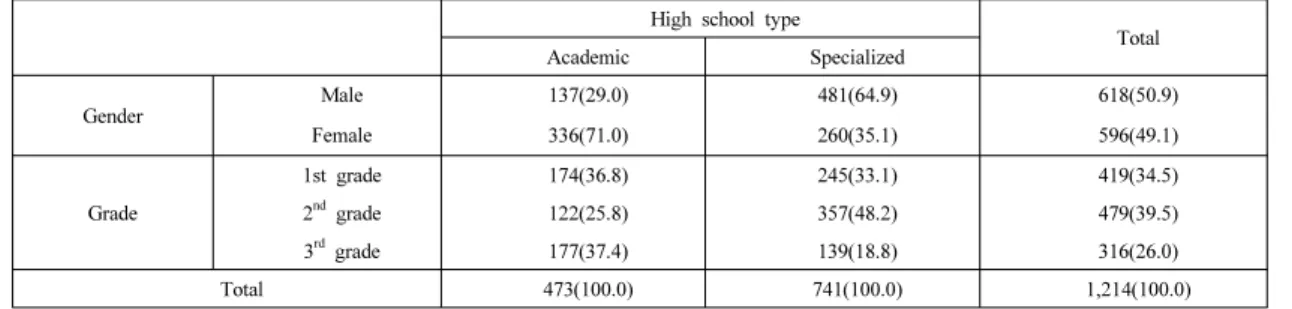
Cronbach's alpha for questionnaire of the food hygiene attitude and personal hygiene management were 0.723 and 0.721, respectively. 39.0%(473) of the survey respondents were academic high school students, and 61.0%(741) were specialized high school students.
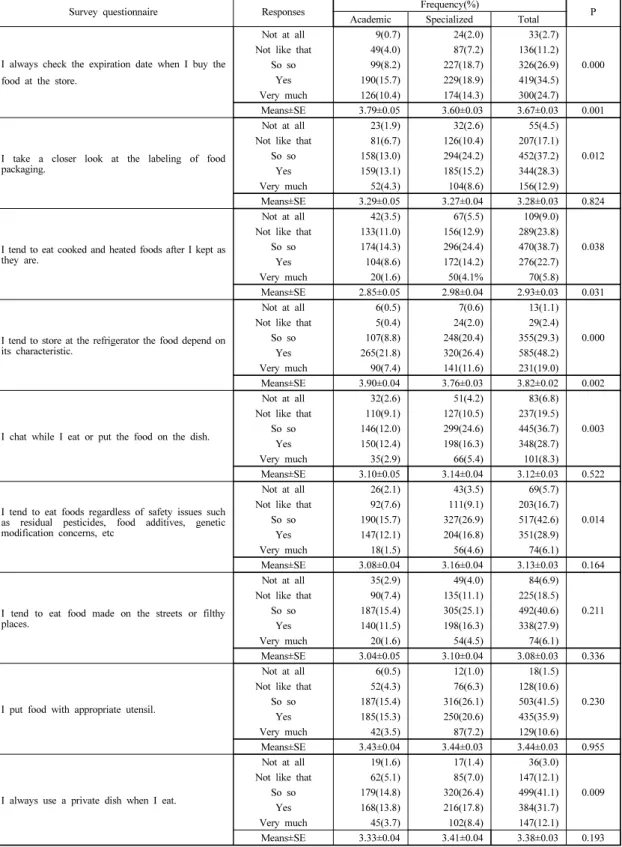
As a result of the self-diagnosis of food hygiene and safety attitude by school type, there was significant difference between the respondents of the specialized high school students and the academic high school students in the under questions. Academic high school students answered more in the question of "I always check the expiration date when I buy food at the store“
High school type
Total
Academic Specialized
Gender
Male 137(29.0) 481(64.9) 618(50.9)
Female 336(71.0) 260(35.1) 596(49.1)
Grade
1st grade 174(36.8) 245(33.1) 419(34.5)
2nd grade 122(25.8) 357(48.2) 479(39.5)
3rd grade 177(37.4) 139(18.8) 316(26.0)
Total 473(100.0) 741(100.0) 1,214(100.0)
Table 1. General characteristics in subjects by school type
(3.79, 3.60), less "I eat cooked and heated food as it is after keeping." than specialized high school students(2.85, 2.98). Academic high school students answered more in the question of "I stored the food depends on it's characteristic" than specialized high school students(3.90, 3.76)(table 2).
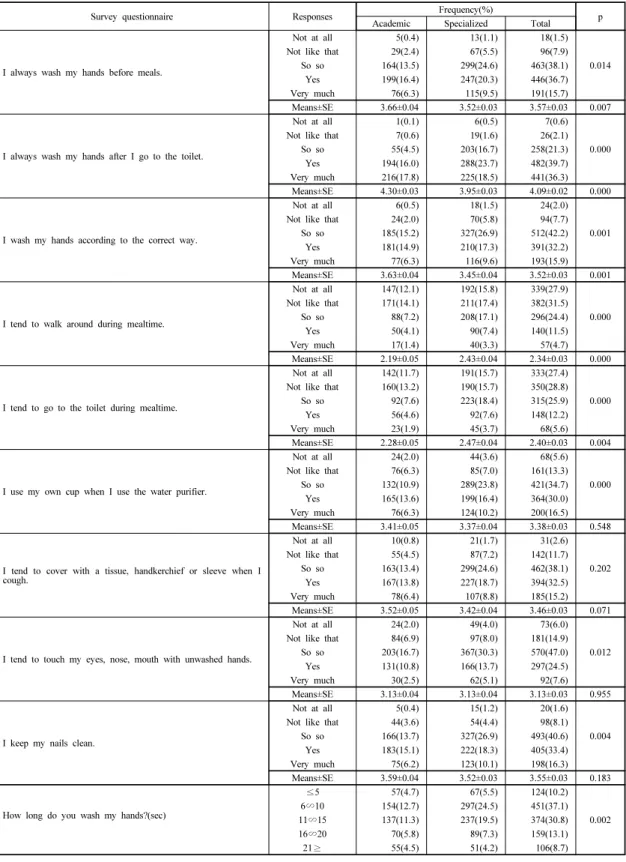
There were significantly different of frequency analysis of food hygiene attitude, such as “I always check the expiration date when I buy food at the store”, academic students answered so so(8.2%), yes(15.7%) and very much(10.4%), compared to 18.7%, 18.9%, 14.3% of the specialized students, respectively. As for taking a closer look at the labeling of food packaging, so so(24.2%), yes(15.2%) and very much(8.6%) of the specialized high school students, compared to 13.0%, 13.1% and 4.3%of academic high school students, respectively. In the question of storing at the refrigerator the food depend on its characteristics, academic students answered so so(8.8%), yes(21.8%), very much(7.4%), compared to 20.4%, 26.4%, 11.6% of specialized students. As a result of self-diagnosis about personal hygiene management, academic students answered more washing hands before meals(3.66, 3.52), after going to the toilet(4.30, 3.95), to the correct way(3.63, 3.45) than specialized students. Academic students seemed to less go to the toilet during mealtime(2.28, 2.47) and walk around during mealtime(2.19, 2.43) than specialized high school students(Table 3).
As for the frequency of personal hygiene management attitude, there was significantly different frequency in the question of "I always wash my hands
before eat", academic high school students answered so so(13.5%), yes(16.4%) and very likely(6.3%), specialized high school students answered so so(24.6%), yes(24.6%) and very likely(9.5%). There was significantly different in the question of "I always wash my hands after I go to toilet", academic high school students answered so so(13.5%), yes(16.4%), very likely(6.3%), specialized high school students answered so so(24.6%), yes(20.3%), very likely(9.5%).
There was significantly different in the question of "I tend to walk around during mealtime.", academic high school students answered so so(7.2%), yes(4.1%) and very much(1.4%), specialized high school students answered so so(17.1%), yes(7.4%) and very much(3.3%). There was significantly different in the question of "I wash my hands according to the correct way", academic high school students answered so so(15.2%), yes(14.9%) and very much(6.3%), compared with specialized high school students answered so so(26.9%), yes(17.3%) and very much(9.6%).
There was significantly different in the question of
"I tend to walk around during mealtime.", academic high school students answered so so(7.2%), yes(4.1%) and very much(1.4%), specialized high school students answered so so(17.1%), yes(7.4%) and very much(3.3%). There was significantly different in the question of "I tend to go to the toilet during mealtime.", academic high school students answered so so(7.6%), yes(4.6%) and very much(1.9%), specialized high school students answered so so(18.4%), yes(7.6%) and very much(3.7%). There was significantly different
Survey questionnaire Responses Frequency(%)
Academic Specialized Total P
I always check the expiration date when I buy the food at the store.
Not at all 9(0.7) 24(2.0) 33(2.7)
Not like that 49(4.0) 87(7.2) 136(11.2)
So so 99(8.2) 227(18.7) 326(26.9) 0.000
Yes 190(15.7) 229(18.9) 419(34.5)
Very much 126(10.4) 174(14.3) 300(24.7)
Means±SE 3.79±0.05 3.60±0.03 3.67±0.03 0.001
I take a closer look at the labeling of food packaging.
Not at all 23(1.9) 32(2.6) 55(4.5)
Not like that 81(6.7) 126(10.4) 207(17.1)
So so 158(13.0) 294(24.2) 452(37.2) 0.012
Yes 159(13.1) 185(15.2) 344(28.3)
Very much 52(4.3) 104(8.6) 156(12.9)
Means±SE 3.29±0.05 3.27±0.04 3.28±0.03 0.824
I tend to eat cooked and heated foods after I kept as they are.
Not at all 42(3.5) 67(5.5) 109(9.0)
Not like that 133(11.0) 156(12.9) 289(23.8)
So so 174(14.3) 296(24.4) 470(38.7) 0.038
Yes 104(8.6) 172(14.2) 276(22.7)
Very much 20(1.6) 50(4.1% 70(5.8)
Means±SE 2.85±0.05 2.98±0.04 2.93±0.03 0.031
I tend to store at the refrigerator the food depend on its characteristic.
Not at all 6(0.5) 7(0.6) 13(1.1)
Not like that 5(0.4) 24(2.0) 29(2.4)
So so 107(8.8) 248(20.4) 355(29.3) 0.000
Yes 265(21.8) 320(26.4) 585(48.2)
Very much 90(7.4) 141(11.6) 231(19.0)
Means±SE 3.90±0.04 3.76±0.03 3.82±0.02 0.002
I chat while I eat or put the food on the dish.
Not at all 32(2.6) 51(4.2) 83(6.8)
Not like that 110(9.1) 127(10.5) 237(19.5)
So so 146(12.0) 299(24.6) 445(36.7) 0.003
Yes 150(12.4) 198(16.3) 348(28.7)
Very much 35(2.9) 66(5.4) 101(8.3)
Means±SE 3.10±0.05 3.14±0.04 3.12±0.03 0.522
I tend to eat foods regardless of safety issues such as residual pesticides, food additives, genetic modification concerns, etc
Not at all 26(2.1) 43(3.5) 69(5.7)
Not like that 92(7.6) 111(9.1) 203(16.7)
So so 190(15.7) 327(26.9) 517(42.6) 0.014
Yes 147(12.1) 204(16.8) 351(28.9)
Very much 18(1.5) 56(4.6) 74(6.1)
Means±SE 3.08±0.04 3.16±0.04 3.13±0.03 0.164
I tend to eat food made on the streets or filthy places.
Not at all 35(2.9) 49(4.0) 84(6.9)
Not like that 90(7.4) 135(11.1) 225(18.5)
So so 187(15.4) 305(25.1) 492(40.6) 0.211
Yes 140(11.5) 198(16.3) 338(27.9)
Very much 20(1.6) 54(4.5) 74(6.1)
Means±SE 3.04±0.05 3.10±0.04 3.08±0.03 0.336
I put food with appropriate utensil.
Not at all 6(0.5) 12(1.0) 18(1.5)
Not like that 52(4.3) 76(6.3) 128(10.6)
So so 187(15.4) 316(26.1) 503(41.5) 0.230
Yes 185(15.3) 250(20.6) 435(35.9)
Very much 42(3.5) 87(7.2) 129(10.6)
Means±SE 3.43±0.04 3.44±0.03 3.44±0.03 0.955
I always use a private dish when I eat.
Not at all 19(1.6) 17(1.4) 36(3.0)
Not like that 62(5.1) 85(7.0) 147(12.1)
So so 179(14.8) 320(26.4) 499(41.1) 0.009
Yes 168(13.8) 216(17.8) 384(31.7)
Very much 45(3.7) 102(8.4) 147(12.1)
Means±SE 3.33±0.04 3.41±0.04 3.38±0.03 0.193
Table 2. The frequency and mean of high school students’ food hygiene attitude by school type
Survey questionnaire Responses Frequency(%)
Academic Specialized Total p
I always wash my hands before meals.
Not at all 5(0.4) 13(1.1) 18(1.5)
Not like that 29(2.4) 67(5.5) 96(7.9)
So so 164(13.5) 299(24.6) 463(38.1) 0.014
Yes 199(16.4) 247(20.3) 446(36.7)
Very much 76(6.3) 115(9.5) 191(15.7)
Means±SE 3.66±0.04 3.52±0.03 3.57±0.03 0.007
I always wash my hands after I go to the toilet.
Not at all 1(0.1) 6(0.5) 7(0.6)
Not like that 7(0.6) 19(1.6) 26(2.1)
So so 55(4.5) 203(16.7) 258(21.3) 0.000
Yes 194(16.0) 288(23.7) 482(39.7)
Very much 216(17.8) 225(18.5) 441(36.3)
Means±SE 4.30±0.03 3.95±0.03 4.09±0.02 0.000
I wash my hands according to the correct way.
Not at all 6(0.5) 18(1.5) 24(2.0)
Not like that 24(2.0) 70(5.8) 94(7.7)
So so 185(15.2) 327(26.9) 512(42.2) 0.001
Yes 181(14.9) 210(17.3) 391(32.2)
Very much 77(6.3) 116(9.6) 193(15.9)
Means±SE 3.63±0.04 3.45±0.04 3.52±0.03 0.001
I tend to walk around during mealtime.
Not at all 147(12.1) 192(15.8) 339(27.9)
Not like that 171(14.1) 211(17.4) 382(31.5)
So so 88(7.2) 208(17.1) 296(24.4) 0.000
Yes 50(4.1) 90(7.4) 140(11.5)
Very much 17(1.4) 40(3.3) 57(4.7)
Means±SE 2.19±0.05 2.43±0.04 2.34±0.03 0.000
I tend to go to the toilet during mealtime.
Not at all 142(11.7) 191(15.7) 333(27.4)
Not like that 160(13.2) 190(15.7) 350(28.8)
So so 92(7.6) 223(18.4) 315(25.9) 0.000
Yes 56(4.6) 92(7.6) 148(12.2)
Very much 23(1.9) 45(3.7) 68(5.6)
Means±SE 2.28±0.05 2.47±0.04 2.40±0.03 0.004
I use my own cup when I use the water purifier.
Not at all 24(2.0) 44(3.6) 68(5.6)
Not like that 76(6.3) 85(7.0) 161(13.3)
So so 132(10.9) 289(23.8) 421(34.7) 0.000
Yes 165(13.6) 199(16.4) 364(30.0)
Very much 76(6.3) 124(10.2) 200(16.5)
Means±SE 3.41±0.05 3.37±0.04 3.38±0.03 0.548
I tend to cover with a tissue, handkerchief or sleeve when I cough.
Not at all 10(0.8) 21(1.7) 31(2.6)
Not like that 55(4.5) 87(7.2) 142(11.7)
So so 163(13.4) 299(24.6) 462(38.1) 0.202
Yes 167(13.8) 227(18.7) 394(32.5)
Very much 78(6.4) 107(8.8) 185(15.2)
Means±SE 3.52±0.05 3.42±0.04 3.46±0.03 0.071
I tend to touch my eyes, nose, mouth with unwashed hands.
Not at all 24(2.0) 49(4.0) 73(6.0)
Not like that 84(6.9) 97(8.0) 181(14.9)
So so 203(16.7) 367(30.3) 570(47.0) 0.012
Yes 131(10.8) 166(13.7) 297(24.5)
Very much 30(2.5) 62(5.1) 92(7.6)
Means±SE 3.13±0.04 3.13±0.04 3.13±0.03 0.955
I keep my nails clean.
Not at all 5(0.4) 15(1.2) 20(1.6)
Not like that 44(3.6) 54(4.4) 98(8.1)
So so 166(13.7) 327(26.9) 493(40.6) 0.004
Yes 183(15.1) 222(18.3) 405(33.4)
Very much 75(6.2) 123(10.1) 198(16.3)
Means±SE 3.59±0.04 3.52±0.03 3.55±0.03 0.183
How long do you wash my hands?(sec)
≤5 57(4.7) 67(5.5) 124(10.2)
6∽10 154(12.7) 297(24.5) 451(37.1)
11∽15 137(11.3) 237(19.5) 374(30.8) 0.002
16∽20 70(5.8) 89(7.3) 159(13.1)
21≥ 55(4.5) 51(4.2) 106(8.7)
Table 3. The frequency and mean of high school students’ food hygiene management by school type
in the question of "I use my own cup when using the water purifier.", academic high school students answered so so(10.9%), yes(13.6%) and very much(6.3%), specialized high school students answered so so(23.8%), yes(16.4%) and very much(10.2%).
There was significantly different in the question of "I tend to cover with a tissue, handkerchief or sleeve when I cough.", academic high school students answered so so(16.7%), yes(10.8%) and very much(2.5%), specialized high school students answered so so(24.6%), yes(18.7%) and very much(8.8%). There was significantly different in the question of “I keep my nails clean”, academic high school students answered so so(13.7%), yes(15.1%) and very much(6.2%), specialized high school students answered so so(26.9%), yes(18.3%) and very much(10.1%).
There was no significantly different in the question of “I tend to cover with a tissue handkerchief of sleeve when I cough”, academic high school students answered yes(13.8%) and very much(6.4%), specialized high school students answered yes(18.7%) and very much(8.8%).
Even though middle east respiratory syndrome(MERS) situation was still during survey, only 20.2% of academic high school students and 27.5% of specialized high school students seemed to have good behavior of cough etiquette.
In the previous study on food hygiene safety awareness, there was a difference between the academic and specialized high school students[18].
Food hygiene attitude and personal hygiene management differed by school type in this study also.
4. Conclusion
In the food hygiene attitude part, the students of the academic high school were significantly more checking of the food’s shelf life when they bought it in the store, they did not eat the cooked and heated food after keeping, and store food in the refrigerator in
accordance with its characteristics. In the personal hygiene management, academic high school students more washed their hand before meals, after went to toilet, according to correct way, not tended to walk around during meal time and went to toilet during meal time than specialized high school students, and those were statistically effective. Specialized high school students need to be educated more with personal hygiene management than academic high school students. Although this survey were conducted at the time of MERS situation, 30.8% of respondents answered yes and 20.4% of them did very much whether cover with a tissue, handkerchief, or sleeve when they cough. The rate of positive respondents were low, so more coughing etiquette should be educated to high school students. In the questionnaire of “How much time do you wash your hands?”, specialized high school students answered 11-15 sec.(19.5%), 16-20 sec.(7.3%), longer than 21 sec.(4.2%), on the other hand , academic high school students answered 11-15 sec.(11.3%), 16-20 sec.(5.8%), longer than 21 sec.(4.5%). There were significantly different frequency by school type, but high school students did not have sufficient time for hand washing compared with 30 seconds, recommended time for washing hands by Ministry of Food and Drug Safety(MFDS).
Therefore, it is necessary to strengthen food hygiene attitude and personal hygiene management in high schools and to differentiate major education contents by type of school.
References
[1] Hyundai Research Institute, “Safety consciousness condition and Policy task”, Pending issue and Task, Vol.
14, No.40, p. 1, 2014.
[2] Seoul city, department of Food Safety, “2015 Seoul city's Food Safety management implement plan”, pp.
1-3, 2015.
[3] S. H. Cho, D. M. Choi, “A Study on the recognition of the students of technical high school on fire safety, -Focusing on skills student in the Seoul metropolis”, J.
of Korean Institute of Fire Sci. & Eng, Vol.20, No.3, pp.
107-112, 2006.
[4] K. E. Lee, H. S. Jung, “Study on the development of a safety education system for technical high schools”
Journal of Korean Society for School Health, Vol. 26, No.3, pp. 169-183, 2013.
[5] S. S. Park, J. Y. Chang, S. Y. Ham, “Survey on actual and recognition of food safety among undergraduate students”, Journal of Korean Society for School Health Education, Vol.19, No.2, pp. 33-46, 2008.
[6] B. B. Choi, “Studies on food safety knowledge of college student according to mass-media impact”, Korean J. Food & Nutr. Vol.24, No2, pp. 166-172, 2011.
DOI: http://dx.doi.org/10.9799/ksfan.2011.24.2.166 [7] J. M. Kim, N. S. Koo, “Concerns for food safety and
safety and the HACCP of college student in Daejeon”, Korean Journal of Human Ecology, Vol.20, No3, pp.
665-675, 2011.
DOI: http://dx.doi.org/10.5934/KJHE.2011.20.3.665 [8] N. S. Koo, J. M. Kim, “College student’s perception of
hygiene”, Korean Journal of Human Ecology, Vol.18, No.3, pp. 769-773, 2009.
DOI: http://dx.doi.org/10.5934/KJHE.2009.18.3.769 [9] M. R. Kim, H. C. Kim, “Awareness and information
acquisition behavior regarding food hygiene and safety of college students in Yeungnam region”, J East Asian Soc Dietary Life, Vol.22, No.2, pp. 305-314, 2012.
[10] J. Y. Lee, K, D. Kim, “A study on the perception of and concern for food safety among urban housewives”, Korean J. Food Preserv. Vol.16, No.6, pp. 999-1007, 2009.
[11] Y. M. Jeon, “On the foodservice customer recognition of food safety”, The Korean Journal of Culinary Research.
Vol. 13, No. 4, pp. 243-255, 2007.
[12] H. S. Choi, “Comparison of Hygiene Behavior between College Students and Adult,” Asia-pacific Journal of Multimedia Services Convergent with Art, Humanities, and Sociology, vol. 5, no. 4, pp. 315-322, Aug. 2015.
[13] S. Xiaoqing, H. C. Kim and M. R. Kim, “Analysis on awareness and information acquisition behavior regarding food hygiene and safety of university students in Shandong province”, China, J East Asian Soc Dietary Life Vol. 23, No. 2, pp. 153-170, 2013.
[14] G. H. Eo, M. H. Hahm, “A Study on restaurant workers' knowledge about food hygiene and safety”, The Korean Journal of Culinary Research, Vol.15, No.2, pp.
268-281, 2009.
[15] E. J. Yoon, S. H. Seo, “Differences on perceptions and attitudes towards food safety based on behavioral intention to prevent foodborne illness among middle school students in Seoul”, KOREAN J. FOOD COOKERY SCI. Vol.28, No.2, pp. 149-158, 2012.
DOI: http://dx.doi.org/10.9724/kfcs.2012.28.2.149 [16] Y. H. Hong, C. H. Lee, C. M. Yim, “Safety awareness
of students by age”, Foodservice Management Society of Korea, Vol.10, No1, pp. 175-193, 2014.
[17] H. E. Soon, “A survey on attitudes of toward food hygiene safety and awareness of HACCP of high
students”, Graduate master’s thesis Yeungnam University, pp. 77-93, 2006.
[18] S. H. Kim, K. H. Joung, “ Study on food hygiene and Safety awareness of high school students in Chungnam area” Journal of the Korea Academia-Industrial cooperation Society, vol.17, No.9 pp570-5772016.
DOI: http://dx.doi.org/10.5762/KAIS.2016.17.9.570
Suk Hee Kim [Full member]
•Feb. 1992 : Seoul Univ., Food and Nutrition, MS
•Feb. 1996 : Seoul Univ., Food and Nutrition, PhD
•Jan. 2008 ~ Jul. 2009 : Univ., of North Carolina, Visiting Scholar
•Mar. 1996 ~ current : Hyejeon College, Dept. of Food and Nutrition, Professor
<Research Interests>
Nutrition, Food Hygiene, Education