ABSTRACT
Purpose: Discontinuation of hormone therapy is known to lead to a poorer prognosis in breast cancer patients. We aimed to investigate the prescription gap as a prompt index of medication adherence by using prescription data extracted from patient electronic medical records.
Methods: A total of 5,928 patients diagnosed with invasive, non-metastatic breast cancer, who underwent surgery from January 1, 1997 to December 31, 2009, were enrolled
retrospectively. The prescription data for 4.5 years of hormonal treatment and breast cancer- related events after treatment completion were analyzed. We examined the characteristics and prognoses of breast cancer in patients with and without a 4-week gap.
Results: Patients with a gap showed a significantly higher risk of breast cancer recurrence, distant metastasis, breast cancer-specific death, and overall death after adjustment (hazard ratio [HR], 1.389; 95% confidence interval [CI], 1.089–1.772; HR, 1.568; 95% CI, 1.158–2.123;
HR, 2.108; 95% CI, 1.298–3.423; and HR, 2.102; 95% CI, 1.456–3.034, respectively). When patients were categorized based on gap summation, the lower third (160 days) and fourth (391 days) quartiles showed a significantly higher risk of distant metastasis (HR, 1.758; 95%
CI, 1.186–2.606 and HR, 1.844; 95% CI, 1.262–2.693, respectively).
Conclusion: A gap of > 4 weeks in hormonal treatment has negative effects on breast cancer prognosis, and can hence be used as a sentinel index of higher risk due to treatment non- adherence. Further evaluation is needed to determine whether the gap can be used as a universal index for monitoring the adherence to hormonal treatment.
Keywords: Breast neoplasms; Estrogen antagonists; Medication adherence;
Neoplasm metastasis
INTRODUCTION
Anti-estrogen hormone therapy is a major treatment modality in breast cancer, and long- term results from randomized clinical trials have indicated its efficacy in reducing mortality rates of estrogen receptor-positive and progesterone receptor-positive breast cancer [1-4].
Original Article
Received: Aug 28, 2018 Accepted: Mar 1, 2019 Correspondence to Jong Won Lee
Department of Surgery, Asan Medical Center, University of Ulsan College of Medicine, 88 Olympic-ro 43-gil, Songpa-gu, Seoul 05505, Korea.
E-mail: [email protected]
*These authors contributed equally to this work.
© 2019 Korean Breast Cancer Society This is an Open Access article distributed under the terms of the Creative Commons Attribution Non-Commercial License (https://
creativecommons.org/licenses/by-nc/4.0/) which permits unrestricted non-commercial use, distribution, and reproduction in any medium, provided the original work is properly cited.
ORCID iDs Yura Lee
https://orcid.org/0000-0003-2048-3727 Yu Rang Park
https://orcid.org/0000-0002-4210-2094 Ji Sung Lee
https://orcid.org/0000-0001-5271-8530 Sae Byul Lee
https://orcid.org/0000-0002-3370-6937 Jong Won Lee
https://orcid.org/0000-0001-7875-1603
Yura Lee 1,2,*, Yu Rang Park 3,*, Ji Sung Lee 4, Sae Byul Lee 2, Il Yong Chung2, Byung Ho Son2, Sei Hyun Ahn2, Jong Won Lee 2
1Department of Biomedical Informatics, Asan Medical Center, Seoul, Korea
2Department of Surgery, Asan Medical Center, University of Ulsan College of Medicine, Seoul, Korea
3Department of Biomedical Systems Informatics, Yonsei University College of Medicine, Seoul, Korea
4Clinical Research Center, Asan Medical Center, Seoul, Korea
Prescription Refill Gap of Endocrine
Treatment from Electronic Medical
Records as a Prognostic Factor in
Breast Cancer Patients
Funding
This study was supported by a grant (No.
2015-668, 2016-668) from the Asan Institute for Life Sciences, Asan Medical Center, Seoul, Korea.
Conflict of Interest
The authors declare that they have no competing interests, and there are no financial conflicts of interest to disclose.
Author Contributions
Conceptualization: Lee Y, Chung IY, Ahn SH, Lee JW; Data curation: Park YR, Lee SB, Son BH, Ahn SH; Formal analysis: Lee Y, Lee JS;
Methodology: Lee Y, Park YR, Lee JS, Chung IY;
Resources: Lee SB; Supervision: Lee JS, Chung IY, Son BH, Ahn SH, Lee JW; Validation: Park YR, Lee JS; Visualization: Park YR; Writing - original draft: Lee Y; Writing - review & editing:
Lee SB, Son BH, Ahn SH, Lee JW.
Oral anti-estrogen agents are generally prescribed for 5 years, and have been used as the first-line adjuvant treatment for early hormone receptor-positive breast cancer. Although numerous resources and consistent efforts have been applied towards novel drug discovery, there has been no paradigm shift in the hormonal treatment of hormone receptor-positive breast cancer. Moreover, several studies have validated the benefits of extended hormonal treatment (for > 5 years) [3,5,6], and the number of recipients of long-term oral hormonal treatment has been increasing.
Adverse events due to hormonal treatment, such as hot flashes, arthralgia, or mood changes, increase the difficulty of medication adherence [7-10]. The socio-economic status of patients, including personal plans for marriage or childbirth, can also affect treatment compliance [11-15]. As adherence to hormonal treatment correlates strongly with breast cancer prognosis [8,16-19], treatment non-adherence, assessed by various methods, has been an important subject of previous research.
Though several studies have assessed the relationship between treatment discontinuation and breast cancer prognosis [19,20], there is a difference in the observations between controlled studies and actual clinical situations “Hawthorne effect”. Moreover, there may be a loss of information when estimating adherence based on claims data obtained from patients [21]. Nevertheless, data on patient visits and drug prescriptions being accumulated in electronic medical records (EMRs) closely mirror actual clinical data, and can thus facilitate compliance assessment. In particular, the prescription refill gap—an indicator of medication adherence—can be measured concurrently, as prescription data are accumulated [22].
In the present study, we aimed to examine differences in clinical outcomes according to the hormone prescription gap in breast cancer patients. To evaluate patient risk as a result of the gap in medication, we assessed prescription data extracted from EMRs in relation to outcomes in a breast cancer patient series. Moreover, we determined the suitability of using the prescription refill gap as an indicator of hormonal treatment adherence.
METHODS
In this retrospective study, we investigated the association between the gap in hormone treatment and breast cancer outcomes using clinical data from the Asan Medical Center.
All clinical data were anonymized for research purposes using a de-identified clinical data warehouse: Asan BiomedicaL research Environment [23]. We assessed adherence by analyzing the gap between successive prescription refill dispensation visits, compared to the interval between regular visits or when the patient visited the hospital after a greater delay than expected. We examined the effect of adherence within the conventional treatment period (4.5 years) on the prognosis of breast cancer after that period.
Study design and subjects
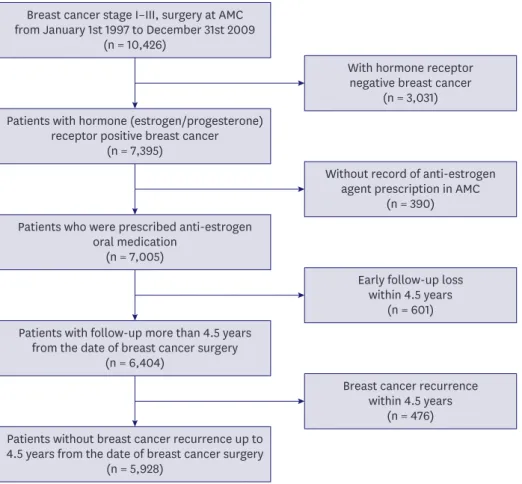
We enrolled patients with pathologically confirmed stage I–III breast cancer who underwent surgery at Asan Medical Center between January 1, 1997, and December 31, 2009. Follow- up data were collected up to May 31, 2015. Among the 10,426 breast cancer patients who underwent surgery at Asan Medical Center, we excluded those who met the following criteria:
presence of early recurrence and/or early loss to follow-up (within 4.5 years [54 months] after surgery). Figure 1 details the patient selection process.
Prescription data (prescription visit date and prescription duration) for hormonal treatments, including first-line adjuvant anti-estrogen oral medications (i.e., tamoxifen citrate, toremifene citrate, letrozole, anastrozole, and exemestane), were analyzed for each patient. Patient demographic data, including the age at breast cancer diagnosis, marital status at diagnosis, type of residential area, education level, body mass index, and family history of breast cancer, were additionally collected. Further, information on breast cancer stage, histologic type, histologic grade, operation methods, and adjuvant treatment (i.e., chemotherapy and/or radiation therapy) were included.
Determining the duration of the prescription refill gap
The number of days of treatment omission was estimated by subtracting the duration of medication coverage from the intervals between prescription dates. Prescription refill gaps (hereafter referred to as gaps) were recorded when the gap duration was > 4 weeks (28 days).
The interval between routine follow-up and a prescription visit was 6 months, and the last visit (without prescription) was not included in the prescription data. Therefore, the total prescription period analyzed was 4.5 years (54 months), starting from the first prescription date; no cases of treatment extensions were considered. The gap was calculated up to
Breast cancer stage I–III, surgery at AMC from January 1st 1997 to December 31st 2009
(n = 10,426)
With hormone receptor negative breast cancer
(n = 3,031)
Without record of anti-estrogen agent prescription in AMC
(n = 390)
Early follow-up loss within 4.5 years
(n = 601)
Breast cancer recurrence within 4.5 years
(n = 476) Patients with hormone (estrogen/progesterone)
receptor positive breast cancer (n = 7,395)
Patients who were prescribed anti-estrogen oral medication
(n = 7,005)
Patients with follow-up more than 4.5 years from the date of breast cancer surgery
(n = 6,404)
Patients without breast cancer recurrence up to 4.5 years from the date of breast cancer surgery
(n = 5,928)
Figure 1. Flow diagram of patient selection; a total of 5,928 patients were enrolled in this study.
AMC = Asan Medical Center.
4.5 years after surgery (the duration of prescription completion). If the medication was discontinued within 4.5 years, the gap was estimated as the duration from the expected date of medication depletion to the date of prescription completion. The gap ranged from 29 to 1,641 days (median gap: 92 days).
Outcome variables
We assessed the follow-up results for up to 10 years (120 months) from the date of
prescription completion. As per a regular follow-up schedule, the last prescription visit was made 4.5 years after the first visit in the planned 5-year treatment regimen. Cancer-related outcome after treatment completion was evaluated after excluding cases of recurrence or death during the 4.5-year treatment period. The outcome parameters included breast cancer recurrence (of any type), distant metastasis, breast cancer-specific death, and overall death, which occurred after the 4.5-year treatment period.
Statistical analysis
All reported p values are 2-sided, and p-values < 0.05 were considered significant. Statistical analysis was performed using SPSS statistics version 21 (IBM Corp., Armonk, USA) and R version 3.2 (R Development Core Team, Vienna, Austria). Differences between groups were examined using the χ2 test for categorical variables. Survival curves were constructed using Kaplan-Meier estimates, and curves were compared using the log-rank test. To determine the accumulated effect of gaps, we sub-classified the patients with gaps according to the summation of the gap (gap sum). The gap-positive group was further divided into 4 subgroups based on quartiles: from 1st quartile (patients with low gap sum) to 4th quartile (patients with high gap sum). The range of the gap sum was 29–1,625 days, and the cut-off between successive quartiles was 64, 160, and 391 days. Analysis using multivariate Cox proportional hazards regression model was performed according to the gap sum quartile.
The relative risk of breast cancer outcomes was assessed to determine the linear tendency of increasing risk as the cumulated gap increased.
Ethics
This study was approved by the Institutional Review Board (IRB) of Asan Medical Center, Korea (IRB No. 2015-0924). The need for informed consent was waived by our Institutional Review Board, as this study involved routinely collected medical data that were anonymously managed at all stages, including during data cleaning and statistical analysis.
RESULTS
Patient characteristics
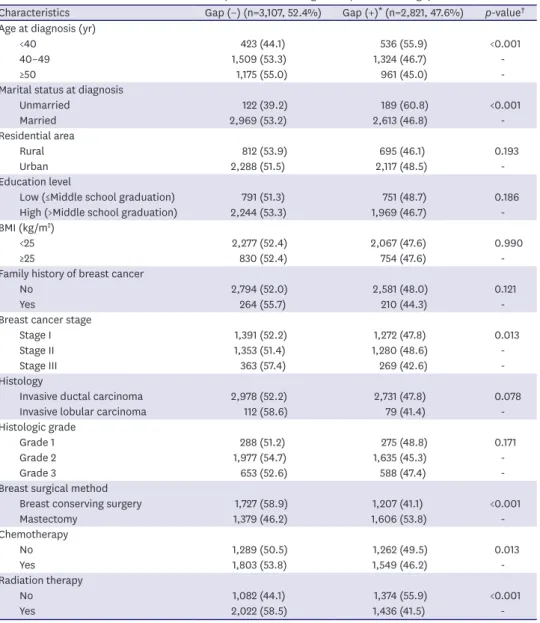
A total of 5,928 patients with no breast cancer recurrence within 4.5 years from the date of breast cancer surgery, were enrolled in the present study. Among these cases, 2,821 (47.6%) had a gap of > 4 weeks. The baseline demographic and clinical characteristics of patients with and without gaps are presented in Table 1. Patients who were younger (p < 0.001), had a non-married status at diagnosis (p < 0.001), had stage II breast cancer (p = 0.013), underwent mastectomy (p < 0.001), or did not undergo chemotherapy (p = 0.013) and/or radiation therapy (p < 0.001), were significantly more likely to have a gap. Patients with invasive lobular carcinoma tended to have a greater gap than patients with invasive ductal carcinoma, although this difference was not significant (p = 0.078).
Prognostic and survival effect of the gap
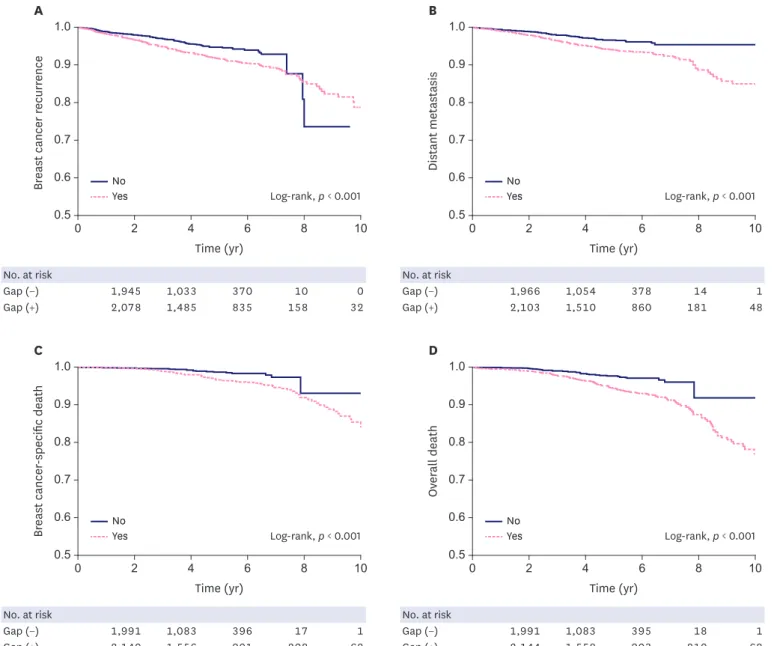
Patients were followed up to 10 years from the completion of hormone treatment, and breast cancer recurrence (of any type) was observed in 318 patients in this period. Distant metastasis was noted in 214 patients and 116 breast cancer-related mortalities occurred. As shown in Figure 2, the presence or absence of the gap was found to be significantly linked to survival outcome in all breast cancer types. In patients with distant metastases, the survival estimate was 95% in patients without a gap, and 85% in patients with a gap (log rank, p < 0.001; Figure 2B).
Table 1. Baseline characteristics of the enrolled patients, according to the presence of a gap
Characteristics Gap (−) (n=3,107, 52.4%) Gap (+)* (n=2,821, 47.6%) p-value† Age at diagnosis (yr)
<40 423 (44.1) 536 (55.9) <0.001
40–49 1,509 (53.3) 1,324 (46.7) -
≥50 1,175 (55.0) 961 (45.0) -
Marital status at diagnosis
Unmarried 122 (39.2) 189 (60.8) <0.001
Married 2,969 (53.2) 2,613 (46.8) -
Residential area
Rural 812 (53.9) 695 (46.1) 0.193
Urban 2,288 (51.5) 2,117 (48.5) -
Education level
Low (≤Middle school graduation) 791 (51.3) 751 (48.7) 0.186
High (>Middle school graduation) 2,244 (53.3) 1,969 (46.7) -
BMI (kg/m2)
<25 2,277 (52.4) 2,067 (47.6) 0.990
≥25 830 (52.4) 754 (47.6) -
Family history of breast cancer
No 2,794 (52.0) 2,581 (48.0) 0.121
Yes 264 (55.7) 210 (44.3) -
Breast cancer stage
Stage I 1,391 (52.2) 1,272 (47.8) 0.013
Stage II 1,353 (51.4) 1,280 (48.6) -
Stage III 363 (57.4) 269 (42.6) -
Histology
Invasive ductal carcinoma 2,978 (52.2) 2,731 (47.8) 0.078
Invasive lobular carcinoma 112 (58.6) 79 (41.4) -
Histologic grade
Grade 1 288 (51.2) 275 (48.8) 0.171
Grade 2 1,977 (54.7) 1,635 (45.3) -
Grade 3 653 (52.6) 588 (47.4) -
Breast surgical method
Breast conserving surgery 1,727 (58.9) 1,207 (41.1) <0.001
Mastectomy 1,379 (46.2) 1,606 (53.8) -
Chemotherapy
No 1,289 (50.5) 1,262 (49.5) 0.013
Yes 1,803 (53.8) 1,549 (46.2) -
Radiation therapy
No 1,082 (44.1) 1,374 (55.9) <0.001
Yes 2,022 (58.5) 1,436 (41.5) -
BMI = body mass index.
*Gap (+): when the duration of treatment omission was more than 28 days; †p-value: t-test was used for age; for the other variables, the χ2 test was used. “Unknown” was treated as a missing value.
Accumulated prognostic effect of the gap
Multivariate Cox analysis indicated that the hazard ratio (HR) of distant metastasis was independently greater in patients with a gap (HR, 1.6; 95% confidence interval [CI], 1.182–
2.166), as compared to patients without a gap, after adjusting for age at diagnosis, breast cancer stage, chemotherapy, and radiation therapy. The risk of distant metastasis increased with an increase in the gap sum, although the increase was not significant in the first and second gap sum quartile groups (p = 0.250 and p = 0.200, respectively). However, in the third and fourth gap sum quartile groups, the risk of distant metastasis was significantly high (HR, 1.758; 95% CI, 1.186–2.606 and HR, 1.844; 95% CI, 1.262–2.693; Table 2). The risk of distant metastasis constantly increased as the gap sum increased, and patients with a gap sum of approximately 3 years appeared to have a 50% greater risk of distant metastasis than those No. at risk
Gap (−) 1,945 1,033 370 10 0
Gap (+) 2,078 1,485 835 158 32
No. at risk
Gap (−) 1,966 1,054 378 14 1
Gap (+) 2,103 1,510 860 181 48
0.50
Breast cancer recurrence
Time (yr) 0.6
0.7 0.8 0.9 1.0
0.50 0.6 0.7 0.8 0.9 1.0
10
A
Time (yr) Log-rank, p < 0.001
Distant metastasis
10
B
2 4 6 8
Yes No
Log-rank, p < 0.001 Yes
No
8 6
4 2
No. at risk
Gap (−) 1,991 1,083 396 17 1
Gap (+) 2,140 1,556 901 208 62
No. at risk
Gap (−) 1,991 1,083 395 18 1
Gap (+) 2,144 1,558 903 210 62
0.50
Breast cancer-specific death
Time (yr) 0.6
0.7 0.8 0.9 1.0
0.50 0.6 0.7 0.8 0.9 1.0
10
C
Time (yr) Log-rank, p < 0.001
Overall death
10
D
2 4 6 8
Yes No
Log-rank, p < 0.001 Yes
No
8 6
4 2
Figure 2. Unadjusted Kaplan-Meier curves comparing patients with a gap and patients without a gap in terms of 4 possible outcomes of breast cancer: (A) Breast cancer recurrence (of any type), (B) Distant metastasis, (C) Breast cancer-specific death, and (D) Overall death.
DISCUSSION
In the present study, we assessed the prognostic significance of prescription gap and accumulated gap during hormonal treatment in a breast cancer cohort. Our findings indicate a negative effect of treatment omission on breast cancer prognosis, in agreement with previous studies that have correlated treatment adherence to better prognosis in breast cancer patients [8,16-18,24-26]. There are 2 important aspects of our study methodology which increase study reliability. Firstly, we used the prescription refill gap, including the non- intended gap between visit intervals, as an indicator of adherence. The index for measuring medication adherence, such as medication possession ratio (MPR) (used in prior studies), can only indicate the ratio within a specific period after completing treatment. In contrast, the gap and gap sum values are more realistic and are immediate indicators of medication administration, as they can be measured using real-world data from EMRs. Secondly, we assessed the long-term follow up results—i.e., up to 10 years following treatment completion, or up to 14.5 years from treatment initiation. Hence, we excluded patients with early loss to follow-up and/or early recurrence of breast cancer, and thus, the prognostic significance of the period without hormonal treatment coverage was presented more Table 2. Multivariate Cox regression analysis of the outcomes of breast cancer and covariates
Covariates Distant metastasis (n=214)
HR 95% CI p-value*
Gap
No gap 1
Gap (+) 1.6 1.182–2.166 0.002
Gap sum quartile (day)
No gap 1
1st quartile (≤64) 1.342 0.813–2.217 0.250
2nd quartile (65–160) 1.344 0.855–2.113 0.200
3rd quartile (161–391) 1.758 1.186–2.606 0.005
4th quartile (≥392) 1.844 1.262–2.693 0.002
BC = breast cancer; HR = hazard ratio; CI = confidence interval
*p-value was derived from multivariate Cox regression survival analysis adjusted by age at diagnosis, breast cancer stage, chemotherapy, and radiation therapy.
Relative risk
0
Gap sum (day) 1.0
1.5 2.0 2.5
1,500 p = 0.007
500 1,000
Figure 3. RR of the gap sum for distant metastasis of breast cancer, adjusted by age at diagnosis, breast cancer stage, chemotherapy, and radiation therapy.
RR = relative risk.
precisely. The prognostic value of disease characteristics (i.e., tumor size, grade, and node status) for early recurrence was thus minimized [27].
Hershman et al. [16] reported that an MPR of < 80% correlates with poor outcomes in breast cancer, and many other studies have defined poor adherence as an MPR < 80% [16,20,28].
Nevertheless, the gap may serve as a more prompt indicator for discrimination between groups with different breast cancer outcomes. We observed here that the difference in disease prognosis could be caused by the accumulation of non-intended treatment blanks.
Our findings can be applied in the clinics to stratify patients according to days of treatment omission, and caution them about the risks of skipping or discontinuing medication, The differences between study groups classified on the basis of a gap period cut-off of 4 weeks were significant in terms of age, marital status, breast cancer stage, breast surgery methods, chemotherapy, and radiation therapy. Unmarried women tended to have a greater gap, which suggests that concerns regarding marriage and childbirth can affect compliance.
However, as marital status was associated with the age at diagnosis (multicollinearity test, t = 16.90; p < 0.001), we could not determine whether the origin of this association was marriage itself. A younger age at diagnosis was also found to correlate with the presence of a gap, which implies that the increased risk associated with younger age in breast cancer may be caused by poor adherence to hormonal treatment [29].
We further found from our present analysis that the breast cancer stage significantly differed based on the presence of the gap, although there was no marked linear tendency for this association. Our results showed that patients who received breast conserving surgery were more likely to adhere to hormonal treatment than those who received mastectomy (Table 1), in contrast to previous findings [20]. Patients receiving radiation and/or chemotherapy should visit the hospital during the early period of adjuvant treatment, as they would have a greater opportunity to communicate with clinicians. Since the emotional support of clinicians has positive effects on medication adherence of hormonal treatment [13,15], those patients would have higher chances of decreasing the gap. In patients who receive breast conserving surgery, the amount of remnant breast tissue and perceived risk of local recurrence can affect adherence.
However, concerns regarding a bad prognosis should be evenly distributed as the gap does not only affect loco-regional recurrence but also distant metastasis.
Due to the limitation of the retrospective study, we did not investigate the actual cause of the treatment gap. In addition, there was no consideration of the cause of death associated with hormone therapy by analyzing overall death, and we could not determine from our present analyses whether skipping medication for 4 weeks would affect the clinical outcomes of breast cancer patients. The presence of < 3% treatment blank phases within the total treatment period is unlikely to be clinically relevant. Our current results are from a single center, and caution should be exercised about generalizing these findings, since the prescription pattern is unique to each medical center. Moreover, the issuing of a prescription does not always indicate an actual purchase or intake of medicine. Although these limitations should be considered, we contend from our present analysis that a gap of 4 weeks can be used as a validated surrogate index of adherence.
Hence, the gap can be used as a sentinel index for longer discontinuation and poor adherence. Moreover, the prescription gap is a convenient parameter that can be easily
can be given to patients at each visit. Patient education and communication is regarded as the main modifiable factor in improving adherence [7,30], and a more prompt response from clinicians may be a good solution to alleviating gap issues. Further studies involving breast cancer patients at other medical centers, or alternatively involving other medications or diseases, would be useful. In addition, further evaluation would help determine whether the gap can be used as a universal index for monitoring the effectiveness of oral medication.
REFERENCES
1. Early Breast Cancer Trialists' Collaborative Group (EBCTCG). Effects of chemotherapy and hormonal therapy for early breast cancer on recurrence and 15-year survival: an overview of the randomised trials.
Lancet 2005;365:1687-717.
PUBMED | CROSSREF
2. Aebi S, Davidson T, Gruber G, Cardoso F; ESMO Guidelines Working Group. Primary breast cancer:
ESMO clinical practice guidelines for diagnosis, treatment and follow-up. Ann Oncol 2011;22 Suppl 6:vi12-24.
PUBMED | CROSSREF
3. Burstein HJ, Temin S, Anderson H, Buchholz TA, Davidson NE, Gelmon KE, et al. Adjuvant endocrine therapy for women with hormone receptor-positive breast cancer: American Society of Clinical Oncology clinical practice guideline focused update. J Clin Oncol 2014;32:2255-69.
PUBMED | CROSSREF
4. Park BW, Park HS. Adjuvant hormonal therapy: current standard and practical issues. J Breast Cancer 2010;13:242.
CROSSREF
5. Gray RG, Rea D, Handley K, Bowden SJ, Perry P, Earl HM, et al. aTTom: long-term effects of continuing adjuvant tamoxifen to 10 years versus stopping at 5 years in 6,953 women with early breast cancer. J Clin Oncol 2013;31:5.
CROSSREF
6. Davies C, Pan H, Godwin J, Gray R, Arriagada R, Raina V, et al. Long-term effects of continuing adjuvant tamoxifen to 10 years versus stopping at 5 years after diagnosis of oestrogen receptor-positive breast cancer: ATLAS, a randomised trial. Lancet 2013;381:805-16.
PUBMED | CROSSREF
7. Harrow A, Dryden R, McCowan C, Radley A, Parsons M, Thompson AM, et al. A hard pill to swallow:
a qualitative study of women's experiences of adjuvant endocrine therapy for breast cancer. BMJ Open 2014;4:e005285.
PUBMED | CROSSREF
8. Chlebowski RT, Kim J, Haque R. Adherence to endocrine therapy in breast cancer adjuvant and prevention settings. Cancer Prev Res (Phila) 2014;7:378-87.
PUBMED | CROSSREF
9. Hadji P, Ziller V, Kyvernitakis J, Bauer M, Haas G, Schmidt N, et al. Persistence in patients with breast cancer treated with tamoxifen or aromatase inhibitors: a retrospective database analysis. Breast Cancer Res Treat 2013;138:185-91.
PUBMED | CROSSREF
10. He W, Fang F, Varnum C, Eriksson M, Hall P, Czene K. Predictors of discontinuation of adjuvant hormone therapy in patients with breast cancer. J Clin Oncol 2015;33:2262-9.
PUBMED | CROSSREF
11. Bradley CJ, Dahman B, Jagsi R, Katz S, Hawley S. Prescription drug coverage: implications for hormonal therapy adherence in women diagnosed with breast cancer. Breast Cancer Res Treat 2015;154:417-22.
PUBMED | CROSSREF
12. Cho J, Jung SY, Lee JE, Shim EJ, Kim NH, Kim Z, et al. A review of breast cancer survivorship issues from survivors' perspectives. J Breast Cancer 2014;17:189-99.
PUBMED | CROSSREF
13. Hershman DL, Kushi LH, Hillyer GC, Coromilas E, Buono D, Lamerato L, et al. Psychosocial factors related to non-persistence with adjuvant endocrine therapy among women with breast cancer: the Breast Cancer Quality of Care Study (BQUAL). Breast Cancer Res Treat 2016;157:133-43.
PUBMED | CROSSREF
14. Sheppard VB, Faul LA, Luta G, Clapp JD, Yung RL, Wang JH, et al. Frailty and adherence to adjuvant hormonal therapy in older women with breast cancer: CALGB protocol 369901. J Clin Oncol 2014;32:2318-27.
PUBMED | CROSSREF
15. Van Liew JR, Christensen AJ, de Moor JS. Psychosocial factors in adjuvant hormone therapy for breast cancer: an emerging context for adherence research. J Cancer Surviv 2014;8:521-31.
PUBMED | CROSSREF
16. Hershman DL, Shao T, Kushi LH, Buono D, Tsai WY, Fehrenbacher L, et al. Early discontinuation and non-adherence to adjuvant hormonal therapy are associated with increased mortality in women with breast cancer. Breast Cancer Res Treat 2011;126:529-37.
PUBMED | CROSSREF
17. McCowan C, Wang S, Thompson AM, Makubate B, Petrie DJ. The value of high adherence to tamoxifen in women with breast cancer: a community-based cohort study. Br J Cancer 2013;109:1172-80.
PUBMED | CROSSREF
18. McCowan C, Shearer J, Donnan PT, Dewar JA, Crilly M, Thompson AM, et al. Cohort study examining tamoxifen adherence and its relationship to mortality in women with breast cancer. Br J Cancer 2008;99:1763-8.
PUBMED | CROSSREF
19. Chirgwin JH, Giobbie-Hurder A, Coates AS, Price KN, Ejlertsen B, Debled M, et al. Treatment adherence and its impact on disease-free survival in the Breast International Group 1-98 trial of tamoxifen and letrozole, Alone and in Sequence. J Clin Oncol 2016;34:2452-9.
PUBMED | CROSSREF
20. Murphy CC, Bartholomew LK, Carpentier MY, Bluethmann SM, Vernon SW. Adherence to adjuvant hormonal therapy among breast cancer survivors in clinical practice: a systematic review. Breast Cancer Res Treat 2012;134:459-78.
PUBMED | CROSSREF
21. McCambridge J, Witton J, Elbourne DR. Systematic review of the Hawthorne effect: new concepts are needed to study research participation effects. J Clin Epidemiol 2014;67:267-77.
PUBMED | CROSSREF
22. Fairman KA, Motheral B. Evaluating medication adherence: which measure is right for your program? J Manag Care Spec Pharm 2000;6:499-506.
23. Shin SY, Park YR, Shin Y, Choi HJ, Park J, Lyu Y, et al. A de-identification method for bilingual clinical texts of various note types. J Korean Med Sci 2015;30:7-15.
PUBMED | CROSSREF
24. Winn AN, Dusetzina SB. The association between trajectories of endocrine therapy adherence and mortality among women with breast cancer. Pharmacoepidemiol Drug Saf 2016;25:953-9.
PUBMED | CROSSREF
25. Makubate B, Donnan PT, Dewar JA, Thompson AM, McCowan C. Cohort study of adherence to adjuvant endocrine therapy, breast cancer recurrence and mortality. Br J Cancer 2013;108:1515-24.
PUBMED | CROSSREF
26. Yood MU, Owusu C, Buist DS, Geiger AM, Field TS, Thwin SS, et al. Mortality impact of less-than- standard therapy in older breast cancer patients. J Am Coll Surg 2008;206:66-75.
PUBMED | CROSSREF
27. Mansell J, Monypenny IJ, Skene AI, Abram P, Carpenter R, Gattuso JM, et al. Patterns and predictors of early recurrence in postmenopausal women with estrogen receptor-positive early breast cancer. Breast Cancer Res Treat 2009;117:91-8.
PUBMED | CROSSREF
28. Ayres LR, Baldoni AO, Borges AP, Pereira LR. Adherence and discontinuation of oral hormonal therapy in patients with hormone receptor positive breast cancer. Int J Clin Pharm 2014;36:45-54.
PUBMED | CROSSREF
29. Ahn SH, Son BH, Kim SW, Kim SI, Jeong J, Ko SS, et al.. Poor outcome of hormone receptor-positive breast cancer at very young age is due to tamoxifen resistance: nationwide survival data in Korea--a report from the Korean Breast Cancer Society. J Clin Oncol 2007;25:2360-8.
PUBMED | CROSSREF
30. Wuensch P, Hahne A, Haidinger R, Meißler K, Tenter B, Stoll C, et al. Discontinuation and non- adherence to endocrine therapy in breast cancer patients: is lack of communication the decisive factor? J Cancer Res Clin Oncol 2015;141:55-60.
PUBMED | CROSSREF