Association Between Temporomandibular Disorders and Cervical Muscle Pressure Pain
Yeong-Gwan Im
1, D.D.S.,M.S.D.,Ph.D., Jae-Hyeong Kim
2, D.D.S.,Ph.D.
Byung-Gook Kim
2, D.D.S.,Ph.D.
Department of Dentistry, College of Medicine, Chung-Ang University1 Department of Oral Medicine, School of Dentistry, Chonnam National University2
Aims: The aims of this study were to identify the association between cervical muscle pain and TMD by pressure pain response, and to find cervical muscles showing moderate to severe pressure pain that are correlated with masticatory muscle pain.
Methods: Patients (n = 129, female 65.9%, mean age 28.8 years) answered a TMD questionnaire asking about headache, neck pain, emotional stress, sleep disturbance, parafunction habits, and pain intensity. A clinical examination of the masticatory system was performed. Of the neck muscles, ⑴ the upper sternocleidomastoid, ⑵ the middle sternocleidomastoid, ⑶ the upper trapezius, ⑷ the splenius capitis, ⑸ the semispinalis capitis, ⑹ the scalene medius, and ⑺ the levator scapulae muscles were examined by palpation. Pressure pain or tenderness of all palpation sites was scored from 0 to 3 according to the pain response. The variables of sum of pressure pain scores were calculated from pressure pain scores and were used for statistical analyses.
Results: Eighty patients (62.0%) answered that they suffer from neck pain in the TMD questionnaire. More than 40%
of sternocleidomastoid and upper trapezius examination sites showed moderate to severe tenderness in the cervical muscles, and 36% of middle masseter in the masticatory muscles.
For the 129 patients, the sum of cervical muscle pain scores (mean = 12.88, SD = 8.06) and the sum of TMD pain scores (mean = 5.36, SD = 5.10) were moderately correlated (ρ = 0.502, P < 0.001). The sum of TMD pain scores tends to increase as the sum of cervical muscle pain scores increases (Y = 0.395․X, R2 = 0.659, P < 0.001). In the patients with masticatory muscle disorders, the sum of sternocleidomastoid and upper trapezius pain scores (mean = 8.67, SD
= 4.95) and the sum of temporalis and masseter pain scores (mean = 3.37, SD = 3.56) showed moderate correlation (ρ
= 0.375, P < 0.001). Those two variables were in a proportionate relationship (Y = 0.359․X, R2 = 0.538, P < 0.001).
In a partial correlation analysis of the sum of unilateral pain scores, the sum of right cervical muscle pain scores and the sum of left cervical muscle pain scores showed the highest correlation (r = 0.802, P < 0.001). The sum of right TMD pain scores and the sum of left TMD pain scores were moderately correlated (r = 0.481, P < 0.001). For the twenty patients with unilateral TMD pain, the partial correlation coefficient between the sum of ipsilateral cervical muscle pain scores and the sum of contralateral cervical muscle pain scores was the largest (r = 0.597, P = 0.009). A partial correlation between the sum of primary TMD side pain scores and the sum of ipsilateral cervical muscle pain scores was 0.564 (P = 0.015).
Conclusions: TMD is associated with cervical muscle pain on condition of pressure pain response to palpation. Of the cervical muscles, sternocleidomastoid and upper trapezius frequently exhibit moderate to severe pressure pain, and they are closely related to the masticatory muscle pain. The characteristic of symmetric involvement of pain is prominent in cervical muscles; however, TMD can affect the level of cervical muscle pain to modify its symmetric nature.
Key words: Neck pain, Neck muscles, Temporomandibular disorder, Palpation, Pressure pain
1)
Ⅰ. INTRODUCTION
Musculoskeletal pain of the head and neck includes temporomandibular disorders (TMD) and neck pain. TMD is further divided into temporoman- dibular joint (TMJ) disorders and masticatory muscle disorders. Similarly, neck pain is classified into cervical spine or joint diseases and cervical muscle disorders. Concomitant cervical pain disorders and TMD comprise a regional pain of the head and neck, or even appear as a part of widespread pain involving the whole body.
The association between TMD and cervical muscle pain has been reported in many studies.
Cervical muscle pain has been commonly observed among patients with TMD. Signs and symptoms of TMD overlap considerably with those of neck pain disorders.
1-5)A significantly higher proportion of signs and symptoms of temporomandibular disorders was present in the group that has both jaw muscle tenderness and neck/shoulder muscle tenderness.
6)In a sample of 483 subjects of the general adult population, there was a significant association between neck pain and the temporomandibular symptomatology.
7)Another study reported that a high degree of association was observed between the presence of cervical muscle pain and the myogenous TMD patients.
8)Widespread pain beyond the facial and masticatory structures has been reported as well.
More than half of subjects with facial pain also experience co-morbid widespread pain.
9)Subjects with facial pain report more pain and had more muscular tenderness outside the facial area compared to controls.
10)Among a great percentage
Corresponding Author: Byung-Gook Kim Department of Oral Medicine
School of Dentistry, Chonnam National University 77 Yongbong-Ro, Buk-gu, Gwangju, 501-757 Korea TEL: 062-530-5670
FAX: 062-530-5679
E-mail: [email protected] Received: 2008-09-01
Accepted: 2008-10-20
of persistent facial pain patients, the pain distribution is more widespread than commonly assumed. Persistent facial pain is primarily in association with pain in the neck, shoulder and back regions.
11)Pain outside the masticatory system was a risk factor for the onset of dysfunctional TMD pain among women.
12)Female patients with TMD had an increased risk of musculoskeletal pain in various parts of the body, such as the neck, shoulders, thoracic back, wrist/hands and knees, compared to women in general population samples.
13)The relationship between TMD and other groups of pain has been studied from different perspectives.
However, the clinical characteristics of the involvement of cervical muscles and their significance to TMD have not been clarified enough.
The aims of this study were: ⑴ to survey the frequency of neck pain in TMD patients; ⑵ to identify the association between cervical muscle pain and TMD by pressure pain response; ⑶ to find cervical muscles, showing moderate to severe pressure pain, that are correlated with masticatory muscle pain; and ⑷ finally, to verify the hypothesis that unilateral TMD pain can affect the level of cervical muscle pain on the same side.
Ⅱ. MATERIALS AND METHOD 1. Samples
This is a cross-sectional study on patients with TMD signs and symptoms seeking care from July to October 2007 at the Chung-Ang University Medical Center, Department of Dentistry. Research assistants distributed a self-administered TMD questionnaire to 154 consecutively seen patients.
The questionnaire asked all subjects whether they
had often experienced headache, neck pain,
emotional stress, and sleep disturbance during the
previous several months. It also asked them whether
they had daytime clenching and nighttime bruxing
habits. It contained questions about pain intensity of
the present time and in the past six months on a
numerical rating scale (NRS) from 0 to 10.
Temporomandibular joints (TMJs) TMJ lateral pole (TMJCp) TMJ retrodiscal area (TMJRd)
Masticatory muscles
Temporalis anterior (Ta) Temporalis middle (Tm) Temporalis posterior (Tp) Masseter superior (Ms) Masseter middle (Mm) Masseter inferior (Mi)
Submandibular region (suprahyoid/digastric anterior) (Sa) Submandibular region (medial pterygoid) (Sm)
Posterior mandibular region (stylohyoid/digastric posterior) (Pm)
Cervical muscles
Sternocleidomastoid upper (SCMu) Sternocleidomastoid middle (SCMm) Upper trapezius (TrpU)
Splenius capitis (SplCp) Semispinalis capitis (SmCp) Scalene medius (ScMd) Levator scapulae (LvSc)
Table 1. List of examination sites for palpation of temporomandibular joints and muscles
One trained specialist of orofacial pain examined each patient for clinical features of TMD and neck muscle pain. The clinical examination on the masticatory system was performed according to the guidelines described in the RDC/TMD diagnostic criteria.
14)Range of motion was measured in millimeters with a ruler. TMJ sounds were assessed on palpation. Tenderness to palpation of the TMJs and masticatory muscles was recorded as described in the guidelines. One exception in the examination sites was the submandibular region. It was subdivided into the anterior digastric region and the medial pterygoid region, which were palpated individually. Of the muscles of the neck, seven examination sites were selected and assessed according to the examination method described by Simons.
15)They were ⑴ the upper third of the sternocleidomastoid divisions, ⑵ the middle third of the sternocleidomastoid, ⑶ the upper trapezius harboring central trigger points 1 and 2, ⑷ the splenius capitis, ⑸ locations 1 to 3 of the semispinalis capitis, ⑹ the scalene medius, and ⑺ the upper trigger point of the levator scapulae muscle. The criteria for selecting the examination sites for the evaluation of cervical muscle pain were
their superficial location for easy identification producing reliable examination results, and their clinical importance in relation to referred pain to the jaw, face and head (Table 1).
The pressure pain or tenderness to palpation of the cervical muscles as well as TMJs and masticatory muscles was scored as 0 for no pain/pressure, 1 for mild pain, 2 for moderate pain, and 3 for severe pain.
After routine radiographic examination, the same orofacial pain specialist evaluated obtained diagnostic information and made a diagnosis for each patient. Patients with cervical spine or cervical joint diseases, fibromyalgia, and connective tissue diseases were excluded. Owing to incomplete data of the questionnaire and clinical examination, only 129 patients diagnosed as TMD with or without cervical myalgia were included in the final study group.
2. Definitions of sum of pressure pain scores
Pressure pain scores obtained on palpation of each
examination site in all patients were processed for
further analysis. Table 2 lists several definitions for
Sum of TMD pain scores
= (Ta + Tm + Tp + Ms + Mm + Mi + Sa + Sm + Pm + TMJCp + TMJRd)R+L*
Sum of cervical muscle pain scores
= (SCMu + SCMm + TrpU + SplCp + SmCp + ScMd + LvSc)R+L*
Sum of temporalis and masseter pain scores
= (Ta + Tm + Tp + Ms + Mm + Mi)R+L*
Sum of SCM and upper trapezius pain scores
= (SCMu + SCMm + TrpU)R+L*
Sum of unilateral masticatory muscle pain scores
= (Ta + Tm + Tp + Ms + Mm + Mi + Sa + Sm + Pm)R or L†
Sum of unilateral TMJ pain scores
= (TMJCp + TMJRd)R or L†
Sum of unilateral TMD pain scores
= (Ta + Tm + Tp + Ms + Mm + Mi + Sa + Sm + Pm + TMJCp + TMJRd)R or L†
Sum of unilateral cervical muscle pain scores
= (SCMu + SCMm + TrpU + SplCp + SmCp + ScMd + LvSc)R or L†
* R+L: right and left side; † R or L: right or left side Table 2. List of calculations of the sum of pressure pain scores
calculation of the sum of pressure pain scores used in the next analyses. The sum of specific pain scores adds up the pressure pain scores of the designated sites of both sides. The sum of specific unilateral pain scores adds up pain scores of only one side, right or left.
3. Data Analysis and Statistics
A normal distribution of quantitative data was assessed by means of the Kolmogorov-Smirnov test. Because all quantitative variables in this study were not normally distributed, they were analyzed with non-parametric tests.
The associations between gender, age, TMD- related factors, and neck pain were examined by Pearson’s χ
2tests. The association between subjective pain intensity and neck pain was
examined by Mann-Whitney U-tests. The frequencies of pressure pain scores of TMJs and muscles were calculated. The examination sites were 258 in total including 2 TMJ sites, 9 masticatory muscle sites, and 7 cervical muscle sites on each side. The frequencies of the presence of pressure pain (scores 1 to 3) and moderate to severe pressure pain response (scores 2 and 3) were calculated separately.
The relationships between subjective pain intensity, opening amounts, and the sum of TMD pain scores were examined by Pearson's correlations. The relationship between the sum of cervical muscle pain scores and the sum of TMD pain scores was examined by Spearman's rank-order correlation and linear regression analysis.
To investigate the relationship between the
cervical and masticatory muscles of moderate to severe tenderness, another study group was formed within the final patient pool. Patients diagnosed with acute disc dislocation without reduction, or arthralgia and osteoarthritis of the TMJs were excluded in order to minimize the effect of TMJ pain on the muscles. The resultant patient group consisted of 90 patients including 59 females. The mean age of the patients was 27.6 and the age range was 11.9 to 61.0. Spearman's rank-order correlation and linear regression analysis were used to examine whether the sum of SCM and upper trapezius pain scores and the sum of temporalis and masseter pain scores are correlated.
The associations between the sum of unilateral TMD pain scores of one side and that of the other, between the sum of unilateral cervical muscle pain scores of one side and that of the other, and between the sum of unilateral TMD pain scores and the sum of unilateral cervical muscle pain scores, were examined by partial correlations. The results of this analysis were compared with those of the following analysis.
To verify the hypothesis that TMD pain would affect the pain level of the cervical muscles on the same side, implying ipsilateral influence of pain from TMD to cervical muscle pain, another study group was constituted with the patients fulfilling the following criteria: ⑴ the sum of unilateral TMJ pain scores should be equal to or greater than two points in only the affected side for the patients with TMJ disorders; ⑵ the sum of unilateral masticatory muscle pain scores of the affected side should be equal to or greater than that of the other side by four points for the patients with masticatory muscle disorders; and ⑶ the sum of unilateral TMD pain scores of the affected side should be equal to or greater than that of the other side by three points for all patients. Twenty patients met the criteria (female 14; right side 10; TMJ disorders 10; and masticatory muscle disorders 10). The sum of primary TMD side pain scores was defined as the sum of unilateral TMD pain scores on the side with a larger pain score than the other. The sum of
opposite side TMD pain scores meant the sum of unilateral TMD pain scores on the side with a lesser pain score.
A null hypothesis was that the sum of ipsilateral and contralateral cervical muscle pain scores will not differ significantly in unilateral TMD patients.
An alternative hypothesis was that the sum of ipsilateral cervical muscle pain scores will be greater than that of contralateral cervical muscle pain scores in unilateral TMD patients. Partial correlations were used to examine the relationships between the four variables of the sum of unilateral TMD pain scores of the primary TMD pain side and its opposite side;
and the sum of the unilateral cervical muscle pain score of the ipsilateral neck side and the contralateral neck side.
All analyses were performed using the statistical software package SPSS 13.0 for Windows (SPSS Inc., USA), with the probability of a type I error set at the 0.05 level.
Ⅲ. RESULTS
1. Gender, age, subjective pain intensity, and neck pain
The 129 patients comprised the primary study group for analysis. The mean age was 28.8 years (range = 10.5 to 61.8). The number of female patients was twice of that of male (65.9%).
Eighty patients (62.0%) answered “yes” they suffer from neck pain in the TMD questionnaire.
There was no difference between the numbers of males and females with a negative answer of neck pain. However, the number of female patients with a positive answer of neck pain was three times that of males (P = 0.005). Patients were grouped into teens, twenties, thirties, and the rest by age. There was no significant association between the age groups and neck pain (P = 0.385).
Subjective pain intensity at present was not
significantly different between the patients with and
without neck pain (P = 0.480). Pain intensity during
the past six months, however, was higher in patients
Neck pain
χ2 P
Yes (80) No (49)
Headache Yes (66) 49 17
8.577 0.003
No (63) 31 32
Clenching habit Yes (45) 34 11
5.378 0.020
No (84) 46 38
Bruxing habit Yes (25) 18 7
1.312 0.252
No (104) 62 42
Emotional stress Yes (70) 47 23
1.708 0.191
No (59) 33 26
Sleep disorder Yes (41) 34 7
11.157 0.001
No (88) 46 42
Pearson’s χ2 tests
Table 3. Associations between TMD-related factors and neck pain
who answered positively regarding neck pain (mean = 4.60, SD = 2.92) than those who answered negatively (mean = 3.10, SD = 2.73) (P = 0.005).
2. TMD-related factors and neck pain
In the TMD questionnaire, more patients with neck pain answered that they also suffered from headache compared to those who did not (P = 0.003).
A clenching habit during the day was associated with neck pain (P = 0.020), but a nighttime bruxing habit was not. It was noteworthy that a recent experience of elevated emotional stress was not significantly associated with neck pain, but that sleep disturbance was (P = 0.001) (Table 3).
3. Pressure pain scores of TMJs, masticatory muscles, and cervical muscles
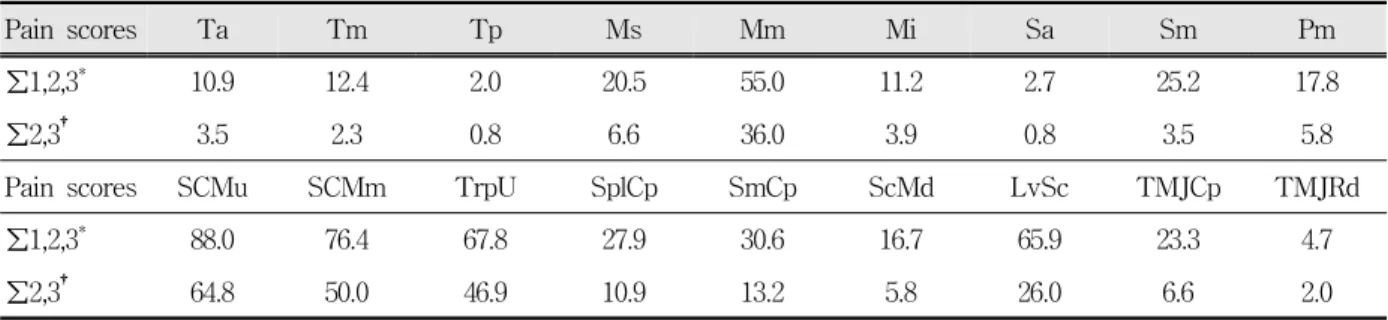
The frequencies of the presence of pressure pain (scores from 1 to 3) and moderate to severe pressure pain (scores 2 and 3) were calculated over 258 palpation sites in total (129 on each side). In the cervical muscles, more than 40% of sternocleido- mastoid and upper trapezius examination sites
showed moderate to severe tenderness, followed by levator scapulae with 26.0%. In the masticatory muscles, masseter middle was the most frequent pressure pain site, with 36.0% of moderate to severe pain.
4. Subjective pain intensity, opening amounts, and TMD pain
The correlation between subjective pain intensity and the sum of TMD pain scores was not significant, whether pain intensity was at present (mean = 3.02, SD = 2.11; r = 0.168, P = 0.058) or during the past 6 months (mean = 4.03, SD = 2.93;
r = 0.093, P = 0.293).
The amount of maximum opening without pain (mean = 40.9 mm, SD = 12.6, n = 129) was inversely correlated with the sum of TMD pain scores (r = -0.200, P = 0.023), which implied that comfortable opening of the mouth was reduced by TMD pain.
The maximum unassisted opening (Mean = 48.0 mm, SD = 9.1) showed an inverse correlation as well; however, it was not statistically significant (r
= -0.153, P = 0.083).
5. Relationship between cervical muscle pain and TMD pain
For the 129 patients, the sum of cervical muscle pain scores (mean = 12.88, SD = 8.06) and the sum of TMD pain scores (mean = 5.36, SD = 5.10) were moderately correlated (Spearman's ρ = 0.502, P <
0.001).
The slope of the regression line was greater than zero, indicating that the sum of TMD pain scores tends to increase as the sum of cervical muscle pain scores increases (slope = 0.395, 95% CI = 0.345 to 0.445, t = 15.727, P < 0.001, Y = 0.395 ․ X, R
2= 0.659). There were extreme outliers implying almost or prominent TMD pain with minimal cervical muscle pain, and vice versa (Fig. 1).
6. Relationship between principal cervical and masticatory muscle pain
For the ninety patients who had masticatory muscle disorders in general, the sum of SCM and upper trapezius pain scores (mean = 8.67, SD = 4.95) and the sum of temporalis and masseter pain scores (mean = 3.37, SD= 3.56) showed moderate correlation (Spearman's ρ = 0.375, P < 0.001).
Fig. 1. A scatter plot showing a moderate to high positive correlation between the sum of cervical muscle pain scores and that of TMD pain scores (R2 = 0.659, n = 129, P < 0.001)
The sum of SCM and upper trapezius pain scores and the sum of temporalis and masseter pain scores were in a proportionate relationship (slope = 0.359, 95% CI = 0.289 to 0.429, t = 10.179, P < 0.001, Y = 0.359․X, R
2= 0.538). Although the patients with severe sternocleidomastoid and upper trapezius muscle pain without apparent temporalis and masseter muscle pain were not uncommon, those with only severe temporalis and masseter pain were not observed (Fig. 2). This result suggests that the effect of sternocleidomastoid and upper trapezius muscle pain on temporalis and masseter muscle pain should not be underestimated or ignored.
7. Correlation between variables of the sum of unilateral pain scores of TMD pain and cervical muscle pain in all patients
For 129 patients, median of sum of right cervical muscle pain scores was 6 (interquartile range = 4 to 10), and that of sum of left cervical muscle pain scores was 6 (interquartile range = 3 to 9). The difference between the two variables was statistically significant (Wilcoxon signed ranks test, P < 0.001), but clinically not important. The reason for the difference was inferred to be either the actual
Fig. 2. A scatter plot showing a moderate positive correlation between the sum of SCM and upper trapezius pain scores and the sum of temporalis and masseter pain scores (R2 = 0.538, n = 90, P < 0.001).
Pain scores Ta Tm Tp Ms Mm Mi Sa Sm Pm
∑1,2,3* 10.9 12.4 2.0 20.5 55.0 11.2 2.7 25.2 17.8
∑2,3† 3.5 2.3 0.8 6.6 36.0 3.9 0.8 3.5 5.8
Pain scores SCMu SCMm TrpU SplCp SmCp ScMd LvSc TMJCp TMJRd
∑1,2,3* 88.0 76.4 67.8 27.9 30.6 16.7 65.9 23.3 4.7
∑2,3† 64.8 50.0 46.9 10.9 13.2 5.8 26.0 6.6 2.0
n = 258 (right 129 + left 129)
* ∑1,2,3 = frequency of the pressure pain scores 1 to 3 (%), indicating the presence of pressure pain
† ∑2,3 = frequency of the pressure pain scores 2 and 3 (%), indicating moderate to severe pressure pain Table 4. Frequencies of pressure pain scores of TMJs, masticatory muscles, and cervical muscles
right dominance of pain or the examiner's unequal dexterity of palpation technique. The median of the sum of right TMD pain scores was 2 (interquartile range = 0 to 5), and that of the sum of left TMD pain scores was 2 (interquartile range = 0 to 4).
The difference between the two variables was not statistically significant (Wilcoxon signed ranks test, P = 0.065).
The sum of right cervical muscle pain scores and the sum of left cervical muscle pain scores showed the highest correlation (r = 0.802, P < 0.001). The sum of right TMD pain scores and the sum of left TMD pain scores were moderately correlated (r = 0.481, P < 0.001). Correlation between the sum of unilateral TMD pain scores and unilateral cervical
Left TMD pain scores* Right cervical muscle pain scores†
Left cervical muscle pain scores†
Right TMD pain scores* 0.481
P < 0.001
0.402 P < 0.001
-0.226 P = 0.011
Left TMD pain scores* - -0.206
P = 0.020
0.374 P < 0.001
Right cervical muscle pain scores† - - 0.802
P < 0.001 Partial correlation coefficients, n = 129
* Sum of unilateral TMD pain scores; † Sum of unilateral cervical muscle pain scores
Table 5. Correlation between the sum of unilateral pain scores of TMD pain and cervical muscle pain in all patients, demonstrating the nature of symmetric pain involvement
muscle pain scores of the same side was the least correlated (r = 0.402, P < 0.001 for the right side;
r = 0.374, P < 0.001 for the left side) (Table 5).
These findings suggest the nature of symmetric involvement of the cervical muscle pain and TMD pain in both sides. The symmetric feature was especially pronounced in the cervical muscle pain.
8. Correlation between variables of the sum of unilateral pain scores of TMD pain and cervical muscle pain in unilateral TMD patients
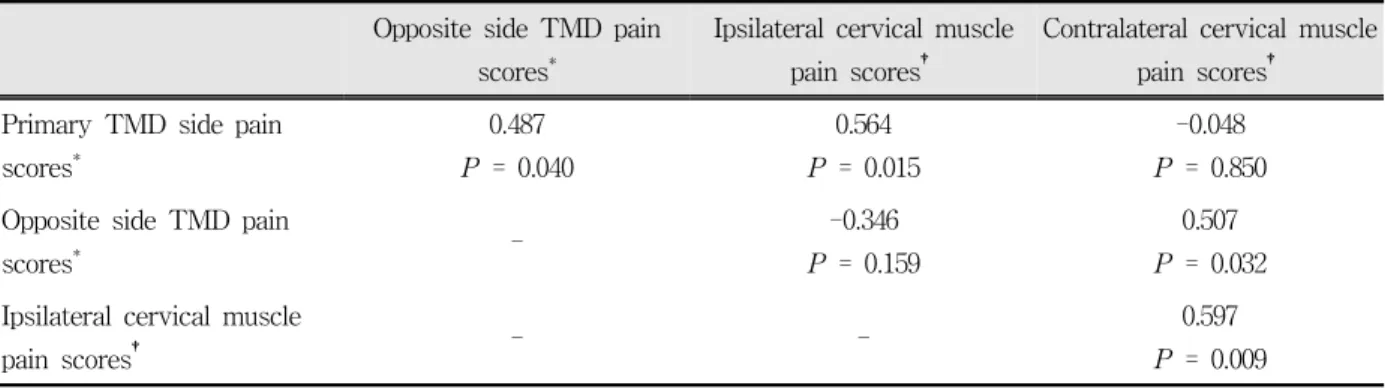
For the twenty patients with unilateral TMD pain,
the median of the sum of primary TMD side pain
Opposite side TMD pain scores*
Ipsilateral cervical muscle pain scores†
Contralateral cervical muscle pain scores† Primary TMD side pain
scores*
0.487 P = 0.040
0.564 P = 0.015
-0.048 P = 0.850 Opposite side TMD pain
scores* - -0.346
P = 0.159
0.507 P = 0.032 Ipsilateral cervical muscle
pain scores† - - 0.597
P = 0.009 Partial correlation coefficients, n = 20
* Sum of unilateral TMD pain scores; † Sum of unilateral cervical muscle pain scores
Table 6. Correlation between the sum of unilateral pain scores of TMD pain and cervical muscle pain in unilateral TMD patients, demonstrating the ipsilateral influence of pain from TMD pain to cervical muscle pain
scores was 6 (interquartile range = 5 to 8). The median of the sum of opposite side TMD pain scores was 1 (interquartile range = 0 to 2). The difference between the sum of primary TMD pain scores and that of opposite side TMD pain scores was statistically significant (Wilcoxon signed ranks test, P < 0.001), which proved the unilaterality of TMD pain of the study patients.
The median of the sum of ipsilateral cervical muscle pain scores was 9 (interquartile range = 5 to 8) and that of the sum of contralateral cervical muscle pain scores was 7 (interquartile range = 4.25 to 10.75). The difference between the sum of ipsilateral cervical muscle pain scores and the sum of contralateral cervical muscle pain scores was not statistically significant (Wilcoxon signed ranks test, P=0.077). The main reasons for statistical non-significance were thought to be too small a number of samples and the strong characteristics of symmetry of cervical muscle pain.
The partial correlation coefficient between the sum of ipsilateral cervical muscle pain scores and the sum of contralateral cervical muscle pain scores was the largest (r = 0.597, P = 0.009). However, it was smaller than that between the sum of unilateral cervical muscle pain scores of the right and left sides in all patients.
The partial correlation between the sum of primary TMD side pain scores and that of ipsilateral
cervical muscle pain scores was 0.564 (P = 0.015), which was larger than that between the sum of unilateral TMD pain scores of the right and left sides (r = 0.487, P = 0.040) (Table 6). In contrast, in the preceding analysis on the 129 patients, the correlation between the sum of right TMD pain scores and that of left TMD pain scores was higher than the correlation between the sum of unilateral TMD pain scores and unilateral cervical muscle pain scores of the same side. These results demonstrated the ipsilateral influence of pain from TMD pain to cervical muscle pain.
Ⅳ. DISCUSSION
The primary objectives of this study were to demonstrate an association between cervical muscle pain and TMD by pressure pain response, and to frequently find cervical muscles presenting moderate to severe pain. An additional objective was to test the hypothesis that unilateral TMD pain affects the level of cervical muscle pain on the same side.
The results of the analysis of the questionnaire
suggested that neck pain was associated with TMD
in symptoms, some of etiologic factors of TMD, and
clinical findings including the amount of mouth
opening. The most important findings of this study
were obtained by an analysis of the variables
produced by processing pressure pain scores.
Muscle pain and TMJ pain is often associated with hyperalgesia of the involved tissues. In clinical practice, palpation is still a common method to locate areas affected by hyperalgesia. A patient's reaction to pressure pain on the palpation of cervical muscles, masticatory muscles as well as TMJs was graded into ordinal data of 0 to 3. Clinical changes in muscle and joint tenderness is more easily detected with a 4-point scale than a 2-point scale.
16)Such variables expressed in a 4-point scale can be further processed to produce secondary variables with a quantitative property. In this study, several variables of the sum of pressure pain scores were defined and used to determine the relationships between TMD and cervical muscle pain. An explanation of well-known associations of pain using these variables was successful, implying that assessment of cervical muscles by pressure pain or tenderness to palpation has clinical value in the diagnosis of head and neck pain disorders.
Myofascial pain is one of the most frequent sources of pain originating from muscle tissues. It arises from hyperirritable foci in muscle, usually referred to as myofascial trigger points. It may mimic a large number of other disorders;
furthermore, the finding of myofascial trigger points does not rule out other conditions.
17)The essential clinical features of myofascial trigger points initially presented by Simons are: ⑴ a tender point within a taut band of skeletal muscle, ⑵ a characteristic pattern of referred pain, ⑶ patient recognition of pain on sustained compression over the tender point, and ⑷ a local twitch response within the band of muscle on plucking palpation across the fibers.
18)These features were also revealed in the head and neck of myofascial pain patients.
19)Spot tenderness is an easy test to perform and an essential finding when examining a myofascial trigger point. However, spot tenderness is not a specific sign of a myofascial trigger point because it is also a defining characteristic of tender points of fibromyalgia, and it is equally characteristic of enthesopathy.
20)Because tenderness alone does not
lead to a distinction of myofascial pain from other muscle pain disorders, it is recommended for investigators to state whether tenderness alone is used, or whether a taut band, referred pain, a local twitch response, or a variable subset of features of myofascial pain is used to define the clinical condition.
21)It should be remembered that the criterion of myofascial pain in the RDC/TMD classification is the pain of muscle origin, including a complaint of pain as well as pain associated with localized areas of tenderness to palpation of muscle. Only myofascial pain and myofascial pain with limited opening of the mouth are included in the RDC/TMD system, ruling out uncommon conditions such as muscle spasm, myositis and contracture.
22)Myofascial trigger points are complicated with the key and satellite trigger points that are called related trigger points. A key myofascial trigger point is one that is responsible for the activity of one or more satellite trigger points. One example in the head and neck is the key trigger points in the upper trapezius and sternocleidomastoid muscles with corresponding satellite trigger points in the temporalis, masseter and digastric muscles.
23)Frequency analysis of the pressure pain scores in this study revealed that sternocleidomastoid and upper trapezius most often exhibited moderate to severe pressure pain in the cervical muscles.
Although not directly fit to the above notion of related trigger points, it was confirmed with a correlation analysis of the pressure pain level of sternocleidomastoid and upper trapezius muscles and that of temporalis and masseter muscles in the patients excluding primarily TMJ disorders. The result indicated a moderate correlation between the pain levels of those two muscle groups, which supports or at least does not contradict the concept of key and satellite trigger points. It was interesting to note that although the sternocleidomastoid and upper trapezius muscle group displayed a wide range of pain levels, the temporalis and masseter muscle group alone did not present extreme pain.
In this study, the characteristic of symmetric
involvement of pain in the neck muscles as well as TMD pain was noted. Neck muscle pain revealed a very strong tendency of symmetric involvement on both sides. It was observed in TMD as well, but it was less strong. Unilateral TMD pain could result from asymmetric local provocation of etiologic agents. The nature of the symmetric involvement of pain in the orofacial area has not been dealt with or reported in detail so far.
Pain referral from cervical muscles to the orofacial area in myofascial pain is well known. Orofacial pain conditions such as TMD are often poorly localized and are often associated with pain in the neck muscles as well as the jaw muscles. Pain in the cervical musculoskeletal tissues may be referred to cranial structures including the jaw muscles.
24)Active trigger points were more frequent in patients presenting with mechanical neck pain than in healthy subjects.
25)Experimental trapezius muscle pain was demonstrated to spread to the posterior neck and posterior temporal zone in most subjects, and produced referred pain in the temporo- mandibular region of some subjects. In addition, trapezius experimental pain was accompanied by a reduction of mouth opening.
26)In contrast, a trigger point injection into the trapezius was shown to significantly reduce pain intensity ratings of the ipsilateral masseter area.
27)The literature seems to favor the direction of pain referral from the cervical muscle to the head. There are fewer articles about pain referral from the head to the neck region than the reverse situation.
28-30)However, this study added further clinical evidence to the concept of pain referral from the head to the neck by proving the unilateral influence of pain from TMD pain to cervical muscle pain.
This study has several limitations, however. First, only one examiner participated in the examination and assessment of the study patients. Second, the reliability of pressure pain examination was not assessed. Third, the number of study patients was not enough to ensure statistical significance and clinical importance of the test results. Fourth, the patient group in this study did not represent the
general population of TMD patients. There might have been a selection bias due to the limited condition of encompassing all TMD patients of concern.
The present study was designed as a cross- sectional one. A longitudinal study would expand our understanding of the relationship between cervical muscle pain and TMD pain. Investigation from the perspective of a specific disease group such as myofascial pain would help develop a more in depth understanding of associated pain.
In conclusion, TMD is associated with cervical muscle pain on condition of pressure pain response to palpation. Of the cervical muscles, sternoclei- domastoid and upper trapezius frequently exhibit moderate to severe pressure pain, and they are closely related to masticatory muscle pain. The characteristic of symmetric involvement of pain is prominent in cervical muscles; however, TMD can affect the level of cervical muscle pain to modify its symmetric nature.
Therefore, cervical muscle pain should be evaluated in patients with complex signs and symptoms in the head and neck.
Ⅴ. CONCLUSION
In a study of 129 patients who were diagnosed with temporomandibular disorders - with or without cervical muscle pain - all were examined to reveal the relation between cervical muscle pain and TMD. Tenderness or pressure pain to palpation was used as a diagnostic test.
The results were as follows:
1. TMD is associated with cervical muscle pain on condition of pressure pain response to palpation.
2. Of the cervical muscles, sternocleidomastoid and upper trapezius frequently exhibit moderate to severe pressure pain, and they are closely related to the masticatory muscle pain.
3. Cervical muscles have a strong tendency of exhibiting symmetric involvement of pain.
4. TMD affects the level of cervical muscle pain to
modify its symmetric nature.
ACKNOWLEDGEMENTS
The authors are grateful to John Goranson for his contribution to the preparation of this manuscript and Yu Eun-Kyung for her help in data manage- ment and entry.
REFERENCES
1. Curtis AW. Myofascial pain-dysfunction syndrome:
the role of nonmasticatory muscles in 91 patients.
Otolaryngol–Head and Neck Surg 1980;88:361–367.
2. Clark GT, Green EM, Dornan MR et al. Craniocervical dysfunction levels in a patient sample from a temporomandibular joint clinic. J Am Dent Assoc 1987;115:251–256.
3. De Wijer A, Steenks MH, Bosman F et al. Symptoms of the stomatognathic system in temporomandibular and cervical spine disorders. J Oral Rehabil 1996;23:
733-741.
4. De Wijer A, Steenks MH, De Leeuw JRJ et al.
Symptoms of the cervical spine in temporomandibular and cervical spine disorders. J Oral Rehabil 1996;23:
742 -750.
5. Sonnesen L, Bakke M, Solow B. Malocclusion traits and symptoms and signs of temporomandibular disorders in children with severe malocclusion. Eur J Orthod 1998;20:543–559.
6. Wänman A. The relationship between muscle tenderness and craniomandibular disorders: a study of 35-year-olds from the general population. J Orofac Pain 1995;9:235-243.
7. Ciancaglini R, Testa M, Radaelli G. Association of neck pain with symptoms of temporomandibular dysfunction in the general adult population. Scand J Rehabil Med 1999;31:17-22.
8. Pallegama RW, Ranasinghe AW, Weerasinghe VS, et al. Influence of masticatory muscle pain on electromyographic activities of cervical muscles in patients with myogenous temporomandibular disorders. J Oral Rehabil 2004;31:423-429.
9. Sipilä K, Zitting P, Siira P, et al. Generalized pain and pain sensitivity in community subjects with facial pain: a case-control study. J Orofac Pain 2005;19:
127-132.
10. Hagberg C, Hagberg M, Kopp S. Musculoskeletal symptoms and psychosocial factors among patients
with craniomandibular disorders. Acta Odontol Scand 1994;52:170-177.
11. Türp JC, Kowalski CJ, O'Leary N et al. Pain maps from facial pain patients indicate a broad pain geography. J Dent Res 1998;77:1465-1472.
12. Sipilä K, Ylöstalo PV, Joukamaa M, Knuuttila ML.
Comorbidity between facial pain, widespread pain, and depressive symptoms in young adults. J Orofac Pain 2006;20:24-30.
13. John MT, Miglioretti DL, LeResche L, Von Korff M, Critchlow CW. Widespread pain as a risk factor for dysfunctional temporomandibular disorder pain. Pain 2003;102:257-263.
14. Dworkin SF, LeResche L. Research diagnostic criteria for temporomandibular disorders. J Craniomandib Disord 1992;6:310-355.
15. Simons DG, Travell JG, Simons LS. Travell &
Simon's myofascial pain and dysfunction: the trigger point manual, Volume 1, 2nd ed., Baltimore, 1999, Williams & Wilkins.
16. Atwood MJ, Dixon DC, Talcott GW, Peterson AL.
Comparison of two scales in the assessment of muscle and joint palpation tenderness in chronic temporomandibular disorders. J Orofac Pain 1993;7:
403-407.
17. Bennett R. Myofascial pain syndromes and their evaluation. Best Pract Res Clin Rheumatol 2007;21:
427-445.
18. Simons DG, Travell JG, Simons LS. Travell &
Simon's myofascial pain and dysfunction: the trigger point manual, Volume 1, 2nd ed., Baltimore, 1999 Williams & Wilkins, pp.33-35.
19. Fricton JR, Kroening R, Haley D, Siegert R.
Myofascial pain syndrome of the head and neck: a review of clinical characteristics of 164 patients. Oral Surg Oral Med Oral Pathol 1985;60:615-623.
20. Hsieh CY, Hong CZ, Adams AH et al. Interexaminer reliability of the palpation of trigger points in the trunk and lower limb muscles. Arch Phys Med Rehabil 2000;81:258-264.
21. Gerwin RD, Shannon S, Hong CZ, Hubbard D, Gevirtz R. Interrater reliability in myofascial trigger point examination. Pain 1997;69:65-73.
22. Dworkin SF, LeResche L. Research diagnostic criteria for temporomandibular disorders. J Craniomandib Disord. 1992;6:310-355.
23. Simons DG, Travell JG, Simons LS. Travell &
Simon's myofascial pain and dysfunction: the trigger
point manual, Volume 1, 2nd ed., Baltimore, 1999 Williams & Wilkins, pp.122.
24. Fricton JR, Kroening R, Haley D, Siegert R.
Myofascial pain syndrome of the head and neck: a review of clinical characteristics of 164 patients. Oral Surg Oral Med Oral Pathol 1985;60:615-623.
25. Fernández-de-Las-Peñas C, Alonso-Blanco C, Miangolarra JC. Myofascial trigger points in subjects presenting with mechanical neck pain: A blinded, controlled study. Man Ther 2007;12:29-33.
26. Komiyama O, Arai M, Kawara M, Kobayashi K, De Laat A. Pain patterns and mandibular dysfunction following experimental trapezius muscle pain. J Orofac Pain 2005;19:119-126.
국문요약
측두하악장애와 경부근육 압통 간의 상관성
중앙대학교 의과대학 치과학교실1, 전남대학교 치의학전문대학원 구강내과학교실2
임영관
1․김재형
2․김병국
2목적: 측두하악장애 환자들에서 압통 검사를 통하여 경부근육 통증의 정도와 위치를 파악하고, 측두하악장애와 경부근육 통증과의 관련성을 규명하고자 하였다.
방법: 측두하악장애 환자(n = 129, 여자 65.9% 평균 = 28.8세)에 대해서 두통, 목의 통증, 정서적 스트레스, 수면 장애, 이상 기능 습관 및 통증 강도에 대한 설문을 실시하였다. 저작계에 대하여 하악 운동범위, 악관절음, 악관절 촉진, 저작근 촉진 검사를 시행하였다. 빗목근 상부(sternocleidomastoid upper), 빗목근 중간(sternocleidomastoid middle), 등세모근 상부 (upper trapezius), 머리널판근(splenius capitis), 머리반가시근(semispinalis capitis), 중간 목갈비근(scalene medius), 어깨올 림근(levator scapulae)의 7부위의 경부 근육에 대하여 촉진에 의한 압통 검사를 하였다. 압통의 정도를 무통(0), 경도(1), 중 등도(2), 심도(3)로 구분하여 판정하였다. 압통점수로부터 여러 통증점수 합계를 계산한 후 이후의 통계분석에 사용하였다.
결과: 80명(62.0%)의 환자가 설문에서 목의 통증을 경험한다고 답하였다. 측두하악장애 통증 점수와 경부 근육통 점수 간에 는 유의한 상관관계가 있었다(r = 0.538, P < 0.001). 경부 근육 중에서 중등도 이상의 압통이 40% 이상 발생하는 근육은 빗목근과 등세모근 상부였고 저작근 중에서는 깨물근(masseter) 중간에서 36%의 중등도 통증이 나타났다. 129명에 대한 경 부근육통점수합과 측두하악장애통증점수합 사이에는 상당한 관련성이 있었으며(ρ = 0.502, P < 0.001), 측두하악장애통증점 수합은 경부근육통점수합이 증가함에 따라 함께 증가하는 경향을 보였다(Y = 0.395 ․ X, R2 = 0.659, P < 0.001). 저작근장 애 환자에서 빗목근등세모근상부통증점수합과 관자근교근통증점수합은 중등도의 관련성(ρ = 0.375, P < 0.001)을 보였으며, 두 변수는 비례 관계에 있었다(Y = 0.359 ․ X, R2 = 0.538, P < 0.001). 편측통증점수의 편상관관계분석에서 우측경부근육 통증점수합과 좌측경부근육통증점수합은 가장 높은 상관성(r = 0.802, P < 0.001)을 보였다. 우측측두하악장애통증점수합과 좌측측두하악장애통증점수합은 중등도의 상관성(r = 0.481, P < 0.001)이 있었다. 편측성 측두하악장애 통증이 있는 20명의 환자에 대한 편상관관계분석에서 우측과 좌측의 편측경부근육통점수간의 상관성이 가장 높았고(r = 0.597, P = 0.009), 측두 하악장애측통증점수합과 동측경부근육통증점수합 사이의 상관성(r = 0.564, P = 0.015)이 그 다음이었다.
27. Carlson CR, Okeson JP, Falace DA, Nitz AJ, Lindroth JE. Reduction of pain and EMG activity in the masseter region by trapezius trigger point injection.
Pain 1993;55:397-400.
28. Janda V. Some aspects of extracranial causes of facial pain. J Prosthet Dent 1986;56:484-486.
29. Block SL. Different diagnosis of craniofacial-cervical pain. In: Sarnat BG, Laskin DM, editors. The temporomandibular joint: a biological basis for clinical practice. 4th ed. Philadelphia, 1992. WB Saunders, pp.
420-468.
30. Norris CW, Eakins D. Head and neck pain: T-M joint syndrome. Laryngoscope 1974;84:1466-1478.
결론: 측두하악장애 통증은 촉진에 의한 압통반응의 측면에서 경부근육 통증과 관련성을 보인다. 경부근육 중에서 빗목근 과 등세모근상부가 중등도 이상의 통증을 흔하게 나타내며 저작근통증과 밀접한 관련이 있다. 경부근육에서는 통증의 대칭 적인 이환 특성이 두드러지지만, 측두하악장애가 경부근육통의 수준에 영향을 주어 대칭적인 특성을 변화시킬 수 있다. 두부 와 경부에 복잡한 통증 질환의 증상과 징후를 보이는 환자에서 경부 근육 통증의 진단과 치료에 관심을 가져야 한다.
주제어: 경부통증, 경부 근육, 측두하악장애, 촉진, 압통