• 검색 결과가 없습니다.

Influences of Physical Soil Properties on Drought Severity in the Central Great Plains Based on Satellite Data and a Digital Soil Database

N/A
N/A
Protected

Academic year: 2021

Share "Influences of Physical Soil Properties on Drought Severity in the Central Great Plains Based on Satellite Data and a Digital Soil Database"

Copied!
14
0
0

로드 중.... (전체 텍스트 보기)

전체 글

(1)

1. Introduction

Drought is a temporary feature resulting from pro- longed absence, or deficiency or poor distribution, of

precipitation (Ogallo, 1994). Although numerous interpretations of drought have been offered, the most significant determinant of drought is the amount of precipitation an area gets compared to

* This study was financially supported by the NASA Headquarters under Earth System Science Fellowship Program (NGT5-30404).

** Post-doctoral research fellow, Kansas Applied Remote Sensing Program, University of Kansas, U.S.A., [email protected]

Influences of Physical Soil Properties on Drought Severity in the Central Great Plains Based on Satellite Data and

a Digital Soil Database*

Sunyurp Park**

인공위성자료와 디지털 토양자료를 통해 분석한 미중부 대평원 지역 가뭄정도에 미친 물리적 토양특성의 영향*

박 선 엽**
Abstract : The State Soil Geographic (STATSGO) database is a valuable source for assessment of soil properties at a state level. Using GIS techniques, eight physical soil properties were extracted from the database, including available water capacity, clay content, soil depth, slope, depth to water table, drainage, texture, and permeability. The influences of these soil properties on drought severity, which was estimated by NDVI departures from normal, were determined over western-central Kansas. Study results showed that seven soil properties had significant relationships with drought severity with correlation coefficients, ranging from -0.89 to 0.85. Thermal emission signals from the Moderate Resolution Imaging Spectroradiometer (MODIS) had a significant relationship with drought severity expressed by NDVI departure from normal and represented spatial progression of drought over time well. High thermal signals, indicating high soil moisture deficit, emerged in the western region and their spatial distribution changed over time. Different sets of soil factors influenced drought severity among early-drying and late-drying areas.

Key Words : STATSGO, physical soil property, drought severity, thermal emission, MODIS.

요약 : STATSGO 데이터베이스는 州단위의 토양 특성을 분석하는 데에 있어 효과적인 자료다. 본 연구에서는

GIS 기법을 이용하여 STATSGO로부터 8개 주요 토양 특성을 추출하였다: 함수력(available water capacity), 점토비 율, 토양깊이, 사면경사, 지하수위까지의 깊이, 배수 특성, 토성, 투수도. 평균적인 NDVI로부터의 편차로 정의된 가뭄 정도(drought severity)에 대해 앞서 열거한 토양 특성이 미치는 영향을 캔자스 중서부 지역을 대상으로 분석하였다.

연구 결과에 따르면, 분석된 8개 변수 중 7개가 통계적으로 유의한 상관관계를 가진 것으로 나타났는데, 상관계수는 -0.89에서 0.85에 이르렀다. Moderate Resolution Imaging Spectroradiometer(MODIS)로부터 취득된 지표복사열(thermal emission) 자료는 평균 NDVI에 대한 편차로 표현되는 가뭄정도와 통계적으로 유의한 상관관계를 가졌으며, 식물생 육기간에 걸친 가뭄지역의 공간적 변화를 잘 나타내었다. 토양수분의 결핍양이 많아질수록, 복사열 시그널 값도 높 아지며, 공간적 분포로 볼 때, 상대적으로 건조한 캔자스 서부로부터 증가하여 시간에 따라 점차 그 분포도 변화하 였다. 연구결과는 또한 가뭄의 진행단계에 따라 가뭄에 대한 각 토양 변수의 영향도 달라짐을 보여주었다.

주요어 : STATSGO, 토양 특성, 가뭄정도, 지표복사열, MODIS.

(2)

normal (Edwards and McGee, 1997). Especially, pre- cipitation is known as a strong predictor of green bio- mass in the central Great Plains (Wang et al., 2001).

However, the spatial distribution, duration, intensity and frequency of drought are dependent upon vari- ous environmental factors. In particular, hydrologic soil properties play an important role in affecting vegetation growth because they determine how long and how much the water will be held in soil layers, and therefore affect the availability of soil moisture for plant uptake. Thus, soil moisture storage is gener- ally controlled by many factors, including soil depths, texture, permeability, slope, available water capacity (AWC), and depths to water table (De Jong et al., 1984; Wright et al., 1990; Reed, 1993; Farrar et al., 1994; Nicholson and Farrar, 1994; Timlin et al., 2001).

To determine the impacts of soil properties on drought severity, it is necessary to define drought areas and their intensity. In drought monitoring, remote sensing techniques became a crucial tool for timely decision-making because they provide a bet- ter spatial footprint of environmental phenomena by alleviating point observational biases and providing estimates where previously few existed (Legates, 2000; Unganai and Kogan, 1998). The Normalized Difference Vegetation Index (NDVI) is a biophysical variable formulated from remote sensing data and has been most widely used for vegetation monitor- ing (Sellers, 1985; Tucker and Sellers, 1986; Kogan, 1997; Reed et al., 1996). It is defined as a dimension- less radiometric measure that indicates activity of green vegetation, such as leaf area index, percent green cover, biomass, chlorophyll content, and absorbed photosynthetically active radiation.

Therefore, vegetation growth can be monitored fre- quently by NDVI from satellite sensors with a high temporal resolution.

One limitation of NDVI in drought studies is a lag effect in its response to rainfall. It has been known that this lag effect makes the changes in NDVI trig- gered by plant water stress or precipitation occur after a delay of up to several weeks (Peters et al.,

1991; Reed, 1993; Seguin et al., 1994; Lozano-Garcia et al., 1995; Yang et al., 1997; Rundquist et al., 2000;

Rundquist and Harrington, Jr., 2000; Wang et al., 2001). However, recent developments in remote sensing techniques are making thermal infrared satellite data useful for better, earlier drought detec- tion (Moran et al., 1994; Kogan, 1995; Yang et al., 1997; Park et al., 2002a; Park et al., 2002b). Land sur- face temperature (LST) is generally governed by net radiation on the surface and soil moisture. Since moisture availability may be the single most impor- tant factor governing the partition between sensible and latent heat fluxes, thermal emission from the land surface is valuable information for instant drought monitoring. Knowing that a sensible heat flux is likely to increase with the gradient between land surface temperature and air temperature, the remotely sensed thermal infrared data are consid- ered promising for drought prediction (Jackson et al., 1981; Moran and Jackson, 1991; Moran et al., 1994).

Previous studies showed that weekly maximum- temperature composite data represented soil mois- ture conditions well, and they had a significant rela- tionship with drought severity (Park et al., 2002a;

Park et al., 2002b; Park, 2003). According to the stud- ies, the spatial patterns of the onset of drought indi- cated by satellite thermal signals changed as the growing season progressed. Since the thermal sig- nals reflected soil moisture conditions on the ground well it was believed that certain areas dried out more quickly than others did. Therefore, it is hypothesized that individual soil properties that sig- nificantly contribute to drought severity may be dif- ferent among areas that dry out in different times.

However, the temporal aspect of soil properties in

their contributions to drought has not been docu-

mented. One of efficient ways to establish relation-

ships between the soil factors and drought severity

is to use digital soil databases and satellite-based

remote sensing data. In this study, NDVI and LST

data were used to identify drought areas and severi-

ty, and individual soil properties were extracted

(3)

from the State Soil Geographic (STATSGO) data- base. Since the STATSGO database includes digital geographic data and soil attribute data at a state level, spatial analyses of soil properties can be effec- tively conducted over a large area. Using Geographic Information Systems (GIS), soil attribute layers can be extracted, analyzed, and represented quickly and accurately.

For this study, thermal emission data were obtained from the Moderate Resolution Imaging Spectroradiometer (MODIS). Thermal infrared data of the MODIS have a similar spatial resolution to that of its predecessor such as the Advanced Very High Resolution Radiometer (AVHRR) system, but the MODIS provides an opportunity to acquire ther- mal infrared data with higher radiometric and spec- tral resolutions. With the innovation in technology and better calibration, thermal infrared data from the MODIS may allow us to more accurately infer changes in surface thermal regimes and assist in determining better relationships between soil prop- erties and drought severity (Barnes et al., 1998;

Kaufman et al., 1998; Schueler and Barnes, 1998). The purpose of this study is to determine the spatial and temporal influences of soil properties on drought severity using MODIS thermal infrared data, NDVI, and a digital soil database.

2. Study Area, Data and Methods

1) Study Area

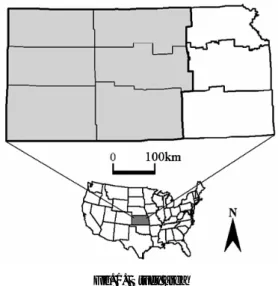
Western and central Kansas was selected as the study area because of frequently occurring droughts and their potential impact on the local agricultural economy and natural grassland/rangeland manage- ment practices (Fig. 1). Due to rapid conversion from grassland to cropland or rangeland since the late 1800s, the region’s economy is based upon grazing, feeding of livestock, dryland farming, and increasing- ly, irrigated agriculture. The agricultural economy of

the western Kansas is very dependent upon the High Plains aquifer as a water resource because of limited water supplies and water deficits caused by high evaporation. This region has a distinct continental cli- mate characterized by high monthly, seasonal, and year-to-year variations in precipitation with a strong west-east gradient. This highly variable precipitation regime made western Kansas one of the most drought-prone regions in the United States (Warrick, 1975; Bark, 1978; Reed, 1993). Frequent droughts and extreme temperature seasonality have resulted in a grassland-type ecosystem; shortgrass in the west and mixed prairies in the central parts of the state (Küchler, 1974). Since this region has relatively flat topography and is mostly vegetated by grasses or crops, the thermal signals from the surface may be rel- atively uncontaminated by slope, aspect, or shadows.

2) Soil Property Extraction

The U.S. Department of Agriculture’s (USDA) Natural Resources Conservation Service (NRCS) col- lects, stores, maintains, and distributes the STATSGO database. The STATSGO database was designed pri- marily for regional, multi-state, state, river basin, and multi-county resource planning, management, and

Fig. 1. Study area

*Internal boundary lines divide the state into nine

climatic regions.

(4)

monitoring. Soil maps of STATSGO are complied by generalizing more detailed soil survey maps, or Soil Survey Geographic (SSURGO) database. The STATS- GO database consists of digital georeferenced spatial data, attribute data, and metadata. The spatial data are spatial objects-polygons, lines, and nodes-whose coordinates represent real locations on the earth’s surface. The attribute data contain both estimated and measured data on the physical/chemical soil properties and soil interpretations for engineering, water management, recreation, agronomic, wood- land, range, and wildlife uses of the soil. Metadata, or data about data, describe the content, quality, condi- tion, history, and other characteristics of the data.

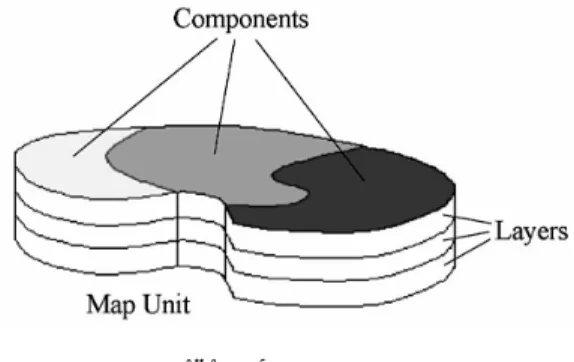
The fundamental graphic feature in STATSGO is the map unit. Each map unit is designed as a sepa- rate polygon, and it contains up to 21 soil compo- nents, typically soil series phases. Each soil compo- nent has up to six layers or soil horizons (Fig. 2, USDA, 1995). Important soil properties considered in this study include permeability, AWC, clay con- tent, soil thickness, slope, soil texture, depth to water table, and drainage. These property layers were extracted using the ARC/INFO software package.

Each map unit value of these soil attributes from the STATSGO database was assigned to the same map unit of the polygons, the spatial data of the STATS-

GO. Since the original STATSGO data were an ARC/INFO coverage, ARC command, POLYGRID was used to create a grid from the polygon coverage.

Finally, the grid for each variable was converted to the ERDAS IMAGINE format for further image analysis. Correlation coefficient analyses were per- formed to determine relationships between these properties and drought severity, expressed by NDVI departures from ten-year mean NDVI.

3) NDVI-Soil Properties Relations

To determine the general impact of individual soil properties on drought throughout the growing sea- son, an overall drought intensity needed to be esti- mated. Time-series NDVI data from AVHRR allow an analysis of changes in vegetation vigor and densi- ty of drought-prone areas. Such NDVI images pro- vide an indication of weather the current period’s vegetation condition is above, below, or similar to the mean vegetation condition during a defined his- torical period. By subtracting the current NDVI image from the “average” image for the same time period for that period, an anomaly image is pro- duced (Monnik, 2000).

In this study, weekly maximum AVHRR NDVI composite data for a growing season (March- October) in 2000 and ten-year mean (1990-1999) weekly NDVI data were obtained from archives in the Kansas Applied Remote Sensing (KARS) Program at the University of Kansas to measure drought severity in each week. In a previous drought study conducted in Kansas, drought-affect- ed areas were identified by subtracting a drought year’s NDVI from a close-to-normal year’s NDVI (Reed, 1993). This one-year-reference approach may not always represent stable, average NDVI due to a local variability. To overcome this problem, ten-year mean NDVI was used as the normal NDVI in the study area. Drought severity is expressed by a NDVI departure from the ten-year mean NDVI and defined as following:

Fig. 2. STATSGO map unit

* Each map unit can have multiple components and each

component can have multiple layers. Individual soil properties

are associated with unique map unit identifier (MUID). The

analysis begins from lowest level (layers) and integrated back

to the highest level (map unit) (USDA, 1995).

(5)

Drought severity = Ten-year mean NDVI - NDVI

2000

(NDVI in 2000) Therefore, negative departure values represent above-normal vegetation growth, whereas positive ones represent below-normal conditions. To deter- mine the relationship between drought severity and soil properties derived from the STATSGO database, correlation coefficient analyses were performed. A drought period for drought-severity calculation was selected based on mean weekly NDVI departure values for the entire study area. Then, drought severity values of a composite period when NDVI values declined significantly (composite 38, Fig. 3) were correlated to the soil property data. To com- pute correlation coefficients, sample points were selected systematically at 10 km intervals from the soil attribute images and the NDVI departure images. In all, 1485 points were selected over the study area. Since many sample points fell on a single map unit, the NDVI departure values of sample points with the same soil property value were aver- aged for a correlation analysis.

Pearson’s correlation coefficients were calculated for AWC, clay, soil thickness, slope, depth to water table, and permeability. However, drainage and soil texture are not usually measured on an interval or ratio scale, but on ordinal scales, where the conven-

tional correlation coefficient is not appropriate. An alternative measure is Spearman’s rank correlation coefficients. This figure expresses the similarity between two sets of rankings (Davis, 1986). It is hypothesized that as AWC, clay content, and soil thickness increase, drought effects will decrease. On the contrary, it is hypothesized that as drainage, slope, and depth to water table increase, or soil tex- ture becomes coarser, drought damage will increase.

4) Temporal Impacts of Soil Properties on Drought

The next task was to evaluate how the impact of the individual soil properties on drought-affected areas would be changing over time as the drought areas changed. For the drought-detection purpose, MODIS’ land surface temperature data were uti- lized. The MODIS is the key instrument of the Earth Observing System (EOS) satellite, Terra that the National aeronautics and Space Administration (NASA) developed and launched in 1999. This sen- sor provides a comprehensive series of global obser- vations of the earth’s land, ocean, and atmosphere. It takes measures in the visible and infrared regions of the electromagnetic spectrum in such a way to view the entire earth every two days. MODIS is a whiskb- room scanning imaging system and collects data in 36 bands, 20 bands from 0.4 to 3µm and 16 bands from 3 to 15µm, with ground resolution cells of 250, 500, and 1000m (Barnes et al., 1998).

Previous studies based on a hydroclimatologcal approach reported that time-integrated LST devia- tion standardized with air temperature had signifi- cant negative relationships with soil moisture and actual/potential evapotranspiration ratio, while it had a positive relationship with moisture deficit/potential evapotranspiration ratio (Park et al., 2002a; Park et al., 2002b; Park, 2003). This indicated that thermal emission from the land surfaces (or LST deviation) increased as soil moisture deficit increased. To compare this thermal emission easily, it was standardized across the study area, formulat- Fig. 3. NDVI deviations defined as ten-year (1990-1999)

mean NDVI minus NDVI in 2000

*A trend line for the NDVI deviation changes was also drawn.

(6)

ing an index called the Standardized Thermal Index (STI). This index was proposed to rescale the land surface temperature standardized with mean air temperature from 0 to 1. The index is defined as the cumulative mean of land surface temperature stan- dardized with mean air temperature ([LST- meanT

air

]

cum

) divided by the cumulative mean of the sum of the land surface temperature and the mean air temperature ([LST+meanT

air

]

cum

):

STI = [LST-meanT

air

]

cum

/[LST+meanT

air

]

cum

If we assume that LST and mean air temperature are not lower than 0°C during the growing season, and LST of maximum temperature composite data is not lower than air temperature, the Standardized Thermal Index (STI) ranges from 0 to 1. Maps of the standardized thermal index (STI) scaled with 0.05 intervals were created in each composite period, and each map was categorized with 7 different STI lev- els. Mean values of these STI classes were calculated, and correlation coefficients between these STI class values and the NDVI decline values were calculated to see if the index was significantly correlated with NDVI departures from the mean. By establishing a relationship between these two variables, it was expected that a threshold STI value could be made to identify drought areas indicated by NDVI declines below the ten-year mean in each month

from July to September 2000. Once possible drought areas with high STI are identified on monthly basis, the impact of individual soil properties on drought severity through time will be examined by compar- ing monthly temporal correlation coefficients between the soil properties and NDVI departures.

3. Results and Discussion

1) Relationships between Soil Properties and Drought

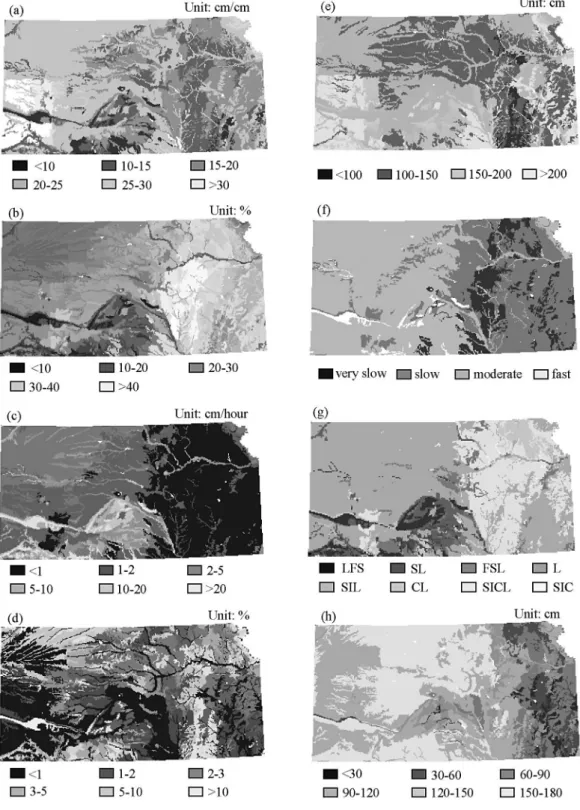
Each of the soil properties considered in this study showed different spatial patterns of distribution.

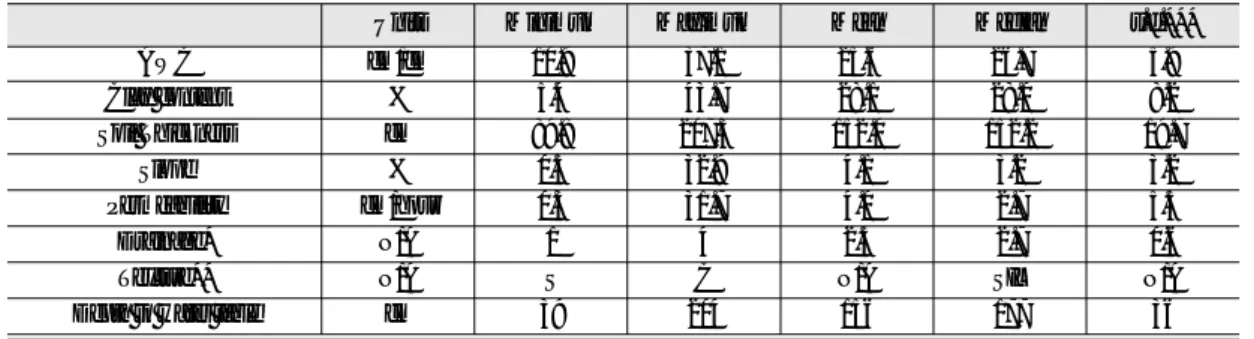
Maps and value ranges for individual soil properties are shown in Fig. 4 and Table 1, respectively. Overall, AWC, clay content, soil thickness, slope, permeabili- ty, drainage, and texture had significant relationships with NDVI deviations (Fig. 5). Soil thickness, drainage, and permeability had negative relation- ships with the NDVI deviations, whereas AWC, clay content, slope, and texture had positive relationships.

However, depth to water table did not show signifi- cant relationship with the NDVI deviations (r=-0.04).

Judging from the correlation coefficients, soil thick- ness and texture seemed to have the strongest rela- tionships with the drought severity, having the corre- lation coefficients of -0.85 and 0.89.

Table 1. Statistics for soil properties calculated from STATSGO database in the study area

Units Minimum Maximum Mean Median s.d.

AWC cm/cm 10.9 37.1 25.6 26.7 5.9

Clay content % 5.4 43.7 28.1 28.0 8.2

Soil Thickness cm 89.8 207.3 152.0 152.2 19.7

Slope % 0.5 32.9 4.1 3.2 3.2

Permeability cm/hour 0.3 31.7 4.0 2.7 5.5

Drainage* N/A 1 4 2.5 2.7 0.6

Texture** N/A S C N/A SIL N/A

Depth to water table cm 39 204 156 177 36

* Drainage : 1-very slow infiltration rates, 2-slow infiltration rates, 3-moderate infiltration rates, and 4-high infiltration rates

** Soil texture was ranked from coarsest to finest. S-sand, C-clay, and SIL-silt loam

*** Standard deviation

Units Minimum Maximum Mean Median s.d.***

(7)

Fig. 4. Rasterized images of soil properties in Kansas

(a) AWC, (b) clay contnet, (c) permeability, (d) slope, (e) soil thickness, (f) drainage, (g) soil texture: LFS-loamy fine sand, SL-sandy

loam, FSL-fine sandy loam, L-loam, SIL-silt loam, CL-clay loam, SICL-silty clay loam, and SIC-silty clay, and (h) depth to water table

(8)

Although the relationships between soil proper- ties and drought severity were significant, five soil attributes did not produce the results as they were hypothesized. Permeability and drainage were thought to have a positive relationship with drought severity because more permeable or draining soils are likely to lose soil moisture easily. But, they had negative intermediate-level relationships with drought severity (r=-0.42, and -0.48). AWC, clay con- tent, and soil texture are similar variables in a fact that they are all related to particle size distribution of soils. AWC refers to the volume of water that should be available to plants if the soil were at field capacity (USDA, 1993). Therefore, finer soils have higher AWC than coarser soils do. Since soils with high AWC, clay content, and fine texture have little pore space than coarser soils, they were expected to have negative relationships with drought severity. On the contrary, they had positive relationships with r-val- ues ranging from 0.40 to 0.89.

Regarding depth to water table, results disagreed with a previous study conducted in the same area.

Reed (1993) found relationships between drought responses and depth to water table with correlation coefficients, ranging from 0.12 to 0.46. Knowing that the relationships were relatively weak, and depths to water table are variable seasonally and yearly, it is

probable that the relationship could vary temporally.

Although these variables had significant relation- ships with drought severity, being represented by the NDVI deviations, the directions of the relation- ships were not always the same way as they were hypothesized. Among the soil attributes considered, only soil thickness and slope conformed to the hypotheses. Since thick soil layers, little pore space, and gentle slopes may alleviate drought severity, it is reasonable to say that soil thickness may have a negative relationship, and slope may have a positive relationship with drought severity. Reed (1993) also analyzed this soil property, but he found that AWC had not contributed to drought responses.

AWC, drainage, permeability, clay content, and texture had relationships with NDVI deviations in opposite directions to the hypothesis. In contrast to the hypotheses, results showed that coarser or more permeable soils with less water-holding capacity had less severe influences on drought severity. A possible explanation for these results would be that finer top- soil layers create more runoff and allow more water to evaporate from the surface than coarser-textured soils, especially in an early stage of drought. Loss by evaporation from surfaces is known to be about 70 to 75 percent of the total rainfall for the Great Plains area. In dry regions, major losses of soil water occur via soil evaporation, and soil evaporation is lower in coarse soils than fine-textured soils because coarse surface soil layers may allow water to penetrate into deeper soil layers (Noy-Meir, 1973; Brady, 1974; Sala et al., 1988). As shown in Table 1, most areas have moderately low permeability values with a median of 2.7 cm/hour (USDA, 1993, p.106). Therefore, it is believed that more permeable, deeper soil layers with lower water-holding capacity are likely to have more water storage than less permeable, shallower soil layers with higher water-hodling capacity in this soil environment.

2) Thermal Emission-NDVI Relationship Mean STI class values ranged from 0.03 to 0.31 Fig. 5. Relationships between soil attributes and drought

severity

* Statistical significance levels are marked with (*a=0.05,

**a=0.01)

(9)

during the study period. NDVI deviations for each STI class were also calculated for a correlation analy- sis (Table 2). As expected, these STI class values had significant positive relationships with NDVI devia- tions in each composite period, and the correlation coefficients increased from 0.85 to 0.98 as time pro- gressed (Fig. 6). These results clearly show that warmer LST correlates with greater drought severity.

Especially, the correlation coefficient reached over 0.9 rapidly in mid-July (composite 30), and showed only small increases thereafter. This result indicated that NDVI responses to the thermal signals could lag behind up to eight weeks in this area. Comparing class mean values of STI and NDVI deviations, STI values higher than 0.2 produced 15% or more NDVI

declines in September (Table 2 and Fig. 7).

A few indices have been formulated from land surface temperature or canopy temperature data to quantify water stress on the ground (Jackson et al., 1981; Moran et al., 1994; Kogan, 1995; Dupigny- Giroux and Lewis, 1999). These indices were consid- ered useful for detecting water-stressed areas using thermal infrared bands. However, these previous studies did not take into account the lagged respons- es of vegetation, and the studies did not thoroughly examine relationships between land surface thermal signals and climatic water budget on the ground throughout a growing season. Due to the lack of hydroclimatological analyses and lag-effect analyses, the indices could not be used as drought ‘predictors’

as opposed to ‘detectors.’

Strong thermal signals in expected drought areas Fig. 6. Relationships between the Standardized Thermal

Index and NDVI deviations in each composite period

* Correlations are significant at the 0.01 level

Fig. 7. Relationships between STI of individual composite periods and NDVI declines in mid-September Table 2. Mean STI values and NDVI deviations of each STI class were calculated for a correlation analysis

Composite 28 Composite 30 Composite 34 Composite 35 Composite 36 Composite 37 Composite 38

Class STI† NDVI* STI NDVI STI NDVI STI NDVI STI NDVI STI NDVI STI NDVI

<0.05 0.04 5.7 0.04 10.1 0.04 8.5 0.03 3.2 0.03 3.2 0.03 3.7 0.03 3.1 0.05-0.10 0.08 11.3 0.09 11.6 0.09 10.4 0.09 9.0 0.08 8.2 0.08 6.2 0.08 5.7 0.10-0.15 0.13 12.9 0.13 9.8 0.13 10.6 0.13 11.3 0.14 11.0 0.14 11.3 0.14 9.8 0.15-0.20 0.17 10.1 0.17 12.1 0.17 10.8 0.18 9.7 0.18 9.0 0.17 9.0 0.17 9.2 0.20-0.25 0.22 16.2 0.22 17.4 0.22 17.3 0.22 17.0 0.22 16.0 0.22 15.0 0.23 14.6 0.25-0.30 0.26 13.4 0.26 19.9 0.26 19.6 0.26 19.4 0.27 19.3 0.27 18.5 0.26 19.5

>0.30 0.30 19.8 0.31 22.2 0.31 20.0 0.30 20.5 0.31 22.8 0.31 20.4 0.31 21.3

† Mean STI for each class

* Percent NDVI deviation defined as ten-year mean NDVI (1990-1999) minus NDVI in 2000 divided by the ten-year mean NDVI.

Composite 28 Composite 30 Composite 34 Composite 35 Composite 36 Composite 37 Composite 38

Class STI† NDVI* STI NDVI STI NDVI STI NDVI STI NDVI STI NDVI STI NDVI

(10)

were identified from July to September with the STI class value of 0.2 or greater. This result was similar to that of a previous study, where Crop Water Stress Index (CWSI) was used as a crop-stress indicator even though it measured land surface conditions in a different way. Using CWSI, Reginato and Howe (1985) determined water stress signals in cotton fields. They found that cotton yield showed the first signs of decline when the CWSI average during the season was greater than 0.2. Since the CWSI also ranges from 0 for no water stress to 1 for maximum water stress, it is reasonable to assume that STI val- ues may be useful as drought indicators.

3) Temporal Influences of Soil Properties on Drought

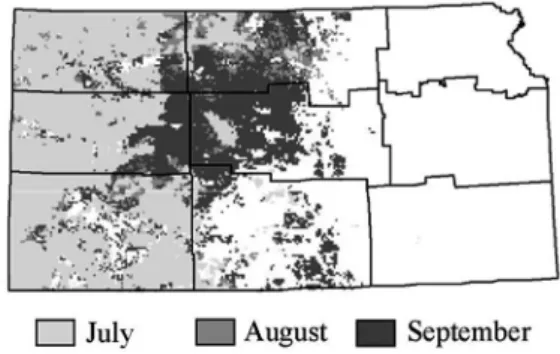
Correlation coefficients between the soil attributes and drought severity were calculated for predicted drought areas with STI values higher than 0.2 in each month to determine the temporal contribution of the soil properties to drought. Fig. 8 illustrates the

distribution of possible drought areas detected by the thermal signals in each month. The thermal sig- nals appeared in the western region in July, moved to upper central area, and spread into central and lower central areas. Results showed that permeabili- ty and slope had early strong influences on drought severity in areas where soil moisture dried out in July (r=-0.65 and 0.45), and AWC and soil thickness significantly contributed in areas that dried out in Fig. 8. Possible drought areas detected by the thermal

signals on a monthly basis

Fig. 9. Temporal changes in the correlation of soil attributes with drought severity from July to September, 2000

* Statistical significance levels are marked with *(*a =0.05, **a =0.01).

(11)

late summer (r=0.61 and -0.76, September). Texture had strong relationships with drought severity throughout the summer months, whereas clay con- tent had only a weak relationship (r=0.28) in August.

Drainage did not have any significant relationship with drought on monthly intervals (Fig. 9).

Influences of soil properties on drought varied through time. It seems that individual soil properties influenced drought severity differently through time. Permeability, texture, and slope had greater impacts on drought than the other properties in the early stage (July). Experiments conducted by Wythers et al. (1999) showed that finer soils (silt loam) had greater evaporation rates than coarser soils (sandy loam) in an early stage after precipita- tion. They concluded that two to three days after precipitation, resistance to evaporation of coarse soils quickly increases as pore spaces dry out, and therefore, evaporation rates for finer soils may sur- pass those of coarser soils. Since the study area is dominated by fine sandy loam, loamy fine sand, and silt loam, evaporation rates for silt loam may have played a similar role in influencing drought severity in the early stage of drought. Permeability has a direct relationship with soil texture. Since coarse soils have higher permeability than fine soils, it is reasonable to say that more permeable soils have less evaporation rates and are less vulnerable to drought. Slope is also important factor for soil mois- ture availability in an early stage because vertical movements of soil water are controlled by slopes.

These results show that water movement is an important aspect in an early stage of drought as indi- cated by permeability and slope factors.

In August, none of the variables had strong influ- ences, but permeability, clay content, soil thickness, and texture showed weak to moderate levels of influences. Clay content plays an important role in deciding soil texture and permeability, but it did not contribute to drought severity by itself. Texture still had a great impact in September even though it was not as strong as in July. AWC and soil thickness

were important variables in this late summer. AWC is calculated for the entire soil profile as total inches of water. Therefore, the deeper the soil, the greater the AWC is. Knowing that AWC and soil thickness are a function of soil profile or depth, they can be considered as capacity for soil moisture storage. A climatic water budget analysis showed that soil moisture dropped below 20% of its field capacity by mid-September data not shown. The result con- firmed that, as a measure for soil moisture storage, AWC and soil thickness became more important for plants as soils dried out in the late-summer period.

4. Conclusions

Remotely sensed thermal infrared data, the STATSGO database, and GIS were effectively inte- grated to determine influences of soil characteristics on drought responses. The digital soil database is useful for extraction and spatial analysis of soil prop- erties because these property values are converted to GIS layers quickly and easily without cost. Eight important soil properties were extracted from the soil database by GIS tools to determine relationships between the soil characteristics and drought severi- ty. Seven variables, including AWC, clay content, soil thickness, slope, permeability, drainage, and tex- ture, had significant relationships with drought severity. Knowing that five out of these seven soil properties had relationships with drought responses in an opposite direction to general hypotheses, it is believed that local soil characteristics do not follow general relationships between soil factors and water movement. In contrast to a general relationship, areas with finer, less permeable soils had severer drought damages than those with coarser, more per- meable soils. Relatively fine-textured soils lose sur- face moisture by evaporation while coarse-textured soils absorb water from the surface and store the water in the subsurface layers.

The spatial distribution of high thermal signals,

(12)

indicating high soil moisture deficits, changed through time. This means that certain areas experi- enced water deficit more quickly than other areas in the study area. Study results indicated that ‘water movement’ was an important component for the depletion of soil moisture in the early stage since permeability and slope had a strong, positive rela- tionship with drought severity in areas where soil moisture dried out early. By contrast, where soil moisture did not dry out severely until late in the season, ‘water storage’ was an important factor for keeping soil moisture longer; AWC and soil thick- ness had a significant, negative relationship with drought severity in areas where soil moisture dried out late. Therefore, evaporation and infiltration char- acteristics of soils are believed to play important roles at different stages of drought in this study area.

Acknowledgements

NASA’s Earth System Science Fellowship Grant, NGT5-30404, supported this study. The Kansas Applied Remote Sensing (KARS) Program at the University of Kansas provided image-processing facilities. The author also thanks the High Plains Regional Climate Center at the University of Nebraska-Lincoln for providing climatic data for the study area.

References

Bark, L.D., 1978, History of American droughts, in Rosenberg, N.J.(eds.), North American Droughts, American Association for the Advancement of Science, Washington DC, 9-23.

Barnes, W.L., Pagano, T.S., and Salomonson, V.V., 1998, Prelaunch characteristics of the moderate resolution imaging spectroradiometer (MODIS) in EOS-AM1, IEEE Transactions on Geoscience and Remote Sensing, 36, 1088-1100.

Brady, N.C., 1974, The Nature and Properties of Soils, Macmillan, London.

Davis, J.C., 1986, Statistics and Data Analysis in Geology, John Wiley & Sons, New York.

De Jong, R., Shields, J.A., and Sly, W.K., 1984, Estimated soil water reserves applicable to a wheat-fallow rotation for generalized soil areas mapped in southern Saskatchewan, Canadian Journal of Soil Science, 64, 667-680.

Dupigny-Giroux, L. and Lewis, J.E., 1999, A moi- sture index for surface characterization over a semiarid area, Photogrammetric Engineering

& Remote Sensing, 65, 937-945.

Edwards, D.C. and McKee, T.B., 1997, Characteristics of 20

th

Century Drought in the United States at Multiple Time Scales, Climatology Report No.

97-2, Colorado State University, Fort Collins, Colorado.

Farrar, T.J., Nicholson, S.E., and Lare, A.R., 1994, The influence of soil type on the relationships between NDVI, rainfall, and soil moisture in semiarid Botswana. II. NDVI response to soil moisture, Remote Sensing of Environment, 50, 121-133.

Jackson, R.D., Idso, S.B., Reginato, R.J., and Pinter Jr., P.J., 1981, Canopy temperature as a crop water stress indicator, Water Resources Research, 17, 1133-1138.

Kaufman, Y.J., Herring, D.D., Ranson, K.J., and Collatz, G.J., 1998, Earth observing system AM1 mission to earth, IEEE Transactions on Geoscience and Remote Sensing, 36, 1045-1055.

Kogan, F.N., 1995, Application of vegetation index and brightness temperature for drought detection, Advances in Space Research, 15, 91- 100.

Kogan, F.N., 1997, Global drought watch from space, Bulletin of the American Meteorological Society, 78, 621-636.

Küchler, A.W., 1974, A new vegetation map of Kansas, Ecology, 55, 586-604.

Legates, D.R., 2000, Remote sensing in hydroclima-

(13)

tology: an introduction, The Professional Geographer, 52, 233-234.

Lozano-Garcia, D.F., Fernandez, R.N., Gallo, K.P., and Johannsen, C.J., 1995, Monitoring the 1988 severe drought in Indiana, U.S.A. using AVHRR data, International Journal of Remote Sensing, 16, 1327-1340.

Monnik, K., 2000, Role of drought early warning sys- tems in South Africa’s evolving drought policy, in Wilhite, D.A., Sivakumar, M.V.K., and Wood, D.A.(eds.), Early Warning Systems for Drought Preparedness and Drought Management, WMO, Geneva, 47-56.

Moran, M.S. and Jackson, R.D., 1991, Assesing the spatial distribution of evapotranspiration using remotely sensed inputs, Journal of Environmental Quality, 20, 725-737.

Moran, M.S., Clarke, T.R., Inoue, Y., and Vidal, A., 1994, Estimating crop water deficit using the relation between surface-air temperature and spectral vegetation index, Remote Sensing of Environment, 49, 246-263.

Nicholson, S.E. and Farrar, T.J., 1994, The influence of soil type on the relationships between NDVI, rainfall, and soil moisture in semiarid Botswana. I. NDVI response to rainfall, Remote Sensing of Environment, 50, 107-120.

Noy-Meir, I., 1973, Desert ecosystems: environment and producers, Annual Review of Ecology and Systematics, 4, 25-51.

Ogallo, L.A., 1994, Drought and desertification: an overview, WHO Bulletin, 43, 18-22.

Park, S., Feddema, J.J., and Egbert, S.L., 2002a, Thermal response patterns of MODIS from land surfaces and their coupling with the cli- matic water budget in western-central Kansas, Thermosense XXIV, SPIE’s 16

th

Annual International Symposium on AeroSense, Orlando, FL, April 1-4.

Park, S., Feddema, J.J., and Egbert, S.L., 2002b, Hydroclimatological parameters and their relationship with land surface temperatures

and NDVI anomalies, ACSM-ASPRS Conference and Technology Exhibition, Washington, D.C., April 19-26.

Park, S., 2003, Evaluation of MODIS land surface temperature as an indicator of the climatic water budget in the central Great Plains, USA, The Geographical Journal of Korea, 37, 257-271.

Peters, A.J., Rundquist, D.C., and Wilhite, D.A., 1991, Satellite detection of the geographic core of the 1988 Nebraska drought, Agricultural and Forest Meteorology, 57, 35-47.

Reed, B.C., 1993, Using remote sensing and Geographic Information Systems for analysing landscape/drought interaction, International Journal of Remote Sensing, 14, 3489-3503.

Reed, B.C., Loveland, T.R., Tieszen, L.L., 1996, An approach for using AVHRR data to monitor U.S. Great Plains grasslands, Geocarto International, 11, 13-22.

Reginato, R.J. and Howe, J., 1985, Irrigation schedul- ing using crop indicators, Journal of Irrigation and Drainage Engineering, 111, 125-133.

Rundquist, B.C. and Harrington, Jr., J.A., 2000, The effects of climatic factors on vegetation dynamics of tallgrass and shortgrass cover, Geocarto International, 15, 31-36.

Rundquist, B.C., Harrington, Jr., J.A., and Goodin, D., 2000, Mesoscale satellite bioclimatology, The Professional Geographer, 52, 331-344.

Sala, O.E., Parton, W.J., Joyce, L.A., and Lauenroth, W.K., 1988, Primary production of the cen- tral grassland region of the United States, Ecology, 69, 40-45.

Schueler, C.F. and Barnes, W.L., 1998, Next-genera- tion MODIS for polar operational environ- mental satellites, Journal of Atmospheric and Oceanic Technology, 15, 430-439.

Seguin, B., Courault, D., and Guerif, M., 1994, Surface temperature and evapotranspiration:

application of local scale methods to regional

(14)

scale using satellite data, Remote Sensing of Environment, 49, 287-295.

Sellers, P.J., 1985, Canopy reflectance, photosynthe- sis and transpiration, International Journal of Remote Sensing, 6, 1335-1372.

Timlin, D., Loechel, S., Pachepsky, Y., and Walthal, C., 2001, The use of a water budget model and yield maps to characterize water avail- ability in a landscape, Soil and Tillage Research, 58, 219-231.

Tucker, C.J. and Sellers, P.J., 1986, Satellite remote sensing of primary production, International Journal of Remote Sensing, 7, 1395-1416.

Unganai, L.S. and Kogan, F.N., 1998, Drought moni- toring and corn yield estimation in southern Africa from AVHRR data, Remote Sensing of Environment, 63, 219-232.

U.S. Department of Agriculture, 1993, Soil survey manual, United states Department of Agriculture Handbook No. 18, U.S.

Government Printing Office, Washington D.C.

U.S. Department of Agriculture, 1995, State Soil Geographic (STATSGO) data base: data use information, Natural Resources Conservation Service, Miscellaneous Publication Number 1492.

Wang, J., Price, K.P., and Rich, P.M., 2001, Spatial patterns of NDVI in response to precipitation and temperature in the central Great Plains, International Journal of Remote Sensing, 22, 3877-3844.

Warrrick, R.A., 1975, Drought Hazards in the United States: a Research Assessment, University of Colorado Institute of Behavioral Science, Boulder, Colorado.

Wright, R.J., Boyer, D.G., Winant, W.M., and Perry, H.D., 1990, The influence of soil factors on yield differences among landscape positions in an Appalachian cornfield, Soil Science, 149, 375-382.

Wythers, K.R., Lauenroth, W.K., and Paruelo, J.M., 1999, Bare-soil evaporation under semiarid field conditions, Soil Science Society of America Journal, 63, 1341-1349.

Yang, X., Zhou, Q., and Melville, M., 1997, Estimating local sugarcane evapotranspira- tion using Landsat TM image and a VITT concept, International Journal of Remote Sensing, 18, 453-459.

Received August 01, 2003

Accepted December 10, 2003

수치

Fig. 1.  Study area
Fig. 2.  STATSGO map unit
Table 1.  Statistics for soil properties calculated from STATSGO database in the study area
Fig. 4.  Rasterized images of soil properties in Kansas
+3

참조

관련 문서