ISSN: 2233-601X (Print) ISSN: 2093-6516 (Online)
Received: August 19, 2015, Revised: September 26, 2015, Accepted: September 30, 2015, Published online: August 5, 2016
Corresponding author: Seong Yong Park, Department of Thoracic and Cardiovascular Surgery, Ajou University Hospital, Ajou University School of Medicine, 164 World cup-ro, Yeongtong-gu, Suwon 16499, Korea
(Tel) 82-31-219-5210 (Fax) 82-2-2228-2140 (E-mail) [email protected]
© The Korean Society for Thoracic and Cardiovascular Surgery. 2016. All right reserved.
This is an open access article distributed under the terms of the Creative Commons Attribution Non-Commercial License (http://creativecommons.org/
licenses/by-nc/4.0) which permits unrestricted non-commercial use, distribution, and reproduction in any medium, provided the original work is properly cited.
Clinical Manifestations of Spontaneous Pneumomediastinum
Soo Jin Park, M.D., Ji Ye Park, M.D., Joonho Jung, M.D., Seong Yong Park, M.D., Ph.D.
Department of Thoracic and Cardiovascular Surgery, Ajou University School of Medicine
Background: Spontaneous pneumomediastinum (SPM) is an uncommon disorder with only a few reported clinical studies. The goals of this study were to investigate the clinical manifestations and the natural course of SPM, as well as examine the current availab le treatment options for SPM. Methods: We retrospectively re- viewed 91 patients diagnosed with SPM between January 2008 and June 2015. Results: The mean age of the patients was 22.7±13.2 years, and 67 (73.6%) were male. Chest pain (58, 37.2%) was the predominant symptom. The most frequent precipitating factor before developing SPM was a cough (15.4%), but the ma- jority of patients (51, 56.0%) had no precipitating factors. Chest X-ray was diagnostic in 44 patients (48.4%), and chest computed tomography (CT) showed mediastinal air in all cases. Esophagography (10, 11.0%), esop- hagoduodenoscopy (1, 1.1%), and bronchoscopy (5, 5.5%) were performed selectively due to clinical suspi- cion, but no abnormal findings that implicated organ injury were documented. Twelve patients (13.2%) were discharged after a visit to the emergency room, and the others were admitted and received conservative treatment. The mean length of hospital stay was 3.0±1.6 days. There were no complications related to SPM except for recurrence in 2 patients (2.2%). Conclusion: SPM responds well to conservative treatment and fol- lows a benign natural course. Hospitalization and aggressive treatment can be performed in selective cases.
Key words: 1. Spontaneous pneumomediastinum 2. Mediastinal emphysema
3. Outpatients
Introduction
Pneumomediastinum (PM) is defined as the pres- ence of air or other gas in the mediastinum; it is al- so known as mediastinal emphysema [ 1]. It can be categorized as spontaneous PM (SPM) or secondary PM [ 1]. SPM is a rare and benign disorder that gen- erally occurs in young adult males without any pre- cipitating factors or disease [1,2]. The hypothesized pathogenesis of SPM was described as the Macklin effect in 1944 [1-3]. Alveolar rupture might lead to air dissection along the bronchovascular sheaths, lead- ing to pulmonary interstitial emphysema that spreads into the mediastinum [ 2-4]. Secondary PM has a defi-
nite precipitating factor such as trauma, a surgical or medical procedure (iatrogenic PM), or infection by a gas-forming organism [5,6].
Generally, SPM is considered a comparatively be- nign disease, but few studies have been published covering substantial data pertaining to SPM [2,4,7].
Previous reports on SPM are usually case series of small numbers of patients; therefore, the clinical manifestations of SPM have not been fully elucidated due to the rarity of this condition [7]. The aim of this study was to document the clinical features and course of SPM and identify the optimal diagnostic methods and treatment by analyzing a large number of patients with SPM.
http://dx.doi.org/10.5090/kjtcs.2016.49.4.287
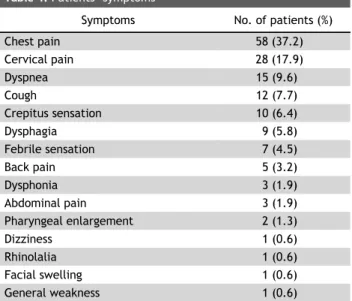
Table 1. Patients’ symptoms
Symptoms No. of patients (%)
Chest pain 58 (37.2)
Cervical pain 28 (17.9)
Dyspnea 15 (9.6)
Cough 12 (7.7)
Crepitus sensation 10 (6.4)
Dysphagia 9 (5.8)
Febrile sensation 7 (4.5)
Back pain 5 (3.2)
Dysphonia 3 (1.9)
Abdominal pain 3 (1.9)
Pharyngeal enlargement 2 (1.3)
Dizziness 1 (0.6)
Rhinolalia 1 (0.6)
Facial swelling 1 (0.6)
General weakness 1 (0.6)
Table 2. Triggering events
Triggering events No. of patients (%)
None 51 (56.0)
Cough 14 (15.4)
Diet 13 (14.3)
Sports (Valsalva maneuver) 7 (7.7)
Vomiting 3 (3.3)
Shouting 1 (1.1)
Working 1 (1.1)
Blowing 1 (1.1)
Table 3. Predisposing conditions
Condition No. of patients (%)
Smoking 19 (20.9)
Upper respiratory infection 7 (7.7)
Asthma 3 (3.3)
Chronic obstructive pulmonary disease 1 (1.1)
Drugs 0
Methods
In total, 162 patients with PM were identified dur- ing the study period (January 2008 to June 2015).
SPM was defined as the radiologic confirmation of air within the mediastinum without any underlying factor. The exclusion criterion was PM with a definite precipitating factor such as trauma, a surgical or me- dical procedure (iatrogenic PM), or infection. Finally, we retrospectively reviewed 91 patients who were diagnosed with SPM. All medical records of these pa- tients were reviewed with consideration of etiologic factors (age and sex), symptoms, precipitating factors, trigger events, complications, radiologic findings, of- fered treatment, length of hospital stay, natural course, and outcome. Categorical variables are expressed as percentages, and continuous variables are expressed as mean±standard deviation. This study was appro- ved by the institutional review board of Ajou Univer-
sity Hospital (MED-MDB-15-268).
Results
Among the 91 patients with SPM, the mean age was 22.7±13.2 years (range, 12–78 years), and 67 (73.6%) patients were male. The most frequently re- ported symptoms were chest pain (58, 37.2%) and cervical pain (28, 17.9%), followed by dyspnea (15, 9.6%), cough (12, 7.7%), and crepitus sensation (10, 6.4%) (Table 1). If the patient had more than one symptom, all symptoms were described. The mean white blood cell (WBC) count, percent neutrophils, and C-reactive proteins were 9,780±2,930/μL, 68.1%±
10.3%, and 0.5±1.2 mg/dL, respectively. The arterial blood gases were analyzed in 15 patients who com- plained of dyspnea. The mean partial pressure of oxygen (PaO2) was 93.2±24.1 mmHg.
In 51 patients (56.0%), there was no apparent trigger factor to generate SPM. However, in the rem- aining 40 patients (44.0%), there were obvious trig- gering events. SPM developed most frequently during cough (14, 15.4%). Other factors included diet (13, 14.3%) and physical activity, which was related to the Valsalva maneuver (7, 7.7%) (Table 2).
A medical history predisposing the occurrence of SPM included smoking in 19 patients (20.9%), recent upper respiratory infection in 7 patients (7.7%), asthma in 3 patients (3.3%), and chronic obstructive pulmonary disease in 1 patient (1.1%). Inhaled ther- apeutics, which are an established precipitating factor for SPM in Western countries [ 1-4], were not used in any of the patients in this study (Table 3).
Chest X-rays were taken in all patients, and chest computed tomography (CT) was performed in 84 pa- tients (92.3%). Mediastinal air was observed in 44 patients (48.4%) by chest X-ray and in 100.0% by chest CT. The Macklin effect was observed in 70 pa- tients (83.3%). Esophagography, esophagogastroduo- denoscopy, and flexible bronchoscopy were per-
formed in 10 patients (11.0%), 1 patients (1.1%), and 5 patients (5.5%), respectively. Esophagography and esophagogastroduodenoscopy were performed se- lectively when esophageal injuries were suspected clinically, and bronchoscopy was performed in pa- tients with a suspected bronchial injury on CT.
However, the patients did not show any organ injury during further investigation.
Most patients (79, 86.8%) were admitted, whereas 12 patients (13.2%) refused admission and were dis- charged after close monitoring in the emergency room. For the patients who were admitted, anti- biotics (first-generation cephalosporin) and nasal oxy- gen were administered as a conservative treatment.
The patients fasted due to the possibility of esoph- ageal injury and were allowed to initiate oral intake after showing no clinical symptoms of esophageal injury. The mean length of hospital stay was 3.0±1.6 days (range, 1–15 days). The mean hospital stay of admitted patients was 3.2±1.6 days, and that of dis- charged patients at the emergency room was 1 day.
The patients were discharged when they had been fully evaluated and had become asymptomatic, even if there were residual radiographic findings of PM.
Among the 91 patients, 2 (2.2%) were readmitted with recurrent SPM (6 and 9 months after discharge, respectively), and both patients had underlying his- tories of asthma.
Discussion
Pneumomediastinum has been recognized since 1,819, when Laennec reported the disease in a case caused by trauma injuries [1]. SPM was further char- acterized in a case series by Hamman in 1939 [1-4].
SPM is a rare disease with a reported incidence of less than 1:44,000 [1,3]. The clinical course of SPM has been regarded as benign, and its detailed clinical manifestations and proper treatment strategies have not been fully evaluated due to its rarity. To our knowledge, this study analyzed the largest number of patients with SPM to date.
The clinical presentation of SPM can often be ig- nored or misdiagnosed because of its vague symp- toms [2,5]. Most affected patients exhibit some of the typical symptoms, and a high level of clinical suspi- cion is necessary for diagnosis [3]. Every patient in our series presented with one or more symptoms.
Chest pain and dyspnea were the predominant symp- toms in our study, which corresponds with previous reports [2-5,8]. Other frequently reported symptoms are cervical symptoms including pain, coughing, dysp- nea, and dysphagia [4,8]. Therefore, the initial differ- ential diagnoses are numerous and include pulmo- nary, cardiac, musculoskeletal, and esophageal etiol- ogies [5]. Generally, clinicians can make the differ- ential diagnosis by taking a patient’s history and per- forming a detailed physical examination, electrocardi- ography, and radiographic or endoscopic studies [5].
The trigger events are mainly associated with the Valsalva maneuver (activity, cough, vomiting, shout- ing, and inhalation of an illicit drug) [4]. However, trigger events are not detected in many cases (30%–
40%) according to previous reports [4,8], and our data also showed that more than half of the patients (52, 56.5%) had no definite triggering events. The most remarkable finding of the physical examination was subcutaneous emphysema in many studies [2,4,8]. Hamman’s sign, which is generated from the crackles heard with each beat of the heart, is also a well-known auscultative sign of SPM [3,4,8]. Fever is also a common finding [7]. However, these physical findings of SPM vary among reports [2].
To make a precise diagnosis, imaging needs to be performed [2-4,8]. The air itself and an enhanced margin of mediastinal structures can be observed on chest X-ray [4]. Additionally, some papers have em- phasized that when air is present between the ster- num and the anterior pericardium or surrounding the pulmonary artery without a lateral film, incorrect diagnosis may occur [2,4]. Chest X-ray is generally useful for diagnosing PM, although there have been false-negative results [9]. In our data, chest X-ray was diagnostic in only 45 patients (48.9%). Chest CT is more useful than chest X-ray because thin slices are obtained and may reveal other findings such as pul- monary disease that could generate secondary PM [9]. Using chest CT, clinicians could rule out cases in- volving any pathologic findings in the lung such as bullae, blebbing, bronchiectasis, and tuberculosis sca- rring. On CT, the Macklin effect appears as linear col- lections of air in the bronchovascular sheaths [9].
The Macklin effect is often seen on CT in patients who have suffered blunt chest trauma, although the Macklin effect has also been reported in CT of pa- tients with SPM [9]. Indeed, 70 patients (83.3%)
showed the Macklin effect on CT in our series.
Therefore, chest CT has to be performed in all cases if SPM is suspected. Further diagnostic tools such as esophagography, esophagoduodenoscopy, or broncho- scopy can be performed when there is high suspicion of an injury of the esophagus or trachea with clinical symptoms such as fever, sweating, leukocytosis, or continuously increasing PM [8]. However, many re- ports did not find any clear benefit of these diag- nostic modalities, and routine use of these studies should be avoided [2,4-8]; they should only be per- formed in cases with diagnostic doubt [2,7]. Based on our experience, chest CT could be a routine diag- nostic imaging modality for PM.
Bed rest and conservative management, such as prophylactic use of analgesics and antibiotics, and limitation of oral intake, are indicated in patients with SPM [2,4,8]. Fasting and antibiotics help to pre- vent mediastinitis by visceral organ perforation [2,4,8], but are unnecessary for patients without a strong clinical suspicion such as severe symptoms or high levels of inflammatory markers [ 4,8]. Oxygen therapy, so-called ‘nitrogen washout,’ accelerates the disappearance of mediastinal gas by increasing the diffusion pressure of nitrogen in the interstitium [3,4].
However, several papers have reported that this in- tervention is also not conclusive, unlike in pneumo- thorax, so routine use of oxygen therapy is not rec- ommended [2,4,8].
Many papers argue that admission and prompt evaluation [3-6,8,10,11] should be performed to al- low treatment of SPM, but we consider that it could be treated without aggressive intervention or hospi- talization if patients are carefully selected. These pa- tients could be followed as outpatients. Most patients were in their teens, twenties, and thirties; had no medical history; and were safely discharged within a few days without complications. In addition, 12 pa- tients (13.2%) who refused admission and were treat- ed in outpatient clinics also had no complications. An aggressive diagnostic work-up and admission are re- quired if underlying disease or organ dysfunction is strongly suspected. Because of this problem, most of the studies to date consider that admission and eval- uation are necessary. However, we believe that pa- tients with no definite clinical symptoms that suggest organ injury could be evaluated minimally and treat- ed in outpatient clinics to save medical resources.
Indeed, 50% of patients with SPM were followed as outpatients in one study, none of whom showed ex- acerbation or future recurrence [2]. The reason for admission is to control severe symptoms such as continuous cough, associated infections, treatment of pneumothorax, and evaluation of suspected infection.
Patients who did not have complications were dis- charged in this study [2]. Taking into consideration the benign course of SPM, hospitalization has to be considered when the diagnosis is in question, the un- derlying disease needs specific treatment, or an eso- phageal or tracheal perforation cannot be ruled out.
This retrospective study has shown unique findings compared with previous reports. First, in terms of precipitating factors of SPM, drug abuse has been re- garded as the cause of SPM; SPM can occur due to the direct toxic action of heat and the strong vaso- constrictive action of the inhaled substances [2,4].
However, no drug abusers were enrolled in our study.
Second, recurrence of SPM is very rare, reportedly ranging from 0% to 1.5% [2,5-8,10]. Our recurrence rate, 2.2%, was slightly higher than that in previous reports. Two patients showed recurrence of SPM at 13 and 25 months after the initial SPM, and both of them had an underlying asthma history. Previous re- search on SPM recurrence reported that such pa- tients usually have comorbidities such as gastroin- testinal ulcers, diabetes mellitus, alcoholism, mental retardation, or asthma [12]. Despite the benign clin- ical course of SPM, patients with comorbidities have to be informed about the possibility of recurrence of SPM.In conclusion, SPM is a rare benign disease that presents primarily in young adults who generally make an uneventful recovery. Therefore, in the ab- sence of concomitant symptoms or severe illness re- quiring inpatient care, approaches that include hospi- talization and aggressive treatment should be limited and individualized. But when the diagnosis is in question, or the underlying disease needs specific treatment or an esophageal or tracheal perforation cannot be ruled out, we should take into account hospital treatment. To avoid the potentially catastro- phic complications of secondary pneumomediastinum, a detailed medical history and careful physical exami- nation are required. CT could help to discriminate other causes of pneumomediastinum.
Conflict of interest
No potential conflict of interest relevant to this ar- ticle was reported.
Acknowledgments
This study was supported by a Grant of the Sam- sung Vein Clinic Network (Daejeon, Anyang, Cheong- ju, Cheonan; Fund No.KTCS04-047).
References
1. Mason R. Pneumomediastinum and mediastinitis. In:
Murray JF, Nadel JA, editors. Murray and Nadel’s textbook of respiratory medicine. 4th ed. Philadelphia (PA): Saunders;
2005.
2. Koullias GJ, Korkolis DP, Wang XJ, Hammond GL. Current assessment and management of spontaneous pneumo- mediastinum: experience in 24 adult patients. Eur J Cardiothorac Surg 2004;25:852-5.
3. Sahni S, Verma S, Grullon J, Esquire A, Patel P, Talwar A.
Spontaneous pneumomediastinum: time for consensus. N Am J Med Sci 2013;5:460-4.
4. Takada K, Matsumoto S, Hiramatsu T, et al. Spontaneous
pneumomediastinum: an algorithm for diagnosis and management. Ther Adv Respir Dis 2009;3:301-7.
5. Caceres M, Ali SZ, Braud R, Weiman D, Garrett HE Jr.
Spontaneous pneumomediastinum: a comparative study and review of the literature. Ann Thorac Surg 2008;86:962-6.
6. Kim DH, Park JH, Chei CS, Hwang SW, Kim HY, Yoo BH.
Spontaneous pneumomediastinum: clinical investigation.
Korean J Thorac Cardiovasc Surg 2006;39:220-5.
7. Iyer VN, Joshi AY, Ryu JH. Spontaneous pneumomediastinum:
analysis of 62 consecutive adult patients. Mayo Clin Proc 2009;84:417-21.
8. Dajer-Fadel WL, Arguero-Sanchez R, Ibarra-Perez C, Navarro-Reynoso FP. Systematic review of spontaneous pneumomediastinum: a survey of 22 years’ data. Asian Cardiovasc Thorac Ann 2014;22:997-1002.
9. Murayama S, Gibo S. Spontaneous pneumomediastinum and Macklin effect: overview and appearance on computed tomography. World J Radiol 2014;6:850-4.
10. Chon SH, Wee JS, Lee CB, Kim H, Kim YH. Clinical analysis of spontaneous pneumomediastinum. Korean J Thorac Cardiovasc Surg 2006;39:56-9.
11. Moon HJ. Spontaneous pneumomediastinum: clinical ex- perience of 24 patients in two medical center. Korean J Thorac Cardiovasc Surg 2010;43:663-8.
12. Natale C, D’Journo XB, Duconseil P, Thomas PA. Recurrent spontaneous pneumomediastinum in an adult. Eur J Cardi- othorac Surg 2012;41:1199-201.