• 검색 결과가 없습니다.

Silastic Molding Method for Pectus Excavatum Correction Using a Polyvinyl Alcohol (Ivalon) Sponge

N/A
N/A
Protected

Academic year: 2021

Share "Silastic Molding Method for Pectus Excavatum Correction Using a Polyvinyl Alcohol (Ivalon) Sponge"

Copied!
3
0
0

로드 중.... (전체 텍스트 보기)

전체 글

(1)

Korean J Thorac Cardiovasc Surg 2012;45:418-420 □ Case Report □ http://dx.doi.org/10.5090/kjtcs.2012.45.6.418 ISSN: 2233-601X (Print) ISSN: 2093-6516 (Online)

− 418 −

Department of Thoracic and Cardiovascular Surgery, Hanyang University Seoul Hospital, Hanyang University College of Medicine Received: May 7, 2012, Revised: August 4, 2012, Accepted: August 16, 2012

Corresponding author: Jeong-Ho Kang, Department of Thoracic and Cardiovascular Surgery, Hanyang University Seoul Hospital, Hanyang University College of Medicine, 222 Wangsimni-ro, Seongdong-gu, Seoul 133-791, Korea

(Tel) 82-2-2290-8461 (Fax) 82-2-2290-8462 (E-mail) [email protected]

C

The Korean Society for Thoracic and Cardiovascular Surgery. 2012. All right reserved.

CC
This is an open access article distributed under the terms of the Creative Commons Attribution Non-Commercial License (http://creative- commons.org/licenses/by-nc/3.0) which permits unrestricted non-commercial use, distribution, and reproduction in any medium, provided the original work is properly cited.

Silastic Molding Method for Pectus Excavatum Correction Using a Polyvinyl Alcohol (Ivalon) Sponge

Jun-Ho Lee, M.D., Sung-Jin Kim, M.D., Jeong-Ho Kang, M.D., Won-Sang Chung, M.D., Hyuck Kim, M.D., Soon-Ho Chon, M.D.

Pectus excavatum is rare, but it is the most common type of sternal congenital disorder. There are many surgical methods to correct pectus excavatum such as the Ravitch method, Wada method, Silastic mold method, and the Nuss operation. We report a case of minimal invasive surgery for pectus excavatum using a polyvinyl alcohol sponge.

Key words: 1. Minimally invasive surgery 2. Funnel chest

3. Polyvinyl alcohol sponge

CASE REPORT

A 15-year-old male had visited our outpatient clinic of Hanyang University Seoul Hospital due to pectus excavatum in 2007. He had no symptoms such as chest pain, dyspnea, or heart problems. However, he complained of cosmetic prob- lems due to the appearance of his asymmetrical chest wall.

Echocardiography was performed to check for possible heart problems, and the results were normal. A pulmonary function test was performed to check for any lung problems, and the results presented a force vital capacity (FVC) of 4.06 L and a forced expired volume in 1 second (FEV1) of 3.68 L, showing a normal pattern of flow-volume. However, the patient wanted to undergo surgery to obtain a more sym- metric chest wall. We recommended a follow-up visit because he was in rapid adolescent growth. Therefore, surgical treat- ment was delayed until his chest wall was fully developed.

In 2010, when he was 18 years old, he still wanted the op-

eration for his pectus deformity. At that age, we assumed that he achieved full skeletal maturity. Therefore, we decided to perform surgical treatment for the pectus excavatum. Echocar- diography and pulmonary function tests were performed. The results of the echocardiogram were an ejection fraction of 57%, normal valve function, normal wall motion, and no per- icardial effusion. In addition, the results of the pulmonary function test were an FVC of 4.1 L and an FEV1 of 3.8 L;

they were within normal range. A follow-up chest computed

tomography showed no interval change of the pectus exca-

vatum (Fig. 1). The laboratory findings showed a white blood

cell count of 5,800/mm

3

, hemoglobin at 15.1 g/dL, platelet

count of 218,000/mm

3

, bleeding time at 3 minutes, and pro-

thrombin time of 10.9 seconds. The liver enzymes aspartate

aminotransferase and alanine aminotransferase were 16 U/L

and 11 U/L, respectively, and the levels of sodium, potas-

sium, and chloride electrolytes were normal. All of the labo-

ratory findings were within normal limits except the bilirubin

(2)

Pectus Excavatum Correction Using Polyvinyl Alcohol Sponge

− 419 − Fig. 1. Preoperative chest computed tomography scan shows that

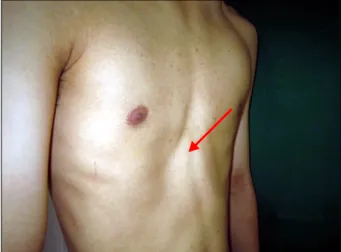
the right chest wall is concave compared to the left chest wall. Fig. 2. Preoperative picture.

Fig. 3. Postoperative picture.

level. The total bilirubin and direct bilirubin were elevated to 2.2 mg/dL and 0.9 mg/dL, respectively. Thus, abdominal ul- trasonography and a consultation with the department of gas- trointestinal medicine were performed. The abdominal ultra- sonography showed normal findings except for dilatation of the common bile duct, and Gilbert’s syndrome was suspected based on the results from the consultation with the Department of Gastrointestinal Medicine. The operation was proceeded as planned (Fig. 2).

Under general anesthesia, the patient was placed in the su- pine position. Right periareolar incision was performed.

Subcutaneous dissection was performed to reach to the con- cave area of the pectus excavatum. The space of that area was filled with a polyvinyl alcohol sponge soaked in anti- biotics mixed with warm saline. The patient was discharged on postoperative day 8 (Fig. 3).

DISCUSSION

Pectus excavatum is rare, but it is also the most common disorder among the congenital conditions of the sternum [1].

It has an incidence of 1 in every 250 children born [2]. Very few patients with this deformity have congenital heart or lung problems [2]. If it is severe, it may cause secondary mechan- ical effects on the respiratory and cardiovascular systems.

However, these are generally mild, and most patients are free from organic symptoms. Complicated cases of pectus ex-

cavatum require surgical treatment due to a decrease in respi- ratory and cardiovascular function. Most cases of un- complicated pectus excavatum need surgical treatment for cosmetic reasons.

There are many surgical methods for treating pectus ex- cavatum such as the Ravitch method, Wada method, Silastic mold method, and the Nuss operation [3,4]. In addition, many techniques have been reported such as subcutaneous insertion of molded Silastic implants, Cronin prosthesis, silicone im- plants, 2 mm Gore-Tex DualMesh, and autologous fat transplantation.

In our case, the patient did not have any complications due

to pectus excavatum such as dyspnea or chest pain, but he

(3)

Jun-Ho Lee, et al

− 420 − wanted to undergo surgery because of the asymmetrical ap- pearance of his chest wall. Therefore, we decided to perform minimally invasive surgery because of the cosmetic effects.

The method we chose was Silastic molding using a polyvinyl alcohol sponge.

Many implantable materials have been used for granulation tissue formation such as steel mesh, polyvinyl alcohol, poly- tetrafluoroethylene, polyurethane, and viscose cellulose sponges. The side effects of these materials on granulation tissue formation are considerable. Ideal materials must not in- terfere with the normal wound-healing process, and the im- plant materials must satisfy several conditions such as flexi- bility, ease of manufacture, long-term durability, non-carcino- genic, non-allergenic, and ease of sterilization [5]. A poly- vinyl alcohol sponge satisfies most of these conditions as an ideal implant material.

The polyvinyl alcohol sponge has been used in many sur- gical procedures such as a rectopexy material for prolapsed rectum and embolization plug material for vascular inter- vention for patent ductus arteriosus, hepatic tumor emboliza- tion, intracranial meningioma, and so on. The results of most polyvinyl alcohol sponge implants has been safe and feasible [6-8].

A polyvinyl alcohol sponge can be the first choice for sat- isfactory cosmetic results, only in patients whose skeletal ma- turity is full and who do not have any cardiogenic or respira- tory symptoms, using filling material for the concave area of the pectus excavatum. The operation performed in this case is simpler and easier than a Nuss operation; there were few complications. Other advantages are that this method can be completed in one procedure, and it is more economical. The best advantage is the cosmetic results because a simple peri-

areolar incision is performed without significant scarring. Our patient was satisfied with the cosmetic results. This method is an excellent choice for correction of pectus excavatum.

CONFLICT OF INTEREST

No potential conflict of interest relevant to this article was reported.

REFERENCES

1. Sun K, Chae SS, Lee CS, Baek KJ, Kim HJ, Kim HM.

Pectus excavatum and operative treatment: 14 case report.

Korean J Thorac Cardiovasc Surg 1983;16:183-90.

2. Nuss D, Kelly RE Jr, Croitoru DP, Katz ME. A 10-year re- view of a minimally invasive technique for the correction of pectus excavatum. J Pediatr Surg 1998;33:545-52.

3. Guller B, Hable K. Cardiac findings in pectus excavatum in children: review and differential diagnosis. Chest 1974;66:

165-71.

4. Wada J. Surgical correction of the funnel chest “sternoturn- over”. West J Surg Obstet Gynecol 1961;69:358-61.

5. Pajulo Q, Viljanto J, Lonnberg B, Hurme T, Lonnqvist K, Saukko P. Viscose cellulose sponge as an implantable ma- trix: changes in the structure increase the production of granulation tissue. J Biomed Mater Res 1996;32:439-46.

6. Madiba TE, Baig MK, Wexner SD. Surgical management of rectal prolapse. Arch Surg 2005;140:63-73.

7. Kang JH. Transfemoral plug closure of patent ductus arte- riosus: experiences in 6 consecutive cases treated without thoracotomy. Korean J Thorac Cardiovasc Surg 1985;18:542- 8.

8. Koike T, Sasaki O, Ishii R, et al. Transcatheter embolization with Ivalon particles in cases of intracranial meningiomas.

Neurol Med Chir (Tokyo) 1985;25:103-9.

수치

Fig. 3. Postoperative picture.

참조

관련 문서

Han Soo Kim, Jeong Min Park, Byung No Lee, Myung Gook Moon, Jang Ho Ha, Nam Ho Lee, Young Soo Kim, Chang Goo Kang, Hyung Ki Cha, Moon Sik Chae, Jeong Ho Moon, Kyung Min Oh,

Seok Ho Song, Jung Hwan Park, Jin Young Heo, and Jeong Ik Lee(KAIST). Preliminary Thermal Sizing of PRHRS Heat Exchanger for Innovative Next

Sandberg D, Lavyne M (1999) Symptomatic spinal epidural lipomatosis after local epidural corticosteroid injections:

Seung Soo Jang Sung Gyun Shin Min Jae Lee Sang Soo Han Chan Ho Choi Sungkyum Kim Woo Sung Cho and Song Hyun Kim POSTECH Yeong Rok Kang Wol Soon Jo Soo Kyung Jeong and

Chang Goo Kang, Ah Hyun Park, Jang Ho Ha, Young Soo Kim, Joon-Ho Oh, Jeong Min Park, Soo Mee Kim, Seung-Jae Lee, Seung Hee Lee, and Han Soo Kim(KAERI). Fabrication

Chang Je Park, Kwoen Ho Kang, Sang Ho Na, Young Hee Kim, Ho Jin Ryu, Geun Il Park, and Kee Chan Song (KAERI). Geun-Suk Choi and

Global structural analysis model of the 300K VLCC by using the developed method. (Shell element, 1-D

Development of Low - Temperature Fuel Performance Analysis Code for Micro Ultra Long Life Lead - cooled Fast Reactor. Ji Won Mun and