http://dx.doi.org/10.46670/JSST.2021.30.4.204 pISSN 1225-5475/eISSN 2093-7563
A case study to standardize odor metadata obtained from coffee aroma based on E-nose using ISO/IEC 23005 (MPEG-V) for olfactory-enhanced multimedia
Jang-Sik Choi
1and Hyung-Gi Byun
2,+Abstract
Immersive multimedia comprising metadata for five senses can provide user experience by stimulating memory and sensation. In the case of olfactory-enhanced multimedia, a computer-generated smell is combined with additional media content to create a richer and/
or more realistic experience for the user. Although several studies have been conducted on olfactory-enhanced multimedia using e-nose and olfactory display, their practical applications have been severely restricted owing to the absence of a related standard. This paper proposes a method to standardize odor metadata obtained from an e-nose system, which has been particularly used to acquire data from different coffee aromas. Subsequently, the data were transferred to an odor display applicable for olfactory-enhanced multimedia using the ISO/IEC 23005 (MPEG-V) data template.
Keywords : E-nose system, ISO/IEC 23005 (MPEG-V) data template, Olfactory-enhanced multimedia.
1. INTRODUCTION
Immersive multimedia is considered to be the next generation of multimedia services because it has it significantly impacts the emotions, sense of presence, and engagement of a user [1]. The sense of presence and immersive experience in immersive multimedia are determined by sensory modalities and surround effect [2,3]. In particular, sensory modalities such as haptics, smell taste, and audio-visual content improve the quality of experience (QoE) of a user for immersive multimedia [4]. Therefore, it is important that a user perceives sufficient information through sensory modalities to experience immersive multimedia [5].
Among these sensory modalities, olfaction or the sense of smell, is an important perceptual function. Olfaction is known to enhance the quality of life and facilitate memory recall [6]. In addition, the olfactory stimuli enhance the productivity, alertness, and physical performance [7]. In the case of olfactory-enhanced
multimedia, a computer-generated smell is combined with additional media content to create a richer and/or more realistic experience for a user [8]. Several studies have been conducted to investigate the impact of olfaction on the user for olfaction- enhanced multimedia. Murray, Niall, et al. showed that the type of scent affects the QoE of a user and statistically significant differences between pleasant and unpleasant scents existed [9].
Ghinea, Gheorghita, and Oluwakemi Ademoye found that the association between scent and content has a significant impact on the user-perceived experience of olfactory-enhanced multimedia [10]. Additionally, they found that olfaction significantly improves the user multimedia experience [11]. Nakamoto et al. showed that presenting smells accurately enhanced the content [12]. The studies regarding olfaction-enhanced multimedia can be divided into two parts in terms of encoding and decoding of odor (scent) metadata (odor label, strength, concentration, and harmfulness).
The first part is related to research using an olfactory display which can present odors to multiple users. This research focuses on adjusting important parameters which are associated with atomization, distribution, ventilation, and synchronization of odor [13-16]. The second part focuses on coding odor metadata obtained from an electronic nose. In these studies, an electronic nose (e-nose) was used to qualify and quantify an odor [17,18].
Most of the olfaction metadata coded from an e-nose was transferred to an olfactory display through a network and the olfactory display generated an odor corresponding to the odor recipe [19,20]. Several studies have been conducted to combine
1
Department of Intelligent Crime Investigation, Donghae Police Station, 107, Cheongok-ro, Donghae-Si, Gangwon-Do, 25754, Korea
2
Divsion of Electronics, Information & Communication Eng., Kangwon National University, 346, Joongang-ro, Samcheok-Si, Gangwon-Do, 25913, Korea
+
Corresponding author: [email protected]
(Received: Jul. 10, 2021, Revised: Jul. 22, 2021, Accepted: Jul. 27, 2021)
This is an Open Access article distributed under the terms of the Creative Commons Attribution Non-Commercial License(https://creativecommons.org/
licenses/by-nc/3.0/) which permits unrestricted non-commercial use, distribution,
and reproduction in any medium, provided the original work is properly cited.
olfaction with multimedia using an e-nose and olfactory display.
However, their practical applications are restricted due to lack of device diversity, inability to utilize non-normative data templates, and absence of a generalized design for devices. Therefore, it is crucial to select a suitable standard that is universally accepted.
ISO/IEC 23005 (MPEG-V), a representative standard related to immersive media, provides normative data templates and commands for the sensory effects of immersive multimedia [21-27].
In particular, this standard specifies information representation which can be used to control olfaction-related sensors (e-nose) and the actuators (olfactory display). This paper proposes a method to standardize odor metadata obtained from an electronic nose system which was particularly used to acquire data from different coffee aromas. Subsequently, the data were transferred to an odor display applicable for olfactory-enhanced multimedia using the MPEG-V (ISO/IEC 23005) data template. A virtual instrument and MPEG-V data templates used for e-nose system were presented in this paper.
2. METHODS
2.1 Electronic Nose (E-NOSE) System
An e-nose system consists of a solenoid valve, chamber, pump, data acquisition module, and a virtual instrument as shown in Fig. 1.
The solenoid valve and pump are used to flow clean air and target sample gases into a sensor array. The sensor array is comprised of four metal oxide semiconductor (MOS)-type sensors based on tin oxide (SnO2). The sensor array was placed in a measurement chamber to improve the sensor response of signals in terms of stability, reproducibility and response time.
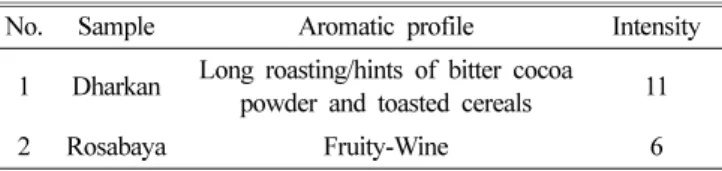
Clean air mixed with nitrogen (80%) and oxygen (20%) was used to stabilize the sensor array. Two bottles (500 mL) containing each sample were prepared. Table 1 shows the information of the samples: Dharkan and Rosabaya coffee capsules by Nespresso.
The experimental preparation included passing clean air
through the chamber for 10 minutes before sampling. When the sensors were stabilized, the solenoid valve was opened to allow the scent of sample to flow inside the chamber. The sensor array responses to the samples were converted by a 10-bit ADC (analog-to-digital converter) of data acquisition module. The sampling time was 1 second. Each sensor response was transformed to a sensitivity value which is given by dR/R, where dR is the change in the resistance and R is the base resistance. The average value between two cursors as shown in Fig. 2 was extracted and used as a representative pattern for the input sample.
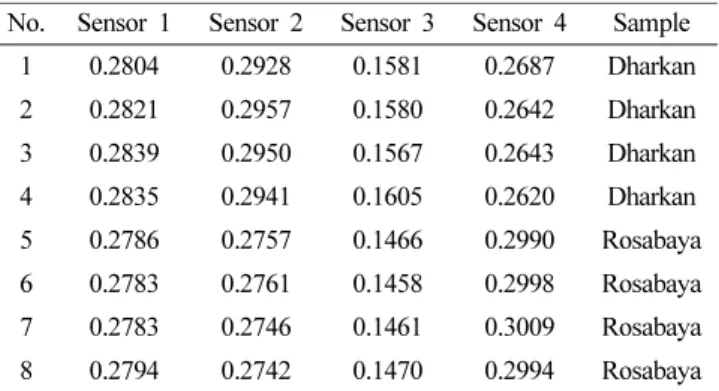
The representative pattern was normalized with respect to the overall sensor array response. Each normalized sensor response is indicative of a percentage of total response which is given by , where n is the number of sensors. The normalized digital signals were transmitted through a universal asynchronous receiver-transmitter (UART) to the virtual instrument. The measurement was repeated five times for each sample. Ten patterns were extracted during the experiment. Eight patterns extracted were used as training data for coffee label recognition and the remaining patterns were used as test data.
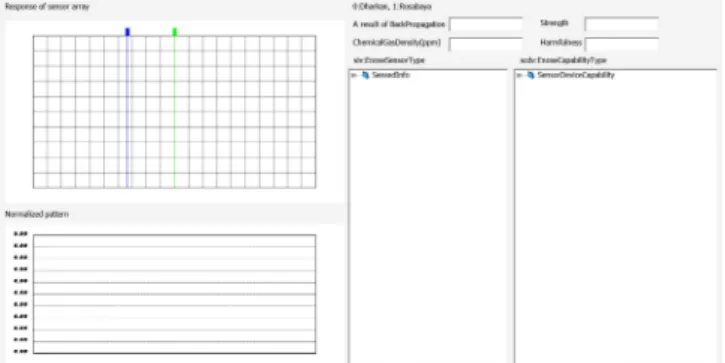
The virtual instrument was developed to visually demonstrate the sensor array response of a sample, normalized pattern, recognition result of the normalized pattern, recognition result encoded to Enose Sensor Type, and the capability of e-nose encoded to Enose Sensor Capability Type. The eXtensible Markup Language (XML) was used for the encoding processing because the MPEG-V standard was originally written in XML Schema, which constitutes semi-structured data.
2.2 MPEG-V DATA TEMPLATES FOR E-NOSE SYSTEM
The odor metadata are encoded into Enose Sensor Type defined in MPEG-V part 5 [25]. A diagram of the data template is shown in Fig. 3.
Enose Sensor Type of MPEG-V consists of strength, harmfulness, chemical Gas Density, chemical Gas Density Unit, mono Chemical for a single gas, and mixture Chemical for a gas mixture. The strength describing odor intensity has one of the
dR ---R