†Corresponding author: Division of Mechanical and Energy Systems Engineering Korea Maritime University. E-mail:
[email protected]. Tel: 410-4792
1 WItzenmann Korea Research Director, E-mail: [email protected]. Tel: 410-4792
2 Graduate School of Mechanical Engineering, Korea Maritime University, E-mail: [email protected]. Tel: 410-4792
Design of exhaust manifold for pulse converters considering fatigue strength due to vibration
Kyung-Sang Cho1․ Kyung-Bin Son2․ Ue-Kan Kim†
(Received January 10, 2011; Revised Aprill 11, 2013;Accepted August 20, 2013)
Abstract: The design of the exhaust manifold for the pulse converters of a 4 strokes high power me- dium-speed diesel engine is presented in terms of fatigue analysis. The said system undergoes thermal ex- pansion due to high temperature of exhaust gas and is exposed to intrinsic vibration of the internal combus- tion engine. Moreover, the exhaust pulse generates pressure pulsating along the runner inside manifold. Under such circumstances, the design and construction of exhaust manifold must be carried out in a way to prevent early failure due to fracture. To validate the design concept, a test rig was developed to simulate the combi- nation of thermal and vibrational movements, simultaneously. Experimental results showed that a certain sense of reliability can be achieved by considering a field factor obtained from the results of engine bench tests.
Keywords: Exhaust manifold, Heat expansion joint, Resonance, Modal analysis, Fatigue analysis, Thermal load, Vibration load.
1. Introduction
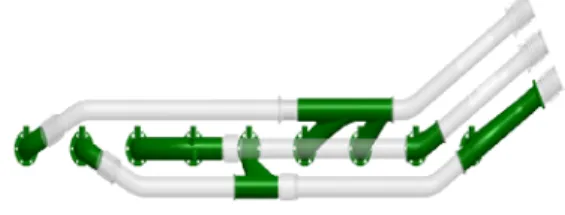
Turbo-charged, medium-speed diesel engines are used for power generation, rail traction, and marine ap- plications [1]. The system of pulse convertors, as de- picted in Figure1, is a useful design technique to sepa- rate exhaust flows of cylinders which are liable to in- terfere with each other and to produce beneficial wave reflections to assist scavenging of the cylinders. The passage of blow-down pulse from the cylinder has to be designed in a way to minimize wave interference, while maximizing wave reflection for scavenging. This, in turn, results in highly complicated, geometric con- straints which makes the system vulnerable to thermal expansion and harsh vibration. The design of exhaust manifold is then discussed to provide a compromise be-
tween geometric constraints and fatigue behaviour.
Figure 1: Example of exhaust manifold
1.1 Absorbing thermal expansion
Because of varying pressure and temperature fluctu- ations in the manifold of the engine, the pulse con- verters are subject to thermal expansion. The temper- ature measured at the outlet of a cylinder is varying in the range of 400 ~ 500 ℃. Considering 4 m long
bank length, a bank is a exhaust gas runner combining a group of cylinders, the thermal expansion should be taken into account in the design of exhaust manifold.
It is a common engineering practice to use a heat ex- pansion joint to absorb thermal stress.
1.2 Vibration operating condition
The medium speed diesel engines normally operate in a speed range around 700 ~ 1,500 rev/min, and have power outputs up to 6,000 kW [2]. When used as a power generator, the range of 70 ~ 80 percent of full load is set to be a normal operating condition.
Under this operating condition, the first natural fre- quency of the exhaust manifolds must be located over 100 Hz which might be considered as a threshold to signify early fracture caused by resonance. It is a rule of thumb to relocate the first natural frequency of the system at least over 100 Hz for such systems which are subject to thermal expansion and vibrational movements. However, it should be recognized that the use of separate bank to include a group of pulse con- verters might require some engineering compromises in terms of stiffness of the system. The complicated geo- metric structure open results in lower natural frequencies. Durability could be then seriously deterio- rated as the operating load exceeds over the normal.
Thus, the heat expansion joint used is designed to absorb thermal expansion and not movements induced by vibration. Since the heat expansion joint is made of a thin stainless sheet metal (0.2 ~ 0.3 mm), the lower frequency resonance of the exhaust manifold could cause permanent damage to the heat expansion joints.
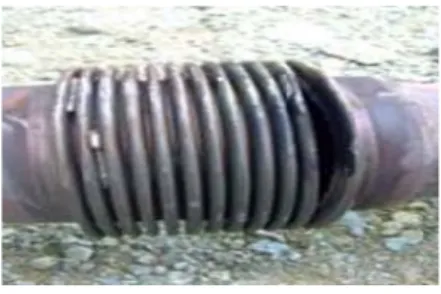
This is because the thermal expansion compounded with pressure pulsation acts as mean stress to shorten the expected life cycle of the material. The operating load has to be regulated at a certain level not to ex- ceed the design standard, for example, 80 percent of full load. Exceeding this might be critical in safety as shown in Figure 2. In other words, a properly de- signed exhaust manifold can help to increase the oper- ating load over the limit.
Figure 2: Early failure due to fracture
2. Design Considerations
2.1 Configuring layout of the system
The configuration of the pulse converters must be made to minimize mounting tolerances. The best way to minimize the accumulation of mounting tolerances is not to use the welded pipes and converters. This is, especially, true for the design of exhaust manifolds for medium-speed diesel engines. The design volume of 4,000⨯1,000⨯500 mm3 is too big to cover with weldings. Welding itself is not sensitive to tolerance, but layers of welding might cause the accumulation of tolerances. When designing a system which is subject to thermal expansion and vibration, welding free con- struction must be considered.
The converters are made by cast parts having gen- eral tolerance of 1/20 mm, and connected by heavy duty V-clamps. It allows mounting tolerance to the similar level of cast parts. The design target of the ex- haust manifold is 8,000 hours of operation without sig- nificant failures. Comparing damage calculations of the cases of ± 5 mm and ± 2 mm offsets, the former results in 50 percent of failure rate (damage of 110 %) and the latter 0.05 % (damage of 11.8 %). Here, dam- ages are calculated at the heat expansion joints by em- ploying the Palmgren-Miner rule.
2.2 Heat expansion joint (HEJ)
Thermal expansion induced by the high temperature exhaust gas is designed to be absorbed by the expansion joint having axial stroke of 18 mm (peak to peak). The heat expansion joints are installed between the cylinders
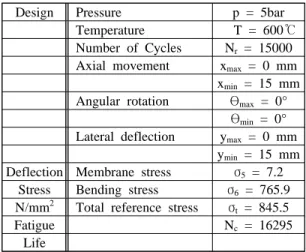
Table 1: EJMA calculation result of HEJ
Design Pressure p = 5bar
Temperature T = 600℃
Number of Cycles Nr = 15000 Axial movement xmax = 0 mm
xmin = 15 mm Angular rotation θmax = 0°
θmin = 0°
Lateral deflection ymax = 0 mm ymin = 15 mm Deflection Membrane stress σ5 = 7.2
Stress Bending stress σ6 = 765.9 N/mm2 Total reference stress σt = 845.5
Fatigue Nc = 16295
Life
It means the safety factor for thermal expansion is considered to be more than 10.
Table 2: 18mm of axial displacement Sample No. of Load Cycles Remarks
1 158000 No failure
2 155600 No failure
3 162500 Failure at
first inner crest
in order to decouple the converters from thermal stresses. According to the EJMA (Expansion Joint Manufacturer's Association) result (see Table 1), the pro- posed HEJ could endure at least 15,000 cycles under the given condition. The proposed HEJ in fact can go more than 10 times of the calculated value (see Table 2).
2.3 Measurement to make system stiffer
A HEJ is not designed to absorb any vibrational movement under 100 Hz. The displacement under this frequency possesses enough energy to kill the HEJ used to absorb thermal expansion. However, the design volume of the complete exhaust manifold is too big to relocate the first natural frequency below 100 Hz. To make the complete system stiffer, a considerable thick- ness increase of the cast converters would be unavoidable. It costs more and makes the system heavy. To increase the natural frequency, the banks are reinforced by U-joints as shown in Figure 3. As expla-
Figure 3: Reinforcement of banks
ined in the next section, the use of U-joints is simple and effective to increase stiffness of the system.
2.4 Experimental modal analysis
To measure the first natural frequency of the com- plete system under full load condition, a set of accel- erometers are used. However, it should be noted that the ambient temperature of the exhaust manifold under full load exceeds 500 ℃. Under this condition, the measurement of acceleration is not possible unless oth- erwise employed specially devised sensors for such high temperature measurements. Even with those sensors, the reliable data cannot be obtained easily. To measure the vibrational behaviour of the complete system under full-load condition, water-cooled adaptors are devised to protect temperature sensitive sensors (Figure 4).
Accelerations were measured both at the inlet and outlet sides of each HEJ. To see the effect of re- inforcements, two different cases, with and without
Figure 4: Water cooled accelerometer
them, were assessed in terms of their first natural frequencies. The exhaust manifold was completely bended like a bow under the full load condition.
Without appropriate reinforcements, Case WO, the first natural frequency was observed at 60 Hz with the am- plitude of ± 0.4mm (Figure 5).
With reinforcements, Case W, the first resonance was seen at 150 Hz with the amplitude of ± 0.02mm (Figure 6). Both were taken from the biggest signals of two different cases in the lateral direction. The magnitude of ± 0.4 mm is significant in terms of fatigue. Assuming 8,000 hours of continuous operation, the HEJ must endure 8000⨯60⨯60⨯60 cycles of ax- ial movement. Simply, it is not working. Without ap- propriate reinforcements to relocate the first natural frequency over 100 Hz, the part cracks within 24 hours of continuous operation.
Figure 5: 1st Resonance (Case WO)
Figure 6: 1st Resonance (Case WO)
3. Fatigue Analysis
3.1 Superposition of loads
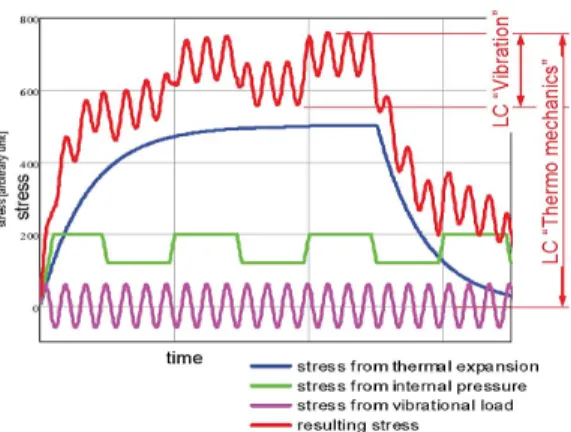
The stress in any point of the HEJ is the result from the combination of different loads are namely, 1) thermal expansion 2) internal pressure and 3) vibration.
Depending on the form of load, different cycles are observed. For example, the thermal expansion can be classified as a lower cycle fatigue, while that of vi- bration as a higher cycle one.
For the higher cycle fatigue, the required number of load cycles must be chosen over 1 million (so called fatigue limit). For the lower cycle fatigue, the required number of load cycles is far less than 1 million. The normal safety factor of 12.5 (5: normal safety factor of
⨯2.5: temperature factor due to high temperature) is
Figure 7: Different characteristics of loads
Figure 8: Stress evaluation
applied for the lower cycle load and the safety factor of 2 for the higher cycle one.
However, it should be recognized that the vibra- tional movements caused by the resonance which is lower than 100 Hz should be treated differently. The normal safety factor of 2 for the higher cycle fatigue is no longer valid due to the significance of its magni- tude (see Figure 8).
3.2 Damage parameter
Unlike the usual case, the majority of fatigue comes from vibration instead of thermal expansion. Moreover, the large quasi-static load caused by the thermal ex- pansion acts as mean stress to reduce number of cy- cles on the S-N curve. Then the modified Goodman line is obtained by
(1)
where
denotes stress amplitude and
mean stress, while
is obtained from the material charac- teristics somewhat higher than
, ultimate strength.The stress amplitude under the mean stress,
is ob- tained by the Smith, Watson, and Topper (SWT) equa- tion as shown in Figure 9 [3].Figure 9: Amplitude-Mean Diagram
4. Experimental Validation
4.1 Thermal load
To find extra space and time for the experimental verification of the whole system is extremely difficult because of the 8,000 hours of operating condition. To run a diesel engine such a long time would be very costly. Considering that most of early failures occurred at the first 24 hours of engine-bench tests, the test rig is developed to validate the durability of the HEJ un- der the combination of thermal and vibrational loads.
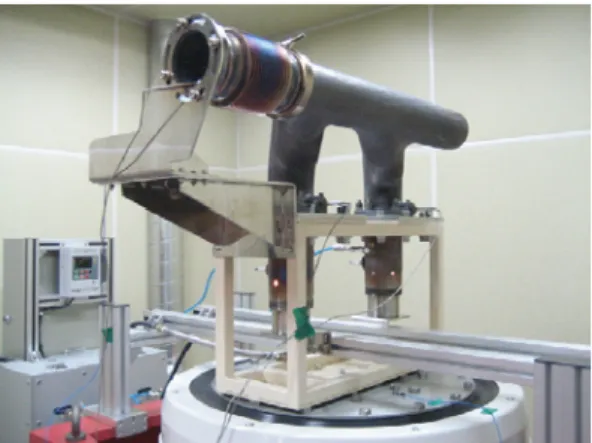
To simulate high temperature of exhaust gas, a set of LPG gas torch are used. The amount of air flow can then be controlled to provide gas temperature of 600
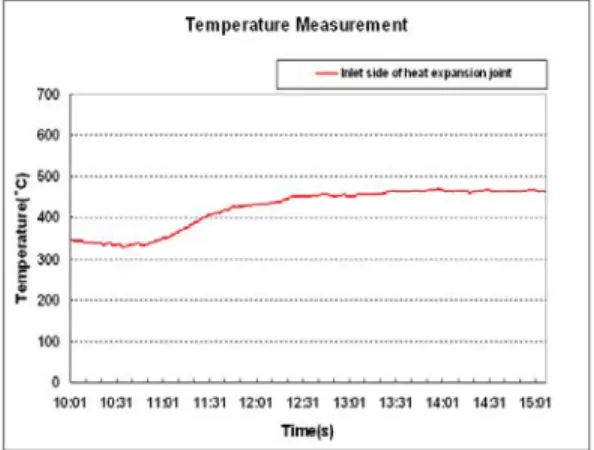
℃ with the temperature variation of maximum 50 ℃ between the inlet and outlet sides of the HEJ. The temperature difference of 50 ℃ is chosen according to the result of actual temperature measurement
Figure 10: Temperature measurement of HEJ
4.2 Vibration load
The measurement result of the exhaust manifolds is obtained from the biggest signal among 3 directional movements. The field factor must be considered to as- sure a reliable, yet efficient simulation. This factor was obtained by trial and error. Considering the HEJ was cracked within the first 24 hours of full load condition without reinforcements, The test rig was used to see
Figure 11: Test rig to simulate thermal and vibration movements
which amplitude cracks the part. It came to 22 G at 60 Hz. Comparing with the result of actual measure- ment, we got the field factor of 3.6. With this field factor, the HEJ was cracked within the first 24 hours on the test rig, as shown in Figure 11.
The field factor of 3.6 is used to simulate the vi- braitonal load in case of the system with bank reinforcements. The HEJ was survived more than 100 hours with the vibration level of 64 G at 150 Hz on the test rig. 100 hours of operation might not guaran- tee durability of 8,000 hours operating condition, but it gives a sense of similarity to ensure durability of the system in many applications.
5. Conclusions
The design of the exhaust manifold for high power medium-speed diesel engine was presented. The com- bination of thermal expansion due to vibrational move- ments exhaust gas and high temperature caused by in- ternal combustion were considered to prevent early failure. The characteristics of different loads were ana- lyzed to allocate appropriate safety factors for damage calculation. It turned out that the normal safety factor of 2 for higher cycle load such as vibration would be dangerous if the first natural frequency of the exhaust manifold is less than 100 Hz.
Figure 12: Field factor of 3.6
The test rig was devised to simulate the combination of two different fatigues, namely, thermal expansion and vibrational movements. Using a set of LPG gas torch, the exhaust gas temperature of 600 ℃ was ach- ieved with the temperature variation of 50 ℃.
Instead of using the costly engine test bench, an electromagnetic shaker was used to generate different vibrational movements. The gas torches were installed right under the cylinder outlets of the pulse converter.
In this way, we were able to simulate the converter with the HEJ under thermal expansion and vibrational movements. This is meaningful because the heat ex- pansion joint is the most vulnerable to thermal and vi- brational loads.
Field factor of 3.6 was used to ensure the reliable simulation. The value was experimentally chosen by taking into account the results of engine bench tests.
With the result of the rig test, we are able to make sure that the durability of the complete exhaust mani- fold is partly assessed without costly engine bench tests. It is not a perfect validation in any sense, but engineering judgment could be made using the result of the rig test.
6. Acknowledgments
The authors gratefully acknowledge the contribution of Hyundai Heavy Industry for allowing to use some
of engine bench test results in the paper. And this re- search is finally supported by Korea Ministry of Ocean and Fisheries(Development of OWC Type Wave Energy Utilization System)
References
[1] D. Woodyard, Ponders's Marine Diesel Engineers and Gas Turbines, 9th ed., Butterworth-Heinemann, pp. 177-185, 2009.
[2] D. Winterbone and R. Pearson, Design Techniques for Engine Manifolds, Professional Engineering Publishing, pp. 198-206, 1999.
[3] N. E. Dowing, Mechanical Behavior of Materials: Engineering Methods for Deformation, Fracture, and Fatigue 3rd ed., Pearson Prentice Hall, pp. 430, 2007.