I. Introduction
The essay Computational Thinking written by Jeannette M. Wing in 2006 [1] divulgated the idea that computational thinking is a 21st century fundamental skill set. This philosophy has rapidly been embraced and spread by the Computer Science Education community and become a pervasive reference when addressing the issue of teaching problem solving inside or outside the realm of computation.
There are currently several well-known organizations and websites that are devoted to design, develop and divulgate computational thinking resources for educators and students.
A small, but representative sample of these initiatives includes ISTE Computational Thinking, CSTA Computational Thinking, CAS Computational Thinking, and Google’s Exploring Computational Thinking, csunplugged.org.
The repositories mentioned above make a wide variety of high quality resources available, however they can be difficult to navigate and search, and choosing an activity among many others is not only time consuming, but a task that requires certain knowledge on the field that not every educator or student possess. We propose a complement to these sites; an educational game designed to exemplify and actualize the elements of
A Guideline for Educational Game Engagement based on a Review of Designing and Developing Non-Digital Games literature An Actual
Implementation of a Tabletop Game
Tatiana Rincon Villegas · Eric Avila Torres · 정종인 · 강신천 · 김창석 · 김의정 공주대학교 컴퓨터교육과
E-mail : [email protected]
ABSTRACT
Digital Game design with educational purposes and User Experience measurement via game analytics has been extensively covered in literature, however non-digital games such as tabletops in education and its corresponding educational impact have limited research. In this paper, we propose a guideline to create non-digital educational games from scratch and evaluate them based on the know-how of developers and the investigation of scholars who have studied the engagement factors related to the digital games and applied their findings to non-digital games. Along with the guideline we provide an actual implementation, a game called HXGN_766, meant to serve as scaffolding of computational thinking and rudimentary Python programing concepts. We believe both, guideline and game, can be a useful reference for those interested on game design, educational content design, game quality control check, and unplugged computer science activities.
This is the first in a series of papers where the game design concept, the evaluation methodology and the game itself will be presented with more detail.
Key Word
Computational Thinking, Game Design, Board Games, non-digital Games, Educational Games, Game-based learning.
193
한국정보통신학회 2019년 춘계 종합학술대회 논문집
Computational Thinking as well as a way to provide basic understanding of rudimentary, yet essential concepts of programming.
In this paper, we propose a guideline for conceptualizing, designing and developing games to be used with educational purposes, as well as an actual instance of a tabletop game created following the aforementioned guideline with the objective of enhancing the learning of notions of computational thinking.
II. Educational Game Engagement Guideline
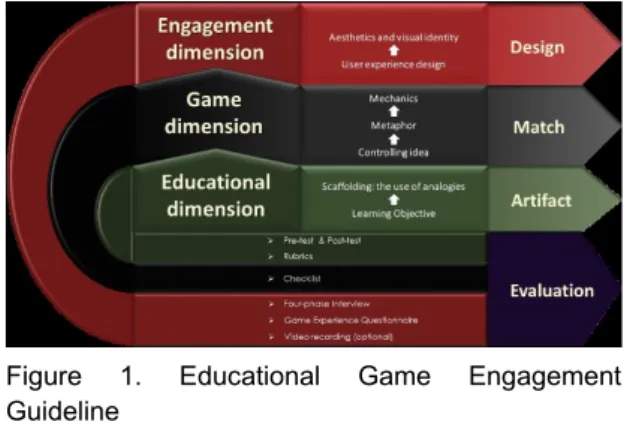
The guideline proposed in this paper is composed of three dimensions: Education, Game, Engagement. Next sections describe how they are constituted, articulated and evaluated in a workflow that allows designing a meaningful educational game experience.
Figure 1. Educational Game Engagement Guideline
2.1. Tabletop
The design process begins from the educational dimension by defining the learning objectives to be scaffolded in the game via meaningful analogies that anchor new information to existing schemata [2]. The output of this process is then used to define the controlling idea of the game, in other
words, “the experience that the designer wishes to impart onto the player” [3]
Once the controlling idea has been established and linked with the learning objectives it can be used to create its Metaphor, which is the narrative or theme that provides the context.
“the metaphor is what the game is supposedly about…the game’s beautiful lie, the fiction that gives the game context and a broader meaning” [4].
When the metaphor has been scripted, the mechanics, the rules that govern the game, can also be designed based on the controlling idea.
Creating these rules is a creative process that implies translating part of the world we want to represent into the mini-world that is the game. This is based on a systematic process of observation and analysis [5].
The last dimension, the engagement dimension affects the other two, and determines how the player will interact with the final product. The first aspect considered under engagement is the User Experience, which has been traditionally considered a field of study in the area of Human Computer Interaction (HCI), nevertheless it can be applied to non-digital games as well, as it was proved by Jonathan Barbara in Measuring User Experience in Board Games [6].
We took into consideration the eight elements proposed by Poels et al for digital game experience: enjoyment, flow, sensory and imaginative immersion, suspense, competence, negative effect, control, and social presence [7]. Based on them we adjusted the original version refining the narrative, aesthetics and visual identity until the product was considered
194
한국정보통신학회 2019년 춘계 종합학술대회 논문집
finalized.
2.2. Evaluation
The evaluation process is a quality control method that serves to answer the following questions:
- Is the product an actual game?
This is determined by a checklist for the game elements (controlling idea, metaphor, and mechanics).
- Does the product have educational impact?
This is measured by applying a pre-test post-test experiment and the corresponding rubrics for the Learning objectives.
- Is the game exciting for users?
This is evaluated through a four-phase interview, the Game experience Questionnaire (GEQ), and optionally a video recording.
III. HXGN: Practical case
HXGN_766 is a turn-based strategy board game for two to eight players designed to serve as a presentation for basic notions of computer science and computational thinking while engaging the players in a sci-fi narrative. It incorporates a series of analogies within the game, so that those who have played it can identify similarities between python programming and the control of the game units.
HXGN_766 was designed to generate genuine engagement among players based on its narrative and mechanics.
- Controlling Idea of the Game HXGN_766 The controlling idea of HXGN_766 is to give the players the experience of being space
archeologists.
- Theme of the Game HXGN_766
Two teams of space archaeologists compete to explore and colonize a planet by taking valuable alien tech from an abandoned landmark to restore an ancient Artificial Intelligence while controlling scavenger robots in a hostile extraterrestrial environment.
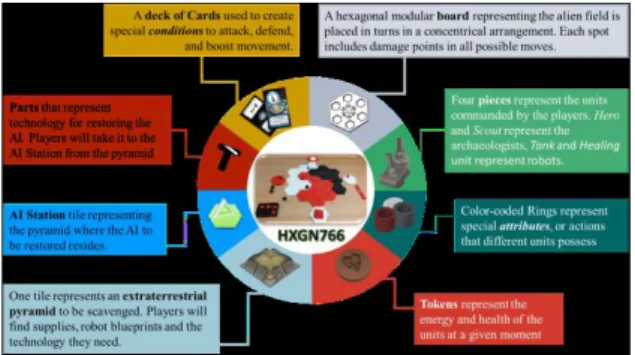
- Components of the game HXGN_766
Figure 2. Components of the game HXGN_766
IV. Conclusion
Although designing a game entails a creative course with infinite paths and alternatives and a great deal of uncertainty, a coherent guideline can be used to guarantee a more systematic approach to a process that otherwise is potentially overwhelming even to the most seasoned game designer.
This paper recommends a guideline as a reference for those interested on creating educational games by implementing the knowledge of experts from the field of game design, along with the theoretical background
195
한국정보통신학회 2019년 춘계 종합학술대회 논문집
of scholars who have rigorously researched the reception of game designs. HXGN_766 is a practical case of educational game design produced by following the guideline proposed herein.
V. Future work
The following papers envisioned will give a more descriptive presentation of the components, elements, mechanics and development of the game. Additionally, its engagement factors and educational impact will be tested in an experiment by using the tools provided in the guideline.
More future work contemplates:
- A blended version of the game with digital and analogical components
- A digital version of the game
References
[1] J. M. Wing, "Computational thinking,"
ACM, vol. 49, no. 3, pp. 33-35, March 2006.
[2] J. Daugherty and N. Mentzer, "Analogical Reasoning in the Engineering Design Process and Technology Education applications,"
Journal of Technology Education, vol. 19, no.
2, pp. 7-21, 2008.
[3] Dr.Wictz , "Game Design Philosophy: The Controlling Idea," 11 April 2014. [Online].
A v a i l a b l e :
https://dr.wictz.com/2014/04/game-design-philoso phy-controlling-idea.html. [Accessed December 2018].
[4] M. Forbeck, "Metaphor vs. Mechanics," in The Kobold Guide to Board Game Design, Wolfgang Baur, 2011, pp. 61-74.
[5] Dr.Wictz, "Game Design Philosophy:
Translating The Controlling Idea Into Theme and Mechanics," 8 May 2014. [Online].
A v a i l a b l e :
https://dr.wictz.com/2014/05/game-design-philoso phy-translating.html. [Accessed October 2018].
[6] J. Barbara, "Measuring User Experience in Board Games," International Journal of Gaming and Computer-Mediated Simulations, vol. 6, no. 1, pp. 64-79, January-March 2014.
[7] W. IJsselsteijn, Y. de Kort, K. Poels, A.
Jurgelionis and F. Bellotti, "Characterising and Measuring User Experiences in Digital Games,"
ACM, pp. 88-89, June 2007.
196