REAL-TIME CORROSION CONTROL SYSTEM FOR CATHODIC PROTECTION OF BURIED PIPES FOR NUCLEAR POWER PLANT
Ki Tae Kim1, Hae Woong Kim1, Young Sik Kim1,†, Hyun Young Chang2, Bu Taek Lim2, and Heung Bae Park2
1Materials Research Center for Energy and Clean Technology, School of Materials Science and Engineering, Andong National University, 1375 Gyeongdongro, Andong 760-749, Korea
2Power Engineering Research Institute, KEPCO Engineering & Construction Company, 8 Gumiro, Bundang, Seongnam, Gyeonggi 463-870, Korea
(Received January 08, 2015; Revised February 23, 2015; Accepted February 23, 2015)
Since the operation period of nuclear power plants has increased, the degradation of buried pipes gradually increases and recently it seems to be one of the emerging issues. Maintenance on buried pipes needs high quality of management system because outer surface of buried pipe contacts the various soils but inner surface reacts with various electrolytes of fluid. In the USA, USNRC and EPRI have tried to manage the degradation of buried pipes. However, there is little knowledge about the inspection procedure, test and manage program in the domestic nuclear power plants. This paper focuses on the development and build-up of real-time monitoring and control system of buried pipes. Pipes to be tested are tape-coated carbon steel pipe for primary component cooling water system, asphalt-coated cast iron pipe for fire protection system, and pre-stressed concrete cylinder pipe for sea water cooling system. A control system for cathodic protection was installed on each test pipe which has been monitored and controlled. For the calculation of protection range and optimization, computer simulation was performed using COMSOL Multiphysics (Altsoft co.).
Keywords : nuclear power plant, buried pipe, cathodic protection, design, computer simulation
†Corresponding author: [email protected]
1. Introduction
Since operation period of nuclear power plants has been increased, damages from degradation of buried pipes grad- ually increased. It has been reported in Korea that lining damage was occurred on a buried pipe in primary compo- nent cooling sea water system in 1998 and water was leaked from the damage of buried pipe in the fire pro- tection system. Auxiliary feed water of about 2.27m3 had been reportedly leaked in Indian Point #2, USA, May 2009 Recently, damage of buried pipes is one of the emerging issues in nuclear industry. Buried pipe, which is different with the pipe above the ground, leads to corrosion of inner surface by internal fluids and to the mechanical or chem- ical damages of outer surface from contacted soils.
Especially, if the pipe leaks, it is very difficult to find the origin of leakage and to reach the damaged pipe being subjected to deprivation of proper maintaining program.
Therefore, US council has asked the inquiry and correc- tion about the maintenance of buried pipe to US NRC
(National Regulatory Commission) and therefore USNRC has published the examination procedure for the structure and facilities which derived licensees to review the proper maintenance status.1) INPO (Institute of Nuclear Power Operations) recommends designing pipes on the base of operating experiences of nuclear power plant. EPRI (Electric Power Research Institute) has also published the maintenance procedure of buried pipes, EPRI-1016456.2) In Korea, regulatory institute has recommended the pro- gram for aging management of major nuclear power plant components in PSR (Periodic Safety Review). However, it was not until 2010 that domestic power plants have setup the procedures and programs to take precautions against damages.
Damages in buried pipelines can be classified into leak- age, fracture, blockage, and mechanical deformation; leak- age (corrosion, fatigue), fracture (corrosion, fatigue), blockage (scale by corrosion, living of organisms in wa- ter). Cathodic protection system for buried pipelines has been installed and operated in the plants. However, it was only a few power plants that adopt the on-line monitoring and control system for cathodic protection. This work in- tends to design the optimum protection system with com-
(a) (b)
(c) (d)
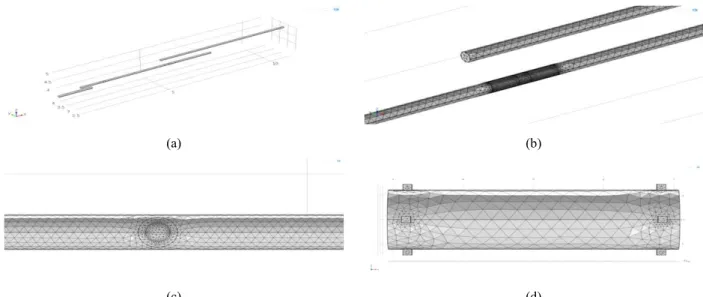
Fig. 1. Model embodiment for computer simulation on cathodic protection of buried pipes : (a) geometry, (b) mesh generation for coated carbon steel pipe, (c) mesh generation for coated cast iron pipe, (d) mesh generation for PCCP.
(a) (b) (c)
Fig. 2. Calculation results of cathodic potential distribution by applying protection current for coated carbon steel pipe buried in the soil : (a) 0.01A, (b) 0.02A, (c) 0.03A.
(a) (b) (c)
Fig. 3. Calculation results of cathodic potential distribution by applying protection current for coated cast iron pipe buried in the soil : (a) 0.01A, (b) 0.015A, (c) 0.03A.
component cooling water system (diameter 100mm, length 6m), an asphalt-coated cast iron pipe for fire-protection system (diameter 300mm, length 5.5m), and a PCC pipe
a secondary current distribution physics solver applied with data for electrolyte conductivity and specific resistance.
Each of on-line monitoring and control system for three buried pipes were also installed and operated.
(a) (b) (c)
Fig. 4. Calculation of cathodic potential distribution by applying protection current for PCCP buried in the soil : (a) 0.03A, (b) 0.04A, (c) 0.05A.
Excavation Anode array Backfill with sand
Pipe array Reference electrode Epoxy coating for insulation
Pipe line Pipe buried site Monitoring/control system
Fig. 5. Installation process of coated carbon steel pipe and on-line monitoring/control system.
3. Results and discussion
Fig. 1 shows the embodiment of pipe models for com-
puter simulation on cathodic protection of buried pipes : (a) geometry construction, (b) mesh generation for coat-
Pipes installation Closed circuit between pipes Reference electrode
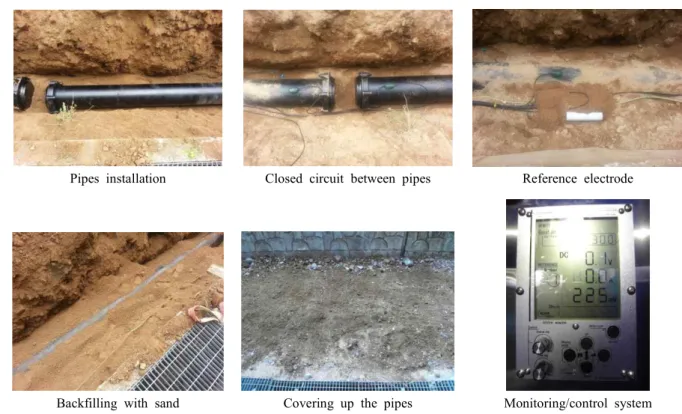
Backfilling with sand Covering up the pipes Monitoring/control system Fig. 6. Installation process of coated cast iron pipe and on-line monitoring/control system.
Excavation and backfill PCCP installation Reference electrode
Epoxy insulation Covering up the pipes Monitoring/control system
Fig. 7. Installation process of PCCP and on-line monitoring/control system.
(a) (b)
(c) (d)
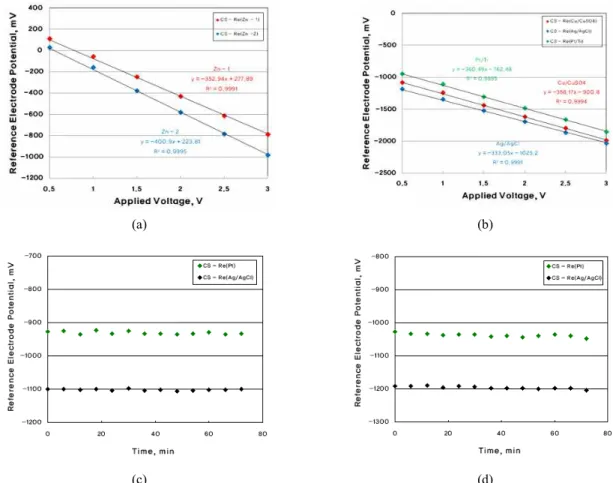
Fig. 8. Cathodic potential monitored or coated carbon steel pipeline : (a) Zn reference electrodes, (b) Cu/CuSO4, Ag/AgCl and Pt/Ti reference electrodes, (c) applied voltage 0.2V, (d) applied voltage 0.3V.
ed carbon steel pipe, (c) mesh generation for coated cast iron pipe, (d) mesh generation for PCC pipe.
Fig. 2 shows calculation results of cathodic potential distribution by applying protection current for tape-coated carbon steel pipe buried in the soil, (a) when 0.01A ap- plied, (b) when 0.02A applied, (c) when 0.03A applied.
10 meter length pipe was tape-coated except a part of axial length of band in the middle of it. It was supposed that the part of 9cm axial length band in the carbon steel exposed to soil and corroded. Applying cathodic pro- tection current led to the potential decrease of the whole system. When 0.01A applied, the minimum potential was calculated as -0.28V which was nobler than -0.85V (the criterion of a typical protection potential for buried carbon steel pipes). When 0.02A applied, the potential was calcu- lated as -0.88V. However, when 0.03A applied, the poten- tial was calculated as -1.46V and this condition is over-protection and should be avoided because of hydro- gen embrittlement. Therefore, optimum cathodic current is applying about 0.02A.
Fig. 3 reveals the calculation of cathodic potential dis-
tribution by applying protection current for asphalt-coated cast iron pipe buried in the soil, (a) is applying 0.01A, (b) is applying 0.015A, (c) is applying 0.03A. 10 meter length pipe was asphalt-coated except only 8cm diameter.
We supposed that only 8cm diameter cast iron exposed into soil and corroded. Applying cathodic protection cur- rent lowered the potential. When 0.01A applied, the poten- tial was calculated as -0.48V, nobler than -0.85V (This is a typical protection potential). When 0.015A applied, the potential was calculated as -0.86V. However, when 0.03A applied, the potential was calculated as -1.93V and this condition is over-protection and should be avoided because of hydrogen embrittlement. Therefore, optimum cathodic current is applying about 0.015A.
Fig. 4 reveals the calculation of cathodic potential dis- tribution by applying protection current for PCC pipe bur- ied in the soil, (a) is applying 0.03A, (b) is applying 0.04A, (c) is applying 0.05A. 4 meter length pipe was epoxy and concrete covered except only eight 7cm2. We supposed that only 7cm2 steel exposed into soil and corroded. Applying cathodic protection current lowered
(a) (b) (c)
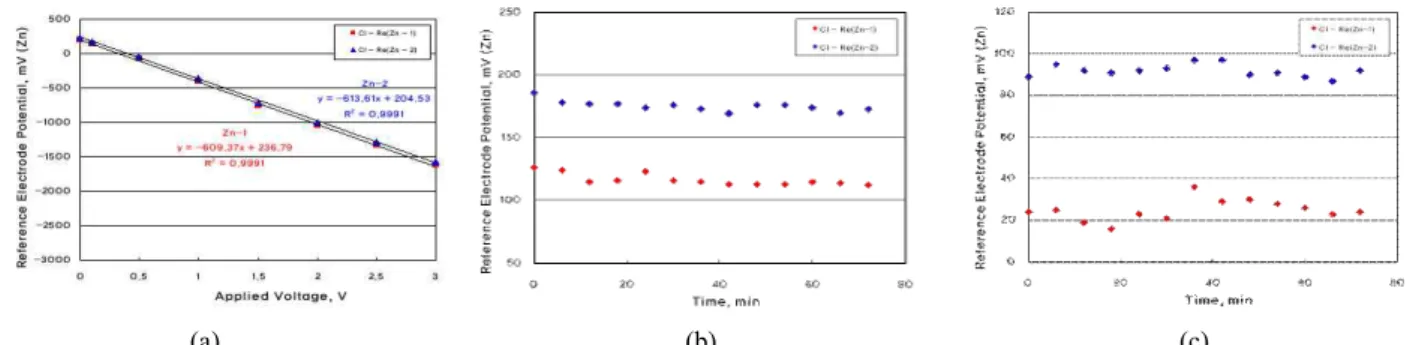
Fig. 9. Cathodic potential monitored for coated cast iron pipeline : (a) Zn reference electrodes, (b) applied voltage 0.2V, (c) applied voltage 0.3V.
(a) (b) (c)
Fig. 10. Cathodic potential monitoring for PCCP : (a) Zn reference electrode, (b) applied voltage 0.2V, (c) applied voltage 0.3V.
the potential. When 0.03A applied, the potential was cal- culated as -0.47V, nobler than -0.85V (This is a typical protection potential). When 0.04A applied, the potential was calculated as -0.86V. However, when 0.05A applied, the potential was calculated as -1.1V. Therefore, optimum cathodic current is applying about 0.015A.
Fig. 5 shows the installation process of on-line monitor- ing and control system for coated carbon steel pipeline buried in the soil. Fig. 6 reveals the installation process of on-line monitoring and control system for coated cast iron pipeline buried in the soil. Also, Fig. 7 represents the installation process of on-line monitoring and control system for PCCP buried in the soil. In every cases, stand- ard process includes excavation of soil, backfill with sand, anode array, backfill with sand, pipeline array, electric cable weld and insulation, backfill with sand, reference electrode array, 1,5m depth cover with soil, and the in- stallation of on-line monitoring and control cathodic pro- tection system.
Fig. 8 shows the result of cathodic potential monitoring for coated carbon steel pipeline, and (a) is for Zn reference electrodes, (b) is for Cu/CuSO4, Ag/AgCl and Pt/Ti refer- ence electrodes, (c) is for applied voltage 0.2V, (d) is for applied voltage 0.3V. One pipe is 10cm width exposure tape-coated carbon steel pipe and the potential is monitor-
ing by reference Zn-1, and the other is whole tape-coated pipe and the potential is monitoring by reference Zn-2.
As shown in Fig. 8(a), linear relationship between two reference electrodes was good but the monitored potentials only show a little different value. Since 10cm width ex- posure tape-coated carbon steel pipe exposed steel surface into the soil, the protection potential under same applied cathodic voltage was a little noble. Reference electrode Cu/CuSO4 and Ag/AgCl showed the same linear trend with applied cathodic voltages and a candidate reference electrode Pt/Ti also showed the good linearity, as shown in Fig. 8(b). In the case of another candidate reference electrode - Ti, the protection potential is also monitoring and even though the applied voltage changes, the potential could be monitored, as shown in Fig. 8(c) and 8(d).
Fig. 9 represents the cathodic potential monitoring re- sults for coated cast iron pipeline, and (a) is for Zn refer- ence electrodes, (b) is for applied voltage 0.2V, (c) is for applied voltage 0.3V. One pipe is 10cm diameter exposure asphalt-coated cast iron pipe and the potential is monitor- ing by reference Zn-1, and the other is whole as- phalt-coated pipe and the potential is monitoring by refer- ence Zn-2. As shown in Fig. 9(a), linear relationship be- tween two reference electrodes was good but the moni- tored potentials only show a little different value. Since
10cm diameter exposure asphalt-coated cast iron pipe ex- posed steel surface into the soil, the protection potential under same applied cathodic voltage was a little noble.
The protection potential well responds with the voltage change, as shown in Fig. 9(b) and 9(c).
Fig. 10 reveals the cathodic potential monitoring results for PCCP, and (a) is for Zn reference electrode, (b) is for applied voltage 0.2V, (c) is for applied voltage 0.3V.
Even though applied voltage changed, the protection po- tentials were well monitored and controlled. This linear relationship implies that the candidate reference electrodes can be used in the field. These metallic reference electro- des will be monitored for a long-term period.
4. Conclusions
This work intends to design the optimum protection sys- tem by computer simulation with installing and operating 3 kinds of test systems that are coated carbon steel pipe, coated cast iron pipe, and PCC pipe. The potential moni- tored from candidate reference electrodes (Pt and Pt/Ti) showed good linear relationships with those of commer- cial reference electrodes (Zn, Cu/CuSO4, Ag/AgCl) in un- derground pilot test pipes.
Acknowledgments
This work was supported by the Nuclear Power Core Technology Development Program of the Korea Institute of Energy Technology Evaluation and Planning (KETEP) grant- ed financial resource from the Ministry of Trade, Industry
& Energy, Republic of Korea (No. 20131520000100)
References
1. Inspection Procedure 62002, Inspection of Structures,
Passive Components, and Civil Engineering Features at Nuclear Power Plants, USNRC, December (1996).
2. EPRI-1016456, Recommendations for an Effective Program to Control the Degradation of Buried and Underground Piping and Tanks, EPRI, 2010 Technical Report. Revision 1 (2010).
3. EPRI-1021626, Nondestructive Evaluation: Buried Pipe Nondestructive Evaluation Reference Guide Rev.
1, EPRI, December (2011).
4. EPRI-1019115, Buried Pipe Guided Wave Examination Reference Document, EPRI, October (2009).
5. EPRI-1015156, Nondestructive Evaluation : Guided Wave Technology Development and Nuclear Application Assessment, EPRI, December (2007).
6. EPRI-1008186, Condition Assessment of Large- Diameter Buried Piping: Phase 1-Feasibility, EPRI, November (2004).
7. EPRI-1011829, Condition Assessment of Large- Diameter Buried Piping: Phase 2-Vehicle Design and Construction, EPRI, December (2005).
8. EPRI-1013468, Condition Assessment of Large- Diameter Buried Piping: Phase 3-Field Trial, EPRI, December (2006).
9. ER-AA-5400, Buried Piping and Raw Water Corrosion Program (BPRWCP) Guide, Excelon Nuclear.
10. Y. S. Kim, H. Y. Chang, and S. H. H, Corros. Sci.
Tech., 31, 70 (2002).
11. H. Y. Chang, I. S. So, T. E. Jin, Y. S. Kim, Y. R.
Yoo, and M. S. Kang, Corros. Sci. Tech., 5, 5 (2006).
12. NACE Standard RP0100, Cathodic protection of pre-stressed concrete cylinder pipelines.
13. NACE Standard RP0575, Internal cathodic protection systems in oil-treating vessels.
14. ASTM G4, Standard guide for conducting corrosion tests in field applications.