Influence of Citric Acid on the Metal Release of Stainless Steels
N. Mazinanian†, I. Odnevall Wallinder, and Y. S. Hedberg
KTH Royal Institute of Technology, School of Chemical Science and Engineering, Department of Chemistry, Division of Surface and Corrosion Science, Drottning Kristinas väg 51, 100 44 Stockholm, Sweden
(Received June 12, 2015; Revised June 12, 2015; Accepted July 23, 2015)
Knowledge of how metal releases from the stainless steels used in food processing applications and cooking utensils is essential within the framework of human health risk assessment. A new European standard test protocol for testing metal release in food contact materials made from metals and alloys has recently been published by the Council of Europe. The major difference from earlier test protocols is the use of citric acid as the worst-case food simulant. The objectives of this study were to assess the effect of citric acid at acidic, neutral, and alkaline solution pH on the extent of metal release for stainless steel grades AISI 304 and 316, commonly used as food contact materials. Both grades released lower amounts of metals than the specific release limits when they were tested according to test guidelines. The released amounts of metals were assessed by means of graphite furnace atomic absorption spectroscopy, and changes in the outermost surface composition were determined using X-ray photoelectron spectroscopy. The results demonstrate that both the pH and the complexation capacity of the solutions affected the extent of metal release from stainless steel and are discussed from a mechanistic perspective. The outermost surface oxide was significantly enriched in chromium upon exposure to citric acid, indicating rapid passivation by the acid. This study elucidates the effect of several possible mechanisms, including complex ion- and ligand-induced metal release, that govern the process of metal release from stainless steel under passive conditions in solutions that contain citric acid.
Keywords : metal release, stainless steel, citric acid, food, surface oxide
†Corresponding author: [email protected]
1. Introduction
Austenitic stainless steel grades, with a minimum of 16 wt% chromium and 6 wt% nickel, are widely used in food contact applications, both domestic and industrial.
Grades AISI 304 and AISI 316 are the most frequently used austenitic grades in food contact applications1). Metals (as ions or complexes) can be released from metals and alloys in food contact, which may unacceptably change the organoleptic characteristics of the food, or pose a risk for consumers1). Therefore, different regulations and technical guidelines have been implemented to ensure the safety of finished articles1-3). Recently, a new technical guide (the CoE (Council of Europe) protocol) has been implemented in the European Union (EU). In this proto- col, 5 g/L (0.3 vol%) citric acid is suggested as the food simulant for acidic foods, while 3 vol% acetic acid has been used as the acidic food simulant in another long-es- tablished test protocol2). Citric acid is a strong metal com-
plexing agent. This means that it is able to form different metal complexes with metals in solution, or with metals of the surface oxide. Depending on the pH, strength of the formed complex, and adjacent bonds, the complex may detach from the surface.
The objectives of this study were to investigate the ef- fect of pH and complexation capacity of citric acid on the metal release process of austenitic stainless steel grades 304 and 316.
2. MATERIALS AND METHODS
2.1. Materials
Austenitic stainless steel sheets of AISI 304 and 316 (2B surface finish (cold-rolled, annealed, pickled and skin passed4)) were supplied by the International Stainless Steel Forum (ISSF). The nominal bulk composition is presented in Table 1.
Table 1. Nominal bulk alloy composition of stainless steel grades AISI 304 and 316 based on supplier information (wt%)
Stainless steel grade (AISI) Fe Cr Mn Ni Mo Cu C P S
304 balance 17.9 1.2 9.0 0.4 0.4 0.04 0.03 0.003
316 balance 17.0 1.3 10.2 2 0.5 0.02 0.03 -
Table 2. Chemical composition of the test solutions of 5 g/L citric acid of different pH values and buffer capacities (BC)
Solution name Citric acid concentration (g/L) Added 50% NaOH (µL/L) pH BC
3.1CA 5 850 3.1 0.02
4.8CA 5 2980 4.8 0.02
6.4CA 5 4280 6.4 0.02
11CA 5 4550 11 0.002
CA- citric acid
2.2. Exposure and experimental conditions
Samples were prepared with an approximate total sur- face area of 6 cm2 and thicknesses of 1 and 2.5 mm for grades 304 and 316, respectively. Abraded (1200 grit SiC paper) and aged surfaces were investigated to ensure re- producible and well-defined uniform surface oxides.
Samples were abraded prior to exposure using 1200 grit SiC paper, ultrasonically cleaned in ethanol and acetone for 5 min, respectively, dried with cold nitrogen gas, and aged for 24 ± 1 h in a desiccator (at room temperature).
The surface area to solution volume ratio was kept con- stant at 1 cm2/mL. Triplicate samples and one blank sam- ple (test solution only) were exposed in parallel for each test solution. The samples were exposed to 5 g/L citric acid of different pH values: 3.1, 4.8, 6.4, and 11.0. All exposures were conducted for 2 h at 70 °C followed by 24 h at 40 °C. Exposure durations/temperatures and the citric acid concentration were chosen in accordance with the CoE protocol1).
All exposures were conducted using the same furnace (Torrsterilisator, Termaks, Norway). All vessels were acid-cleaned in 10% HNO3 for at least 24 h, rinsed four times in ultrapure water (18 MΩcm, Millipore, Sweden) and dried in ambient laboratory air. All chemicals used were of analytical grade (p.a.) or puriss p.a. grade (in the case of nitric acid, used to acidify solution samples to a pH of <2 prior to total metal release measurements).
The pH of all test solutions was measured before and after exposure (with pH changes ˂ 0.23 in all cases).
Citric acid, with the molecular formula of C6H8O7, is a weak triprotic organic acid with three carboxyl groups (COOH)5), pKa values of 3.12, 4.76, and 6.396) and one hy- droxyl group that can be ionized at pH of approximately
117). The pH largely influences the extent of metal complex- ation with complexing agents and shows the largest influence at pH values close to the pKa values of the acid8). In order to investigate the effect of complexation capacity of citric acid on the metal release process, citric acid test solutions of pH 3.1, 4.8, 6.4 (with the buffer capacity (BC) ≈ 0.02) and pH 11 (with BC ≈ 0.002) were selected, Table 2.
2.3. Metal analysis (atomic absorption spectroscopy) and presentation of data
Total concentrations of released Fe, Cr, Ni and Mn in solution were determined for acidified samples (pH<2) by means of graphite furnace atomic absorption spectroscopy, GF-AAS (Perkin Elmer AA800 analyst). The atomization temperature was 2400 °C (for Fe and Ni), 2300 °C (for Cr), and 1900°C (for Mn). All analyses were based on three replicate readings for each solution sample and a quality control sample of known concentration was ana- lyzed every 8th sample. Limits of detection (LOD) for Fe, Cr, Ni and Mn were 0.0004, 0.0003, 0.0004, and 0.0005 µg/cm2, respectively. The limit of quantification (LOQ), above which a value has approximately < 30% error, was estimated to ≤ 0.004 µg/cm², or ≤ 4 µg/L for all elements and test solutions. Calibration was conducted using a blank solution (ultrapure water) and three calibration standards, 10, 30, and 100 µg/L for Cr, Ni and Mn and, 50, 100, and 200 µg/L for Fe. The solutions were diluted up to 12 times to ensure their concentrations to be in the calibration range.
All metal release results (with the blank value, if >0, subtracted) are normalized to the surface area and solution volume, and presented in µg/cm² as average and standard deviations of three independent samples.
Fig. 1. Released amounts of Fe, Cr, Mn, and Ni (µg/cm2) from abraded and aged (24 h) austenitic stainless steel grades 304 and 316 after immersion into citric acid (CA) solutions of pH 3.1, 4.8, and 6.4 (Buffer capacity ≈ 0.02) and pH 11 (Buffer capacity ≈ 0.002) for 2 h at 70 °C followed by 24 h at 40 °C, respectively. Asterisks indicate significant differences among the citric acid containing solutions, with p<0.05 (*), p<0.01 (**), and p<0.001 (***).
2.4. Surface analysis (X-ray photoelectron spectroscopy) Compositional analysis of the outermost surface (5-10 nm) was performed by means of X-ray photoelectron spectroscopy, XPS (UltraDLD spectrometer, Kratos Analytical, Manchester, UK) using a monochromatic Al Kα X-ray source (150 W) on two separate surface areas approximately sized 700 × 300 µm2. Elements of the out- ermost surface oxide were identified by running a wide spectrum and high resolution spectra (pass energy of 20 eV) for the main alloying elements; Fe 2p, Cr 2p, Ni 2p, Mn 2p, O 1s, and C 1s (as energy reference, 285.0 eV).
The results are presented as the relative content of oxi- dized Fe, Cr, Ni, and Mn in the outermost surface oxide,
e.g. [CrOX / (FeOX + CrOX + NiOX + MnOX)]. Peak overlap between Ni and Mn was accounted for. Relative changes in the surface oxide thickness (before and after exposure) were roughly assessed based on the absence or presence of non-oxidized metal peaks.
2.5. Statistical evaluation
A student’s t-test (for unpaired data with unequal var- iances) was employed to test the significance of a differ- ence between two independent sample sets (triplicate sam- ples, respectively). If the probability (p-value) was < 0.05, the difference between two values was considered as sig- nificant9). In this study, p-values < 0.05, < 0.01, and <
0.001 are identified by (*), (**), and (***) with higher
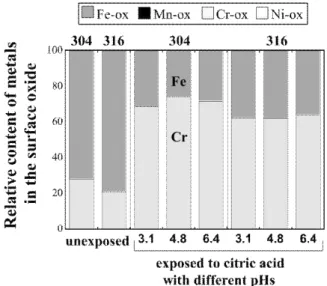
Fig. 2. Relative content of oxidized metals (wt%) in the surface oxide of austenitic stainless steel grades 304 and 316 (abraded and 24 h aged) prior to (unexposed) and after exposure to three different citric acid solutions of pH 3.1, 4.8, and 6.4 for 2 h at 70 °C followed by 24 h at 40 °C. No oxidized Mn or Ni was detected.
significance for smaller p-values.
3. RESULTS AND DISCUSSION
As-received 304 and 316 (both 2B surface finish) surfa- ces exposed for 2 h at 70 °C followed by 24 h at 40
°C in 5 g/L citric acid (pH 2.4) released amounts of Fe, Cr, Ni, and Mn, that all were well below stipulated specif- ic release limits (data not shown). Abraded and aged surfa- ces release slightly higher amounts of metals compared with as-received surfaces due to a shorter time for surface passivation10). Figure 1 shows a comparison between re- leased amounts of metals from abraded grades 304 and 316 after exposure to 5 g/L citric acid of pH 3.1, 4.8, 6.4 (BC ≈ 0.02) and pH 11 (BC ≈ 0.002) immersed for 2 h at 70 °C followed by 24 h at 40 °C. Generally, the amounts of all released metals were relatively low. This indicates no active or metastable corrosion, which is ex- pected from previous studies at similar conditions11) (Mazinanian, Odnevall Wallinder, Hedberg, unpublished results).
As evident from Fig. 1, Fe was predominantly released from both grades followed by the release of Ni, Cr, and Mn. This is in agreement with previous investigations of metal release from these grades in citric acid and other aqueous acidic or neutral solutions11-19). The release pat- tern is related to the passive mixed surface oxide of Cr2O3
and Fe2O3 with metallic nickel present in the alloy surface layer beneath the surface oxide11,20). Part of this nickel
is only released initially and is related to the initial pres- ence of surface defects (as in this study)21) or released in any case of active corrosion (not observed in this study).
Pure Fe2O3 is more soluble compared with pure Cr2O3
at acidic conditions.
From Fig. 1 it is evident that the extent of released metals in citric acid decreased significantly for both grades at alkaline pH (pH 11) compared with neutral and acidic pH conditions (pH 3.1, 4.8, and 6.4). A lower metal re- lease in alkaline solutions compared with acidic solutions is generally expected for stainless steels19,22,23). Citric acid has been shown to induce ligand/complexation-induced metal release for stainless steels (no corrosion of the alloy substrate, but chemical or electrochemical dissolution of the surface oxide)19,22,23) (Mazinanian, Odnevall Wallinder, Hedberg, unpublished data).
This mechanism depends on the adsorption of the ligand to be pH dependent, its capacity to form stable complexes with a metal of the surface oxide, and the capacity and kinetics of the complex detachment from the surface24). The adsorption of citrate on iron oxide (hematite) has been investigated at 20 and 60 °C at varying solution pH25). The results revealed citrate-induced iron release from hematite particles to predominantly take place at pH 4.5 for both temperatures, but be marginal at pH 11, results that correlated with citrate adsorption. These literature findings suggest for both grades that a low amount of citrate adsorption at pH 11 and a high adsorption at pH 4.5 may contribute to the observed low amount of released metals at pH 11 and the relatively high amount of released Fe at pH 4.8, Fig. 1.
Different complexes of citric acid of different stability form at different pH values. Generally, the predominant species of citric acid are H3Cit and H2Cit- at pH 3.1, H2Cit- and HCit-2 at pH 4.8, HCit-2 and Cit-3 at pH 6.4, and Cit3- at pH 117,26).
The release of Cr was among the investigated alloying constituents most dependent on the pH. Cr released from stainless steel is in its trivalent form at these con- ditions13,27) and complexed to citrate13). This has been con- firmed for as-received 304 exposed for 10 days to 5 g/L citric acid (pH 2.4), measured by stripping voltammetry as in13) (data not shown). Generally, trivalent Cr shows a slower surface and/or solution complexation compared with the bivalent or trivalent metal ions of Fe, Ni, and Mn28). In agreement with previous investigations, the re- lease of Mn was least dependent on pH13,21). There was no significant difference observed in metal release for Fe and Ni at pH 3.1 compared with 4.8. This underlines the importance of complexation for these two metals, ob- servations in agreement with theoretical considerations
and previous investigations13,28,29).
Higher amounts of metals were released from grade 316. It corresponds to approximately 10 wt% lower Cr content of the outermost surface oxide of grade 316 com- pared with grade 304 in Fig. 2. This is most probably related to a faster passivation of grade 304 during the age- ing process after abrasion compared with the more corro- sion resistant grade 31630), since opposite findings were observed for as-received (non-abraded) surfaces. More metals were released from as-received surfaces of grade 304 compared with 316 at similar conditions, and more Cr was enriched in the outermost surface of 316 compared with 304 (Mazinanian, Odnevall Wallinder, Hedberg, un- published data). Approximately 10% more Cr was en- riched in the outermost surface oxide of unexposed abrad- ed and aged surfaces of grade 304 compared with grade 316 after exposure to the citric acid solutions at pH 3.1-6.4, Fig. 2. A significant enrichment of Cr in the outer- most surface oxide (up to 74 wt% for grade 304 after exposure into 5 g/L citric acid of pH 4.8 (BC ≈ 0.02) compared with 20 wt% Cr for the unexposed surface) was evident for both grades and all citric acid solutions of pH 3.1-6.4, Fig. 2. No significant difference was observed between the different pH values for the same grade, in- dicating strong surface Fe-citrate complexation in all cases.
4. CONCLUSIONS
This study investigated the effect of pH and complex- ation capacity of citric acid on the extent of metal release from austenitic stainless steel grades AISI 304 and 316.
The following main conclusions can be drawn:
1. Complexation-induced metal release from the outer- most surface oxide was important in all cases except active corrosion which was not observed in these tests, predominantly for Fe and Ni, followed by Mn. Among the investigated metals Cr release was least affected by complexation, but most by pH, whereas Mn release was least affected by pH.
2. Strong Fe-citrate complexation was evident from the strong enrichment of Cr in the outermost surface oxide after exposure to 5g/L citric acid solutions at pH 3.1-6.4.
3. The pH-dependence of iron release suggests a citrate adsorption-controlled mechanism.
4. The results indicate that foods containing citric acid at acidic or neutral pH values can induce a strong sur- face complexation of Fe, with initially increased metal release and surface passivation as a consequence.
ACKNOWLEDGMENTS
The International Stainless Steel Forum, Belgium, and Jernkontoret, Sweden, are gratefully acknowledged for finan- cial support and for providing stainless steel samples. The members of Team Stainless (http://www.teamstainless.org/) are highly acknowledged for financial support and val- uable discussions.
References
1. CoE, Council of Europe, Metals and alloys used in food contact materials and articles, a practical guide for manu- facturers and regulators, in ISBN: 978-92-871-7703- 22013, European Directorate for the Quality of Medicines
& HealthCare (EDQM) (2013).
2. Italian law text, Decreto ministeriale 21/03/1973, hygienic conditions of packaging, containers and articles intended to come into contact with foodstuffs or with substances of human use (1973).
3. C. Simoneau, Guidelines on Testing Conditions for Articles In Contact With Foodstuffs (With A Focus on Kitchenware) - A CRL-NRL-FCM Publication, 1st Edition 2009, 2009, Office for Official Publications of the European Communities: http://publications.jrc.ec.europa.eu/repository/
handle/111111111/8793 (2009).
4. Aperam, Standard Finishes, http://www.aperam.com/europe/
markets-products/product-offer/surface-finishes/stand- ard-finish (2014).
5. R. Myers, The 100 Most Important Chemical Compounds : A Reference Guide, Greenwood Publicing Group, USA (2007).
6. R. N. Goldberg, N. Kishore and R. M. Lennen, J. Phys.
Chem. Ref. Data, 31, 231 (2002).
7. J. L. Pierre and I. Gautier-Luneau, Biometals, 13, 91 (2000).
8. T. I. Lin, Y. H. Lee and Y. C. Chen, J. Chromatogr.
A, 654, 167 (1993).
9. E. H. Livingston, J. Surg. Res., 118, 58 (2004).
10. G. Herting, I. Odnevall Wallinder, and C. Leygraf, Corros.
Sci., 48, 2120 (2006).
11. Y. Hedberg, N. Mazinanian and I. Odnevall Wallinder, Environ. Sci.,: Processes & Impacts, 15, 381 (2013).
12. Y. Hedberg, J. Gustafsson, H. L. Karlsson, L. Möller and I. Odnevall Wallinder, Particle and Fibre Toxicology, 7, 23 (2010).
13. Y. Hedberg, J. Hedberg, Y. Liu and I. Odnevall Wallinder, Biometals, 24, 1099 (2011).
14. Y. Hedberg, X. Wang, J. Hedberg, M. Lundin, E.
Blomberg and I. O. Wallinder, J. Mater. Sci. Mater. M., 24, 1015 (2013).
15. K. Midander, A. D. Frutos, Y. Hedberg, G. Darrie and I. Odnevall Wallinder, Integr. Environ. Assess. Manag., 6, 441 (2010).
16. G. Herting, I. O. Wallinder and C. Leygraf, Corros. Sci., 49, 103 (2007).
17. G. Herting, I. O. Wallinder and C. Leygraf, J. Environ.
Monit., 10, 1092 (2008).
18. J. C. Galván, L. Saldaña, M. Multigner, A. Calzado-Martí n, M. Larrea, C. Serra, N. Vilaboa and J. L. González- Carrasco, J. Mater. Sci. Mater. M., 23, 657 (2012).
19. Y. Okazaki and E. Gotoh, Biomaterials, 26, 11 (2005).
20. I. Olefjord, B. Brox and U. Jelvestam, J. Electrochem.
Soc., 132, 2854 (1985).
21. Y. Hedberg and K. Midander, Mater. Lett., 122, 223 (2014).
22. S. Virtanen, I. Milošev, E. Gomez-Barrena, R. Trebše, J.
Salo and Y. T. Konttinen, Acta Biomater., 4, 468 (2008).
23. Y. Hedberg and I. O. Wallinder, Mater. Corros., 63, 481
(2012).
24. U. Schwertmann, Dev. Plant Soil Sci., 43, 3 (1991).
25. Y. Zhang, N. Kallay and E. Matijevic, Langmuir, 1, 201 (1985).
26. A. J. Francis and C. J. Dodge, Appl. Environ. Microb., 59, 109 (1993).
27. Y. Hedberg and I. O. Wallinder, J. Biomed. Mater. Res., 102, 693 (2014).
28. M. E. Essington, Vadose Zone J., 4, 445 (2005).
29. I. Milošev, J. Appl. Electrochem., 32, 311 (2002).
30. A. J. Sedriks, Corrosion of Stainless Steels, 2nd ed., John Wiley & Sons, New York (1996).