https://doi.org/10.4174/astr.2021.101.1.20 Annals of Surgical Treatment and Research
Association of mortality with drug-coated devices in femoropopliteal artery based on the nationwide data
Hyunsook Choi1,2,5, Haine Lee1, Sang-Soo Lee1,5, Jeonghoon Ahn2, Jin Hyun Joh3, Moo-Yeol Lee4
1Healthcare Economics and Government Affairs, Medtronic Korea Ltd., Seoul, Korea
2Department of Health Convergence, Ehwa Womans University, Seoul, Korea
3Department of Surgery, Kyung Hee University Hospital at Gangdong, School of Medicine, Kyung Hee University, Seoul, Korea
4Department of Physiology, Chung-Ang University School of Medicine, Seoul, Korea
5Department of Medical Device Management & Research, Samsung Advanced Institute for Health Science & Technology, Sungkyunkwan University, Seoul, Korea
INTRODUCTION
Peripheral arterial occlusive disease (PAOD) affects more than 200 million worldwide [1]. In 2017, 3.7 million patients underwent peripheral vascular interventions and it is estimated that the number of patients will exceed 4.5 million by 2022
[2]. Endovascular treatment including balloon angioplasty or stent implantation is now performed more commonly than open surgery for PAOD in Korea [3]. With a growing number of patients with PAOD, drug (paclitaxel)-coated technology including drug-coated balloons (DCBs) and drug-eluting stents (DESs), has been widely accepted as the most promising
Received December 18, 2020, Revised March 11, 2021, Accepted March 26, 2021
Corresponding Author: Jeonghoon Ahn
Department of Health Convergence, Ehwa Womans University, 52 Ewhayeodae-gil, Seodaemun-gu, Seoul 03760, Korea
Tel: +82-2-3277-2813, Fax: +82-2-3277-2867 E-mail: [email protected]
ORCID: https://orcid.org/0000-0002-0177-0192
Copyright ⓒ 2021, the Korean Surgical Society
cc Annals of Surgical Treatment and Research is an Open Access Journal. All articles are distributed under the terms of the Creative Commons Attribution Non- Commercial License (http://creativecommons.org/licenses/by-nc/4.0/) which permits unrestricted non-commercial use, distribution, and reproduction in any medium, provided the original work is properly cited.
Purpose: Drug-coated devices have been widely accepted as one of the most promising therapies for femoropopliteal artery revascularization. A recent meta-analysis showed increased mortality in patients treated with drug-coated devices. We sought to examine the association between mortality and drug-coated devices after the treatment of the femoropopliteal artery based on the Korea national administrative claims data.
Methods: In the National Health Insurance Service database from August 2015 to December 2017, we identified patients with femoropopliteal artery revascularization using percutaneous transluminal angioplasty (PTA), bare metal stents (BMS), drug-coated balloon (DCB), or drug-eluting stents (DES). Kaplan-Meier methods were used to estimate the survival among devices, and log-rank tests were used to evaluate differences between groups. Adjusted hazard ratios (aHRs) were computed using the inverse probability of treatment weightings (IPTW).
Results: There were 1,724 patients (mean age, 70.9 ± 10.7 years; male, 1,350 [78.3%]) included in the analysis. The median follow-up period was 552 days (interquartile range, 404–688 days). There was a difference in IPTW-adjusted mortality risk among device types (26.3% in PTA, 22.1% in BMS, 17.7% in DCB, and 17.8% in DES; P = 0.004). IPTW-adjusted Cox proportional hazard analysis showed that drug-coated devices were associated with decreased all-cause mortality risk (aHR, 0.70; 95% confidence interval, 0.58–0.86).
Conclusion: Our real-world analysis showed that there was no evidence of increased all-cause mortality after femoropopliteal artery revascularization with drug-coated devices compared with non-drug-coated devices.
[Ann Surg Treat Res 2021;101(1):20-27]
Key Words: Angioplasty, Mortality, Paclitaxel, Peripheral arterial occlusive disease, Stents
strategy to reduce restenosis rates compared to percutaneous transluminal angioplasty (PTA), or bare metal stents (BMS) [4-8].
However, patient safety related to drug-coated technology has been controversial, and the attention regarding the mortality of patients treated with drug-coated devices for femoropopliteal artery revascularization has increased after the disclosure of meta-analysis results of randomized clinical trials (RCTs) [9].
The authors reported a higher risk of death at 2 years and 5 years following the use of paclitaxel-coated balloons and stents in the femoropopliteal artery.
The aim of this study was to present a real-world survival analysis after the treatment of the femoropopliteal artery with drug-coated devices using the Korea national administrative claims data.
METHODS
Data source, study population, and study outcome
The administrative claims dataset from the National Health Insurance Service (NHIS) of Korea was used. The NHIS system is a universal and mandatory health insurance service that provides medical care coverage to 97% of the Korean population, and nearly all the data in the health system are centralized in large databases (Supplementary Table 1). All individuals’
demographic information, diagnoses, drug prescription records, medical devices, and procedure codes from inpatient and outpatient services are collected. Diagnoses are coded according to the Korean Classification of Disease, which is a system similar to the International Classification of Disease [10-12].
Thus, NHIS data have been used as a population-based resource in nationwide studies of many diseases [13]. The data of all Koreans aged ≥19 years between January 2013 and December 2017 were included, and the customized data with 50% of the random sampling were provided and used for analysis.
We identified patients with femoropopliteal revascularization procedures and relevant device codes (PTA, BMS, DCB, and DES) between August 1, 2015 and December 31, 2016. For patients with repeated femoropopliteal artery revascularization within the study period, the index procedure was defined as the first revascularization. For those who crossed over the non-drug- coated and drug-coated devices, index procedure was defined as the first time drug-coated device use. The primary outcome was all-cause mortality, and the end of follow-up was on December 31, 2017. This study was approved by the Institutional Review Board of Chung-Ang University School of Medicine (No. 1041078- 201810-HRBM-201-01) and informed consent was waived for the retrospective data analysis.
Patient selection
All patients aged ≥19 years who underwent femoropopliteal revascularization using PTA, BMS, DCB, or DES between August
1, 2015 and December 31, 2016 were indexed for this study.
We excluded the patients with a history of femoropopliteal procedure between January 1, 2013 and July 31, 2015.
Patients were assigned to one of the 4 subgroups according to their first femoropopliteal procedure within the index period considering crossover.
(1) Drug-eluting stents: stent implantation procedures combined with DES devices
(2) Drug-coated balloons: PTA procedures combined with DCB devices
(3) Bare metal stents: stent implantation procedures combined with BMS devices
(4) Percutaneous transluminal angioplasty: PTA procedures combined with PTA devices
The selection process and procedure/device codes for patient identification are presented in detail in Supplementary Fig. 1 and Supplementary Table 2.
Statistical analysis
Categorical variables were reported as counts and percentages, and continuous variables as means with standard deviations. Between-group differences were assessed using the chi-square tests for categorical variables and t-tests or Wilcoxon rank-sum tests for continuous variables.
Survival was evaluated using the Kaplan-Meier methods and log-rank tests were used to evaluate differences between groups. A Cox proportional hazards regression model was used to calculate hazard ratios (HRs) and inverse probability of treatment weighting (IPTW) was used to adjust for differences among the 4 groups. Analyses were stratified by treatment with drug-based devices and calculated standardized differences post-IPTW adjustment to ensure that all baseline covariates were equally distributed in the adjusted cohorts. We then built IPTW-adjusted Cox proportional hazards regression models to calculate adjusted HRs for the risk of death and estimated IPTW-adjusted survival curves. In addition, we conducted a subgroup analysis based on the type of treatment modalities (DCB vs. PTA and DES vs. BMS), and patient group of critical limb ischemia and intermittent claudication.
All P-values were 2-sided, and P < 0.05 was considered statistically significant. All statistical analyses were conducted using SAS ver. 9.4 (SAS Institute, Cary, NC, USA).
RESULTS
Baseline characteristics
We identified a total of 1,724 patients who underwent femoropopliteal artery revascularization during the study period; PTA was used in 476 (27.6%), DCB was used in 865 (50.2%), BMS was used in 282 (16.4%), and DES in 101 (5.9%). For the total population, the mean age was 70.9 ± 10.7 years, 1,350
(78.3%) were male, and 1,467 (85.1%) had hypertension disease.
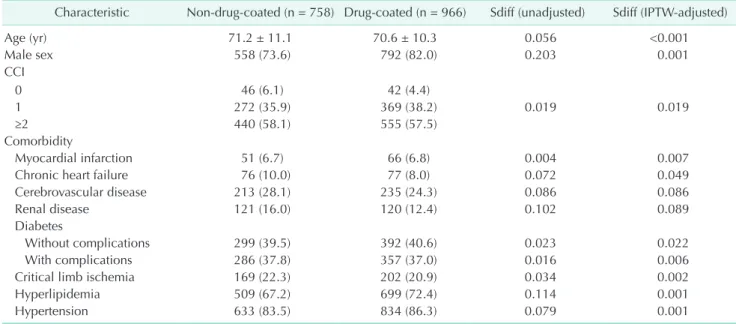
A total of 241 (14.0%) patients had renal disease and 1,334 (77.4%) had diabetes. The baseline characteristics of the 4 index cohorts are shown in Table 1 and those of drug vs. non-drug-coated device groups in Table 2, respectively.
Survival by device type after femoropopliteal artery revascularization
After femoropopliteal artery revascularization, the median follow-up period was 552 days (interquartile range [IQR], 404–688 days). There was a difference in the adjusted mortality
Table 1. Patient characteristics at baseline according to index procedure
Characteristic Overall (n = 1,724) PTA (n = 476) DCB (n = 865) DES (n = 101) BMS (n = 282) P-value
Age (yr) 70.9 ± 10.7 71.0 ± 11.7 70.4 ± 10.3 72.8 ± 9.7 71.5 ± 10.2 0.059
Male sex 1,350 (78.3) 337 (70.8) 711 (82.2) 81 (80.2) 221 (78.4) <0.001
CCI
0 88 (5.1) 27 (5.7) 34 (3.9) 8 (7.9) 19 (6.7)
1 641 (37.2) 156 (32.8) 336 (38.8) 33 (32.7) 116 (41.1) 0.038
≥2 995 (57.7) 293 (61.6) 495 (57.2) 60 (59.4) 147 (52.1)
Comorbidity
Myocardial infarction 117 (6.8) 30 (6.3) 57 (6.6) 9 (8.9) 21 (7.5) 0.766
Chronic heart failure 153 (8.9) 52 (10.9) 70 (8.1) 7 (6.9) 24 (8.5) 0.302
Cerebrovascular disease 448 (26.0) 122 (25.6) 210 (24.3) 25 (24.8) 91 (32.3) 0.065
Renal disease 241 (14.0) 88 (18.5) 108 (12.5) 12 (11.9) 33 (11.7) 0.011
Diabtes
Without complications 691 (40.1) 208 (43.7) 350 (40.5) 42 (41.6) 91 (32.3) 0.019 With complications 643 (37.3) 212 (44.5) 327 (37.8) 30 (29.7) 74 (26.2) <0.001
Critical limb ischemia 371 (21.5) 125 (26.3) 187 (10.9) 15 (14.9) 44 (15.6) 0.002
Intermittent claudication 896 (52.0) 213 (44.8) 482 (55.7) 51 (50.5) 150 (53.2) 0.002
Hyperlipidemia 1,208 (70.1) 320 (67.2) 634 (73.3) 65 (64.4) 189 (67.0) 0.030
Hypertension 1,467 (85.1) 397 (83.4) 749 (86.6) 85 (84.2) 236 (83.7) 0.375
Values are presented as mean ± standard deviation or number (%).
PTA, percutaneous transluminal angioplasty; DCB, drug-coated balloons; DES, drug-eluting stents; BMS, bare metal stents; CCI, Charlson comorbidity index.
Table 2. Patient characteristics at baseline for drug vs. non-drug-coated device group
Characteristic Non-drug-coated (n = 758) Drug-coated (n = 966) Sdiff (unadjusted) Sdiff (IPTW-adjusted)
Age (yr) 71.2 ± 11.1 70.6 ± 10.3 0.056 <0.001
Male sex 558 (73.6) 792 (82.0) 0.203 0.001
CCI
0 46 (6.1) 42 (4.4)
1 272 (35.9) 369 (38.2) 0.019 0.019
≥2 440 (58.1) 555 (57.5)
Comorbidity
Myocardial infarction 51 (6.7) 66 (6.8) 0.004 0.007
Chronic heart failure 76 (10.0) 77 (8.0) 0.072 0.049
Cerebrovascular disease 213 (28.1) 235 (24.3) 0.086 0.086
Renal disease 121 (16.0) 120 (12.4) 0.102 0.089
Diabetes
Without complications 299 (39.5) 392 (40.6) 0.023 0.022
With complications 286 (37.8) 357 (37.0) 0.016 0.006
Critical limb ischemia 169 (22.3) 202 (20.9) 0.034 0.002
Hyperlipidemia 509 (67.2) 699 (72.4) 0.114 0.001
Hypertension 633 (83.5) 834 (86.3) 0.079 0.001
Values are presented as mean ± standard deviation or number (%).
Sdiff, standardized difference; IPTW, inverse probability treatment weighting; CCI, Charlson comorbidity index.
Sdiff > 0.1 indicates significant difference.
risk among device types (26.3% in PTA, 22.1% in BMS, 17.7% in DCB, and 17.6% in DES, P = 0.004) (Fig. 1). As a result of the IPTW-adjusted Cox proportional hazard analysis with PTA as a reference, the adjusted HR was 0.84 (95% confidence interval [CI], 0.62–1.13) for BMS, 0.65 (95% CI, 0.51–0.82) for DCB, and 0.71 (95% CI, 0.43–1.17) for DES, respectively (Table 3).
Treatment with drug-coated devices was associated with a lower cumulative incidence of all-cause mortality compared to treatment with non-drug-coated devices after a median time period of 552 days from the procedure (24.6% for non-drug- coated devices vs. 17.9% for drug-coated devices; log-rank P = 0.001) (Fig. 2). The result of the IPTW-adjusted Cox proportional
hazard analysis revealed that drug-coated devices were associated with reduced mortality risk (adjusted HR, 0.70; 95%
CI, 0.57–0.86).
Subgroup analysis
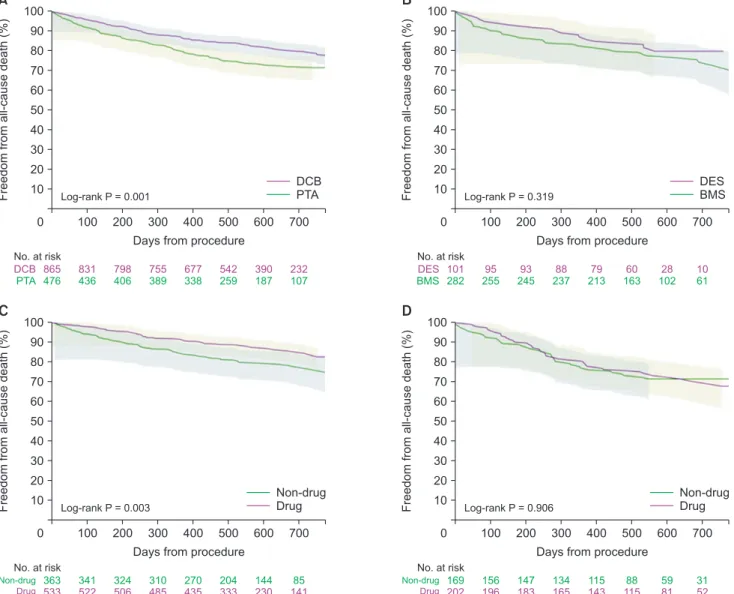
When stratified by the type of device used for revasculariza- tion, similar survival trends were observed for patients who were treated with DCB vs. non-DCB angioplasty (log-rank P = 0.001; Fig. 3A), and DES vs. BMS (log-rank P = 0.319; Fig. 3B). In patients with intermittent claudication, drug-coated vs. non- drug-coated groups showed significant differences (log-rank P = 0.003; Fig. 3C) while there was no difference between the groups in patients with critical limb ischemia (log-rank P = 0.906; Fig.
3D).
Table 3. Risk factors of mortality after femoropopliteal artery revascularization by treatment
Variable Univariate Multivariate
HR (95% CI) P-value HR (95% CI) P-value
Age 1.06 (1.05–1.07) <0.001 1.06 (1.04–1.07) <0.001
Male sex 0.57 (0.45–0.71) <0.001 0.72 (0.57–0.90) 0.004
CCI 1.11 (1.06–1.17) <0.001 1.11 (1.06–1.17) <0.001
Critical limb ischemia 1.39 (1.11–1.76) 0.005 1.28 (1.00–1.63) 0.046
Claudication 0.63 (0.52–0.78) <0.001 0.61 (0.49–0.75) <0.001
Hyperlipidemia 0.80 (0.65–0.99) 0.047 0.83 (0.66–1.03) 0.095
Hypertension 1.83 (1.28–2.62) 0.001 1.29 (0.89–1.86) 0.175
DCB 0.65 (0.51–0.82) <0.001 0.65 (0.51–0.82) <0.001
BMS 0.86 (0.63–1.16) 0.311 0.84 (0.62–1.13) 0.245
DES 0.65 (0.40–1.07) 0.092 0.71 (0.43–1.17) 0.176
PTA NA NA
HR, hazard ratio; CI, confidence interval; CCI, Charlson comorbidity index; DCB, drug-coated balloons; BMS, bare metal stents; DES, drug-eluting stents; PTA, percutaneous transluminal angioplasty; NA, not applicable.
Freedomfromall-causedeath(%)
700 Days from procedure
100 90 80 70 60 50 40 30 20 10
0
BMS DCB DES PTA
100 200 300 400 500 600
282 865 101 476
255 831 95 436
245 798 93 406
237 755 88 389
213 677 79 338
163 542 60 259
102 390 28 187
61 232
10 107 No. at risk
Log-rank P = 0.004
BMS DCB
DES PTA
Fig. 1. Inverse probability treatment weighting-adjusted Kaplan-Meier curves following femoropopliteal artery revascularization for 4 device types. BMS, bare metal stents;
DES, drug-eluting stents; DCB, drug-coated balloons; PTA, percutaneous transluminal angioplasty.
Freedomfromall-causedeath(%)
700 Days from procedure
100 90 80 70 60 50 40 30 20 10
0
Non-drug Drug
100 200 300 400 500 600
758 966
691 926
651 891
626 843
551 756
422 602
289 418
168 242 No. at risk
Log-rank P = 0.001
Non-drug Drug
Fig. 2. Inverse probability treatment weighting-adjusted Kaplan-Meier curves following femoropopliteal artery revascularization for drug vs. non-drug-coated devices.
Causes of death
Among the total 1,724 patients, 370 patients (21.5%) died and information on the causes of death was available only for 365 patients. The major causes of death were diabetes (21.9%), cardiac death (13.1%), cancer (11.2%), and pulmonary disease (10.9%). Causes of death were well-balanced among the group with no pattern or trend toward an increase in any specific causes of death in certain device groups except for renal failure and infection (Supplementary Table 3).
DISCUSSION
In this analysis of the national claims data set that were treated for femoropopliteal artery revascularization, we found no evidence of increased death following treatment with drug-
coated devices compared to non-drug-coated devices over a median time period of 552 days (IQR, 404–688 days). Moreover, mortality risk was lower for patients treated with drug-coated devices compared with those who were treated with non-drug- coated devices. Similar trend was shown in the patients with claudication. The causes of death were well-balanced among groups except for renal failure and infection.
The findings of this study were consistent with the findings of other studies based on administrative claims data. Secemsky et al. [14] evaluated the differences in all-cause mortality between patients who were treated with drug-coated devices vs. non-drug-coated devices based on nationwide 16,560 Centers for Medicare and Medicaid services beneficiaries who were admitted for femoropopliteal artery revascularization.
Treatment with drug-coated devices was associated with a
Freedomfromall-causedeath(%)
700 Days from procedure
100 90 80 70 60 50 40 30 20 10
0
DCB PTA
100 200 300 400 500 600
865 476
831 436
798 406
755 389
677 338
542 259
390 187
232 107 No. at risk
Log-rank P = 0.001
DCB
PTA Freedomfromall-causedeath(%)
700 Days from procedure
100 90 80 70 60 50 40 30 20 10
0
DES BMS
100 200 300 400 500 600
101 282
95 255
93 245
88 237
79 213
60 163
28 102
10 61 No. at risk
Log-rank P = 0.319
DES BMS
Freedomfromall-causedeath(%)
700 Days from procedure
100 90 80 70 60 50 40 30 20 10
0 100 200 300 400 500 600
363 533
341 522
324 506
310 485
270 435
204 333
144 230
85 141 No. at risk
Log-rank P = 0.003
Non-drug
Drug Freedomfromall-causedeath(%)
700 Days from procedure
100 90 80 70 60 50 40 30 20 10
0 100 200 300 400 500 600
169 202
156 196
147 183
134 165
115 143
88 115
59 81
31 52 No. at risk
Log-rank P = 0.906
Non-drug Drug
Non-drug Drug
Non-drug Drug
A B
C D
Fig. 3. Inverse probability treatment weighting-adjusted Kaplan-Meier curves by subgroup. (A) DCB vs. PTA, (B) DES vs. BMS, (C) patients with intermittent claudication, and (D) patients with critical limb ischemia. DCB, drug-coated balloons; PTA, percutaneous transluminal angioplasty; DES, drug-eluting stents; BMS, bare metal stents.
lower cumulative incidence of all-cause mortality compared with treatment with non-drug-coated devices through 600 days after procedure (32.5% vs. 34.3%, respectively; log-rank P
= 0.007). In addition, drug-coated devices were not associated with a difference in all-cause mortality compared with non- drug-coated devices after multivariable adjustment (HR, 0.97;
95% CI, 0.91–1.04). Their study, however, was limited by a relatively short follow-up with a median of 389 days. In a recent retrospective health insurance claims analysis of propensity- matched 37,914 German patients, the author reported that DCBs and stents were significantly associated with a 17%
improvement in overall survival (HR, 0.83; 95% CI, 0.77–0.90) compared to uncoated devices at 5 years postoperatively for patients with chronic limb threatening ischemia. This trend was observed in patients with intermittent claudication, although there was no statistical significance [15]. In another study using German BARMER health insurance data by Freisinger et al.
[16], 64,771 patients were included over a median time period of 7.6 years. Multivariable Cox regression analysis showed that the use of DES was not associated with increased long- term mortality for over 11 years (P > 0.006), moreover DCB was associated with decreased mortality for the first-year past application (HR, 0.92; P < 0.001) [16].
In an updated systematic review and meta-analysis of all available RCTs comparing DCB to PTA, 3,217 patients from 22 RCTs were included in the analysis [17]. There was no difference in mortality between DCB and PTA in the femoropopliteal artery (relative risk [RR], 1.33; 95% CI, 0.97–1.84) at a median follow-up of 21.6 ± 14.4 months. This study was the most comprehensive analysis as it included all available studies, but the results were inconsistent with the major findings and conclusions of a meta-analysis published by Katsanos et al.
[9] in 2018. Dake et al. [18] reported a mortality risk between DES and non-drug comparators (BMS/PTA) using patient-level data from 2 large studies. There was no difference in all-cause mortality for the DES compared to PTA/BMS (19.1% of DES vs.
17.1% of PTA/BMS through 5 years, P = 0.600). In a Japanese post-market surveillance study, the mortality was not different between the 2 groups (15.8% DES vs. 15.3% BMS through 3 years, P = 0.890). Cox proportional hazard models revealed that age, tissue loss, and congestive heart failure were the risk factors associated with mortality in the RCT, and critical limb ischemia, age, renal failure, and sex were the risk factors in the Japanese study. At a VIVA analysis of the de-identified individual patient-level data of 8 RCTs, including 2,185 patients with 4-year median follow-up, it was indicated that 38% (95%
CI, 6%–80%) increased mortality risk, corresponding to 4.6%
absolute increase at 5 years after drug-coated device use [19].
However, the authors suggest that selection bias is influential when using an aggregate data approach and a limited number of long-term follow-up studies. Furthermore, the data of 9.5%
of the participants were not available due to follow-up loss or withdrawal. Notably, recent data showed that loss to follow- up is associated with worse survival [20]. Interestingly, these results were not consistent with those of other studies based on patient-level data, although the study approach using meta- analysis methodology of patient-level data of existing RCTs was similar, the data included for analysis were different, and this may have resulted in the disparity in the association of mortality between drug-coated devices and non-drug-coated devices.
Katsanos et al. [9] also suggested a significant relationship between paclitaxel dose and increased incidence of death, the risk of death increased by 0.4% per paclitaxel milligram-year.
However, a dose-effect assessment applied in the meta-analysis has several limitations including lack of precise paclitaxel dose information and intention-to-treat analysis approach without consideration of crossover after index treatment [21]. Looking into the patient-level meta-analysis using detailed information, there was no difference in mean paclitaxel dose between patients who died and survived, also no correlation between paclitaxel dose and mortality when survival was stratified paclitaxel dose by low, mid, and upper dose in patient-level meta-analysis of trials using IN.PACT Admiral DCB by Schneider et al. [22]. Rocha-Singh et al. [19] showed that mortality risk was not associated with paclitaxel exposure level in another patient data meta-analysis based on 8 RCTs comparing DCB and PTA. So far, it is remained controversial due to the cytotoxicity of paclitaxel, and further investigation and evaluation are warranted.
The strengths of our analysis are its comprehensive database of unselected real-world patients covering the period of drug- coated device usage from its introduction to the market until the end of 2017. The methodological approach of our analysis was to address the potential treatment selection bias due to the retrospective nature of the study design using the IPTW method, which allows us to obtain unbiased estimates of average treatment effects. In addition, we investigated the cause of death among the 4 groups as there is a potential risk of cancer development after the use of paclitaxel-based devices, but there were no differences among groups in terms of death caused by cancer. Our study has some limitations. First, as with all non-randomized studies, potential imbalances in unmeasured confounders, such as current or prior tobacco use, body mass index, alcohol use, and obesity may have biased our results; however, we used IPTW methods to mitigate this potential bias as mentioned above. Second, as we lacked treated lesion information in the NHIS administrative claims data, there is a possibility that patients treated for below-the-knee (BTK) or iliac lesion were not completely excluded although we tried to exclude those patients based on current clinical practice. When we define the patients differently by including
BTK or iliac lesion as a sensitivity analysis, the results remained unchanged. Third, real-world administrative data lacked laboratory information such as cholesterol, dyslipidemia, etc.
at baseline and follow-up and does not provide information on the underlying reason for drug-coated or non-drug-coated device treatment for the patients. Lastly, inaccurate coding in administrative claims databases which is general constraints in the use of secondary health care data may have biased our results.
Our real-world analysis found that the use of drug-coated devices for endovascular therapy for the femoropopliteal artery does not increase mortality compared to the mortality of non-drug-coated devices. The results of this study provide important information for physicians caring for patients with femoropopliteal arteries, and this information should be considered in addition to data from RCTs.
SUPPLEMENTARY MATERIALS
Supplementary Tables 1–3 and Supplementary Fig. 1 can be found via https://doi.org/10.4174/astr.2021.101.1.20.
ACKNOWLEDGEMENTS
Fund/Grant Support
This study used customized research database of Korean
National Health Insurance Service (NHIS-2019-1-134). Medtronic Korea funded NHIS data utilization fee.
Conflict of Interest
No potential conflict of interest relevant to this article was reported.
ORCID iD
Hyunsook Choi: https://orcid.org/0000-0002-0107-5915 Haine Lee: https://orcid.org/0000-0002-9643-1176 Sang-Soo Lee: https://orcid.org/0000-0002-3619-6303 Jeonghoon Ahn: https://orcid.org/0000-0002-0177-0192 Jin Hyun Joh: https://orcid.org/0000-0002-8533-6755 Moo-Yeol Lee: https://orcid.org/0000-0002-4682-6161
Author Contribution
Conceptualization: HC, SSL, MYL Formal Analysis: HC, HL Investigation: HC, HL, JHJ Methodology: HC, HL, JA
Project Administration: HC, HL, MYL Writing – Original Draft: HC, HL, SSL, JA, JHJ Writing – Review & Editing: All authors
REFERENCES
1. Fowkes FG, Rudan D, Rudan I, Aboyans V, Denenberg JO, McDermott MM, et al. Comparison of global estimates of prevalence and risk factors for peripheral artery disease in 2000 and 2010: a systematic review and analysis. Lancet 2013;382:1329-40.
2. Life Science Intelligence. Peripheral vascular trends & opportunities: procedure volumes analysis – global [Internet]. Huntington Beach (CA): Life Science Intelligence; 2018 [cited 2020 Jun 8]. Available from: https://
www.researchandmarkets.com/research/
nztgg6/peripheral?w¼4.
3. Park YY, Joh JH, Han SA, Kim SH, Cho S, Park HC, et al. National trends for the treatment of peripheral arterial disease in Korea between 2004 and 2013. Ann Surg Treat Res 2015;89:319-24.
4. Tepe G, Schnorr B, Albrecht T, Brechtel K, Claussen CD, Scheller B, et al. Angioplasty of femoral-popliteal arteries with drug- coated balloons: 5-year follow-up of the THUNDER trial. JACC Cardiovasc Interv 2015;8(1 Pt A):102-8.
5. Ansel GM, Jaff MR, Popma JJ, Battisti AJ, Lottes A E, Harnish P, et al. A quantitative angiographic comparison of restenotic tissue following placement of drug-eluting stents and bare metal stents in symptomatic patients with femoropopliteal disease. J Endovasc Ther 2017;24:499-503.
6. Rosenfield K, Jaff MR, White CJ, Rocha- Singh K, Mena-Hurtado C, Metzger DC, et al. Trial of a paclitaxel-coated balloon for femoropopliteal artery disease. N Engl J Med 2015;373:145-53.
7. Tepe G, Laird J, Schneider P, Brodmann M, Krishnan P, Micari A, et al. Drug- c o at e d b a l lo on ve r su s s t a nd a rd percutaneous transluminal angioplasty for the treatment of superficial femoral and popliteal peripheral artery disease:
12-month results from the IN.PACT SFA randomized trial. Circulation 2015;131:495-502.
8. Dake MD, Ansel GM, Jaff MR, Ohki T, Saxon RR, Smouse HB, et al. Paclitaxel- eluting stents show superiority to balloon angioplasty and bare metal stents in femoropopliteal disease: twelve-month Zilver PTX randomized study results. Circ Cardiovasc Interv 2011;4:495-504.
9. Katsanos K, Spiliopoulos S, Kitrou P, Krokidis M, Karnabatidis D. Risk of death following application of paclitaxel-coated
balloons and stents in the femoropopliteal artery of the leg: a systematic review and meta-analysis of randomized controlled trials. J Am Heart Assoc 2018;7:e011245.
10. Seong CS, Kim YY, Khang YH, Park JH, Kang HJ, Lee H, et al. Data resource profile: the National Health Information Dat abase of t he National Healt h Insurance Service in South Korea. Int J Epidemiol 2017;46:799-800.
11. Song SO, Jung CH, Song YD, Park CY, Kwon HS, Cha BS, et al. Background and data configuration process of a nationwide population-based study using the Korean National Health Insurance system. Diabetes Metab J 2014;38:395- 403.
12. Lee EK, Park JA, Cole A, Mestre-Ferrandiz J. Data governance arrangements for real- world evidence: South Korea. London:
Office of Health Economics; 2017.
13. Lee YH, Han K, Ko SH, Ko KS, Lee KU;
Taskforce Team of Diabetes Fact Sheet of the Korean Diabetes Association.
Data analytic process of a nationwide population-based study using National Health Information Database established by National Health Insurance Service.
Diabetes Metab J 2016;40:79-82.
14. Secemsky EA, Kundi H, Weinberg I, Jaff MR, K rawisz A, Parikh SA, et al. Association of survival with femoropopliteal artery revascularization with drug-coated devices. JAMA Cardiol 2019;4:332-40.
15. Behrendt CA, Sedrakyan A, Peters F, Kreutzburg T, Schermerhorn M, Bertges DJ, et al. Editor’s choice – long term survival after femoropopliteal artery revascularisation with paclitaxel coated devices: a propensity score matched cohort analysis. Eur J Vasc Endovasc Surg 2020;59:587-96.
16. Freisinger E, Koeppe J, Gerss J, Goerlich D, Malyar NM, Marschall U, et al. Mortality after use of paclitaxel-based devices in peripheral arteries: a real-world safety analysis. Eur Heart J 2020;41:3732-9.
17. Anantha-Narayanan M, Shah SM, Jelani QU, Garcia S, Ionescu C, Regan C, et al.
Drug-coated balloon versus plain old balloon angioplasty in femoropopliteal disease: an updated meta-analysis of randomized controlled trials. Catheter Cardiovasc Interv 2019;94:139-48.
18. Dake MD, Ansel GM, Bosiers M, Holden
A, Iida O, Jaff MR, et al. Paclitaxel-coated Zilver PTX drug-eluting stent treatment does not result in increased long-term all- cause mortality compared to uncoated devices. Cardiovasc Intervent Radiol 2020;43:8-19.
19. Rocha-Singh KJ, Duval S, Jaff MR, Schneider PA, Ansel GM, Lyden SP, et al.
Mortality and paclitaxel-coated devices:
an individual patient data meta-analysis.
Circulation 2020;141:1859-69.
20. Wang GJ, Judelson DR, Goodney PP, Bertges DJ. Loss to follow-up 1 year after lower extremity peripheral vascular intervention is associated with worse survival. Vasc Med 2019;24:332-8.
21. Holden A, Varcoe RL, Jaff MR, Schneider PA, Tepe G, Zeller T. Paclitaxel and mortality: the dose argument is critical. J Endovasc Ther 2019;26:467-70.
22. Schneider PA, Laird JR, Doros G, Gao Q, Ansel G, Brodmann M, et al. Mortality not correlated with paclitaxel exposure:
an independent patient-level meta- analysis of a drug- coated balloon. J Am Coll Cardiol 2019;73:2550-63.