서 론
국민건강영양조사 자료에 따르면 성인(만 19세 이상) 흡연율은 1998년 35.1%에서 2007년 28.8%로 감소하였으며, 이후 꾸준하게 감소 하는 추이를 보이나 최근 연도별 감소가 정체되는 추세이다.1) 그리
고 성인 여성 흡연율은 1998년 6.5%에서 2015년 5.5%로 지난 18년 간 큰 변동이 없는 것으로 조사되었고,1) 청소년 흡연율은 2016년 6.3%
(남 9.6%, 여 2.7%)로 청소년건강행태온라인조사가 시작된 2005년 이 후로 소폭의 감소 추세를 보인다.1) 즉, 흡연이 개인·국가적 건강수준 을 결정하는 중요한 요인으로 강조되고 있고, 각종 건강증진사업을
Received May 10, 2017 Revised July 11, 2017 Accepted July 30, 2017
Corresponding author Seock-Hwan Lee Tel: +82-53-560-7390, Fax: +82-53-560-7499 E-mail: [email protected]
ORCID: http://orcid.org/0000-0002-0638-643X
Copyright © 2018 The Korean Academy of Family Medicine
This is an open-access article distributed under the terms of the Creative Commons At- tribution Non-Commercial License (http://creativecommons.org/licenses/by-nc/4.0) which permits unrestricted noncommercial use, distribution, and reproduction in any medium, provided the original work is properly cited.
Original Article
https://doi.org/10.21215/kjfp.2018.8.3.341 eISSN 2233-9116
Korean J Fam Pract. 2018;8(3):341-347
Korean Journal of Family Practice
KJFP
한국 청소년의 요중 코티닌 농도와 혈중 납, 수은, 카드뮴 농도의 연관성: 국민건강영양조사 2010-2011년
손정우, 이석환*, 조재항, 배현석
대구의료원 가정의학과
The Relationship between Urinary Cotinine and Blood Lead, Mercury and Cadmium
Concentrations in Korean Adolescents: The 2010–2011 Korean National Health and Nutrition Examination Survey
Jung-Woo Sohn, Seock-Hwan Lee*, Jae-Hang Cho, Hyun-Sug Bae Department of Family Medicine, Daegu Medical Center, Daegu, Korea
Background: Tobacco smoke consists of a variety of hazardous chemicals, including heavy metals. Exposure to tobacco smoke in childhood and adolescence makes one more vulnerable to various diseases. The aim of this study was to investigate the association between urinary cotinine (UCot) concentration and serum heavy metal concentration in adolescents.
Methods: This cross-sectional study was conducted on 445 persons participated in the Korean National Health and Nutrition Examination Survey (2010–2011), were between 13 and 19 years of age, and who underwent UCot and serum heavy metal concentration analysis. The correlation between serum lead, mercury and cadmium concentrations and urinary low-cotinine and high-cotinine concentrations was analyzed.
Results: Serum concentrations of lead and cadmium in the high-cotinine group were significantly higher than those in the low-cotinine group.
However, serum mercury concentration did not correlate with UCot concentration. Only serum cadmium concentration showed a significant correlation with UCot concentration after adjustment for age and sex. By contrast, serum lead and cadmium concentrations significantly correlated with UCot concentration after adjustment for region and frequency of fish and seaweed intake.
Conclusion: Smoking is a source of exposure to heavy metals and various hazardous chemicals. As exposure to tobacco smoke increases the absorption of lead and cadmium, policies and countermeasures against smoking and exposure to second-hand smoking are needed, for promotion of national health. Further studies on the risk of smoking in children and adolescents are needed.
Keywords: Smoking; Cotinine; Heavy Metals; Adolescents
Jung-Woo Sohn, et al. Relationship between Urinary Cotinine and Heavy Metals Concentrations in Adolescents
Korean Journal of Family Practice
KJFP
수행하고 있음에도 흡연율의 감소는 둔화를 보인다는 것이다. 특히 청소년은 성인에 비해 흡연으로 인한 질병에 더욱 취약하고,2) 흡연 시작 시기가 빠를수록 이후에 금연하기가 더 어려워지므로3) 청소년 흡연율의 정확한 파악과 적절한 금연정책은 더욱 중요하겠다.
담배에는 담뱃잎과 담배종이를 포함하는 가공물질 등 약 7,000여 개 이상의 인체에 유해한 화합물이 존재하며, 이 중 다양한 금속성 분이 담배의 유해성에 영향을 미친다고 알려져 있다.4) 담배에 포함 된 금속성분 중 비소, 카드뮴, 크롬, 니켈의 유해성은 널리 보고되고 있으며, 국제 암 연구소(International Agency for Research on Cancer, IARC)에서는 이들을 1급 발암물질로 규정하였다.5) 또한, IARC는 담 배에 다량 포함된 납을 2A급 발암물질로 규정하였다.5) 유해 금속물 질들은 흡연 시 담배연기를 통해 인체에 전달되는데, 그 전달률은 금속물질에 따라 다양하다. 최근 연구에서 담배에 포함된 금속물질 중 탈륨, 카드뮴, 납은 각각 85%–92%, 81%–90%, 46%–60%의 높은 전 달률을 보인다고 보고하였다.6) 특히 비소, 납, 카드뮴은 흡연자의 폐 조직에서의 축적도가 비흡연자보다 유의하게 높다고 보고되었다.6)
한편, 흡연 여부를 판단할 수 있는 생체지표 중 대표적인 것이 혈 액, 타액, 그리고 소변의 니코틴 및 코티닌을 들 수 있다. 이 중 니코틴 은 담배에 특이적인 물질로서 이론적으로는 가장 바람직한 지표이 지만 반감기가 1–2시간으로 짧아 흡연의 만성적인 노출을 확인하는 데 부적절하고, 검사 방법 또한 까다롭기 때문에 통상적인 검사로 시 행하기 어려운 단점을 가지고 있다.7) 반면 니코틴의 대사물질 중의 하나인 코티닌은 18–20시간의 긴 반감기를 가지고 있으므로 만성 흡 연자에서 안정적인 농도를 보이기 때문에 흡연의 좋은 지표로 인정 되고 있다.8)
우리나라에서는 1985년부터 농산물, 수산물 및 여러가지 식품 중 미량 금속함량에 관한 모니터링을 계속 수행해오고 있으나9) 인체 혈액 중 중금속함량에 대한 연구는 많지 않으며, 특히 흡연과 관련 된 중금속 농축과 코티닌 농도의 직접적인 상관관계를 밝힌 연구10) 는 드문 실정이다. 국내 자료를 활용하여 흡연 여부와 인체 내 중금 속 농도간의 상관성을 조사한 연구11)는 있으나 연구 대상은 대부분 성인이며, 흡연 여부는 자가 보고에 의한 조사가 대부분이었다. 그리 고 청소년을 대상으로 요중 코티닌(urinary cotinine, UCot) 같은 생체 지표를 활용하여 흡연과 중금속 간의 상관성을 밝힌 연구는 없었다.
따라서 본 연구는 국민건강영양조사 자료를 활용하여 UCot 검사로 확인된 청소년의 흡연 특성을 파악하고, UCot 농도와 혈중 중금속 농도 간의 상관성을 알아보고 그 영향을 고찰하였다.
방 법
1. 연구 대상
본 연구는 국민건강영양조사 제5기 자료 중, 청소년을 대상으로 UCot 측정을 진행한 2010년, 2011년 자료를 이용하였다. 양 해 년도 수검자 총 17,476명(2010년 8,958명, 2011년 8,518명) 중에서 중∙고등학 생에 해당하는 만 13세 이상–만 19세 미만의 1,261명을 선별하고, 그 중 UCot 수치 및 혈중 납, 수은, 카드뮴 수치가 측정된 445명을 최종 분석 대상으로 하였다. 흡연자를 구분하는 UCot 농도의 절단값은 연구에 따라 20–100 ng/mL의 다양한 기준점이 사용되고 있고, 흡연 여부의 일반적인 판단 기준점으로 50 ng/mL가 가장 널리 사용된 다.12) 청소년의 경우 UCot 농도의 특정 절단값으로 흡연자와 비흡연 자를 구분하기에는 농도의 편차가 크고, 특이도가 떨어지므로,13) 본 연구에서는 대상자 중 UCot 농도가 50 ng/mL 미만일 경우 저-코티닌 군, 50 ng/mL 이상일 경우 고-코티닌군으로 분류하였다.
2. 측정변수
연구 대상자의 일반적 특성에 대한 설문은 만 나이, 성별, 주거지 역, 소득수준, 가족원 수, 주관적 건강상태, 소아청소년질환 유무, 교 육수준, 평균수면시간, 평소 스트레스 인지정도, 1년 간 자살생각 유 무, 1년 간 정신문제상담 유무, 흡연경험 유무를 조사하였다. 임상변 수로 UCot을 비롯하여, 키(height), 몸무게(weight), 체질량지수(body mass index), 공복혈당(fasting blood sugar, FBS), 당화혈색소(hemoglo- bin A1c, HbA1c), 총콜레스테롤(total cholesterol), 고밀도 콜레스테롤 (high-density lipoprotein [HDL] cholesterol), 저밀도 콜레스테롤(low- density lipoprotein [LDL] cholesterol), 중성지방(triglycerides, TG), 간기 능검사로 glutamic oxaloacetic transaminase (GOT)와 glutamic pyruvic transaminase (GPT), 혈색소(hemoglobin, Hb), 적혈구용적(hemato- crit), 페리틴(ferritin), 철(Fe), 철결합력(iron binding capacity), 혈청/소 변 크레아티닌(creatinine), 백혈구(white blood cell, WBC), 적혈구(red blood cell, RBC), 혈소판(platelet), 비타민 D (vitamin D), alkaline phos- phatase (ALP)를 조사하였다. 혈중 중금속은 납(Pb), 수은(Hg), 카드 뮴(Cd)을 조사하였다.
3. 측정방법
모든 혈액/소변 검사는 금식 후 시행하였다. FBS, total cholesterol, HDL cholesterol, LDL cholesterol, TG, 혈액 GOT/GPT, 혈액/소변 크레 아티닌, 철, ALP는 생화학자동분석기(Hitachi Automatic Analyzer 7600; Hitachi Co., Tokyo, Japan)를 사용하여 검사하였으며, HbA1c는 당화혈색소분석기(HLC-723G7; Tosoh Co., Tokyo, Japan)를 사용하여
손정우 외. 청소년의 요중 코티닌 농도와 혈중 중금속 농도의 연관성 Korean Journal of Family Practice
KJFP
High performance liquid chromatography 방법으로 검사하였다. Hb, 적혈구용적, WBC, RBC, 혈소판은 혈액분석기(XE-2100D; Sysmex, Kobe, Japan)를 사용하여 각각 SLS hemoglobin, cumulative pulse height detection, laser flow cytometry, DC detection 방법을 통해 검사 하였다. 페리틴과 비타민 D는 각각의(Immuno) radiometric assay를 통해 자동 카운터(1470 WIZARD gamma-counter; Perkin Elmer, Turku, Finland)로 측정하였다. 납과 카드뮴은 원자흡광도법(graphite furnace atomic absorption)을 통해 특정 분석장비(AAnalyst 600; Per- kin Elmer)로 측정하였으며 수은은 골드아말감법 환원법(amalgama- tion process)을 통해 특정분석장비(DMA-80; Milestone Inc., Sorisolo, Italy)로 측정하였다.
4. 통계분석
통계분석을 위해 Statistical Package for Social Sciences software (SPSS 19.0; IBM Co., Armonk, NY, USA)를 이용하였으며 모든 결과 값 은 평균±표준편차(standard deviation)로 나타냈다. 국민건강영양조 사 자료를 이용하여 분석한 결과를 통해 목표모집단인 대한민국에 거주하는 국민의 특성을 정확히 추정하기 위해서는 가중치를 적용 하여 산출해야 하므로, 권장하는 가중치를 적용하는 분석방법인
‘복합표본 분석’을 이용하여 각 변수들의 가중치가 적용된 기대빈도 를 구하였다. 각 변수의 군간 동질성은 변수의 특성에 따라 카이제 곱검정, Fisher 정확검정, 혹은 독립표본 t 검정을 통해 조사하였다.
UCot과 혈중 중금속간의 상관관계는 Pearson 상관계수를 통해 검 증하였고, 중금속에 영향을 미칠 수 있는 영향을 보정한 후 변수들 간의 상관성을 분석하기 위해 편상관계수를 통해 검증하였다. 모든 분석의 통계유의성은 P<0.05로 설정하였다.
결 과
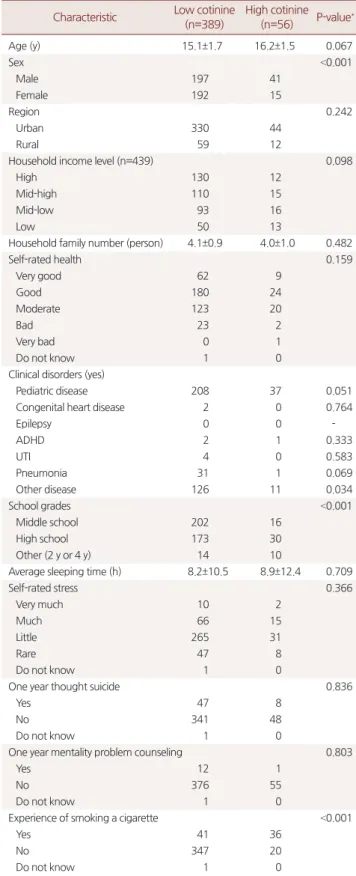
연구 대상자 총 445명 중 남성은 238명(53.5%), 여성은 207명(46.5%) 이었다. 저-코티닌군은 389명(87.4%)이고 고-코티닌군은 56명(12.6%) 이었다. 남녀 성비의 경우 저-코티닌군에 비해 고-코티닌군의 남자 비 율이 유의하게 높은 것으로 나타났다(P<0.001). 설문을 통한 유병질 환 여부를 분석한 결과 소아청소년질환, 선천성심장질환, 간질, 주의 력결핍 과잉행동장애, 요로감염, 폐렴은 두 군 간 유의한 차이가 나 타나지 않았으나, 불특정 기타 질환의 유병률이 저-코티닌군에서 고-코티닌군 보다 유의하게 높은 것으로 나타났다(P=0.034). 연구 대 상자에 대한 인구사회학적 특성과 임상적 특성을 Table 1에 제시하 였다.
연구 대상자의 키, 몸무게, 허리둘레 수치는 저-코티닌군에서 고-
Table 1. Comparisons of the demographic and clinical characteristics between the low cotinine group and the high cotinine group (n=445)
Characteristic Low cotinine (n=389)
High cotinine (n=56) P-value*
Age (y) 15.1±1.7 16.2±1.5 0.067
Sex <0.001
Male 197 41
Female 192 15
Region 0.242
Urban 330 44
Rural 59 12
Household income level (n=439) 0.098
High 130 12
Mid-high 110 15
Mid-low 93 16
Low 50 13
Household family number (person) 4.1±0.9 4.0±1.0 0.482
Self-rated health 0.159
Very good 62 9
Good 180 24
Moderate 123 20
Bad 23 2
Very bad 0 1
Do not know 1 0
Clinical disorders (yes)
Pediatric disease 208 37 0.051
Congenital heart disease 2 0 0.764
Epilepsy 0 0 -
ADHD 2 1 0.333
UTI 4 0 0.583
Pneumonia 31 1 0.069
Other disease 126 11 0.034
School grades <0.001
Middle school 202 16
High school 173 30
Other (2 y or 4 y) 14 10
Average sleeping time (h) 8.2±10.5 8.9±12.4 0.709
Self-rated stress 0.366
Very much 10 2
Much 66 15
Little 265 31
Rare 47 8
Do not know 1 0
One year thought suicide 0.836
Yes 47 8
No 341 48
Do not know 1 0
One year mentality problem counseling 0.803
Yes 12 1
No 376 55
Do not know 1 0
Experience of smoking a cigarette <0.001
Yes 41 36
No 347 20
Do not know 1 0
Values are presented as mean±standard deviation or number only.
ADHD, attention deficit and hyperactivity disorder; UTI, urinary tract infection.
*Independent t-test for continuous variables and Pearson’s chi-square test for discrete variables.
Jung-Woo Sohn, et al. Relationship between Urinary Cotinine and Heavy Metals Concentrations in Adolescents
Korean Journal of Family Practice
KJFP
코티닌군보다 유의하게 낮은 것으로 나타났다(각각 P<0.001, P=0.003, P=0.031). 그리고 혈중 혈색소, 적혈구용적, 페리틴의 수치도 저-코티닌군에서 고-코티닌군보다 유의하게 낮은 것으로 나타났다 (각각 P=0.047, P=0.025, P=0.002). 반면 혈중 HDL cholesterol 수치의 경 우 저-코티닌군에서 고-코티닌군 보다 유의하게 높은 것으로 나타났 다(P=0.030). 연구 대상자의 신체 검사결과의 특성은 Table 2에 제시 하였다.
저-코티닌군과 고-코티닌군에서 혈중 납, 수은, 카드뮴의 농도를 Table 3에 제시하였다. 저-코티닌군의 납과 카드뮴의 혈중 농도가 고- 코티닌군에 비해 각각 유의하게 낮게 나타난 반면(각각 P=0.006, P<0.001), 혈중 수은 농도의 경우 두 군 간의 유의한 차이가 나타나지 않았다.
혈중 중금속 수준과 UCot 수준 간의 상관관계를 분석한 결과를 Table 4에 제시하였다. 혈중 납 및 카드뮴 수준과 UCot 수준 간의 유 의한 상관관계가 각각 나타난 반면(각각 P=0.002, P<0.001), 혈중 수
은 수준의 경우 UCot 수준 간의 상관성은 나타나지 않았다. 혈중 중 금속 농도에 영향을 미칠 수 있는 요소를 보정한 후 분석한 결과 나 이, 성별을 보정하였을 경우 혈중 납 수준과 UCot 수준 간의 통계적 유의성이 상실된 반면, 혈중 카드뮴 수준은 UCot 수준과 상관성이 유의하게 유지되는 것으로 나타났다(P<0.001). 그리고 주거지역을 보 정한 경우 혈중 납 및 카드뮴 수준과 UCot 수준 간의 상관성이 각각 유의한 것으로 나타났다(각각 P=0.002, P<0.001). 한편, 어류 및 해조 류 섭취 빈도를 보정하였을 경우에도 혈중 납 및 카드뮴 수준과 UCot 수준 간의 상관성이 각각 유의하게 나타났다(각각 P=0.019, P<0.001). 더불어 주거지역과 어류 및 해조류 섭취 빈도를 함께 보정 하였을 경우에도 혈중 납 및 카드뮴 수준과 UCot 수준 간의 상관성 이 유지되었다(각각 P=0.023, P<0.001).
고 찰
본 연구는 국민건강영양조사 자료를 활용하여 설문과 UCot 농도 그리고 혈중 중금속 농도의 연관성을 비교하였다. 이번 연구 결과 고-코티닌군에서 저-코티닌군보다 납과 카드뮴의 혈중 농도가 높았 으며, 혈중 수은 농도의 경우에는 유의한 차이를 보이지 않았다. 이 러한 연구 결과는 기존의 국내 연구10,11) 및 국외 연구14,15) 결과에서도 흡연과 혈중 납과 카드뮴 농도가 연관성이 있다고 확인된 바 있다.
특히 이번 연구는 흡연을 통한 중금속 체내 축적의 위해성을 파악하 Table 2. Comparisons of the laboratory features between the low coti-
nine group and the high cotinine group (n=445) Laboratory result Low cotinine
(n=389)
High cotinine
(n=56) P-value*
Height (cm) 165.2±8.5 171.0±7.7 <0.001
Weight (kg) 58.5±12.7 64.8±14.5 0.003
WC (cm) 70.9±9.6 74.3±11.2 0.031
BMI (kg/m2) 21.3±3.5 22.1±4.5 0.133
FBS (mg/dL) 88.4±6.6 88.2±6.0 0.801
HbA1c (%) 5.43±0.28 5.42±0.30 0.941
Total cholesterol (mg/dL) 157.0±28.0 152.2±29.9 0.260 HDL cholesterol (mg/dL) 49.6±9.4 46.9±8.4 0.030 LDL cholesterol (mg/dL) 90.2±25.3 91.9±26.4 0.732
TG (mg/dL) 83.7±48.0 80.4±41.7 0.585
GOT (IU/L) 17.6±4.8 16.2±4.0 0.022
GPT (IU/L) 14.1±11.3 13.3±9.4 0.563
Hb (g/dL) 14.1±1.3 14.5±1.4 0.047
Hematocrit (%) 42.0±3.4 43.1±3.4 0.025
Ferritin (ng/mL) 40.4±30.5 55.8±57.6 0.002
Fe (µg/dL) 108.4±42.4 118.7±48.8 0.138
Iron binding capacity (µg/dL) 338.5±45.0 323.7±46.2 0.028 Blood creatinine (mg/dL) 0.75±0.14 0.81±0.14 0.002
WBC (103/uL) 6.28±1.52 6.48±1.81 0.416
RBC (106/uL) 4.84±0.41 4.90±0.44 0.356
Platelet (103/uL) 280.1±55.9 274.4±56.5 0.481
Vitamin D (ng/mL) 15.9±4.8 16.1±5.4 0.741
ALP (IU/L) 467.7±287.3 391.3±227.9 0.026
Urine creatinine (mg/dL) 206.8±91.0 213.7±93.0 0.605 Values are presented as mean±standard deviation.
WC, waist circumference; BMI, body mass index; FBS, fasting blood sugar;
HbA1c, hemoglobin A1c; HDL, high-density lipoprotein; LDL, low-density lipo- protein; TG, triglycerides; GOT, glutmic oxalacetic transaminase; GPT, gluta- mate-pyruvate transaminase; Hb, hemoglobin; Fe, ferrum; WBC, white blood cell; RBC, red blood cell; ALP, alkaline phosphatase.
*Independent t-test.
Table 3. Blood lead, mercury, cadmium concentrations by the levels of urine cotinine (n=445)
Levels of urine cotinine
Low cotinine (n=389)
High cotinine
(n=56) P-value*
Lead (µg/dL) 1.33±0.48 1.52±0.54 0.006
Mercury (µg/dL) 2.35±1.23 2.30±1.14 0.779
Cadmium (µg/dL) 0.40±0.25 0.69±0.39 <0.001 Values are presented as mean±standard deviation.
*Independent t-test for continuous variables.
Table 4. Associations between blood levels of heavy metals and urine cotinine levels
Heavy metals
Lead (Pb) Mercury (Hg) Cadmium (Cd)
r P-value r P-value r P-value
Crude 0.145 0.002 -0.024 0.619 0.333 <0.001
Model* I 0.088 0.064 -0.030 0.526 0.296 <0.001 II 0.144 0.002 -0.023 0.626 0.335 <0.001 III 0.120 0.019 -0.028 0.583 0.305 <0.001 IV 0.117 0.023 -0.028 0.591 0.308 <0.001 Model I: adjusted for age and sex. Model II: adjusted for regions. Model III: ad- justed for frequency of fishes and seaweeds intake. Model IV: adjusted for re- gions and frequency of fishes and seaweeds intake.
*Partial correlations between urinary cotinine and heavy metals.
손정우 외. 청소년의 요중 코티닌 농도와 혈중 중금속 농도의 연관성 Korean Journal of Family Practice
KJFP
기 위해 청소년을 대상으로 자가설문조사 방식의 흡연 여부 파악이 아닌 UCot 농도를 활용하여 흡연과 혈중 중금속 농도 간의 양적 상 관관계를 밝힌 데에 의의가 있겠다.
Table 2의 검사결과 특성을 살펴보면, 심뇌혈관질환 예방요인으로 알려진 HDL cholesterol의 혈중 수치가 고-코티닌군에서 저-코티닌군 보다 낮게 나타났다. Batić-Mujanović 등16)의 연구에서도 흡연자의 혈 중 HDL cholesterol 수치가 비흡연자와 비교하여 유의하게 낮다고 보 고하였다.
그리고 Hb, 적혈구용적, 페리틴의 혈중 수치의 경우 고-코티닌군 에서 저-코티닌군보다 각각 더 높게 나타났는데, 이전 연구에서도 흡 연이 Hb 수치를 증가시키는 것과 관련이 있다고 발표하였다.17) 흡연 을 하게 되면 니코틴 뿐만 아니라 산화질소, 일산화탄소, 자유 라디 칼(free radical) 등 많은 독소와 발암물질에 노출되게 된다.18) 특히 일 산화탄소는 Hb와의 친화력이 산소의 245배이기 때문에 비흡연자의 혈중 일산화탄소결합혈색소(carboxyhemoglobin, COHb)는 일반적 으로 1.5% 미만이지만 흡연자의 경우 3%–15%이다.19) 흡연으로 인해 일산화탄소가 체내에 증가하게 되면 산소 운반능력이 없는 COHb 가 증가하고, 산소와 결합된 Hb의 비율은 감소하게 되어 인체 조직 의 산소공급이 줄어들게 된다.20) 이것을 보상하기 위해 Hb의 증가가 이루어진다고 생각한다. 한편, 혈중 페리틴의 수치가 염증이나 세포 손상과 스트레스와 관련되어 있다는 연구 결과를 통해 보았을 때,21) 그 기전은 명확히 밝혀지지 않았지만 흡연이 고-코티닌군에서 저-코 티닌군 보다 혈중 페리틴의 수치가 높은 원인이라고 생각할 수 있다.
Ghio 등22)의 미국 국민건강영양조사를 활용한 연구에서는 비흡연 자에 비해 흡연자의 혈청 및 폐포 세척액의 페리틴 수치가 높았다고 보고하였다.
인체 내 중금속의 농축은 나이, 성별, 직업, 식습관, 흡연, 음주 등 여러가지가 연관되어 있는 것으로 알려져 있다. 이 중 카드뮴의 경우 흡연과 높은 관련성을 가지는 것으로 보고되고 있으며, 납과 수은은 흡연 이 외의 경로를 통해서도 많은 노출이 이루어진다고 알려져 있
다.23,24) 납 노출의 경우 대기 오염이나 먼지, 토양 오염, 나이, 부모의 직
업 등에 영향을 받을 수 있다.25) 그리고 수은 노출의 경우 주로 해산 물, 어패류 등의 음식물 섭취나 음주를 통해 영향을 받는 것으로 알 려져 있다.26)
본 연구 결과 UCot 수준은 납과 카드뮴의 혈중 수준과 각각 양적 상관관계가 있는 것으로 밝혀졌다. 혈중 중금속 농도에 영향을 미칠 수 있는 요소인 나이, 성별을 보정한 후에도 카드뮴은 UCot 수준과 유의한 상관성이 있었다. 또 다른 요소인 주거지역과 어류 및 해조류 섭취빈도를 함께 보정한 후에도 납과 카드뮴은 UCot 수준과 각각 유의한 상관성이 있었다. 이는 곧 연구 대상자인 청소년들의 혈중 유
해 중금속 농도가 흡연에 의해 영향을 받는다고 해석할 수 있다. 중 금속의 체내 농축 정도가 나이와 연관성이 있다는 연구 결과들은 다수 보고되고 있으며,27) 이러한 현상이 청소년기 흡연에 의해 가중 된다는 본 연구결과는 체내 중금속 농축으로 인한 질환의 위험도가 어린 나이에서부터 시작되어 전 생애에 걸쳐 증가할 가능성이 있다 는 것을 보여준다. 나아가 청소년들의 정확한 흡연율 파악과 적극적 인 금연정책 도입이 필요하다는 것을 시사하겠다.
본 연구의 제한점으로 첫째, 1회 측정한 자료를 이용한 단면연구 로서 변수들의 연관성만 확인했을 뿐 원인과 결과에 대해 파악하는 것은 어려웠다. 둘째, 음식에 들어있는 니코틴이 UCot 농도에 미치는 영향을 고려하지 않았다. 비교적 흔한 음식인 감자, 토마토, 피망 등 을 통해 하루 1–2개비 정도의 담배를 피울 때 흡수되는 니코틴의 양 이 섭취될 수 있다.28) 셋째, 흡연에 노출된 후 소변에서 코티닌을 측정 할 때까지의 시간을 고려하지 않았다. 니코틴에 노출되면 UCot 농도 는 6시간 후에 급속히 증가하고, 12시간 동안 안정기로 유지되며, 이 후 19시간 동안 지속적으로 감소하게 된다.29) 본 연구에서는 흡연 노 출 후 시간 경과에 대한 자료가 없어 이것이 결과에 미칠 영향을 알 수 없다. 넷째, UCot 검사가 청소년의 흡연 여부를 감별하는데 성인 에서만큼 유용하지 않았다. Kang 등7)의 연구 결과를 보면 UCot 검 사는 성인의 직접 흡연자 선별 시에는 민감도와 특이도가 높지만, 청 소년에서는 간접 흡연자와 직접 흡연자의 구별에 유용하지 않다.13) 특히 간접 흡연에 많이 노출되는 청소년의 경우는 흡연 여부와 다른 변수와의 연관성을 증명하기 어렵다. 그래서 본 연구에서는 대상자 를 비흡연군, 간접 흡연군, 흡연군으로 나누지 않고, 저-코티닌군과 고-코티닌군으로 나누어 상관관계를 분석하였다. 앞으로 청소년 흡 연과 관련된 설문조사뿐만 아니라 간접 흡연자를 선별할 수 있는 UCot 농도의 절단값에 대한 연구가 더 필요할 것으로 보인다.
앞서 말했듯이 중금속은 인체 내 농축으로 인해 여러가지 질병을 일으킨다. 어린 나이에서부터 중금속 노출의 원인이 되는 청소년 흡 연은 건강수준을 위협하는 중요한 요인으로 볼 수 있다. 그러므로 이 번 연구가 건강증진사업 및 금연 정책에 있어 청소년 흡연의 위해성 평가를 위한 기초자료로 활용되었으면 한다.
요 약
연구배경:
담배연기에는 중금속을 포함한 다양한 유해화합물질이 존재하며, 소아청소년기에는 담배연기에 노출되면 여러가지 질환에 더욱 취약하다. 이에 본 연구는 청소년을 대상으로 흡연의 지표인 UCot 농도와 혈중 중금속 농도의 연관성에 대해 알아보고자 하였 다.Jung-Woo Sohn, et al. Relationship between Urinary Cotinine and Heavy Metals Concentrations in Adolescents
Korean Journal of Family Practice
KJFP
방법:
본 단면 연구는 국민건강영양조사(2010–2011년) 대상자 중 만 13세 이상–만 19세 미만의 청소년 중에서 UCot 농도와 혈중 중금속 농도가 측정된 445명을 대상으로 하였다. 요중 저-코티닌군과 고-코 티닌군의 혈중 납, 수은, 카드뮴 농도의 연관성을 분석하였다.결과:
고-코티닌군은 저-코티닌군에 비해 혈중 납과 카드뮴 농도는 각각 유의하게 높게 나왔다. 하지만 혈중 수은 농도는 UCot 농도와 연관성을 보이지 않았다. 나이, 성별을 보정 변수로 분석한 결과 혈 중 카드뮴 농도는 UCot 농도와 유의한 상관성을 보였다. 그리고 주거 지역과 어류 및 해조류 섭취 빈도를 보정 변수로 분석한 결과 혈중 납 및 카드뮴의 농도가 UCot 농도와 각각 유의한 상관성을 보였다.결론:
흡연은 중금속과 다양한 유해화합물질의 노출원이며, 담배 연기에 많이 노출될수록 납과 카드뮴의 흡수가 증가하므로 보건증 진을 위해 흡연 및 간접흡연 노출에 대한 대책이 필요하다. 나아가 청소년 흡연의 위해성에 대한 추가 연구가 필요하겠다.중심단어:
흡연; 코티닌; 중금속; 청소년REFERENCES
1. Ministry of Health and Welfare. The Korea National Health and Nutrition Examination Survey (KNHNES) [Internet]. Cheongju: Korea Centers for Disease Control and Prevention [cited 2017 Feb 20]. Available from: http://
www.index.go.kr/potal/main/PotalMain.do.
2. United States Department of Health and Human Services. Preventing to- bacco use among young people: a report of the surgeon general. Atlanta, GA: United States Department of Health and Human Services, Centers for Disease Control and Prevention; 1994 Mar. Report No. RR-4. 11 p.
3. Hyland A, Borland R, Li Q, Yong HH, McNeill A, Fong GT, et al. Individual- level predictors of cessation behaviours among participants in the Interna- tional Tobacco Control (ITC) four country survey. Tob Control 2006; 15 Suppl 3: iii83-94.
4. Caruso RV, O’Connor RJ, Stephens WE, Cummings KM, Fong GT. Toxic metal concentrations in cigarettes obtained from U.S. smokers in 2009: re- sults from the International Tobacco Control (ITC) United States survey cohort. Int J Environ Res Public Health 2013; 11: 202-17.
5. Smith CJ, Livingston SD, Doolittle DJ. An international literature survey of
“IARC group I carcinogens” reported in mainstream cigarette smoke. Food Chem Toxicol 1997; 35: 1107-30.
6. Pinto E, Cruz M, Ramos P, Santos A, Almeida A. Metals transfer from tobac- co to cigarette smoke: evidences in smokers’ lung tissue. J Hazard Mater 2017; 325: 31-5.
7. Kang YH, Lee YJ, Kim HK, Yun YH, Jeong SY, Lee JS, et al. Usefulness of uri- nary cotinine test to distinguish smokers from nonsmokers. Korean J Lab Med 2003; 23: 92-7.
8. Jarvis MJ, Tunstall-Pedoe H, Feyerabend C, Vesey C, Saloojee Y. Compari- son of tests used to distinguish smokers from nonsmokers. Am J Public Health 1987; 77: 1435-8.
9. Chung SY, Kim MH, Sho YS, Won KP, Hong MK. Trace metal contents in vegetables and their safety evaluations. J Korean Soc Food Sci Nutr 2001; 30:
32-6.
10. Kang DW, Jeong KJ, Hwang YS, Yang HH, Yoo SM, Park SG, et al. The rela- tionship between direct and indirect smoking exposure and blood lead and cadmium concentrations in Korean adults: analysis of the national health and nutrition survey 2008-2011. Korean J Fam Pract 2017; 7: 49-54.
11. Moon SW, Gwak JI, Park YH. The Effect of Smoking and Second-Hand Smoking on the concentration of mercury, lead and cadmium in the blood:
based on the fifth Korea national health and nutrition examination survey.
Korean J Fam Pract 2016; 6: 44-8.
12. Apseloff G, Ashton HM, Friedman H, Gerber N. The importance of mea- suring cotinine levels to identify smokers in clinical trials. Clin Pharmacol Ther 1994; 56: 460-2.
13. Kang YH, Lee YJ, Kong SY, Lee DH, Yun YH. Usefulness of urinary cotinine test to discriminate between smokers and nonsmokers in Korean adoles- cents. Korean J Lab Med 2004; 24: 155-9.
14. Mannino DM, Homa DM, Matte T, Hernandez-Avila M. Active and passive smoking and blood lead levels in U.S. adults: data from the third national health and nutrition examination survey. Nicotine Tob Res 2005; 7: 557-64.
15. Shaham J, Meltzer A, Ashkenazi R, Ribak J. Biological monitoring of expo- sure to cadmium, a human carcinogen, as a result of active and passive smoking. J Occup Environ Med 1996; 38: 1220-8.
16. Batić-Mujanović O, Zildzić M, Beganlić A, Kusljugić Z. The effect of ciga- rette smoking on HDL-cholesterol level. Med Arh 2006; 60(6 Suppl 2): 90-2.
17. Tirlapur VG, Gicheru K, Charalambous BM, Evans PJ, Mir MA. Packed cell volume, haemoglobin, and oxygen saturation changes in healthy smokers and non-smokers. Thorax 1983; 38: 785-7.
18. Kharitonov SA, Robbins RA, Yates D, Keatings V, Barnes PJ. Acute and chronic effects of cigarette smoking on exhaled nitric oxide. Am J Respir Crit Care Med 1995; 152: 609-12.
19. Light A, Grass C, Pursley D, Kruse J. Carboxyhemoglobin levels in smokers vs. non smokers in a smoking environment. Respir Care 2007; 52: 1576.
20. Sagone AL Jr, Lawrence T, Balcerzak SP. Effect of smoking on tissue oxygen supply. Blood 1973; 41: 845-51.
21. Kell DB, Pretorius E. Serum ferritin is an important inflammatory disease marker, as it is mainly a leakage product from damaged cells. Metallomics 2014; 6: 748-73.
22. Ghio AJ, Hilborn ED, Stonehuerner JG, Dailey LA, Carter JD, Richards JH, et al. Particulate matter in cigarette smoke alters iron homeostasis to pro- duce a biological effect. Am J Respir Crit Care Med 2008; 178: 1130-8.
23. Bernhard D, Rossmann A, Wick G. Metals in cigarette smoke. IUBMB Life 2005; 57: 805-9.
24. Moon CS. Evaluation of Cd and Pb intake and exposure routes in some Ko- rean women. Korean J Environ Health Sci 2007; 33: 353-8.
25. Yankel AJ, von Lindern IH, Walter SD. The silver valley lead study: the rela- tionship between childhood blood lead levels and environmental exposure.
J Air Pollut Control Assoc 1977; 27: 763-7.
26. Kim CW, Kim YW, Chae CH, Son JS, Park SH, Koh JC, et al. The effects of the frequency of fish consumption on the blood mercury levels in Koreans.
Korean J Occup Environ Med 2010; 22: 114-21.
27. Korea Centers for Disease Control and Prevention. A study on the concen- tration of heavy metals in Korean blood [Internet]. Sejong: Ministry of En-
손정우 외. 청소년의 요중 코티닌 농도와 혈중 중금속 농도의 연관성 Korean Journal of Family Practice
KJFP
vironment [cited 2005 Nov]. Available from: http://webbook.me.go.kr/DLi- File/F005/000/151341.pdf.
28. Davis RA, Stiles MF, deBethizy JD, Reynolds JH. Dietary nicotine: a source of urinary cotinine. Food Chem Toxicol 1991; 29: 821-7.
29. Willers S, Skarping G, Dalene M, Skerfving S. Urinary cotinine in children and adults during and after semiexperimental exposure to environmental tobacco smoke. Arch Environ Health 1995; 50: 130-8.