Corresponding author: Yoo, Yang Sook https://orcid.org/0000-0003-1466-0539
College of Nursing, The Catholic University of Korea, 222 Banpo-daero, Secho-gu, Seoul 06591 , Korea.
Tel: +82-2-2258-7411, Fax: +82-2-2258-7772, E-mail: [email protected] Received: Aug 30, 2019 / Revised: Oct 21, 2019 / Accepted: Nov 20, 2019
This is an open access article distributed under the terms of the Creative Commons Attribution Non-Commercial License (http://creativecommons.org/licenses/
by-nc/3.0), which permits unrestricted non-commercial use, distribution, and reproduction in any medium, provided the original work is properly cited.
ORIGINAL ARTICLE Open Access
Development and Effectiveness of an Oncology Nursing Standardized Patient Simulation Program for Nursing Students
Jang, Kie In1 · Yoo, Yang Sook2 · Roh, Young Sook3
1Assistant Professor, College of Nursing, The Kyungbok University of Korea, Namyangju, Korea
2Professor, College of Nursing, The Catholic University of Korea, Seoul, Korea
3Professor, Red Cross College of Nursing, Chung-Ang University, Seoul, Korea
Purpose: Standardized patient-based simulation is known to be a useful tool in the training of nursing students;
however, few studies have examined the use of this method in oncology nursing education. This study aimed to evaluate the effects of an oncology nursing simulation program that used standardized patients on knowledge, nursing performance ability, and satisfaction among nursing students. Methods: This study used a non-equivalent control group pretest-posttest design. The experimental group (n=25) participated in an 8-hour oncology nursing simulation program that consisted of a lecture (2 hours) and a four-session simulation program (6 hours). The control group (n=29) received case-based learning (6 hours) and a lecture (2 hours). Knowledge level was assessed with a 33-item knowledge assessment multiple-choice questionnaire. Nursing performance ability was assessed with a nursing performance ability checklist. Educational satisfaction was evaluated using the 12-item Course Satis- faction Evaluation tool. Data were collected from June to July of 2012 and were analyzed using descriptive statistics, independent t-test, and repeated measures analysis of variance. Results: The experimental group showed signifi- cantly higher nursing performance ability and satisfaction compared with the control group. Knowledge of oncology nursing increased in both the experimental and control groups. Conclusion: An oncology nursing simulation program was more effective than case-based learning in improving nursing student performance and was found to produce high satisfaction.
Key Words: Nursing education; Nursing students; Patient simulation; Personal satisfaction
INTRODUCTION
Cancer is a life-threatening disease and a primary cause of death in Korea [1]. Owing to the aging of the population and advances in diagnostic technology, the incidence rate of cancer continues to grow [2]. Oncology nursing focuses not only on pain management, but also on safety manage- ment and the side effects of chemotherapy, and emer- gency situations [3]. Because the most common symptom experienced among cancer patients is pain [4], it is neces- sary to reinforce the education on effective pain manage- ment [5] and the management of side effects [6]. Therefore, education is needed to ensure optimal professional com-
petency in oncology nursing [7].
As an alternative to passive clinical practice education, simulation-based learning is regarded as an effective teach- ing and learning method that allows nursing students to experience experiential learning and to develop their own professional identities [8]. Standardized Patients (SPs) are individuals who have been trained to express specific pa- tient characteristics [9]. Many recent studies have found SP-based training to be a useful and effective tool for im- proving cognitive, affective, and psychomotor domain outcomes among undergraduate nursing students [10-12].
Standardized patients have been used to train nursing stu- dents in areas such as psychiatric mental health nursing
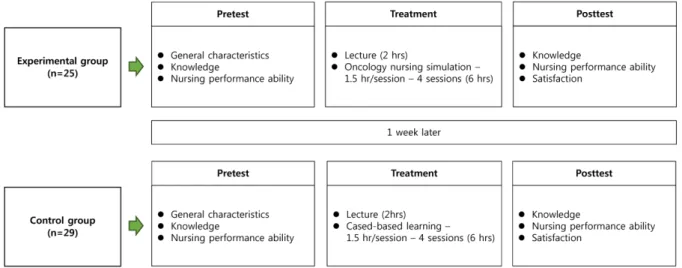
Figure 1. Research design.
[13,14], health assessment [15-18], hearing impairment [19], dementia care [20], women’s health [21], and funda- mental nursing [22,23]. However, these outcomes are mostly focused on nursing students’ perceived learning or confidence and do not objectively assess clinical skills or performance. Because high-fidelity simulator-based simu- lation has some limitations with regard to symptom mani- festation of cancer patients, SP-based simulation may be a better educational tool for the acquisition of nursing com- petencies among nursing students.
One study found that faculty and new graduate nurses responded positively after participating in an oncology symptom management training program that used SPs.
Standardized patient-based simulation has been found to be a realistic and helpful learning strategy for acquiring knowledge and skills in evidence-based oncology symp- tom management [24]. In one study, health assessments for patients with skin cancer were conducted by nursing students, and the students who had received high-fidelity patient simulation training in oncology nursing showed improved confidence and problem-solving ability [25,26].
Considering the specificity of oncology nursing care and the current limitation of clinical practicum in undergra- duate nursing education, there is a need for SP-based sim- ulation education to help nursing students gain competen- cies by providing realistic simulated experiences. However, few studies have evaluated the effects of oncology nursing SP simulation programs. Furthermore, previous studies focused only on specific aspects of nursing care for cancer patients, and, thus, integrated nursing care simulation for cancer patients is needed. The purpose of this study was to develop an oncology nursing simulation program using SPs and to identify its effects on knowledge, nursing per-
formance ability, and satisfaction among nursing students.
METHODS
1. Study DesignThis study used a non-equivalent control group pre- test-posttest design (Figure 1).
2. Participants
The minimum sample size was calculated using the G*Power 3.0.10 program (Universität Düsseldorf, Düssel- dorf, Germany). At least 17 nursing students were required for each group with .25 for effect size, .05 for significance level, .80 for the power of the test using repeated measures analysis of variance. The effect size was based on a pre- vious study [27]. The participants were junior nursing stu- dents at Chung-Ang University located in Seoul. They had received no theoretical education on oncology nursing and had no clinical practice experience in the cancer ward prior to participating in the study. Junior nursing students who satisfied the selection criteria were recruited through a no- tice posted on a bulletin board of Chung-Ang University.
Nursing students who agreed to participate were con- veniently assigned to either the experimental (n=25) or con- trol group (n=29).
3. Measurements
This study examined three learning outcomes that are commonly measured in simulation-based educational re-
search [9-12]: knowledge level, nursing performance abil- ity, and educational satisfaction.
1) Knowledge assessment multiple-choice questionnaire Knowledge level was assessed using a 33-item knowl- edge assessment multiple-choice questionnaire that was developed by the authors based on published literature [28,29]. Its validity was verified by two nursing professors and one oncology nurse. This instrument consists of a total of 33 questions on pain management in oncology nur- sing (11 questions), safety management in chemotherapy (9 questions), side effects management in chemotherapy (7 questions), and management of emergency situations (6 questions). One point was given for a correct answer, and 0 points were given for an incorrect answer or no an- swer. A higher score indicated a higher level of knowledge.
2) Nursing performance ability checklist
Nursing performance ability was assessed by a rater (researcher or instructor) using a nursing performance ability checklist that had been developed by the authors based on a literature review [30]. The researcher and in- structor assessed the nursing performance ability of the students who participated in their intervention session both before and after the intervention. Rater training was conducted through pilot testing with two new graduate nurses. Two raters simultaneously assessed the perform- ances of the two new graduate nurses in four scenarios. To secure agreement between the raters, agreement between them was assessed in the pilot test session until 100%
agreement was reached. Some modifications were made as a result of the pilot test. For the simulation on the safety management rules for chemotherapy, the time to assess the participants’ nursing performance exceeded the 15 mi- nutes that was initially allotted; therefore, it was decided that some drugs (antihistamine and antiemetic) would be ready when the simulation was performed with the stu- dents. No modifications were made to the checklist.
Each rater directly assessed the performance of each student group on an SP in four simulated scenarios. Three nursing professors and seven oncology ward nurses, each with more than 5 years of work experience, verified con- tent validity with the content validity index. The checklist consisted of items on pain management in oncology nurs- ing (32 questions: for example: The intensity of pain is as- sessed using the Numeric Rating Scale.), safety manage- ment in chemotherapy (45 questions), side effects manage- ment in chemotherapy (40 questions), and management of emergency situations (30 questions). For each question, 1 point was given to a student with proper performance, and
0 points were given for improper or failed performance. A higher score indicated a higher level of nursing perform- ance ability.
3) Course satisfaction evaluation
Educational satisfaction was evaluated using the 12- item Course Satisfaction Evaluation tool [23]. The authors had obtained permission to use the tool from its original developer. Responses on the tool were based on a 5-point Likert scale that ranged from 1 (“very unsatisfied”) to 5 (“very satisfied”), and a higher score indicated a higher level of educational satisfaction. Cronbach's ⍺ was .94 in Yoo’s study [23], whereas it was .89 in the present study.
4. Oncology Nursing Simulation-Based Program 1) Development of the program
In order to identify educational needs in oncology nurs- ing, focus group interviews were conducted four times with three oncology nurse specialists, three oncology ward nurses (each with a career of more than 5 years), six head nurses in a cancer ward, and six nursing students. A self-administered questionnaire was given to 20 nursing students and 20 new graduate nurses working in a cancer ward to select priority content. Responses on the ques- tionnaire were based on a 5-point Likert scale (1=“not nec- essary,” 5=“very necessary”). The items on the question- naire, which were based on the results of the group inter- views, were on administration of chemotherapy drugs, safe handling of cytotoxic drugs, side effects and effects of cytotoxic drugs, management of emergency situations, cancer pain management, management of extravasation, case management of cancer patients, psychosocial care of patients, transfusion, and nursing records. The reason for targeting nursing students (prospective new graduate nurses) for the needs assessment survey was to identify the educational needs of new graduate nurses who lack oncology nursing competency. The nursing students were recruited from a college of nursing.
The authors developed a learning module and the sim- ulation scenarios. The learning module was developed based on the current guidelines [28]. Then the feasibility of this learning material was verified by two nursing pro- fessors and one oncology nurse who had expertise in on- cology nursing. PowerPoint slides (Microsoft Corpora- tion, Redmond, WA, USA) were created for the 2-hour lecture. The slides were on four educational themes, which had been selected based on the results of the educational needs assessment. The themes were as follows: 1) pain management in oncology nursing, 2) safety management
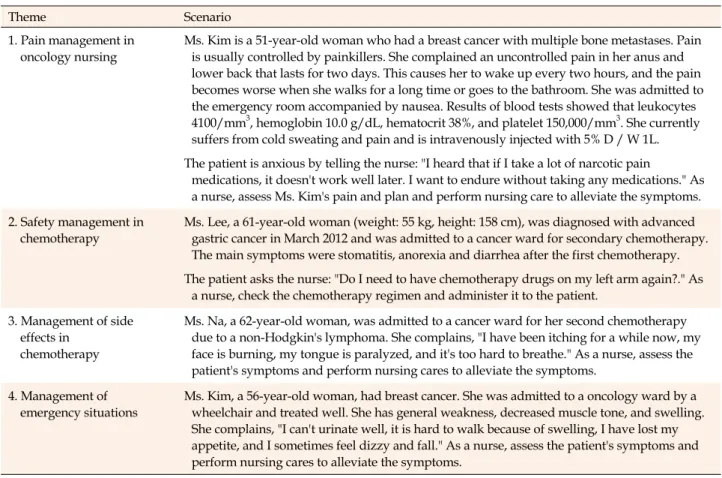
Table 1. Overview of Scenarios for Oncology Nursing Simulation Program using a Standardized Patient
Theme Scenario
1. Pain management in oncology nursing
Ms. Kim is a 51-year-old woman who had a breast cancer with multiple bone metastases. Pain is usually controlled by painkillers. She complained an uncontrolled pain in her anus and lower back that lasts for two days. This causes her to wake up every two hours, and the pain becomes worse when she walks for a long time or goes to the bathroom. She was admitted to the emergency room accompanied by nausea. Results of blood tests showed that leukocytes 4100/mm3, hemoglobin 10.0 g/dL, hematocrit 38%, and platelet 150,000/mm3. She currently suffers from cold sweating and pain and is intravenously injected with 5% D / W 1L.
The patient is anxious by telling the nurse: "I heard that if I take a lot of narcotic pain
medications, it doesn't work well later. I want to endure without taking any medications." As a nurse, assess Ms. Kim's pain and plan and perform nursing care to alleviate the symptoms.
2. Safety management in chemotherapy
Ms. Lee, a 61-year-old woman (weight: 55 kg, height: 158 cm), was diagnosed with advanced gastric cancer in March 2012 and was admitted to a cancer ward for secondary chemotherapy.
The main symptoms were stomatitis, anorexia and diarrhea after the first chemotherapy.
The patient asks the nurse: "Do I need to have chemotherapy drugs on my left arm again?." As a nurse, check the chemotherapy regimen and administer it to the patient.
3. Management of side effects in
chemotherapy
Ms. Na, a 62-year-old woman, was admitted to a cancer ward for her second chemotherapy due to a non-Hodgkin's lymphoma. She complains, "I have been itching for a while now, my face is burning, my tongue is paralyzed, and it's too hard to breathe." As a nurse, assess the patient's symptoms and perform nursing cares to alleviate the symptoms.
4. Management of emergency situations
Ms. Kim, a 56-year-old woman, had breast cancer. She was admitted to a oncology ward by a wheelchair and treated well. She has general weakness, decreased muscle tone, and swelling.
She complains, "I can't urinate well, it is hard to walk because of swelling, I have lost my appetite, and I sometimes feel dizzy and fall." As a nurse, assess the patient's symptoms and perform nursing cares to alleviate the symptoms.
in chemotherapy, 3) management of side effects in chemo- therapy, and 4) management of emergency situations. The educational objectives of the program were as follows: af- ter completion of the program, nursing students would be able to 1) assess the cancer patient’s physical and psycho- logical status, 2) perform accurate nursing interventions according to the patient’s condition, and 3) communicate effectively with patients, families, and other health care professionals.
For the simulation scenarios, nursing care for patients with stomach cancer, colorectal cancer, breast cancer, and lymphoma were selected out of the top 10 most common cancers in Korea [29]. The authors selected these four can- cers because it was feasible to simulate the symptoms of these cancers using SPs. Based on the actual medical re- cord and literature [28,29], scenarios featured information on symptoms, present and past medical history, major symptoms claimed, family history, diagnostic testing, treat- ment, and nursing. Scenarios also reflected the four educa- tional themes (pain management in oncology nursing, safety management in chemotherapy, management of side effects in chemotherapy, and management of emergency situations) (Table 1). The scenarios were reviewed by two
nursing professors and one oncology nurse.
The module (for the simulation-based education with four themes) was developed based on guidelines from the National League for Nursing [31]. Units of the module in- cluded progress sequence; supply; educational objectives;
learning materials; matters to be attended to; an algorithm for instructors, students, and SPs; and debriefing. After the development of the module, its feasibility was verified by two nursing professors and one oncology nurse.
A script for the training of SPs for each case was com- posed based on the literature on the training of SPs [32].
We recruited and trained SPs who were laypersons and had previously participated in a simulation-based educa- tion program at a college of nursing. A nursing professor with more than 5 years of experience in simulation educa- tion trained the SPs. The SPs (two people for each case) were trained for 2 hours on which of the students’ ques- tions should and should not be answered and on other matters related to carrying out the scenarios.
2) Implementation of the educational program
For the experimental group, the oncology nursing sim- ulation-based program consisted of four simulation ses-
sions (6 hours) and a lecture (2 hours). Two instructors (a researcher and an instructor) led the sessions. A total of 25 students was assigned to two teams. The researcher led one team (n=14), and the instructor led the other team (n=11). All members of the experimental group attended the lecture together. The researcher delivered the 2-hour lecture, which was on the four educational themes, using the learning module and the PowerPoint slides in a lecture room at Chung-Ang University. With regard to the dura- tion of the simulation, a total of 6 hours was decided on (each session lasting 1.5 hours) based on the literature re- view, which provided information on educational simu- lation duration and average weighted effect size in the field of healthcare education [33]. Each simulation session consisted of case introduction, 20 minutes of demonstra- tion, 30 minutes of task training, 15 minutes of simulation practice, and 25 minutes of debriefing. While nursing stu- dents on one team underwent task training, nursing stu- dents on the other team performed simulation practice.
The nursing students performed simulation practice in pairs. The SPs provided feedback on the nursing care per- formed by the two nursing students. The performance of the nursing students was video recorded for the debrief- ing session. As recommended in the literature [34], the de- briefing consisted of a 25-minute instructor-led video-as- sisted debriefing session was implemented in the lecture room after the completion of the simulation-based session.
The control group received case-based learning (6 hours) and a lecture (2 hours). The two instructors (the researcher and the instructor) who had led the experimental group al- so led the case-based learning sessions. The researcher led one team (n=15), and the instructor led the other team (n=14). The researcher delivered the same lecture to the control group as the one delivered to the experimental group. A total of four sessions was held for 1.5 hours each.
The topics addressed in the sessions included nursing care for patients with stomach cancer, colorectal cancer, breast cancer, and lymphoma. Twenty-nine nursing students were divided into two teams, one a team of 15 students and the other a team of 14 students. All members of the control group attended the lecture together. Each team was then divided into three smaller groups, which were asked to discuss the same cases that had been simulated in the experimental group sessions for 40 minutes. After the small group discussion on each case, the students were asked to create a conceptual map on a whole sheet of paper depicting the name of the nursing diagnosis, assessments of nursing problems, and interventions. Then, each small group gave a 10-minute presentation. The instructors pro- vided feedback for 30 minutes. In addition to the case-
study-based training, the control group also underwent SP-based performance evaluation with four scenarios.
After the completion of data collection for both groups, an additional simulation education session on safety man- agement in chemotherapy was provided to the nursing students in the control group. The lowest nursing per- formance ability scores were obtained during this session.
5. Data Collection
In accordance with the curriculum schedules of the nursing students, the intervention was applied to the ex- perimental group first and then to the control group 1 week later. During the same period, one group performed a clinical practicum for 2 weeks, and the other group at- tended class lectures for 2 weeks. Intervention and data collection took place during the students’ class lecture period. Therefore, there was a 1-week gap to minimize treatment diffusion between groups. To assess knowledge and nursing performance ability, both the experimental and control groups were administered a pretest before the intervention and a posttest immediately after the interven- tion. To assess satisfaction, both groups completed a self- administered questionnaire immediately after the inter- vention. Data were collected from June 18 to July 11, 2012.
6. Ethical Considerations
Ethical approval was obtained from the institutional review board of the Catholic University of Korea (No.:
MC12QASI0043). Participation in the study was voluntary, and written informed consent was obtained from each participant. Confidentiality was ensured throughout the study, including during data collection and analysis. The class was not part of the regular curriculum, and student participation in the study was not reflected in their grades.
7. Data Analysis
Data were analyzed using SPSS/WIN 18.0 software (IBM Corporation, Armonk, NY, USA). For the test of ho- mogeneity between the two groups, Fisher's exact test and independent t-test were used. The Shapiro-Wilk’s test was used to test the normality of the dependent variables. All variables were found to be normally distributed. Pretest- posttest differences in knowledge and nursing perform- ance ability were compared between the experimental and the control groups was analyzed using repeated measures analysis of variance, and differences in satisfaction were analyzed with independent t-test.
Table 2. Homogeneity Test for General Characteristics and Research Variables (N=54)
Variables Categories Exp. (n=25) Cont. (n=29)
x2 or t p n (%) or Mean±SD n (%) or Mean±SD
Age (year) 21.12±1.78 22.21±3.16 1.58 .121
Gender† Women
Men
23 (92.0) 2 (8.0)
28 (96.6) 1 (3.4)
.591
Knowledge 21.08±1.41 20.38±2.14 1.39 .170
Nursing performance ability
Pain management in oncology nursing Safety management in chemotherapy Side effects management in chemotherapy Management of emergency situation
16.68±2.95 21.20±4.08 24.76±3.74 14.76±3.83
16.31±4.59 22.31±4.75 23.51±4.67 14.41±4.17
0.36 0.92 1.08 0.32
.723 .360 .284 .752 Exp.=experimental group; Cont.=control group; SD=standard deviation; †Fisher's exact test.
Table 3. Effects of Oncology Nursing Simulation Program on Knowledge and Nursing Performance Ability (N=54)
Variables Group Pretest Posttest
Sources F p
Mean±SD Mean±SD
Knowledge Exp. (n=25)
Cont. (n=29)
21.08±1.41 20.38±2.14
24.44±2.00 23.76±1.86
Group Time Group*Time
3.15 100.16 0.00
.082
<.001 .977 Cancer pain management Exp. (n=25)
Cont. (n=29)
16.68±2.95 16.31±4.59
24.36±2.70 21.48±3.20
Group Time Group*Time
5.14 105.50 4.01
.028 .001 .050 Safety management
in chemotherapy
Exp. (n=25) Cont. (n=29)
21.20±4.08 22.31±4.75
36.72±5.38 26.03±5.48
Group Time Group*Time
17.80 167.90 63.10
.001 .001 .001 Side effects management
in chemotherapy
Exp. (n=25) Cont. (n=29)
24.76±3.74 23.51±4.67
36.52±2.83 27.20±4.97
Group Time Group*Time
28.30 181.40 49.50
.001 .001 .001 Management of
emergency situations
Exp. (n=25) Cont. (n=29)
14.76±3.83 14.41±4.17
25.16±2.99 20.41±2.51
Group Time Group*Time
12.70 181.60 13.10
.001 .001 .001 Exp.=experimental group; Cont.=control group; SD=standard deviation.
RESULTS
1. Homogeneity of General Characteristics of the Parti- cipants and Study Variables
There were no significant differences between the ex- perimental and control groups in terms of age (t=1.58, p=.121), gender (p=.591), knowledge (t=1.39, p=.170), nursing performance ability in pain management (t=0.36, p=.723), safety management in chemotherapy (t=0.92, p=
.360), side effects management in chemotherapy (t=1.08, p=.284), and management of emergency situations (t=0.32, p=.752) (Table 2).
2. Effects on Knowledge, Nursing Performance Ability, and Satisfaction
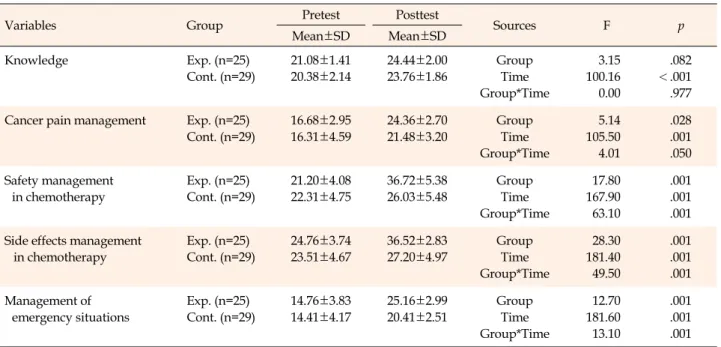
With regard to knowledge, scores of the experimental group increased from 21.08±1.41 before the program to 24.44±2.00 after the program (out of a perfect score of 33).
Scores of the control group increased from 20.38±2.14 to 23.76±1.86. No interaction was found between time and group (p=.977) (Table 3).
For pain management in oncology nursing, the scores of the experimental group increased from 16.68±2.95 to 24.36±2.70 (out of a perfect score of 32), whereas the scores of the control group increased from 16.31±4.59 to 21.48±3.20. No interaction was found between time and
Table 4. Comparison of Satisfaction between Experimental and Control Groups (N=54)
Variables Exp. (n=25) Cont. (n=29)
t p
Mean±SD Mean±SD
Active participation in education 4.60±0.50 4.48±0.57 0.80 .426
Increased interest in nursing 4.64±0.49 4.55±0.57 0.61 .544
Proper educational content 4.80±0.40 4.31±0.54 3.78 <.001
Fulfillment of learning objectives 4.84±0.37 4.59±0.56 1.96 .055
Proper course materials and resources 4.44±0.65 3.97±0.62 2.72 .009
Appropriate educational time 4.80±0.40 4.28±0.52 4.11 <.001
Educational usefulness in teaching patient and family 4.72±0.54 4.45±0.57 1.79 .079
Intention of recommendation to others 4.80±0.40 4.24±0.51 4.46 <.001
Versatile and effective teaching method 4.40±0.70 4.24±0.68 0.83 .410
Acquisition of knowledge 4.80±0.40 4.31±0.60 3.53 .001
Improvement in nursing performance ability 4.92±0.27 4.69±0.47 2.22 .031
Improvement in communication ability 4.80±0.40 4.34±0.72 2.90 .006
Overall 4.71±0.30 4.37±0.37 3.71 .001
Exp.=experimental group; Cont.=control group; SD=standard deviation.
group (p=.050). For safety management in chemotherapy, the scores of the experimental group increased from 21.20±4.08 to 36.72±5.38 (out of a perfect score of 45). The scores of the control group increased from 22.31±4.75 to 26.03±5.48, and an interaction was found between time and group (p=.001). For side effects management in che- motherapy, the scores of the experimental group increased from 24.76±3.74 to 36.52±2.83 (out of a perfect score of 40), whereas the scores of the control group increased from 23.51±4.67 to 27.20±4.97. An interaction was found between time and group (p=.001). Finally, for the manage- ment of emergency situations, scores of the experimental group increased from 14.76±3.83 to 25.16±2.99 (out of a perfect score of 30). Scores for the control group increased from 14.41±4.17 to 20.41±2.51, and an interaction was found between time and group (p=.001) (Table 3).
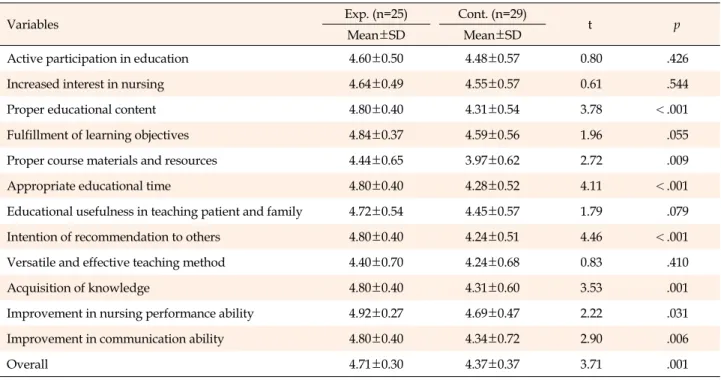
For educational satisfaction, the experimental group showed higher overall satisfaction compared with the control group (t=3.71, p=.001) (Table 4).
DISCUSSION
This study aimed to develop an oncology nursing simu- lation program using SPs and to identify its effects on knowledge, nursing performance ability, and satisfaction among nursing students in comparison to case-based learning. Results indicated that oncology nursing simu-
lation programs using SPs were more effective than case- based learning programs in improving nursing students’
performance with higher satisfaction. However, know- ledge regarding oncology nursing increased in both groups.
According to the results, both the experimental and control groups showed improvement in knowledge re- garding oncology nursing; thus, there was no interaction in terms of time and group. In other words, it is known that both simulation and case-based learning effectively improve knowledge on oncology nursing. This result is similar to the outcome derived from a study that reported no knowledge score difference between SP-based learning and usual learning among nursing students [27]. In con- trast to our finding, some systematic reviews of SP-based simulations reported gain in knowledge among nursing students based on improved test scores [9-12]. In compar- ison with other teaching methods, SP-based training re- sulted in higher knowledge scores compared with high-fi- delity simulator group [17] or lecture-based learning [9].
In this study, lecture was provided for 2 hours and the same cases were used in both simulation and case-based learning; thus, improvement in the level of knowledge was observed in both groups.
In terms of nursing performance ability, the experi- mental group showed higher scores compared with the control group. Some systematic reviews identified high ef- fect sizes in nursing performance outcomes [9-12]. Our re-
sult is similar to those of a study in which nurses in a SP-based communication skills training group showed improvement in communication in cancer pain manage- ment, compared with untrained nurses, by improving their assessment skills [35]. Previous studies have demon- strated higher nursing performance in students with SP-based training compared with those with traditional training [18,23]. Conversely, there was no significant dif- ference in performance scores between SP-based and sim- ulator-based learning [17]. Thus, simulation education can improve performance and help students evaluate their er- rors through debriefing [31]. In this study, the experi- mental group may have gained confidence by practicing nursing using situations found in actual clinical settings.
Educational satisfaction was higher in the experimental group than in the control group. Standardized-patient- based education has been found to induce high learning satisfaction [13,22] and positive learner perceptions [19, 24]. However, some studies did not show a statistically significant benefit of SP-based learning on perceived learn- ing satisfaction [12,18]. Using SPs helps students to under- stand patients’ histories and to improve in their ability to educate patients. In this study, members of the control group reported difficulty in actual nursing practice and in communication with patients. This situation may be due to lack of experience in following safety management rules for chemotherapy, practicing actual nursing techni- ques related to drug administration, or interacting with SPs. Student knowledge regarding cancer patients also improved through the lecture and case study. However, students who underwent simulation training showed higher satisfaction. These students were able to practice the delivery of nursing services with the SPs in an environ- ment that reproduced actual clinical settings. Our finding supports the notion that learner satisfaction can be in- duced by features of SP-based learning, such as self-re- flection through debriefing and active learning with real- istic scenarios [13,22].
The significant finding of this study was that the per- formance and satisfaction of nursing students improved through the development and application of an oncology nursing simulation program using SPs. This study had some limitations. Although this study identified the effec- tiveness of the SP-based simulation, the results are from 2012. Therefore, revision of the educational contents is needed in order to reflect recent clinical practice guide- lines in oncology nursing. Although there was a 1-week gap to minimize treatment diffusion between groups, the possibility of treatment diffusion could not be completely eliminated. The raters were not blind to the student group
assignments. Therefore, caution should be taken when ge- neralizing the study results. Because our participants were nursing students from a college of nursing in the Republic of Korea, we cannot generalize the results to other health- care professionals. Further study is needed to identify the effect of nurses' performance on patient outcomes after simulation-based training.
CONCLUSION
This study assessed the effects of oncology simulation- based nursing education that used SPs by developing such a program and evaluating it application in nursing stu- dents. It also provided a foundation for the use of such programs in the training of students and new graduate nurses in the future by proving their effectiveness in im- proving knowledge regarding oncology nursing, enhanc- ing nursing performance ability for cancer patients, and increasing educational satisfaction. The results of this study can contribute to quality improvement in oncology nurs- ing through the use of the program that was developed for oncology nursing in undergraduate courses and actual cli- nical settings.
CONFLICTS OF INTEREST
The authors declared no conflict of interest.
AUTHORSHIP
Conception and design - JKI and YYS; Data collection - JKI; Analy- sis and interpretation of the data - JKI, YYS and RYS; Drafting and revising the manuscript - JKI, YYS and RYS.
ACKNOWLEDGEMENT
This article is a condensed form of the first author's doctoral dis- sertation from the Catholic University of Korea.
REFERENCES
1. Jung K-W, Won Y-J, Kong H-J, Lee ES. Cancer statistics in Korea: incidence, mortality, survival, and prevalence in 2015.
Cancer Research and Treatment. 2018;50(2):303-16.
https://doi.org/10.4143/crt.2018.143
2. Siegel RL, Miller KD, Jemal A. Cancer statistics, 2019. CA: A Cancer Journal for Clinicians. 2019;69(1):7-34.
https://doi.org/10.3322/caac.21551
3. Campbell P, Torrens C, Kelly D, Charalambous A, Domenech -Climent N, Nohavova I, et al. Recognizing European cancer nursing: protocol for a systematic review and meta-analysis of the evidence of effectiveness and value of cancer nursing. Jour- nal of Advanced Nursing. 2017;73(12):3144-53.
https://doi.org/10.1111/jan.13392
4. Koh S-J, Keam B, Hyun MK, Seo JJ, Park KU, Oh SY, et al.
Cancer pain management education rectifies patients' mis- conceptions of cancer pain, reduces pain, and improves qual- ity of life. Pain Medicine. 2018;19(12):2546-55.
https://doi.org/10.1093/pm/pny039
5. Bouya S, Balouchi A, Maleknejad A, Koochakzai M, AlKha- sawneh E, Abdollahimohammad A. Cancer pain management among oncology nurses: knowledge, attitude, related factors, and clinical recommendations: a systematic review. Journal of Cancer Education. 2019;34(5):839-46.
https://doi.org/10.1007/s13187-018-1433-6
6. Bužgová R, Špatenková N, Fukasová-Hajnová E, Feltl D.
Assessing needs of family members of inpatients with advan- ced cancer. European Journal of Cancer Care. 2016;25(4):592-9.
https://doi.org/10.1111/ecc.12441
7. Yamani N, Taleghani F, Alizadeh M, Khabaz-Mafinejad M.
Determining the expected competencies for oncology nursing:
a needs assessment study. Iranian Journal of Nursing and Midwifery Research. 2018;23(3):188-92.
https://doi.org/10.4103/ijnmr.IJNMR_217_16
8. Benner P. Curricular and pedagogical implications for the Car- negie Study, educating nurses: a call for radical transforma- tion. Asian Nursing Research. 2015;9(1):1-6.
https://doi.org/10.1016/j.anr.2015.02.001
9. May W, Park JH, Lee JP. A ten-year review of the literature on the use of standardized patients in teaching and learning:
1996-2005. Medical Teacher. 2009;31(6):487-92.
https://doi.org/10.1080/01421590802530898
10. Kim YA, Yoon S. The effects of nursing practical education us- ing standardized patients in Korea: a systematic review and meta-analysis. Journal of the Korean Data & Information Sci- ence Society. 2018;29(1):125-40.
https://doi.org/10.7465/jkdi.2018.29.1.125
11. Kim J, Park J-H, Shin S. Effectiveness of simulation-based nursing education depending on fidelity: a meta-analysis. BMC Medical Education. 2016;16:152.
https://doi.org/10.1186/s12909-016-0672-7
12. Oh P-J, Jeon KD, Koh MS. The effects of simulation-based learning using standardized patients in nursing students: a meta-analysis. Nurse Education Today. 2015;35:e6-e15.
https://doi.org/10.1016/j.nedt.2015.01.019
13. Goh Y-S, Selvarajan S, Chng M-S, Tan C-S, Yobas P. Using standardized patients in enhancing undergraduate students' learning experience in mental health nursing. Nurse Education Today. 2016;45:167-72.
https://doi.org/10.1016/j.nedt.2016.08.005
14. Sarikoc G, Ozcan CT, Elcin M. The impact of using stand- ardized patients in psychiatric cases on the levels of motiva- tion and perceived learning of the nursing students. Nurse
Education Today. 2017;51:15-22.
https://doi.org/10.1016/j.nedt.2017.01.001
15. Andrea J, Kotowski P. Using standardized patients in an un- dergraduate nursing health assessment class. Clinical Simu- lation in Nursing. 2017;13(7):309-13.
https://doi.org/10.1016/j.ecns.2017.05.003.
16. Slater LZ, Bryant KD, Ng V. Nursing student perceptions of standardized patient use in health assessment. Clinical Simu- lation in Nursing. 2016;12(9):368-76.
https://doi.org/10.1016/j.ecns.2016.04.007
17. Tuzer H, Dinc L, Elcin M. The effects of using high-fidelity sim- ulators and standardized patients on the thorax, lung, and car- diac examination skills of undergraduate nursing students.
Nurse Education Today. 2016;45:120-5.
https://doi.org/10.1016/j.nedt.2016.07.002
18. Choi SJ, Kwon MS, Kim SH, Kim HM, Jung YS, Jo GY. Effects of using standardized patients on nursing competence, commu- nication skills, and learning satisfaction in health assessment.
The Journal of Korean Academic Society of Nursing Educa- tion. 2013;19(1):97-105.
https://doi.org/10.5977/jkasne.2013.19.1.97
19. Yuksel C, Unver V. Use of simulated patient method to teach communication with deaf patients in the emergency depart- ment. Clinical Simulation in Nursing. 2016;12(7):281-9.
https://doi.org/10.1016/j.ecns.2016.03.007
20. Webster D, DiBartolo MC. Using a standardized patient learn- ing activity to teach baccalaureate nursing students about de- mentia care. Nurse Educator. 2014;39(3):103-4.
https://doi.org/10.1097/NNE.0000000000000027
21. Beaird G, Nye C, Thacker LR. The use of video recording and standardized patient feedback to improve communication per- formance in undergraduate nursing students. Clinical Simula- tion in Nursing. 2017;13(4):176-85.
https://doi.org/10.1016/j.ecns.2016.12.005
22. Kim SM, Park MJ, Yang YK. Effects on problem solving ability and learning satisfaction of nursing students of receiving a teaching method using standardized patients-blood transfu- sion. Journal of Korean Academy of Fundamentals of Nurs- ing. 2015;22(4):406-15.
https://doi.org/10.7739/jkafn.2015.22.4.406
23. Yoo MS. The effectiveness of standardized patient managed instruction for a fundamental nursing course. The Journal of Korean Academic Society of Nursing Education. 2001;7(1):
94-112.
24. Ross JG, Burrell SA. Standardized patient simulation to facili- tate learning in evidence-based oncology symptom manage- ment. Journal of Nursing Education. 2018;57(4):250-3.
https://doi.org/10.3928/01484834-20180322-12
25. Kuhrik NS, Kuhrik M, Rimkus CF, Tecu NJ, Woodhouse JA.
Using human simulation in the oncology clinical practice set-
ting. The Journal of Continuing Education in Nursing. 2008;39 (8):345-55. https://doi.org/10.3928/00220124-20080801-07 26. Kuhrik M, Seckman C, Kuhrik N, Ahearn T, Ercole P. Bringing
skin assessments to life using human patient simulation: an emphasis on cancer prevention and early detection. Journal of Cancer Education. 2011;26(4):687-93.
https://doi.org/10.1007/s13187-011-0213-3
27. Becker KL, Rose LE, Berg JB, Park H, Shatzer JH. The teaching effectiveness of standardized patients. Journal of Nursing Edu- cation. 2006;45(4):103-11.
28. National Cancer Center Cancer Pain Management Committee.
Cancer pain management guideline. 4th ed. Seoul: Ministry of Health & Welfare; 2011.
https://www.ncc.re.kr/main.ncc?uri=subIndex04
29. National Cancer Information Center. Annual report of cancer statistics in Korea. Seoul: Ministry of Health & Welfare; 2011.
https://www.ncc.re.kr/main.ncc?uri=subIndex04
30. Kardong-Edgren S, Adamson KA, Fitzgerald C. A review of currently published evaluation instruments for human patient simulation. Clinical Simulation in Nursing. 2010;6(1):e25-35.
https://doi.org/10.1016/j.ecns.2009.08.004
31. Jeffries PR. Simulation in nursing education: from concep- tualization to evaluation. 1st ed. NY: National League for Nursing; 2007. p. 42-58.
32. Wallace P. Coaching standardized patients for use in the as- sessment of clinical competence. NY: Springer Publishing Com- pany; 2006. p. 151-79.
33. McGaghie WC, Issenberg SB, Petrusa ER, Scalese RJ. Effect of practice on standardized learning outcomes in simulation-based medical education. Medical Education. 2006;40(8):792-7.
https://doi.org/10.1111/j.1365-2929.2006.02528.x
34. Steinwachs B. How to facilitate a debriefing. Simulation &
Gaming. 2008;23(2):186-95.
https://doi.org/10.1177/1046878192232006
35. Canivet D, Delvaux N, Gibon A-S, Brancart C, Slachmuylder J-L, Razavi D. Improving communication in cancer pain man- agement nursing: a randomized controlled study assessing the efficacy of a communication skills training program. Support- ive Care in Cancer. 2014;22(12):3311-20.
https://doi.org/10.1007/s00520-014-2357-2