D I A B E T E S & M E T A B O L I S M J O U R N A L
This is an Open Access article distributed under the terms of the Creative Commons At- tribution Non-Commercial License (http://creativecommons.org/licenses/by-nc/3.0/) which permits unrestricted non-commercial use, distribution, and reproduction in any medium, provided the original work is properly cited.
Association between Diabetic Polyneuropathy and Cardiovascular Complications in Type 2 Diabetic Patients
Jin Ook Chung, Dong Hyeok Cho, Dong Jin Chung, Min Young Chung
Department of Internal Medicine, Chonnam National University Medical School, Gwangju, Korea
Background: Diabetes mellitus is a major independent risk factor for cardiovascular disease (CVD), but high cardiovascular risk in diabetes mellitus patients is not completely explained by clustering traditional risk factors. Recently, associations between dia- betic polyneuropathy (DPN) and macrovasculopathy have been suggested. We aimed to assess associations between DPN and cardiovascular complications in type 2 diabetic patients.
Methods: Microvascular and cardiovascular complications were evaluated in 1,041 type 2 diabetic patients.
Results: In patients with DPN, the age, prevalence of hypertension, diabetes duration, systolic blood pressure, pulse pressure, and hemoglobin glycation (HbA1c) levels were significantly higher, while the high density lipoprotein cholesterol (HDL-C) levels were lower than in those without DPN. The prevalence of CVD was higher in patients with DPN. In multivariate analysis, DPN was independently associated with CVD (odds ratio, 1.801; 95% confidence interval, 1.009 to 3.214).
Conclusion: Our results showed that DPN was associated with a high prevalence of cardiovascular disease in type 2 diabetic patients, but further studies are needed to investigate the causative nature of associations between DPN and CVD.
Keywords: Cardiovascular diseases; Diabetes mellitus, type 2; Diabetic neuropathies
Corresponding author: Min Young Chung
Division of Endocrinology and Metabolism, Department of Internal Medicine, Chonnam National University Medical School, 8 Hak-dong, Dong-gu, Gwangju 501-757, Korea
INTRODUCTION
Type 2 diabetes mellitus is the major cause of blindness, end- stage renal disease, and non-traumatic amputation. Diabetes mellitus is also a major independent risk factor for cardiovas- cular disease such as ischemic heart disease and stroke [1]. This high cardiovascular risk is not completely explained by clus- tering traditional risk factors. In this regard, additional linkage between diabetes mellitus and increased cardiovascular mor- bidity and mortality might be related to the development of microvascular complications, such as albuminuria, decreased glomerular filtration rate, retinopathy, and cardiovascular au- tonomic neuropathy [2-4].
Diabetic polyneuropathy (DPN) is one of the microvascular complications of diabetes that is attributed to chronic hyper- glycemia and is a common cause of morbidity in patients with diabetes mellitus [5]. The major morbidity associated with DPN is foot ulceration, predisposition to gangrene, and limb loss [5]. Calcification of the media of arterial walls is common in patients with diabetes mellitus. Recently, some studies have reported that DPN is associated with medial arterial calcifica- tion in diabetes mellitus [6,7]. Young et al. [7] reported that medial arterial calcification correlated with vibration percep- tion threshold. Medial arterial calcification is known to be as- sociated with coronary heart disease and all-cause mortality [8,9]. Thus, DPN might be directly related to cardiovascular pISSN 2233-6079 · eISSN 2233-6087
disease. However, relationships between DPN and cardiovas- cular disease in type 2 diabetic patients are not fully under- stood. In the present study, we aimed to assess associations be- tween DPN and cardiovascular complications in type 2 dia- betic patients.
METHODS
This study was an observational study designed to investigate the prevalence of chronic complications in type 2 diabetic pa- tients. The data was obtained from September 2008 to August 2009. The study was approved by the Ethics Committee of Chonnam National University Hospital. All participants gave informed consent. A total of 1,041 patients with type 2 diabe- tes mellitus diagnosed after the age of 35 years who visited our hospital to evaluate chronic diabetic complications were inves- tigated. Patients having any of the following characteristics were excluded from the study: active liver disease, glucocorticoid use, positive GAD autoantibodies, malignancy or primary neurologic disorders (previous spinal injury, a history of lum- bar or cervical discopathies, carpal tunnel syndrome, alcoholic neuropathy, inherited neuropathy). A history and physical ex- amination, including measurements of blood pressure, height, and body weight, were performed. Body mass index was cal- culated as weight (kg) divided by the square of height (m2).
Blood pressure was measured twice in a sitting position at a 5-minute interval after 30 minutes of rest, and the mean values were calculated. Pulse pressure was calculated as the difference between systolic and diastolic blood pressures. Hypertension was considered if the patient had a blood pressure greater than 140/90 mm Hg or used antihypertensive drugs. Smoking was defined as never/past or current.
Blood samples were collected after a 10 to 12 hour overnight fast. The plasma glucose level was measured using the hexoki- nase method (Hitach 7600-110; Hitachi Co., Tokyo, Japan), and HbA1c was measured using ion exchange liquid chromatogra- phy (HLC-723-GHbV; Tosoh, Tokyo, Japan). Levels of total cholesterol (AU 5400; Olympus, Tokyo, Japan), high density lipoprotein cholesterol (HDL-C) (AU5400), low density lipo- protein cholesterol (LDL-C) (AU5400), and triglycerides (AU5400) were measured. High-sensitivity C-reactive protein was measured using the BNTM system (N High Sensitivity CRP; Dade Behring, Marburg, Germany).
Urinary albumin excretion was determined using the uri- nary albumin: creatinine ratio (UAE) in random urine sam-
ples. The urinary albumin concentration was measured using the immunoturbidimetric method with a commercial kit (Randox, Antrim, UK). Nephropathy was defined as UAE
≥300 mg/gCr in two of three urine collections. To evaluate retinopathy, an ophthalmologist performed fundoscopy after pupillary dilation. In addition to a clinical neurological exami- nation, peripheral neuropathy was assessed through the mea- surement of peripheral nerves with an electroneuromyograph- ic device (Medelec Synergy; Oxford Instruments, Oxford, UK).
Motor and sensory amplitudes, conduction velocities, F re- sponses and latencies were recorded. If two or more different nerves showed abnormal findings greater than two standard deviations from the normal range in three or more of four pa- rameters, the patient was determined as having neurophysio- logically diagnosed peripheral polyneuropathy [10,11]. Deep breathing (E/I ratio), Valsalva and posture tests were used to assess cardiovascular autonomic function with the Monitor one nDx (QMed Inc., Entontown, NJ, USA). Cardiovascular autonomic neuropathy was diagnosed in patients having at least two abnormal tests: an abnormal E/I ratio based on age- adjusted norms, a Valsalva ratio <1.2 or a 30:15 ratio <1.03.
Coronary heart disease and cerebrovascular disease were defined as cardiovascular disease. A diagnosis of coronary heart disease was based on a history of myocardial infarction, angina pectoris or ischemic heart disease, coronary artery an- gioplasty, or pathological findings coded using Minnesota codes 1.1 to 3, 4.1 to 4, and 5.1 to 3 in the resting electrocardiogram [12]. Cerebrovascular disease (CVD) was defined according to medical records, if pathological findings such as ischemic stroke on computed tomography or an area of low signal intensity measuring at least 3 mm on T1-weighted images and a hyper- intense lesion on T2-weighted images on magnetic resonance imaging of the brain had been documented [13].
Statistical analysis
Data were expressed as the mean±standard deviation, unless otherwise stated. A χ2 test was used to determine significance, if any, in the differences measured between groups for each vari- able. Continuous variables were analyzed using Mann-Whitney U test or a Student’s t-test. Multivariate logistic regression analy- ses were performed to determine associations between DPN and other diabetic complications. Using the logistic regression model with the forward Wald method, multivariate analyses were performed with identified independent variables and factors previously reported to have independent associations
in order to analyze the association of DPN with cardiovascular disease. Statistical analysis was performed using SPSS software version 17.0 (SPSS Inc., Chicago, IL, USA). A P value of less than 0.05 was considered statistically significant.
RESULTS
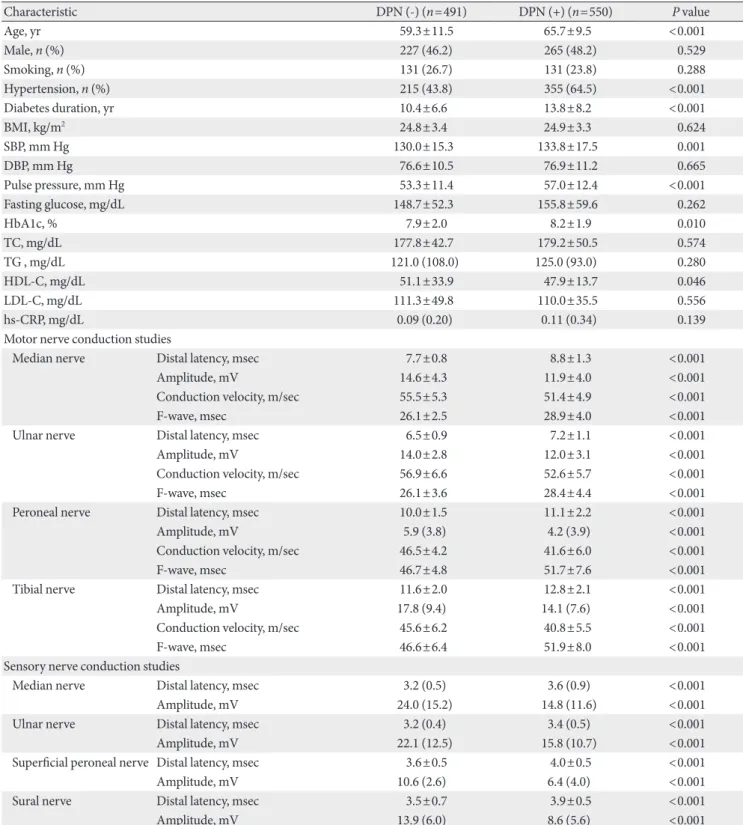
The mean age of the participants was 62.6±11.1 years; diabetes duration and HbA1c level were 12.2±7.7 years and 8.1±2.0%, respectively. The treatment methods for diabetes were: lifestyle modification alone (6.8%), oral hypoglycemic agents alone (61.2%), insulin dosing (11.8%), or a combination of oral hy- poglycemic agents and insulin (20.2%). The clinical findings and laboratory data of type 2 diabetic patients, with and with- out DPN, are shown in Table 1. Of a total of 1,041 type 2 dia- betic patients, 550 patients were in the DPN group. In patients with DPN, the age, prevalence of hypertension, diabetes dura- tion, systolic blood pressure, pulse pressure, and HbA1c level were significantly higher, while the HDL-C level was signifi- cantly lower compared to those in patients without DPN. Af- ter age adjustment, there were also significant differences in systolic blood pressure, diabetes duration, pulse pressure and HbA1c between patients with and without DPN (P<0.05, re- spectively). In motor and sensory nerve studies, there were significant differences between patients with and without DPN (Table 1). The prevalence of diabetic retinopathy, nephropathy, or autonomic neuropathy was higher in patients with DPN, remaining significant after adjustment for age, diabetes dura- tion, and hypertension (Table 2).
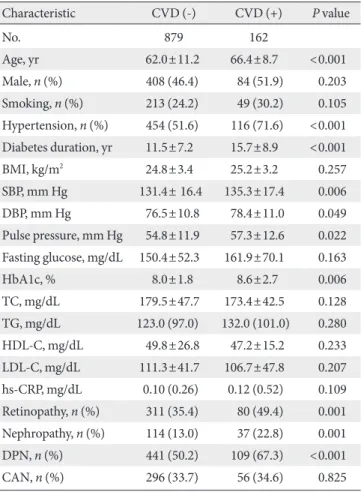
CVD was significantly associated with increased age, greater prevalence of hypertension, longer diabetes duration, a wider range in pulse pressure, and higher HbA1c level (Table 3). The prevalence of diabetic retinopathy, nephropathy or DPN was higher in patients with CVD. To identify the significant inde- pendent determinants for CVD in all patients, logistic regres- sion analyses were performed. In univariate analysis, DPN was associated with CVD (odds ratio [OR], 2.043; 95% confidence interval [CI], 1.434 to 2.910). For the multivariate analysis, we included the identified independent variables and factors pre- viously reported to have independent associations with CVD.
Here, DPN was independently associated with CVD (OR, 1.947; 95% CI, 1.169 to 3.241) (Table 4). When retinopathy, nephropathy, and autonomic neuropathy were also included in this model (model 2), DPN was also independently associ- ated with CVD (OR, 1.801; 95% CI, 1.009 to 3.214).
DISCUSSION
In this study, our results showed that other diabetic complica- tions, e.g., diabetic retinopathy and nephropathy were more prevalent in type 2 diabetic patients with DPN. Also, we found that there was a strong association between DPN and CVD prevalence in type 2 diabetic patients.
Type 2 diabetic patients with DPN had longer diabetes du- ration and higher HbA1c levels than those without DPN sup- porting previous studies [14,15]. Also, DPN was associated with higher prevalence of retinopathy and nephropathy. Sev- eral prior studies have suggested that DPN is closely associated with diabetic retinopathy. O′Hare et al. [16] showed that dia- betic neuropathy was associated with retinopathy in type 2 di- abetes mellitus. Cohen et al. [17] demonstrated that DPN was associated with the high prevalence of both retinopathy and overt proteinuria in type 2 diabetic patients. However, a rela- tionship between DPN and diabetic nephropathy has not been consistently demonstrated. Shaw et al. [18] reported that a sig- nificant proportion of type 1 diabetic patients with diabetic nephropathy did not have diabetic peripheral neuropathy. Re- cently, Karvestedt et al. [19] reported that DPN was more common in type 2 diabetic patients with overt proteinuria than it was in those without overt proteinuria. Results from these prior studies, in conjunction with our findings, suggest a close relationship between neuropathy and nephropathy, as well as between neuropathy and retinopathy.
DPN is known to predict foot ulceration, lower-extremity amputation, and mortality [20]. The presence of cardiovascu- lar autonomic neuropathy contributes to a higher mortality rate in patients with diabetes mellitus, in part due to asymp- tomatic (painless) myocardial ischemia and hence delayed di- agnosis [2]. Recently, associations between DPN and macro- vasculopathy have been suggested [21,22]. Coppini et al. [23]
showed that higher vibration perception thresholds were more strongly associated with increased mortality than were other microvascular complications in diabetic patients. Forsblom et al. [24] reported that neurophysiologically diagnosed neurop- athy might have a direct role for cardiovascular mortality in type 2 diabetes. In the Detection of Ischemia in Asymptomatic Diabetics (DIAD) study, a significant relation to CVD outcomes such as nonfatal myocardial infarction and cardiac death was found with symptom (numbness) and sign (absent sensation) of peripheral polyneuropathy [25]. The Action to Control Car- diovascular Risk in Diabetes (ACCORD) trial suggested the
Table 1. Characteristics of type 2 diabetic patients with or without diabetic polyneuropathy
Characteristic DPN (-) (n=491) DPN (+) (n=550) P value
Age, yr 59.3±11.5 65.7±9.5 <0.001
Male, n (%) 227 (46.2) 265 (48.2) 0.529
Smoking, n (%) 131 (26.7) 131 (23.8) 0.288
Hypertension, n (%) 215 (43.8) 355 (64.5) <0.001
Diabetes duration, yr 10.4±6.6 13.8±8.2 <0.001
BMI, kg/m2 24.8±3.4 24.9±3.3 0.624
SBP, mm Hg 130.0±15.3 133.8±17.5 0.001
DBP, mm Hg 76.6±10.5 76.9±11.2 0.665
Pulse pressure, mm Hg 53.3±11.4 57.0±12.4 <0.001
Fasting glucose, mg/dL 148.7±52.3 155.8±59.6 0.262
HbA1c, % 7.9±2.0 8.2±1.9 0.010
TC, mg/dL 177.8±42.7 179.2±50.5 0.574
TG , mg/dL 121.0 (108.0) 125.0 (93.0) 0.280
HDL-C, mg/dL 51.1±33.9 47.9±13.7 0.046
LDL-C, mg/dL 111.3±49.8 110.0±35.5 0.556
hs-CRP, mg/dL 0.09 (0.20) 0.11 (0.34) 0.139
Motor nerve conduction studies
Median nerve Distal latency, msec 7.7±0.8 8.8±1.3 <0.001
Amplitude, mV 14.6±4.3 11.9±4.0 <0.001
Conduction velocity, m/sec 55.5±5.3 51.4±4.9 <0.001
F-wave, msec 26.1±2.5 28.9±4.0 <0.001
Ulnar nerve Distal latency, msec 6.5±0.9 7.2±1.1 <0.001
Amplitude, mV 14.0±2.8 12.0±3.1 <0.001
Conduction velocity, m/sec 56.9±6.6 52.6±5.7 <0.001
F-wave, msec 26.1±3.6 28.4±4.4 <0.001
Peroneal nerve Distal latency, msec 10.0±1.5 11.1±2.2 <0.001
Amplitude, mV 5.9 (3.8) 4.2 (3.9) <0.001
Conduction velocity, m/sec 46.5±4.2 41.6±6.0 <0.001
F-wave, msec 46.7±4.8 51.7±7.6 <0.001
Tibial nerve Distal latency, msec 11.6±2.0 12.8±2.1 <0.001
Amplitude, mV 17.8 (9.4) 14.1 (7.6) <0.001
Conduction velocity, m/sec 45.6±6.2 40.8±5.5 <0.001
F-wave, msec 46.6±6.4 51.9±8.0 <0.001
Sensory nerve conduction studies
Median nerve Distal latency, msec 3.2 (0.5) 3.6 (0.9) <0.001
Amplitude, mV 24.0 (15.2) 14.8 (11.6) <0.001
Ulnar nerve Distal latency, msec 3.2 (0.4) 3.4 (0.5) <0.001
Amplitude, mV 22.1 (12.5) 15.8 (10.7) <0.001
Superficial peroneal nerve Distal latency, msec 3.6±0.5 4.0±0.5 <0.001
Amplitude, mV 10.6 (2.6) 6.4 (4.0) <0.001
Sural nerve Distal latency, msec 3.5±0.7 3.9±0.5 <0.001
Amplitude, mV 13.9 (6.0) 8.6 (5.6) <0.001
Data are mean±standard deviation or median (interquartile range). Number in parenthesis is percentage. Analyzed using Mann-Whitney U test, Student’s t-test or χ2 test.
DPN, diabetic polyneuropathy; BMI, body mass index; SBP, systolic blood pressure; DBP, diastolic blood pressure; HbA1c, hemoglobin glyca- tion; TC, total cholesterol; TG, triglyceride; HDL-C, high density lipoprotein cholesterol; LDL-C, low density lipoprotein cholesterol; hs-CRP, high-sensitivity C-reactive protein.
possible role of cardiac autonomic neuropathy and peripheral polyneuropathy as a strong predictor for CVD mortality [26].
Also, some studies have demonstrated that distal symmetrical neuropathy is associated with medial arterial calcification in diabetes mellitus patients [6,7], which has been reported to be associated with an increase in coronary heart disease and all- cause mortality in type 2 diabetes mellitus patients [8,9]. Yo- shida et al. [27] reported that the extent of coronary artery cal- cification measured by electron beam computed tomography was significantly higher in patients with DPN. In the present study, DPN was associated with a high prevalence of risk fac- tors for macrovascular complications, such as poor metabolic control, dyslipidemia, hypertension, increased pulse pressure, and albuminuria. Also, DPN was associated with a high preva- lence of CVD in type 2 diabetes patients. Thus, the results in the present study may support a common pathogenic mecha- nism as the relationship between neuropathy and macrovas- cular complications [19,22,28-30], suggesting the roles of vas- cular and metabolic factors. However, further studies are need- ed to investigate the mechanism that links DPN with cardio- vascular complications.
This study has some limitations. Although nerve electro- physiologic studies are the sensitive, objective and highly re- producible means of investigating diabetic polyneuropathy and have a key role in the elimination of other causes of neu- ropathy, they have limitations in the assessment of small-fiber dysfunction [10]. Also, because our study was cross-sectional, the causative natures of the associations between DPN and Table 2. Associations of diabetic polyneuropathy (DPN) with other microvascular complications in type 2 diabetic patients
Variable Present aORa 95% CI P value
Retinopathy
DPN (-) (n=491) 121/491 (24.6) 1.00
DPN (+) (n=550) 270/550 (49.1) 2.219 1.593-3.090 <0.001 Nephropathy
DPN (-) (n=491) 51/491 (10.4) 1.00
DPN (+) (n=550) 100/550 (18.2) 1.808 1.144-2.585 0.011 Autonomic neuropathy
DPN (-) (n=491) 150/491 (30.5) 1.00
DPN (+) (n=550) 202/550 (36.7) 1.779 1.065-2.971 0.028 Number in parenthesis is percentage. Analyzed using χ2 test and mul- tivariate logistic regression.
OR, odds ratio; CI, confidence interval.
aAdjusted for age, diabetes duration and hypertension.
Table 4. Multivariate logistic regression analysis with CVD as a dependent variable
Variable aORa 95% CI P value
Model 1
DPN (-, +) 1.947 1.169-3.241 0.010
Model 2
DPN (-, +) 1.801 1.009-3.214 0.046
OR, odds ratio; CI, confidence interval.
aModel 1: adjusted for age, sex, smoking, body mass index, hyperten- sion, HbA1c, diabetes duration, low density lipoprotein cholesterol, high density lipoprotein cholesterol, and pulse pressure; Model 2:
model 1 plus retinopathy, nephropathy, and autonomic neuropathy.
Table 3. Characteristics of type 2 diabetic patients in associa- tion with cardiovascular complications
Characteristic CVD (-) CVD (+) P value
No. 879 162
Age, yr 62.0±11.2 66.4±8.7 <0.001
Male, n (%) 408 (46.4) 84 (51.9) 0.203
Smoking, n (%) 213 (24.2) 49 (30.2) 0.105 Hypertension, n (%) 454 (51.6) 116 (71.6) <0.001 Diabetes duration, yr 11.5±7.2 15.7±8.9 <0.001
BMI, kg/m2 24.8±3.4 25.2±3.2 0.257
SBP, mm Hg 131.4± 16.4 135.3±17.4 0.006
DBP, mm Hg 76.5±10.8 78.4±11.0 0.049
Pulse pressure, mm Hg 54.8±11.9 57.3±12.6 0.022 Fasting glucose, mg/dL 150.4±52.3 161.9±70.1 0.163
HbA1c, % 8.0±1.8 8.6±2.7 0.006
TC, mg/dL 179.5±47.7 173.4±42.5 0.128
TG, mg/dL 123.0 (97.0) 132.0 (101.0) 0.280
HDL-C, mg/dL 49.8±26.8 47.2±15.2 0.233
LDL-C, mg/dL 111.3±41.7 106.7±47.8 0.207
hs-CRP, mg/dL 0.10 (0.26) 0.12 (0.52) 0.109 Retinopathy, n (%) 311 (35.4) 80 (49.4) 0.001 Nephropathy, n (%) 114 (13.0) 37 (22.8) 0.001 DPN, n (%) 441 (50.2) 109 (67.3) <0.001
CAN, n (%) 296 (33.7) 56 (34.6) 0.825
Data are mean±standard deviation or median (interquartile range).
Number in parenthesis is percentage. Analyzed using Mann-Whit- ney U test, Student’s t-test or χ2 test.
CVD, cardiovascular disease; BMI, body mass index; SBP, systolic blood pressure; DBP, diastolic blood pressure; HbA1c, hemoglobin glycation; TG, triglyceride; HDL-C, high density lipoprotein choles- terol; LDL-C, low density lipoprotein cholesterol; hs-CRP, high-sen- sitivity C-reactive protein; DPN, diabetic polyneuropathy; CAN, car- diovascular autonomic neuropathy.
CVD cannot be established. Further investigation is necessary to evaluate whether DPN is associated with incident CVD among type 2 diabetic adults and to determine possible mech- anisms between DPN and CVD adverse outcomes.
In conclusion, this study shows that DPN is associated with a high prevalence of cardiovascular disease in type 2 diabetic patients and suggests that type 2 diabetic patients with DPN may warrant a more careful cardiovascular assessment and follow-up.
CONFLICTS OF INTEREST
No potential conflict of interest relevant to this article was re- ported.
REFERENCES
1. Grundy SM, Benjamin IJ, Burke GL, Chait A, Eckel RH, How- ard BV, Mitch W, Smith SC Jr, Sowers JR. Diabetes and cardio- vascular disease: a statement for healthcare professionals from the American Heart Association. Circulation 1999;100:1134-46.
2. Maser RE, Mitchell BD, Vinik AI, Freeman R. The association between cardiovascular autonomic neuropathy and mortality in individuals with diabetes: a meta-analysis. Diabetes Care 2003;26:1895-901.
3. Ninomiya T, Perkovic V, de Galan BE, Zoungas S, Pillai A, Jar- dine M, Patel A, Cass A, Neal B, Poulter N, Mogensen CE, Cooper M, Marre M, Williams B, Hamet P, Mancia G, Wood- ward M, Macmahon S, Chalmers J; ADVANCE Collaborative Group. Albuminuria and kidney function independently pre- dict cardiovascular and renal outcomes in diabetes. J Am Soc Nephrol 2009;20:1813-21.
4. Ogawa O, Hayashi C, Nakaniwa T, Tanaka Y, Kawamori R. Ar- terial stiffness is associated with diabetic retinopathy in type 2 diabetes. Diabetes Res Clin Pract 2005;68:162-6.
5. Bloomgarden ZT. Diabetic retinopathy and neuropathy. Dia- betes Care 2005;28:963-70.
6. Jeffcoate WJ, Rasmussen LM, Hofbauer LC, Game FL. Medial arterial calcification in diabetes and its relationship to neurop- athy. Diabetologia 2009;52:2478-88.
7. Young MJ, Adams JE, Anderson GF, Boulton AJ, Cavanagh PR.
Medial arterial calcification in the feet of diabetic patients and matched non-diabetic control subjects. Diabetologia 1993;36:
615-21.
8. Everhart JE, Pettitt DJ, Knowler WC, Rose FA, Bennett PH.
Medial arterial calcification and its association with mortality and complications of diabetes. Diabetologia 1988;31:16-23.
9. Lehto S, Niskanen L, Suhonen M, Ronnemaa T, Laakso M.
Medial artery calcification. A neglected harbinger of cardio- vascular complications in non-insulin-dependent diabetes mellitus. Arterioscler Thromb Vasc Biol 1996;16:978-83.
10. Claus D, Mustafa C, Vogel W, Herz M, Neundorfer B. Assess- ment of diabetic neuropathy: definition of norm and discrimi- nation of abnormal nerve function. Muscle Nerve 1993;16:
757-68.
11. Andersen H, Stalberg E, Falck B. F-wave latency, the most sen- sitive nerve conduction parameter in patients with diabetes mellitus. Muscle Nerve 1997;20:1296-302.
12. Rose GA, Blackburn H. Cardiovascular survey methods.
Monogr Ser World Health Organ 1968;56:1-188.
13. Saver JL. Proposal for a universal definition of cerebral infarc- tion. Stroke 2008;39:3110-5.
14. Franklin GM, Shetterly SM, Cohen JA, Baxter J, Hamman RF.
Risk factors for distal symmetric neuropathy in NIDDM. The San Luis Valley Diabetes Study. Diabetes Care 1994;17:1172-7.
15. Valensi P, Giroux C, Seeboth-Ghalayini B, Attali JR. Diabetic peripheral neuropathy: effects of age, duration of diabetes, gly- cemic control, and vascular factors. J Diabetes Complications 1997;11:27-34.
16. O′Hare JA, Abuaisha F, Geoghegan M. Prevalence and forms of neuropathic morbidity in 800 diabetics. Ir J Med Sci 1994;
163:132-5.
17. Cohen JA, Jeffers BW, Faldut D, Marcoux M, Schrier RW. Risks for sensorimotor peripheral neuropathy and autonomic neu- ropathy in non-insulin-dependent diabetes mellitus (NIDDM).
Muscle Nerve 1998;21:72-80.
18. Shaw JE, Gokal R, Hollis S, Boulton AJ. Does peripheral neu- ropathy invariably accompany nephropathy in type 1 diabetes mellitus? Diabetes Res Clin Pract 1998;39:55-61.
19. Karvestedt L, Martensson E, Grill V, Elofsson S, von Wendt G, Hamsten A, Brismar K. Peripheral sensory neuropathy associ- ates with micro- or macroangiopathy: results from a popula- tion-based study of type 2 diabetic patients in Sweden. Diabe- tes Care 2009;32:317-22.
20. Carrington AL, Shaw JE, Van Schie CH, Abbott CA, Vileikyte L, Boulton AJ. Can motor nerve conduction velocity predict foot problems in diabetic subjects over a 6-year outcome peri- od? Diabetes Care 2002;25:2010-5.
21. Elliott J, Tesfaye S, Chaturvedi N, Gandhi RA, Stevens LK, Em- ery C, Fuller JH; EURODIAB Prospective Complications Study
Group. Large-fiber dysfunction in diabetic peripheral neurop- athy is predicted by cardiovascular risk factors. Diabetes Care 2009;32:1896-900.
22. Yokoyama H, Yokota Y, Tada J, Kanno S. Diabetic neuropathy is closely associated with arterial stiffening and thickness in type 2 diabetes. Diabet Med 2007;24:1329-35.
23. Coppini DV, Bowtell PA, Weng C, Young PJ, Sonksen PH.
Showing neuropathy is related to increased mortality in dia- betic patients: a survival analysis using an accelerated failure time model. J Clin Epidemiol 2000;53:519-23.
24. Forsblom CM, Sane T, Groop PH, Totterman KJ, Kallio M, Sal- oranta C, Laasonen L, Summanen P, Lepantalo M, Laatikainen L, Matikainen E, Teppo AM, Koskimies S, Groop L. Risk fac- tors for mortality in type II (non-insulin-dependent) diabetes:
evidence of a role for neuropathy and a protective effect of HLA-DR4. Diabetologia 1998;41:1253-62.
25. Young LH, Wackers FJ, Chyun DA, Davey JA, Barrett EJ, Taille- fer R, Heller GV, Iskandrian AE, Wittlin SD, Filipchuk N, Rat- ner RE, Inzucchi SE; DIAD Investigators. Cardiac outcomes after screening for asymptomatic coronary artery disease in patients with type 2 diabetes: the DIAD study--a randomized controlled trial. JAMA 2009;301:1547-55.
26. Pop-Busui R, Evans GW, Gerstein HC, Fonseca V, Fleg JL, Hoogwerf BJ, Genuth S, Grimm RH, Corson MA, Prineas R;
Action to Control Cardiovascular Risk in Diabetes Study Group. Effects of cardiac autonomic dysfunction on mortality risk in the Action to Control Cardiovascular Risk in Diabetes (ACCORD) trial. Diabetes Care 2010;33:1578-84.
27. Yoshida M, Takamatsu J, Yoshida S, Tanaka K, Takeda K, Hi- gashi H, Kitaoka H, Ohsawa N. Scores of coronary calcifica- tion determined by electron beam computed tomography are closely related to the extent of diabetes-specific complications.
Horm Metab Res 1999;31:558-63.
28. Eaton SE, Harris ND, Ibrahim S, Patel KA, Selmi F, Radatz M, Ward JD, Tesfaye S. Increased sural nerve epineurial blood flow in human subjects with painful diabetic neuropathy. Dia- betologia 2003;46:934-9.
29. Zenere BM, Arcaro G, Saggiani F, Rossi L, Muggeo M, Lechi A.
Noninvasive detection of functional alterations of the arterial wall in IDDM patients with and without microalbuminuria.
Diabetes Care 1995;18:975-82.
30. Cameron NE, Eaton SE, Cotter MA, Tesfaye S. Vascular factors and metabolic interactions in the pathogenesis of diabetic neu- ropathy. Diabetologia 2001;44:1973-88.