상황실의 효율적인 재난관리를 위한 COP기반
상황판 정보요소 분석에 관한 연구: 풍수해를 중심으로
조정윤, 송주일*, 장초록, 장문엽
㈜부린
A Study on the Analysis of Information Element of COP-Based
Situation Panel for Efficient Disaster Management in the Situation
Room
Jung-Yun Cho, Ju-Il Song*, Cho-Rok Jang, Moon-Yup Jang
Burin Co.,Ltd
요 약 본 연구에서는 효율적인 상황실 운영을 위한 새로운 인프라스트럭처 방안으로 공통작전상황도(Common Operating Picture, 이하 COP)의 개념을 활용하여 상황판에 공유되어야 하는 필수 정보요소들을 도출하고자 하였다.
이에 COP의 개념과 실제 해외사례를 확인하고, 재난상황 적용시 고려되어야 하는 COP 정보요소들을 재정립하였으며, 국내 발행된 재난대응 표준매뉴얼과 일일상황보고서 등을 분석하여 COP 재난대응 정보요소를 최종적으로 도출하였다.
정보요소는 재난유형 중 매년 피해를 야기하는 풍수해를 중심으로 총 4개의 단계(①신고접수 및 인지단계, ②상황전파 및 보고단계, ③비상기구 운영단계, ④수습·복구단계)로 구분하였다. 각 재난대응 단계별로 필요한 정보 요소들을 사고규 모, 기상 정보, 자원 현황, 구조 정보, 라이프 라인 시설 등으로 다시 구분하였으며, 해당 항목별 세부 정보요소들을 추가 적으로 분석하여 필수적으로 상황판에 공유되어야 하는 정보요소를 도출하였다. 본 연구에서 도출해낸 정보들은 COP 특성상 공간적·지리적 특징과 함께 공유되기 때문에 의사결정권자들과 담당자들에게 복합적인 정보를 제공하여 재난상 황에 대한 다각적인 접근을 가능하게 한다. 또한 재난대응 담당부처들이 해당 정보들을 공통적으로 공유함으로써 재난대 응이 보다 효율적으로 이루어 질 수 있을 것으로 기대된다.
Abstract This study derives essential information elements that should be shared in the situation board by utilizing the concept of common operating picture (COP). The COP's concept and actual overseas cases were confirmed, and COP information elements that should be considered for disaster situations were redefined. The COP disaster response information elements were derived by analyzing the standard manual for disaster response and daily situation reports issued in Korea. The information elements were divided into four stages (①Report reception and recognition stages, ②Situation propagation and reporting stages, ③Emergency equipment operation stages, ④Recovery and recovery stages), centered on storm and flood damage. Further analysis of the detailed information elements was conducted to derive the information elements that must be shared in the context board. The information is shared along with spatial and geographical characteristics due to the characteristics of the COP, providing complex information to decisionmakers and officials, enabling diverse access to disaster situations. Furthermore, it is expected that disaster response will be more efficient by sharing the information in common.
Keywords : Common Operating Picture, COP, Situation Management, Disaster Response, Briefing Board 본 연구는 행정안전부 재난안전 산업육성지원 사업의 지원을 받아 수행된 연구임(no.20009742).
*Corresponding Author : Ju-Il Song(Burin Co.,Ltd) email: [email protected]
Received August 21, 2020 Revised October 14, 2020 Accepted January 8, 2021 Published January 31, 2021
1. 서론
1.1 연구의 필요성2018년 기준 총 29개의 태풍이 발생하고 그중 총 5개 의 태풍이 한반도에 영향을 주었으며, 2019년 기준 총 29개의 태풍이 발생하고 그중 7개의 태풍이 한반도에 영 향을 미친 것으로 나타났다[1, 2]. 이렇게 매년 발생하는 태풍의 경우 그 빈도수와 강도가 점자 증가하는 양상을 보이고 있으며, 재난유형 특성상 미리 예측했다 하더라도 광범위한 피해를 입고 있는 실정이다. 이와 같이 재난의 발생빈도와 피해가 점차 증가하게 되면서 재난대응 및 관리에 있어 효과적인 관리방안을 필요로 하게 되었다 [3]. 특히나 재난이 발생하게 되면 신속하게 현장상황을 파악하고, 재난대응에 필요로 하는 지원과 상황관리가 빠 르게 이루어져야한다. 이를 위해서는 재난대응과 상황관 리에 중추적인 역할을 담당하는 상황실의 기능이 그 무 엇보다 중요하다. 그러나 현재 상황실에서는 특정부분에 대한 과잉투입이나 신속한 자원 투입 지연 등 여러 문제 점이 발생하고 있다[4]. 특히 재난현장으로 부터 수집되 는 정보들에 있어서 단순히 전파에만 그치고, 각 단계별 로 확인되어야 하는 정보에 대한 가이드라인이 없어 효 과적인 상황실 운영에 어려움을 겪고 있다. 위와 같은 문 제점들을 해결하기 위해서는 상황실에 새로운 재난대응 인프라스트럭처(infrastructure)의 도입이 필요하다.
본 연구에서는 재난대응 상황실 상황판의 정보수집 및 활용체계 구축을 목적으로 재난유형별 및 대응 단계별로 상황판에 공유되어야 하는 정보요소들을 확인하기 위한 기초연구를 수행하였다. 이에 공통작전상황도(Common Operating Picture, 이하 COP)의 개념을 도입하여 재 난발생시 각 재난대응단계별로 공유되어야하는 정보요소 를 도출하였다.
1.2 연구의 목적 및 연구방법
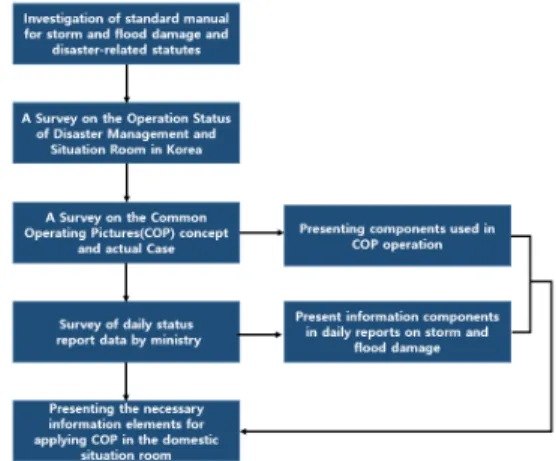
본 연구에서는 상황판의 정보수집 및 활용체계 구축을 목적으로 국내 표준매뉴얼 중 매년 발생하는 재난 유형 중 하나인 풍수해에 집중하여 상황판에 공유되어야 하는 정보요소 도출을 주요내용으로 하고 있다. 아래 Fig.1 은 본 연구의 흐름도를 도식화 한 것이다.
재난이 발생시 재난대응을 위해 각 담당자들은 해당 재난에 대하여 준비된 매뉴얼에 기반 하여 재난대응을 실시한다[5]. 이에 본 연구에서는 우선적으로 표준매뉴얼 의 재난대응단계에 따른 풍수해 대응활동에 중점을 두었
다. 또한 해당 연구를 위해 국내 재난대응 및 상황관리에 관한 현황과 상황판 운영에 관한 분석을 실시하여 기존 상황판 운영에 대한 문제점을 확인하였다. 뿐 만 아니라 해외에서 사용하고 있는 COP에 대한 개념과 실제 해외 적용사례를 확인하여 COP의 특성과 재난발생시 요구되 는 정보요소들을 확인하였으며, 국내자료로는 풍수해 발 생시 부처별로 발행되었던 일일상황보고 자료를 추가적 으로 분석하여 재난발생시 포함되어야 하는 재난정보 요 소를 도출하였다.
Fig. 1. Research Flow Chart
2. 재난관리와 국내 상황실 운영현황
2.1 재난관리의 개념 및 특성재난관리는 재난발생시 사전과 사후에 실시되는 하나 의 관리활동을 뜻하며, 계획을 포함한 대응활동을 모두 아우르는 용어로써 사용되고 있다[6]. 현재 국내 법 상에 서 정의된 재난관리란 「재난 및 안전관리 기본법」 제3조 3항에 의하면 재난의 예방, 대비, 대응, 복구를 위한 일련 의 모든 활동을 뜻하며, ①완화·예방, ②대비, ③대응, ④ 복구의 4단계로 구분하고 있다. 첫 번째 예방단계에서는 재난이 발생할 가능성을 미리 염두하여 준비하는 단계로 서 재난발생 가능성을 낮추는 것을 목표로 하는 단계이 다[7]. 두 번째 대비단계는 재난 대응에 활용되어지는 자 원들과 대응기관의 사전 동원을 확보하고, 재난대응훈련 과 계획 및 경보체계 등을 준비하는 일련의 활동이 이루 어지는 단계이며, 세 번째 대응단계는 재난이 발생하여 대응기관들이 수행해야하는 다양한 임무와 기능이 적용 되는 단계이다[8]. 마지막 복구단계는 재난이 발생하기 전 단계로 회복하기 위한 모든 활동이 이루어지는 단계
로서 피해지역 주민에 대한 물적 피해 및 정신적 피해에 대한 복구도 포함된다.
2.2 상황실의 재난관리 운영현황 2.2.1 중앙재난안전상황실
중앙재난안전상황실은 「재난 및 안전관리 기본법」 제 18조에 의하여 운영되며, 평시 범정부 차원의 국가 재난 안전을 지휘하고 조정 및 통제의 목적으로서 365일 24 시간 운영된다. 해당 상황실에서는 사회재난, 자연재난과 같이 재난안전 및 위기상황을 종합적으로 관리하며, 재난 상황의 접수 뿐 만 아니라 파악, 전파, 상황판단 및 초동 보고를 담당한다. 더욱이 국내·외 언론보도 등 재난정보 의 수집과 분석 및 전파를 통해 재난대응을 실시하고 있 다. 다만 평시에는 중앙재난안전상황실에서 모든 재난상 황을 관리하지만 대규모 재난 발생시 중앙재난안전대책 본부가 가동되는데 이 경우 중대본 가동 전까지 초동조 치 등의 상황관리 업무를 수행한다.
현재 중앙재난안전상황실에서 운영되는 상황판의 경 우 재난상황 발생시 현장상황에 대한 정보확인 및 공유 에만 급급하여 해당 상황에 대한 정확인 이해나 분석, 판 단 등에 어려움을 겪고 있다. 특히 재난상황에서 대응에 필요한 정보들을 동시에 확인하기 어려워 신속한 의사결 정을 내릴 수 없다는 문제가 발생하고 있다.
2.2.2 서울 종합방재센터
서울시의 경우 재난재해 발생시 모든 신고를 119 하 나로 통일시켜 한 장소에서 통합적으로 관리하도록 하고 있다. 해당 센터는 365일 24시간동안 운영되며, 소방뿐 만 아니라 재난, 재해, 민방위 등 4개의 상황실을 하나의 지휘체계로 통합하여 운영함으로서 신속하고 체계적으로 대응하고자 하였고, 출동지령도 자동화하여 운영되고 있 다[9]. 종합방재센터는 신고 접수시 현장으로 출동하는 119대원들을 통해 사고현장의 상황을 공유 받아 사령탑 의 역할을 수행하고 있다.
현재 서울종합방재센터에서 운영되고 있는 상황판에 서는 CCTV 연계를 통해 바로 현장상황을 파악할 수 있 도록 하였으나 화재와 같은 상황발생시 대상물의 특성과 현황에 대한 정보는 같이 확인하기 어렵다[10]. 또한 화 재발생 대상물의 정보들과 현장으로부터 공유되는 정보 들을 함께 취합하여 현장과 지원기관에 공유가 제대로 이루어지지 않아 현장과 상황실간의 의사소통에 어려움 을 겪고 있다. 즉, 정보를 취합하여 이를 적재적소에 알려
줄 수 있는 상황실의 관제기능 강화가 필요하다.
3. COP 기반 상황판 정보요소 분석
3.1 COP개념COP는 80년대에 처음으로 등장하면서 군사적 대응 을 위해 도입되었다. 이러한 COP는 군사적인 약어로서 전투공간과 공동작전지역(Joint Operating Area, 이하 JOA)을 직접 보고 이해하는 것을 의미하며, 정보공유의 차원에서 활용되었다[11]. COP와 관련하여 정확한 개념 적 정의가 따로 존재하지 않으나 크게 2가지 유형으로 나누어 설명하고 있다[12]. 첫 번째로는 정보 분산 기능 에 초점을 맞추어 설명하는 것으로서 두 명이상의 사람 이나 사물을 통해 해당정보를 그룹 구성원들에게 공유되 며, 그림과 같은 디자인적인 표현을 통해 해당정보를 설 명하는 것이 COP라 정의한다. 이에 반해 두 번째 COP 의 개념은 공통의 이해를 목표로 하고 있다. COP는 당사 자들에게 해당 작전에 필요로 하는 정보들을 공통의 지 도로 나타내고 사전에 정의된 정보들을 확인토록 하여 공통의 이해를 이끌어 내는 것을 COP라 정의하고 있다.
결국 COP는 사용자가 해당상황에 관하여 정보를 재 정 의하고 조정할 수 있도록 하고, 관련정보들을 공유하고 새로이 구축할 수 있도록 하며, 지리적인 정보를 함께 나타내어 현재 상황에 대한 전반적인 이해도를 높이는 하나의 체계로 정의할 수 있다.
미 군부대에서 사용되어진 COP는 3가지 요소로 구성 되어 있다. 첫 번째로는 현재 상태를 확인할 수 있는 상 황판단의 지도로서 보았고, 두 번째로는 작전에 관한 해 당자원의 보고서로서 사용하였으며, 마지막으로 여러 분 석을 통해 얻은 정보제공 요소로서 COP를 활용하였다 [12].
3.2 COP 활용사례
이러한 COP는 군부대에서 뿐만 아니라 긴급 상황과 같은 재난상황 발생시에도 활용되고 있다. 특히 재난상황 의 경우 매우 긴급한 상황이 동시다발적으로 발생함으로 서 그 무엇보다 발 빠른 대응이 필수적으로 이루어져야 한다. 그러기 위해서는 비상대응 구성원들 간에 여러 정 보들이 빠르게 공유되어야 하고 신속한 상황판단이 같이 이루어져야하므로 COP가 가지고 있는 요소들이 활용될 수 있다.
(a)
(b)
(c) Fig. 2. Case of COP application (a) Federal Emergency Management Agency COP
(b) U.S. International Development Cooperation Agency COP (c) United Nations COP
3.2.1 미국 연방재난관리청
미국의 연방재난관리청(Federal Emergency Management Agency, 이하 FEMA)에서는 COP를 바탕으로 재난별 대응을 실시하고 있다. 하나의 화면에 재난대응을 위한 요소들을 포함시켜 재난에 대한 상황인지를 이끌어 내고, 해당 재난상황의 해결과 파악을 위한 정보 분석 등을 같 이 실시하고 있다. FEMA에서 사용하고 있는 COP내 구
성 데이터는 911콜센터 신고사항, 기상정보, 현장 의사 소통 상황, 시민제보, 뉴스 또는 소셜미디어 정보 등이 포 함되어 있으며, 이외에도 현장에 관한 정보 및 구체적인 대응상황이나 요구사항 등의 정보들도 포함하고 있다. 현 재 FEMA에서 사용하는 COP는 fig.2의 (a)와 같으며, 하 나의 재난 뿐 만 아니라 여러 개의 재난이 동시에 발생하 는 경우에도 사용하고 있다.
3.2.2 미국 국제개발협력처
2015년에 10월 아프카니스탄에서 규모 7.5의 지진이 발생하여 백여 명의 사망자와 수만 명의 이재민이 발생 하였다. 해당지진의 경우 겨울이 오는 시점에 발생하였기 때문에 이재민들을 위한 대피소가 필요했으며, 특히나 산 악지대에 많은 피해를 입어 피해지역에 사람이 접근하기 어렵다는 문제점들이 발생하였다. 미국국제개발협력처 (U.S. International Development Cooperation Agency)에서는 해당 재난에 대한 국가적 원조를 지원하 고자 COP를 바탕으로 아프카니스탄 지진피해의 상황을 파악하여 필요로 하는 지원들을 제공하였으며, 해당 COP는 fig.2의 (b)와 같다.
3.2.3 국제연합
2014년 5월 폭우로 인해 세르비아에서 최소 20명이 사망하고 100만 명이 넘는 이재민이 발생하였다. 침수는 물론 산사태와 다리붕괴, 도로유실, 전력의 50%를 공급 해주는 주요 시설물 손실과 더불어 화학물질 유출 등의 심각한 손해가 발생하였다. 국제연합(United Nations, 이하 UN)에서는 유럽연합(European Union, 이하 EU) 의 비상관리구(Sector of Emergency Management, 이하 SEM) 데이터, 코페르니쿠스 위성 데이터, 지뢰탐지 센터(Mine Action Center)등의 정보를 취합하여 데이 터베이스를 구축하고 “MapAction”을 제작하였다.
MapAction의 주된 임무는 정보관리와 UN주재 관리자 및 담당 기관들이 전체적으로 해당 지역의 상황을 인식 하고 의사결정을 내리기 위한 것으로서 지도기반의 COP 를 사용하였다. 실제로 피해지역의 위치정보, 상황보고 서, 도로의 위치, 산사태 위험지역, 홍수로 인한 잠재적 위험지구, 폐수 누출 위험지역, 보스니와의 국경지대에 위치한 지뢰 매몰 지역 등에 대한 정보를 지도에 맵핑하 여 하나의 정보로 제공하였으며 해당 COP는 Fig. 2의 (c)와 같다.
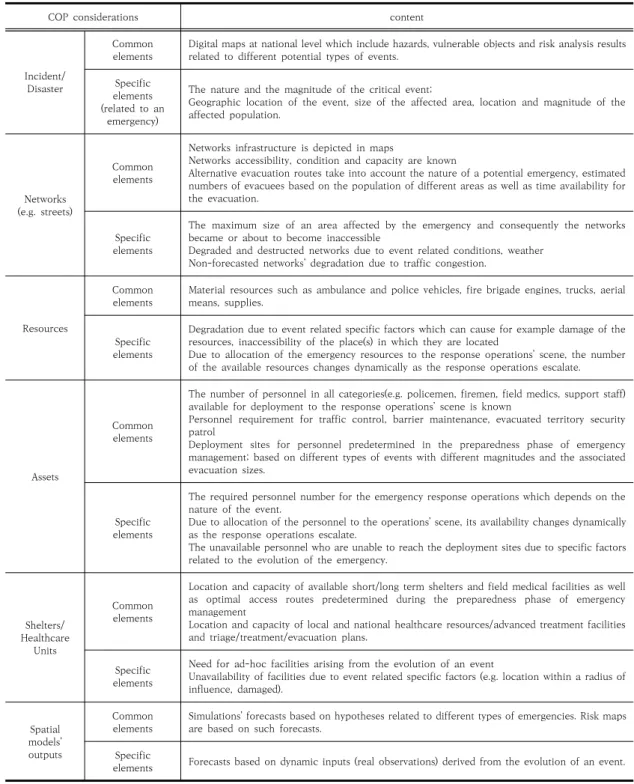
Table 1. Examples of common and variable elements included in a COP.
COP considerations content
Incident/
Disaster
Common
elements Digital maps at national level which include hazards, vulnerable objects and risk analysis results related to different potential types of events.
Specific elements (related to an
emergency)
The nature and the magnitude of the critical event;
Geographic location of the event, size of the affected area, location and magnitude of the affected population.
Networks (e.g. streets)
Common elements
Networks infrastructure is depicted in maps
Networks accessibility, condition and capacity are known
Alternative evacuation routes take into account the nature of a potential emergency, estimated numbers of evacuees based on the population of different areas as well as time availability for the evacuation.
Specific elements
The maximum size of an area affected by the emergency and consequently the networks became or about to become inaccessible
Degraded and destructed networks due to event related conditions, weather Non-forecasted networks’ degradation due to traffic congestion.
Resources
Common
elements Material resources such as ambulance and police vehicles, fire brigade engines, trucks, aerial means, supplies.
Specific elements
Degradation due to event related specific factors which can cause for example damage of the resources, inaccessibility of the place(s) in which they are located
Due to allocation of the emergency resources to the response operations’ scene, the number of the available resources changes dynamically as the response operations escalate.
Assets
Common elements
The number of personnel in all categories(e.g. policemen, firemen, field medics, support staff) available for deployment to the response operations’ scene is known
Personnel requirement for traffic control, barrier maintenance, evacuated territory security patrol
Deployment sites for personnel predetermined in the preparedness phase of emergency management; based on different types of events with different magnitudes and the associated evacuation sizes.
Specific elements
The required personnel number for the emergency response operations which depends on the nature of the event.
Due to allocation of the personnel to the operations’ scene, its availability changes dynamically as the response operations escalate.
The unavailable personnel who are unable to reach the deployment sites due to specific factors related to the evolution of the emergency.
Shelters/
Healthcare Units
Common elements
Location and capacity of available short/long term shelters and field medical facilities as well as optimal access routes predetermined during the preparedness phase of emergency management
Location and capacity of local and national healthcare resources/advanced treatment facilities and triage/treatment/evacuation plans.
Specific elements
Need for ad-hoc facilities arising from the evolution of an event
Unavailability of facilities due to event related specific factors (e.g. location within a radius of influence, damaged).
Spatial models’
outputs
Common
elements Simulations’ forecasts based on hypotheses related to different types of emergencies. Risk maps are based on such forecasts.
Specific
elements Forecasts based on dynamic inputs (real observations) derived from the evolution of an event.
Source: quoted in Giaoutzi and Scholten, 2017, 23
3.3 COP 구성요소
앞 절을 통해 COP가 군부대에서 뿐만 아니라 긴급 상 황과 같은 재난상황 발생시에도 다양하게 활용되고 있음 을 확인하였다. 본 절에서는 COP 적용사례를 바탕으로 재난 대응시 활용되어진 COP정보의 구성요소들을 분석 하였다. 이때 재난대응을 위해 활용되어진 정보요소들을 사고 정보, 네트워크 정보, 자원 및 재원 정보, 보호소 정 보, 지리적 공간 정보로 구분하였으며 공통적인 요소와 변동성이 가능한 정보에 대하여 재정의 하였다(Table 1).
4. 국내 공식보고 자료의 정보요소 분석
본 연구에서 활용한 국내 자료로는 각 부처에서 발행 한 일일상황보고와 같은 공식자료로서 풍수해 재난대응 을 직접적으로 관리하고 있는 행정안전부의 자료를 바탕 으로 하였다. 실제 재난사례를 기준으로 자료를 수집하였 기 때문에 행정안전부 뿐 만 아니라 이전의 국민안전처 포털에 게시되어있는 일일상황보고 자료와 대처상황보고 자료를 수집하여 재난대응 및 상황 파악 등에 직접적으 로 관련성이 높은 자료들을 중심으로 분석을 실시하였다.
현재 행정안전부에서는 일일상황보고를 재난관리실에 서 담당하여 발행하고 있었으며, 2017년 9월 25일 전까 지는 국민안전처에서 이를 담당하였다. 태풍 차바를 기점 으로 국민안전처와 행정안전부의 포털을 대상으로 일일 상황보고 및 대처상황보고 자료를 수집하였으며, 이를 분 석한 결과 총 2,003건에서 풍수해와 관련이 있는 데이터 는 833건으로 집계되었다(Table 2).
Table 2. Data collection scope and duration
Category Term N storm and
flood N Source MPSS 16.10.1.~17.
9.24 597 228 http://www.m
pss.go.kr MOIS 17.9.25-19.
12.31 1408 605 http://www.m
ois.go.kr Total 16.10.1-19.
12.31 2005 833
*MPSS : Ministry of Public Safety and Security
*MOIS : Ministry of the Interior and Safety
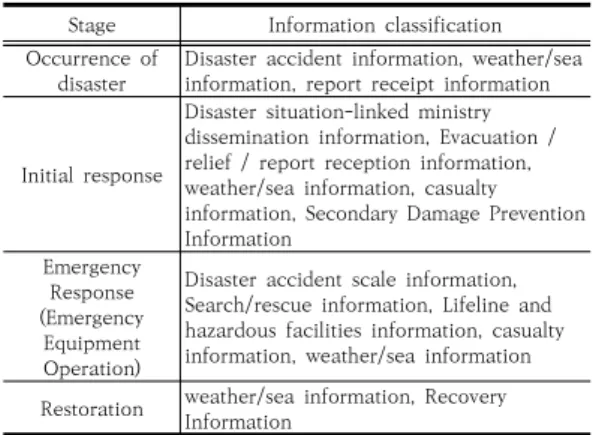
또한 일일상황보고와 대처상황보고 등에 포함되어 있 는 주요 정보요소들을 풍수해 표준매뉴얼에서 제시하고 있는 4개 단계에 맞추어 분석한 결과 Table 3과 같은 결 과가 도출되었다.
Table 3. Standard Manual Response Step-by-Step Information Element
Stage Information classification Occurrence of
disaster Disaster accident information, weather/sea information, report receipt information Initial response
Disaster situation-linked ministry dissemination information, Evacuation / relief / report reception information, weather/sea information, casualty information, Secondary Damage Prevention Information
Emergency Response (Emergency
Equipment Operation)
Disaster accident scale information, Search/rescue information, Lifeline and hazardous facilities information, casualty information, weather/sea information Restoration weather/sea information, Recovery
Information
5. COP 기반 정보요소 도출 : 풍수해
풍수해의 경우 대규모 피해를 야기하며 시간차를 두고 각 지역별로 피해가 발생한다는 특징을 가진다. 더욱이 기상요인에 가장 큰 영향을 많이 받는 재난유형으로서 미리 예방을 한다고 할지라도 지역적 특성으로 인해 피 해가 야기되기도 한다. 즉 풍수해가 발생하기 최소 3,4일 전부터 기상정보를 통해 해당 사실을 미리 인지하고 예 방작업을 해둔다 하더라도 산사태위험지역, 침수위험지 역 등과 같이 지형적인 요건으로 인해 피해가 발생하게 된다. 이는 결국 지형적인 특성 정보와 피해가 예상되는 지역에 대한 정보들이 복합적으로 활용되어 대응계획을 수립해야 함을 의미한다.
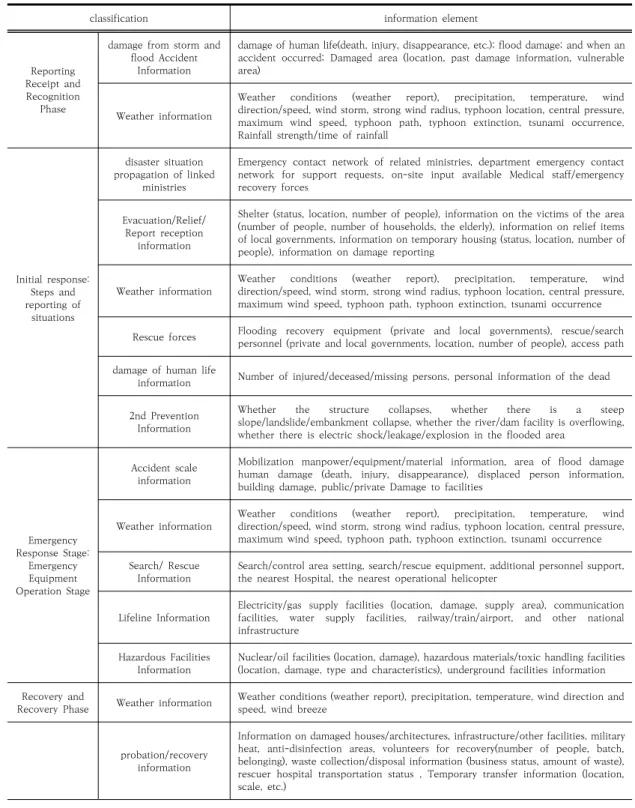
본 연구를 통해 도출한 COP 기반 상황판 정보요소의 경우 지도가 가진 공간적 요소와 지리적 정보들을 모두 고려하고 있어 복합적인 의사결정과 재난대응에 필요한 지원 사항들을 신속하게 확인할 수 있다. 더욱이 풍수해 표준매뉴얼에서 제시하고 있는 재난대응 단계인 4개의 단계로 구분하고 있어 각 단계별로 필요로 하는 정보요 소를 확인할 수 있다.
첫 번째 단계인 신고접수 및 인지단계는 재난발생 단 계이자 태풍정보 입수단계로서 풍수해의 초기 사고정보 와 기상정보로 구분하여 정보를 도출하였다. 사고정보에 는 초기 피해지역과 피해의 현 상황을 빠르게 파악할 수 있는 지리적 특성 정보를 바탕으로 과거 피해사례, 피해 위치, 취약지역 여부 등의 정보들을 도출하였으며, 풍수 해 특성상 주시해야하는 기상정보를 초기 단계에서 같이 확인 할 수 있도록 사고정보와 함께 구성하였다.
Table 4. Examples of common and variable elements included in a COP(The storm and flood)
classification information element
Reporting Receipt and Recognition
Phase
damage from storm and flood Accident
Information
damage of human life(death, injury, disappearance, etc.); flood damage; and when an accident occurred; Damaged area (location, past damage information, vulnerable area)
Weather information
Weather conditions (weather report), precipitation, temperature, wind direction/speed, wind storm, strong wind radius, typhoon location, central pressure, maximum wind speed, typhoon path, typhoon extinction, tsunami occurrence, Rainfall strength/time of rainfall
Initial response:
Steps and reporting of
situations
disaster situation propagation of linked
ministries
Emergency contact network of related ministries, department emergency contact network for support requests, on-site input available Medical staff/emergency recovery forces
Evacuation/Relief/
Report reception information
Shelter (status, location, number of people), information on the victims of the area (number of people, number of households, the elderly), information on relief items of local governments, information on temporary housing (status, location, number of people), information on damage reporting
Weather information Weather conditions (weather report), precipitation, temperature, wind direction/speed, wind storm, strong wind radius, typhoon location, central pressure, maximum wind speed, typhoon path, typhoon extinction, tsunami occurrence Rescue forces Flooding recovery equipment (private and local governments), rescue/search
personnel (private and local governments, location, number of people), access path damage of human life
information Number of injured/deceased/missing persons, personal information of the dead 2nd Prevention
Information
Whether the structure collapses, whether there is a steep slope/landslide/embankment collapse, whether the river/dam facility is overflowing, whether there is electric shock/leakage/explosion in the flooded area
Emergency Response Stage:
Emergency Equipment Operation Stage
Accident scale information
Mobilization manpower/equipment/material information, area of flood damage human damage (death, injury, disappearance), displaced person information, building damage, public/private Damage to facilities
Weather information Weather conditions (weather report), precipitation, temperature, wind direction/speed, wind storm, strong wind radius, typhoon location, central pressure, maximum wind speed, typhoon path, typhoon extinction, tsunami occurrence Search/ Rescue
Information Search/control area setting, search/rescue equipment, additional personnel support, the nearest Hospital, the nearest operational helicopter
Lifeline Information Electricity/gas supply facilities (location, damage, supply area), communication facilities, water supply facilities, railway/train/airport, and other national infrastructure
Hazardous Facilities
Information Nuclear/oil facilities (location, damage), hazardous materials/toxic handling facilities (location, damage, type and characteristics), underground facilities information Recovery and
Recovery Phase Weather information Weather conditions (weather report), precipitation, temperature, wind direction and speed, wind breeze
probation/recovery information
Information on damaged houses/architectures, infrastructure/other facilities, military heat, anti-disinfection areas, volunteers for recovery(number of people, batch, belonging), waste collection/disposal information (business status, amount of waste), rescuer hospital transportation status , Temporary transfer information (location, scale, etc.)
두 번째 단계인 상황전파 및 보고단계는 다수의 피해 상황들이 각 지자체로 접수되는 단계로서 재난상황 연계 부처, 대피·구호·신고접수, 구조현황, 인명피해, 2차 피해 예방으로 구분하여 정보요소를 도출하였다.
세 번째 단계인 비상기구 운영단계는 중앙재난안전대 책본부가 가동되는 시점으로 대규모 피해가 우려되는 상 황이라 할 수 있다. 이 단계에서는 현 피해규모, 수색·구 조, 시설정보 등으로 구분하여 정보를 도출하였다. 해당 단계의 경우 응급복구가 진행되는 상황으로서 복구에 대 한 인력 및 장비 등의 추가 지원과 발 빠른 인명구조 등 이 이루어져야 하므로 해당 정보들을 중심한 정보요소들 을 도출하였다.
마지막 단계인 수습·복구 단계의 경우 재난대응의 막 바지 단계로서 풍수해로 인한 피해를 추산하며, 시설복구 에 중심을 두고 대응한다. 해당 단계에서는 피해를 입은 기반시설 및 건축물 등의 정보와 풍수해로 인해 발생한 폐기물, 방역 등을 중심으로 정보요소를 도출하였다. 최 종 도출된 COP 기반 상황판 정보요소는 Table 4와 같다.
6. 결론
국내에 운영되고 있는 상황실의 경우 단순히 정보전달 에 급급하거나 현장과 상황실간의 의사소통이 제대로 이 루어지지 않는 등 정보공유에 있어 어려움을 겪고 있다.
본 연구에서는 효율적인 정보공유 및 상황실 운영을 위 하여 새로운 재난대응 인프라 도입이 필요하다 보았고, 이를 위해 국내에 적용되지 않은 COP의 개념을 바탕으 로 한 기초연구를 수행하였다. 특히 매년 발생하는 재난 유형 중 하나인 풍수해를 중심으로 COP기반 상황판 운 영시 필수적으로 고려해야할 정보요소들을 도출하였다.
COP 기반 상황판 정보요소는 표준매뉴얼에서 제시하고 있는 재난단계별로 ①신고접수 및 인지단계, ②상황전파 및 보고단계, ③비상기구 운영단계, ④수습·복구단계 총 4개의 단계로 구분하였다. 각 단계별로 필요한 정보 요소 들을 크게 사고규모, 구조/복구, 2차 피해, 라이프라인 시설 등으로 구분하였고 해당 항목별로 세부 정보요소들 을 도출하여 필수적으로 상황판에 공유되어야 하는 정보 요소들을 확인할 수 있도록 하였다. COP 기반 상황판 활 용은 공간적·지리적 특성을 다른 정보와 함께 공유하기 때문에 재난대응 및 상황관리를 담당하는 의사결정권자 들과 담당자들에게 단일한 정보가 아닌 복합적인 정보를 제공함으로써 재난 상황에 대한 다각적인 접근을 가능하
게 한다. 또한 해당 정보들이 각 부처에 공통적으로 공유 됨으로써 재난대응이 보다 효율적이고 신속하게 이루어 질수 있을 것으로 기대된다. 그러나 아직 COP기반의 기 초연구에 그치는 만큼 COP 활용과 관련한 추가 연구가 필요하다는 한계가 존재하므로 지속적인 연구가 이루어 져야 할 것으로 판단된다.
References
[1] S. B. Jung, I. Y. Oh, D. J. Kim, D. J. Kim, “Analysis Report on Influence of the Korean Peninsula (2018)”, Analysis Report, National Typhoon Center of the Korea Meteorological Administration's Forecasting Bureau, Korea, pp.7, Feb 2019.
[2] S. B. Jung, I. Y. Oh, D. J. Kim, D. J. Kim, “Analysis Report on Influence of the Korean Peninsula (2019)”, Analysis Report, National Typhoon Center of the Korea Meteorological Administration's Forecasting Bureau, Korea, pp.7, Feb 2020.
[3] D. H. Kim, “A Study on the Establishment of an Efficient Disaster Management System: Focused on the Jeju area”, Master’s thesis, Kangwon National University of Industrial Science, pp. 1, Feb 2010.
[4] G. Lee, I. S. Jung, “Classification of Disaster Safety Data Management System based on Daily Situation Report”, Journal of the Korea Academia-Industrial cooperation Society, vol.20, no.9, pp.290-298, Sep.
2019.
DOI: https://doi.org/10.5762/KAIS.2019.20.9.290 [5] C. Y. Lee, G. J. Park, T. H. Kim, H. S. Lee, “A Study of
the Situation Based Disaster Response Model from the Damage of Storm and Flood Field Manual”, vol.15, no.4, pp. 617-625, December 2019
DOI: https://doi.org/10.15683/kosdi.2019.12.31.617 [6] J.Y. Cho, “Job Analysis of the Disaster Situation
Management Personnel Working in National Disaster and Safety Status Control Center”, Master’s thesis, Seoul University of Administration, Seoul, Korea, pp.5, Aug. 2016.
[7] M. K. Chung, “Study on the effect of expression type of information design for disaster response on the attitude of recipients: focusing on the cognitive response by age group”, Master’s thesis, Hongik University of Design, Seoul, Korea, pp.15-18, Aug.
2016.
[8] J. S. Lee, “A Study on Monitoring System Improvement Strategy for Comprehensive Disaster Situation Room”, Master’s thesis, Gyeonggi University of Construction Industry Co., Ltd., Gyeonggi, Korea, pp.10, Feb. 2014.
[9] H. E. Koo, “A Study on the Problem Analysis and Response Strategies for Fire-Fighting Related to the Complex Building in Jecheon and Sejong Hospital in
Miryang”, Final Report, Korean Fire and Disaster Prevention Association, korea, pp.59-66, July. 2018.
[10] G.S, Wi, “Reseach Topics on Strategies for Advancement in Korean Emergency Management System focused on Emergency Preparedness”, Final Report, National Emergency Management Agency, korea, pp.183-187, March. 2013.
[11] B. R. Norquist, “Common Operating Picture and Planning Environment for Disaster Response”, North American Aerospace Defense Command, United States, pp.1-2, June. 2008.
[12] M. Giaoutzi, H. J. Scholten, “A Common Operational Picture in Support of Situational Awareness for Efficient Emergency Response Operations”, Journal of Future Internet, vol.2, no.1, pp.10-35, Jully. 2017.
조 정 윤(Jung-Yun Cho) [정회원]
• 2019년 2월 : 경기대학교 일반대 학원 범죄학과 (범죄학석사)
• 2019년 3월 ~ 현재 : 경찰대학교 치안대학원 공공안전학과 (박사과 정)
• 2019년 5월 ~ 현재 : ㈜부린 부설 연구원
<관심분야>
공공안전, 방재
송 주 일(Ju-il Song) [정회원]
• 2008년 2월 : 경기대학교 일반대 학원 토목공학과 (공학석사)
• 2012년 8월 : 경기대학교 일반대 학원 토목공학과 (공학박사)
• 2014년 4월 ~ 2015년 12월 : (특)한국방재협회 책임연구원
• 2016년 1월 ~ 현재 : ㈜부린 부설 연구소 수석연구원
<관심분야>
수자원, 방재
장 초 록(Cho-Rok Jang) [정회원]
• 2015년 2월 : 경기대학교 일반대 학원 범죄학과 (범죄학석사)
• 2018년 6월 ~ 현재 : ㈜부린 부설 연구소 선임연구원
<관심분야>
수자원, 방재
장 문 엽(Moon-Yup Jang) [정회원]
• 2011년 8월 : 아주대학교 일반대 학원 건설교통공학과 (토목학석사)
• 2016년 10월 ~ 현재 : ㈜부린 부 설연구소 책임연구원
<관심분야>
수자원, 방재