• 검색 결과가 없습니다.

Anti-microbial and Anti-inflammatory Activity of New 4-methoxy-3-(methoxymethyl) Phenol and (E)-N'-(5-bromo-2-methoxybenzylidene)-4-methoxy Benzohydrazide Isolated from Calotropis gigantean white

N/A
N/A
Protected

Academic year: 2022

Share "Anti-microbial and Anti-inflammatory Activity of New 4-methoxy-3-(methoxymethyl) Phenol and (E)-N'-(5-bromo-2-methoxybenzylidene)-4-methoxy Benzohydrazide Isolated from Calotropis gigantean white"

Copied!
6
0
0

로드 중.... (전체 텍스트 보기)

전체 글

(1)

https://doi.org/10.20307/nps.2017.23.1.69

69

Anti-microbial and Anti-inflammatory Activity of New 4-methoxy-3-

(methoxymethyl) Phenol and (E)-N'-(5-bromo-2-methoxybenzylidene)-4-methoxy Benzohydrazide Isolated from Calotropis gigantean white

R. Manivannan* and R. Shopna

Department of Chemistry, Government Arts College (Autonomous), Kumbakonam, Tamilnadu-612001, India

Abstract − A new phenol and hydrazide derivatives were obtained for the first time from the C. giganteawhite by silica gel column chromatography. The structure of the isolated compounds was identified by UV, IR NMR and MS. C. gigantea was scientifically reported for several medicinal properties viz. analgesic, antimicrobial and cytotoxic. In this screening work, anti-microbial activity of test compounds was found to be active against all organisms. Additionally, anti-inflammatory activity of the test groups has reduced the thickness of edema of the hind paw compared to the control group.

Keywords − Calotropis gigantea white, anti-microbial activity, Anti-inflammatory activity, 4-methoxy-3-(methoxymethyl) phenol, (E)-N'-(5-bromo-2-methoxybenzylidene)-4-methoxy benzohydrazide

Introduction

Calotropis gigantiea L. (Apocynaceae) locally known as ‘badabadam’ or ‘erruku’ is common to Africa and Asia and widely available throughout India, Srilanka, Nepal, Maldives, South China and Malaysia as per the reports of Flora of Pakistan.

1

The plants produce white or violet colored flower in bunches, much branched, tall, erect, large and enduring with latex throughout. Ethanobotanical and common plants serve as a rich of natural drugs for research and development. C. giganteais frequently available in India and used for several medication purposes in the traditional medicinal system.

2

It is scientifically reported for several medicinal properties viz. analgesic, antimicrobial and cytotoxic,

3

anti-diarrheal

4

and antipyretic activity.

5

Thus, over 50% of modern drugs used are of natural products origin and therefore, these natural products play an important role in the drug development in phar- maceutical industry.

6

Generally, bacteria have the genetic ability to transmit and acquire resistance to drugs that are used as therapeutic agents. The only way to prevent antibiotic by the resistance bacteria is to use new compounds which are not comparable to the existing synthetic antimicrobial agents.

7

In order to promote the

use of medicinal plants as potential sources of antimicrobial agents, it is important to thoroughly investigate their composition and activity and thus to validate their use.

8

Inflammation is considered as a primary physiologic defense mechanism that helps the body to protect itself against infection, burn, toxic chemicals, allergens or other noxious stimuli.

9

Nonsteroidal anti-inflammatory drugs (NSAIDs), steroidal drugs and immune suppressant drugs, which have been usually used for the relief of inflammation worldwide, are often associated with severe side effects such as gastrointestinal bleeding and peptic ulcer.

10

Therefore, the development of potent anti-inflammatory drugs with fewer side effects is necessary. The present study describes the isolation and structural elucidations of phenol and hydrazide derivatives obtained for the first time from the C. giganteawhite and to study its anti- microbial activity by disc diffusion method and anti- inflammatory activity in a carrageenan-induced paw edema bioassay in male albino rats.

Experimental

General experimental procedures − Melting points were determined using SMP20 melting point apparatus (Fisher Scientific Ltd, UK) without correction. UV spectrum was recorded on Ultraviolet spectrophotometer (UV2550, Shimadzu, Japan) and IR spectrum was recorded on FT-IR spectrograph (Perkin Elmer Spectrophotometer,

*Author for correspondence

R. Manivannan, Department of Chemistry, Government Arts Col-

lege (Autonomous), Kumbakonam, Tamilnadu-612001, India

Tel: +91- 9095715550; E-mail: [email protected]

(2)

USA) with KBr tablets from 4000 to 400 cm

−1

with 2 cm

−1

resolution.

1

H and

13

C-nuclear magnetic resonance (NMR) spectra were recorded with a Bruker AMX 400 NMR (Bruker Company, Faelladen, Switzerland) spectrometer in CDCl

3

using tetramethylsilane (TMS) as an internal standard. Chemical shifts were reported in parts per million ( δ) and coupling constants (J) were expressed in Hertz (Hz). Repeated column chromatography (CC) was performed on silica gel 60 as stationary phase (particle size 0.04 - 0.036 mm, 230 - 400 mesh, ASTM E. Merck, Germany) and activated by heating at 110

o

C for one hour before use. All the other chemicals and reagents were of analytical grade.

Plant material − Fresh flowers of Calotropis gigantea white (Apocynaceae) was randomly collected in the month of December from the Siva temple at Kumbakonam, Thanjavur District, Tamilnau (India) and verified by Prof.

N. Ramakrishnan, Head and Associate Professor, (Department of Botany) and a voucher specimen (No.

GACBOT-209) was deposited in the Herbarium of Botany Department at Government Arts College (Autonomous), Kumbakonam, Bharathidasan University, India.

Extraction and isolation − The air-dried flowers (1.5 kg) of C. giganteawhite were extracted with 90%

methanol (MeOH) (6 × 500 mL) under reflux. The methanolic extract was evaporated to dryness (136.5 g) under reduced pressure at 40

o

C. The dried MeOH extract (60.8 g) was then eluted by using different solvent systems (chloroform, ethyl acetate) in a column chroma- tography packed with silica gel (silica gel: 60). Three further extractions of the plant material, using the same procedure, yielded additional amounts respectively of crude material. These fractions were collected and the solvents were recovered by simple distillation and concentrated in vacuo and left in an ice-chest for a week.

The chloroform fraction (15.3 g) was further subjected to silica gel column chromatography (eluent: n-hexane-ethyl acetate 9.1 v/v) to obtain compound 1 (3.9 g). The ethyl acetate fraction (13.1 g) was evaporated under reduced pressure to obtain the crude form, which was purified by column chromatography (eluent: 5% ethyl acetate/

petroleum ether) to afford compound 2 (6.7 g) as a brown solid and recrystallized from hot methanol.

Antibacterial and antifungal activities − Anti-microbial activity was carried out by the method originally described by Bauer et al.

11

Bacterial strains of Escherichia coli (MTCC 62), Staphylococcus aureus (MTCC 87) and fungal strains of Aspergillus flavus (MTCC 96), Aspergillus niger (MTCC 107) Candida albicans (MTCC 118) were obtained from Microbial Type Culture Collection Centre

(MTCC), Chandigarh, India. Muller Hinton agar was prepared and autoclaved at 15 lbs pressure for 20 minutes and cooled to 45

o

C. The cooled media was poured onto sterile Petri plates and allowed for solidification. The plates with media were seeded with the respective microbial suspension using a sterile swab. The isolated compounds were dissolved in 2% dimethyl sulfoxide (DMSO) and individually placed on the each Petri plates along with the control and standard (streptomycin and amphotericin).

The plates were incubated at 37

o

C for 24 h. After the incubation period, the zone of inhibition surrounding the discs was measured using a transparent ruler and the diameter was measured in mm.

Anti-inflammatory activities by carrageenan-induced paw edema − The anti-inflammatory activity of the test compounds was evaluated in male albino rats (200 - 250 g).

The animals were divided into control, standard and different test groups, each consisting of six animals and were kept under standard conditions (26 ± 2

o

C relative humidity 60 - 65% and 12 h light and 14 h dark cycles) for a week prior to the experiment. The test groups were dose with 100 and 200 mg/kg of test compounds 1 and 2 respectively and 100 mg/kg diclofenac sodium was admi- nistered to the standard group by the oral route. Control group animals were received 1% DMSO at the dose of 10 ml/kg body weight. They are housed in cages and kept under standard conditions for one week. The experimental protocol was subjected to the scrutiny of the Institutional Animal Ethics Committee (IAEC), Bharathidasan University, Trichirappalli, Tamilnadu, India (Approval No. BDU/

IAEC/2011/31/29.03.2011). Acute inflammation was in- duced by the subplantar administration of 0.1 mL of 1%

carrageenan in the right paw. Paw volume was measured by using digital plethysmometer (Ugo Basile-Italy) before treatment (V

0

). After one hour 0.1 mL of carrageenan was administered into the subcutaneous tissue of the plantar surface in the right hind paw. Then the volume of the paw was noted at 1

st

, 2

nd

and 3

rd

hour after carrageenan administration (V

T

). The efficacy of different groups was tested on its ability to inhibit paw edema by comparing the control group. The increase in the volume of paw edema ( ΔV) was expressed as

Volume of edema ( ΔV) = Final Paw Volume (V

T

) − Initial Paw Volume (V

0

) Statistical analysis − All data are presented as the mean ± SD. The data were analyzed using the one-way ANOVA analyzed using Duncan’s multiple range tests and the statistical significance was defined as P < 0.05.

4-methoxy-3-(methoxymethyl) Phenol (1) − Brown

(3)

solid (CHCl

3

); mp 66 - 68

o

C; UV (log ε) 220, 280, 320 nm; IR (KBr): ν

max

3560, 3000, 2900, 1610, 1602, 1280, 1030, 820, and 710 cm

−1

; M

+

m/e : 167.4905 (C

9

H

12

O

3

);

1

H-NMR (CDCl

3

, 400 MHz): δ 7.04 (1H, dd, J = 1.38, 2.82 Hz, H-2), 6.69 (2H, dd, J = 2.82, 8.66 Hz, H-5, H-6), 3.69, 3.41 (each 3H, s, 4-OCH

3

and 3-OCH

3

), 4.69 (1H, s, 3-CH

2

);

13

C-NMR (CDCl

3

, 125 MHz): δ 154.8 (C-1); 115.9 (C-2); 129.05 (C-3); 152.1 (C-4);

113.16 (C-5); 117.23(C-6); 55.66 (C-7); 73.81 (C-8);

56.97 (C-9).

(E)-N'-(5-bromo-2-methoxybenzylidene)-4-methoxy benzohydrazide (2) − Brown solid (ethyl acetate-methanol);

mp 66 - 68

o

C; UV (log ε) 275, 325, 380 nm; IR (KBr): ν

max

3290, 3060, 3050, 3035, 3019, 2995, 1670, 1610, 1580, 1530, 690 cm

−1

; M

+

m/e : 363.1493 (C

16

H

15

BrN

2

O

3

);

1

H-NMR (CDCl

3

, 400 MHz): δ 7.61 (1H, d, J = 8.3 Hz, H-3), δ 6.97 (1H, dd, J = 8.4, 2.0 Hz, H-4), δ 6.82 (1H, d, J = 2.0 Hz, H-6), 8.18 (CH=N), 7.26 (2H, dd, J = 8.8 Hz, H-10, H-14), 6.80 (2H, dd, J = 8.8 Hz, H-11, H-13) 3.84, 3.85 (each 3H, s, 15-OCH3 and 16- OCH

3

), 12.3 (NH);

13

C-NMR (100 MHz, CDCl

3

): 56.33 (OCH

3

-15), 56.19 (OCH

3

-16), δ 161.3 (C-2), 113.7 (C-3), 134.2 (C-4, C-6), 127.2 (C-5), 140.6 (C-7), 163.7 (C-8), 129.8 (C-9), 132.3 (C-10, C-14), 118.8 (C-11, C-13), 162.1 (C-12,).

Result and Discussion

Structural elucidation of the isolated compounds − The present study describes the isolation, anti-microbial and anti-inflammatory activity of 4-methoxy-3-(metho- xymethyl) phenol(1) and (E)-N'-(5-bromo-2-methoxy- benzylidene)-4-methoxy benzohydrazide (2) from the flower extract of Calotropis gigantea white. Methoxy phenol derivatives are used in formulating analgesics, biocides, antitumor, hepatoprotective, anti-inflammatory, anti-ulcer, antimicrobial, and antiviral activities.

12

Hydrazide derivatives possess interesting biological activities such as analgesic,

13,14

antimicrobial

15

anti-inflammatory

16

and anti- cancer activities.

17

The hydrazide (HC=N–NH–CO–) moiety also plays an important role as antitumor agents.

18,19

Furthermore, compounds 1 and 2 were reported for the first time in C. gigantea white and also the antimicrobial and anti-inflammatory studies were conducted. The structures of the compounds (Fig. 1) were characterized and confirmed by FT-IR,

1

H NMR,

13

C NMR spectral studies.

The molecular formula of compound 1 (C

9

H

12

O

3

) was established by the [M+H]

+

ion peak at m/z 167.4905 in the HRESIMS spectrum. The GC/MS data showed a

major peak at the retention time of 11.38. The mass spectrum of compound 1 contains peaks at m/z 150.40 and 120.32 that corresponds to the ions formed by the loss of methyl radicals (15 mu) from the aromatic methoxy group. This molecular formula was confirmed by elemental analysis as follows, anal. C - 64.37 (calcd, 64.24); H - 7.09 (calcd, 7.14); O - 28.58 (calcd, 28.65)

%.The UV-VIS spectrum consists of three absorption maxima at 220, 280, and 320 nm. The absorption bands in the spectra mainly result from → * transitions of the aromatic electrons and n → * transitions of the electrons from lone pairs of the hydroxy and methoxy groups.

20

IR absorptions at 3560, 1610, and 1602 and 1280 cm

−1

indicate the presence of a phenolic group. The band at 1040 cm

−1

was assigned to symmetrical stretching between –CH

3

and -OCH

3

group. The

1

H-NMR spectrum of compound 1 showedan ABX-type of signal pattern appeared at δ 7.04 (1H, d, J = 2.82 Hz), 6.69 (2H, dd, J = 2.85, 8.66 Hz) was assigned to H-2, H-5 and H-6 indicated the presence of 1, 3, 4-trisubstituted aromatic ring. The tri-substituted aromatic ring was further con- firmed by

13

C-NMR spectrum which displayed signals for substituted carbons at δ 154.8 (C-1), 129.05 (C-3), 152.1 (C-4). The downfield shift of C-3 and C-4 in comparison to C-1 indicates that these carbons bear oxygen functions.

A sharp signals at δ 3.69 and δ 55.66 ppm was due to the presence of electron donating groups like (-OCH

3

) at C-7.

Also, the

1

H NMR signals observed at δ 4.69 and δ 3.41, with 2 and 3 proton intensities respectively, were assigned to methyl and methoxy protons of the methoxymethyl group. On the basis of the above spectral evidence compound, 1 was characterized as 4-methoxy-3-(methoxy- methyl) phenol.

Compound 2 was obtained as brown solid. The molecular formula (C

16

H

15

BrN

2

O

3

) was established by the molecular ion peak at m/z 363.1493 in the ESI-MS spectrum. This molecular formula was confirmed by elemental analysis as follows, anal. C -52.84 (calcd, 52.92); H -4.17 (calcd, 4.12); N -7.61 (calcd, 7.76); Br -21.89 (calcd, 22.0); O -13.32 (calcd, 13.24) %. In the structure of the compound (Fig. 1) the molecule exists in λ

maxMeOH

λ

maxMeOH

Fig. 1. Chemical structures of compounds 1 and 2 isolated from

Calotropis gigantea white.

(4)

an E configuration with respect to the methylidene unit and the molecules are linked by intermolecular N - H

O hydrogen bonds involving carbonyl and amine functio- nalities, to form chains.

21

UV-absorption spectra of the hydrazide showed three absorption maxima at 275, 325 and 380. The higher energy bands region at 275 nm were due to the excitation of π electrons (π → π* transitions) in the aromatic chromophore. The second band at 325 nm range was assigned to n → π* transition within the C=N group, while the longer wavelength at 380 nm was due to an intramolecular charge transfer involving the whole molecule.

22

In the IR spectra, the absorption for NH bands was observed in the region of 3290 cm

−1

and the two azomethine groups exhibited C=N and -O=C-N- stretching frequencies in the region of 1610 - 1670 cm

−1

. This was within the range reported for the similar group of Schiff base ligands.

23,24

Also IR spectrum showed Ar-H stretching band in the region 2995 cm

−1

, C=C stretching band at 1580 cm

−1

(in the aromatic ring) and C-Br band at 690 cm

−1

. The

1

H NMR spectrum showed one ABX type signal pattern which appeared at δ 7.61(1H, d, J = 8.3 Hz, H-3), δ 6.97 (1H, dd, J = 8.4, 2.0 Hz, H-4), δ 6.82 (1H, d, J = 2.0 Hz, H-6) and one set of AA`BB` type signals at δ 7.26 (2H, d, J = 8.8 Hz, H-10, H-14), and δ 6.80 (2H, d, J = 8.8 Hz, H-11, H-13), respectively. Also, methoxy protons signal were observed in the region of 3.85 – 3.84 ppm, while the

13

C NMR spectrum showed signals at δ 56.33 and 56.19 proving the existence of two methoxy groups respectively. In addition, one sharp peak at δ 12.3 ppm was due to the presence of one proton in -CONH.

Another sharp peak at δ 8.18 ppm was due to the azomethine proton (-CH=N) in the Schiff base. The

13

C NMR data were also in agreement with the formation of Schiff bases. Two peaks around δ 163.71 and δ 140.67 were attributed to C=O and C=N carbons respectively.

The chemical shifts between 113.06 - 134.24 ppm were consistent with those of the aromatic carbons in Schiff base ligands.

23,24

These spectroscopic data’s consistent with structure 2 as (E)-N'-(5-bromo-2-methoxybenzy- lidene)-4-methoxy benzohydrazide, which to the best of our knowledge is a new ingredient from natural resources.

Antibacterial and antifungal activities − The anti- bacterial activity of the plant C. giganteawhite examined in the present study was assessed qualitatively by measuring the inhibition zone diameters and quantitatively by determining minimum inhibitory concentrations. For the determination of zone of inhibition, pure Gram- positive, Gram-negative and fungal strains were taken along with a standard antibiotic (Ciprofloxacin and Amphotericin - B) for comparison of the results. A set of two dilutions (100 and 200 µg/mL) of test the compounds and standard drugs (Ciprofloxacin 200 µg/ml and Amphotericin B-200 µg/mL) were prepared in double distilled water using nutrient agar tubes. The results of the anti-microbial activities were presented in Table 1.

Isolated compound 1 at a 100 and 200 µg/mL showed 08

± 0.98 and 17 ± 1.28 mm zone of inhibition against E.

coli and compound 2 demonstrated significant inhibitory activity of 07 ± 0.84 and 14 ± 1.34 mm against it. On the other hand, the tested compound 1 at a 200 µg/mL showed the highest activity of 13 ± 1.85 mm inhibition zones against S. aureus whereas compound 2 at a 200 µg/

mL showed 11 ± 1.74 mm. Both isolated compounds showed better activity compared to standard drugs. Of the tested organisms, E. coli was highly resistant followed by S. aureus. In general, the activity of plant extracts is high on Gram-positive organism when compared to the Gram- negative organism. This finding was already reported

25,26

and could be explained by the different cell wall structures of these bacteria. Gram-negative bacteria possess an outer Table 1. Anti-microbial activity of phenol 4-methoxy-3-(methoxymethyl) phenol (1) and (E)-N'-(5-bromo-2-methoxybenzylidene)-4-methoxy benzohydrazide (2) extracted from Calotropis gigantea white

Micro organism

Zone of inhibition mm in diameter

Compound 1 Compound 2

Standard Antibiotic Concentration in µg/ml

100 200 100 200

Escherichia coli (MTCC 62) 08 ± 0.98 17 ± 1.28 07 ± 0.84 14 ± 1.34 18 ± 1.22*

Staphylococcus aureus (MTCC 87) 05 ± 0.65 13 ± 1.85 04 ± 0.24 11 ± 1.74 17 ± 1.98*

Aspergillus flavus (MTCC 96) 09 ± 0.36 14 ± 1.06 02 ± 0.88 09 ± 1.08 12 ± 1.04**

Aspergillus niger (MTCC 107) 10 ± 0.65 13 ± 1.55 05 ± 0.75 08 ± 1.57 12 ± 1.50**

Candida albicans (MTCC 118) 09 ± 0.30 16 ± 1.50 04 ± 0.45 12 ± 1.50 22 ± 1.60**

Standard-Ciprofloxacin*

Standard-Amphotericin - B**

Values are expressed in Mean ± Standard Deviation (M ± SD) (n=3)

(5)

phospholipidic membrane with structural lipopolysaccharide components which is not found in Gram-positive bacteria.

But the present study revealed a controversy report that gram-negative bacteria were more susceptible to the test compound than gram-positive bacteria. It may be due to the presence of a broad spectrum of antibacterial compounds in the flowers of C. giganteawhite.

The antifungal activities of the test compounds increased linearly with increase in the concentration of the extracts (µg/mL) as compared to standard drugs. These results revealed that the isolated compounds were more sensitive towards fungal as C. albicansshowed the good result as compared to A. niger and A. flavus. The growth inhibition zone ranged from 02 ± 0.88 to 16 ± 1.50 mm for fungal strains (Table 1). These results showed that the isolated compounds were found to be more effective against all the microbes tested. In this screening work, test com- pounds were found to be active against all organisms, such as Gram-positive, Gram-negative, and fungal strains.

Anti-inflammatory activities by carrageenan-induced paw edema − Inflammation is a response of living tissue to injury and involves activation of various enzymes, mediators, cell migration, tissue breakdown, and repair.

27

The most widely used primary test to screen new anti- inflammatory agent’s is to measure the ability of a compound to reduce local edema induced in the right paw by injection of an irritant.

28

Carrageenan induced hind paw edema is a suitable experimental animal model of acute inflammation.

29

The evaluation of anti-inflammatory activity of compounds 1 and 2 isolated from chloroform and ethyl acetate fractions from C. giganteawhite.

Carrageenan-induced paw edema takes place in three phases, the first phase (1 h after carrageen an induce) involves the release of serotonin and histamine from mast cells, a second phase (2 h) was provided by kinins and the third phase (3 h) was mediated by prostaglandins, the

cyclooxygenase and lipoxygenase products.

30

Edema was induced by injecting 0.1 mL of 1% carrageenan solution into six groups (six animals each). Group I served as negative control, whereas group II, III, IV and V test groups for the dose of 100 and 200 mg/kg respectively and group VI served as standard (diclofenac sodium).

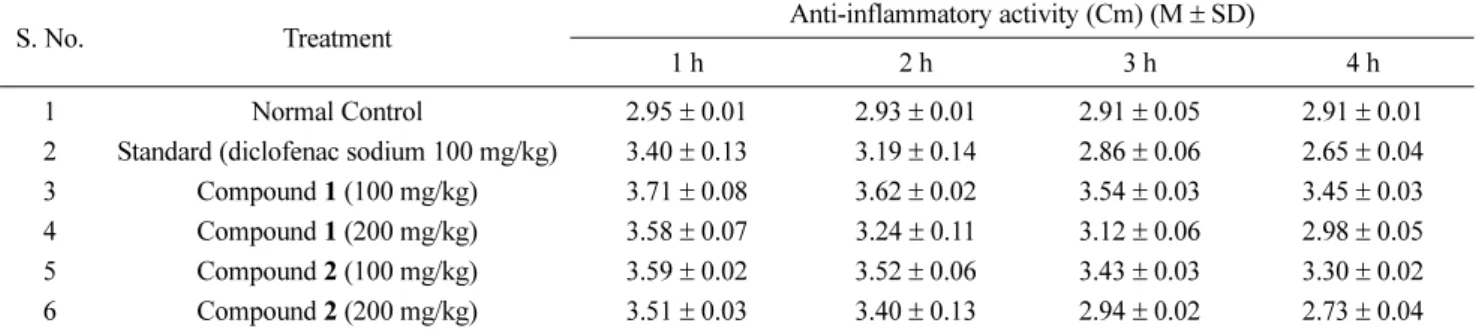
Table 2 clearly shows that the compounds 1 and 2 administered at two different doses demonstrated a good anti-inflammatory activity. As shown in the results, restraint of paw edema (after 3 h) at the dose of 100 and 200 mg/kg for test compound 1 is 3.45 ± 0.03 and 2.98 ± 0.05 and for test compound 2 3.30 ± 0.02 and 2.73 ± 0.04 respectively. It also confirms that the test compounds have significant anti-inflammatory effect as compared with standard diclofenac sodium (100 mg/kg) and there is the paw volume reduction of 2.65 ± 0.04. In the carrageenan induced rat paw edema, 4-methoxy-3-(methoxymethyl) phenol (1) and (E)-N'-(5-bromo-2-methoxybenzylidene)- 4-methoxy benzohydrazide (2) showed a significant inhi- bitory effect on the edema formation.

In conclusion, the presence of 4-methoxy-3-(methoxy- methyl) phenol (1) and (E)-N'-(5-bromo-2-methoxybenzy- lidene)-4-methoxy benzohydrazide (2) in the C. gigantea- white was reported for the first time. The phytochemicals from this plant can, therefore, be employed to demonstrate antimicrobial activity for the treatment of various bacterial and fungal infections and to show pronounced anti- inflammatory effects after three hours of injection. The resulting information will contribute to a better under- standing of the antimicrobial and anti-inflammatory activity of C. gigantea white.

References

(1) Subramanian, S. P.; Saratha, V. J. Pharm. Res. 2010, 3, 517-521.

(2) Kirtikar, K. R.; Basu, B.D. Indian Medicinal Plants: Volume III, 2nd Table 2. Anti-inflammatory activity of phenol 4-methoxy-3-(methoxymethyl) phenol (1) and (E)-N'-(5-bromo-2-methoxybenzylidene)-4- methoxy benzohydrazide (2) extracted from Calotropis gigantea white

S. No. Treatment Anti-inflammatory activity (Cm) (M ± SD)

1 h 2 h 3 h 4 h

1 Normal Control 2.95 ± 0.01 2.93 ± 0.01 2.91 ± 0.05 2.91 ± 0.01

2 Standard (diclofenac sodium 100 mg/kg) 3.40 ± 0.13 3.19 ± 0.14 2.86 ± 0.06 2.65 ± 0.04

3 Compound 1 (100 mg/kg) 3.71 ± 0.08 3.62 ± 0.02 3.54 ± 0.03 3.45 ± 0.03

4 Compound 1 (200 mg/kg) 3.58 ± 0.07 3.24 ± 0.11 3.12 ± 0.06 2.98 ± 0.05

5 Compound 2 (100 mg/kg) 3.59 ± 0.02 3.52 ± 0.06 3.43 ± 0.03 3.30 ± 0.02

6 Compound 2 (200 mg/kg) 3.51 ± 0.03 3.40 ± 0.13 2.94 ± 0.02 2.73 ± 0.04

Values are expressed in mean ± standard deviation (n=6).

One-way ANOVA (Dunnett’s method) Means for groups in homogeneous subsets are displayed.

There is no significant difference between standard and test drug at p > 0.05 significant level.

(6)

ed; International Book Distributors: India, 1999, pp191-192. pp420-422.

pp993-994. pp2045-2047.

(3) Habib, M. R.; Karim, M. R. Microbiology 2009, 37, 31-36.

(4) Chitme, H. R.; Chandra, M.; Kaushik, S.J. Pharm. Pharm. Sci.

2004, 7, 70-75.

(5) Chitme, H. R.; Chandra, R.; Kaushik, S. Phytother. Res. 2005, 19, 454-456.

(6) Jeyachandran, R.; Mahesh, A. Res. J. Micro. 2007, 2, 645-649.

(7) Shah, P. M. Clin. Microbiol. Infect. 2005, 11, 36-42.

(8) Nair, R.; Chanda, S. Indian J. Pharmacol. 2006, 38, 142-144.

(9) Denko, C.W.Biochemistry of Inflammation: The role of leukocyte chemotaxis in inflammation; Springer Netherlands: London, 1992, pp177- 181.

(10) Hajhashemi, V.; Sajjadi, S. E.; Heshmati, M. V.J. Ethnopharmacol.

2009, 124, 475-480.

(11) Bauer, A.W.; Kirby, W.M.; Sherries, J. C.; Turck, M. Am.

J.Clin.Pathol. 1966, 45, 493-496.

(12) Wright, D.A.; Payne, J.P.Br. J. Anesth. 1962, 34, 379-385.

(13) Leite, L.F.; Ramos, M. N.; da Silva, J.B.; Miranda, A.L.; Fraga, C.A.; Barreiro, E. J. Farmaco. 1999, 54, 747-757.

(14) Lima, P.C.; Lima, L.M.; da Silva, K. C.; Léda, P. H.; de Miranda, A. L.; Fraga, C.A.; Barreiro, E. J. Eur. J. Med. Chem. 2000, 35, 187-203.

(15) Loncle, C.; Brunel, J.M.; Vidal, N.; Dherbomez, M.; Letourneux, Y. Eur. J. Med. Chem. 2004, 39, 1067-1071.

(16) Todeschini, A.R.; De Miranda, A.L.P.; Da Silva, K. C. M.; Parrini, S. C.; Barreiro, E. J. Eur. J. Med. Chem. 1998, 33, 189-199.

(17) Terzioglu, N.; Gürsoy, A. Eur. J. Med. Chem. 2003, 38, 781-786.

(18) Abadi, H.; Eissa, A.A.; Hassan, G. S. Chem. Pharm. Bull. 2003, 51, 838-844.

(19) Kumar, D.; Maruthi Kumar, N.; Ghosh, S.; Shah, K. Bioorg. Med.

Chem. Lett. 2012, 22, 212-215.

(20) Ofner, J.; Krüger, H. U.; Grothe, H.; Schmitt-Kopplin, P.;

Whitmore, K.; Zetzsch, C. Atmos. Chem. Phys. 2011, 11, 1-15.

(21) Ban, H. Y.; Li, C. M. ActaCryst. Sec. 2008, E64, o2260.

(22) Liu, L.; Alam, M. S.; Lee, D. U. Bull. Korean Chem. Soc. 2012, 33, 3361-3367.

(23) Yin, H.D.; Hong. M.; Wang, Q.B.; Xue, S.C.; Wang, D. Q. J.

Organo.Chem. 2005, 690, 1669-1676.

(24) Yin, H.D.; Chen, S. W. Inorg. Chim. Acta 2006, 359, 3330-3338.

(25) Gangoué-Piéboji, J.; Pegnyemb, D.E.; Niyitegeka, D.; Nsangou, A.; Eze, N.; Minyem, C.; Mbing, J. N.; Ngassam, P.; Tih, R. G.;

Sodengam, B. L.; Bodo, B. Ann. Trop. Med. Parasitol. 2006, 100, 237- 243.

(26) Shan, B.; Cai, Y.Z.; Brooks, J. D.; Corke, H. Int. J. Food Microbiol. 2007, 117, 112-119.

(27) Katzung, B. G. Basic and Clinical pharmacology: 9

th

edn; McGraw Hill: London, 2004, pp641-646.

(28) Winter, C. A.; Risley, E. A.; Nuss, G. W. Proc. Soc. Exp. Biol. Med.

1962, 111, 544- 547.

(29) Turner, R. A. Screening methods in pharmacology; Academic Press: New York, 1965, p158.

(30) Vinegar, R.; Truax, J. F.; Selph, J. L.; Johnston, P. R.; Venable, A.

L.; Mckenzie, K.K. Fed. Proc. 1987, 46, 118-126.

Received November 1, 2016

Revised January 8, 2017

Accepted January 12, 2017

수치

Fig. 1. Chemical structures of compounds 1 and 2 isolated from Calotropis gigantea white.
Table 2 clearly shows that the compounds 1  and  2 administered at two different doses demonstrated a good anti-inflammatory activity

참조

관련 문서