
Growth Characteristic, Mono-strain Mass Culture and Antioxidant Effects of Two Benthic Diatoms Amphora coffeaeformis and Achnanthes longipes from Korea
13
0
0
전체 글
(2) Two Benthic Diatoms from Korea. environments [35] and growth response to temperature may be essential in regulating the predominance of phytoplankton species [17]. It is well known that salinity is an important abiotic factor affecting phytoplankton growth. Wide ranges of salinity and temperature may explain frequent appearance of phytoplankton throughout the year in the ocean [20]. However, Jeju is located at the southern coast of Republic of Korea, characterized by volcanic rocky inter-tidal and sub-tidal zones that are subjected to strong wave action. The waters off the west coast of Jeju is influenced by Yellow Sea Warm Current from winter to spring, in contrast the waters receive runoff from Changjiang River during summer [28,22]. The temperature and salinity of the coastal waters fluctuate widely and the benthic diatoms are available throughout the year. Among the benthic diatoms, Amphora coffeaeformis and Achnanthes longipes have been found throughout the year with high abundance (more than 10% abundance in total phytoplankton community) in winter and in autumn [1,4]. Traditionally cultured wild mixed benthic diatoms on wavy plates are used as live feed in commercial shellfish hatcheries in Jeju. Due to technical problem in benthic diatom mass culture system, the abalone seedling production from the aquaculture farms is still very low in relation to its increasing demand in Korea [21]. At present, benthic diatoms are cultured based on the natural conditions with the application of fertilizer for aquaculture purposes. But this traditional production of benthic diatoms cannot fulfill the demands year-round for rapidly expanding aquaculture sector due to phytoplanmkton population fluctuations resulted from natural environmental dynamics. The development of sustainable and suitable technique for the mass culture of benthic diatoms is necessary to meet up aquaculture demand and for other advanced study such extraction of pharmaceutical and nutraceutical ingredients. For mass culture of benthic diatoms, the most important task is the selection of species which depends on i) the availability of the species year-round, and ii) their optimal environmental conditions for growth. Therefore, isolation of single species, finding out their best growth condition with different environmental factors and finally the development of low-cost mass culture technique are utmost important for further study of benthic diatoms. However, microalgae are increasingly being promoted in the human diet as nutraceutical and health. 175. food products. Much effort has been expended to search new compounds of therapeutic potential, and it was demonstrated that all taxa of micoralgae possess antibacterial, antifungal and anticancer ability [38]. Several microalgal species of Chlorella, Spirulina, and Dunaliella, are grown commercially for producing βcarotene and phycocyanin. The antioxidative activity of phycocyanobilin from Spirulina platensis was evaluated against oxidation of methyl linoleate in a hydrophobic system or using phosphatidylcholine liposomes [33]. Phycocyanobilin effectively inhibited peroxidation of the methyl linoleate, which was characterized by a prolonged induction period. Among the microalgae, Spirulina platensis [19], Botryococcus braunii [31] and Dunaliella salina [18] are important sources of antioxidants for human consumption. There are few published reports about the benthic diatoms related to antioxidant activity or properties. The benthic diatom, Grammatophora marin and Navicula incerta showed very good antioxidant activities, especially for metal chelating and DPPH (1,1-diphenyl-2-picrylhydrazyl) free-radical-scavenging activity [3,2]. However, the objectives of the present study were isolation, growth characteristics study and investigation of the antioxidant properties of the benthic diatom A. coffeaeformis and A. longipes. Materials and Methods. of Amphora Achnanthes longipes Isolation. coffeaeformis. and. The isolation procedure was performed as described by Affan et al. [3]. In summary, benthic diatoms attached to a wavy plastic plate (‘‘papan’’) were collected from the abalone culture hatchery of the National Fisheries Research and Development Institute (NFRDI), Jeju, Korea. The diatoms were removed from the papan with a brush and diluted with seawater. A 1 mL diluted sample was transferred to a Sedgwick-Rafter (S-R) counting chamber, and single cell was micropipetted from the counting chamber under an inverted microscope (Olympus IX71, Olympus, Tokyo, Japan). For subculture, each cell was transferred to a multi-well plate where synthetic seawater medium was kept. The synthetic seawater culture medium was prepared by dilution of sea salt (Energy Savers Unlimited Inc., Carson, CA, USA) with distilled water and enriched with F / 2 medium nutrients (Aquacenter Inc., Leland,.
(3) 176. AFFAN et al.. MS, USA), trace metals (Aquacenter Inc.), and metasilicate anhydrous crystals (Na2SiO3). The isolation process was performed until a monostrain was obtained. To identify the subcultured benthic diatom, samples were observed with a phase-contrast Zeiss Axioplan microscope (Carl Zeiss, Oberkochen, Germany) at X 400 magnification. By following the above procedure, two species of benthic diatioms were identified as monostrain sample identified as A. coffeaeformis and A. longipes. Thereafter, the mono-strain sample was streaked onto an agar plate with 2% agar (w / v), 0.04% F /2 (v/ v) nutrient medium, and autoclaved seawater. The monostrain colony was then transferred to a 250 mL flask containing 100 mL of synthetic seawater culture medium and antibiotics. Seven different dosages of antibiotic cocktail were used (100-250 unit mL-1 penicillin, 100-250 μg mL-1 streptomycin, and 200-500 μg mL-1 neomycin). Doses were increased by 25 units penicillin mL-1, 25 μg streptomycin mL-1, and 50 μg neomycin mL-1 (P 4083; Sigma Aldrich Corp, St. Louis, MO, USA). About 10 mL of each A. coffeaeformis and A. longipes sample was transferred from the antibiotic medium to a 250 mL flask with 100 mL of culture medium. The cultured sample was streaked again on the bacto-agar media to observe for bacterial presence. In this way, we obtained an axenic strain of A. coffeaeformis and A. longipes for further study. Growth characteristics experiments. For growth characteristics study, synthetic seawater culture medium was used as mentioned above by providing three different salinities: 25, 30, and 35 psu. The optimal growth conditions of A. coffeaeformis and A. longipes were investigated under three culture parameters: water temperature (15oC, 20oC, 25oC), salinity (25, 30, 35 psu), and nutrient concentration (F / 4 = 50%, F / 2 = 100%, F = 200%). For nutrient enrichment to the synthetic seawater culture media, each of the A and B solutions of F / 2 media (Aquacenter Inc.) were added at 1 mL per 7.75 L synthetic seawater, plus 13 μL trace element solution (Aquacenter Inc.) and 13 μg L-1 metasilicate anhydrous crystal. The synthetic seawater culture medium was used for the growth characteristics experiments and mass culture. Each 500 mL flask with 250 mL culture media was inoculated with approximately 20 cells mL-1 of each species. The cultures were grown under fluorescent lights (180 μmol photons m-2 s-1) on a 12:12 light:dark cycle for 2 weeks. Each treat-. ment was replicated twice. A 1 mL sample was collected from each culture flask every 2 d and fixed with Lugol’s iodine solution. The fixed sample was diluted, and the cells were counted using an S-R counting chamber with an inverted microscope at X 400 magnification. For growth curve of each sample, we counted the replicates and used the mean value. The specific growth rate μ is defined as the increase in cell density per unit time [30], and formulated as follows: μ (day. -1. ) =. ln (X2/X1) t2 - t1. (1). , where, X2 = cell density at the end of selected time interval (between inoculation and maximum cell density occurring day). X1 = cell density at the beginning of selected time interval. t2 - t1 = elapsed time between selected time intervals, d (day). Mass culture and sample preparation for antioxidant assay. Mass culture of A. coffeaeformis and A. longipes was performed in 20 L polycarbonate transparent bottles (Nalgene, Rochester, NY, USA) under the optimal growth condition (i.e., C5 and E6 culture condition in Fig. 3C and 4B) using synthetic seawater enriched with F / 2 nutrients under the same irradiance as given above. Distilled water was added in the mass culture bottles regularly to maintain the salinity, and continuous aeration was provided during the culture. The biomass was filtered from the culture medium using Advantec filter paper (Tokyo, Japan). The biomass from both bottles was collected and transferred to a petri dish and stored in a freezer at 70oC for 24 h. The sample was then freeze-dried at 50oC at 5 m torr. Antioxidant assay chemicals. The 1,1-diphenyl-2-picrylhydrazyl (DPPH), sodium nitroprusside, xanthine, xanthine oxidase from buttermilk, nitro blue tetrazolium salt (NBT), BHT, a-tocopherol, 3-(2-pyridyl)- 5,6-di (p-sulfophenyl)-1,2,4-triazinedisodium salt (ferrozine), potassium ferricyanide [K3Fe(CN)6], Folin-Ciocalteu reagent, and linoleic acid were purchased from Sigma. The 2, 2-azinobis (3-ethylbenzthiazoline)-6-sulfonic acid (ABTS) and.
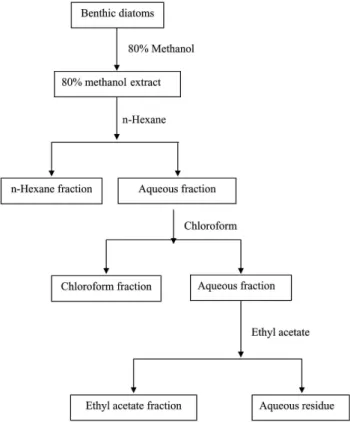
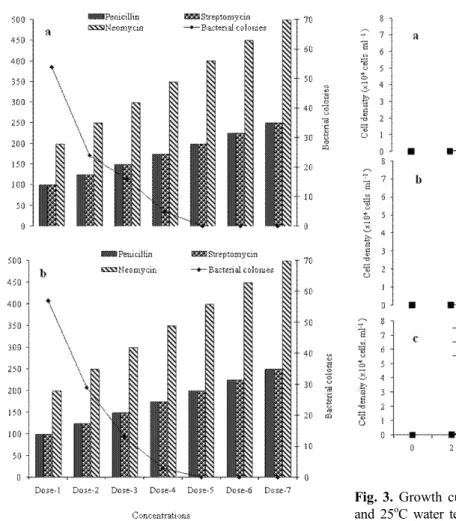
(4) Two Benthic Diatoms from Korea. 2-deoxyribose were purchased from Fluka Chemie AG, Buchs, Switzerland. All other chemicals used were analytical grade, supplied by Fluka or Sigma. Preparation of 80% methanol extract and solvent fractions. Five gram freeze-dried powdered sample of A. coffeaeformis and A. longipes were immersed separately in 80% methanol (500 ml) and placed in a shaking incubator for 24 h at 25oC. The macerated mixture was filtered and the 80% methanol extract was collected and concentrated. The extracts obtained were in sequence fractionated in a separatory funnel with different organic solvents, such as n-hexane, chloroform, and ethylacetate, respectively (Fig. 1). Each fraction was concentrated and redissolved in methanol to a concentration of 2 mg/ ml. All activities of fractions were compared with standard antioxidants (BHT and α- tocopherol) dissolved in methanol.. 177. DPPH free radical scavenging activity. This assay involved the scavenging of stable DPPH radicals by the radical-scavenging components of A. coffeaeformis and A. longipes extracts, respectively using Brand-Williams modified method [5]. A 2 mL fraction of each species of benthic diatoms extract was mixed thoroughly with 2 mL freshly prepared 3 × 10⁻⁵ M DPPH solution in DMSO. The reaction mixture was incubated for 1 h, and the absorbance of the supernatant was measured at 517 nm using an Opron 3000 UV-VIS spectrophotometer (Hanson Tech. Co. Ltd., Seoul, and Republic of Korea). Superoxide anion scavenging assay. The superoxide-anion scavenging effect was tested following Nagai method [27]. The reaction mixture consisted of 0.48 mL of 0.05 M sodium carbonate buffer (pH 10.5), 0.02 mL of 3 mM xanthine, 0.02 mL of 3 mM EDTA, 0.02 mL of 0.15% BSA, 0.02 mL of 0.75 mM NBT, and 0.02 mL of each species benthic diatoms extract. After incubation at 25oC for 10 min, the reaction was started by adding 6 mU xanthine oxidase and maintained at 25oC for 20 min. The reaction was stopped by adding 0.02 mL of 6 mM CuCl2. The absorbance was measured using a Sunrise microplate reader (Tecan Co. Ltd., Salzburg, Austria) at 560 nm. Hydrogen peroxide scavenging activity. Hydrogen-peroxide scavenging activity was determined following method of Rice-Evans et al. [32]. A sample was prepared in a 96-microwell plate by mixing 80 μL of A. coffeaeformis and A. longipes extract, respectively to 100 μL of PBS (0.1 M, pH 5.0), and 20 μL of 10 mMH2O2, and the sample was incubated at 37oC for 5 min. Then, 30 μL ABTS (1.25 mM) and 30 μL peroxidase (1 unit mL-1) were added, and the mixture was incubated at 37oC for 10 min. The absorbance was recorded at 405 nm. Hydroxyl radical scavenging activity. Fig. 1. Scheme of solvent fractionation of A. coffeaeformis and A. longipes. Fig.1. Presence of bacterial colonies with the concentration antibiotics in the culture media of Amphora coffeaeformis (a) and Achnanthes longipes (b). Dose 1 (penicillin 100 units mL-1, streptomycie 100 mg mL-1 and neomycin 200 mg mL-1). Each succeeding dose was increased by 25 untis penicillin, 25 mg streptomycin and 50 mg neomycin per mL.. The hydroxyl-radicals scavenging effect was determined according to the method described by Chung et al. [6]. A Fenton reaction mixture (200 μL of 10mM FeSO4.7H2O, 200 μL of 10 mM EDTA, and 200 μL of 10 mM 2-deoxyribose) was mixed with 1.2 mL of 0.1 M PBS (pH 7.4) and 200 μL of A . coffeaeformis and A. longipes extract, respectively. Then, 200 μL of.
(5) 178. AFFAN et al.. 10 mM H2O2 was added, and the mixture was incubated at 37oC for 4 h, after which 1 mL of 2.8% trichloroacetic acid (TCA) and 1 mL of 1% 2-thiobarbituric acid (TBA) were added, and the mixture was kept in a bath of boiling water for 10 min. After cooling, the mixture was centrifuged for 5 min at 395g, and the absorbance was measured at 532 nm. Nitric oxide radical inhibition assay. The nitric-oxide-radical inhibition effect was determined following the method described by Garrat [12]. A mixture of 2 mL of 10 mM sodium nitroprusside in 0.5 mL of PBS (pH 7.4) and 0.5 mL of A. coffeaeformis and A. longipes extract was incubated separately at 25oC for 150 min. From this, 0.5 mL was removed and added to 1.0 mL of sulfanilic acid reagent (0.33% in 20% glacial acetic acid) and incubated at room temperature for 5 min. Finally, 1.0 mL naphthylethylenediamine dihydrochloride (0.1% w / v) was added, and the mixture was incubated at room temperature for 30 min. The absorbance was measured at 540 nm.. Scavenging activity/chelating ability calculation. The radical scavenging activity/chelating ability was calculated using the following equation: [1-(Ai -Aj)/Ac] × 100. (2). , where Ai is the absorbance of A. coffeaeformis and A. longipes extract, respectively mixed with reactive oxygen or nitrogen compounds, Aj is the absorbance of the each species of benthic diatoms that is A. coffeaeformis and A. longipes extract without the reactive compounds, and Ac is the absorbance of the control. Statistical analysis. All the experiments to determine growth characteristics were conducted in duplicate (n = 2). The experiments to estimate antioxidant activity were conducted in triplicate (n = 3). The mean values of each treatment were compared using one-way analysis of variance (ANOVA) followed by Tukey’s tests. A P-value of <0.05 was considered as significant. All statistical analyses were performed using SPSS Statistical Software, version 11.5 (Edinburgh, Scotland).. Metal chelating assay. Metal-chelating ability was determined according to the method described by Decker and Welch [7]. The mixture sample was prepared by adding 5 mL of A. coffeaeformis and A. longipes extract, respectively to a solution of 0.1 mL of 2 mM FeCl2. The reaction was started by adding 0.2 mL of 5 mM ferrozine solution. The reaction mixture was incubated, with shaking, at room temperature for 10 min. The absorbance was measured at 562 nm. Determination of antioxidant activity using the ferric thiocyanate (FTC) method. This assay was performed following the method of Kikuzaki and Nakatani [23]. The mixture, consisting of 2 mL of each benthic diatoms species extract (100 mg L-1), to 2 mL of 2.51% linoleic acid in ethanol, 4 mL of 0.05 M PBS (pH 7.0), and 2 mL of distilled water, was kept in the dark at 40oC. From this mixture, 0.1 mL was added to 9.7 mL of 75% ethanol and 0.1 mL of 30% ammonium thiocyanate. After 5 min, 0.1 mL of 0.02 M ferrous chloride in 3.5% HCl was added. The absorbance was measured every 24 h for 7 d.. Results. Axenic strain. Bacterial cell was found when the mono-strain stock was observed with inverted microscope. Thereafter, the presence of bacteria in the mono-strain stock was confirmed by streaking on agar plates at the same conditions of A. coffeaeformis and A. longipes culture. The antibiotics penicillin, streptomycin, and neomycin were used individually to eradicate the bacteria from the mono-strain stock but failed to result in an axenic strain of A. coffeaeformis and A. longipes, even though the dose was lethal to A. coffeaeformis and A. longipes. A cocktail of antibiotics was tested at different dosages, and the axenic strain was obtained using 200 units penicillin mL-1, 200 μg streptomycin mL-1, and 400 μg neomycin mL-1 added to the culture medium (Fig. 2A and 2B). Growth characteristics production. and. mass. culture. The both benthic diatoms species that is A. coffeaeformis and A. longipes grew in all culture conditions.
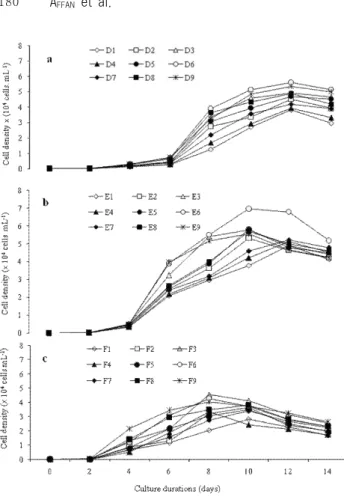
(6) Two Benthic Diatoms from Korea. Fig. 2. Growth curve of Amphora coffeaeformis at 15oC, 20oC and 25oC water temperature with F/4 (50%), F/2 (100%) and F (200%) nutrient concentrations and 25, 30 and 35 psu salinity. Culture conditions: A1 (25 psu, F/4 nutrients), A2 (25 psu, F/2 nutrients), A3 (25 psu, F nutrients), A 4 (30 psu, F/4 nutrients), A5 (30 psu, F/2 nutrients), A6 (30 psu, F nutrients), A7 (35 psu, F/4 nutrients), A7 (35 psu, F/2 nutrients) and A9 (35 psu, F/4 nutrients) in 15oC water. Conditions B (20oC water) and C conditions (25oC water) same as A with regard to salinity and nutrient concentrations.. with different maximum cell abundance. They also showed good sigmoid growth (Fig. 3 and 4). The maximum cell densities occurred either 10 or 12 d after being inoculated in all treatments. In 15oC water, with various salinities and nutrient concentrations, the specific growth rate of A. coffeaeformis varied from 0.81 to 1.01 d-1 and the maximum cell density (4.56 × 10⁴ cells mL-1) occurred at 1.01 d-1 on day 10 after being inoculated in medium with 30 psu salinity and F nutrient concentration (Table 1). In 20oC water, the specific growth rate was 0.83-1.03 d-1 among several salinities and nutrient concentrations. The maximum cell density of A. coffeaeformis at temperature of 20oC was 5.73 ×10⁴ cells mL-1 on day 10 after being inoculated in. 179. Fig. 3. Growth curve of Achnanthes longipes at 15oC, 20oC and 25oC water temperature with F/4 (50%), F/2 (100%) and F (200%) nutrient concentrations and 25, 30 and 35 psu salinity. Culture conditions: D1 (25 psu, F/4 nutrients), D2 (25 psu, F/2 nutrients), D3 (25 psu, F nutrients), E4 (30 psu, F/4 nutrients), D5 (30 psu, F/2 nutrients), D6 (30 psu, F nutrients), D7 (35 psu, F/4 nutrients), D8 (35 psu, F/2 nutrients) and D9 (35 psu, F/4 nutrients) in 15oC water. Conditions E (20oC water) and F conditions (25oC water) same as D with regard to salinity and nutrient concentrations.. medium with salinity of 35 psu and F nutrient concentration (i.e., the B9 culture condition; Table 1). The cell density of A. coffeaeformis was the greatest in 25oC water temperature which was followed by 20oC and 15oC (Fig. 3c, 3b and 3a). Among, the all culture conditions, the highest cell density was 7.47 ×10⁴ cells mL-1 in the 25oC water temperature with salinity of 30 psu and nutrients concentration of F/2 (Fig. 3c), and maximum cell density occurring on day 12 after being inoculated was significantly higher (P < 0.01) than that of all other culture conditions. Mass culture of A. coffeaeformis was done under the optimal growth condition (i.e., C5 culture condition: temperature of 25oC, salinity of 30 psu and F/2 nutrient concentrations). The biomass production of A. coffeaeformis was 1.1 g L-1 of culture media as dry weight basis after two week.
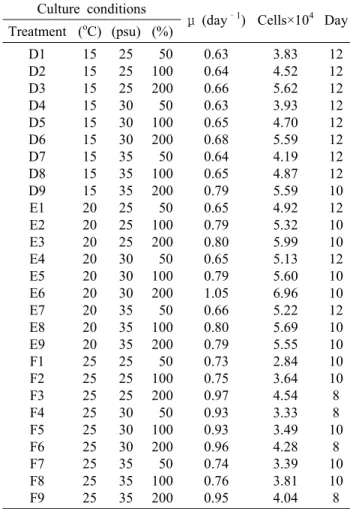
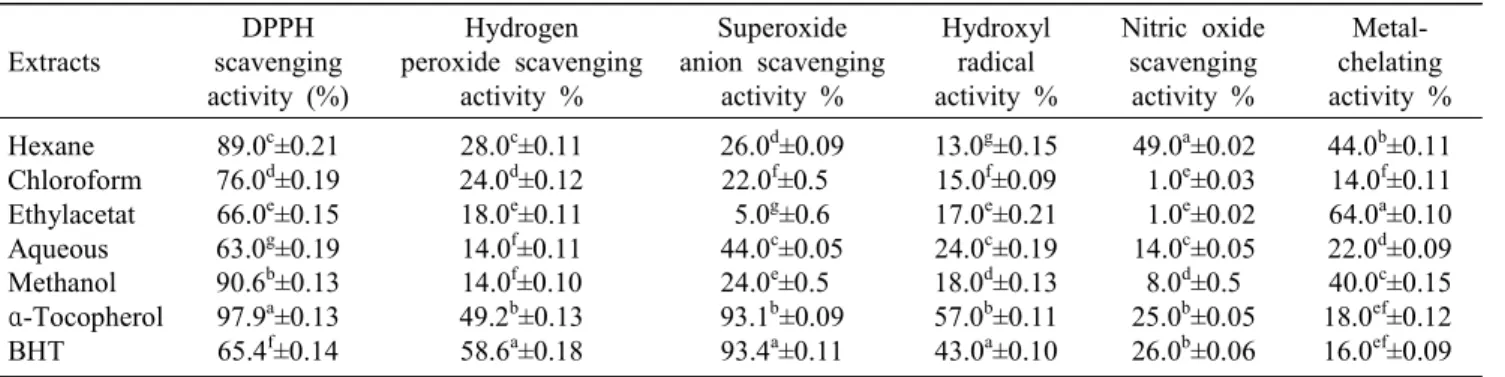
(7) 180. AFFAN et al.. Table 1. The maximum specific growth rate (μ day –1) of A. coffeaeformis at different temperature (oC), salinity (psu) and nutrient concentrations (%), and maximum growth occurring duration (day) Culture conditions Treatment (oC) (psu) (%). Fig. 4. Antioxidant activity of different organic solvent fractions from Amphora coffeaeformis (a) Achnanthes longipes (b), compared to butylated hydroxytoluene BHT and a- tocopherol at 1 mg ml -1 of concentration of ethanol, as assessed by linoleic acid.. of mass culture. In 15oC of water temperature, the maximum cell density of A. longipes varied from 3.83 to 5.59 ×10⁴ cells mL-1 with the highest in D6 culture condition where the culture media was composed of 30 psu salinity and F nutrients concentration (Fig. 4a). The specific growth rate varied from 0.63 to 0.79 d-1, and the maximum cell density was found at the growth rate of 0.68 d-1 (Table 2). In 20oC of water temperature, the highest cell density occurrence varied from 4.92 to 6.96 ×10⁴ cells mL-1, and the maximum cell density was counted at the maximum growth rate of 1.05 d-1 in E6 culture conditions where the salinity and nutrients concentration was 30 psu and F, respectively (Fig. 4b and Table 2). In 25oC of water temperature, the maximum cell density varied from 2.84 to 4.54 ×10⁴ cells mL-1. The specific growth rate varied from 0.73 to 0.97 d-1, and the maximum cell density (4.54 ×10⁴ cells mL-1) among the all culture conditions of 25oC water temperature was found at the maximum specific growth rate (0.97 d-1) where the media was composed of 25 psu. A1 A2 A3 A4 A5 A6 A7 A8 A9 B1 B2 B3 B4 B5 B6 B7 B8 B9 C1 C2 C3 C4 C5 C6 C7 C8 C9. 15 15 15 15 15 15 15 15 15 20 20 20 20 20 20 20 20 20 25 25 25 25 25 25 25 25 25. 25 25 25 30 30 30 35 35 35 25 25 25 30 30 30 35 35 35 25 25 25 30 30 30 35 35 35. 50 100 200 50 100 200 50 100 200 50 100 200 50 100 200 50 100 200 50 100 200 50 100 200 50 100 200. μ (day–1) Cells×104 Day 0.81 0.95 0.98 0.95 0.96 1.01 0.97 0.83 0.98 0.95 0.83 1.00 0.99 0.99 0.84 0.84 1.03 1.03 0.98 0.85 1.04 0.86 0.88 0.88 0.85 0.87 0.85. 3.08 2.49 3.42 2.52 2.74 4.56 3.12 4.09 3.54 2.43 4.19 4.14 3.90 3.72 4.59 3.12 5.30 5.73 3.34 5.16 6.02 5.58 7.47 7.11 4.76 6.24 5.23. 12 10 10 10 10 10 10 12 10 10 12 10 10 10 12 12 10 10 10 12 10 12 12 12 12 12 12. of salinity and F nutrients concentration (Fig. 4c and Table 2). However, among the all culture conditions, the highest cell density was in E6 culture condition. Therefore, E6 culture condition was selected for mass culture of A. longipes. Antioxidant activities. The DPPH-free-radical scavenging rate varied from 18.9 to 67.5% and 63.0 to 90.6% among the hexane, chloroform, ethylacetate, aqueous and methanolic of A. coffeaeformis and A. longipes, respectively (Table 3 and 4). Hexane extraction of A. coffeaeformis showed the highest DPPH-free-radical scavenging activity in comparison to other extraction, and the value was statistically higher than BHT but lower than α-tocopherol. All the extraction of A. longipes showed higher DPPH-free-radical scavenging effect in comparison to BHT, and the methanolic extraction showed the highest.
(8) Two Benthic Diatoms from Korea. Table 2. The maximum specific growth rate (μ day –1) of A. longipes at different temperature (oC), salinity (psu) and nutrient concentrations (%), and maximum growth occurring duration (day) Culture conditions Treatment (oC) (psu) (%) D1 D2 D3 D4 D5 D6 D7 D8 D9 E1 E2 E3 E4 E5 E6 E7 E8 E9 F1 F2 F3 F4 F5 F6 F7 F8 F9. 15 15 15 15 15 15 15 15 15 20 20 20 20 20 20 20 20 20 25 25 25 25 25 25 25 25 25. 25 25 25 30 30 30 35 35 35 25 25 25 30 30 30 35 35 35 25 25 25 30 30 30 35 35 35. 50 100 200 50 100 200 50 100 200 50 100 200 50 100 200 50 100 200 50 100 200 50 100 200 50 100 200. μ (day–1) Cells×104 Day 0.63 0.64 0.66 0.63 0.65 0.68 0.64 0.65 0.79 0.65 0.79 0.80 0.65 0.79 1.05 0.66 0.80 0.79 0.73 0.75 0.97 0.93 0.93 0.96 0.74 0.76 0.95. 3.83 4.52 5.62 3.93 4.70 5.59 4.19 4.87 5.59 4.92 5.32 5.99 5.13 5.60 6.96 5.22 5.69 5.55 2.84 3.64 4.54 3.33 3.49 4.28 3.39 3.81 4.04. 12 12 12 12 12 12 12 12 10 12 10 10 12 10 10 12 10 10 10 10 8 8 10 8 10 10 8. (90.6%) scavenging effect than those of other extractions (Table 4). Hydrogen peroxide scavenging rate was 19.2 to 47.6% and 14.0 to 28.0% among the extracts of A. coffeaeformis and A. longipes, respectively (Table 3 and 4). Among the extracts of two benthic. 181. diatoms, hexane (48.6%) and chloroform (47.2%) extracts of A. coffeaeformis had higher hydrogen peroxide scavenging activity which was statistically similar with α-tocopherol (Table 3). All the extracts of two benthic diatoms had less superoxide anion scavenging effect in comparison to commercial antioxidants. Hydroxyl radical scavenging rate was 4.0 to 55.6% and 13.0 to 24.0% among the extracts of A. coffeaeformis and A. longipes, respectively (Table 3 and 4). Hexane extract of A. coffeaeformis had the highest hydroxyl radical scavenging effect which was statistically higher than BHT and similar to α-tocopherol, and the remaining extracts had less activity (Table 3). Nitric oxide scavenging rate was 3.0 to 29.6% and 1.0 to 49.0% among the extracts of A. coffeaeformis and A. longipes, respectively, with hexane (49.0%) extracts of A. longipes showing the highest rate which was almost two times more than commercial antioxidants (Table 4). All of the extracts of two benthic diatoms showed very strong metal-chelating effects which were significantly higher (P<0.05) than that of α-tocopherol and BHT (18.0% and 16.0%, respectively). The aqueous extract of A. coffeaeformis and ethylacetate extraction of A. longipes had the highest metal-chelating activity among the all extractions (Table 3 and 4). Antioxidant activity with ferric thiocyanate was determined at 40oC for 7 d. As shown in Figure 4a and 4b, the linoleic acid emulsion without A. coffeaeformis and A. longipes extracts (the control) resulted in an increase in lipid peroxidation, and the absorbance increased significantly (P < 0.05). Among all the extracts of A. coffeaeformis and A. longipes, the ethylacetate and chloroform extracts exhibited notable antioxidant activity, which exceeded that of α-tocopherol. No significant difference was observed among the activity of BHT and. Table 3. Antioxidative effects of different A. coffeaeformis extracts Extracts Hexane Chloroform Ethylacetat Aqueous Methanol α-Tocopherol BHT. DPPH scavenging activity (%). Hydrogen peroxide scavenging activity %. Superoxide anion scavenging activity %. Hydroxyl radical activity %. Nitric oxide scavenging activity %. Metalchelating activity %. 67.5b±0.21 35.5d±0.19 23.4e±0.15 18.9g±0.19 22.8f±0.13 97.9a±0.13 65.4c±0.14. 48.6b±0.11 47.2c±0.12 21.5f±0.11 19.2g±0.11 23.4e±0.10 49.2b±0.13 58.6a±0.18. 27.4f±0.09 15.1g±0.5 34.1c±0.6 31.4d±0.05 28.1e±0.5 93.1b±0.09 93.4a±0.11. 55.6a±0.15 13.4c±0.09 6.4e±0.21 8.0d±0.19 4.0f±0.13 57.0a±0.11 43.0b±0.10. 3.0g±0.02 6.0f±0.03 16.8d±0.02 29.6a±0.05 14.8e±0.5 25.0c±0.05 26.0b±0.06. 1.8f±0.11 2.1f±0.11 43.3c±0.10 75.6a±0.09 51.1b±0.15 18.0d±0.12 16.0e±0.09. The values represent the mean ± SD of 2 mg/ml determined from triplicate samples. Values followed by the superscript letters a, b, c, d, e, f and g indicate a significant difference (p<0.05)..
(9) 182. AFFAN et al.. Table 4. Antioxidative effects of different A. longipes extracts Extracts. DPPH scavenging activity (%). Hydrogen peroxide scavenging activity %. Superoxide anion scavenging activity %. Hydroxyl radical activity %. Nitric oxide scavenging activity %. Metalchelating activity %. 89.0c±0.21 76.0d±0.19 66.0e±0.15 63.0g±0.19 90.6b±0.13 97.9a±0.13 65.4f±0.14. 28.0c±0.11 24.0d±0.12 18.0e±0.11 14.0f±0.11 14.0f±0.10 49.2b±0.13 58.6a±0.18. 26.0d±0.09 22.0f±0.5 5.0g±0.6 44.0c±0.05 24.0e±0.5 93.1b±0.09 93.4a±0.11. 13.0g±0.15 15.0f±0.09 17.0e±0.21 24.0c±0.19 18.0d±0.13 57.0b±0.11 43.0a±0.10. 49.0a±0.02 1.0e±0.03 1.0e±0.02 14.0c±0.05 8.0d±0.5 25.0b±0.05 26.0b±0.06. 44.0b±0.11 14.0f±0.11 64.0a±0.10 22.0d±0.09 40.0c±0.15 18.0ef±0.12 16.0ef±0.09. Hexane Chloroform Ethylacetat Aqueous Methanol α-Tocopherol BHT. The values represent the mean ± SD of 2 mg/ml determined from triplicate samples. Values followed by the superscript letters a, b, c, d, e, f and g indicate a significant difference (p<0.05).. α-tocopherol and the ethylacetate and chloroform extracts (P < 0.05) of two benthic diatoms. None of the remaining extracts showed notable antioxidant activity compared to the commercial antioxidants. DISCUSSION. Axenic strain. Bacteria grew with A. coffeaeformis and A. longipes. in the culture media and decomposed diatom cells. We used antibiotics to make the strain axenic because the bacteria could have influenced the antioxidant properties of A. coffeaeformis and A. longipes the extracts, by releasing their cellular compounds. The successful antibiotic dosages were lower than those (gentamycin, 0.05 mg L-1; penicillin-G, 16 mg mL-1; and streptomycin, 0.8 mg mL-1) used by Kotaki et al. [25] to get the axenic culture of domoic acid producing Nitzschia species. Our previous study [2] about obtaining an axenic strain of Navicula incerta, the antibiotics applying dosages was similar to this study results though the bacterial colonies were different on the agar plate up to getting axenic species of A. coffeaeformis and A. longipes. However, the optimal antibiotic dosages may be dependent on the bacterial load or on the presence of specific bacteria, such as gram-negative or gram-positive species. For eradication of both species of bacteria, neomycin and streptomycin were used, since neomycin is principally active against gram-positive bacteria, whereas streptomycin is mostly active against gram negative bacteria, and the penicillin family is active against both [14]. Therefore, our successful result of applying antibiotics dosages for obtaining of axenic benthic diatom is suggesting that an antibiotic cocktail is more effective to eradicate the bacteria under benthic diatom culture conditions. Growth characteristics and approximate cellular composition. Fig. 5. Antioxidant activity of different organic solvent fractions from Amphora coffeaeformis (a) Achnanthes longipes (b), compared to butylated hydroxytoluene BHT and α-tocopherol at 1 mg ml-1 of concentration of ethanol as assessed by linoleic acid.. Measuring growth rates is an informative way to ascertain the activity of microbial populations, which can increase at exponential rates. Significant biological information for the mass culture of algae can be obtained by determining growth characteristics under controlled,.
(10) Two Benthic Diatoms from Korea. measurable conditions and can be used to create a high-density mass-culture system. We determined the limitations of A. coffeaeformis and A. longipes growth characteristics by using different temperature, salinity, and nutrient concentrations. F / 2 medium and meta-silicate anhydrous crystal (Na2SiO3) were used as a nutrient source, as it is commercially available, easy to use, and suited to our goal of producing this alga commercially for industrial and aquaculture use. The cell density of A. coffeaeformis was greater at the low (15oC) and moderate (20oC) water temperatures than at high (25oC) temperature, with the greatest cell densities. The growth pattern of this species suggests that it is eurythermal and euryhaline, but high temperature and moderate salinity with moderate nutrients may create the most favorable conditions for growth. This finding is well agreed with results of Affan and Lee [1] who found more than 10% A. coffeaeformis cell abundance to the total phytoplankton during monitoring the seasonal dynamics of phytoplankton and environmental factors in coastal Jeju Island waters. They found the highest cell abundance of A. coffeaeformis in spring bloom. Our result suggests that the maximum biomass of A. coffeaeformis in commercial aquaculture can be obtained at temperature 25oC with moderate salinity (30 psu) and nutrient concentrations (F/2). A. longipes was found to grow well in all the experimental conditions with wide range of temperature and salinity. The growth pattern of this species also seems to be eurythermal and euryhaline with eutrophic habitat as highest cell density was found to be occurred in a condition with moderate temperature and with maximum nutrient concentrations (F/2). The culture condition which showed the most favorable to A. longipes to reach the greatest cell abundance than that of other conditions is agreed with in situ blooming of this species. Affan et al. [4] reported that A. longipes abundance was remarkably higher to the total phytoplankton during autumn bloom at the West coast of Jeju Island, when nutrients concentration was higher with moderate temperature and salinity. Thus, we suggest that E6 culture condition can be used to produce A. longipes in commercial scale. Evaluation of antioxidant effects of Amphora coffeaeformis and Achnanthes longipes. Cells generate reactive oxygen species (ROS) such as free radicals, nitric oxide, hydrogen peroxide during. 183. normal metabolism. ROS oxidize lipids, proteins and can damage the DNA, therefore, normal cellular metabolism can breakdown. Plants have numerous antioxidant defense systems and because of that they are not susceptible to damage by ROS. Recently the interest about the antioxidants from the natural resources like plant has been increasing because of their reducing power on ROS, since they produce polyphenolics, and nitrogen containing compounds, phytosterols, carotenoids and chlorophyll derivatives. In the present study, antioxidant potentiality was determined by using different kinds of antioxidant assays from the 80% methanolic, hexane, chloroform and ethylacetate extract of A. coffeaeformis and A. longipes. However, very few phytoplankton such as Spirulina platensis, Dunaliella salina and Botryococcus braunii [19,18,31] are known about their antioxidants properties. In this study, hexane extract of A. coffeaeformis and all the extracts of A. longipes showed more DPPH free radical scavenging efficacy than BHT. Methanol and hexane extracts of A. longipes had better the antioxidant ability on scavenging of DPPH free radicals which was statistically similar with α-tocopherol and higher than BHT. In our previous study, benthic diatoms, Grammatophora marina and Navicula incerta had the more DPPH free radical scavenging activity when the antioxidants were extracted with methanol and neutrase enzymes [3,2]. Form the results of this and previous study, it can be suggested that the benthic diatoms can be a good source of antioxidants which is responsible for scavenging of DPPH free radicals. H2O2, a reactive non-radical compound is very important as it can penetrate biological membranes. The extract of A. coffeaeformis with the solvent of hexane had the more hydrogen peroxide scavenging activity than α-tocopherol and BHT among all the extracts of A. coffeaeformis and A. longipes. Although H2O2 itself is not very reactive, it may convert into more reactive species, such as singlet oxygen and hydroxyl radicals [16]. Thus, removing H2O2 is very important for the protection of living systems. In the previous and this study, it was found that n-hexane is the most suitable solvent for the extraction of H2O2 peroxide scavenging antioxidants from benthic diatoms than even from the enzymatic extraction [3,2]. The superoxide anion is an oxygen-centered, selectively reactive radical produced by a number of enzyme systems in auto-oxidation reactions and by.
(11) 184. AFFAN et al.. non-enzymatic electron transfers that reduce molecular oxygen univalently. It also reduces certain iron complexes, such as cytochrome c. The effects of the superoxide anion can be exaggerated, as it produces other kinds of cell-damaging free radicals and oxidizing agents [26]. The superoxide anion has been implicated in several pathophysiological processes because of its conversion into more reactive species, such as hydrogen peroxide, singlet oxygen, and the hydroxyl radical, which initiate oxidative damage in lipids, proteins, and DNA [29]. The superoxide-anion scavenging efficacy of A. coffeaeformis and A. longipes from all the extracts were inferior to inferior to α-tocopherol and BHT. The hydroxyl radical is the most reactive ROS because of its strong affinity for various biomolecules. It can extract hydrogen atoms from phospholipid membranes and perform peroxidic reactions with lipids [24]. Extract of A. coffeaeformis with n-hexane showed the better hydroxyl radical scavenging activity than all the extract of both benthic diatoms, and the scavenging ability was statistically similar with α-tocopherol and superior to BHT. Nitric oxide is a gaseous free radical which has important functions for the physiological and pathological conditions, like renal injuries. N-hexane extracts of A. longipes showed high nitric oxide- scavenging activity, significantly higher than standard commercial antioxidants. Thus, n-hexane is a strong solvent to get hydroxyl radical and nitric oxide scavenging antioxidants from A. coffeaeformis and A. longipes. Metal-chelating activity can reduce the concentration of catalyzing transition metals in lipid peroxidation [9]. Ferrozine complexes with ferrous ions can initiate lipid peroxidation by the Fenton reaction and accelerate peroxidation by decomposing lipid hydroperoxides into peroxyl and alkoxyl radicals [16,11]. Furthermore, chelating agents that form σ-bonds with a metal are effective as secondary antioxidants because they reduce the redox potential and thereby stabilize the oxidized form of the metal ion [13]. The chloroform and hexane extracts of A. coffeaeformis had very negligible antioxidants activity, but the extract of aqueous, ethylacetate and methanol showed the scavenging efficacy 4-fold, 2.5-fold and 3-fold than commercial antioxidants. All the extracts of A. longipes showed excellent metal chelating activity than that of commercial antioxidants, and the chloroform extract had 3.5-fold and 4-fold more metal chelating activity than BHT and α-tocopherol. These results suggest that both of these species have a high ability to bind iron.. FTC method is used to determine the amount of peroxide generated at the initial stage of lipid peroxidation. During the linoleic acid oxidation, peroxides formed and these compounds oxidize Fe2+ to Fe3+ and making a complex with SCN−. In this method, the concentration of peroxide decreases as the antioxidant activity increases. Thus, high absorbance is an indication of high concentration of formed peroxides. Fractions of hexane and chloroform extracts of A. coofeaeformis showed better results than α-tocopherol and statistically similar to BHT. Ethylacetate and chloroform extracts of A. longipes had better effect of reducing the peroxides than α-tocopherol, but the ethylacetate extract showed statistically similar efficacy to BHT. It can be suggested that can be used for inhibition of the lipid peroxidation, and can also be used for food additives. We used different solvents for our extractions and then compared their antioxidant activities with commercial antioxidants. The extracts of two benthic diatoms showed better results from different extracts, especially metal-chelating and free-radical activity. Except in aquaculture, diatom culture for biotechnologically applications is still at an early stage of development. Further progress will depend on the advances in cultivation, including lower costs and sustainable techniques. A. coffeaeformis and A. longipes showed more antioxidant activity in DPPH, superoxide, nitric oxide, and the metal-chelating assays than commercial antioxidants. These results indicate that these algae may be a good candidate for a natural antioxidant source and could be applied in the functional food field. Further studies are necessary to isolate and purify the biochemical compounds responsible for antioxidant effects and to characterize their in vivo antioxidant activity and related antioxidant mechanisms. Acknowledgement. This research was supported by a grant (P-2004-03) from the Marine Bioprocess Research Center of the Marine Bio 21 Center, funded by the Ministry of Maritime Affairs and Fisheries, Republic of Korea and by the Korea Ocean Research and Development Institute (PE 97802). References. 1. Affan, A. and Lee, J. B. 2004. Seasonal characteristics of phytoplankton dynamics and environmental factors in.
(12) Two Benthic Diatoms from Korea. 2.. 3.. 4.. 5.. 6.. 7.. 8.. 9.. 10.. 11. 12. 13.. 14.. 15.. 16.. 17. 18.. the coast of Mara-do and U-do, Jeju Island, Korea. Algae 19, 235-45. Affan, A., Karawita, R., Jeon, Y. J. and Lee, J. B.2007. Growth characteristics and antioxidant properties of the benthic diatom Navicula incerta (Bacillariophyceae) from jeju island, korea. J. Phycol. 43, 823-832. Affan, A., Karawita, R., Jeon, Y. J., Kim, B. Y. and Lee, J. B. 2006. Growth characteristics, biochemical composition and antioxidant activities of benthic diatom Grammatophora marina from Jeju coast, Korea. Algae 21, 141-8. Affan, A., Lee, J. B., Kim, J. T., Choi, Y.C., Kim, J. M. and Myoung, J. G. 2007. Seasonal dynamics of phytoplankton and environmental factors around the chagwi-do off the west coast of Jeju Island, Korea. OSJ 42, 117-127. Brand-Williams, W., Cuvelier, M. E. and Berset, C. 1995. Use of a free radical method to evaluate antioxidant activity. Lebensm.-Wiss.Technol. 28, 25-30. Chung, S. K., Osawa, T. and Kawakishi, S. 1997. Hydroxyl radicalscavenging effects of species and scavengers from black mustard (Brassica nigra). Biosci. Biotechnol. Biochem. 61, 118-123. Decker, E. A. and Welch, B. 1990. Role of ferritin as a lipid oxidation catalyst in muscle food. J. Agric. Food Chem. 38, 674-677. Dempster, T. D. and Sommerfeld, M. R. 1998. Effects of environmental conditions on growth and lipid accumulation in Nitzschia communis (Bacillariophyceae). J. Phycol. 34, 712-721. Duh, P. D., Tu, Y. Y. and Yen, G. C. 1999. Antioxidant activity of water extract of Harng Jyur (Chrysanthemum morifolium Ramat). Lebensm.-Wiss. Technol. 32, 269-277. Field, C. B., Behrenfeld, M. J., Randerson, J. T. and Falkowski, P. 1998. Primary production of the biosphere: integrating terrestrial and oceanic components. Science 281, 237-240. Fridovich, I. 1995. Superoxide radical and superoxide dismutases. Annu. Rev. Biochem. 64, 97-112. Garrat, D. C. 1964. The Quantitative Analysis of Drugs, Vol. 3. Chapman and Hall, Tokyo, Japan, pp. 456-458. Gordon, M. H. 1990. The mechanism of the antioxidant action in vitro. In Hudson, B. J. F. [Ed.] Food Antioxidants. Elsevier, NewYork, pp. 1-18. Guillard, R. R. L. 2005. Purification methods for microalgae. In Anderson, R. A. [Ed.] Algal ulturing Techniques. Elsevier Academic Press, San Diego, CA, pp. 117-32. Gülcin, I., Oktay, M., Ku¨frevioglu, O. and Aslan, A. 2002. Determinationof antioxidant activity of lichen Cetraria islandica (L) Ach. J. Ethnopharmacol. 79, 325-329. Halliweill, B. 1991. Reactive oxygen species in living systems: source, biochemistry, and role in human disease. Am. J. Med. 91, 14-19. Harris P. H. 1986. Phytoplankton Ecology. Chapman and Hall, London. Herrero, M., Jaime, L., Martín-Álvarez, P. J., Cifuentes,. 19.. 20.. 21. 22.. 23. 24.. 25.. 26.. 27.. 28.. 29. 30.. 31.. 32.. 33.. 34.. 185. A. and Ibáñez, E. 2006. Optimization of the extraction of antioxidants from Dunaliella salina microalga by pressurized liquids. J. Agric. Food Chem. 54, 5597-5603. Herrero, M., Martín-Álvarez, P. J., Señoráns, F. J., Cifuentes, A. and Ibáñez, E. 2005. Optimization of accelerated solvent extraction of antioxidants from Spirulina platensis microalga. Food Chem. 93, 417-423. Hoshiai, G., Suzuki, T., Kamiyama, T., Yamasaki, M. and Ichimi, K. 2003. Water temperature and salinity during the occurrence of Dinophysis fortii and D. acuminate in Kesennuma Bay, northern Japan. Fish. Sci. 69, 1303-1305. Hur, S. B. 1997. Present status of larval-rearing technology in Korea. Hydrobiologia 358, 21-26. Hyun, K.H., Pang, I.C., Lee, J.H. and Rho, H.K. 1997. Water mass analysis in the East China Sea in summer and the northward route of the Tsushima Current. Bull. Mar. Res. Inst. Cheju Nat. Univ. 21, 85-101. Kikuzaki, H. and Nakatani, N. 1993. Antioxidant effects of some ginger constituents. J. Food Sci. 58, 1407-1410. Kitada, M., Igarashi, K., Hirose, S. and Kitagawa, H. 1979. Inhibition by polyamines of lipid peroxidase formation in rat livermicrosomes. Biochem. Biophys. Res. Commun. 87, 388-394. Kotaki, Y., Koike, K., Yoshida, M., Thuoc, C. V., Huyen, N. T. M., Hoi, N. C., Fukuyo, Y. and Kodama, M. 2000. Domoic acid production in Nitzschia sp. (Bacillariophyceae) isolated from a shrimpculture pond in Do Son, Vietnam. J. Phycol. 36, 1057-1060. Liu, F. and Ng, T. B. 2000. Antioxidative and free radical scavenging activities of selected medicinal herbs. Life Sci. 66,725-735. Nagai, T., Inoue, R., Inoue, H. and Suzuki, N. 2003. Preparation and antioxidant properties of water extract of propolis. Food Chem. 80, 29-33. Pang, I.C., Rho, H.K., Lee, J. H and Lie, H.J. 1996. Water mass distribution and seasonal circulation Northwest of Cheju Island in 1994. J. Korean Fish. Soc. 29, 862-875. Pietta, P. G. 2000. Flavonoids as antioxidants. J. Nat. Prod. 63, 1035-1042. Pirt, S. J. 1975. Principle of Microbe and Cell Cultivation. Blackwell Scientific Publications, Oxford, UK, 244 pp. Rao, A. R., Sarada, R., Baskaran, V. and Ravishankar, G. A. 2006. Antioxidant activity of Botryococcus braunii extract elucidated invitro models. J. Agric. Food Chem. 54, 4593-4599. Rice-Evans, C. A., Miller, N. J., Bolwell, P. G., Bramley, P. M. and Pridham, J. B. 1995. The relative antioxidant activities of plantderived polyphenolic flavonoids. Free Radic. Res. 22, 375-383. Romay, C., Armesto, J., Remirez, D., Gonzalez, R., Ledon, N. and Garcia, I. 1998. Antioxidant and anti-inflammatory properties of C-phycocyanin from blue-green algae. Inflamm. Res. 47, 36-41. St. John, M. A., Clemmesen, C., Lund, T. and Koster, T. 2001. Diatom production in the marineenvironment:.
(13) 186. AFFAN et al.. implications for larval fish growth and condition. ICES J. Mar. Sci. 58, 1106-1113. 35. Talling J. F. 1955. The relative growth rates of three planktonic diatoms in relation to underwater radiation and temperature. Ann. Bot. N.S. 19, 329-341. 36. Thessen, A. E., Dortch, Q., Parsons, M. L. and Mossison, S. 2005. Effect of salinity on Pseudo-nitzschia species (Bacillariophyceae) growth and distribution. J. Phycol.. 41, 21-29. 37. Tomas, J. H. 1996. Effects of temperature and illuminance on cell division rates of three species of tropical oceanic phytoplankton. J. Appl. Phycol. 2, 17-22. 38. Tredici, M. R. 2004. Mass production of microalgae: photobioreactors. In Richmond, A. [Ed.] Handbook of Microalgae Culture Biotechnology and Applied Phycology. Blackwell Science, Oxford, UK, pp. 179-203..
(14)
수치
+2
관련 문서
