신경재활치료과학 제 4권 제 2호
Therapeutic Science for Neurorehabilitation Vol. 4, No. 2. 2015.
The effects of vibration stimulation applied to the left forearm on unilateral neglect in patients with stroke:
A pilot randomized controlled trial
Jin-hyuck Park*, Ji-hyuk Park**
*Department of Occupational Therapy, Graduate School, Yonsei University,
**Department of Occupational Therapy, College of Health Science, Yonsei University
Abstract
Objective : The purpose of this study was to investigate the effects of vibratory stimulation applied to the left forearm on unilateral neglect in patients with stroke.
Methods : The subjects were 11 unilateral neglect patients with stroke. They were divided into 2 groups;
6 experimental subjects and 5 control subjects. Both groups received standardized rehabilitation pro- gram and occupational therapy for the intervention of unilateral neglect in a day. In random order, line bisection test (LBT), Albert test, and star cancellation test (SCT) were conducted at baseline, the next day. During the process of all assessments of the next day, vibration stimulation was provided for the 6 subjects in the experimental group (EG), while the 5 subjects in CG carried out all assessments with- out vibration stimulation.
Result : No significant differences were found between groups on any demographic variable or baseline as- sessments scores. In the next day, there was significant improvement in the EG for the LBT(p<0.05), Albert's test(p<0.05), and SCT(p<0.05). However, there was no significant improvement in the CG for the LBT(p<0.05), Albert's test(p<0.05), and SCT(p<0.05).
Conclusion : These result indicate that vibratory stimulation has a positive effect on the unilateral neglect, and may be considered as alternative choice in clinical occupational therapy for reducing unilateral neglect.
Key words : Stroke, Unilateral neglect, Vibration stimulation
교신저자 : 박지혁([email protected]) I I 접수일: 2015. 7. 10 I I 심사일: 2015. 7. 15 I I 게재승인일: 2015. 8. 3
I. Introduction
Vibration stimulation is one of the methods of proprioceptive training to promote the trans- mission of information about the position, vi- bration, exercise and pressure of the joints from the muscles, joints, tendons and the surround- ing tissues to the central nervous system(Oak, 2006). Especially, the vibration stimulation of tendons or muscles affects afferent nerve path- ways(Pollock, Provan, Martin, & Newham, 2011) and stimulates muscle spindles to contract the muscles effectively, so it is used for the im- provement of motor skills in the field of therapy in various ways(Kerschan Schindl et al., 2001).
In recent years, there have been studies re- porting the effects of the application of vi- bration stimulation on the reduction of unilat- eral neglect as well as the improvement of motor skills(Johannsen, Ackermann, & Karnath, 2003;
Kamada, Shimodozono, Hamada, & Kawahira, 2011; Pitteri, Arcara, Passarini, Meneghello, &
Priftis, 2013). Unlike traditional interventions for unilateral neglect such as mental prac- tice(Smania, Bazoli, Piva, & Guidetti, 1997), constraint induced movement therapy(van der Lee et al., 1999), visual search(Robertson &
Murre, 1999), and limb activation(Robertson, Hogg, & McMillan, 1998), which have demerits that the patient should actively move the af- fected upper limb, most of them require special skills and it is difficult to apply to daily life, vibration stimulation has merits that it costs less, the method of use is simple and it can be easily applied(Schindler, Kerkhoff, Karnath, Keller, & Goldenberg, 2002).
While most studies applying vibration stim- ulation for the reduction of unilateral neglect
stimulate vibration on the patient's neck ex- tensor muscles (Johannsen et al., 2003; Kamada et al., 2011; Schindler et al., 2002), there are also studies reporting the reduction of unilateral neglect by stimulating the vibration of the pa- tient' left forearm(Pitteri et al., 2013; Vallar et al., 1995). Studies on the effects of vibration stimulation of the patient's affected upper limb on the reduction of unilateral neglect have long been conducted overseas; however, most of them applied it along with other interventions, and there has been a dispute over its curative val- ue(Karnath, 1995; Karnath, Christ, & Hartje, 1993; Pitteri et al., 2013).
Vibration stimulation of the affected upper limb has the clinical advantage of being appli- cable with a variety of upper extremity activ- ities at the same time. Therefore, we carried out this pilot study to determine whether vibration stimulation applied to the left forearm could lead to an improvement in unilateral neglect in patients with stroke.
II. Methods 1. Subjects
Subjects were recruited in a local re- habilitation hospital in Republic of Korea. The subjects of this study included 20 patients with stroke. All subjects provided written informed consent prior to study.
1) Inclusion criteria
(1) stroke was confirmed by means of a com- puter tomography scan or magnetic resonance imaging
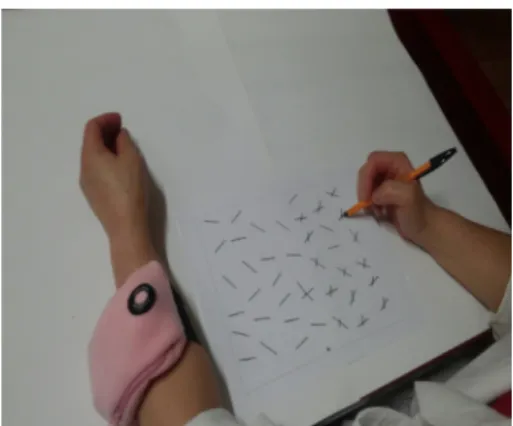
Figure 1. Vibrator Figure 2. Vibration stimulation
by pathological performance on the following test motor-free visual perception test (MVPT)
(3) no hemianopsia or apraxia
(4) Korean version of Mini Mental State Examination score 24.
2. Materials
1) The Vibrator
The vibrator(Minqing Top Art & Craft Co., China) is 80×120×35mm units weighting 0.5kg, which has a frequency range of 40 to 85 Hz(Figure 1). The surface of vibrator is wrapped with a soft cotton and the strap connected to the vibrator’ body serves to fix the vibrator to the left forearm of each patients.
2) Unilateral neglect assessments (1) Line bisection test
The line bisection test (LBT), the overall number of omissions of the 18 lines and the average deviation score from objective midline were determined. The LBT consisted 20 cm long, horizontal line segments place on a white A4 sheet of paper (210 mm × 297 mm). Patients pointed to the estimated center position using
either a pencil or a stick(Schenkenberg, Bradford, & Ajax, 1980). The LBT has good test-retest reliability and interrater reli- ability(Halligan, Cockburn, & Wilson, 1991).
(2) Albert's test
In Albert's test, 40 short lines randomly laid out A4 size paper. The test sheet is presented to the patients, including those to extreme right and extreme left. The examiner then asks the patients to cross out all the lines, and demon- strates what is required by crossing out the central line. The Albert's test has been found to be reliable and valid(Fullerton, McSherry, &
Stout, 1986).
(3) Star cancellation test
In star cancellation test (SCT), target de- tection task is presented to patients on an A4 sheet of paper. The test comprises 52 darkened large stars, 10 short words, and 13 randomly laid out letters, which are all spread around 56 filled small stars. Patients were instructed to cross out all targets, which are subdivided into 6 sections with 27 on each side(Bodak, Malhotra, Bernardi, Cocchini, & Stewart, 2014).
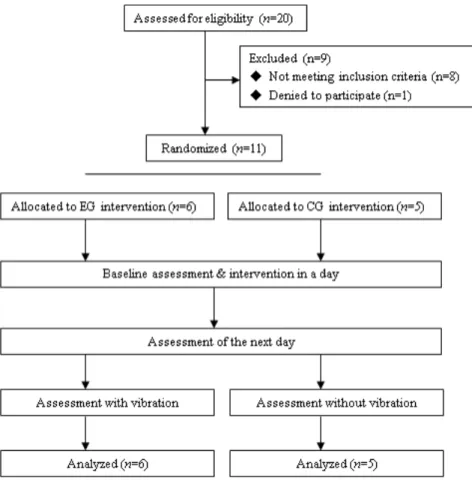
Figure 3. Flow diagram of the study
3. Procedures
This study was designed as a pilot randomized controlled trial. This study was conducted from November 3, 2014 to November 4, 2014. 20 pa- tients were screened; 11 patients fulfilled the inclusion. The 11 subjects were randomly as- signed to the experimental group (EG) or the control group (CG) in accordance with a random number table. Random allocation was performed by a research assistant under the blinded condition. All subjects were unaware of group assignments.
As for the baseline assessments, the extent of unilateral neglect was examined through a line bisection test, Albert test and star cancellation test. After the baseline assessments, both groups received occupational therapy for the in- tervention of unilateral neglect, such as visual scanning training and limb activation in a day.
On the next day, all assessments were carried out in a random order to measure the subjects' unilateral neglect. During the process of all the assessments, vibration stimulation at a fre- quency of 85Hz was applied to the left forearm of the subjects in the EG(Figure 2), while the
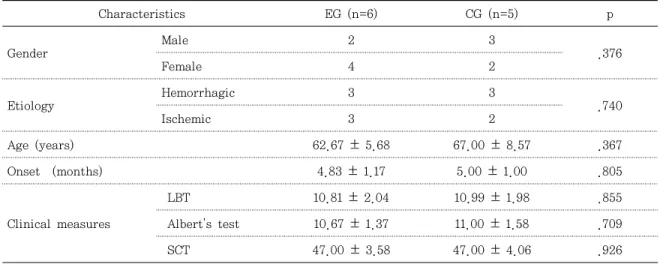
Characteristics EG (n=6) CG (n=5) p
Gender Male 2 3
.376
Female 4 2
Etiology Hemorrhagic 3 3
Ischemic 3 2 .740
Age (years) 62.67 ± 5.68 67.00 ± 8.57 .367
Onset (months) 4.83 ± 1.17 5.00 ± 1.00 .805
Clinical measures
LBT 10.81 ± 2.04 10.99 ± 1.98 .855
Albert's test 10.67 ± 1.37 11.00 ± 1.58 .709
SCT 47.00 ± 3.58 47.00 ± 4.06 .926
Table 1. General Characteristics of subjects
subjects in CG were carried out the assessments without vibration stimulation. The overall re- search procedures of this experiment are sum- marized as follows(Figure 3).
4. Statistical analysis
Due to our small number, the distributional that underlie the t test could not be satisfied.
Thus, non-parametric statistical tests were used. The chi-squared was used to compare the difference the groups in sex, etiology, age, and onset time. The Mann-Whitney U test was used to test difference in baseline line bisection test, Albert test, and star cancellation test scores.
The Wilcoxon signed-rank test was used to test difference in continuous variables within groups. For a statistical analysis, SPSS 20.0 was used, and the level of statistical sig- nificance was defined as p<0.05.
III. Results
The distribution of the subjects by sex, etiol- ogy, age, and onset time, and main clinical characteristics did not show significant differ- ence between the EG and CG(p>0.05)(Table 1).
Table 2 summarizes the observed mean ± stand- ard deviation(SD) and other statistical results for all tests as they were measured on the com- pliant subjects at baseline assessment, post assessment. Using the Wilcoxon signed-rank test, a statistically significant improvement in the EG for the LBT(p<.05), Albert's test(p<.05), SCT(p<.05) was found. However, the Wilcoxon signed-rank test did not show statistically sig- nificant improvement in the CG for the LBT(p>.05), Albert's test(p>.05), SCT(p>.05).
LBT Albert's test SCT M (SD)
Pre Post p Pre Post p Pre Post p
EG (n=6)
10.81 (2.04)
9.38
(2.56) .028 10.67
(1.37)
9.50
(1.87) .038 47.00
(3.58)
48.67
(3.27) .023
CG 10.99 10.70
.138 11.00 10.60
.317 47.00 47.80
.102 Table 2. Subjects score on the LBT, Albert's test, and SCT pre- and post day
IV. Discussion
This study investigated the effects of vi- bration stimulation applied to the left forearm on unilateral neglect in patients with stroke.
Interventions for unilateral neglect can be divided into three categories of functional ap- proach, environmental adaptation approach, and impairment approach. From among these ap- proaches, impairment approach is a method to control and identify the cause of unilateral ne- glect(Robertson, & North, 1992). The therapy focused on spatial representation attention is typical of impairment approach and it has been found that a positive effect on the reduction of unilateral neglect by promoting the spatial rep- resentation of the right cerebral hemi- sphere(Kim, 2011; Pitteri et al, 2013; Vallar et al, 1995). One of methods that focus on the spatial representation is the vibration stim- ulation(Kim & Chang, 2009).
As a result of this study, there was sig- nificant improvement in the experimental group only. These results from the promotion of spatial representation on the right hemisphere through vibration stimulation of the left forearm(Pitteri et al., 2013) and the improvement of attention
on the left side under stimulation(Vallar et al., 1995). It can be said that such a report in the preceding studies supports the results of this study. In contrast, control group did not show significant improvement, which means that the intervention of unilateral neglect in a day do not significantly effect unilateral neglect.
Also, therapy providing vibration stimulation to the left forearm of patients with stroke for the unilateral neglect intervention is based on the proprioceptive stimulation therapy. This therapy aims to change the damaged right brain as well as reducing unilateral neglect in patients with stroke(Tardy-Gervet, Guieu, Ribot-Ciscar,
& Roll, 1993). Regarding preceding research re- lated to this study, Pitteri et al(2013) reported on the reduction of unilateral neglect when vi- bration stimulation on the left forearm of pa- tients with stroke was provided for two weeks(Pitteri et al., 2013). Like this, it is known that vibration stimulation affects the ac- tivation of the sensori-motor region of the right hemisphere, which means a change in the dam- aged central nervous system(Vallar et al., 1995).
Most preceding studies reported the effects of vibration stimulation applied to the left neck extensor muscles in patients with stroke on the reduction of unilateral neglect(Johannsen et al.,
2003; Kamada et al., 2011; Schindler et al., 2002) but there have been a few studies of the effects of vibration stimulation applied to other parts of the body instead of the neck on the re- duction of unilateral neglect, as well(Karnath, 1995; Karnath et al., 1993; Pitteri et al., 2013;
Vallar et al., 1995). As a result of a study about vibration stimulation applied to the left hand in patients with stroke, there was no impact on unilateral neglect, so it reported that uncondi- tional vibration stimulation of the body opposite to the damaged hemisphere did not have any ef- fects on the reduction of unilateral ne- glect(Karnath et al., 1993).
Limitations of this study include: First, it was carried out with a small number of subjects. The reason was that since the effects of vibration stimulation applied to the upper limbs of pa- tients with stroke on unilateral neglect were yet unclear, it was difficult to provide a large num- ber of subjects with that as therapy. Second, since the intervention of occupational therapy was focused on unilateral neglect, it could not be seen as the pure effects of vibration stimulation. Lastly, this study used a written examination only for the assessment of unilat- eral neglect. Since there are many cases of uni- lateral neglect clinically in the patient's daily life in spite of normal performance in the writ- ten examination(Halligan & Marshall, 1992), Azouvi et al(2002) reported that behavioral as- sessment with higher sensitivity could be ach- ieved when a behavioral assessment was used together, rather than a written examination was used alone(Azouvi et al., 2002).
In the future, a study of the effects of vi- bration stimulation with various activity on unilateral neglect in patients with stroke should
be carried out more because vibration can be easily applied to various upper limbs activity.
Regarding the effects of vibration stimulation used for the intervention of unilateral neglect, most studies prove its immediate effects, but there are not sufficient studies that understand its long-term effects(Luautó, Halligan, Rode, Rossetti, & Boisson, 2006). Therefore, studies in the future should verify whether vibration stimulation has long-term effects on unilateral neglect; discuss the methods of using it as oc- cupational therapy in clinical settings; and pre- pare methods of its application.
V. Conclusion
The purpose of this study was to investigate the effects of vibration stimulation on unilateral neglect in patients with stroke. The subjects were a total 11 of patients with stroke, and vi- bration stimulation was provided to the left forearm of six persons in an EG to carry out the assessments of unilateral neglect. As a result of the study, there was significant improvement in all the assessments of unilateral neglect in EG only. Future studies should carry out behavioral assessments as well as written examinations when vibration stimulation is provided for the intervention of unilateral neglect and consider the long-term effects of the vibration stimulation.
References
Azouvi, P., Samuel, C., Louis-Dreyfus, A., Bernati, T., Bartolomeo, P., Beis, J., ...
Martin, Y. (2002). Sensitivity of clinical and behavioural tests of spatial neglect after right
hemisphere stroke. Journal of Neurology, Neurosurgery & Psychiatry, 73(2), 160-166.
doi:10.1136/jnnp.73.2.160
Bodak, R., Malhotra, P., Bernardi, N. F., Cocchini, G., & Stewart, L. (2014). Reducing chronic vi- suo-spatial neglect following right hemisphere stroke through instrument playing. Frontiers in human neuroscience, 8, 413. doi:
10.3389/fnhum.2014.00413
Fullerton, K., McSherry, D., & Stout, R. (1986).
Albert's test: a neglected test of perceptual neglect. The Lancet, 327(8478), 430-432.
doi:10.1016/S0140-6736(86)92381-0
Halligan, P. W., & Cockburn, J., & Wilson, B.
(1991). The behavioural assessment of visual neglect. Neuropsychological Rehabilitation, 1, 5-32. doi:10.1080/09602019108401377
Halligan, P. W., & Marshall, J. C. (1992).
Left visuo-spatial neglect: A mean- ingless entity? Cortex, 28(4), 525-535.
doi:10.1016/S0010-9452(13)80225-0 Johannsen, L., Ackermann, H., & Karnath, H. O.
(2003). Lasting amelioration of spatial neglect by treatment with neck muscle vibration even without concurrent training. Journal of Rehabilitation Medicine, 35(6), 249-253.
doi:10.1080/16501970310009972
Kamada, K., Shimodozono, M., Hamada, H., &
Kawahira, K. (2011). Effects of 5 minutes of neck-muscle vibration immediately before occu- pational therapy on unilateral spatial neglect.
Disability & Rehabilitation, 33(22-23), 2322-2328. doi: 10.3109/09638288.2011.570411 Karnath, H. O. (1995). Transcutaneous electrical
stimulation and vibration of neck muscles in neglect. Experimental Brain Research, 105(2), 321-324. doi:10.1007/BF00240969
Karnath, H., Christ, K., & Hartje, W. (1993).
Decrease of contralateral neglect by neck mus- cle vibration and spatial orientation of trunk midline. Brain, 116(2), 383-396.
doi:10.1093/brain/116.2.383
Kerschan‐Schindl, K., Grampp, S., Henk, C., Resch, H., Preisinger, E., Fialka‐Moser, V., ...
Imhof, H. (2001). Whole‐body vibration exercise leads to alterations in muscle blood volume.
Clinical physiology, 21(3), 377-382.
doi:10.1046/j.1365-2281.2001.00335.x
Kim, J. H., Chang, M. Y. (2009). The effects of modified constraint-induced movement therapy on unilateral neglect and activities of daily liv- ing in stroke patients. The Journal of Korean Society of Occupational Therapy, 17(3), 27-40.
Kim, T. S. (2011). Effects of video observation training on neglect and ability to perform activities of daily living of stroke patients (Master's thesis). Daegu University, Daegu.
Luautó, J., Halligan, P., Rode, G., Rossetti, Y., &
Boisson, D. (2006). Visuo-spatial neglect:
a systematic review of current inter- ventions and their effectiveness.
Neuroscience & Biobehavioral Reviews,
30(7), 961-982.
doi:10.1016/j.neubiorev.2006.03.001
Oak, J. S., Bag, W. Y., & Kim, K. H. (2006).
Effects of proprioceptive neuromuscular ex- ercise on equilibrium sensory function in eld- erly woman. Exercise science, 15(1), 87-96.
Pitteri, M., Arcara, G., Passarini, L., Meneghello, F., & Priftis, K. (2013). Is two better than one?
Limb activation treatment combined with con- tralesional arm vibration to ameliorate signs of left neglect. Frontiers in human neuro- science, 7. doi:10.3389/fnhum.2013.00460 Pollock, R. D., Provan, S., Martin, F. C., &
Newham, D. J. (2011). The effects of whole body vibration on balance, joint position sense and cutaneous sensation. European journal of ap- plied physiology, 111(12), 3069-3077. doi:10.1007/
s00421-011-1943-y
Robertson, I. H., Hogg, K., & McMillan, T. M.
(1998). Rehabilitation of unilateral neglect:
improving function by contralesional limb activation. Neuropsychological rehabilitation, 8(1), 19-29. doi:10.1080/713755556
Robertson, I. H., & Murre, J. M. (1999).
Rehabilitation of brain damage: brain plasticity and principles of guided recovery.
Psychological bulletin, 125(5), 544.
doi:10.1037/0033-2909.125.5.544
Robertson, I. H., & North, N. (1992). Spatio-motor cueing in unilateral left neglect: The role of hemispace, hand and motor activation.
Neuropsychologia, 30(6), 553-563. doi:10.1016 /0028-3932(92)90058-T
Schenkenberg, T., Bradford, D., & Ajax, E. (1980).
Line bisection and unilateral visual neglect in patients with neurologic impairment. Neurology, 30(5), 509-509. doi:10.1212/WNL.30.5.509 Schindler, I., Kerkhoff, G., Karnath, H., Keller, I., &
Goldenberg, G. (2002). Neck muscle vibration in-
duces lasting recovery in spatial neglect. Journal of Neurology, Neurosurgery & Psychiatry, 73(4), 412-419. doi:10.1136/jnnp.73.4.412
Smania, N., Bazoli, F., Piva, D., & Guidetti, G.
(1997). Visuomotor imagery and rehabilitation of neglect. Archives of physical medicine and re- habilitation, 78(4), 430-436. doi:10.1016/S0003 -9993(97)90237-9
Tardy-Gervet, M.-F., Guieu, R., Ribot-Ciscar, E.,
& Roll, J. P. (1993). Les vibrations mócaniques transcutanóes: effets antalgiques et móca- nismes antinociceptifs. Revue neurologique, 149(3), 177-185.
Vallar, G., Rusconi, M., Barozzi, S., Bernardini, B., Ovadia, D., Papagno, C., ... Cesarani, A.
(1995). Improvement of left visuo-spatial hem- ineglect by left-sided transcutaneous electrical stimulation. Neuropsychologia, 33(1), 73-82.
doi:10.1016/0028-3932(94)00088-7
van der Lee, J. H., Wagenaar, R. C., Lankhorst, G.
J., Vogelaar, T. W., Devilló, W. L., & Bouter, L.
M. (1999). Forced use of the upper extremity in chronic stroke patients results from a single-blind randomized clinical trial. Stroke, 30(11), 2369-2375. doi: 10.1161/01.STR.30.11.2369