Review Article The Korean Journal of Sports Medicine 2017;35(1):1-4 https://doi.org/10.5763/kjsm.2017.35.1.1 pISSN 1226-3729 eISSN 2288-6028
제35권 제1호 2017 1
척추 및 하지의 골프 손상
서울대학교 의과대학 분당서울대병원 정형외과학교실
이 용 석ㆍ이 승 훈
Golf-related Spine and Lower Extremity Injury
Yong Seuk Lee, Seung Hoon Lee
Department of Orthopedic Surgery, Seoul National University Bundang Hospital, Seoul National University College of Medicine, Seongnam, Korea
Golf is a popular worldwide sport played regardless of skill level, age, and sex. This characteristic is a major part of appeal. However, the golf swing involves a large range of motion and large forces of whole body and it is associated with a significant number of injuries. Lower back and upper extremity has similarly high injury incidence and followed by lower extremity. Knee, especially anterior cruciate ligament, can be serious in lower extremity injury.
Poor swing mechanics and overuse are frequently related. However, injuries are also sustained from hitting the ground or being hit by a golf ball or club.
Keywords: Golf, Back pain, Leg injury
Received: April 19, 2017 Revised: May 25, 2017 Accepted: May 25, 2017
Correspondence: Yong Seuk Lee
Department of Orthopedic Surgery, Seoul National University Bundang Hospital, Seoul National University College of Medicine, 82 Gumi-ro 173beon-gil, Bundang-gu, Seongnam 13620, Korea
Tel: +82-31-787-7199, Fax: +82-31-787-4056 E-mail: [email protected]
Copyright ©2017 The Korean Society of Sports Medicine
CC
This is an Open Access article distributed under the terms of the Creative Commons Attribution Non-Commercial License (http://creativecommons.org/
licenses/by-nc/4.0) which permits unrestricted non-commercial use, distribution, and reproduction in any medium, provided the original work is properly cited.
Introduction
Golf is a popular worldwide sport played regardless of skill level, age, and sex. This characteristic is a major part of appeal 1) . However, the golf swing involves a large range of motion and large forces of whole body. This complex and whole body nature
allows considerable variation in its production, introduction of technical faults which may increase the potential for injuries 2) . In this review, we will overview the characteristic of golf injury and focus on the special body part injury such as spine and lower extremity.
Characteristics of Golf Injury
Many studies have been conducted to evaluate golf injuries in amateur, professional, and both amateur and professional golfers.
Researchers have used varying methodological procedures such as mailing, direct interview of players, and data collection at hospitals and sports medicine clinics 3-9) .
In professional golfers, the most common site of injury for
males was lower back (25%–36%), followed by the left wrist
(18%–28%) and left shoulder. In the female professional, the
most common site of injury was the left wrist (12%–36%), followed
YS Lee, et al. Golf-related Spine and Lower Extremity Injury
2 대한스포츠의학회지
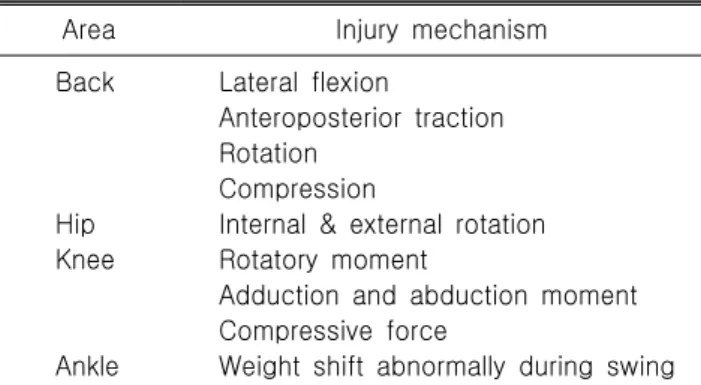
Table 1. Injury mechanism of back and lower extremity
Area Injury mechanism
Back Lateral flexion
Anteroposterior traction Rotation
Compression
Hip Internal & external rotation Knee Rotatory moment
Adduction and abduction moment Compressive force
Ankle Weight shift abnormally during swing by the lower back (22%–27%) and left hand 1,6) . The most common mechanism of injury for professional golfers was the high frequency (repetitive) of practicing the golf swing, followed by hitting an object other than the ball while swinging 1) .
In amateur golfers, common injury sites include the low back (15%–34%), wrist (13%–20%), the elbow (25%–33%), and the shoulder 7) . The most common mechanisms of injury in golfers are overuse, poor biomechanics of the swing and hitting the ground of an object during the swing 4,6) . Catastrophic injury like fracture or deep laceration may occur as a consequence of being struck by either a golf club or golf ball although this is rare 7,10) .
Lower Back Pain in Golf
Lower back has been reported as being the most common site of injury in a golfer, accounting for 23% to 35% of all injuries 1,7,11-13) . The forces that occur as a result of the mechanics of the golf swing may be categorized as downward compression, side to side bending, sliding from back to front shearing 1) . During the swing, compression forces on the spine reach eight times body weight in both golfers. In modern swing, along with the lumbar hyper extension found and twisting or torsion of the lumbar spine is associated with low back injury because of the relative intolerance of the lumbar spine to rotation. Moreover, compression, torsion, and lateral bending have been shown to be the most common mechanisms for disc herniation (Table 1) 13) . In an analysis of the differences in the golf swing of amateurs and professionals, compression loads were similar, but amateurs showed 80% more lateral bending and peak shear loads and 50% more torque 1) .
Back pain in golfers can present in many ways, as like other
sports and activities, causes of pain include mechanical pain, such as muscle strain, or spasm, discogenic pain, spondylogenic pain, or facet arthropathy. It is generally characterized by localized pain, associated muscle tightness, and spasm, and it usually begins gradually 1,14) . Thought that decreased internal rotation of the lead hip during the swing may translate more force to the lumbar spine, causing mechanical elements to be stressed 13,15) .
Change of the golf swing is related to the increased lower back pain. There was classic golf swing that was popular in the early and mid-part of the 20th century and there was the modern swing that Jack Nicklaus introduced in the 1960s 1) . Classic golf swing requires large pelvic and shoulder rotation and then, spine is relatively positioned neutral and body momentum is moved forwardly. Modern golf swing was designed for increasing the distance and higher shots. Pelvic rotation is limited compared to the shoulder rotation for coiling effect. Spine is hyperextended and body momentum is moved upwardly. This make hyperextended spine and right lateral flexion 1) .
Most of low back pain will be clinically improved by rest, anti-inflammatory medication, physical therapies, traction or manipulation, and rehabilitation program. But long-term program including gradual muscular stretching and flexibility exercises will be needed 9) . Key factors for decreasing lower back pain from golf as follow. First, don’t play or practice excessively and players must listen to their body and find a balance between overall participation volume and recovery. Second, seek pro- fessional assistance and assess swing mechanics. Third, improve trunk rotation flexibility, Fourth, maintain good hip rotation especially on the lead side. Fifth, allowing the lead heel to lift slightly at the completion of the backswing may avoid excessive spinal torsion by allowing more pelvic turn 11) .
Lower Extremity Pain in Golf
Lower extremity injury (11%) is much lower than upper
extremity injury (54%). Lower extremity injury mechanism was
summarized in Table 1. Among lower extremity injury, knee
injury is most common (6%–8%). Although knee injuries are
not a leading cause of golf injuries, the force can be large. Right
knee has its peak force at the end of backswing (compression,
540 N) and left knee has its peak force near impact and follow
이용석 외. 척추 및 하지의 골프 손상
제35권 제1호 2017 3
through (compression, 756 N) 4,6,7) . And the magnitudes of both
external knee adduction and abduction moments on the target-side knee during a golf swing were larger than those reported in gait.
So many of golfers are older and experience osteoarthritis in the hips and knees. In addition, as many in the golfing population may have undergone total knee arthroplasty or total hip arthroplasty.
Mallon and Callaghan 16) and Mallon et al. 17) conducted survey of both golfers who had a total knee arthroplasty and knee surgeons.
Most golfers (87%) had no pain during play and only 35% had mild pain after play. Most surgeons (94%) did not discourage golf and 90% of surgeons reported not giving any particular instructions.
Due to rotatory moment of the knee during swing phase, meniscus and ligament around the knee can be injured. Among them, anterior cruciate ligament (ACL) injury is often and catastrophic injury. Attention has been focused on knee injuries in golf recently as a result of the ACL damage or Tiger Woods’s left (front) knee. Woods has had three surgeries on his left knee:
the first (1994) removed a benign tumor; the second (2004) was to repair his ACL and; the most recent in 2008 was to reconstruct his ACL 2) . Golf swing generates forces and torques which cause internal rotation or external rotation of the tibia on the femur and these are resisted by the ligament and menisci 2) . Modern technique is characterized by the front foot remaining flat on the ground and net internal rotational torque at the shoe-surface interface. This generates repeated transmission of these force and torques by the knee joint 18,19) .
Purevsuren et al. 20) evaluated the fatigue injury risk in ACL of target side knee during golf. ACL force and strain reached their maximum values within a short time just after ball impact.
Leading causes of increased ACL loading were smaller knee flexion, higher internal rotation, increase of the joint compressive force, and knee abduction moments.
In golf swing, hip rotation is an essential part of the kinetic chain and it can generate hip pain. During swing phase, the lead hip moves rapidly from external to maximal internal rotation, and the trail hip moves from internal to external rotation. In closed kinetic chain, these repetitive asymmetrical forces risk injuries to the hip such as labral tear and femoroacetabular impingement 21) . It can be managed with rest or anti-inflammatory and surgical treatment can be possible depending on the symptom 22) .
Foot and ankle pain can also be caused by golf but percentage of foot and ankle was lowest 6) . Ankle sprain during swing and overuse syndrome like peroneal tendonitis, Achilles tendinitis, plantar fascitis can be occurred. This pain can be managed by rest and cooling, anti-inflammatory drug, and proprioceptive exercise to improve ankle and foot stability.
Stress fracture due to golf was also reported in lower extremity.
Tibial stress fracture is reported and the shape of fracture is often transverse fractures that involve the diaphysis. In these cases, lead side tibia was affected and the patients reported prodromal symptoms of “shin splint” localized to the affected tibia. But these symptoms are not common in golfers, their presence should warrant prompt investigation and management to prevent major injury 23) .
Conclusions
Despite of the fact that golf is a low intensity sport, it is associated with a significant number of injuries. Lower back and upper extremity has similarly high injury incidence and followed by lower extremity. Knee osteoarthritis is often caused in lower extremity and ACL injury is rare but it can be serious injury.
Poor swing mechanics and overuse are frequently related. However, injuries are also sustained from hitting the ground or being hit by a golf ball or club.
Conflict of Interest
No potential conflict of interest relevant to this article was reported.
References
1. McHardy A, Pollard H, Luo K. Golf injuries: a review of the literature. Sports Med 2006;36:171-87.
2. Marshall RN, McNair PJ. Biomechanical risk factors and mechanisms of knee injury in golfers. Sports Biomech 2013;
12:221-30.
3. Arbuthnot JE, McNicholas MJ, Dashti H, Hadden WA. Total
hip arthroplasty and the golfer: a study of participation and
performance before and after surgery for osteoarthritis. J
Arthroplasty 2007;22:549-52.
YS Lee, et al. Golf-related Spine and Lower Extremity Injury
4 대한스포츠의학회지