․접수 : 2009년 12월 17일 ․수정접수 : 2010년 4월 20일 ․채택 : 2010년 4월 22일
* Corresponding Author : Hae-Mo Park, Department of Preventive Medicine, School of Oriental Medicine, Sangji University, Woosan-dong, Wonju-si, Kangwon-do, 220-702, South-Korea.
Tel : 82-33-738-7508, Fax : 82-33-738-7825, E-mail : [email protected]
Comparative Study on the Effects of Herbal Medicine and Western Medicine on the Liver Function
Based on Cross-Sectional Design
Hae-Mo Park
*Department of Preventive Medicine, School of Oriental Medicine, Sangji University
Abstract
Objective : The purpose of this study is to examine safety of herbal medicine on liver function and compare with western medicine.
Method : 303 subjects of skin disease(vitiligo and psoriasis) were chosen at a local oriental medical clinic, and tested with a spot liver function test from Sept 1, 2006 to Dec 31, 2006. Subjects were grouped into untreated, herbal medicine, western medicine, and combination group by treatment record. Total bilirubin, AST, ALT and LDH was compared in each group, odds ratio and regression coefficient was calculated.
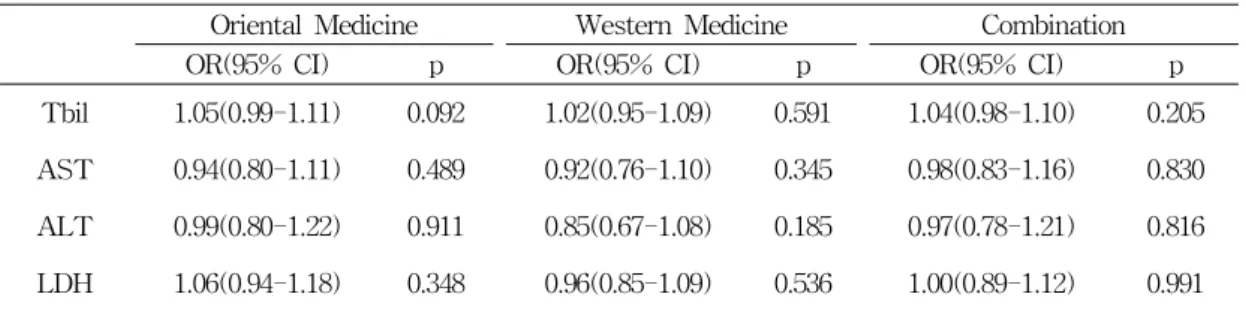
Results : Subjects comprised of 116 individuals receiving western medication(38.28%), 54 receiving herbal medication(17.82%), 107 receiving combined forms of medication(35.31%), and 26 individuals without any types of medication(8.58%). With the mean age of 37.0 yr. 204 were male(67.3%), 99 were female(32.7%). Comparing variables of liver functions, there was no significant difference between the control and experiment groups. After adjusting potential confounders, monthly β(SE) of multiple regression -0.009~0.000 for the herbal group, -0.005~0.000 for the western group, and -0.001~0.001 for the combination group. No significant difference between the groups. OR of T-bilirubin were 1.02, 1.05, and 1.04. AST were 0.92, 0.94, and 0.98. ALT were 0.85, 0.99, and 0.97. LDH were 0.96, 1.06, 1.00 for the herbal, western, and combination group, respectively.
Conclusion : Comparing with western medication, herbal medication did not cause special ill-effect on the liver function based on liver function tests.
Key words:Liver function, Herbal medicine, Western medicine, Safety, Complementary and
alternative medicine
I. Introduction
According to WHO report, 65∼85% of the world populations rely on alternative medicine as the primary medical service,
1)and 34% of Americans experienced at least one form of non-conventional medicine in the previous year.
2)Traditional medicine still contributes heavily in their respective countries and this trend will continue for quite some time.
Forms of traditional medicine include herbal medicine, acupuncture, moxibustion, and others.
3)Herbal medicine is most frequently used in Korea and China and is also most effective. Various herbal prescriptions are popularly used in oriental medical clinics and these prescriptions comprise anywhere from a single herb to 20∼30 herbs. Composite herbal prescriptions taken orally are in forms of decoction, pill, and powder which are meta- bolized in the liver. Substances that can damage the liver are carbon tetrachloride, yellow phosphorus, mushroom, and other pharmacological substances including herbal medicine.
4)Few studies were conducted overseas regarding effects of herbal medicine and the outcomes weren't favorable.
5-7)Other studies from Korea resulted in very opposite results as short or long term intake actually provides protection to the liver.
8-11)Contradicting results are causing confusion to the general public and more concrete results are needed to verify either outcome. Very few studies were aimed at long-term intake of herbal medicine and research procedures had some
flaws in few cases. Cross-sectional survey was conducted on patients with mid to long-term intake of herbal medicine at oriental medical clinics to verify effects of herbal medicine in serum liver functions.
Study groups were classified into control and experiment groups(herbal medicine, western medicine, and combination).
II. Materials and Methods 1. Materials
1) Subjects
Study subjects were chosen from one Oriental medical clinic in Seoul, Korea for treating skin disease of vitiligo and psoriasis.
Total of 303 subjects whom have consented the study were chosen. Duration of study ranged from September 1, 2006 to December 31, 2006. Average month of medicine intake was 5.9(month) in western medicine group, 2.3(month) in oriental medicine group.
Patients were explained the purpose of research and questionnaire was completed before the liver function test. The question- naire was completed on own in most cases and for incomprehensive questions, trained assistant aided in completion. Items in the questionnaire included gender, age, marriage, drinking, smoking, occupation, BMI(Body mass index), and duration of herbal and western medications.
2) Blood sampling and analysis
Under permission from patients and
guardians, 1㎖ spot sampling was collected
from a vein in the elbow area using a sterile syringe. Collected sample was centrifuged for 5 minutes and then analyzed through Auto dry Chemistry Analyzer(Spotchem TM SP- 4410, Kyoto Daichi Kagaku Co. Ltd.) for T-bilirubin(Total bilirubin), ALT(Alanine amino- transferase), AST(Aspartate aminotransferase), and LDH(Lactic dehydrogense) for liver functions.
2. Manufacturing and prescription of herbal and western medicines 1) Herbal medicine
Chronic relapsing skin disease such as vitiligo and psoriasis are approached with fixed treatment for all patients but indi- vidualized in Oriental medicine according to one's symptoms and constitution. Therefore, different herbal prescription is given for each patient with some basic herbs. Prescribed herbs are categorized into oral administration, external application, or combination. This ex- periment was focused on herbs for oral administration. Total of 155 herbs were used and commonly prescribed herbs were Rx.
Sophorae Flavescentis, Rx. Glycyrrhizae Ura- lensis, Rx. Salviae Miltiorrhizae, Rx. Codonopsis Pilosulae, Hb. Lemnae seu Spirodelae, Rx.
Iedebouriellae Sesloidis, Fr. Lugustri Lucidi, Fr. Xanthii, Se. Sesami Indici, Rx. Astragali, Rz. Polygonati, Rz. Gusuibu, Rx. Angelicae Sinensis, Fr. Psoraleae Corylifoliae, Rz.
Zingiberis Officinalis, and others.
(1) Decoction
Based on the doctor's prescription, set of herbs for 15 days worth of volume were inserted into a sanitized polypropylene bag.
To make an extract, herbs were cooked in an electric herb extractor for 3 hours at 10 0℃ with 5,500cc of water. Then the extract is sealed in a retort pouch : 50cc for children and 100cc for adults. Vacuum packed pouches were either picked up directly or sent via courier service to patients. Patients were instructed to keep pouches refrigerated.
(2) Pill
According to the prescription, dried herbs are gathered and powdered. Powder is then mixed with rice starch, wheat starch, and/or honey to make into a pill weighing 1 to 10g using a pill generator. Pills were normally taken three times a day before or after a meal but depending on the illness, dosage was adjusted to once a day to up to five times a day.
2) Western medicine
Patients diagnosed under western dermatolo- gist and given only oral medications were surveyed for total duration of treatment.
3. Statistical analysis
For statistical analysis, Stata(2001) statistical
package
12)was used for mean(SD)%, ANOVA,
multiple regression, and odds ratio (OR).
Variables Responses Subjects (n=303)
% or Mean(SD)
Age 303 37.0(9.5)
Gender Male 204 67.3
Female 99 32.7
Marriage Married 198 65.4
Divorced or separated 10 3.3
Single 95 31.4
Occupation White-color 152 50.2
Blue-color 85 28.1
Others 66 21.8
Alcohol Drinker 172 56.8
Non-drinker 131 43.2
Smoking Smoker 116 38.3
Non-smoker 187 61.7
BMI 303 23.5(3.0)
Treatment type Western med. only 116 38.3
Oriental med. only 54 17.8
Combination✽ 107 35.3
Untreated 26 8.6
✽Combination : Western medicine and oriental medicine
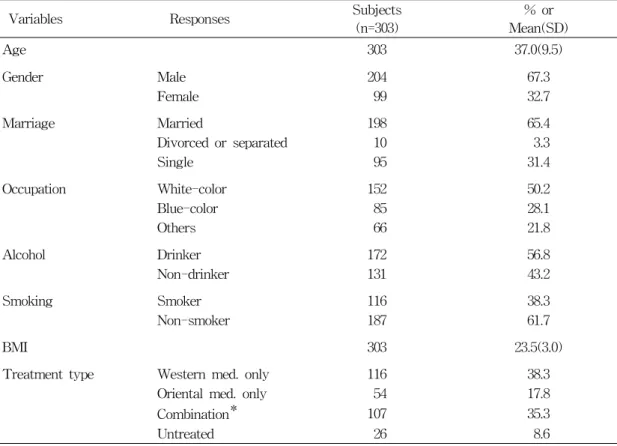
Table 1. General characteristics of study populations
III. Results
Socio-economic characters of the subjects are listed in Table 1. Among 303 subjects, 204 were male(67.3%), 99 were female(32.7%) with the mean age of 37.0±9.5. 198 subjects with normal marriage(65.6%). For the occu- pation, white-color workers comprised of 152 subjects (50.2%), and blue-color workers were numbered at 85(28.1%). 172 subjects were under habitual alcohol consumption(56.8%), and 116 subjects were smokers(38.3%). 116 subjects were only taking western medica-
tions(38.3%), 54 subjects with only herbal medicine(17.9%), and 107 responded with taking both western and herbal medicines concur- rently(35.3%). 26 subjects had neither western nor herbal medicine for the treatment(8.9%).
Among the total participants in the study, minimum, maximum, arithmetic mean and SD, and % exceeding upper limit range of liver functions in blood are listed in Table 2.
The range of minimum and maximum
values were increased in the order of 0.5
(0.2)㎎/㎗ for T-bilirubin, 27.5(24.3)U/L(male)
and 16.7(6.1)U/L(female) for AST, 40.8(44.6)
U/L(male) and 19.3(11.3)U/L(female) for ALT,
and 251.3±73.4㎎/㎗ for LDH. In the analysis
Variables Min Max AM(SD) % exceeding upper
limit reference range reference valuea
Tbil 0.2 1.8 0.5( 0.2) 1.7% 0.3~1.0
AST 10.0m
10.0f
282.0m 36.0f
27.5(24.3)m 16.7( 6.1)f
5.9%m 0.0%f
m : <39 f : <29
ALT 10.0m
10.0f
559.0m 106.0f
40.8(44.6)m 19.3(11.3)f
32.4%m 3.0%f
m : <47 f : <32
LDH 116.0 672.0 251.3(73.4) 3.0% 106~211
aReference value : Reference provided by (Kyoto Daichi Kaguku Co. Ltd), the manufacturer of auto drug chemistry analyzer
mmale, ffemale
Tbil : Total bilirubin (unit : mg/㎗)
AST : Aspartate aminotransferase(unit : U/L) ALT : Alanine aminotransferase(unit : U/L)
LDH : Lactic dehydrogense)for liver functions(mg/㎗)
Table 2. Minimum, maximum, arithmetic mean(SD), and percent exceeding upper limit reference range of liver functions in blood
Variables Control Oriental Western Combination
p-value
(N=26) (N=54) (N=116) (N=107)
Tbil 0.51( 0.07) 0.46( 0.03) 0.52(0.02) 0.50(0.02) 0.44 AST 24.65( 2.91) 20.04( 0.92) 25.02(2.47) 24.73(1.94) 0.50 ALT 31.35( 3.83) 25.09( 1.84) 38.00(5.12) 34.20(2.60) 0.24
LDH 249.65(14.13) 234.61(11.69) 262.88(6.64) 247.68(6.54) 0.11
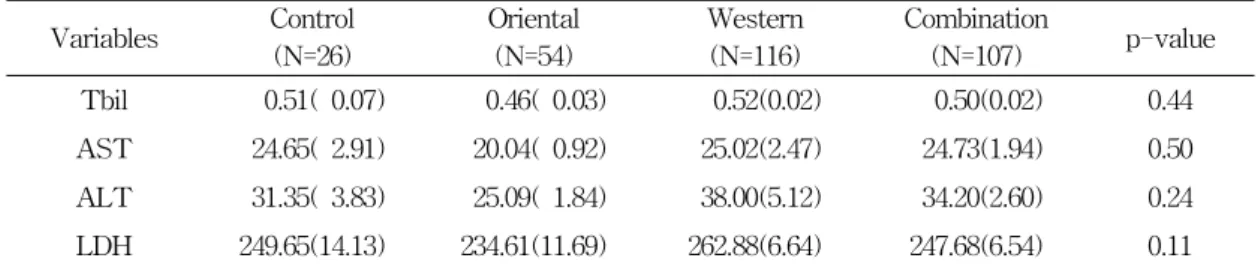
Table 3. Arithmetic mean(SE) of liver function test values in each groups
of percent exceeding upper limit reference
range, 1.7% for T-bilirubin, 5.9%(male) and 0.0%(female) for AST, 32.4%(male) and 3.0%
(female) for ALT, and 3.0% for LDH.
Liver function levels in blood among the experiment groups are listed in Table 3.
T-bilirubin was in the range of 0.51(0.07)
㎎/㎗ for the control group and 0.46(0.03)- 0.52(0.02)㎎/㎗ for the experiment groups.
AST was in the range of 24.65(2.91)U/L for the control group and 20.04(0.92)-25.02(2.47) U/L for the experiment groups. ALT was in the range of 31.35(3.83)U/L for the control
group and 25.09(1.84)-38.00(5.12)U/L for the experiment groups. Finally, LDH was in the range of 249.65(14.13)㎎/㎗ for the control group and 234.61(11.69)-262.88(6.64)㎎/㎗ for the experiment groups. For all variables, no statistical significance was shown(Table 3).
Multiple regression of liver functions in the
blood of the control group and experiment
groups are shown in Table 4. after adjusting
potential confounders. Monthly β(SE) of Mon-
thly β(SE) of T-bilirubin were -0.006(0.004),
0.001 (0.001), and 0.001(0.000) for the Oriental
medicine group, western medicine group, and
Dependent Variables^
Oriental Medicine (month) Beta(SE)
Western Medicine (month) Beta(SE)
Combination (month) Beta(SE)
Tbil -0.006(0.004) 0.001(0.001) 0.001(0.000)
AST -0.009(0.006) -0.004(0.002) -0.001(0.002)
ALT -0.001(0.009) -0.005(0.002) 0.001(0.002)
LDH 0.000(0.008) -0.001(0.001) 0.001(0.001)
✽ Adjusted for Age, Sex, Smoking, Drinking and Occupation
^ Dependent Variables are natural logarithm of each liver function level plus one, for example, log(1+AST)
Table 4. Regression coefficient (SE) of monthly liver functions in the herbal intake groups adjusted for potential confounders✽
Oriental Medicine Western Medicine Combination
OR(95% CI) p OR(95% CI) p OR(95% CI) p
Tbil 1.05(0.99-1.11) 0.092 1.02(0.95-1.09) 0.591 1.04(0.98-1.10) 0.205
AST 0.94(0.80-1.11) 0.489 0.92(0.76-1.10) 0.345 0.98(0.83-1.16) 0.830
ALT 0.99(0.80-1.22) 0.911 0.85(0.67-1.08) 0.185 0.97(0.78-1.21) 0.816
LDH 1.06(0.94-1.18) 0.348 0.96(0.85-1.09) 0.536 1.00(0.89-1.12) 0.991
✽ Reference group is the control group(untreated).
^ Adjusted for age, sex, smoking, drinking, occupation, and residence.
Table 5. Odds ratios✽ for exceeding reference values of liver function tests adjusted for potential confounders^(N=303)