Effect of Irradiation on the Quality of Pale, Soft, Exudative (PSE) Pork During Storage at 4℃
Aera Jang
1․ Xiande Liu
1․ Cheorun Jo
1*방사선 조사가 PSE 돈육의 냉장저장 중 품질에 미치는 영향
장애라
1․ 류현덕
1․ 조철훈
1*요 약
방사선 조사가 PSE 돈육의 품질에 미치는 영향을 알아보기 위해 전문 육류등급사에 의해 외관적 으로 확인된 PSE 돈육 등심을 4.5 kGy로 감마선 조사 후 pH, 육색, 지방산화, 미생물 및 관능적 품 질을 2주간 냉장저장하면서 측정하였다. pH는 4.5 kGy의 방사선 조사에 의해 영향 받지 않았으나 육 색 중 적색도를 나타내는 a*값은 방사선 조사된 등심근에서 저장기간 전체를 통하여 유의적으로 증 가하였음을 관찰할 수 있었다(P<0.05). 방사선 조사 4.5 kGy는 비조사구(0 kGy)와 비교하여 2주간 냉장저장기간 중 약 2 log의 총균수 감소효과를 보였다. 관능검사 결과 적색도 증가에 따른 방사선 조사 돈육등심의 선호도가 높았다. 이상의 결과를 종합해 볼 때 식육 방사선 조사기술은 미생물학적 안전성뿐만 아니라 PSE 돈육의 육색을 향상시키는데 유용하게 사용될 수 있음을 알 수 있었다.
핵심어: PSE(Pale-soft-exudative), 돈육, 방사선 조사, 품질
1
1
충남대학교 농업생명과학대학 동물자원과학부(Division of Animal Science and Resources, Chungnam National University, Daejeon 305-764, Korea)
* 교신저자: 조철훈(E-mail: [email protected], Tel: 042-821-5774)
I. Introduction
Irradiation of meat provides consumers a reduced risks from pathogens and parasites. Radiolytic products produced from irradiated meat are neither unique nor toxicologically significant (Thayer, 1994). Therefore, irradiation is known to the best method to control microorganisms over any other non-heat treatment pasteurization. However, Murano (1995) reported that radiolysis of myoglobin and lipids by irradiation could lead to discoloration and rancidity or other off-odor production.
Apart from microbial spoilage, lipid oxidation is the primary process by which quality loss of muscle food occurs (Buckley et al., 1995).
Initiators of lipid oxidation in irradiated meat are OH radicals generated by the interaction of ionizing energy with water molecules in muscle tissues or in meat products (Thakur and Singh, 1994). Regardless of packaging type, irradiated raw pork patties produced more volatiles than non-irradiated ones and developed a characteristic aroma immediately after irradiation (Ahn et al., 1998). The odor of irradiated meat was also characterized as a barbecued corn-like odor (Ahn et al., 2000a). Lebpe et al. (1990) reported that irradiated vacuum packaged pork had a fairly stable bright red or pink color. The degree of color change of irradiation can vary depending on animal species, muscle types and locations in muscle, but are commonly related to the oxygen availability of meat at the time of irradiation and during storage. Jo et al.
(2000) also found the color change to red from
the processed meat products by irradiation after long term frozen storage.
The ultimate pH of meat is also known to be a key factor of meat quality. Depending on the ultimate pH and color of meat, pork can be classified as normal, pale-soft-exudative (PSE), or dark-firm-dry (DFD). The distribution and proportion of free and bound water in normal, PSE and DFD pork are different, and their biological membrane function should be different as important barriers to deteriorative changes that can affect meat quality (Stanley, 1991).
PSE pork could be more susceptible to oxidative changes and could produce more off-flavor volatiles than normal or DFD meat on irradiation because of its denatured muscle membrane structure. Chen and Waimaleongora-Ek (1981) concluded that the lower the pH values in the raw chicken meat samples, the higher the TBARS values. Ahn et al. (2000b) reported that vacuum packaging was better than aerobic packaging for irradiation and subsequent storage of meat because of it minimized oxidative changes in pork during storage.
The objective of this study was to determine and compared the effects of irradiation on lipid oxidation, color, and sensory characteristics of PSE pork during storage at 4℃.
II. Materials and Methods 1. Sample
The PSE pork was obtained from Livestock
Packing Center at Gimje, Korea. The loin muscles (longissimus dorsi) from 4 different carcasses which were apparently thought to be severe PSE pork by an expert meat grader were selected. The sample was put into an ice box and transferred to laboratory.
2. Irradiation
Irradiation was performed next morning using a Co-60 gamma irradiator (point source, AECL, IR-79, Nordion International Co., Ltd, Ontario, Canada) with a source strength of 100 kCi.
The dose rate was 70 Gy/min at 16 ± 0.5℃ and the absorbed dose was 0 and 4.5 kGy. Dosimetry was performed using 5 mm-diameter alanine dosimeters (Bruker Instruments, Rhienstetten, Germany), and the free radical signal was measured using a Bruker EMS 104 EPR Analyzer. The actual dose was within ±2% of the target dose. The irradiated pork were transferred to a 4℃ refrigerator or a freezer (-20℃) and analyses were performed until 2 weeks with an week-interval.
3. pH and color measurement
pH was measured by pH meter (Model 520A, Orion Research Inc., Boston, MA 02129, USA) adding 9 part of deionized distilled water (DDW) into 1 part of the sample.
For color measurement, samples were cut into 2 cm-thick pieces and measured on the plate of the Color Difference Meter (Spectrophotometer CM-3500d, Minolta Co., Ltd. Osaka, Japan).
The instrument was calibrated to standard
black and white tiles before analysis. Eight pieces per treatment were measured and mean values were used for replication. A medium size aperture was used and the measurement was duplicated. The Hunter color L*-, a*-, and b*-values were reported through the computerized system usinga Spectra Magic software (version 2.11, Minolta Cyberchrom Inc. Osaka, Japan).
4. Lipid oxidation
Lipid oxidation was determined as a 2-thiobarbituric acid reactive substances (TBARS) value by using a spectrophotometer (UV 1600 PC, Shimadzu, Tokyo, Japan) as described by Ahn et al. (1998). Five gram sample was homogenized in a 50-mL centrifuge tube with a 50 L of BHA (7.2 % in ethanol) and 15 mL of distilled water byusing a homogenizer (DIAX 900, Heidolph Co., Ltd., Schwabach, Germany).
One milliliter of the homogenate was mixed with 2 mL of a thiobarbituric acid (TBA)/ trichloroacetic acid (TCA) solution (20 mM TBA in 15 % TCA), heated in boiling water, and centrifuged for 15 min at 2,000 rpm by using a centrifuge (UNION 5KR, Hanil Science Industrial, Co., Ltd., Incheon, Korea). The absorbance of the supernatant was measured at 532 nm by using a spectrophotometer (UV 1600 PC, Shimadzu, Tokyo, Japan). The concentration (mg/kg sample on the basis of wet weight) was calculated by using a determination curve.
5. Microbial analysis
Twenty five grams of sample was put into a
sterile plastic bag and stomached with 225 mL of 0.1 % peptone solution at a high speed for 2 min. After serial dilutions, 0.1 mL aliquots were plated onto a plate count agar for the total plate counts and onto eosin methylene blue agar for the Escherichia coli counts by using a standard spread plate method. Duplicate plates for each sample were incubated at 30oC for 48 hrs for the total plate counts and 37oC for 48 hrs for the E. coli counts.
6. Sensory evaluation
Sensory analysis was performed with 10 panel members, who were semi-trained and accustomed to the color and flavor of the normal pork before analysis. Sensory scores were evaluated with a 7-point scale: 1, very poor through 7, very good. The sensory parameters including flavor and color were evaluated independently by the panel members at 3 different times using raw sliced pork.
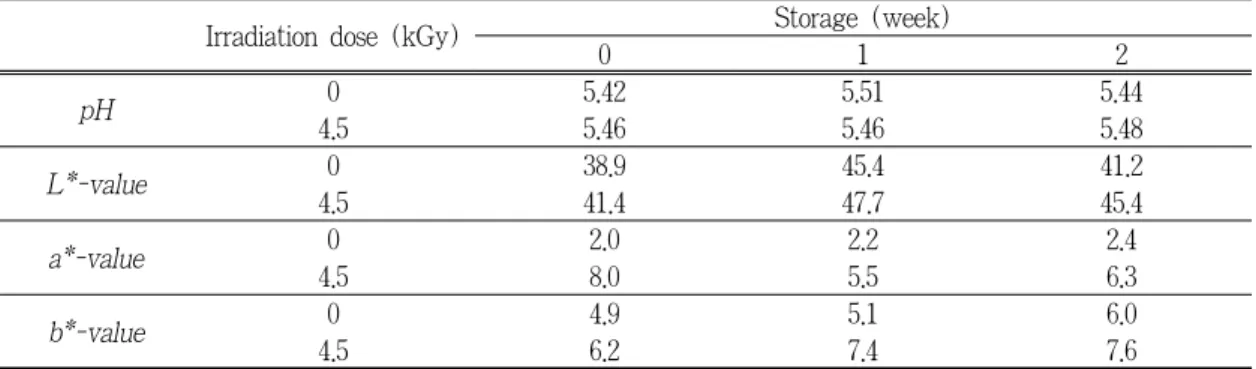
Table 1. pH and Hunter color values of irradiated pale-soft-exudative (PSE) pork loin during storage at 4℃.
Irradiation dose (kGy) Storage (week)
0 1 2
pH 0 5.42 5.51 5.44
4.5 5.46 5.46 5.48
L*-value 0 38.9 45.4 41.2
4.5 41.4 47.7 45.4
a*-value 0 2.0 2.2 2.4
4.5 8.0 5.5 6.3
b*-value 0 4.9 5.1 6.0
4.5 6.2 7.4 7.6
7. Statistical Analysis
Analyses of Variance was performed using SAS software and the Student-Newman-Keul’s multiple range test was used to compare differences among mean values. Mean values and standard deviation were reported, and the significance was defined at P<0.05.
III. Results and Discussion
1. pH and color
The pH values of non-irradiated and 4.5 kGy-irradiated PSE raw pork loin was not different (Table 1). The original ultimate pH was also maintained during 2 weeks of storage.
The ultimate pH of the samples were 5.42-5.46 which a little lower than that of normal pork (pH 5.6-5.8) and is agreed well to the pale appearance of the sample when collected. Nam et al. (2002) also demonstrated that irradiation of normal, PSE and DFD pork showed no
effect on the pH of all three pork types.
Irradiation did not show any difference in Hunter color L*-value during storage except for the sample at 2 weeks storage at 4℃ (Table 1).
However, Hunter color a*-value, which represents redness of meat surface showed significant increase in the irradiated pork loin at 4.5 kGy. This higher Hunter color a*-value maintained during 2 weeks of storage. The Hunter color b*-value also increased the surface meat color by irradiation. Jo et al. (2000) reported that a*-values of the surface of irradiated sausage without sodium nitrite were increased as a dose-dependent manner. Previous studies also indicated that irradiation increased redness of pork in vacuum packaging state (Luchsinger et al., 1996; Nanke et al., 1998).
Nam et al. (2002) reported that the a*-value in normal, PSE, and DFD pork with vacuum packaging decreased after 5 days of storage, but increased after 10 days of storage. The authors discussed this phenomenon as the residual oxygen in the vacuum packaging bag could have oxidized myoglobin at the early part of the storage time.
2. Lipid oxidation
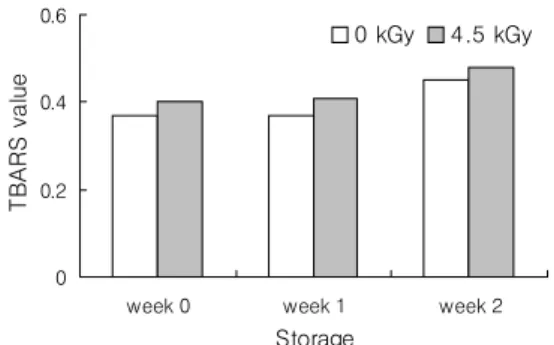
The 2-thiobarbituric acid reactive substances (TBARS) value of PSE pork loin was ranged from 0.37–0.40 and there was no difference between non-irradiated and irradiated sample (Fig. 1). The storage effect was also not found.
DFD pork was stable and resistant to both irradiation and storage in terms of quality of
pork (Nam et al., 2002). Yasosky et al. (1984) reported that the ultimate pH of ground pork was negatively correlated with the TBARS values of pork after 12 days of storage at 2C.
Low pH values in meat play an important role in lipid oxidation by denaturing antioxidant proteins, disrupting cell structure, and exposing membrane lipids to free radicals. The distribution of water and its location, where hydroxyl radicals are formed by irradiation and storage, could be critical for the irradiation-dependent reaction. Therefore, it was expected that the denatured membrane structure of PSE pork would make it more susceptible to lipid oxidation than normal pork.
However, there was no difference found in the present study.
0 0.2 0.4 0.6
week 0 week 1 week 2
Storage
TBARS value
0 kGy 4.5 kGy
Fig. 1. 2-thiobarbituric acid reactive substances (TBARS) value of irradiated pale-soft-exudative (PSE) pork loin during storage at 4℃.
3. Microbial quality
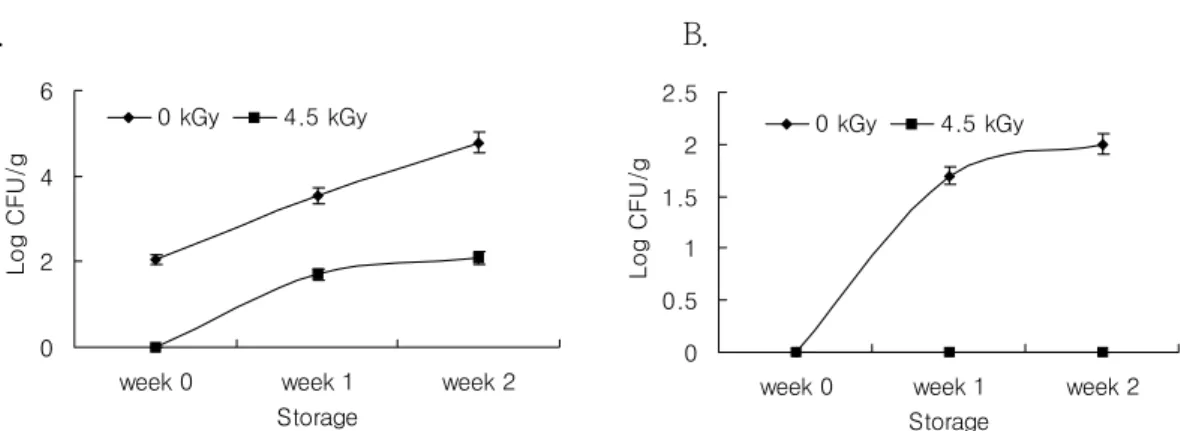
The original microbial contamination was about 1.14 x 10² CFU/g meat. The number of total aerobic bacteria increased during storage
for 2 weeks (Fig. 2). After 2 weeks, the total aerobic bacterial count reached to 6.0 x 10⁴ CFU/g. Irradiation at 4.5 kGy significantly reduced the number of total aerobic bacteria. At week 0, bacteria were not detected but after 1 and 2 weeks, the bacterial number was increased. However, approximately 2 log reduction was achieved by irradiation of 4.5 kGy during 2 weeks of storage when compared with non-irradiated control. Irradiation is known to be the best method for the control of potentially pathogenic microorganisms in raw meat (Gants, 1998). Because of irradiation’s effectiveness in controlling common food-borne pathogens and treating packaged food, thereby minimizing the possibility of cross contamination prior to consumer use, most food safety officials and scientists view irradiation as an effective critical control point in a Hazard Analysis and Critical Control Points (HACCP) system established for meat and poultry processing (Satin, 2002). Application of gamma radiation up to a dose level of 10 kGy can be used to eliminate or greatly reduce the numbers of food spoilage microorganisms as well as food-borne pathogens in food products without compromising the nutritional or sensory quality (Abu-Tarboush et al., 1996; Yousef, 1994). Jo et al. (2005) reported that the range of the D10
value was from 0.24-0.45 among the 4 strains including Staphylococcus aureus, Listeria ivanova, Salmonella Typhimurium, and Escherichia coli.
4. Sensory quality
Sensory analysis was conducted for the parameters of color and flavor because this study was only tested for raw meat state.
Sensory panelists prefer the color of irradiated PSE meat which showed redder than that of non-irradiated control (Fig. 3). This provides a possibility that irradiation may be used to improve color of PSE meat if other quality characteristics after irradiation are not significantly changed.
The significant difference was found until 1 week storage but the difference was not found at 2 week. Odor preference between non-irradiated and irradiated PSE meat was not shown in all storage period (P>0.05).
Usually irradiation of meat produces characteristic irradiation odor since S-containing volatile compounds are produced by irradiation treatment. As the irradiation odor intensity increased, the preference of meat odor decreased (Nam et al., 2002). Hashim et al.
(1995) showed that irradiating uncooked chicken breast and thigh produced a characteristic bloody and sweet aroma that remained after the thighs were cooked, but was not detectable after the breasts were cooked.
Nam et al. (2002) reported that panelist could easily distinguish odors of irradiation but not among normal, PSE, and DFD meat types.
However, Ahn et al. (2000) reported that panelists detected irradiation odor from irradiated pork loin and described it as a
"barbecued corn-like" odor but no objection to the odor was observed.
A. B.
0 2 4 6
week 0 week 1 week 2
Storage
Log CFU/g
0 kGy 4.5 kGy
0 0.5 1 1.5 2 2.5
week 0 week 1 week 2
Storage
Log CFU/g
0 kGy 4.5 kGy
Fig. 2. The number of total aerobic bacteria and coliforms in irradiated pale-soft-exudative (PSE) pork loin during storage at 4℃ (A: Total aerobic bacteria, B: Coliforms)
A. B.
0 1 2 3 4 5
week 0 week 1 week 2
Storage
Sensory score
0 kGy 4.5 kGy
0 1 2 3 4 5
week 0 week 1 week 2
Storage
Sensory score
0 kGy 4.5 kGy
Fig. 3. Sensory preference of irradiated pale-soft-exudative (PSE) raw pork loin during storage at 4℃ (A: Color, B: Odor).
From the results it is possible to use an irradiation technology to improve not only microbiological safety but also the color of meat which has severe defect such as PSE. However, the considerable assessment of meat quality should be tested before its application for industry.
Abstract
The effect of irradiation on the quality characteristics of pale-soft-exudative (PSE) pork was studied. The pork loin with severe PSE appearance was selected by meat grader, irradiated at 0 and 4.5 kGy, and meat quality characteristics including pH, color, lipid oxidation development, microbial and sensory quality were analyzed during 2 weeks of storage at 4℃. The
pH values of non-irradiated and 4.5 kGy-irradiated PSE raw pork loin was not different. Hunter color a*-value, which represents redness of meat surface showed significant increase (P<0.05) in irradiated PSE pork loin.
This higher Hunter color a*-value maintained during 2 weeks of storage. By 4.5 kGy of irradiation, approximately 2 log reduction of total aerobic bacterial counts was achieved during 2 weeks of storage when compared with non-irradiated control. Sensory panelists prefer the color of irradiated PSE meat than that of non-irradiated control because of redness. From the results, it is possible to use an irradiation technology to improve not only microbiological safety but also the color of meat which has severe defect such as PSE.
References