이산웨이블릿 변환과 퍼지추론을 이용한 적응적 물체 분류
Adaptive Object Classification using DWT and FI
김윤호* Yoon-Ho Kim*
요 약
본 논문에서는 이산웨이블릿 변환과 퍼지추론을 이용하여 물체를 분류하는 방법을 제안 한 바, 컨베이어 혹 은 무인 운송장치와 같은 저속도에 적용 할 수 있는 퍼지추론 알고리즘과 알고리즘의 퍼지 규칙수를 최소화하 는 방법에 중점을 두었다. 특징추출을 위한 전처리 과정에서 는 이산웨이블릿 변환 계수로부터 물체의 특징 파 라미터들을 구하였다. 물체의 특징 파라미터는 계수 블록으로부터 계산된 물체의 면적, 둘레, 면적과 둘레의 비 율을 이용하였다. 외부 환경에 기인하는 파라미터들의 변화에 적응할 수 있도록 퍼지 If-then 규칙을 설계하였 다. 제안한 추론 알고리즘의 성능 평가를 위하여 Mamdani 및 Larsen의 함의 연산자를 이용하여 실험하였고, 외부 환경 변화에 대하여도 적용 가능성을 보였다.
Abstract
This paper presents a method of object classification based on discrete wavelet transform (DWT) and fuzzy inference(FI). It concentrated not only on the design of fuzzy inference algorithm which is suitable for low speed uninhabited transportation such as, conveyor but also on the minimize the number of fuzzy rule. In the preprocess of feature extracting, feature parameters are extracted by using characteristics of the coefficients matrix of DWT. Such feature parameters as area, perimeter and a/p ratio are used obtained from DWT coefficients blocks. Secondly, fuzzy if - then rules that can be able to adapt the variety of surroundings are developed. In order to verify the performance of proposed scheme, In the middle of fuzzy inference, the Mamdani's and the Larsen 's implication operators are utilized. Experimental results showed that proposed scheme can be applied to the variety of surroundings.
Key words: DWT, FUZZY INFERENCE, TRANSFORM COEFFICIENTS, SIMILARITY
* 목원대학교 컴퓨터공학부(Division of Computer Engineering., Mokwon University) ‧ 제1저자 (First Author) : 김윤호
‧ 접수일자 : 2006년 5월 30일
I. Introduction
Shape classification(or analysis)is one of the major fundamental of vision system-based industrial applications.
In spite of the short of a complete method of recognition and classification, extensive research of these problems has
led to some satisfying treatments of the subject in the non-fuzzy way [1]-[3]. On the other hand, fuzzy logic has a great advantage in comparison with discrete formal logical system: It can approximate very well, it is suitable for the construction of approximation models as well as computationally effective algorithms of reasoning and
control [4]-[6].
This paper presented the optimal design of fuzzy if - then rules, which can be adapted the wide variety of circumstances and analyzed a useful membership function to classify the moving object both from the experimental as well as methodological standpoint. In the preprocessing, the extraction of image features are performed by using DWT which decomposes an image into sub-bands that vary in spatial frequency and orientation. Some feature parameters such as area, perimeter and area/perimeter ratio are directly calculated from the DWT coefficients, and the authors already have been reported in the literature, which treated these parameters are very useful in estimating motion vectors [5]. After the generation rule is made from the reference parameter, the fuzzy composition operation is performed.
Ⅱ. DWT-based Selection of Feature Vector
Since our generalized preprocessing of extracting feature parameter is based on DWT, we shall determine the meaningful coefficients according to the specification of it.
An important property of this DWT is that they preserve the spatial localization of image features [7]-[8]. Feature extraction is often the first major operation in many image recognition application. In this point of view, we invoke the idea that taking the DWT as a preprocessor of recognition system, feature parameters are directly obtained by transformed coefficients matrix. In a typical application, an image is subjected to a two-dimensional DWT whose coefficients are then quantized and may be used as a feature parameters.
Since the extracting operation computes for each group of pixels a list of its properties, the coefficients matrix guarantees that the output of the DWT have some properties might include its centroid, its area, its circumscribing portion, its orientation, its spatial moments, and so on.
The continuous wavelet transform can be defined as
CWTf(a,b)= 1a ⌠⌡Rψ *
(
t-ab)
f(t)dt (1)In this case, of course, we assume that ψ satisfies
⌠⌡ψ(t)dt = 0 (2)
where a∈R+, b∈R with a≠0 and the factor 1/ a is used to conserve the norm. For small a(a< 1), ψ a,b(t) will be short and of high frequency, while for large a(a≻1) ψ a,b(t) will be long and of low frequency. Thus, a natural discretization will use large time steps for large a, and conversely, choose fine time steps for small a.
From Eq.(1), we choose a=a m0, where m ∈Z, and the dilation step is fixed. For convenience, we will assume a 0>1. For , it seemsnatural as well to discretize b by taking only the integer multiples ofone fixed , where is appropriately chosen. For different values of m, we choose a=a m0, b=nb 0 am0, where m,n range over Z, and a 0>1, b0>0 are fixed; the appropriate choices for a 0,b0 depend on the wavelet ψ. And so the discretized family of wavelet is given by
ψ m,n(x)=a -0m/2ψ
(
x-nbam00am0)
=a-0 m/2ψ(a-0 mx-nb0) (3)
Finally, discrete wavelet transform can be expressed as Eq. (4).
DWTm, n ( f) = a-0m/2⌠
⌡ f(t) ψ (a-0mt-nb0)dt (4)
There exist many different types of wavelet
functions, all starting from the basic formulas (1)-(4).
The above multiresolution framework is closely related to the filter bank decomposition of signals. A multiresolution analysis of a signal f can be performed with a filter bank composed of a low-pass analysis filter {h} and a high-pass analysis filter {g}.
When the wavelet framework is applied to a discrete sequence, the original signal samples, fn=f(nX) , with X=1, are regard as the coefficients of the projection of a continuous function f(x) onto V 0 . Consequently, the DWT coefficients are organized into wavelet sub-tree. It provides hierarchical multi-resolution: three part of multi-resolution representation and a part of multi-resolution approximation. Extension to the 2D cae is achieved by applying the 1D analysis to the rows and columns of images. At each stage the image is decomposed into four, half-sized, sub-images, called image sub-bands.
Namely, consider a 2D image, wavelet decomposition will result a sub-bands structure and it can be expressed as
A2j+ 1f=∑k∑l h(2m-k)h(2n-l)A 2jf H2j+ 1f=∑k∑l h(2m-k)g(2n-l)A 2jf V2j+ 1f=∑k∑l g(2m-k)h(2n-l)A 2jf D2j+ 1f=∑k∑l g(2m-k)g(2n-l)A 2jf
(5)
Where the sub-bands A 2j+ 1f, represent the low-pass (LL) sub-band resulting in the application of low-pass filtering in both horizontal and vertical directions. And the H2j+ 1f and the V2j+ 1f also represent two detail sub-bands obtained by applying a low (high) pass filter in the horizontal direction and a high (low) pass one in the vertical direction (LH and HL sub-bands), consequently, D 2j+ 1f means high-high sub-band obtained by applying a high pass (HH) filter in both horizontal and vertical directions. Generally, the human visual system is not sensitive to detect changes in such bands as H2j+ 1f,
V2j+ 1f and D 2j+ 1f.
In our approach, we invoke the idea that taking the DWT as a preprocessor, feature parameters are directly obtained as well as segmented by transformed coefficients matrix. The coefficients matrix guarantees that the output of DWT have some properties might include its centroid, area, circumscribing portion, orientation, its spatial moments, and so on.
Ⅲ. Adaptive Fuzzy Rule Design by using Transform Coefficients
In order to design a fuzzy inference system, a crisp data must be translated into if-then language of fuzzy inference.
One of the most important steps in inference system design is the design of its membership function. This function can take interval values between 1 and 0 and is often shown inside straight brackets [1,0]. One common way of representing a fuzzy set is
A=Y xi∈Xμ A(xi)/xi
where the fuzzy set A is the collection or union of all singletons μ A(xi)/xi.
In order to generate the optimal inference rule, interpolative technique is utilized for the reduction of typical rules that is standard if-then inference based on the generalized modus pones inference paradigm. According to this, our inference rule can be formulated as follows:
Rule= {If X is MP1then Y is COE1 If X is MP2then Y is COE1
If X is MP3then Y is COE 2 If X is MP4then Y is COE2
... } These can be compressed into
Rule M= {If X is MP1or MP2 then Y is COE1
If X is MP3or MP4 then Y is COE 2 ... }
Here, the terms MP1,....,MP4 are feature parameters obtained from DWT coefficients and COE1, COE2 are inference output, respectively. Proposed shape classification algorithm can be described informally as follows:
* feature extraction stage * Step 1. Pre processing
. Perform the DWT
. Select a set of feature parameters from the sub-bands A 2j+ 1f, H2j+ 1f, V2j+ 1f and
D 2j+ 1f * fuzzy inference stage *
Step 2. While image sequence is not empty repeat step 3 - step 10
Step 3. Calculate the maximum error of DWT coefficients.
Step 4. If maximum error is larger TH then go to step 3.
Step 5. Repeat the step 6 - step 9.
Step 6. For each value of MPn applying COEn from MP1 to MP4.
Step 7. Find the defuzzification value.
Step 8. Find the certainty factor.
Step 9. If similarity factor greater than or equal to α- cut, then current vector is equal to reference image else, not equal to reference image.
Step 10. Store the number of similarity factor.
Step 11. End of algorithm.
Ⅳ. Experimental Considerations
In order to evaluate the proposed scheme, some experiments are performed with Matlab software.
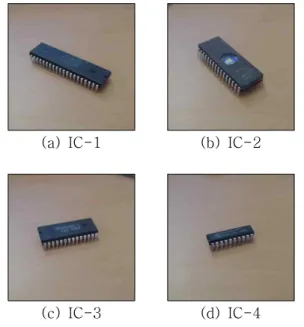
Experimental images are shown in Fig. 2. Each has a size of 256*256 and the image is gray scale with a range of 256 different gray level. To testify the adaptability of proposed scheme, experiments were conducted under some constrained conditions. Namely, in the middle of
experiment, the range of illumination have changed from 600 to 1200 lux with respect to the every single object, and 30 times of similarity experiments are carried out for variation of illumination.
The general architecture of the fuzzy inference system for classifying the object is composed of five basic functional blocks as shown in Fig. 1. In the preprocessing, real object are transformed into the coefficients matrix by using DWT.
Thus, some feature parameters related with the characteristics, such as frequency distribution, angle distribution and that of translation are selected.
In fuzzy inference module, the two of them organize an information interface (the fuzzification and defuzzification) linking the fuzzy inference module. Secondly, basic three procedures - fuzzificaton, inference module, defuzzification- are involved in classification stage.
Fuzzyfication step transforms an input crisp value into a fuzzy representing a degree of membership.
Test object
DWT coefficients
Fuzzified data
Fuzzy output
Similarity output
2D DWT ( Wavelet function )
Fuzzification ( Membership function )
Inference module ( Rule function ) Defuzzification ( Defuzzification )
Classification Test object
DWT coefficients
Fuzzified data
Fuzzy output
Similarity output
2D DWT ( Wavelet function )
Fuzzification ( Membership function )
Inference module ( Rule function ) Defuzzification ( Defuzzification )
Classification Fig. 1. Functional structure for shape classification
scheme.
In order to design the adaptive fuzzy rule, we calculated the maximum tolerance range of each parameter due to environmental condition such as variation of background, unpredicted noise. Consequently, based on these tolerance ranges, fuzzy data which can directly be used in membership function are generated. In the inference module, the generalized modus pones algorithm is considered as a transformation from the degree of
fulfillment in condition part ( also known as assumption ) to the degree of commensurateness in operation part( or conclusion ) by means of selected implication operator.
This implication process yields the output of fuzzy inference, and consequently, it is very important for inference rule designer to select the implication operator.
There are two important points to consider when evaluating an implication operator on an individual basis: the first is how well the operator represents a decision or how accurately it maps, the second point is how it behaves from one initiation step to another.
In this approach, the Mamdani and the Larsen operator are utilized to calculate the implication operation, which are defined in Eq. (6), respectively.
Φ M[ μ A(j), μ B(k) ] = μA(j)∙ μB(k) ΦL[ μ A(j), μ B(k) ] = μA(j)∧ μB(k) (6)
These operators are the most commonly used in control applications. one reason is that its behavior is regular, which makes it easy to anticipate the output of the modeled inference. It also generate a nonbinary decision in which elements vary between 1 and 0, which means this operator is suitable for composite rules.
Lastly, defuzzification phase, translates the fuzzy output into a crisp value, which is the similarity value of the classified object. We used the center of gravity method that based on finding a balance point of a property that can be the total geometric figure of output. This function is calculated by Eq. (7)
x= ∑iN
= 1 xiμ0(x)
∑N
i= 1μ0(x)
(7)
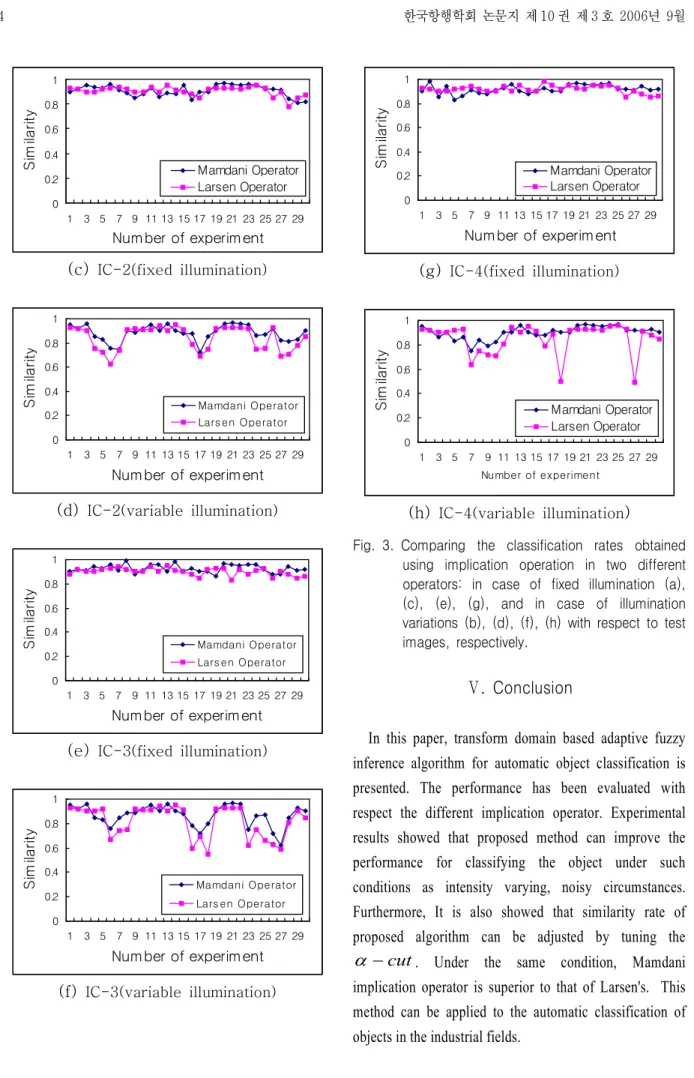
In order to evaluate the performance of proposed method some kinds of industrial IC patterns are chosen (Fig. 2). Fig. 3 illustrated the classification results using the Larsen's as well as the Mamdani's operator. It also
presented that Mamdani operator is superior to that of Larsen's for different values of illumination.
(a) IC-1 (b) IC-2
(c) IC-3 (d) IC-4
Fig. 2. Examples of test images: (a) IC-1, (b) IC-2, (c) IC-3, (d) IC-4.
0 0.2 0.4 0.6 0.8 1
1 3 5 7 9 11 13 15 17 19 21 23 25 27 29
Num ber of experim ent
Similarity
Mamdani Operator Larsen Operator
(a) IC-1(fixed illumination)
0 0.2 0.4 0.6 0.8 1
1 3 5 7 9 11 13 15 17 19 21 23 25 27 29
Number of experiment
Similarity
Mamdani Operator Larsen Operator
(b) IC-1(variable illumination)
0 0.2 0.4 0.6 0.8 1
1 3 5 7 9 11 13 15 17 19 21 23 25 27 29
Num ber of experim ent
Similarity
Mamdani Operator Larsen Operator
(c) IC-2(fixed illumination)
0 0.2 0.4 0.6 0.8 1
1 3 5 7 9 11 13 15 17 19 21 23 25 27 29
Num ber of experim ent
Similarity
Mamdani Operator Lars en Operator
(d) IC-2(variable illumination)
0 0.2 0.4 0.6 0.8 1
1 3 5 7 9 11 13 15 17 19 21 23 25 27 29
Num ber of experim ent
Similarity
Mamdani Operator Lars en Operator
(e) IC-3(fixed illumination)
0 0.2 0.4 0.6 0.8 1
1 3 5 7 9 11 13 15 17 19 21 23 25 27 29
Num ber of experim ent
Similarity
Mamdani Operator Lars en Operator
(f) IC-3(variable illumination)
0 0.2 0.4 0.6 0.8 1
1 3 5 7 9 11 13 15 17 19 21 23 25 27 29
Num ber of experim ent
Similarity
Mamdani Operator Larsen Operator
(g) IC-4(fixed illumination)
0 0.2 0.4 0.6 0.8 1
1 3 5 7 9 11 13 15 17 19 21 23 25 27 29 Number of experiment
Similarity
Mamdani Operator Larsen Operator
(h) IC-4(variable illumination)
Fig. 3. Comparing the classification rates obtained using implication operation in two different operators: in case of fixed illumination (a), (c), (e), (g), and in case of illumination variations (b), (d), (f), (h) with respect to test images, respectively.
Ⅴ. Conclusion
In this paper, transform domain based adaptive fuzzy inference algorithm for automatic object classification is presented. The performance has been evaluated with respect the different implication operator. Experimental results showed that proposed method can improve the performance for classifying the object under such conditions as intensity varying, noisy circumstances.
Furthermore, It is also showed that similarity rate of proposed algorithm can be adjusted by tuning the
cut
a - . Under the same condition, Mamdani implication operator is superior to that of Larsen's. This method can be applied to the automatic classification of objects in the industrial fields.
Reference
[1] R. C. Berkan and L. Trubatch, Fuzzy System Design Principles, IEEE Press. 1997.
[2] A. Costa and M. Olivier, "Fuzzy Logic Micro control", IEEE Micro, vol. 17, no. 1, 1997.
[3] T. Miki and T. Ymakawa, "Fuzzy Inference on an Analog Fuzzy Chip", IEEE Micro, vol. 15, no. 4, 1995.
[4] W. Pedrycz and J. Oliveira, "Optimization of Fuzzy Models", IEEE Trans. Systems, Man, and Cybernetics, vol. 26, no. 4, 1996.
[5] Y. H. Kim, M.K. Lee and J. S. Lee,"
Shapeclassification of SMD IC using WT and NN" , Proceedings, ICEIC, vol. 1, Aug, 1998.
[6] E. Grimson and J. Shapiro, "An unified multi-resolution frame work for automatictarget recognition,"
Proceedings, Image Understanding Workshop, vol. 1.
May, 1997.
[7] Y. H. Kim and H. H. Song, "An Adaptive Digital Watermarking using DWT and FIS," KDCS, vol. 5, no 2, Jun., 2004.
[8] M. Barni, F. Bartolini, V. Cappellini, N, Checcacci,:
Object Watermarking for MPEG4 Video Streams Copyright Protection, Proc. of the SPIE in security and watermarking of multimedia contents, vol. 3971. pp.
465-476, 2000
Yoon-Ho Kim
received the B.S. degree inelectronic engineering from Chong Ju Univ. and M.S. degree in electronic engineering from Kyung Hee Univ. in 1986, and the phD. degree in electronic engineering in 1992 from Chong Ju Univ., respectively.
In 1992, he join the faculty member of the Mok Won Univ., where he is currently a professor in the Dept. of Computer Engineering. From 2005 to 2006, he was with Univ. of Auckland, where he serveed as a research fellow. His research interests focus on image processing, including pattern recognition, computer vision, fuzzy technologies. He is a member of IEEE, IEEK, KICS, KIIT and KONI.