J Korea Industr Inf Syst Res Vol.19 No.1, 2014 http://dx.doi.org/10.9723/jksiis.2014.19.1.001
Secure Attribute-Based Access Control with a Ciphertext-Policy Attribute-Based Encryption Scheme
†Rifki Sadikin*, Young Ho Park**, and Kil Houm Park***
Abstract An access control system is needed to ensure only authorized users can access a sensitive resource. We propose a secure access control based on a fully secure and fine grained ciphertext-policy attribute-based encryption scheme. The access control for a sensitive resource is ensured by encrypting it with encryption algorithm from the CP-ABE scheme parameterized by an access control policy. Furthermore, the proposed access control supports non-monotone type access control policy. The ciphertext only can be recovered by users whose attributes satisfy the access control policy. We also implement and measure the performance of our proposed access control. The results of experiments show that our proposed secure access control is feasible.
Key Words : ciphertext-policy attribute-based encryption, public key encryption, access control
1. Introduction1)
Security service which ensures prevention of unauthorized use of a resource and limiting the flow of information is access control [1]. There are 3 types access control model known so far:
discretional, mandatory and role-based. In discretional model the decision of access policy is created by a user by specifying the access mode of a resource. Discretional model is easy to implement and has flexibility for the user. However, the
†This research was supported by Basic Science Research Program through the National Research Foundation of Korea(NRF) funded by the Ministry of Education, Science and Technology(NRF-2012R1A1A4A01002603)
* School of Electrical Engineering and Computer Science, Kyungpook National University, First Author
** Department of Electronics Engineering, Kyungpook National University, Corresponding Author ([email protected])
*** School of Electronics Engineering, Kyungpook National University
discretional model does not provide assurance on the flow of information in a system. In contrary, mandatory model assured the flow of information but in a rigid access control environment. While, the access structure of the role model combines the advantage of discretional and mandatory by partitioning the users into group of roles while role is defined as a set of actions and responsibilities associated with a working activity [2].
A new model for access control, called attribute-based access control (ABAC) is an access control model whereby the access policy use user's and resource's attribute altogether. The term of
"attribute" has broader meaning than "role" in role-based access control. Attributes defines the property of a user or a resource. For example, a user's attributes in an academic information system can be
where represents school's name,
represents laboratory's name,
represents his/her role in the system and
represents year of entrance. Then, an access policy is embedded to a resource to divide the set of attributes into two collections: authorized sets and unauthorized sets. For example, an access policy is represented as a Boolean function
∧∨ ∧
. The user is granted an access only if his/her set of attributes satisfy the access policy.
Traditionally, the attribute-based access control mechanism employs a trusted server that records user's attributes and resource's protection in a trusted network [2]. However, this traditional approach solely depends on the security of the trusted server. Once the trusted server compromised, then the access control mechanism was also compromised. In general, an ABAC mechanism usually deploys a symmetric and a public cryptographic schemes to reduce the role of a trusted server [3,4]. However, any public cryptography schemes only support one-to-one relation between a secret key and a ciphertext which is not compliance with the nature of ABAC model. Moreover, such kind access control solutions still rely on a trusted server and a secure storage.
Ciphertext-policy attribute-based encryption (CP-ABE) is a class of attribute-based encryption system which improved the expressibility of access structure in the ciphertext [5]. CP-ABE systems can be used to provide access control in distributed environments since it can express complex relation between sensitive resources and principals. In CP-ABE, a plaintext is encrypted with an access structure where the access structure can be expressed in a Boolean function such as: ("student"
AND "computer-science") OR "professor". A principal can recover the ciphertext, only if its attributes satisfy the access structure. In this case, a principal with a set of attributes {"student","electronics"} can not recover the ciphertext, while a principal with a set of attributes
{"professor"} can recover the plaintext.
In this paper, we develop and evaluate an ABAC system built on a fully-secure CP-ABE with non-monotonic access structures. The CP-ABE is used for protecting the sensitive resource which encrypted with a certain access policy. Meanwhile, the access structure is used for authorizing access policy between resources and principals. Our CP-ABE scheme can express non-monotonic access policy which is problematic in CP-ABE schemes [5-9]. The non-monotonicity of our CP-ABE allows user to express the access policy with 4 logical gates: AND, OR, Threshold and NOT.
Furthermore, our CP-ABE scheme is proven under fully security CP-ABE definition by applying dual encryption framework [10-11]. We also implement our ABAC system with pairing-based cryptography library [12]. We analyze the computation cost and the memory requirement of our ABAC system. We demonstrate that the cost of setup, key generation, encryption and decryption of our system are feasible.
2. Access Structure and CP-ABE 2.1 Access Structure
In a CP-ABE scheme, an access structure will be used in encryption algorithm to produce a ciphertext that parametrized by the given access structure.
Formal definition of access structure is given as follows:
Definition 1. (Access Structure [13]). Let us define be a set of parties. A collection
∈ is monotone if ∈ and ⊆, implies ∈ . An access structure is a monotone collection of non-empty subsets of . The sets in are called the authorized sets, and the sets not in are called the unauthorized sets.
A non-monotonic access structure has more
expressibility than a monotonic access structure.
CP-ABE schemes in [5-9] only allowed monotonic access structure. Whereas the recent CP-ABE can handle non-monotonic access structure [14-17].
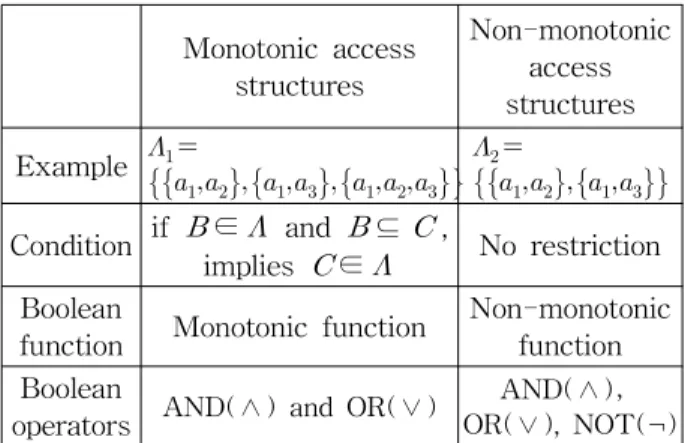
Table 1 summarizes the differences between monotonic access structures and non-monotonic access structures.
Monotonic access structures
Non-monotonic access structures Example
Condition if ∈ and ⊆,
implies ∈ No restriction Boolean
function Monotonic function Non-monotonic function Boolean
operators AND(∧) and OR(∨) AND(∧),
OR(∨), NOT()
<Table 1> Differences between monotonic and non- monotonic access structures
2.2 Construction of the CP-ABE Scheme
We used a CP-ABE scheme which based on bilinear groups with composite order of 3 primes.
We used variant of subgroup membership problems in [9] to prove that the CP-ABE construction is secure. Let us define a group generator:
← (1)
Where is a composite number of 3 primes: ,
and , and are (additive/multiplicative) cyclic groups with order of , and ×→ is a bilinear map satisfying bilinearity and non-degenerate:
∃ ∈ ∀ ∈ (2)
∃ ∈ ≠ (3)
The bilinear groups with composite order enjoy orthogonallity between different subgroups
if ≠ where ∈
∈
and
is sub group of with order of .
We present our CP-ABE construction as follows:
Setup Algorithm
←, where is a security parameter and is a bounded number for maximum size of the set of attributes, does the following:
(1) Generates bilinear groups
←
(2) Selects group generator ←
, ←
and
selects randomly ⋯← (3) Selects a public cryptographic hash function
→ (4) Sets a public function
∆ ∆ where
and ∆
∈ ≠
(known as Lagrange coefficient). is actually a function that computes where
is a random polynomial function degree of , with .
(5) Sets public parameters
and
master keys
Secret Key Generation Algorithm
←, where
is a set of attributes, does the following:
(1) Selects ← at random.
(2) Selects randomly
′ ′ ′ ← by exponentiation of .
(3) Sets the secret key as follows:
′
′ ∈
(4)
Encryption Algorithm
← , where ∈ as a plaintext and is an access structure related to a well-formed non-monotonic Boolean function
where is a Boolean operator (∧,∨
or ), and is either a Boolean operator, a non-negated attribute or negated attribute . Let us denote as a set of attributes that defined the Boolean function
where is either a non-negated attribute or a negated attribute . The encryption algorithm does the following:
(1) Selects ← at random.
(2) Runs the generalized secret sharing algorithm from [18] for the Boolean function
and recursively (from top to bottom) until is either a non-negated attribute or negated attribute. Let us assume that and the secret share is ′, we have 4 cases.:
(a) AND operator, ∧:
① Selects ← as shares for
respectively.
② Sets
′
mod as ashare for
(b) OR operator, ∨: sets ′ as shares for
(c) Threshold operator, :
① Selects ← and set a polynomial function
′
② Sets mod as a share for
(d) A non-negated or negated attribute: sets
share for the attribute as ′
(3) Sets the ciphertexts as follows:
∀ ∈
∀
∈
∀
∈
(5)
Decryption Algorithm
⊥←, where is a secret key parameterized by a set of attributes ,
is a ciphertext parametrized by an access structure, and is an access structure related to a well-formed non-monotonic Boolean function
. The decryption does the following:
(1) Checks whether ∈ , if ∉ returns ⊥ (2) If ∈ , then there is a set ⊆,
where ≤ satisfying , we have two cases:
(a) If
is a non-negated attribute
, then there must be ∈ satisfying
, the decryption computes:
′
(6) (b) If
is a negated attribute
, then
∀∈: . Let ′ ∪, then the decryption computes:
∈
∆ ∆
∈
∆
∈
∆
(7) (3) The decryption algorithm now can reconstruct the secret sharing in bottom-up manner until
is satisfied, for each Boolean
operator we have 3 cases:
(a) AND operator: ∧ and shares are , the decryption computes:
(8)
(b) OR operator: ∨ and shares are
, the decryption algorithm chooses where is satisfied and yields:
(9)
(c) Threshold operator:
and shares are
, chooses ⊆ where
and ∀ ∈, is satisfied.
The decryption algorithm computes:
∀ ∈
∆ (10)
(4) At the end of reconstruction of the secret share the decryption algorithm yields
and recover the plaintext as follows:
(11)
Correctness of the CP-ABE scheme
The decryption algorithm shows that our CP- ABE scheme satisfied correctness requirement.
2.3 Security of the CP-ABE Scheme
The proposed CP-ABE scheme is proven to be
fully secure though a model of security based on indistinguishable game under chosen plaintext (ciphertext) attack (CPABE-IND-CPA). The security proof used dual encryption system from [10]. We introduce semi-functional ciphertext and secret key by using elements from . First, we define the as follows:
- Setup. The challenger runs the
algorithm and gives the public parameters
to the adversary.
- Phase 1. The adversary makes repeated private keys corresponding to arbitrary sets of attributes
.
- Challenge. The adversary submits two equals length messages and . In addition, the adversary gives a challenge non-monotone access structure given that none of the sets
from Phase 1 satisfy the challenge access structure . The challenger flips a random coin ← and encrypt
under .
- Phase 2. Phase 1 is repeated with the restriction that none of sets of attributes
satisfy the access structure corresponding to the challenge access structure
.
- Guess. The adversary outputs a guess ′ of .
The advantage of an adversary in this game is defined as
P r ′
(12)This model can be extended to handle chosen-chipertext attacks by allowing for decryption queries in Phase 1 and Phase 2.
Definition 3. (Secure CP-ABE Scheme [17]). A CP-ABE scheme is secure if all probabilistic polynomial time (PPT) adversary has at most
a negligible advantage in CPABE-IND-CPA game.
We also define where the challenger always return a semi-functional secret key in secret key query (phase 1 and phase 2) and return a semi-functional ciphertext with random element in challenge phase. Similar to [8], we can show that is indistinguishable with
for any PPT adversary to satisfy Definition 3.
3. Attribute-Based Access Control System 3.1 Set of Attributes and Secret Key
In ABAC system, a user is not identified by an identity but a set of attributes which is a subset over an attribute space ⊆ where
. Every user who wants to be a decryptor must generate a secret key parameterized by his/her attributes set . For example, in a simplified health insurance system from [19] the attributes space is:
(13)
Let assume there is a doctor named Alice which works for hospital and covers insurance
<Fig. 1> Registration server setup and principal secret key generation.
issued for a company under prescription plan. Therefore, a set of attributes that parameterized secret key for Alice is
. In order to use the health insurance system, she must generate a secret key parameterized by as illustrated in Figure 1.
3.2 Access Policy and Ciphertext
Let us define as a set of sensitive objects in an access control system.
Access control for an object is defined by a non-monotonic access structure . The non-monotonic access structure is related to a non-monotonic Boolean function . The function can be transformed to a monotonic Boolean function containing AND, OR and
-threshold functions. is either a non negated attribute or a negated attribute .
One of examples of non-monotonic Boolean functions is
∨∧ . The function can be represented as a tree structure as Figure 2. Note that our system allowed NOT gate in leaf nodes. However, this limitation does not affect the expressibility of the access structure.
<Fig. 2> An example of access control.
The access control system employs encryption algorithm from the CP-ABE scheme to protect a
<Table 2> Comparisons between our CP-ABE and other CP-ABE Schemes Beth [6] Cheung [15] Lewko [8] Okamoto [16] Ours
Security Full Selective Full Full Full
Access
structure Monotone Non-monotone Monotone Non-monotone Non-monotone
Number of pairing (
matched)
≤
≤
sensitive object . The encryption algorithm requires an access structure , our system used a non-monotonic Boolean function to segregate users into authorized users or unauthorized users of the object . Principally, when an sensitive object want to be distributed across unsecured network the encryption algorithm
← is invoked and the encryptor distributes instead of where is symmetric block cipher with a key .
In the same example as in previous section, a patient in a simplified health insurance system could have electronic health record (EHR) that contains current medication history of the patient . Suppose only doctors, nurses, and pharmacists that support insurance for any corporation under
prescription plan and are not working for
can access his current medication. Let us denote represents the current medication of . When Bob creates through a EHR system, the EHR system supplies an access policy presented in a non-monotonic Boolean function:
∨∨∧∧
∧
(14)
Just like in key generation, the EHR system employs the same hash function →. It selects random ← as a secret key for a symmetric encryption algorithm . Then, it calls:
← ∨∨
∧ ∧ ∧
At the end, EHR publishes/stores
, as illustrated in Figure 3.
<Fig. 3> Encryption of a resource with an access policy.
3.3 Accessing Object
When a user wants to access a protected object
in a ciphertext , the user must provide a secret key parameterized by a set of (15)
attributes . If ∈ ( is an authorized set according to the access structure ) then the user can decrypt and receive the original plaintext
. For example, for a ciphertext ′ where the access structure is defined by a Boolean function:
′ ∨∧ . The user with a secret key parameterized by
can decrypt ′. While,
can not decrypt ′.
<Fig. 4> Access of a sensitive resource by a principal.
In the simplified health insurance system example as illustrated in Figure 4, Alice who has
where
can retrieve a protected object of Bob's recent medication () stored by the EHR system since satisfied the access policy of
∨∨
∧∧∧ . To recover , Alice invokes:
(16)
4. Performance 4.1 Comparison
We compare our CP-ABE construction with other
existing schemes in regards of monotonicity of the access structure, security of CP-ABE, space requirement (public parameters, secret key and ciphertext length) and computation cost (number of pairing pin decryption). From Table 2, our CP-ABE scheme achieves full security CP-ABE definition and non-monotone access structure. Most of the existing schemes do not achieve these properties.
The size of public parameters of ours is in linear function of where is maximum size of a set of attributes to parameterize a secret key.
While, others are in linear function of (attribute space size). Therefore, our CP-ABE scheme supports large universe construction.
The size of a secret key and a cipher text in our CP-ABE depends on the choice of bilinear groups.
We denote and to represent the size of element in group and respectively in bits.
The size of a secret key of our CP-ABE
is in linear function of (which is the same as others CP-ABE schemes except Cheung [15]). The exact size of a secret key in our CP-ABE scheme is . While, the size of a ciphertext of our CP-ABE is in linear function of (the number of attributes in the access structure ) where the exact size of a ciphertext in our CP-ABE scheme is
.
4.2 Implementation
We implement our proposed access control system in C language and compiled the implementation with GNU C compiler. The program structure of our implementation is given by Figure 5. We use three libraries: pairing based cryptography (PBC) library, GNU multi-precision and GNU Crypto library. PBC library is developed by Ben Lynn of Standford University as a part of his PhD thesis [12]. PBC library provides operation in bilinear groups and pairing function. GNU Crypto
library provides standard cryptographic systems which includes cryptographic hash functions and key encapsulation methods [20]. While, GNU multi-precision library provides functions to compute big number arithmetic [21]. The CPABE toolkit from [6] provides interface for using our CP-ABE library.
The CP-ABE library contains supporting and main functions. The supporting functions include a group generator, memory (de)allocators and cryptographic hashes. While, the main provides the implementation of 4 algorithm in CP-ABE scheme:
, , , and .
<Fig. 5> Program structure of access control based on CP-ABE.
4.3 Experiment Results
We do some experiment to get actual time needed for the access control system executing 4 basic functions: , , , and
. We vary the number of attributes and security parameter (size of bits). The experiment is conducted in a 64-bit dual core processor each with speed 3.30GHz and 3.70 GHz with 8GByte RAM.
We conducted the experiment for 3 different security parameters: 160. 256 and 512 bits. For each security parameters we execute , ,
, and for different size of attributes. In , number of attributes represents the size of attribute space. While for and
, it represents the size of attributes set in
and the number of attributes in the access
structure.
Figure 6 shows the Setup running time consumption is linear function in the size of attribute space. Typically, the size of attribute space is large. However, the Setup function is only executed once throughout the life time of the access control system. When (the size of element in group and are 160 bits) we found the relation between the running time and the size of attributes is in seconds by linear regression. We also find the relation for other security parameters are
and
. Surely there is trade-off between the size of security parameter and time consumption, but from our measurement when and , the time consumption for Setup function still in order of unit of seconds for in order of thousands and for is in the order hundreds.
<Fig. 6> Setup time consumption.
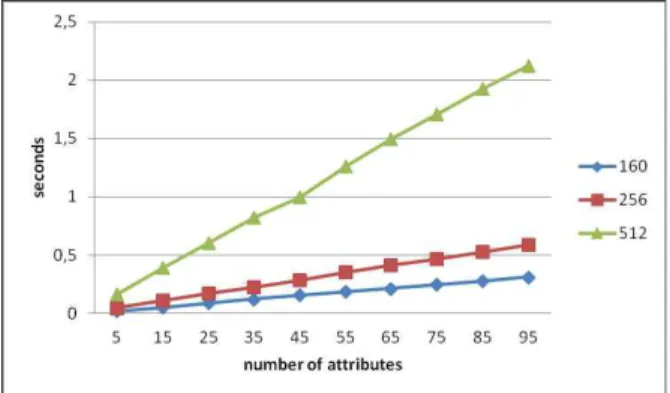
Figure 7 illustrates the cost of Secret Key Generation function. The number of attributes is the size of a set of attributes to parameterize secret key. Our experiments show that the cost of secret key generation is a linear function of where ,
and
in seconds.
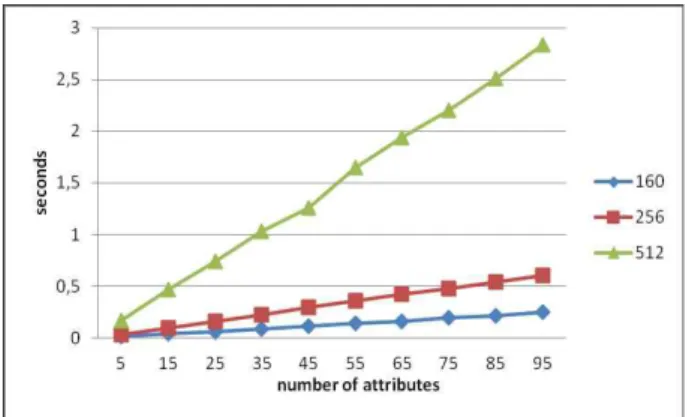
We found similar result for the cost of encryption.
Figure 8 shows the cost of encryption function is in linear function of (the number of attributes in
the access structure ) where
,
and
in seconds.
We found that the cost of decryption function is costlier than other functions as illustrated in Figure 9. This is because the decryption function uses pairing function from bilinear groups. Pairing function is the costliest than other group operations in bilinear groups. The cost of decryption function is in linear of , where is the number of matching attributes between the set attributes and attributes in the access structure , are
<Fig. 7> Key generation time consumption.
<Fig. 8> Encryption time consumption.
<Fig. 9> Decryption time consumption.
,
and
in seconds.
This shows the cost of key generation, encryption or decryption when is 160, 256, and 512.
5. Conclusion
This paper proposed an access control system based on a CP-ABE scheme. We used a fully secure CP-ABE constructions that support non-monotonic access control. The proposed access control allows complex relation between principals and resources. Principals give the set of its attributes for generating a secret key parameterized with its attributes. While, resources are given an access policy in a non-monotonic Boolean function to allow/disallow access based on principal's attributes. The performance of our access control system depends on the performance of the proposed CP-ABE. From analysis we found that our proposed CP-ABE retains fully secure and non-monotonicity of access structure and has reliable cost regarding memory requirement and computation cost compared to other existing CP-ABE schemes. The experiments shows that the computation cost of our access control. When the security parameter is 160 or 256, the order of the