JESK
http://jesk.or.kr eISSN:2093-8462Development of Management Guidelines and Procedure for Anthropometric Suitability Assessment: Control
Room Design Factors in Nuclear Power Plants
Kyung-Sun Lee, Yong-Hee Lee
Korea Atomic Energy Research Institute (KAERI), I&C/Human Factors Research Division, Daejeon, 305-353
Corresponding Author Yong-Hee Lee
Korea Atomic Energy Research Institute (KAERI), I&C/Human Factors Research Division, Daejeon, 305-353
Mobile : +82-10-5500-7958 Email : [email protected]
Received : November 18, 2014 Revised : November 21, 2014 Accepted : December 01, 2014
Copyright@2015 by Ergonomics Society of Korea. All right reserved.
○
ccThis is an open-access article distributed under the terms of the Creative Commons Attribution Non-Commercial License (http://creativecommons.org/licenses/by-nc/3.0/), which permits unrestricted non-commercial use, distribution, and reproduction in any medium, provided the original work is properly cited.
Objective: The aim of this study is to develop management guidelines and a procedure for an anthropometric suitability assessment of the main control room (MCR) in nuclear power plants (NPPs).
Background: The condition of the MCR should be suitable for the work crews in NPPs. The suitability of the MCR depends closely on the anthropometric dimensions and ergonomic factors of the users. In particular, the MCR workspace design in NPPs is important due to the close relationship with operating crews and their work failures. Many documents and criteria have recommended that anthropometry dimensions and their studies are one of the foremost processes of the MCR design in NPPs. If these factors are not properly considered, users can feel burdened about their work and the human errors that might occur.
Method: The procedure for the anthropometric suitability assessment consists of 5 phases: 1) selection of the anthropometric suitability evaluation dimensions, 2) establishment of a measurement method according to the evaluation dimensions, 3) establishment of criteria for suitability evaluation dimensions, 4) establishment of rating scale and improvement methods according to the evaluation dimensions, and 5) assessment of the final grade for evaluation dimensions. The management guidelines for an anthropometric suitability assessment were completed using 10 factors: 1) director, 2) subject, 3) evaluation period, 4) measurement method and criteria, 5) selection of equipment, 6) measurement and evaluation, 7) suitability evaluation, 8) data sharing, 9) data storage, and 10) management according to the suitability grade.
Results: We propose a set of 17 anthropometric dimensions for the size, cognition/
perception action/behavior, and their relationships with human errors regarding the MCR design variables through a case study. The 17 selected dimensions are height, sitting height, eye height from floor, eye height above seat, arm length, functional reach, extended functional reach, radius reach, visual field, peripheral perception, hyperopia/myopia/astigmatism, color blindness, auditory acuity, finger dexterity, hand function, body angle, and manual muscle test. We proposed criteria on these 17 anthropometric dimensions for a suitability evaluation and suggested an improvement method according to the evaluation dimensions.
Conclusion: The results of this study can improve the human performance of the crew in an MCR. These management guidelines and a procedure for an anthropometric suitability assessment will be able to prevent human errors due to inadequate anthropometric dimensions.
Application: The proposed set of anthropometric dimensions can be integrated into a managerial index for the anthropometric suitability of the operating crews for more careful countermeasures to human errors in NPPs.
Keywords: Anthropometry, Suitability, Human error, Main Control Room (MCR), Guideline, Nuclear Power Plants (NPPs)
1. Introduction
All facilities of the main control room (MCR) of a nuclear power plants (NPPs) should be efficiently designed for the crew to successfully fulfill their work. In the design of the MCR, the operation efficiency, the relationship with the associated equipment, the repair/maintenance of the
equipment, and the release/warehousing need to be comprehensively
considered (IAEA, 2000). For the efficient design of the MCR, various ergonomic functions should be optimally met, along with the functional arrangement.Ergonomic consideration is an essential factor for safety and productivity, and a variety of analysis methods and experiments are used for regulations, standards, and guidelines critically to reflect the ergonomics in the design.
The U.S. Nuclear Regulatory Commission (NRC) presented Human-System Interface Design Review Guidelines (NUREC-0700) to consider for the design, selection, and installation of an MCR, which are also used as a regulatory document (NRC, 2011). The U.S. Electric Power Research Institute (EPRI) also provides ergonomic guidelines for the MCR design (EPRI, 2004). In addition, IEEE-STD-1289 (1998) is used as the guidelines for the MCR design. In Korea, Korean Industrial Standards (KS) that can be used for function selection, consideration, and composition of a human-machine linkage, and for checking and verifying the functional design in designing the MCR of NPPs (Korean Agency for Technology and Standard, 2004), are provided. A nuclear power plant design company in Korea developed and has used ergonomic design guidelines, the Human Factors Engineering Guidelines (HF-010) (KOPEC, 2006).
The documents of the regulations, criteria, and guidelines mentioned above provide ergonomic guidelines on the items (dimensions) including the basic human-system interface (HSI) elements, HSI systems, workstation and workplace design, and HSI support. All of these documents recommend that all conditions of the MCR should be suitable for the operating crew, and should also fit the anthropometric and ergonomic dimensions of user groups for job performance success in the design of the control panel and workstation of an MCR that has adopted the latest digital technology. NPPs putting the highest priority on safety ensure mechanical reliability, as well as coping with human errors, through the efforts mentioned above.
Studies to evaluate the designed MCR have been actively conducted to prevent human errors together with researches on devising regulations and the criteria for the design. Lee (2000) performed an experiment to assess the suitability on the basic demand, as well as the pending issues drawn in the MCR arrangement design process. As a result, he said improvements of the design including the workstation curve, keyboard height at the horizontal front part of the workstation, and LDP height and slope were needed. Oh et al. (2002) calculated the predicted Korean anthropometric variables in 2010 using existing population's anthropometric data by drawing MCR design factors and the related anthropometric variables of each control room design factor. By reflecting the calculated the predicted variable dimensions, they carried out a study to develop the guidelines for design factors in order to prevent human errors. Lee et al. (2003) suggested that a modification method of the human error analysis technique for designing a man-machine interface in NPPs features based on a computerized working environment. In the study by Song and Lee (2004), they performed an experiment and evaluation on ergonomic suitability regarding MCR's soft controller and safety control panel, and presented the results and solutions to the ergonomic pending issues. Cha and Kim (2009) performed a study to present guidelines based on the ergonomic factor for a human machine system control room assessment under a hybrid environment, which is a neutral environment of digital and analog systems.
In addition to a human error prevention method through devising regulations and criteria in designing and conducting a design assessment during operation, the method to evaluate the job suitability from the management aspect is used as a means to prevent human errors and enhance the work efficiency. The 10CFR26, Fitness-For-Duty Program, developed by NRC and ILO criteria are generally used the most so as to assess the suitability of the operating crew in NPPs. Based on these criteria, the technical criteria for the fitness of duty of the operating crew in NPPs are presented by Article 299 of the Enforcement Ordinance of the Korean Nuclear Power Act and Article 115 of the Enforcement Regulations of the same act. The factors to judge the
suitability include a medical examination, mental health, job stress, behavior observation, crew support, administrative measures, and fatigue control (Lee et al., 2011). In the airline field classified into a large system with high reliability, in addition to NPPs, an aviation medical examination certification system is operated. Here, the weight, height, visual and auditory functions and motor skill and other anthropometric system dimensions are presented as management items (Ministry of Land, 2013).
Suitability evaluation data can be used critically for duty management, in addition to an improvement of the design from a human error preventive aspect. However, the suitability items evaluated in NPPs are concentrated on the recognition and job performance items. To cope with human errors that may be caused by a change in anthropometric capability, according to the age increase and environment, an evaluation of the human suitability dimensions should be accompanied. In addition, there is a need to precisely present the procedure and criteria for the assessment of suitability.
This study proposes the following as part of proactive actions to prevent human errors in NPPs: 1) developing an anthropometric suitability assessment procedure, 2) applying the developed anthropometric suitability procedure to the MCR of NPPs and assessing the efficiency, and 3) proposing the guidelines for an anthropometric suitability assessment.
2. A Procedure for Anthropometry Suitability Assessment
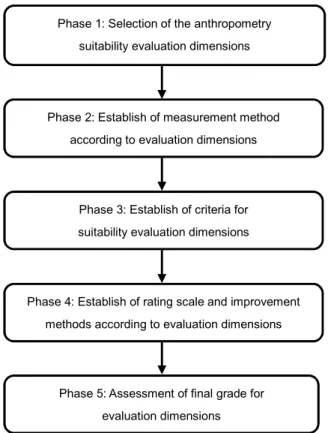
Figure 1 shows the overall procedure for an anthropometric suitability assessment. The procedure for an anthropometric suitability assessment consists of the following five phases: 1) Selection of anthropometric suitability evaluation dimensions related to the design variables, 2) establishment of a measurement method according to the evaluation dimensions, 3) establishment of criteria
Phase 5: Assessment of final grade for evaluation dimensions
Phase 4: Establish of rating scale and improvement methods according to evaluation dimensions
Phase 3: Establish of criteria for suitability evaluation dimensions Phase 2: Establish of measurement method
according to evaluation dimensions Phase 1: Selection of the anthropometry
suitability evaluation dimensions
for suitability evaluation dimensions, 4) establishment of the rating scale and improvement methods according to the evaluation dimensions, and 5) assessment of final grade for the evaluation dimensions.
2.1 Phase 1: Selection of the anthropometry suitability evaluation dimensions
To evaluate the anthropometric suitability of the crew in specific NPPs, the following need to be carried out: 1) review regulatory documents or guidelines used in the NPPs in those days, through which, the design variable-related anthropometric suitability assessment dimensions are drawn, 2) select and review the dimensions to be related with human errors through an evaluation using a focus group interview (FGI) or Delphi technique together with NPPs operating experts, MCR design and evaluation experts, ergonomic experts, and regulatory experts for the first phase, 3) carry out a literature review for the dimensions to be added by age, gender, and other environment factors, and 4) lastly, add relevant machines/apparatuses and related anthropometric suitability assessment dimensions through a human error-caused suspension/failure case study.
2.2 Phase 2: Establishment of measurement method according to evaluation dimensions
For the finally drawn anthropometric suitability assessment dimensions, the relevant data and equipment need to be prepared through a literature review so that the working level staff can measure the evaluation dimensions. To acquire the precise measurement values, based on the same criteria by the evaluation dimensions, the guidelines on the definitions of the measurement dimensions, measurement posture, criteria, method, and practical work need to be provided. In addition, photos and videos to help with an understanding of the measurements should be added.
2.3 Phase 3: Establishment of criteria for suitability evaluation dimensions
Establishing the criteria for anthropometric suitability evaluation dimensions is the most important phase for a final rating. For the anthropometric dimension variables, the suitability criteria should be devised based on the dimensions and scope considered at the time of designing the facilities and machines and apparatuses. For example, if the stand-up console height is designed using the mean criteria dimensions of the population (red line) and the permissible scope was 5% for females and 95% for males at the time of design, there is a gap in the criteria dimensions, when applying the population's dimension criteria (blue line) (Figure 2). Therefore, the criteria at the time of design should be complied with in order to evaluate the anthropometric suitability on the currently manufactured facility.
For the establishment of the criteria for items (dimensions) for cognition/perception and action/behavior, proper criteria need to be devised by a literature review of the measured dimensions.
2.4 Phase 4: Establishment of rating scale and improvement methods according to evaluation dimensions
Human errors in NPPs, especially human errors caused by anthropometric unsuitability, are a rare event with a low possibility to actually occur; however, the results can be very serious. Despite the dimensions with a low occurrence possibility, a conservative evaluation is necessary in view of the NPPs characteristics (Lee, 2002). Therefore, a suitability evaluation is conducted using two scales - suitability (S) and unsuitability (U) on an individual evaluation dimension.
To determine the anthropometric suitability rating, after assessing the suitability based on the dimension, reflect the possible action for each evaluation dimension. The possible improvement actions on the unsuitability of the evaluation dimensions were classified into an engineering approach (Category-E) and management approach (Category-M). Category-E corresponds to a case of unsuitable dimensions owing to the use of supplementary machines and apparatuses and a partial change in the facilities.
Category-M is classified into the first phase response and second phase response. The former corresponds to the unsuitable dimensions that can be coped with gymnastics/stretching, treatment, supervision, and supplementary support, and the latter corresponds to a reorganization and change in duties.
2.5 Phase 5: Assessment of final grade for evaluation dimensions
For practical work management of anthropometric suitability, the final grade was classified into levels I, II, and III (Table 1). Level I mean that the evaluation dimensions are suitable, and level II corresponds to the case in which unsuitability can be solved or errors can be coped with in Category-E (engineering approach). Levels I and II mean they are suitable for the duty concerned.
Level III corresponds to a case that cannot be prevented with Category-E, and means the unsuitability for the duty concerned.
If the dimensions corresponding to this case are unsuitable, a re-evaluation needs to be carried out after the first phase approach is taken. If unsuitability is still shown, a reorganization of the duty and duty change should be considered as the second approach.
3. Case study: Main Control Room in Nuclear Power Plants
This study evaluated the procedural usefulness by applying the evaluation procedure presented in this study to the main control room (MCR) of NPPs.
Table 1. Level of anthropometry suitability
Level Criteria Suitability /possibility
I All suitability
Suitability II Non-suitability of engineering improvement essential dimension
III Non-suitability of management improvement essential dimension Non-suitability (In case of type 2)
3.1 Phase 1: Selection of the anthropometric suitability evaluation dimensions
Design variables and anthropometric dimensions: These comply with the anthropometric suitability assessment dimensions selection procedure presented in Section 2.1 above. This study selected a control panel and workstation applying the most anthropometric characteristic dimensions among various facilities in the MCR of NPPs. To draw the design variables and anthropometric suitability evaluation dimensions, this study reviewed the Human-System Interface Design Review Guidelines (NUREC-0700), the ergonomic guidelines of the U.S. Nuclear Regulatory Commission.
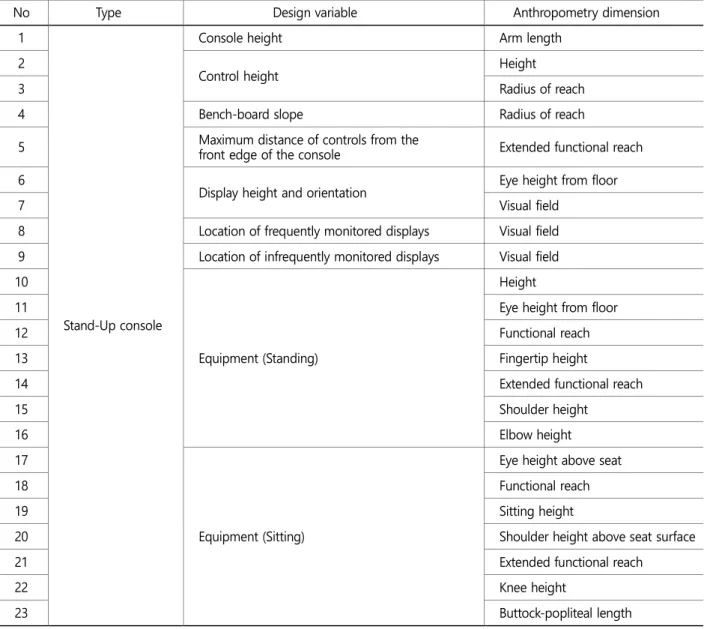
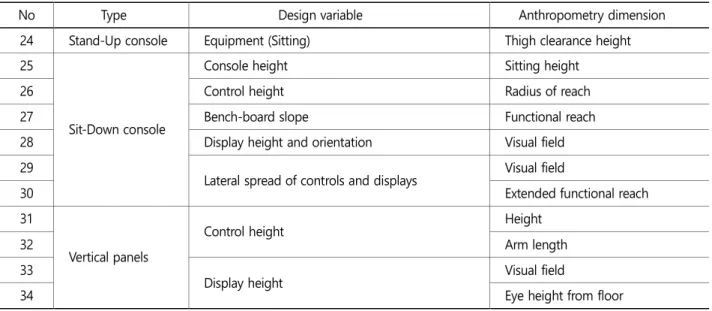
The target dimensions were a stand-up console, sitting console, and vertical panel. This study drew 16 detailed design variables and 34 anthropometric dimensions-related variables in total (16 in total, if duplicate anthropometric characteristic variables are excluded) (Table 2).
Table 2. Design variables and anthropometry dimensions for MCR
No Type Design variable Anthropometry dimension
1
Stand-Up console
Console height Arm length
2
Control height Height
3 Radius of reach
4 Bench-board slope Radius of reach
5 Maximum distance of controls from the
front edge of the console Extended functional reach 6
Display height and orientation Eye height from floor
7 Visual field
8 Location of frequently monitored displays Visual field
9 Location of infrequently monitored displays Visual field
10
Equipment (Standing)
Height
11 Eye height from floor
12 Functional reach
13 Fingertip height
14 Extended functional reach
15 Shoulder height
16 Elbow height
17
Equipment (Sitting)
Eye height above seat
18 Functional reach
19 Sitting height
20 Shoulder height above seat surface
21 Extended functional reach
22 Knee height
23 Buttock-popliteal length
Questionnaire, FGI, Expert's advice and Literature review: Among the dimensions selected in the first phase in Table 2, this study conducted a questionnaire survey and FGI to identify the dimensions to consider from a human error aspect. The subjects for the questionnaire survey were three operating experts, who worked at the MCR in NPPs, and nine ergonomic experts with experience in the design and evaluation of an MCR in NPPs. Qualitative opinions were collected after the evaluation. The questionnaire was used to evaluate the possibility of impact on human error occurrence during duty performance with A (higher), B (intermediate), and C (lower), when the facility, machine and apparatus dimensions or anthropometric dimension-related variables were unsuitable. To select the anthropometric characteristic variables highly related with human errors, this study analyzed experts' grades rated as A, B, and C. The evaluation criterion was used to select dimensions taking up more than 70%
of the frequency ratios of A and B in priority (1). Here, N indicates the total number of evaluations.
Evaluation dimension ratio (%) = (High frequency+medium frequency)/N X 100 (1)
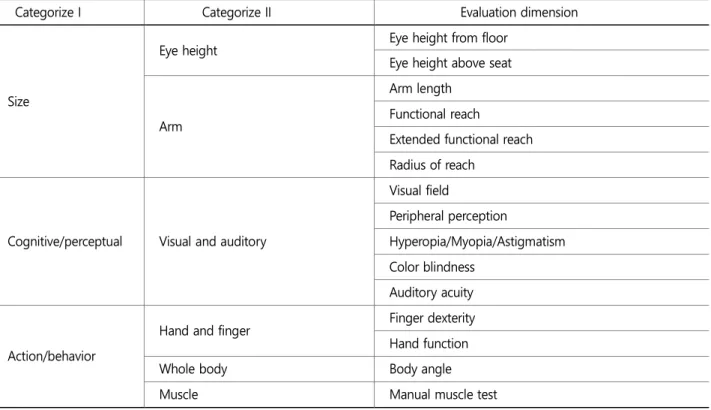
The dimensions in Table 2 considered only the anthropometric dimensions related with the design variables. However, human errors are errors occurring in each phase of human cognition/perception and action/behavior, and therefore, their consideration is necessary. In this regard, this study drew additional dimensions and reviewed the targeting of four NPP experts, one nuclear regulatory expert, and three ergonomic experts. For drawing additional dimensions, this study took into account the dimensions to be considered in the digital-based MCR and practical applicability from a human error management aspect. Based on the procedure, this study selected detailed items for anthropometric suitability by classifying them into anthropometric dimensions, cognition/perception, and action/behavior (Table 3).
Table 2. Design variables and anthropometry dimensions for MCR (Continued)
No Type Design variable Anthropometry dimension
24 Stand-Up console Equipment (Sitting) Thigh clearance height
25
Sit-Down console
Console height Sitting height
26 Control height Radius of reach
27 Bench-board slope Functional reach
28 Display height and orientation Visual field
29
Lateral spread of controls and displays Visual field
30 Extended functional reach
31
Vertical panels
Control height Height
32 Arm length
33
Display height Visual field
34 Eye height from floor
Table 3. Anthropometry suitability evaluation dimensions in MCR
Categorize I Categorize II Evaluation dimension
Size Height Height
Sitting height
This study drew 17 items in total including eight anthropometric dimensions, five cognition/perception, and four action/behavior items as anthropometric suitability evaluation dimensions for MCR in NPPs.
3.2 Phase 2: Establishment of measurement method according to evaluation dimensions
Through a literature review, this study arranged the relevant data and necessary equipment for working level personnel to Table 3. Anthropometry suitability evaluation dimensions in MCR (Continued)
Categorize I Categorize II Evaluation dimension
Size
Eye height Eye height from floor
Eye height above seat
Arm
Arm length Functional reach
Extended functional reach Radius of reach
Cognitive/perceptual Visual and auditory
Visual field
Peripheral perception
Hyperopia/Myopia/Astigmatism Color blindness
Auditory acuity
Action/behavior
Hand and finger Finger dexterity
Hand function
Whole body Body angle
Muscle Manual muscle test
Table 4. Measurement of the anthropometry dimensions (Example: Functional reach)
Anthropometry dimension Functional reach
Definition The horizontal distance from the wall to the tip of the thumb
Posture Anatomical standing posture
Measurement method Measure with the subject's forward, and the index finger touching the tip of the thumb
Figure*
*Source: Stephen Pheasant (1996)
measure the evaluation dimensions. The guidelines on the definition of the measurement dimensions, measurement posture, criteria, method, and practical work were provided. Table 4 shows the definition, measurement posture, and method, as well as relevant photos on the scope of the functional reach.
The data of Size Korea were used for items related with anthropometric dimensions (Size Korea, 2011). The data of Phesant (1996) were referred to for the functional reach, maximum arm reach, and rotation radius measurement methods. For visual and auditory function, a Ferstel perimeter was used for visual field measurements, and the peripheral perception was measured through a peripheral perception test. The method and interpretation of the measurement complied with the study of LaGrone et al. (1943).
Hyperopia, myopia, and astigmatism tests complied with the radiation indicator test, and the sense of color abnormality test used a color blindness test chart. For an auditory test, a simple tone auditory test was carried out. For a finger dexterity test, O'Connor's finger dexterity test method was used (Corlett et al., 1971), and Jebsen-Taylor's hand function test was used for a hand function test (Jebsen et al., 1969). For whole-body angle measurements, the measuring method presented from ISO 1226 was used, and a manual muscle test was used for the measurement of muscular strength (Mage, 2007).
3.3 Phase 3: Establishment of criteria for suitability evaluation dimensions
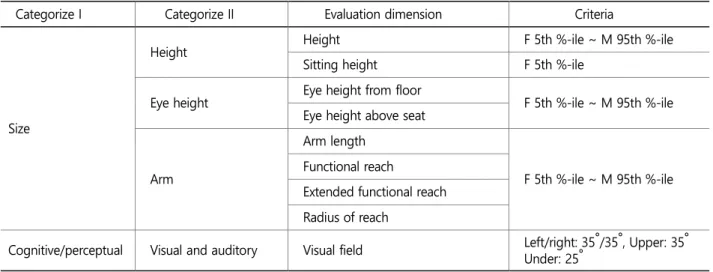
For the criteria for the anthropometric suitability evaluation dimensions, the criteria dimensions presented by NUREC-0700 were applied. Concerning the variables of cognition/perception and action/behavior in addition to the dimensions, the criteria were established on the basis of the literature mentioned in Section 3.2 (Table 5).
Concerning the anthropometric dimensions and action/behavior, when the measured values were within the criteria, they were evaluated as suitable. In the case of hyperopia, myopia and astigmatism, color abnormality, and auditory function, the suitability was evaluated based on the status of abnormality. The suitability criterion for finger dexterity was determined to be 5.5 with a higher standard score by which machine manipulation was possible (Corlett et al., 1971). Table 5 shows the suitability criterion for hand function, which were selected on the basis of the normal scope of Korean adults (Kim et al., 2984). The suitability criterion for whole body angle complied with ISO 1226. The suitability criterion for MMT (manual muscle test) was determined to be of G and higher grade (winning against gravity and winning against optimum gravity) (Magee, 2007). All of these indicate a normal state without overdoing to exert a force, based on a conservative evaluation in view of the NNP characteristics.
Table 5. Criteria for suitability evaluation dimensions
Categorize I Categorize II Evaluation dimension Criteria
Size
Height Height F 5th %-ile ~ M 95th %-ile
Sitting height F 5th %-ile
Eye height Eye height from floor
F 5th %-ile ~ M 95th %-ile Eye height above seat
Arm
Arm length
F 5th %-ile ~ M 95th %-ile Functional reach
Extended functional reach Radius of reach
Cognitive/perceptual Visual and auditory Visual field Left/right: 35°/35°, Upper: 35°
Under: 25°
3.4 Phase 4: Establishment of rating scale and improvement methods according to evaluation dimensions
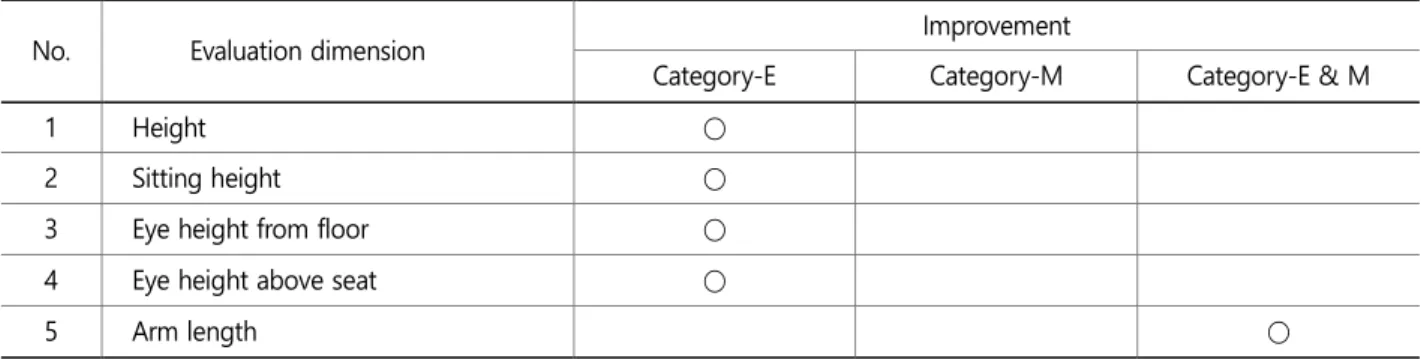
After measuring the subjects of evaluation, based on the measurement method by the evaluation dimension presented in Section 3.2, this study conducted an evaluation with two scales (suitability (S) and unsuitability (U) on the basis of the criteria in Section 3.3. With regard to the evaluation dimensions for the MCR drawn in Table 3, this study classified actions for each dimension into Category-E (engineering actions) and Category-M (management actions), based on the opinions of NPP ergonomic experts (Table 6).
Table 5. Criteria for suitability evaluation dimensions (Continued)
Categorize I Categorize II Evaluation dimension Criteria
Cognitive/perceptual Visual and auditory
Peripheral perception Left/right: 35°/35°, Upper: 35°
Under: 25°
Hyperopia/Myopia/Astigmatism O, X
Color blindness O, X
Auditory acuity O, X
Action/behavior
Hand and finger
Finger dexterity Standard score: over 5.5
Hand function
W: 9.0s T: 3.3s P: 5.6s SF: 7.3s SC: 3.1s PL: 3.0s PH: 2.9s
Whole body Body angle Neck: under 25°
Trunk: under 60°
Muscle Manual muscle test Over G grade
*W: Writing, T: Turning over 3-by 5inch card, P: Picking up small object, SF: Simulated feeding, SC: Stacking checkers, PL: Picking up large light object, PH: Picking up large heavy objects
Table 6. Improvement method according to evaluation dimensions
No. Evaluation dimension Improvement
Category-E Category-M Category-E & M
1 Height ○
2 Sitting height ○
3 Eye height from floor ○
4 Eye height above seat ○
5 Arm length ○
4. Management Guidelines for Anthropometric Suitability Assessment
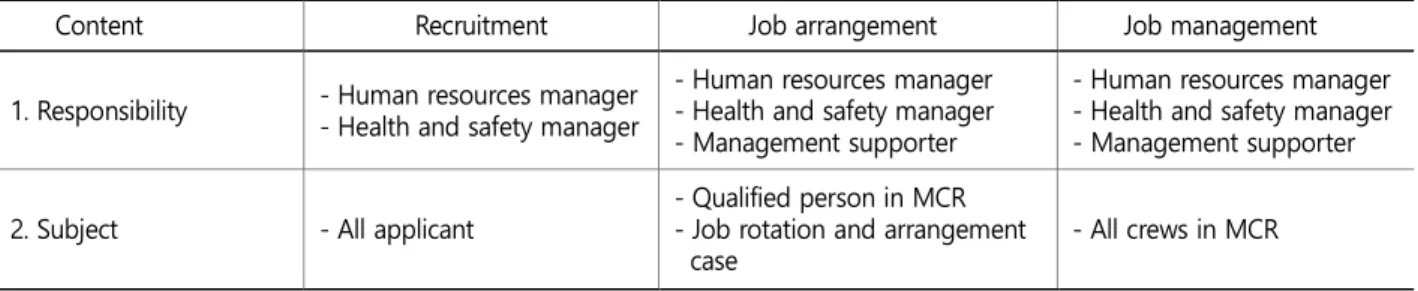
This study aims to cope with human errors that may occur owing to the anthropometric unsuitability by devising management guidelines for the anthropometric suitability of an MCR operating crew, based on the anthropometric suitability assessment procedure proposed in this study. The management guidelines were drawn up to be used for selection, assignment, and work management. The details of the guidelines were categorized into the following: 1) responsibility, 2) evaluation subject, 3) evaluation period, 4) measurement method and criteria of the evaluation dimensions, 5) selection of the measuring equipment, 6) measurement and evaluation, 7) suitability assessment according to the criterion based on the dimension, 8) data sharing, 9) data storage, and 10) management according to anthropometric suitability assessment grade (Table 7).
The details of the guidelines may differ in terms of responsibility, evaluation subject, evaluation period, and data sharing scope, according to the application period of the management guidelines. In addition, the details of the guidelines can be modified by reflecting the characteristics of NPPs to which the guidelines are applied.
Table 6. Improvement method according to evaluation dimensions (Continued)
No. Evaluation dimension Improvement
Category-E Category-M Category-E & M
6 Functional reach ○
7 Extended functional reach ○
8 Radius of reach ○
9 Visual field ○
10 Peripheral perception ○
11 Hyperopia/Myopia/Astigmatism ○
12 Color blindness ○
13 Auditory acuity ○
14 Finger dexterity ○
15 Hand function ○
16 Body angle ○
17 Manual muscle test ○
Table 7. Content of management guidelines for an anthropometry suitability assessment
Content Recruitment Job arrangement Job management
1. Responsibility - Human resources manager - Health and safety manager
- Human resources manager - Health and safety manager - Management supporter
- Human resources manager - Health and safety manager - Management supporter
2. Subject - All applicant
- Qualified person in MCR - Job rotation and arrangement
case
- All crews in MCR
5. Discussions
This study developed an anthropometric suitability procedure for workers of NPPs, applied the procedure to an MCR, and reviewed the procedure's efficiency. This study also proposed a general system of management guidelines for an anthropometric suitability of an MCR operating crew, based on the developed procedure for an anthropometric suitability assessment.
To apply the procedure and guidelines to actual NPPs, the entire system proposed in this study should be complied with, but the overall situation of the actually applied NPPs should be reviewed. The evaluation dimensions to be applied in a human-system interaction (HIS) should be drawn by reviewing the core facilities, machines/equipment, and systems of an NPPs to which the guidelines are to be applied. Through an existing human error-caused suspension/accident case study, such a case occurring by the unsuitability of HIS needs to be checked and reviewed. The feasibility of selection should be reviewed by reflecting the opinions of the operating crew, NPPs design experts, and ergonomists for the dimensions selected in the first phase.
The measurement and preparation of criteria for anthropometric suitability assessment dimensions are the most important phase to determine the suitability/unsuitability concerned with the evaluation dimensions. In this regard, accurate criteria and information on the measurement method and evaluation criteria should be provided, and training/education needs to be accompanied for managers. To devise the criteria for the evaluation dimensions, a sincere review of the literature and other data is required, and the data also need to be acquired in order to utilize the data related to NPPs or in a similar field.
To determine the applicable actions in an actual worksite for the selected anthropometric suitability assessment dimensions, ergonomic research of the target worksite's characteristics should be carried out. Maintenance/repair and improvement experts Table 7. Content of management guidelines for an anthropometry suitability assessment (Continued)
Content Recruitment Job arrangement Job management
3. Evaluation period - With physical examination - Planning the job rotation and arrangement
- Regular: once a year - Special: change the facilities/,
accident occurrence - Other: require of crew 4. Measurement method
and criteria
- Followed by phase 2 & 3 (Reference)
- Followed phase 2 & 3 (Reference)
- Followed phase 2 & 3 (Reference)
5. Selection of equipment - Health and safety manager - Health and safety manager - Health and safety manager 6. Measurement and
evaluation - Health and safety manager - Health and safety manager - Health and safety manager 7. Suitability evaluation - Followed by phase 3 & 4 - Followed phase 3 & 4 - Followed phase 3 & 4
8. Data sharing - Human resources team - Health and safety team
- Human resources team - Health and safety team - Management support team
- Human resources team - Health and safety team - Management support team
9. Data storage
- Until retirement
- With personal information - Human resources team
- Until retirement
- With personal information and existing data - Human resources team
- Until retirement
- With personal information and existing data - Human resources team 10. Management according
to suitability grade - Followed by phase 4 - Followed by phase 4 - Followed by phase 4
including ergonomists, design experts, maintenance technology team, system technology team, and machine team should participate in the field study.
The anthropometric suitability grades proposed in this study are for management convenience, and if they are not essential information for NPPs worker's HR evaluation, selection and assignment, they should not be considered to have priority. However, the grades can be used as linkage information to apply proper supplementary actions in the job or situation, in which human error-caused suspension/accident frequently occurs, or coping with human errors is considered important, according to the details. In an individual worksite, not only the selection of specific facilities to be cautioned by workers and the anthropometric characteristic-dimensions, but also an action strategy for insufficient suitability can be diversely reorganized strategically.
To prevent human errors in NPPs, a variety of efforts were made including a department/assignment suitability evaluation, worker fitness for duty (FDD) criteria development, and human error evaluation method development, according to the adoption of digital equipment (Lee et al., 2011). However, the anthropometric suitability dimensions proposed in this study have yet to be considered. Therefore, the evaluation procedure and management guidelines for anthropometric suitability can improve the NPP workers' human fulfillment and are expected to contribute to the prevention of rare human errors that may occur due to anthropometric unsuitability in advance. The data collected through a suitability assessment can be usefully utilized for work hardening and work conditioning programs or education/training programs.
This study has a limitation in that the case study and field study on existing suspensions/accidents occurring in the MCR of NPPs were not carried out together. In addition, there is a demerit that the number of study subjects was slightly insufficient in selecting the suitability assessment dimensions. In addition, some supplementation needs to be undertaken to ensure the feasibility through a pilot application of the proposed anthropometric suitability assessment method and guidelines for some operating crews.
Therefore, verification of the procedure and management guidelines for an anthropometric suitability assessment will be carried out in a further study. In addition, a study on the selection of relevant evaluation dimensions and criteria preparation to evaluate and manage the anthropometric suitability for not only an MCR, but also various jobs and worksites are planned to be performed.
Acknowledgements
This research was supported by the nuclear energy research and development project (Grant. 2012M2A8A-4004256) funded by the Ministry of Education, Science and Technology.
References
Agency for Technology and Standards,
Design for Control rooms of Nuclear Power Plants
, KS C IEC 60964, 2004.Cha, W.C. and Kim, N.C., A study of the Evaluation for the Control Room in Human Machine System Under Hybrid Environment,
Journal of the Ergonomics Society of Korea
, 28(2), 1-8, 2009.Corlett, E.N., Salvendy, G. and Seymour, W.D., Selecting operators for fine manual tasks: A study of the O'Connor finger dexterity test and the purdue pegboard,
Occupational Psychology
, 45(1), 57-65, 1971.EPRI,
Human Factors Guidance for Control Room and Digital Human-System Interface Design and Modification - Guidelines for Planning, Specification, Design, Licensing, Implementation, Training, Operation, and Maintenance
, No. 1008122, 2004.IAEA,
Safety of nuclear power plants: design, Safety Standards
, Series No. NS-R-1, 2000.IEEE
, IEEE Guide for the Application of Human Factors Engineering in the Design of Computer-Based Monitoring and Control Displays for Nuclear Power Generating Stations
, IEEE-STD-1289, 1998.ISO 1126:
Ergonomics-evaluation of static working posture
(12.00). Beuth, Berlin, 2000.Jebsen, R.H., Taylor, N., Trieschmann, R.B., Trotter, M.J. and Howard, L.A., An objective and standardized test of hand function,
Archives of Physical Medicine and Rehabilitation
, 50(6), 311-319, 1969.Korea Atomic Energy Research Institute (KAERI),
Guideline of personal traits for countermeasures against to the human error in Nuclear Power Plants (NPPs),
KAERI/TR-5659/2014, 2014.KOPEC,
Human Factors Engineering Guideline
, HF-010, 2006.Kim, Y.H., Choi, M.S. and Kim, B.W., Assessment of hand function in normal Korean adults by Jebsen hand function test,
Annals of Rehabilitation Medicine
, 8(2), 1984.LaGrone, C.W. and Holland, B.F., Accuracy of perception in peripheral vision in relation to dextrally, intelligence and reading ability,
The American Journal of Psychology
, 56(4), 592-598, 1943.Lee, D.H., An experiment for top-down suitability verification for layout of Korea next generation reactor control room equipment,
Theses collection
, 18, 333-340, 2000.Lee, Y.H., "Facilitating HRA through the Input from HIS Design",
2-nd OECD/NEA Workshop on Building the New HRA
, 2002.Lee, Y.H., Jang, T.I. and Lim, H.K., A modification of human error analysis technique for designing man-machine interface in Nuclear Power Plants,
Journal of the Ergonomics Society of Korea
, 22(1), 31-42, 2003.Lee, Y.H., Jang, T.I., Lee, Y.H., Oh, YJ., Kang, S.H. and Yun, J.H., Research Activities and Techniques for the Prevention of Human Errors during the Operation of Nuclear Power Plants,
Journal of the Ergonomics Society of Korea
, 30(1), 75-86, 2011.Magee, D.J.,
Orthopedic physical assessment
, 5th ed, Saunders, 2007.Ministry Government Legislation,
Enforcement decree of the atomic energy act 299
(Medical examination), 2013.Ministry Government Legislation,
Enforcement decree of the atomic energy regulation 115
(Medical examination), 2013.Ministry of Land,
Infrastructure and Transport
, Aeromedical licensing system, 2013.Pheasant, S.,
Body space; anthropometry, ergonomics and the design of work
, 2nd Ed., Taylor & Francis, 1996.Size Korea Home Page,
http://sizekorea.kats.go.kr
(retrieved Dec. 1, 2011).Song, T.Y. and Lee, N.Y., A Study on Suitability Evaluation for Design of Soft Control and Safety Console in Advanced Control Room of Korea Nuclear Power Plants,
Journal of Chungnam Science
, 31, 45-54, 2004.URNRC,
10CFR26, Fitness-For-Duty (FFD) Program
, 2009.URNRC,
Human-System Interface Design Review Guidelines
, NUREC- 0700, rev.2, 2011.Author listings
Kyung-Sun Lee: [email protected]
Highest degree: PhD, Department of Industrial Engineering, Ajou University
Position title: Senior Researcher, I&C Human Factors Research Division, Korea Atomic Energy Research Institute (KAERI) Areas of interest: Physical ergonomics, WMSDs, Work design, Biomechanics, Human Error
Yong-Hee Lee: [email protected]
Highest degree: MS, Department of Industrial Engineering, Seoul National University
Position title: Principal Researcher, I&C Human Factors Research Division, Korea Atomic Energy Research Institute (KAERI) Areas of interest: Cognitive System Engineering, Human Interface Design, Human Error, System Safety, Safety Culture