Ⅰ. 서 론
주의력결핍과잉행동장애(Attention Deficit Hype ractivity Disorder: 이하 ADHD)아동은 발달상으로 부적절한 주의 력 결핍, 과잉행동, 충동성이 주된 증상으로 나타나는 아동 기에 흔히 볼 수 있는 신경학적 행동장애이다(American Psychiat ric Association: APA, 2013). ADHD의 원인으로
는 뇌의 신경전달물질인 도파민과 아세틸콜린 수용체의 결핍 또는 불균형 등과 같은 신경생리학적 혹은 생화학적 이상 그리고 유전적 요인과 임신과 출산의 문제 및 환경적 요인에 이르기까지 다양한 설명들이 보고되고 있다(Yang, Kim, Kim, Cho, & Kim, 2008; Park, 2016; Hong, 2018).
그러나 최근 들어 사회심리학적 요인보다 근본적인 신경 생리학적 요인이 중요시되며 신경학, 유전학, 신경 생화학
대한지역사회작업치료학회지 제8권 제2호
The Journal of Korean Society of Community Based Occupational Therapy Vol. 8 No. 2 (August 2018), 1-14
ISSN 2234-0866 https://doi.org/10.18598/kcbot.2018.8.2.01
과제 중심 다감각운동 프로그램이 학습지연을 동반한 ADHD성향 아동의 자아효능감과 쓰기능력에 미치는 변화
노효련*, 곽성원**
*강원대학교 물리치료학과
**강원대학교 일반대학원 작업치료전공
— 국문초록 —
목적 : 학습지연을 동반한 ADHD성향을 지닌 아동에게 교육매체를 접목한 과제 중심 다감각운동 프로그램을 적용한 후 자아효능감과 쓰기능력의 변화를 알아보고자 하였다.
연구방법 : 학습지연을 동반한 ADHD성향을 지닌 아동을 대상으로 과제 중심 다감각운동 프로그램을 실시하였다. 연구 절차는 사전검사, 중재, 사후검사 순으로 진행되었다. 사전-사후검사로 자아효능감 및 KNISE-BAAT 쓰기검사 ‘가’
형과 ‘나’형을 사용하였다. 중재는 총 8회기 동안 실시하였다. 수집된 자료는 SPSS version 18 프로그램을 사용하여 분석하였다.
결과 : 과제 중심 다감각운동 프로그램 적용 결과 자아효능감(학교, 사회), 쓰기능력(어휘구사력, 문장구사력)에 유의미 한 향상이 나타났다.
결론 : 과제 중심 다감각운동 프로그램은 학습지연을 동반한 ADHD성향을 지닌 아동의 자아효능감 및 쓰기능력을 향 상시킬 수 있는 유익한 중재방안으로 활용될 수 있을 것이다. 후속 연구에서는 교육매체를 접목한 과제 중심 다감각 운동 중재모형을 다양하게 구안할 필요가 있다고 사료된다.
주제어 : ADHD 성향, 과제 중심, 다감각, 쓰기능력, 자아효능감
교신저자: 곽성원([email protected])
접수일: 2018. 06. 22. 심사일: 2018. 08. 01. 게재승인일: 2018. 08. 22.
등 여러 분야의 연구들에 의해 이마엽-선조체(Fronto- striaral)의 비정상적 조직(Network)이 ADHD의 주요 원 인임을 추측할 수 있게 되었다(Oh, 2017; Konrad et al., 2010; Durston, 2003; Bush, Eve, Valera, & Seidman, 2005;
Kim, & Kim, 2007).
DSM-5에 의하면 ADHD의 진단은 부주의나 과잉행 동·충동성의 하위 항목 중에서 6항목 이상이 6개월 이상 으로 나타나고, 2가지 이상의 상황에서 지속적으로 나타 나야 한다(APA, 2013). 다수의 선행연구에서는 위의 진 단 기준을 모두 채우지 못한다 하더라도 ADHD로 진단 받은 경우와 비슷한 수준의 ADHD성향을 지닌 아동의 심리 사회적 장애가 보고되고 있다(Kang, 2017; Song, 2014; Cho, 2009; & Rohde, 2008). 2014년 국립특수교육 원의 특수교육실태조사에 따르면 학습장애를 가진 초등 학생의 30.2%가 ADHD성향을 수반한다고 보고하여, 높 은 유병률과 함께 심각한 사회적 문제로 대두되고 있다 (Korea National Institute for Special Education, 2014).
이에 따라 2016년 2월 초·중등교육법 개정을 통해 기타 학습부진 학생에 대한 교육적 지원을 제 28조에 명확히 하였으며, 개입을 위한 프로그램 개발과 예산의 지원 등 에 관한 법률적 근거를 신설하는 것으로 ADHD성향을 지닌 아동과 경계선 지적능력을 지닌 아동을 한 데 묶어 지원하는 법안이 마련되었다(Korea Ministry of Government Legislation, 2016).
ADHD성향을 지닌 아동들은 주의력 결핍과 충동성 조 절의 어려움으로 인해 과제나 학습에 집중하는데 어려움 이 있고, 성공적인 학업을 수행하기 위한 내적 동기유발에 어려움을 겪으므로 학습지연으로 이어지는 이차적 문제가 나타난다(Kwon, & Jeon, 2012; Barkley, Fischer, Smallish,
& Fletcher, 2006). 이러한 이차적 문제는 청소년기나 성인 기까지 지속되는 경향이 있어 조기 발견 및 적절한 치료적 개입이 요구된다(Bae, 2013; Barkley, 1990).
ADHD성향을 지닌 아동은 읽기, 쓰기, 수학 영역을 포 함한 학업성취도가 낮아 결과적으로 지능에 비해 낮은 성취도 보인다(Brakley, 1990). 성공적인 학업을 수행하 기 위한 요소 중 하나인 쓰기능력은 학령기에 접어들면 서 수업과정에서 더욱 요구받게 되는데, 쓰기능력의 습 득 과정은 읽기능력과 비교해 자연스럽게 습득되는 것이 아닌 의도적으로 학습되어야 하는 언어 영역이다(Maeng, 2011). 또한 쓰기는 모든 학습에 기초가 되며, 쓰기 능력 이 결여되면 타 교과 학습도 지체되는 결과를 초래하게
된다(Shin, 2016).
쓰기 능력의 결핍은 ADHD성향을 지닌 아동에게서 더 욱 두드러지게 나타나는데 이는 부주의와 충동성이라는 인지 행동적 특성이 학습지연을 일으키는 매우 중요한 원 인이기 때문이다(Feder, & Majnemer, 2007; Christensen, 2004). 쓰기는 지각과 운동 기술의 복합적인 활동으로 높 은 난이도의 시지각, 시운동 협응, 소근육 조절, 지속적 집 중력 등의 다양한 기술이 요구된다(Case-smith, &
O'Brien, 2013). 또한 쓰기를 하는 동안 이미 알고 있던 내용을 회상하는 상위 인지능력이 요구되며, 쓰기 과제에 주의를 집중해야 하고, 여러 가지 문제들을 해결하면서 쓰 기를 지속하려는 내적 동기를 유지할 수 있어야 한다(Lee, 2013). 이러한 쓰기 능력의 저하로 인해 ADHD성향을 지 닌 아동은 지속적으로 교사, 또래로부터 부정적인 피드백 을 받게 됨으로 학업성취도가 저하되는 문제뿐만 아니라 자아효능감 저하를 유발하게 된다(Shin, & Park, 2016).
자아효능감이란 자신의 능력에 대한 판단으로 주어진 환경에서 활동에 대한 스스로의 믿음을 의미한다. 이는 활동을 조직화하고 실행하기 위한 자신의 능력에 대한 주관적 기대감 또는 자신감을 뜻한다(Barua, Ghosh, Kar, & Basilio, 2011). 다수의 연구에 의하면 ADHD성향 을 지닌 아동은 반복되는 과제의 실패, 비판, 좌절에서 오 는 낮은 자아효능감을 긍정적이고 적극적인 수준으로 높 여 줄 수 있는 치료적 노력이 필요하다고 보고하였다 (Seo, & Min, 2013; Kim, Kim, & Lee, 2009; Kim, 2006;
Kim, 2005; Alves, Peixoto, Gouveia, Amaral, & Pedro, 2002). 즉 자아효능감의 증진은 학습에 대한 예측 능력 및 결과를 향한 자신의 통제력의 발달을 촉진시킴으로 ADHD성향 아동의 자아효능감 증진은 매우 중요하다고 할 수 있다(Yoon, 2007).
최근 ADHD성향 아동에 대한 치료의 중요성이 부각되면 서 다양한 연구가 활발히 진행되고 있다(Kim, 2007; Lee,
& Kim, 2014). 일반적으로 ADHD의 중재는 약물인 메틸페 니데이트(Methylphenidate)와 아토목세틴(Atomoxetine) 처방이 가장 흔한 방법으로 ADHD아동의 70-80%에서 충동 성을 줄여주고, 주의력을 증진시켜준다(Ernst, Liebenauer, King, Fitzgerald, Cohen, & Zametkin, 1994). 그러나 약물치 료는 중재 효과의 지속성 및 학습장애를 줄이는 데 좋지 못한 결과를 낳아왔으며, 장기적으로 뇌에 긍정적인 영향을 미치는지는 알기 어렵다(Findling, 2008; Purdie, Hattie, &
Carroll, 2002; MTA Cooperative Group, 1999).
약물치료 외에 ADHD성향 아동의 중재에는 감각통합치 료, 인지·행동치료, 미술·놀이치료 등이 주로 보고되고 있다.
그 중 감각통합치료는 신경과학, 심리학, 교육학의 원리에 기초하여 수많은 연구와 논의를 창출하여 작업치료분야에 서 많은 성과를 가져왔으며, 신경과학, 특수교육 등의 분야로 확장되어 감각통합이론을 발전시켜왔다(Kwag, Sim, &
Roh, 2014; Brown, Rodcer, & Roever, 2005).
감각통합이론을 개발한 A, Jean Ayres(1972)는 학습 의 지연을 뇌의 감각운동 하위 중추를 상위 중추가 조절 하지 못하기 때문이라 가정하였다. 따라서 감각운동의 발달은 학습을 위해 중요한 토대가 되며, 의미 있는 감각 운동 활동은 신경계를 변화시킬 수 있다고 보고하였다 (Schaaf, & Miller, 2005). 감각운동 접근 방법 중 하나인 다감각(Multisensory approach)접근 방법은 다양한 감각 재료(미술재료, 감각교구, 감각매체)를 제공하여 아동의 신경계가 감각정보를 효율적으로 조직화하는 것을 도와 적절히 읽을 수 있는 글자를 시간 내에 쓰는 등의 바람직 한 피드백을 이끌어 내는 것이다(Feder, Majnemer, &
Synnes, 2000; Ham, Kim, Lee, & Jeon, 2012).
ADHD아동 및 성향을 지닌 아동을 대상으로 감각운 동 활동을 적용한 국내 선행연구를 살펴보면 종속변인으 로 주의집중력(Son, 2009; Lee, & Kim, 2011; Ji, 2014;
Yoon, 2016)과 과잉행동(Ahn, 2009; Kim, & Kim, 2007;
Song, 2015)그리고 과제 수행능력(Yoo, & Lee, 2005;
Lee, 2010) 등 다양한 연구가 이루어져왔다. 그러나 ADHD아동을 대상으로 쓰기능력과 자아효능감을 종속 변인으로 감각운동 접근을 적용한 국내의 선행연구는 매 우 미비한 실정이다. 국내 학술데이터베이스를 통해 최 근 보고된 학위논문과 학술지에 개제된 연구를 살펴보면 Ham, Kim, Lee와 Jeon(2012)의 연구에서 감각운동 접근 이 ADHD아동의 글씨를 쓰는 동안의 명료도와 속도에 향상을 보고하였고, Hwang, Kim과 Jung(2017)의 연구 에서 ADHD로 명명되진 않았으나 착석 자세나 집중유지 에 어려움을 가진 아동을 대상으로 고유·전정감각 중심 의 감각운동중재 후 한글자모쓰기검사(Korean alphabet writing assessment)를 실시한 결과 통계적으로 유의한 명료도의 향상을 보고하였다. 그러나 이러한 연구들은 쓰기능력의 기능적인 측면의 변화만을 보고하는 연구로 써 실제 학습지연을 동반한 ADHD성향 아동의 학업성취 도와 관련된 쓰기능력의 변화를 알아본 연구는 찾아볼 수 없었다. 또한 ADHD아동의 감각운동관련 중재를 사
용하여 자아효능감을 종속변인으로 한 연구 역시 찾아 볼 수 없었다.
따라서 본 연구에서는 쓰기능력과 자아효능감 향상을 위한 과제 중심 다감각운동 프로그램 모형을 구안하여 적 용함으로써 학습지연을 동반한 ADHD성향을 지닌 아동 의 쓰기능력(표기능력, 언어구사력, 문장구사력)과 자아효 능감의 변화를 알아보고자 한다. 이를 통해 ADHD성향을 지닌 아동의 쓰기능력과 자아효능감을 효율적으로 개선할 수 있는 방안을 제공할 수 있을 것으로 사료된다.
Ⅱ. 연구 방법 1. 연구 대상자 및 기간
본 연구는 2017년 3월부터 5월까지 경상북도 K시 교 육지원청의 '교육 취약학생 심리치료 지원사업'의 수행 과제를 E아동청소년 상담연구소에서 위탁·의뢰받아 10 주간 실시되었다. K시에 소재한 S초등학교에 재학 중인 학습지연을 동반한 ADHD성향을 지닌 3∼4학년 아동이 다. 청력과 시력의 문제가 없는 21명을 선정하였다. 자세 한 선정기준은 다음과 같다.
첫째, 교사가 실시한 한국판 아동·청소년 행동평가척 도(Korean Child Behavior Checklist: K-CBCL 6-18)에 서 주의집중문제 65점 이상을 받은 아동
둘째, 연구자가 학부모에게 배부한 한국 주의력 결핍 과잉행동장애 진단검사(Korean Attention-Deficit Hyperactivity Disorder Diagnostic Scale: K-ADHDDS)의 하위영역인 부주의 항목에서 15점 이상을 받은 아동
셋째, 위 기준에 해당하는 학생 중 연구자가 실시한 기 초학습진단검사(Korea National Institute for Special Education Basic Academic Achievement Tests: KNISE- BAAT)의 쓰기영역 원점수가 75점 이하로 쓰기영역에서 백분율 기준 하위 10% 이하로 학습지연을 보이는 아동 넷째. ADHD관련 향정신성 약물을 복용하지 않고 이 와 관련된 치료를 받지 않고 있는 아동으로 프로그램 참 여에 대한 부모의 동의를 받은 아동이다. 대상자에 대한 구체적인 정보는 다음과 같다(Table 1).
2. 연구 도구
1) 선별도구
(1) 한국판 아동·청소년 행동평가척도 부모용(Korean Child Behavior Checklist; K-CBCL 6-18)
K-CBCL 6-18은 Achenbach와 Rescorla (2001)가 개 발한 CBCL을 OH, Kim, Ha, Lee, 와 Hong(2010)이 한국 판으로 표준화한 평가도구이다. 총 119문항으로 구성되 었고 각 문항마다 ‘전혀 해당되지 않는다 0점’부터 ‘많이 그렇다 2점’까지 3점 Likert 척도로 구성되어있다. 문항 의 내용은 내재화 문제(우울, 의사소통의 어려움, 강박, 신체화 증상)으로 구성되어 있고, 외현화 문제(사고, 주 의집중, 비행, 공격성)으로 구성되어있다. 도구의 신뢰도 인 내적합치도 계수(Cronbach's a)는 .59∼,97이며, 검사 -재검사 신뢰도는 .53∼.96로 보고하였다.
(2) 한국판 주의력 결핍 결핍 과잉행동장애 검사(Korean
Attention-Deficit Hyperactivity Disorder Dianostic Scale: K-ADHDDS)
K-ADHDDS는 DSM-IV의 ADHD장애 진단기준과 Gilliam Attention Deficit Hyperactivity Disorder Test 를 Lee와 Yoon(2004)에 의해 표준화된 도구로 ADHD로 의심되는 아동의 증상 및 정도를 알 수 있다. 문항의 구 성은 과잉행동 13문항, 충동성 10문항, 부주의 13문항으 로 총 세 개의 하위검사로 구성되어있다. 심한정도에 따 라 0점에서 2점까지 3점 Likert척도로 구성되어있다. 도 구의 신뢰도인 내적합치도 계수(Cronbach's a)는 과잉행 동 .92, 충동성 .90, 부주의 .94이며, 검사-재검사 신뢰도 는 과잉행동 .91, 충동성 .92, 부주의 .90으로 보고하였다 Hong(2010).
2) 측정도구
(1) 쓰기 검사(Korea National Institute for Special Education Basic Academic Achievement Tests; KNISE-BAAT)
Number Gender School year K-CBCL K-ADHDDS KNISE-BATT
attention carelessness Writing ability
1 M 4 69 16 48
2 M 3 70 17 37
3 M 4 67 15 39
4 M 4 65 15 46
5 M 3 69 15 70
6 M 4 81 18 55
7 M 3 65 16 50
8 M 3 76 17 45
9 M 3 67 16 48
10 M 4 65 16 66
11 F 3 65 15 54
12 F 3 70 16 52
13 F 3 71 18 60
14 F 3 68 16 70
15 F 4 65 15 75
16 F 4 66 17 44
17 F 3 68 15 44
18 F 4 72 16 78
19 F 4 83 19 38
20 F 4 73 16 46
21 F 3 74 17 73
K-CBCL: Korean Child Behavior Checklist
K-ADHDDS: Korean Attention-Deficit Hyperactivity Disorder Dianostic Scale
KNISE-BATT: Korea National Institute for Special Education Basic Academic Achievement Tests
Table 1. Participants Information본 연구는 대상자의 쓰기능력을 측정하기 위해 KNISE- BATT는 Park, Chung, Jung, Kim, 과 Song(2009)이 학교 학습에서 읽기와 쓰기에 부진이 있는 아동을 선별과 진단하 고 부진한 영역과 수준을 파악하기 위해 ‘가’형과 ‘나’형 2종의 동형검사로 구성된 도구이다(Korea National Institute for Special Education, 2009). 본 연구에서는 사전 사후 검사도구로 쓰기검사 (가)형과 (나)형을 사용하였다.
쓰기 영역은 다섯 개의 평가 영역의 18개의 하위 문항으로 구성되어있다. 이 중 ‘표기능력’, ‘어휘구사력’, ‘문장구사력’
의 세 개 영역을 선택하여 연구에 사용하였다.
표기능력은 맞춤법과 띄워 쓰기, 문장부호 달기 등을 말하며, 어휘구사력은 제시된 낱말로 짧은 글을 짓거나 연상되는 단어를 쓰거나 주어진 문장에 적절한 단어를 쓰는 능력을 의미한다(Shin, 2016). 문장구사력은 자기의 생각을 표현하기 위해 다양한 방법으로 문장을 변환하거 나 단어를 배열할 수 있는 능력을 말한다(Cho, 2008). 도 구의 신뢰도인 내적합치도 계수(Cronbach's a)는 가형 .88, 나형 .89로 보고하였다. 문항의 내적 합치도는 가형 .87, 나형 .79이다(Park, Chung, Jung, Kim, & Song, 2009). 구체적인 하위영역 및 평가 내용은 다음과 같다 (Table 2).
(2) 자아효능감(Self-Efficacy) 검사도구
본 연구에서는 초등학생의 자아효능감을 검사하기 위 해 Coopersmith(1967)가 개발한 아동용 자아효능감 측정 도구를 Lee(1990)가 번안한 것을 사용하였다. 도구의 구 성은 사회적 효능감(8문항), 학교에서의 효능감(8문항), 가정에서의 효능감(8문항)의 3개 하위영역을 포함하여 총 24문항으로 구성되어 있다. 각 문항은 ‘전혀 아니다’ 1 점부터 ‘매우 그렇다’ 5점의 Likert 척도로 구성되어있다,
점수가 높을수록 효능감이 좋은 것으로 보고하였다. 도 구의 신뢰도인 내적합치도 계수(Cronbach's a)는 사회적 효능감 .81, 학교 효능감 .63, 가정 효능감 .72으로 보고하 였다(Lee, 1990).
3) 중재 방법
(1) 과제 중심 다감각운동 프로그램
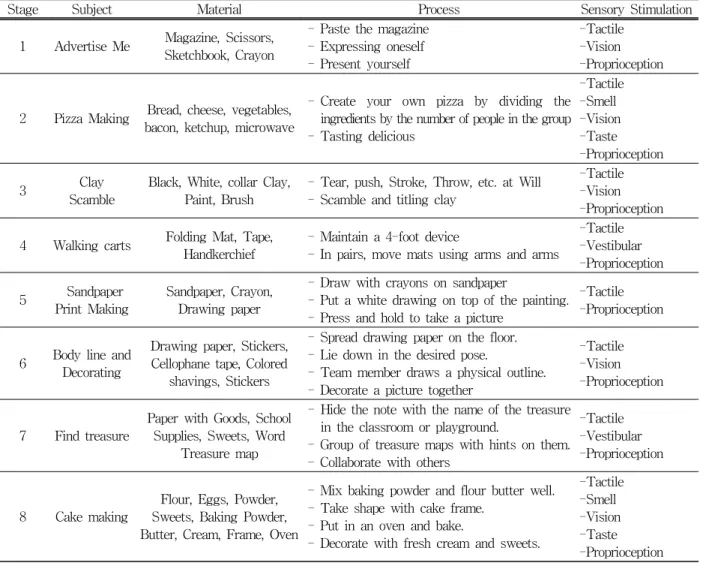
본 연구에서 사용된 과제 중심 다감각운동 프로그램은 감각통합의 기본감각 중 촉각, 고유수용성감각을 중심으 로 하여 학생에게 흥미와 친숙함을 유발할 수 있는 교수 매체를 접목한 과제중심의 내용들로 구성하였다. 프로그 램 구성을 위해 Kim, Ji와 Noh(2003)가 번안한 ‘감각통합 Q&A'와 Koo와 Oh(2007)의 ’통합아동미술교육‘ 그리고 Choi(2011)의 내용을 참고로 물리치료학 전공교수 1인과 연구자가 검토 및 재구성하여 사용하였다. 프로그램 내 용은 다음과 같다(Table 3).
(2) 중재 프로그램 사회적 타당도
쓰기능력의 변화를 이끌어 내기 위해 구안된 과제 중 심 다감각운동 프로그램의 목표설정 및 방법이 사회적으 로 타당한가를 확인하기 위해 사회적 타당도를 측정하였 다. 측정자는 감각통합 치료경력 5년 이상의 작업치료사 3명, 특수교사 1명을 대상으로 중재 시작 전 타당도를 평 가 하였다. 사회적 타당도 검사는 선행연구(Shin, 2016) 를 수정·보완하였다. 중재 유용성 2문항, 적절성 3문항, 중재의 추천 정도를 묻는 1문항으로 총 6문항으로 제작 하였다. 각 문항을 5점 리커드 척도(1점: 전혀 그렇지 않 다∼5점: 매우 그렇다)로 평가하였고, 그 결과 작업치료 사 4.39점, 특수교사 4.56점으로 나타났다(Table 4).
Area Questions
Writing ability
Letter, Word, Write spelling Dictation, Spacing
Punctuation Marks Use
Vocabulary ability
Short writing using the given word
Write a short sentence that separates the meanings of the two given words Write a word that is associated with a given word
Look at a given sentence and write the right words
Composing Abilities
Arrange the given words in order
Create different types of sentences by looking at pictures Fixing the wrong sentence structure
Writing a question, a comment, a statement, an admonition
Table 2. KNISE-BAAT Examination questions3. 연구절차
본 연구는 과제중심 다감각운동 프로그램이 독립변인 이며, 프로그램 적용 후 자아효능감과 쓰기능력의 변화 를 종속변인으로 하는 실험으로 사전-사후 실험설계 (One-Group Pretest Posttest Design)를 사용하였다.
실험 장소는 경상북도 K시에 소재한 ‘S초등학교 교실’
에서 실시하였다. 본 연구는 소아전공 물리치료학 전공 교수 1인과 작업치료사 2인, 특수교사 1인과 함께 다학제 간(Multidisciplinary)팀 구성을 통해 과제 중심 다감각운
동 프로그램을 실시하였다. 절차는 사전검사(1회기)-프 로그램 중재(8회기)-사후검사(1회기) 순으로 진행되었 다. 최초 1회기는 사전검사로 자아효능감(Self-Efficacy) 검사 및 KNISE-BAAT 쓰기검사 ‘가’형을 사용하여 쓰 기능력을 검사하였다. 프로그램 중재는 1주일에 한 번, 총 8회기 동안 진행하였다. 10회기에는 자아효능감(Self- Efficacy)검사 및 KNISE-BAAT ‘나’형 쓰기검사를 사용 하여 사후검사를 실시하였다(Table 4). 중재 프로그램 내 용은 회기 당 80분 중 도입(인사, 프로그램 소개 10분)과
Stage Subject Material Process Sensory Stimulation
1 Advertise Me Magazine, Scissors, Sketchbook, Crayon
- Paste the magazine - Expressing oneself - Present yourself
-Tactile -Vision -Proprioception
2 Pizza Making Bread, cheese, vegetables, bacon, ketchup, microwave
- Create your own pizza by dividing the ingredients by the number of people in the group - Tasting delicious
-Tactile -Smell -Vision -Taste -Proprioception
3 Clay
Scamble
Black, White, collar Clay, Paint, Brush
- Tear, push, Stroke, Throw, etc. at Will - Scamble and titling clay
-Tactile -Vision -Proprioception
4 Walking carts Folding Mat, Tape, Handkerchief
- Maintain a 4-foot device
- In pairs, move mats using arms and arms
-Tactile -Vestibular -Proprioception
5 Sandpaper Print Making
Sandpaper, Crayon, Drawing paper
- Draw with crayons on sandpaper
- Put a white drawing on top of the painting.
- Press and hold to take a picture
-Tactile -Proprioception
6 Body line and Decorating
Drawing paper, Stickers, Cellophane tape, Colored
shavings, Stickers
- Spread drawing paper on the floor.
- Lie down in the desired pose.
- Team member draws a physical outline.
- Decorate a picture together
-Tactile -Vision -Proprioception
7 Find treasure
Paper with Goods, School Supplies, Sweets, Word
Treasure map
- Hide the note with the name of the treasure in the classroom or playground.
- Group of treasure maps with hints on them.
- Collaborate with others
-Tactile -Vestibular -Proprioception
8 Cake making
Flour, Eggs, Powder, Sweets, Baking Powder, Butter, Cream, Frame, Oven
- Mix baking powder and flour butter well.
- Take shape with cake frame.
- Put in an oven and bake.
- Decorate with fresh cream and sweets.
-Tactile -Smell -Vision -Taste -Proprioception
Table 3. Task-Oriented Multi-Sensory Movement ProgramCategory Stage Occupational Therapist Special Teacher
Intervention Usability 2 4.5 5
Intervention Adequacy 3 4.33 4.67
intervention Recommendation degree 1 4.33 4
Sum(Mean) 6 13.16(4.39) 13.67(4.56)
Table 4. Social Relevance
본 활동(60분), 마무리(느낌 및 소감 쓰기 10분으로 구성 하였다(Fig 1).
4. 분석 방법
과제 중심 다감각운동 프로그램 중재가 학습장애를 동 반한 ADHD성향을 지닌 아동의 자아효능감과 쓰기능력 에 미치는 효과를 알아보기 위해 SPSS version 18 프로 그램을 사용하였다. 본 연구는 21명의 대상자로 전체 실 험 사례 수가 모집단의 분포에 대한 가정을 충족시키기 어려우므로 비모수적 통계방법을 사용하였다.
대상자의 일반적 특성을 알기 위해 기술통계를 실시하였
다. 중재 전·후 자아효능감과 쓰기능력에 미치는 효과를 알아보기 위해, 윌콕슨 부호-순위 검증(Wilcoxon rank test) 을 사용하였다. 통계결과에 대한 유의수준은(a)은 0.05로 하였다.
Ⅲ. 연구 결과
1. 프로그램 실시에 따른 사전-사후 자아효능 감 변화
자아효능감(사전 M=66.95, 사후 M=77.19)과 하위 영 역에서의 사회적효능감(사전 M=22.00, 사후 M=24.00)과
Intervention Social Relevance Test (March 10)
↓
Pre-test(March 14, 1session)
↓ Intervention
(March 21 ∼ May 9, 8session, 80minutes per session)
↓
Post-Test (May 23, 1session)
Fig 1. Research ProcedureFig 2. Multisensory Group Activity Program
학교효능감(사전 M=21.76, 사후 M=29.48)에서 영역별 통계적으로 유의미한 차이가 나타났다(p<.05, p<.001).
가정효능감 변인은 영역별 차이가 없었다(Table 5).
2. 프로그램 실시에 따른 사전-사후 쓰기능력 의 변화
쓰기능력의 하위 영역은 어휘구사력(사전 M=13.14, 사후 M=15.19)과 문장구사력(사전 M=12.49, 사후 M=
13.67)에서 영역별 통계적으로 유의미한 차이가 나타났 다(p<.05, p<.01). 표기능력은 통계적으로 유의미한 차이 는 나타나지 않았으나 사전 평균(13.44)과 사후 평균 (14.34)로 변화가 있는 것으로 나타났다(Table 6).
Ⅳ. 고 찰
본 연구는 과제 중심 다감각운동 프로그램이 학습지연 을 동반한 ADHD성향을 지닌 아동들의 자아효능감과 쓰 기능력에 미치는 효과를 알아보고자 21명의 ADHD성향 을 지닌 아동을 대상으로 과제 중심 다감각운동 프로그 램을 10주간 8회기를 실시하였다. 이를 알아보기 위해 사 전 사후 자아효능감, 검사와 쓰기 검사(KNISE-BAAT) 를 실시하고 그 결과를 비교하였다. 이를 토대로 논의 하 고자 한다.
첫째, 과제 중심 다감각운동 프로그램은 ADHD성향을
지닌 아동의 자아효능감 사전·사후 검사에서 자아효능감 과 하위영역인 사회적 효능감, 학교 효능감 향상에 효과 가 있었다. 감각운동관련 접근이 신경학적 장애를 가진 아동의 자아효능감 향상에 유익함을 보고한 선행연구를 살펴보면 뇌성마비 아동에게 전정·고유감각운동 중재를 통해 자기효능감 향상을 보고한 Ko(2009)의 연구와 Lee(2015)의 고유수용성 감각통합 중재가 뇌성마비 아동 의 신체적 효능감을 증진시킨다고 보고하였다. 본 연구 의 자아효능감에 대한 연구결과 역시 언급한 선행연구와 맥락을 같이 따른다. Jang, Kim, Jeong과 Baek(2017)의 연구에 따르면 ADHD성향을 지닌 대학생과 일반대학생 의 감각처리능력과 학습태도 하위 변인들 간의 상관성을 비교한 결과 ADHD성향 대학생의 감각처리능력 하위변 인(감각등록, 감각추구, 감각회피)과 교우관계 및 학업자 신감 변인 간의 유의미한 상관관계가 있음을 보고하였 다. 이러한 결과는 감각처리능력의 증진을 통해 자아효 능감을 향상 시킬 수 있는 가능성을 시사하며, 본 연구를 통해 과제 중심 다감각운동 중재가 사회적 효능감과 학 교에서의 효능감을 향상시킬 수 있는 유익한 방법임을 실증하였다.
둘째, 과제 중심 다감각운동 프로그램 중재는 ADHD 성향을 지닌 아동의 쓰기능력 사전·사후 검사에서 쓰기 능력 하위영역인 어휘구사 능력과 문장구사 능력 향상에 효과가 있었다. Grennbaum과 Markel (2001)은 ADHD 아동에게 나타나는 문제로 일반적인 어휘의 부족으로 인 해 어휘목록을 다양하게 사용하여 문장을 만들기 어렵고
Division Pre Post
z p
M SD M SD
Self-efficacy 66.95 15.08 77.19 10.84 -3.925 .000
***Details area
Social efficacy 22.00 6.94 24.00 5.08 -2.292 .022
***School efficacy 21.76 4.60 29.48 3.49 -4.025 .000
***Family efficacy 23.43 5.31 23.71 4.55 -1.471 .141
****p<.05, ***p<.001
Table 5. Self-effective Pre-Post Comparison
Division Pre Post
z p
M SD M SD
Writing area
Writing Ability 13.44 5.23 14.34 5.97 -1.744 .081
**Vocabulary Ability 13.14 5.67 15.19 5.88 -2.982 .003
**Composing Abilities 12.49 5.91 13.67 7.01 -2.389 .017
***p<.05, **p<.01
Table 6. Writing Ability Pre-post Comparison
어휘 수의 한정을 특징으로 보고하였다. 감각운동이 쓰 기 등의 학습을 위한 매개체로 사용된 선행 연구를 살펴 보면 Zentall(1993)은 ADHD아동을 대상으로 복잡한 쓰 기 과제나, 긴 과제를 수행하는 경우 시각자극을 제공하 였을 경우 더 좋은 수행을 보고하였다. 또한 본 연구의 중재에서 제공된 감각은 아니지만 Hilliard와 Tolin(1979) 과 Parente (1976)는 익숙한 청각자극의 제시가 학업 과 제수행에 긍정적인 영향을 미쳤다고 보고하였다. 다양한 감각의 제공은 감각통합이론의 토대인 뇌가소성이론에 근거하여 ADHD성향을 지닌 아동의 신경계에 새로운 시 냅스를 형성하거나 신경전달 물질이 더욱 활발하게 생성 될 수 있을 것이라 보고하였다(Lee. 2010). 본 연구의 쓰 기능력의 결과 역시 언급한 선행연구들의 맥락을 같이 따른다. 또한 고유·전정·촉감각 등의 다감각을 적용한 감 각활동이 ADHD성향을 지닌 아동이 스스로를 조절하고 조직화하는 능력을 향상시켜 학업과 관련된 쓰기능력이 향상된 것으로 판단된다. 따라서 본 연구결과를 통해 과 제 중심 다감각운동 중재가 어휘구사력과 문장구사력을 향상시킬 수 있는 유익한 방안으로 활용될 수 있을 것이 다. 한편 쓰기능력의 하위영역인 표기능력에서는 통계적 으로 유의미한 변화가 나타나지 않았다. 본 연구의 표기 능력은 맞춤법과 띄워 쓰기, 문장부호 달기 등을 말하는 데(Park, Kim, Song, Jung, & Jung, 2004), ADHD성향을 지닌 아동의 경우 표기에서 나타나는 오류를 통해 전반 적인 쓰기수준을 알아볼 수 있는 창문의 역할을 하므로 쓰기의 지도와 평가에 많은 시사점을 가진다(Kee, 1995).
표기능력의 결과는 최근 스마트 폰 채팅 어플리케이션 사용에서 소리 나는 데로 문자를 쓰거나 줄여 쓰는 등의 경우가 많음으로 정확한 표기 사용을 방해하는 원인으로 사료되며, 단기간의 개입으로 잘못된 표기습관이 교정되 기가 어려운 것으로 판단된다. 따라서 표기능력의 향상 을 위한 다방면의 지원과 중·장기간의 개입이 필요하다 고 사료된다. 후속 연구에서는 표기능력의 향상을 위한 감각운동 접근을 기반으로 교육매체를 접목하여 다양하 게 중재모형을 구안할 필요가 있다고 사료된다.
본 연구의 제한점으로는 대상자의 수가 정규분포를 충 족하지 못함으로 효과를 일반화하기에는 무리가 있으며, 중재기간 동안 진행된 정규교육에 의한 학습효과 역시 배제하지 못하였다. 따라서 이러한 제한점을 보완한 새 로운 시도들의 연구가 이루어져야 할 것으로 사료된다.
Ⅴ. 결 론
현대사회에서 학습은 인간다운 삶을 영위하는데 있어 서 매우 중요한 요소 중 하나이다. 장애를 가진 아동 역 시 인간다운 삶을 영위하는데 필요한 지식의 습득이 반 드시 이루어져야 하고 이러한 지식의 습득은 교육을 통 해 달성되어야한다(Kwag, Nam, & Roh, 2013). ADHD 성향을 지닌 아동을 위한 교육은 일반교육과정의 보편성 과 ADHD성향 아동이 가지는 개별적 요구가 함께 고려 되어야 하고 이러한 개별적 요구는 교사를 포함한 관련 분야의 전문가의 지원을 통해 개발되고 적합하게 실행되 어야 한다. 이러한 관점에서 다학제간(Multidisciplinary) 팀 접근을 통해 ADHD성향을 지닌 아동의 교육적 문제 를 해결하기 위한 시도가 본 연구의 학문적 의의를 가질 것으로 사료된다. 또한 본 연구에서 제시한 과제 중심 다 감각운동 프로그램이 ADHD성향을 지닌 아동의 교육적 개입 시 수행과 접근에 유용한 방안으로 활용 될 수 있기 를 기대한다.
REFERENCES
Achenbach, T. M., Rescorla, L. A. (2001). Manual for
the ASEBA School-Age Forms and Profiles.
Burlington, VT: University of Vermont Research Center for Children, Youth, and Families.
Ahn, M. Y. (2009). The Effect of behavior characteristic on ADHD children’s sensory processing ability.
The Korean Society Interdisciplinary Therapy, 1(1), 5-17.
Alves, M. M., Peixoto, F., Gouveia, P. M., Amaral, V.,
& Pedro, I. (2002). Self-esteem and academic achievement among adolesent. Educational Psychology, 22(1), 51-62.
American Psychiatric Association (2013). Diagnostic
and statistical manual of mental disorders(5th ed.).
Washington, DC: American Psychiatric Association.
Bae, E. K. (2013). Study on a cognitive-behavioral
program development for children with the
propensity of ADHD: in a school setting. Doctoral
dissertation, University of Ewha Womans, Seoul.Barkley, R. A. (1990). Attention-deficit/ hyperactivity
disorder: A hand book for diagnosis and treatment.
New York: Guilford Press.
Barkley, R. A., Fischer, M., Smallish, L., Fletcher, K. (2006).
Young adult outcome of hyperactive children:
adaptive functioning in major life activities. Journal
of the American Academy of Child and Adolescent Psychiatry, 45(2), 192-202.
Barua, A., Ghosh, M. K., Kar, N., Basilio, M. A. (2011).
Prevalence of depressive disorders in the elderly.
Annals of Saudi Medicine, 31(6), 620-624.
Brown, G. T., Rodcer, S., Brown, A., & Rover, C. (2005).
A comparison of Canadian and Australian paediatric occupational therapists. Occupational Therapy
International, 12(3), 137-161.
Bush, G., Valera, E. M., Seidman, L. J. (2005). Functional Neuroimaging of Attention-Dificit/ Hyperactivity Disorder: A Review and Suggested Future Directions.
Biology Psychiatry, 57(1), 1273-1284.
Case-Smith, J., O’Brien, J. C. (2013). Occupational therapy
for children. St. Louis, MO: Elsevier Mosby.
Cho, N. O. (2008). Case Study on Effects of Newspaper-
In-Education(NIE) Program on Improving Writing Ability of Children with Dysgraphia. Master's
thesis, University of Yeongnam, Daegu.Cho, S. C. (2009). Full syndrome and sub threshold attention-deficit/hyperactivity disorder in a Korean community sample: comorbidity and temperament findings. European Child and Adolescent Psychiatry,
18(7), 447-457
Choi, S. H. (2011). The Impacts of Sensory Integration
Training program in School on the Functional Ability in Task Performance of the Children with Developmental Disabilities. Master's thesis, University
of Daegu, Daegu.Christensen, C. A. (2004). Relationship between orthographic- motor integration and computer use for the production of creative and well-structured written text. British Journal of Educational Psychology,
74(4), 551-564.
Coopersmith, S. (1967). The antecedents of self-esteem.
San Francisco: Freeman.
Durston, S. (2003). A review of the biological bases of ADHD: What have we learned from imaging studies?
Mental Retardation Development Disability Research Review, 9(1), 184-195.
Ernst, M., Liebenauer, L. L., King A. C., Fitzgerald, G.
A., Cohen, R. M., Zametkin, A. J. (1994). Reduced brain metabolism in hyperactive Girls. Journal of
the American Academy of Child and Adolescent Psychiatry, 33(6), 858-868.
Feder, K., Majnemer, A. (2007). Handwriting development, competency, and intervention. Developmental Medicine
and Child Neurology, 49(4), 312-317.
Feder, K., Majnemer, A., Synnes, A. (2000). Handwriting:
Current trends in occupational therapy practice.
Canadian Journal of Occupational Therapy, 67(3),
197-204.Findling, R. L. (2008). Evolution of the treatment of attention-deficit/hyperactivity disorder in children:
a review. Clinical Therapeutics, 30(5), 942-957.
Grennbaum, J., Markel, G. (2001). Helping Adolescents
with ADHD and Learning Disabilities: Ready- to-Use Tips, Technique, and Checklists for School Success. New Jersey: Paramus.
Ham, B. H., Kim, S. K., Lee, J. S., Jeon, B. J. (2012).
The Effects of Sensory Integration Treatment on Handwriting Performance in Children With Attention Deficit Hyperactivity Disorder. The Korean Society
of Occupational Therapy, 20(2), 55-71.
Hilliard, O. M., Tolin, P. (1979). Effect of familiarity with background music on performance of simple and difficult reading comprehension tasks. Perceptual
and Motor Skill, 49(1), 713-714.
Hong, J. H. (2018). Genetic Associations of Dopamine
Transporter(DAT1) and D4 Receptor(DRD4) VNTRs with Attention Deficit and Hyperactivity Disorder in Korean Children. Master's thesis,
University of Dankook, Cheonan.Hwang, J. H., Kim, H. J., Jung, H. R. (2017). The Effect of Sensory Integrative Intervention Focused on Proprioceptive -Vestibular Stimuli on the Handwriting
and Fine Motor Function in Lower Grade Elementary School Children. Korean Academy of Sensory
integration, 15(1), 10-20.
Jang, Y. S., Kim, H. D., Jeong, G. U., Baek, J. Y. (2017).
A Life caretatinment Based Approach to Investigating Correlation between Learning Satisfaction and Sensory Processing in ADHD-prone University Students. The Korea Entertainment Industry
Association, 11(8), 297-304.
Ji, S. A. (2014). The Effects of Sensori -motor Centered Visual Art Activity on Three Year Old Children`s Drawing Representation, Language, and Attention Span Ability. The Korean Society for Early
childhood Teacher Education, 18(3), 79-105.
Kang, M. K. (2017). The Effect of Activity-Oriented Group
Art Therapy on Attention Concentration and Self- regulation of Children with ADHD Tendency.
Master's thesis, University of Pyongtaek, Pyongtaek.
Kee, K. H. (1995). A study on Error Patterns on Oral
Reading and Reading Process as Reading Ability and Passage Difficulty Level. Master's thesis,
University of Korea national Education, Cheongju.Kim, H. S. (2006). The effect of a teacher education
program an elementary-school teachers and children with ADHD tendency. Master's thesis,
University of KeiMyung, Daegu.Kim, H. S. (2007). The Effects of LAD Program on Attention and Attitude of Learning among ADHD Children. Korean Society For Child Education,
16(4), 83-94.
Kim, J. Y., Kim, J. K., Lee, T. Y. (2009). A Study on the Prevalence of Attention Deficit Hyperactivity Disorder in Normal Children and Their Self- Efficacy and Self-Control. The Korean Society of
Occupational Therapy, 17(4), 81-87.
Kim, K. M., Ji, S. Y., Noh, J. S. (2003). Sensory
Integration Q&A. Seoul: Jungdam Media.
Kim, K. M., Kim, J. M. (2007). The Effects of Sensory Integrative Intervention on the Balance and Attention of Children with Attention Deficit Hyperactivity Disorder: Single-Subject Research
Design. Journal of Special Education & Rehabilitation
Science, 46(4), 103-130.
Kim, P. S. (2005). The Relationship between School-
related Adjustment, Stress Coping behaviors and Self-effcacy of Attention-Deficit Hyperactivity Disorder Children. Master's thesis, Catholic University of
Daegu, Daegu.Ko, B. K. (2009). The Way of Improving Self-Esteem for the Cerebral Palsy. The Journal of Public
Policy and Governance, 3(2), 35-68.
Konrad, A., Dielentheis, T. F., El Masri, D., Bayerl, M., Fehr, C., Gesierich, T. et al. (2010). Disturbed structural connectivity is related to inattention and impulsivity In adult attention deficit hyperactivity disorder. European Journal of Neuroscience, 31 (5), 912-191.
Koo, J. H., Oh, C. Y. (2007). Integrated Child Art
Education. PaJu: Yangseowon.
Korea Ministry of Government Legislation (2016). Article
28 of the Act on Elementary and Secondary Education. Korea Ministry of Government Legislation.
www.law.go.kr
Korea National Institute for Special Education (2014).
2014 Special Education Status Survey. Asan:
Korea National Institute for Special Education.
Kwag, S. W., Nam, Y. S., Roh, H. L. (2013). Developing an Instructional Medial Selection Attributes Check list for Students with Intellectual Disabilities.
Journal of Special Education & Rehabilitation Science, 52(4), 305-319.
Kwag, S. W., Sim, J. M., Roh, H. L. (2014). Study on the Characteristics and Quality Level of Single Subject Researches in the Sensory Integration Therapy Field of Korean Occupational Therapy.
Korean Academy of Sensory integration, 12(2),
25-36.Kwon, M. K., Jeon, W. C. (2012). Developm ent and Application of MLE-based Smart Education System for Improving Self-efficacy of ADHD Students.
Journal of The Korean Association of information
Education, 16(3), 337-352.
Lee, D. Y., Kim, K. H. (2011). Effects of Sensory Integration Training Based on Tactile Sense for Attention Cathexis of the Child With ADHD.
Journal of Special Physical Education, 9(1), 108-
181.Lee, E. K. (2015). The effect of proprioceptive activities
in sensory integration on body scheme, motor function and physical self-efficacy in children with cerebral palsy. Master's thesis, University of
Gachon, Seongnam.Lee, H. J. (1990). The relationship between the child's
perceived type of language control and the child's sense of self respect. Master's thesis, University
of Korea, Seoul.Lee, M. S. (2010). ADHD The relationship between
sensory profile and functional activities in school for children with ADHD. Master's thesis, University
of Dankook, Yongin.Lee, N. H., Kim, K. M. (2014). The Intervention and Outcome Measurement Tools of Children With Attention Deficit Hyperactivity Disorder: A Systematic Review. Korean Academy of Sensory integration,
12(1), 39-50.
Lee, S. B., Yoon, C. Y. (2004). K-ADHD Diagnostic
Scale. Busan: Tespia.
Lee, S. K. (2010). Brain-scientific Understanding of
Attention Deficit Hyperactivity Disorder and Educational Application. Master's thesis, University
of Seoul Education, Seoul.Lee, S. Y. (2013). Relations among Writing Achievement
Goal Orientations, Writing Self-Efficacy, Writing Meta-Cognitive Strategies and Writing Ability.
Doctoral dissertation, University of Hanyang, Seoul.
Maeng, H. S. (2011). Syntax Characteristic shown in
Written Expression of School Age ADHD Children.
Master's thesis, University of Daegu, Daegu.
MTA Cooperative Group (!999). A 14-month randomized clinical trial of treatment strategies for attention- deficit/hyperactivity disorder. Archives of General
Psychiatry, 56(1), 1073–1086.
Oh, K. J., Kim, Y. A., Ha, E. H., Lee, H. R., Hong, K.
E. (2010). Korean Version of CBCL 6-18 for
Parents. Seoul: Huno.
Oh, S. B. (2017). Diffusion Tensor Imaging of White
Matter Tracts in Children with Attention Deficit/
Hyperactivity Disorder: Tracy Based Spatial Statistics Analtsis. Master's thesis, University of
Ewha Womans, Seoul.Parente, J. A. (1976). Music preference sa a factor of music distraction. Perceptual and Motor Skills,
43(1), 337-338.
Park, J. H. (2016). Multigenerational transmission of
ADHD-like behavioral phenot ypes in rodent offspring exposed to EtOH during gestation period.
Doctoral dissertation, University of Konkuk, Seoul.
Park, K. S. Chung, D. Y., Jung, I. S., Kim, G. O., Song, Y. J. (2009). KNISE-BATT. Seoul: Korea National Institute for Special Education.
Park, K. S., Kim, K. O., Song, Y. J., Jung, D. Y., Jung, I. S. (2004). A Study on the Development of
KISE-BAAT. Seoul: Korea National Institute for
Special Education.Purdie, N., Hattie, J., Carroll, A. (2002). A Review of the Research on Interventions for Attention Deficit Hyperactivity Disorder: What Works Best? Review
of Educational Research, 72(1), 61-99
Rohde, L. A. (2008). Is there a need to reformulate attention deficit hyperactivity disorder criteria in future nosologic classification? Child and Adolescent
Psychiatry Clinics of North America, 17(2), 405-420.
Schaaf, R. C., Miller, L. J. (2005). Occupational therapy using a sensory integrative approach for children with developmental disabilities. Mental Retardation
and Developmental Disabilities Research Reviews, 11(2), 143-148.
Seo, V. A., Min E. J. (2013). The effects of the cognitive-behavioral program for depression problem with ADHD-prone children's self-esteem and self- efficacy. Korean Journal of Child Psychotherapy,
8(2), 43-60.
Shin, H. S. (2016). Activity of Drama for Education using
Graphic Organizers on Middle School Students
with Intellectual Disabilities' Reading and Writing Ability. Doctoral dissertation, University of Uiduk,
Gyeongju.Shin, M. K., Park, J. H. (2016). Effects of a Task- Oriented Intervention on Handwriting of School Aged Children With ADHD : A Case Study. The
Korean Society of Occupational Therapy, 24(1),
65-74.Son, M. H. (2009). Effects of Sensory Integration
Education in Elementary School on Improving ADHD(Attention Deficit Hyperactivity Disorder) Children's Concentration. Master's thesis, University
of Konkuk, Seoul.Song, B. B. (2015). The Study of Relationship Between Sensory Processing Ability and the Problem Behavior of ADHD Children in Lower Grade Elementary School. The Special Education Research
Institute, 14(1), 7-25.
Song, Y. J. (2014). Estimated Prevalence of ADHD Symptoms and Relationships among ADHD Symptoms, Environmental Variables, and Peer Relationships in Elementary School Students. Asian Journal of
Education, 15(4), 189-217.
Yang, Y. H., Kim, J. W., Kim, Y. N., Cho, S. C., Kim, B. N. (2008). Screening for Attention Deficit/
Hyperactivity Disorder for Children in Seoul. The
Korean Neuropsychiatric Association, 47(3), 292-
298.Yoo, E. Y., Lee, J. Y. (2005). Effects of a Weighted Vest on Attention Task in Children with Attention Deficit and Hyperactivity Disorder. The Korean
Society of Occupational Therapy, 13(1), 37-44.
Yoon, J. H. (2007). The Effects of Group Game-Play
Program on Executive Function and Self-Control of Children with ADHD. Master's thesis, University
of Duksung Women's, Seoul.Yoon, J. Y. (2016). The Effect of Multiple Sensory Exercise
Program on the Attentiveness of Children with ADHD. Master's thesis, University of Yongin,
Yongin.Zentall, S. S. (1993). Research on the educational
implications of attention deficit hyperactivity disorder.
Exceptional Children, 60(1), 143-153.
Abstract
The Effect of Task-Oriented Multi-Sensory Movement Program on Self-efficacy and Writing Ability of Children with ADHD Tendency Accompanied by
Learning Delays
Roh, Heo-Lyun*, Ph.D., P.T., Kwag, Sung-Won**, E.d.M., O.T.
*Dept. of Physical Therapy, Kangwon National University
**Doctor's course of Occupational Therapy, Kangwon National University
Objective : The purpose of this study was to investigate the change in self-efficacy and writing ability after applying a Task-Oriented Multi-Sensory Movement Program to children with ADHD tendency accompanied by learning delays.
Methods : A Task-Oriented Multi-Sensory Movement Program was implemented to children with ADHD tendency accompanied by learning delays attending S elementary school. The research proceeded in the order of a pre-test, Task-Oriented Multi-Sensory Movement intervention, and a post-test. The first session involved a pre-test, in which the children’s self-efficacy and writing ability were examined using self-efficacy test and type ‘A’ KNISE-BAAT writing test. The multisensory group activity program intervention was conducted for a total of 8 sessions. In the last session, a post-test was conducted using self-efficacy test and type ‘B’ KNISE-BAAT writing test. Data collected from the tests were analyzed using SPSS Statistics 18.
Results : According to the tests taken before and after implementing the Task-Oriented Multi-Sensory Movement Program, there was a significant improvement in self-efficacy (school, society), writing ability(command of vocabulary and sentence).
Conclusion : Task-Oriented Multi-Sensory Movement Program may be used as a beneficial measure to improve the self-efficacy and writing abilities of children with ADHD tendency accompanied by learning delays. It is necessary to design various intervention models by combining educational media based on a multisensory approach.
Key words : Task-Oriented, Multisensory, Writing ability, Self-efficacy, ADHD tendency