한국정보통신학회논문지(J. Korea Inst. Inf. Commun. Eng.) Vol. 21, No. 1 : 173~179 Jan. 2017
ISMC와 외란관측기 기반 고자유도 로봇의 강인한 임피던스제어
아브너 어시그네시온 · 박승규* · 김민찬
Robust Impedance Control of High-DOF Robot Based on ISMC and DOB
Abner Asignacion Jr. · Seung-kyu Park* · Min-chan Kim
Department of Electrical Engineering, Changwon National University, Changwon 51140, Korea
요 약
본 논문은 고자유도의 로봇에 대한 강인한 임피던스제어를 제안한다. 자유도가 높은 로봇에 대해서 동특성기반으 로 제어하기 위해서는 해석적인 로봇의 동특성확보가 거의 불가능하기 때문에 수치해석적인 모델을 사용하게 된다.
이에 근본적으로 모델링오차가 존재하고 작업공간에서 임피던스제어기를 설계하는 경우에 많은 개수의 관절의 움 직임의 영향을 받기 때문에 강인제어의 필요성이 더욱 절실하다. 이에 모델링 불확실성과 외란의 존재와 상관없이 원하는 임피던스를 유지하기 위해서는 공칭계통의 동특성에 슬라이딩모드의 강인성을 추가할 수 있는 적분슬라이 딩모드제어를 도입하였고 입력외란의 영향을 제거할 수 있는 외란 관측기를 동시에 적용한 강인한 임피던스제어기 를 제안하였다. 외란과 모델 불확실성이 존재함에도 불구하고 공칭계통을 기반으로 한 임피던스제어기의 특성을 그 대로 유지할 수 있는 제어기가 설계되었다.
ABSTRACT
This paper proposes a robust impedance controller for high-DOF robots. The model-based control of a higher DOF robot uses a numerical dynamic model because the analytical dynamic model is difficult to be derived and this means that modeling error is inevitable. The impedance control in the task space is affected by joint motions and has more difficulties in the higher DOF robots. In addition, the disturbances must be decoupled in the control of high DOF robot.
This paper proposes a robust impedance controller based on integral sliding mode control (ISMC) and disturbance observer(DOB) for high-DOF robot manipulator. The ISMC is used to improve the robustness of the impedance control and to preserve its nominal performance. DOB is also employed to cancel the effects of input disturbances and to reduce the maximum gain of the ISMC which eventually determines the input chattering size.
키워드 : 임피던스제어, 강인제어, 적분슬라이딩모드, 외란관측기, 고자유도 로봇
Key word : Impedance Control, Robust Control, Integral Sliding Mode, Disturbance Observer, High DOF robot
Received 13 October 2016, Revised 26 October 2016, Accepted 01 November 2016
* Corresponding Author Seung-Kyu Park(E-mail:[email protected], Tel:+82-55-213-3634) Department of Electrical Engineering, Changwon National University, Changwon 51140, Korea
Open Access http://doi.org/10.6109/jkiice.2017.21.1.173 print ISSN: 2234-4772 online ISSN: 2288-4165 Communication Engineering
Ⅰ. INTRODUCTION
Nowadays, robots work in various environments and their impedance must be properly chosen according to their respective environment.
The widely known impedance control that was proposed by Hogan [1] received numerous citations in the past three decades. Impedance control determines the dynamic relationship between the robot and its environment [2-7]. It is based on the robot dynamics, however, its control performance is deteriorated by the uncertainties and disturbances.
The analytical dynamic model of a high DOF robot is difficult to be derived but only numerical model is possible. With the numerical model, the modeling error is unavoidable and with the high DOF, the control in the task space is affected by the moving joints as disturbances.
The integral sliding mode control(ISMC) improves the robustness preserving the nominal control performance in its sliding mode dynamics and has no reaching phase by choosing the initial value of integral properly [8-14].
In this paper, the impedance control characteristic is preserved in the sliding mode of the ISMC.
Disturbance observers (DOB) have been used to decouple the disturbances. Among them, the DOB which uses the inverse of plant dynamic is conceptually simple and easy to implement and has many applications [15-17]. Recently, it is utilized in the sensor-less impedance control for human-compliant application [17].
In this paper, the desired impedance is achieved by PD type controller and implemented on the sliding mode dynamic of ISMC. A DOB is supplemented to decouple the input disturbances and lowers the nonlinear gain of ISMC and this leads decreasing the chattering of ISMC[18].
In the simulation, the control of high-DOF robot is considered based on the numerical dynamic model provided by the robot control software called Stanford
WBC [19, 20].
This paper is the extended version of [21] which includes only brief description of this paper.
This paper is organized as follows: Robot dynamic is given in chapter II, DOB and ISMC are designed in the chapter III. In the chapter IV, computer simulation shows the overall performance of the proposed controller.
Ⅱ. PROBLEM STATEMENT
Dynamic model of a n-link robot manipulator can be expressed by
(1)
where ∈ is the joint variable, is the n×n inertia matrix, is the centrifugal and Coriolis,
is the gravity, and is disturbance and τ is the input torque.
The problem is to decouple the disturbance in impedance control of robot manipulator.
For the above joint space description, the task space dynamics is described as follows:
(2)
where , ,
, and ∈ is the end-effector configuration, is the projected disturbance in the task space, and J is the Jacobian matrix.
After the compensation for Coriolis-centrifugal, and gravity forces in joint space, Eq. (2) is as
(3)
where
The term is considered as part of the disturbance, so Eq. (3) is written as
(4)
where
This is the starting point for the following sections.
The goal of position-tracking impedance control is to make the desired error dynamics as
(5)
where is the position error and and K are the desired damping and stiffness of the robot manipulator.
The force from the environment must be nullified for position tracking.
If control law is determined in the task space as
(6)
Then, equation (4) will be rewritten as
(7)
Under the assumption of ,
(8)
Then, the error dynamic is
(9)
In the above equation, the impedance is affected by the disturbance . This shows that conventional impedance control requires robustness improvement.
Ⅲ. CONTROLLER DESIGN
3.1. Disturbance Observer
DOB will be designed to decouple the input disturbance and minimize the chattering size of ISMC.
The DOB design is based on the inverse system. From Eq.(4), the nominal plant is
(10)
DOB is designed based on this transfer function.
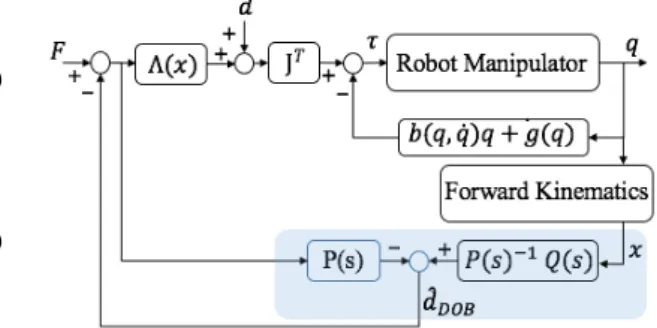
The structure of the DOD is shown in the Fig.1 and the estimated disturbance is given by
(11)
where ∋, ∋ . Q filter is a low-pass filter designed to make the inverse of the system proper [15].
Fig. 1 DOB structure
Most DOB is usually designed in the joint space, but in this paper, it is designed in the task space for higher DOF robot.
By using DOB, the disturbance is considered as follows.
(12)
where denotes , the remaining bounded disturbance and uncertainties. This is expected to be much lower than the disturbance in Eq. (2).
DOB makes the ISMC have lower nonlinear gains, as it deals with lower disturbances and leads lower chattering.
max≫ ∥∥ (13)
3.2. Impedance-based Integral Sliding Mode Control In this paper, the ISMC is designed to obtain the desired impedance without the effect of input disturbances. The is added to as follows.
(14)
Then the error model Eq. (9) in the state space form is
(15)
where , ,
,
. The is used for ISMC.
In the SMC, the overall control dynamics is determined by the sliding mode dynamics. So, the desired impedance in Eq. (5) must be included in the sliding mode dynamics.
To achieve this, the following sliding surface is chosen.
(16)
where
(17)
If the error states are guaranteed to stay on the sliding surface, then and .
The is calculated as follows.
(18)
Hence, the system has the desired impedance on the sliding surface.
In order to guarantee the existence of sliding surface, the following V must be Lyapunov function.
> (19)
and its time derivative has to be negative.
{ } (20)
The following input makes the above < be negative.
max
(21)
The overall input consists of nominal control input, ISMC input and DOB output.
(22)
Ⅳ. SIMULATION
To show the performances of the proposed controller in robustness improvement and preserving the desired impedance, the computer simulation has been performed using the Stanford WBC software. This software provides the numerical robot dynamic model based on TAO dynamics engine library.
From the robot structure saved in the xml file, it numerically computes the Jacobian matrix, the inertia, Coriolis-centrifugal and gravity values.
The structure of the simulated robot is stored in a xml file. The robot has eight joint and 1 meter links.
Their detail descriptions are in the following Table 1.
The software prepares the dynamic model Eq. (1) numerically.
Table. 1 Robot structure stored in the xml file
Number of links 8[links]
Length of every link 1[meter]
Mass of every link 1[kg]
Gravitational acceleration 9.81[m/s2] Center of mass of every link (basically at the
middle of each link) 0.5[m]
In the simulation, three cases are considered. First one is the nominal system with PD-type impedance
control, second one is the system with disturbances and pure impedance control and third one is the system with proposed controller for the system with disturbances.
The third one must have the same time response with the first one even with disturbances.
The goal position is set in sinusoidal as follows.
x=2.5 sin 0.2t
y=2.5 sin 0.37t (23) The proposed controller is
(24)
where which determine the damping and stiffness.
The simulation result is shown in the following figures.
Fig. 2 Time responses of x-axis with disturbance
Fig. 3 Time responses of y-axis with disturbance
In Fig. 2 and 3, the time response of pure impedance control (red) is greatly affected by the external disturbance of 500sin(t), while the proposed controller (blue) shows the considerably same as a system without disturbance (green)
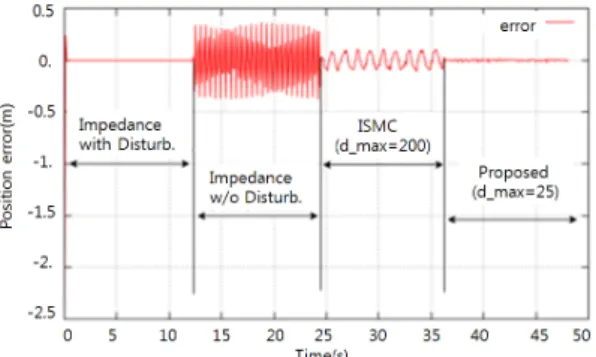
Fig. 4 Reference tracking performance comparison with disturbance (150 sin t)
Fig. 4 shows the tracking performances of four different controllers in turn. First, PD type impedance control performance is shown. There is no disturbance in this time and this is the ideal control performance.
Comparison of position tracking performance of the PD-type impedance control without and with disturbance, ISMC controlled and the proposed controller. The goal position is set at (2.5, 2.5) of the Cartesian plane while the manipulator is affected by disturbance at all joints.
The PD-type impedance control with disturbance is greatly affect by the disturbances in its tracking performance. The ‘Proposed Controller’ shows that DOB rejects the input disturbances as the ISMC max gain is only set to 25 even the disturbance is set to 150 maximum value and this validate the assumption in Eq.
(11), and eventually decreasing the chattering caused by ISMC.
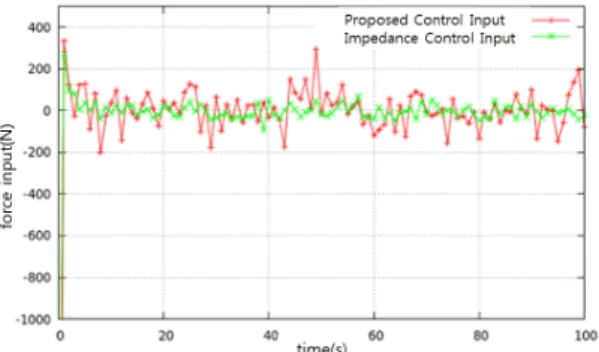
Fig. 5 shows the comparison of the PD-type impedance controller and the proposed controller. The proposed controller shows more chattering inherent in the SMC.
Fig. 5 Control inputs of impedance control and proposed controller
Ⅴ. CONCLUSIONS
A robust impedance controller is proposed using ISMC and DOB for high DOF robot. For disturbances, the proposed controller shows its robustness improvement compared to PD type impedance control.
The time responses of proposed controller with disturbances are the same with the responses of the PD type controller without disturbances. The robustness is from ISMC characteristic. DOB is used decouple input disturbances and lowers the burden of ISMC and leads the 70% lower nonlinear gains. The proposed controller is considered for high DOF robot in task space where uncertainties are inevitable. The software used in the simulation can be used for the actual control of high DOF robots.
ACKNOWLEDGMENTS
This research is financially supported by Changwon National University in 2015~2016.
REFERENCES
[ 1 ] N. Hogan, “Impedance Control: An Approach to
Manipulation,” American Control Conference, pp. 304- 313, 1984.
[ 2 ] S. P. Chan, B. Yao, W. B. Gao, and M. Cheng, “Robust Impedance Control of Robot Manipulators,” International Journal of Robotics and Automation, vol. 6, no. 4, pp. 220- 227, Dec. 1991.
[ 3 ] X. Dong, Z. Shaoguang, L. Xuerong, L. Min, and W.
Hongxing, “Impedance Control of Robot Manipulator with Model Reference Torque Observer,” in Proceedings of the 2013 IEEE 8th International Conference on Industrial Electronics and Applications, pp. 994-998, 2013.
[ 4 ] R. Platt, M. Abdallah, and C. Wamplet, “Multiple-priority impedance control,” in Proceedings of the 2011 IEEE International Conference on Robotics and Automation, pp.
6033-6038, 2011.
[ 5 ] Y. C. Tsai, “Robust Impedance Control of Pressure-Sensor Free Pneumatic Servo Systems,” in Proceedings of the 2011 IEEE International Conference on Electric Information and Control Engineering, pp. 2549-2553, 2011.
[ 6 ] C. Schindlbeck and S. Haddadin, “Unified Passivity-Based Cartesian Force/Impedance Control for Rigid and Flexible Joint Robots via Task-Energy Tanks,” in Proceedings of the 2015 IEEE International Conference on Robotics and Automation, pp. 440-447, 2015.
[ 7 ] F. Caccavale, P. Chiacchio, and A. Marino, “Six-DOF Impedance Control of Dual-Arm Cooperative Manipulators,”
IEEE/ASME Transactions On Mechatronics, vol. 13, no. 5, pp. 576-586, Oct. 2008.
[ 8 ] R. Naoual, E. M. Mellouli, and I. Boumhidi, “Adaptive fuzzy sliding mode control for the two-link robot,” in Proceedings of IEEE 9th International Conference on Intelligent Systems:
Theories and Applications, pp. 1-6, 2014.
[ 9 ] J. Baek, M. Jin, and S. Han, “A new Adaptive Sliding-Mode Control Scheme for Application to Robot Manipulator,”
IEEE Transactions on Industrial Electronics, vol. 63, no. 6, pp. 3628-3637, Jun. 2016.
[10] Y. W. Liang, S. D. Xu, and T. C. Chu, “Robust Control of the Robot Manipulator via an Improved Sliding Mode Scheme,” in Proceedings of the 2007 IEEE International Conference on Mechatronics and Automation, pp. 1593- 1598, 2007.
[11] R. A Silva Viego and R. S Ashok, “Comparative Study of PD Controller (Vs.) Integral Sliding Mode Control on 5-Link 2 DOF Planar,” in Proceedings of IEEE Southeastcon, pp.
1-6, 2013.
[12] D. S. You, “Integral Sliding Mode Control for Robot
Manipulators,” Journal of Institute of Control, Robotics and Systems, vol. 14, no. 12, pp.1266-1269, Dec. 2008.
[13] V. Utkin, J. Shi, “Integral Sliding Mode in Systems Operating under Uncertainty Conditions,” in Proceedings of the 35th IEEE Conference on Decision and Control, vol.
4, pp. 4591-4596, 1996.
[14] S. G. Khan and J. Jalani, “Realisation of model reference compliance of a humanoid robot arm via integral sliding mode control,” International Journal of Mechanical Sciences, vol. 7, no. 1, pp. 1-8, Jan. 2016.
[15] J. N. Yun and J. B. Su, “Design of a Disturbance Observer for a Two-Link Manipulator with Flexible Joints,” IEEE Transactions on Control Systems Technology, vol. 22, no. 2, pp. 809-815, Mar. 2014.
[16] M. J. Kim, and W. K. Chung, “Disturbance-Observer-Based PD Control of Flexible Joint Robots for Asymptotic Convergence,” IEEE Transactions on Robotics, vol. 31, no.
6, pp. 1508-1516, Dec. 2015.
[17] S. Oh, H. Woo, and K. Kong, “Frequency-Shaped Impedance Control for Safe Human-Robot Interaction in
Reference Tracking Application,” IEEE/ASME Transactions on Mechatronics, vol. 19, no. 6, pp. 1907-1916, Dec. 2014.
[18] O. Khatib, “A Unified Approach to Motion and Force Control of Robot Manipulators: The Operational Space Formulation,” IEEE Journal on Robotics Research, vol. 3, no. 1, pp. 43-53, Feb. 1987.
[19] Y. J. Choi, K. J. Yang, W. K. Kyun, H. R. Kim, and I. L.
Suh, “On the Robustness and Performance of Disturbance Observers for Second-Order Systems,” IEEE Transactions on Automatic Control, vol. 48, no. 2, pp. 315-320, Feb.
2003.
[20] O. Khatib, L, Sentis, J. Park, and J. Warren, “Whole-Body Dynamic Behavior And Control Of Human-Like Robots,”
International Journal of Humanoid Robotics, vol. 1, no. 1, pp. 29-43, Mar. 2004.
[21] A. Abner, S. K. Park, and G. P. Kwak , “ISMC and DOB Based Robust Impedance Control of High-DOF Robot in Task Space,” in Proceeding of KIEE Summer Annual Conference, pp. 1402-1403, 2016.
아브너 어시그네시온(Abner Asignacion Jr.)
Received the B. S. degrees in Electronic Engineering from Bulacan Unversity, Philippines in 2014. He is currently a student in Master & PhD Integrated program in the Department of Electrical Engineering at Changwon National University, Changwon, Korea.
※research interests : robust control , robot control
박승규(Seung-Kyu Park)
Received the B. S., M. S., and Ph. D. degrees in Electrical Engineering from Korea University in 1984, 1986 and 1990, respectively. He was a visiting professor of Strathclyde University, Scotland from 1995 to 1996, a visiting professor in University of Wisconsin from 2003 to 2004 and a visiting professor in Unversity of Texas Austin from 2011 to 2012. Since 1990, he is currently a professor in the Department of Electrical Engineering at Changwon National University, Changwon, Korea.
※research interests : Robust control theory and Whole body control of robots
김민찬(Min-Chan Kim)
Received the B. S., M. S., and Ph. D. degrees in Electrical Engineering from Changwon National University in 1996, 1998 and 2003, respectively. From 2006 to 2009, he was a research professor under the Brain Korea 21 Project Corps. He worked with the Human resource development center for Offshore and Plant Engineering(HOPE) at Changwon National University as a research professor from 2009 to 2012. He worked with the Department of Electricity at Gyeongnam Provincial Namhae College from 2012 to 2014. Since 21016, he is currently a visiting professor in the Smart Mechatronics Creative Educational Corp at Changwon National University, Changwon, Korea.
※research interests : H∞ robust control theory, sliding mode control theory, T-S fuzzy control