― 519 ―
*Corresponding author. E-mail: [email protected]
Tannic acid와 Bacillus thuringiensis subsp. kurstaki KB100균주의 혼합처리에 의한 파밤나방 살충활성의 상승효과
진나영ㆍ정선영ㆍ박 찬ㆍ백승경
1ㆍ서미자ㆍ윤영남ㆍ유용만*충남대학교 농업생명과학대학 응용생물학과, 1성보(주)
The Synergy Effects of Mixed Treatment with Tannic Acid and Bacillus thuringiensis subsp. kurstaki KB100 against Spodoptera exigua
(Lepidoptera: Noctuidae)
Na Young Jin, Sun Young Jung, Chan Park, Seung Kyoung Paek1, Mi Ja Seo, Young Nam Youn and Yong Man Yu*
Dept. Applied Biology, College of Agriculture and Life Science, Chungnam National University, Daejon, 305-764;
1Sungbo Chemical Co. Ltd., Chungju 361-230 Republic of Korea
ABSTRACT : Bacillus thuringiensis subsp. kurstaki KB100 isolated from the domestic soil have the
most effective activity against the beet armyworm, Spodoptera exigua larva. The tannic acid as protease inhibitor might be increased the efficacy of sublethal concentrations of B. thuringiensis. The tannic acid was identified as a protease inhibitor that could increased the efficacy of sublethal concentrations of B. thuringiensis. Mixture of B. thuringiensis and tannic acid was investigated the mortality of S. exigua larva in the laboratory and field. When B. thuringiensis treated to 2nd larva of S. exigua, mortality was shown 54.4%. However, mixtures of B. thuringiensis with 4 and 40 mM tannic acid were increased mortalities to 2nd larva of S. exigua as 64.0 and 95.5%, respectively. Also, synergy effect of mixture of B. thuringiensis and 40 mM tannic acid was increased the mortality of S. exigua 3rd larva to 93.3%, even though 60.0% mortality with only B. thuringiensis treatment. On the other hand, the mortality of mixture with B. thuringiensis and 80 mM tannic acid was 53.3% lower than B. thuringiensis single treatment. In the welsh onion field, the accumulated mortalities of 3 times replicated with mixture of B. thuringiensis and 40 mM tannic acid were 83.9, 89.4 and 66.8% compare with 61.8, 80.4 and 47.3%as only B. thuringiensis treatment, respectively.
KEY WORDS : Bacillus thuringiensis, Protease inhibitor, Tannic acid, Spodoptera exigua, Synergy effect
초 록
: 국내 토양으로부터 파밤나방에 활성있는 Bacillus thuringiensis subsp. kurstaki KB100균주를 분리 동정하였다. 난방제 해충인 파밤나방에 대한 B. thuringiensis의 살충력을 강화시키기 위해 몇 개의 protease inhibitor를 조사하였으며, 이 중 단백질 분해 억제 능력이 가장 좋은 tannic acid을 선발하였다.B. thuringiensis의 배양액에 tannic acid을 혼합 처리하여 파밤나방 2령 유충을 대상으로 생물활성을 조사한 결과, B. thuringiensis 단독처리는 54.4%의 사충율을 보인 반면 B. thuringiensis와 4 mM tannic acid을 혼합하여 처리하면 64.0% 그리고 B. thuringiensis+40 mM tannic acid는 95.5%의 높은 상승효과를
각각 나타냈다. 그러나 B. thuringiensis+80 mM tannic acid 에서는 53.3%로 단독처리의 경우 보다 사충율이 낮게 나타났다. 3령 유충에서도 B. thuringiensis 단독처리는 60.0%였으며 B. thuringiensis+40 mM tannic acid는 93.3%로 사충율이 증가하는 상승효과를 보였다. 야외포장 실험에서 B. thuringiensis 단독처리는 1회, 2회, 3회 누적 처리에서 각각 61.8%, 80.4% 그리고 47.3%의 사충율을 나타낸 것에 비해 B. thuringiensis 와 40 mM tannic acid의 혼합 처리구에서는 83.9%, 89.4%와 66.8%로 사충율이 증가되었다.
검색어 : Bacillus thuringiensis, Protease inhibitor, Tannic acid, 파밤나방, 상승효과
파밤나방은 나비목(Lepidoptera), 밤나방과(Noctuide), Spodoptera속에 속하는 광폭식성의 난방제 해충으로 주 요 농작물에 심각한 피해를 입힌다(Ahn et al., 1989).
파밤나방은 동남아시아가 원산지로서 주로 열대 및 아 열대지역에 넓게 분포하고 있으나 이동성이 강하여 최 근에는 온대지역에도 발생이 증가하고 있다. 기주 범위 가 광범위하여 채소, 화훼, 과수 등 40과 200여종에 피 해를 입히고 있으며, 국내에서는 파, 배추, 수박 등 다양 한 농작물에 발생하여 큰 피해를 주고 있다. 파밤나방은 연간 보통 4~5회 발생하고, 남부지방의 경우 6월 상순 부터 나타나기 시작하여 11월 하순까지 발생하는데 7월 하순에서 10월 하순에 성충의 발생이 많으며 최성기는 8월 중순경으로 알려져 있다(Goh et al., 1991; Kim et al., 1995a, b; Park et al., 1991). 우리나라에서는 1986 년에 전남 진도에서 피해가 확인 된 이후(Goh et al., 1993a, b; Park et al., 1991), 1998년부터 전국적으로 대 량 발생하여 피해가 심각하다(Ahn et al., 1989). 또한 최근에 기온상승과 시설재배지의 확대로 발생세대수가 증가하고 내한성기작으로 월동 가능성이 증폭되어 해마 다 발생이 증가되고 있는 추세이다(Kim and Kim, 1997). 파밤나방은 기주범위가 광범위하고 피해확산이 빠르며 발생세대가 혼재되어 있어 포장에서의 방제가 매우 어려운 해충이다(Luo et al., 2000). 이러한 해충을 방제하기위해 주로 유기인계, 카바메이트계, 피레스로 이드계 등 화학 살충제를 사용하고 있다(Eveleens et al., 1973). 상업적으로 시판되는 대부분의 살충제에 대 해서 높은 저항성 개체의 출현으로 방제가 어려우며, 더 욱이 노령 유충으로 갈수록 화학 살충제에 대해 확연하 게 낮은 감수성을 나타낸다. 또한 최근에는 친환경 농업 을 위하여 미생물 살충제의 사용이 요구되고 있으나 파 밤나방의 생리 생태적 특성과 포장에서의 발생세대가 혼재되어 있으며 특히 노령 유충의 방제가 매우 어려운 상태이다. 현재 국내에서 파밤나방의 방제를 위하여 미
생물 살충제로 사용되고 있는 Bacillus thuringiensis제 의 경우 방제효과가 낮게 나타나므로 이에 대한 사용방 법과 처리시기에 있어서 효과를 증진시키는 연구가 필 요하며, 한편으로는 파밤나방에 활성이 강한 새로운 B.
thuringiensis균주의 분리도 중요하다고 생각된다.
미생물농약의 일종인 B. thuringiensis는 포자를 형성 하는 동안 δ-endotoxin이라 불리우는 살충성 독소 단백 질(insecticidal crystal proteins, ICPs)을 포함하는 crystalline parasporal inclusions을 만드는 그람 양성 세균이다. B.
thuringiensis는 100개 이상의 ICPs 살충 특성과 분자구 조에 의해 Cry I, II, III, IV, V의 다섯 종류로 분류된다.
이들은 나비목(Cry I), 나비목과 파리목(Cry II) 딱정벌 레목(Cry III), 파리목(Cry IV), 나비목과 딱정벌레목 (Cry V)에 대해서 살충 활성이 있다(Crickmore et al., 1998). 이 중 나비목에 대한 B. thuringiensis의 내독소 단백질은 유충 발육단계 동안에 독성을 나타낸다. B.
thuringiensis가 생산하는 ICPs는 그 자체적으로는 살충 활성을 나타내지 못하나 곤충이 섭식하게 되면 중장 protease에 의해 B. thuringiensis 독소 즉, ICPs를 생산 하여 독성을 나타낸다. 감수성인 곤충의 중장에서 생성 되는 강알칼리성 소화효소에 의해 크리스탈은 약 130kDa의 분자량인 전독소 상태로 용해되고 전독소는 재차 대상 해충의 중장 protease에 의해 단백질 가수분 해로 55~70kDa의 살충성을 나타내는 독소 단백질로 된 다. 이러한 독소는 유충의 중장 상피세포에 작용하여 세 포막에 구멍을 형성 사충에 이르게 한다.
B. thuringiensis제의 활성을 강화시켜주고 기주범위와 독소의 생물학적 활성을 증가시킬 수 있도록 제품에 다 양한 계면활성제를 첨가 시키는 보고가 있다. 섭식 자극 제를 사용하여 B. thuringiensis 독소의 섭식을 증가시키 거나(El-Nockrashy et al., 1986; Bartelt et al., 1990), protease inhibitor를 첨가하여 과분해 되는 독소를 억제 하여 그 효과를 높일 수 있다(MacIntosh et al., 1990).
Table 1. Toxicity of B. thuringiensis subsp. kurstaki against lepidopteran and dipteran larva
Strain
Tested insects
Lepidopteran Dipteran
P.xylostella S.litura S.exigua C. pipiens
molestus
C. pipiens pallens
A.
aegypti
KB098 +++ +++ +++ - - -
KB100 +++ - +++ - - ++
CAB162 +++ +++ +++ - - -
+++: over 70%; ++: 70-30%; +: 10-30%; -: under 10% mortality.
이렇게 사용되는 다양한 protease inhibitor 중에서 tannic acid은 Taxus sp.의 주요성분이며, 곤충의 가해로부터 보호하기 위한 식물의 방어기작 물질로 알려져 있다 (Raubenheimer, 1992).
본 연구는 파 농가재배 포장에서 파밤나방이 알에서 부터 성충까지 혼재되어 있으며 특히 노령유충의 방제 가 어려운 상태에서 활성이 강한 새로운 B. thuringiensis 를 선발하기 위하여 시도되었으며, 또한 이 해충의 중장 액이 강력한 소화 활성으로 B. thuringiensis의 독소 단 백질이 과분해 되는 것을 방지할 수 있는 억제인자인 protease inhibitor을 선발하여 B. thuringiensis의 독소 단백질의 과분해를 막아 방제효과를 높일 수 있는 방법 을 검토하였다.
재료 및 방법 실험곤충
본 실험에 사용된 파밤나방(Spodoptera exigua)은 안 동대학교 곤충생리학 교실 에서 분양받아 생물적 해충 제어 실험실에서 인공사료(Gho et al., 1990)로 누대 사 육 하면서 사용하였다. 사육 조건은 온도 25 ± 1℃, 광조 건 16L:8D이었다. 성충의 먹이로는 10% 설탕물을 산란 상자 (직경: 20 cm, 높이: 15 cm의 플라스틱)에 공급하였다.
Bacillus thuringiensis 균주 동정
국내 토양으로부터 분리하여 실험실에 보관 중 이던 B. thuringiensis 중에 파밤나방에 높은 살충활성을 보이 는 3종의 B. thuringiensis KB098, KB100, CAB162 균 주를 선발하여 실험을 수행하였다(Table 1). B. thuringiensis 균주의 동정은 일본 규슈대학 농학부 M.. obha박사(Institute of Biological Control, Faculty of Agriculture, Kyusu Uni-
versity, Fukuoka, Japan)에 H serotype을 의뢰한 결과, KB098 균주는 B. thuringiensis subsp. aizawai로 동정 되었고, KB100균주와 CAB162균주는 B. thuringiensis subsp. kurstaki로 동정되었다.
Bacillus thuringiensis 균주와 tannic acid 준비
본 실험실에서 분리 선발된 B. thuringiensis subsp.
kurstaki KB100균주를 NA배지에 접종하고 27℃에서 5 일 동안 배양하여 위상차현미경으로 autolysis가 일어나 는 것을 확인한 후, 집균 하여 -20℃에 보관 하면서 곤 충에 대한 독성검정에 사용하였다. KB100균주는 생물 검정에 이용하기 위하여 배양액을 1.02✕105(cfu/ml)으 로 적용하였으며 tannic acid(Sigma Co.)을 4단계의 농 도(0.4, 4, 40, 그리고 80 mMℓ-1)로 증류수를 이용하여 희석한 후 처리하였다. Protease activity를 측정하기 위 해 Bradford(1976)의 방법을 일부 수정하여 실험하였다.
Protease의 기질로 azocasein을 사용하여 분석하였고, protease inhibitor로는 tannic acid, SBTI, PMSF, EDTA, TLCK(Sigma Co.)의 5종류를 사용하였다. 증류수로 희 석한 파밤나방의 중장액과 각각의 protease inhibitor를 1:1의 비율로 혼합한 후 37℃에서 15분간씩 반응시켰 다. 소화된 샘플 100㎕에 azocasein(10mg/ml, pH10) 300㎕를 혼합한 후 37℃에서 15분간 반응 시킨 후, 10% TCA를 200㎕ 첨가 하여 반응을 중지 시켰다. 샘 플을 15,000rpm, 4℃에서 30분 동안 원심 한 후 단백질 을 응집시키기 위해 상층액에 1M NaOH와 1:1이 되도록 혼합 한 후 흡광도 405 nm로 단백질 농도를 측정하였다.
생물활성 검정
파밤나방에 대한 실내 생물활성 검정은 -20℃에서 보 관되어 있던 spore-crystal mixtures 희석액 100 µl와 tannic acid 농도별(0.4, 4, 40, 그리고 80 mMℓ-1)로 각각
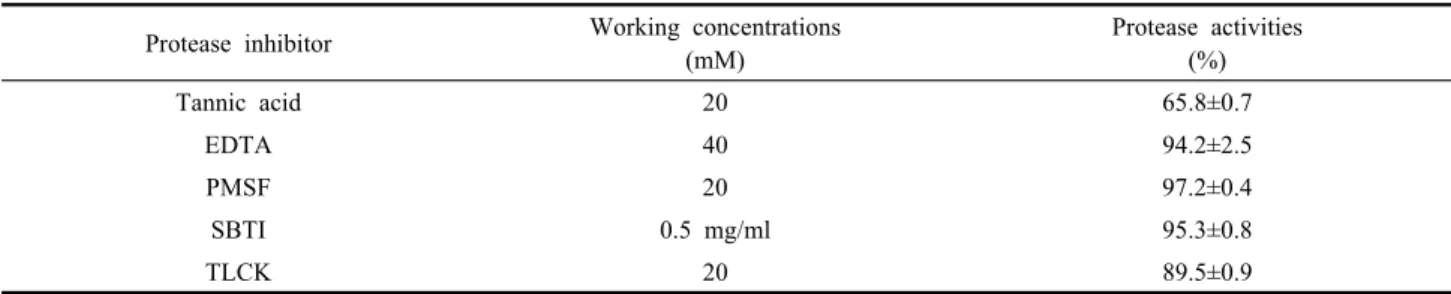
Table 2. Effects of protease inhibitor against midgut juice of S. exigua Protease inhibitor Working concentrations
(mM)
Protease activities (%)
Tannic acid 20 65.8±0.7
EDTA 40 94.2±2.5
PMSF 20 97.2±0.4
SBTI 0.5 mg/ml 95.3±0.8
TLCK 20 89.5±0.9
의 혼합물 30㎕ 씩을 0.5 g의 인공사료에 살포 한 후 2, 3령 유충 30마리씩 petri dish에 넣고 120시간 후 치사 율을 조사하였다. 야외 포장에서의 실험은 전라남도 진 도의 파밤나방이 발생한 농가 파 포장에서 적당량의 B.
thuringiensis와 tannic acid 혼합액을 처리해 3회 살포하 여 살충효과 실험을 수행하였다. 모든 실험은 3반복 실 시하였으며, 파밤나방에 대한 사충율은 Finney(1971)의 probit 계산법에 기초한 PC 프로그램(Raymond, 1985) 을 이용하여 반수치사농도(LC50)를 산출하였다. 야외 포장 실험의 살충율은 {(처리구 살충율 - 무처리구 살충 율)/(100 - 무처리구 살충율)} × 100%로 나타냈다. 유의 성 검정은 SPSS 17.0 프로그램에서 일원배치분산분석 (One way - ANOVA)을 통해 통계분석 하였으며 Scheffe를 통해 사후 검정 하여 처리 들 간 비교 하였다.
SDS-PAGE
실험에 사용된 B. thuringiensis 균주를 NA배지에 접 종하고 27℃에서 5일 동안 배양하여 위상차현미경으로 autolysis가 일어나는 것을 확인한 후, PBS buffer를 사 용하여 원심튜브에 15,000rpm으로 4℃에서 10분간 원 심을 하였다. 원심 후, 상층액은 버리고 washing buffer I(500 mM NaCl, 2% Triton X-100)은 3번, washing buffer II(500 mM NaCl)는 2번 세척 하였다. 세척된 parasporal inclusion는 멸균수를 첨가한 후 -20℃에 보 관하였다. 일반적 소화 실험을 위하여 B. thuringiensis 의 parasporal inclusion과 파밤나방의 중장액은 7:3 ㎕ 의 비율로 혼합하여 37℃에서 20분간 소화시켰으며, 저 해현상을 관찰하기 위하여 파밤나방 중장액과 protease inhibitor를 3:3 ㎕씩을 혼합하여 37℃에서 20분간 반응 한 후, B. thuringiensis의 parasporal inclusion을 7 ㎕를 첨가 하여 37℃에서 20분간 소화시킨 후 실험에 사용하 였다. SDS-PAGE는 Laemmli(1970)의 방법을 일부 수 정하여 12% separating gel과 5% stacking gel을 사용했
다. 전기영동이 끝난 gel은 0.5% Coomassie brilliant blue로 염색하였다.
결과 및 고찰
파밤나방 중장액에 대한 protease inhibitor의 저 해효과
파밤나방과 같이 내성이 강한 해충의 경우에는 B.
thuringiensis에 대한 살충효과가 낮거나 그 효과가 늦게 나타나는 지효성을 보인다(Kim et al., 2008). 이러한 원 인으로 손상된 중장 상피세포의 신속한 회복, 독소 단백 질의 살충효과 변화, cry 독소와 결합하는 수용체의 변 화 등으로 보고되었다(Satinder et al., 2007). 본 실험에 서는 cry 독소가 파밤나방의 유충 중장 protease에 의해 과분해 되어 특성이 낮게 된다는 것을 가정 하고 실험 을 수행하였다. 따라서 파밤나방 중장액이 cry 독소를 과분해 하는 것을 억제하기 위해 몇 종류의 protease inhibitor를 사용하여 분해 억제 실험을 수행하였다.
파밤나방의 중장액에 protease inhibitor로서 가장 효 과 있게 저해하는 것을 선발하기 위하여 5종류의 tannic acid, PMSF, EDTA, TLCK, SBTI를 실험하였다. 파밤 나방 중장액에 대한 5종의 protease inhibitor의 활성 결 과가 Table 2에 나타나 있다. 실험한 것 중에서 20 mM tannic acid에서는 약 35% 정도 단백질 분해 활성을 억 제 하였으나 또 다른 4종의 protease inhibitor들은 활성 정도가 미비하게 나타났다. 따라서 실험된 저해제 중 tannic acid는 파밤나방 중장액 protease의 활성을 가장 높게 억제하는 것으로 확인하였다. 이러한 결과는 파밤 나방의 중장액은 주로 serine protease로 구성되어 있으 며, metallo protease와 trypsin은 단백질 분해 활성을 나 타내는 것으로 보고 한 결과와 일치하였다(Opprert, 1999).
파밤나방 중장액 속에서 KB100균주의 결정성 독소
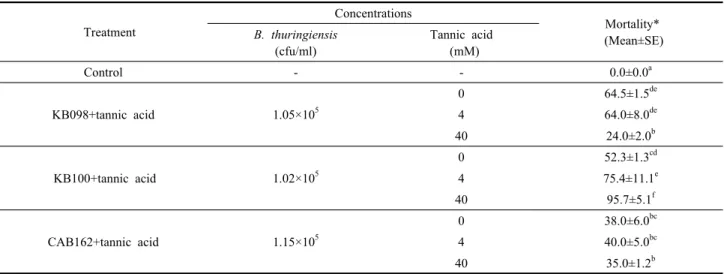
Table 3. Mortalities of S. exigua 2nd larva treated with B. thuringiensis KB098, KB100, CAB162 and mixtures of B. thuringiensis and tannic acid
Treatment
Concentrations
Mortality*
(Mean±SE) B. thuringiensis
(cfu/ml)
Tannic acid (mM)
Control - - 0.0±0.0a
KB098+tannic acid 1.05×10⁵
0 64.5±1.5de
4 64.0±8.0de
40 24.0±2.0b
KB100+tannic acid 1.02×10⁵
0 52.3±1.3cd
4 75.4±11.1e
40 95.7±5.1f
CAB162+tannic acid 1.15×10⁵
0 38.0±6.0bc
4 40.0±5.0bc
40 35.0±1.2b
* Values represent mean ± SD. Different letters at values in rows show significant differences (One-way ANOVA, Post Hoc tests by Scheffe) in SPSS Version 17.0 (p=0.000
M 1 2 3 4 5 6 7
Fig. 1. Effect of protease inhibitors on the protoxin activation in S. exigua midgut. M: standard marker; lane 1: KB100 protoxin; lane 2: KB100 digested by midgut juice; lane 3-7:
protoxin activated by gut juice incubated with tannic acid (20 mM), SBTI (0.5 mg/ml), EDTA (40 mM), PMSF (20 mM) and TLCK (20 mM), respectively.
단백질이 분해되는 과정에 대해 protease inhibitor가 억 제 하는 효과를 SDS-PAGE로 나타냈다(Fig. 1). B.
thuringiensis의 protoxin의 경우 파밤나방 중장액에 의 해 깨끗하게 분해된 반면(Fig. 1, lane2), 나머지의 tannic acid, EDTA, PMSF, SBTI와 TLCK를 포함하는 모든 protease inhibitor는 파밤나방 중장액에서 protoxin의 분 해를 억제하는 것으로 나타냈다(Fig. 1, lanes 3-7). 특히 5종의 protease inhibitor 중에서 tannic acid는 파밤나방 중장액과 protoxin의 반응에 있어서 가장 효과적으로 억 제하는 것을 확인하였다(Fig. 1, lane 3). 그 밖의 다른
종류들인 SBTI, PMSF와 TLCK의 protease inhibitor도 억제 활성을 나타냈지만, tannic acid에 비해 약하게 나 타났다(Fig. 1, lanes 4, 6, 7). 한편 Serine protease inhibitor인 EDTA는 다른 종류와 다르게 약간의 억제 효과를 나타냈다(Fig. 1, lane 5). 파밤나방 중장액의 활 성을 가장 효과적으로 억제한 tannic acid을 선발하여 저해제의 농도에 따른 차이와 B. thuringiensis균주에 따 른 살충활성을 조사하였다(Table 3). 이러한 조합의 실 험은 B. thuringiensis의 3종류에서 KB100균주가 40 mM tannic acid와 혼합되었을 때 가장 높은 95.5%의 살충효과를 나타냈다.
그러나 B. thuringiensis의 다른 2종인 KB098과 CAB162 균주는 4 mM tannic acid와 혼합했을 때 가장 높은 살 충활성이 64%와 40%로 비교적 낮게 나타났다. 결론적 으로 파밤나방 중장에서 B. thuringiensist의 결정성 독 소 단백질의 과분해를 억제하기 위하여 40 mM tannic acid와 KB100균주의 혼합 조합을 선발하였다.
파밤나방 중장액과 tannic acid에 의하여 분해되는 Bacillus thuringiensis 독소 단백질
Table 3에 표시된 것 같이 독소단백질의 과분해를 억 제하는데 가장 적합한 protease inhibitor로 선발된 40 mM tannic acid와 파밤나방에 활성을 나타내어 선발된 B. thuringiensis의 3종류인 KB098, KB100, KB162균 주에 대한 단백질의 과분해 정도의 활성 반응을 시킨 다음 SDS-PAGE 실험을 통하여 관찰 되었다(Fig. 2,
M 1 2 3 4 5 6
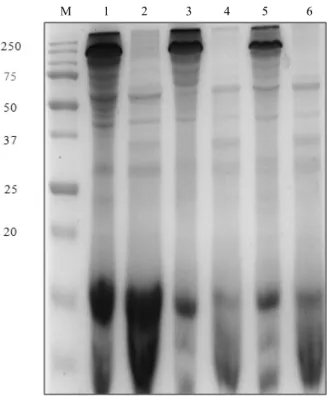
Fig. 2. SDS-PAGE analysis of parasporal incubations of KB098, KB100 and CAB162. M: standard marker; lane 1, KB98 protoxin; lane 2: KB098+midgut juice; lane 3: KB100 protoxin; lane 4: KB100+midgut juice; lane 5: CAB162 protoxin;
lane 6; CAB162+midgut juice.
M 1 2 3
Fig. 3. Effect of tannic acid on the protoxin activation in S.
exigua midgut. M: standard marker; lane 1-3: KB098, KB100 and CAB162 were activated by gut juice incubated with tannic acid, respectively.
Fig. 3). 세 균주 모두 130kDa의 전독소를 나타냈고(Fig.
2, lane1, 3, 5), 파밤나방 중장액의 소화에 의해 60kDa 의 살충활성 단백질로 분해됨을 알 수 있었다(Fig. 2, lane2, 4, 6). 한편 세 균주의 독소 단백질을 파밤나방 중장액과 tannic acid을 동시에 혼합하여 반응시킨 결과 KB100균주가 가장 효과적으로 억제 됐음을 나타냈다 (Fig. 3, lane2). 나머지 KB098과 CAB162 균주는 KB100 균주에 비해 반응에 대한 억제가 약하게 나타냈다(Fig.
3, lane1, 3). 이러한 결과는 KB100균주의 독소 단백질 을 소화시킬 때 tannic acid를 첨가함으로써 살충활성 단백질이 과분해를 저해 시키는 것으로 판단되며 Table 3의 결과와 일치함을 알 수 있다.
Bacillus thuringiensis KB100균주와 tannic acid의 혼합처리에 의한 파밤나방의 살충효과
파밤나방 2령 유충에 가장 높은 살충활성을 보이는 KB100 균주의 동일한 독소 단백질에 파밤나방 중장액 과 tannic acid의 양의 변화를 주면서 처리했을 때와 B.
thuringiensis 단독처리를 각각 비교하였다(Table 4). 파
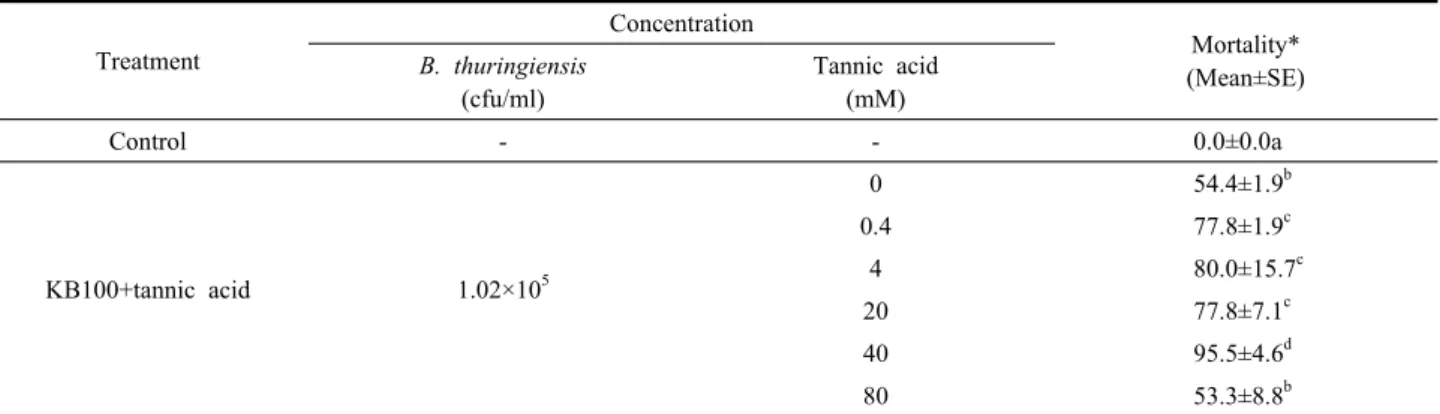
밤나방 2령 유충에 KB100균주의 배양액에서 포자가 1.02×10⁵ cfu/ml농도로 단독처리 했을 때는 54.4% 사충 율을 나타냈지만, 5 단계의 tannic acid 0.4, 4, 20, 40, 80 mM 와 혼합처리 했을 때에는, 각각 77, 80, 77, 95, 53%의 사충율로 모든 조합이 높게 나타냈다. 그러나 tannic acid가 2배로 증가된 80 mM에서 오히려 방제가 가 낮게 나타났다.
또한 3령 유충에서도 KB100균주를 1.02×10⁵ cfu/ml 의 농도로 단독처리 했을 때에는 60%의 사충율을 기록 했지만, 균주를 0.4, 4, 20, 40, 80 mM tannic acid와 함 께 처리했을 때는 각각 73, 76, 86, 93, 76%의 사충율로 2령의 결과와 유사하게 나타냈다(Table 5). 이상의 결과 로 tannic acid의 40 mM 첨가는 단독처리와 비교해서 사충율을 가장 높게 증가 시켰다.
농가 파포장에서의 혼합처리 효과
실내 생물검정을 통해 가장 높은 사충율을 보인 40 mM tannic acid의 농도로 파 재배농가 포장에서 살충효 과 실험을 수행하였다. B. thuringiensis만을 처리 했을 때에는 1회 살포 후 사충율은 약 61.1% 이었으며 2회
Table 4. Mortalities of S. exigua 2nd larva treated with B, thuringiensis KB100 and five different concentrations of tannic acid Treatment
Concentration
Mortality*
(Mean±SE) B. thuringiensis
(cfu/ml)
Tannic acid (mM)
Control - - 0.0±0.0a
KB100+tannic acid 1.02×10⁵
0 54.4±1.9b
0.4 77.8±1.9c
4 80.0±15.7c
20 77.8±7.1c
40 95.5±4.6d
80 53.3±8.8b
* Values represent mean ± SD. Different letters at values in rows show significant differences (One-way ANOVA, Post Hoc tests by Scheffe) in SPSS Version 17.0 (p=0.000)
Table 5. Mortalities of S. exigua 3rd larva treated with B. thuringiensis KB100 and five different concentrations of tannic acid Treatment
Concentration
Mortality*
(Mean±SE) B. thuringiensis
(cfu/ml)
Tannic acid (mM)
Control - - 6.7±0.8a
KB100+tannic acid 1.02×10⁵
0 60.0±1.7b
0.4 73.3±1.6c
4 76.7±1.8c
20 86.6±0.5d
40 93.3±0.8e
80 76.7±1.3c
* Values represent mean ± SD. Different letters at values in rows show significant differences (One-way ANOVA, Post Hoc tests by Scheffe) in SPSS Version 17.0 (p=0.000)
Table 6. Accumulated mortalities of S. exigua larva against B. thuringiensis KB100 and mixtures of B. thuringiensis and tannic acid on the welsh onion field
Treatment
Concentration Corrected mortality*(%) of Weeks after Treatment B. thuringiensis
(cfu/ml)
Tannic acid
(mM) 1 2 3
KB100 1.02×10⁵ 0 61.8±9.9b 80.4±4.9b 47.3±6.8b
KB100+tannic acid 1.02×10⁵ 40 83.9±3.5a 89.4±2.5a 66.8±7.0a
Corrected mortality = ((X - Y) / (100 - Y)) × 100%
X = Percentage mortality of treated group, Y = Percentage mortality of untreated group
* Values represent mean ± SD. Different letters at values in rows show significant differences (One-way ANOVA, Post Hoc tests by Scheffe) in SPSS Version 17.0 (p=0.000)
처리 후 약 80.4%였으며, 3회 처리 후 약 47.3%의 결과 를 나타냈다(Table 6). 그러나 B. thuringiensis를 단독처 리 한 것 보다 B. thuringiensis + 40 mM tannic acid를 혼합처리 한 것이 실험실 연구결과와 동일하게 1주차에 는 83.9%, 2주차에는 89.4%, 3주차에는 66.8%로 살충 효과가 더 높게 상승하는 결과를 얻었다.
본 연구는 tannic acid의 혼합에 따른 B. thuringiensis
의 살충활성에 대한 상승효과를 검토하였는데, 파밤나 방의 살충활성은 B. thuringiensis와 tannic acid의 혼합처 리구가 B. thuringiensis 단독 처리구에 비해 사충율이 더 높아진다는 결과를 얻었다. 이러한 결과는 B. thuringiensis 와 독소 단백질이 파밤나방 중장액의 높은 pH와 단백 질 분해 효소에 의하여 소화될 때 tannic acid가 저해 작 용을 하는 것을 암시한다.
따라서, 난방제 해충인 파밤나방의 환경 친화적 방제를 위하여 B. thuringiensis 제제에 Tannic acid을 첨가하므 로 높은 활성을 나타낼 것으로 판단되는 결과를 얻었다.
파밤나방과 같은 난방제 해충 방제에서 기존의 살충활성 성분에 독성을 높일 수 있는 물질을 첨가시키는 연구는 생물농약으로서 방제 효과를 높이는데 필요 한 연구 중 의 하나일 것 이다. 본 결과를 통하여 미생물 농약의 단 점인 좁은 기주범위와 저활성 문제 등에 있어서 적절한 제형의 개선을 통하여 효과를 증진시킬 수 있을 것으로 판단된다. 국내의 난방제 해충의 방제를 위하여 다양한 방법으로 효과를 높일 수 있는 연구 개발이 필요하다.
사 사
본 연구는 농촌진흥청 국립 농업과학원의 “해충방제 용 미생물 살충제의 현장 활용 평가 기술 개발”과제에 의해 지원되었으며 이에 감사드립니다.
Literature Cited
Ahn, S.B., I.S. Kim, W.S. Cho, M.H. Lee and K.M. Choi. 1989.
The Occurance of the crop insect pests from Korea in 1988.
Korean J. Appl. Entomol. 28(4): 246-253.
Bartelt, R.J., M.R. Mc Guire and D.A. Black. 1990. Feeding stimulants for the European corn borer(Lepidoptera pyralidae):
Additives to a starch-based formulation of Bacillus thuringiensis.
Environ. Entomol. 19: 182-189.
Bradford, M.M. 1976. A Rapid and sensitive method for the quantitation of microgram quantities of protein utilizing the principle of protein-dye binding. Anal. Biochem. 72: 248-254.
Crickmore, N., D.R. Zeigler., J. Feitelson., E. Schnepf., J. van Rie., D. Lereclus., J. Baum and J.H. Dean. 1998. Revision of the nomenclature for the Bacillus thuringiensis pesticidal crystal protein. Microbiol. Mol. Biol. Rev. 62: 807-813.
El-Nockrashy, A.S., H.S. Salama and F. Taha. 1986. Influence of bait formulations on the effectiveness of Bacillus thuringiensis against Spodoptera littoralis (Boisd) (lepidoptera:Nocutidae). J.
Appl. Entomol. 101: 389-399.
Eveleens, K.G., R. Van Den Bosch and L.E. Ehler. 1973.
Secondary outbreak induction of beet armyworm by experimental insecticide application in cotton in California. Entomol. 2:
497-503.
Finney, D.J. 1971. Probit analysis, estimation of the median effective dose. Cambridge University Press. London. pp 19-47.
Goh, H.G., J.D. Park, Y.M. Choi, K.M. Choi and I.S. Park. 1991.
The host plants of beet armyworm, Spodoptera exigua (Hübner), (Lepidoptera: Noctuidae) and its occurrence. Korean J. Appl.
Entomol. 30(2): 111-116.
Goh, H.G., J.S. Choi, K.B. Uhm, K.M. Choi and J.W. Kim. 1993a.
Spatial distribution pattern of beet armyworm, Spodoptera exigua (Hübner), larvae in the welsh onion field. Korean J.
Appl. Entomol. 32(2): 134-138.
Goh, H.G., J.S. Choi, K.B. Uhm, K.M. Choi and J.W. Kim. 1993b.
Seasonal fluctuation of beet armyworm, Spodoptera exigua (Hübner), adult and larva. Korean J. Appl. Entomol. 32(4):
389-394.
Goh, H.G., S.G. Lee, B.P. Lee, K.M. Choi and J.H. Kim. 1990.
Simple mass-rearing of beet armyworm, Spodoptera exigua (Hübner) (Lepidoptera: Noctuidae), on an artificial diet. Korean J. Appl. Entomol. 29: 180-183.
Kim, D.A., J.S. Kim., M.R. Kil., S.K. Paek., S.Y. Choi., D.Y. Jin., Y.N. Youn., I.C. Hwang., Y.M. Yu. 2008. Characterization of new Bacillus thuringiensis isolated with bioactivities to tobacco cutworm, Spodoptera litura (Lepidoptera: Noctuidae). Korean J.
Appl. Entomol. 47(1): 87-93.
Kim, H.S., D.W. Lee, H.W. Park, Y.M. Yu, J.I. Kim and S.K.
Kang. 1995a. Distribution and characterization of Bacillus thuringiensis isolated form soils of sericultural farms in Korea.
Korean J. Seric. Sci. 34(1): 57-61.
Kim, K.C., J.D. Park and D.S. Choi. 1995b. Seasonal occurrence of Spodoptera exigua in Chonnam province and a possibility of their control in vinyl house with pheromone trap. Korean J.
Appl. Entomol. 34(2): 106-111.
Kim, Y. and N. Kim. 1997. Cold hardiness of the beet armyworm, Spodoptera exigua (Noctuidae: Lepidoptera). Environ Entomol.
26: 1117-1123.
Laemmli, U.K. 1970. Cleavage of structural proteins during the assembly of the head of bacteriophage T4. Nature 277: 680-685.
Luo, L.Z., Y.Z. Cao and X.F. Jiang. 2000. The study on occurrence characteristics and trend of beet armyworm. Plant Protection. 26(3): 37-39.
Maclntosh, S.C., G.M. Koshore, F.J. Perlak, P.G. Marrone, T.B.
Stone, S.R. Sims and R.L. Fuchs. 1990. Potemtiation of Bacillus thuringiensis insecticidal activity by serine protease inhibitor. J.
Agric. Food Chem. 38: 1145-1152.
Opprert, B. 1999. Protease interaction with Bacillus thurigiensis insecticidal toxin. Arch. Insect Biochem. Physiol. 42: 1-12.
Park, J.D., H.G. Goh, J.H. Lee, W.J. Lee and K.J. Kim. 1991.
Flight activity and injury characteristics of beet armyworm, Spodoptera exigua (Hübner), (Lepidoptera: Noctuidae) in Southern Region of Korea. Korean J. Appl. Entomol. 30(2):
124-129.
Raubenheimer, D. 1992. Tannic acid, protein, and digestible carbohydrate: Dietary imbalance and nutritional compensation in locusts. Ecology 73: 1012-1027.
Raymond, M. 1985. Presentation d'un programme d'analyse log-probit pour micro-ordinnateur. Cah. ORSTOM, Ser. Ent.
Med. et parasitol. 22: 117-121.
Satinder K.B., M. Verma, R.D. Tyagi, R.Y. Surampalli, S.
Barnabe´, J.R. Vale´ro. 2007. Bacillus thuringiensis proteases:
production and role in growth, sporulation and synergism.
Process Biochem. 42: 773-790.
(Received for publication December 3 2009;
revised December 11 2009; accepted December 17 2009)