Research Articles Open Access
50
Glufosinate-ammonium 저항성 형질전환벼의 저항성 수준과 적응성에 관한 연구
윤영범·국용인*
순천대학교 생명산업과학대학 한약자원개발학과
Levels of Resistance and Fitness in
Glufosinate-ammonium-Resistant Transgenic Rice Plants
Young Beom Yun and Yong In Kuk*
Dept. of Development in Oriental Medicine Resources, College of Life Science and Natural Resources, Sunchon National University, Suncheon 540-742, Korea
ABSTRACT. The objectives of this research were to quantify resistance levels of transgenic rice expressing the bar gene to glutamine synthetase (GS)-inhibiting, and methionine sulfoximine and photosynthesis-inhibiting herbicide, paraquat, and compare the ammonium accumulation, chilling injury, and yield between transgenic and non-transgenic rice. The transgenic rice lines were 45-96-fold more resistant to glufosinate-ammonium than non- transgenic rice. The transgenic rice lines were also 18-fold more resistant to methionine sulfoximine, but was not resistant to paraquat, which has different target site. Glufosinate-ammonium increased the ammonium accumulation in leaves of non-transgenic rice plants, but had minimal or no effect on leaves of transgenic lines. The transgenic lines except for 258, 411, 607 and 608 were more susceptible during chilling and recovery than non-transgenic rice plants. The yield of transgenic lines 142, 144, 258 and 608 was similar or higher than that of non-transgenic rice in pot conditions.
Key words: Fitness, Glufosinate-ammonium, Herbicide, Transgenic rice
서 론
벼는 한국을 비롯한 아시아에서 가장 많이 재배되는 작 물 중의 하나이다. 또한 쌀은 세계인구의 절반이상이 섭 취하는 주요 식량원이기도 하다(Singh and Khush, 2000).
벼의 생장을 제한하는 요인 중의 하나인 잡초발생은 벼 경작자들에게 경제적 손실과 수량감소를 야기한다. 제초 제는 잡초관리를 위해 가장 많이 사용되는 수단이며, 이 중 glufosinate-ammonium(GLU)는 1981년에 개발된 비선 택성 경엽처리 제초제로서 비경작지, 과수원 등에 발생한 잡초를 방제하기 위해 주로 사용되고 있다(Krausz et al., 1999). 또한 GLU는 후기에 발생한 잡초를 방제할 수 있
는 제초제로서 토양에 떨어지면 빠르게 불활성화되어 토 양내에 축적되지 않을 뿐만 아니라 이동성이 낮은 제초제 이다. 그러나 GLU는 비산에 의한 약해의 우려로 작물 재 배지에 사용이 극히 제한되어 있다. GLU의 작용점은 식 물의 질소대사에서 주요 효소인 글루타민합성효소(glutamine synthetase, GS; E.C. 6.3.1.2)이다. 이 효소가 크게 저해되 면 암모니아의 급속한 축적이 이루어지고, 이 암모니아가 독성물질로 작용하여 광합성을 저해한다(Coetzer and Al- Khatib, 2001; Manderscheid and Wild, 1986). 이런 과정으 로 GLU 처리에 의해 식물은 황화 및 위조현상이 야기되 고 결국 처리 2~5일 후에 죽게 된다.
식물유전공학은 제초제 저항성 작물을 개발을 위한 좋 은 수단이다. GLU 저항성은 식물에 phosphinothricin acetyl transferase(pat) 유전자 삽입에 의해 부여된다(De Block et al., 1987; Shelp et al., 1992; Strauch et al., 1988; Wild and Manderscheid 1984; Wild and Wendler, 1993). Bar 유전자를 사용하여 GLU 저항성 유채(De Block et al., 1989), 벼(Cao
*Corresponding author; Yong In Kuk
Tel: +82-61-750-3286, Fax: +82-61-750-3280 E-mail: [email protected]
Received : November 23, 2012, Revised : December 3, 2012, Accepted : December 9, 2012
et al., 2004)와 사탕수수(Saccharum spp.) (Manickavasagam et al., 2004), 고구마(Yi et al., 2007) 등이 개발되었다. 특히, GLU 저항성 형질전환벼는 직파재배 확대, 설포닐우레아계 저항성 잡초, 잡초성벼 방제 및 양질미 생산 등에 이용될 수 있을 것이다. 그러나 GLU 저항성 형질전환 흑미벼 계 통에 대한 연구는 아직 없는 상태이다.
따라서 본 연구의 목적은 bar 유전자 발현 형질전환벼 계통에 대한 GS 저해제 GLU, L-methionine sulfoximine과 광합성저해제 paraquat에 대한 저항성 수준을 알아보고, GLU 처리 후 형질전환벼와 비형질전환벼의 암모늄 축적 정도와 형질전환벼 계통별 유묘기 저온반응과 수확기 수 량구성요소와 수량을 산출하여 제초제에 저항성을 보이면 서 수량이 많은 계통을 선발하는데 있다.
재료 및 방법
식물재료
본 연구에 사용된 형질전환 흑미 계통은 bar 유전자가 들어간 제초제 저항성 동진벼 형질전환체와 흑미 상해향 혈나를 교배하여 F2세대에서 흑미 및 적미 제초제 저항성 형질전환체를 선발한 후 1개체 1계통육종법에 의하여 F12 세대까지 전개된 계통이다(순천대학교 진일두 교수 제공).
본 연구에 사용된 비형질전환벼는 동진벼와 샹해향혈나이 며, 형질전환 계통은 600여 계통 중에 수량 등 우수한 특 성을 보인 13계통(31, 38, 142, 144, 258, 268, 400, 411, 515, 538, 564, 607, 608)을 선발하여 이용하였다.
제초제 저항성 형질전환벼의 GLU에 대한 저항성 수준 형질전환벼 계통에 대한 GLU에 저항성 유무를 확인하 기 위하여 이들 계통의 종자를 수도용 상토를 채운 플라 스틱컵(150 ml)에 파종 후 15일에 GLU를 농도별(0, 0.034, 0.068, 0.14, 0.27, 0.54, 1.09, 2.18, 4.36, 8.72 kg ai ha-1)로 처리하였다. GLU 처리 후 5일에 지상부 생체중을 조사하 여 회귀식을 구하고, 이 회귀식에 의해 GR50를 구하여 저 항성 정도를 비형질전환벼와 비교하였다.
GLU 저항성 형질전환벼의 교차 및 다중저항성
GLU 저항성 벼의 교차저항성을 알아보기 위하여 GLU 와 동일한 작용기작을 가지고 있는 L-metionine sulfoximine 을 사용하였고, GLU와 작용기작이 다른 제초제인 paraquat 를 사용하여 다중저항성을 조사하였다. L-metionine sulfoximine의 처리 농도는 0, 5, 10, 30, 60 mM 그리고 paraquat는 0, 30, 50, 100, 300 µM 이었다. L-metionine sulfoximine는 처리 후 5일에 그리고 paraquat는 처리 후 2 일에 지상부 생체중을 조사하였다. 저항성 정도는 위의 저
항성 수준 실험과 동일하게 I50를 구하여 비교하였다.
형질전환벼와 비형질전환벼의 ammonium 축적량 형질전환벼의 저항성기작을 구명하기 위하여 암모늄 축 적정도를 조사하였다. 2엽기가 된 형질전환벼와 비형질전 환벼를 GLU 0.3 mM로 처리하고, 처리 후 24시간에 시료 500 mg를 채취하여 액체질소로 마쇄한 후 polyvinyl polypyrrolidione 200 mg이 함유된 2 ml 증류수에 넣어 균 질화 시킨 후 4oC에서 5분 동안 12,000 g로 원심분리하였 다. 원심분리 후 상등액은 1.5 ml 시약 A(5 g phenol과 25 mg sodium hydroxide nitroprusside/500 ml 증류수)와 1.5 ml 시 약 B(2.5 g sodium hydroxide와 1.6 ml sodium hypochlorite/
500 ml 증류수)를 넣기 전에 증류수로 희석하였다. 그후 15 분간 37oC에서 배양 후 spectrophotometer로 625 nm에서 흡광도를 측정하였다. 표준곡선은 0.1-2.0 µg ammonium- nitrogen(NH4+-N), 3.82 g의 ammonium chloride(NH4-N)=1 g NH4+
-N을 사용하였다(D'Halluin et al., 1992).
제초제 저항성 형질전환벼와 비형질전환벼의 저온과 생장 반응 형질전환 및 비형질전환벼의 저온과 생장반응 특이성을 평가하기 위하여 이들 계통의 종자를 수도용 상토가 충진 된 플라스틱컵(150 ml)에 파종하고 파종 후 15일된 유묘 를 5oC의 생장상에 24시간 둔 후 25oC에 96시간 두어 회 복시켰다. 각각의 저온과 회복기간에 잎에 위조정도를 달 관평가하였다. 또한 온실조건하에서 형질전환벼 계통과 비 형질전환벼를 파종하여 20일묘를 사각포트(40×60 cm)에 이 앙하여 수확기에 간장, 고건중 및 수량구성요소(이삭수, 영 화수, 등숙률, 천립중)를 조사하였다.
결과 및 고찰
제초제 저항성 형질전환벼의 GLU에 대한 저항성 수준 형질전환 600여 계통 중에 생육 및 수량 등에서 우수한 특성을 보인 13계통을 선발하고 그 계통의 종자를 파종한 후 15일째에 GLU를 처리하였다. GLU 처리 후 5일째 지 상부 생체중으로 GR50을 산출하였다(Table 1). 비형질전환 벼(상해향혈나, 동진벼)의 GR50은 0.1 kg ai ha-1이고, 형질 전환벼 계통의 GR50은 3.6~7.6 kg ai ha-1으로서 형질전환 벼 계통은 비형질전환벼에 비해 45~95배 높은 저항성을 보였다. 이러한 결과는 모든 형질전환 계통에서 bar 유전 자가 F12세대에서 안정하게 발현됨을 의미한다. GLU는 비농경지에 일년생과 다년생잡초를 방제하기 위하여 잡초 가 발생되었을 때 경엽에 0.54 kg ai ha-1 수준으로 처리한 다(Pesticide Use Manual, 2012). 모든 형질전환벼 계통은 GLU 0.54 kg ai ha-1 처리뿐만 아니라 2배 처리에도 전혀
약해가 발생되지 않았으나 비형질전환벼는 표준량의 배량 (1.09 kg ai ha-1)에서 완전방제되었다(자료 미제시). 따라서 GLU에 저항성 형질전환벼 계통을 최근 문제시되고 있는 설포닐우레아계 저항성 잡초종(Kuk et al., 2003)과 잡초 성벼(Kuk et al., 2008)가 문제되는 지역에서 이용할 수 있 을 것으로 생각된다. Oard et al.(1996)은 bar 유전자를 유 전자총으로 벼품종인 Koshihikari와 Gulfmont 품종에 형질 전환하고 이들 벼에 대한 포장실험에서 GLU에 저항성임 을 최초로 보고된 이래 GLU에 저항성 형질전환벼가 개 발되고 있다(Cao et al., 2004; Jeong et al., 2005; Park et al., 2007).
GLU와 유사하게 L-methionone sulfoximine은 GS 저해제 이다(Manderscheid and Wild, 1986; Wild and Manderscheid, 1984). 따라서 GLU에 저항성 형질전환벼 계통이 L- methionone sulfoximine에도 교차내성이 있는지를 조사하 였다(Table 2). 저항성 형질전환벼 계통은 60 mM L- methionone sulfoximine처리에서도 2~43%만이 방제되어 I50을 산출할 수 없었다. 그러나 비형질전환벼는 I50이 2.4~3.3 mM로서 저항성 형질전환벼 계통(I50 60 mM 이상) 에 비해 18.2배 이상 감수성으로 나타났다. 비록 L-methionone sulfoximine 처리로 정확한 I50을 산출할 수 없었지만 GLU 에 비해 저항성 수준이 적은 것으로 보아 GLU가 L- methionone sulfoximine에 비해 고등식물에서 글루타민합 성효소 저해제로 더 효과가 있는 것으로 보인다(Manderscheid
Table 1. Whole plant bioassays of wild types and transgenic rice plants treated with glufosinate-ammonium.
Line Regression equation R2 GR50 (kg a.i. ha-1)a Line / WT-2 ratio
31 Y=119.3+(-23.7)x+1.4x2 0.98 3.8b 47.6c
38 Y=116.1+(-21.7)x+1.1x2 0.98 3.6 45.0
142 Y=104.3+(-11.4)x+0.3x2 0.99 5.8 73.0
144 Y=112.2+(-17.5)x+0.9x2 0.99 4.8 59.9
258 Y=104.4+(-11.8)x+0.5x2 0.99 7.6 95.0
268 Y=109.4+(-15.8)x+1.0x2 0.98 7.4 92.4
400 Y=101.4+(-13.9)x+0.6x2 0.95 4.7 59.1
411 Y=98.1+(-10)x+0.1x2 0.99 4.1 51.0
515 Y=98+(-5.5)x+(-0.2)x2 0.99 6.3 78.5
538 Y=115.8+(-19.9)x+0.9x2 0.99 3.7 45.9
564 Y=92.7+2.2x+(-3.8)x2 0.99 4.1 50.8
607 Y=107.6+(-14.1)x+0.6x2 0.98 5.2 65.5
608 Y=100.5+(-8.2)x+0x2 0.99 5.6 70.1
(WT-1) Y=112.77+(-1040.82)x+2,540x2 0.92 0.1 0.9
(WT-2) Y=117.44+(-984.00)x+2,341x2 0.99 0.1 1.0
a Regression equation generated using the herbicide concentration in kg a.i. per ha
b GR50 values were the herbicide concentrations that appeared leaf injury by 50%.
c Line WT-1 ratios were calculated relative to the I50 values of the wild-type rice plants (WT-1: Dongjinbyeo; WT-2: Sanghehyanghyeolra).
Table 2. Whole plant bioassays of wild types and transgenic rice plants treated with L-metionine sulfoxime.
Line Regression
equation R2 I50
(mM)a
Line/WT-2 ratio
31 >60 mMb >18.2c
38 >60MM >18.2
142 >60MM >18.2
144 >60MM >18.2
258 >60MM >18.2
268 >60MM >18.2
400 >60MM >18.2
411 >60MM >18.2
515 >60MM >18.2
538 >60MM >18.2
564 >60MM >18.2
607 >60MM >18.2
608 >60MM >18.2
(WT-1) Y=19.85+(80.20×1.54)/
(1.54+X) 0.96 2.4 0.7 (WT-2) Y=18.22+(81.84×2.13)/
(2.13+X) 0.97 3.3 1.0
a Regression equation generated using the herbicide concentration in µM
b I50 values were the herbicide concentrations that appeared leaf injury by
c Line / WT-2 ratios were calculated relative to the I50%. 50 values of the wild- type rice plants (WT-1: Dongjinbyeo; WT-2: Sanghehyanghyeolra).
and Wild, 1986; Wild and Manderscheid, 1984). 한편 GLU 와 작용기작이 다른 광합성저해제인 paraquat에 대한 다중 저항성을 조사하였다(Table 3). 비형질전환벼에 비해 형질 전환벼 계통 38, 258, 400, 515, 607은 1.3배 정도의 내성 을 보였을 뿐 그 밖의 계통은 차이가 없거나 오히려 감수 성이었다. 따라서 GLU에 저항성 형질전환벼는 paraquat에 대해 다중저항성을 보이지 않았다.
제초제 저항성 형질전환벼의 ammonium 축적량
GLU 처리에 의해 글루타민 합성효소가 저해되면 암모 늄의 급속한 축적이 이루어지는데, 암모늄은 독성물질로 작용하여 광합성을 저해하는 것으로 알려져 있다(Coetzer and Al-Khatib, 2001). 따라서 GLU에 저항성 형질전환벼 의 작용기작을 알아보기 위하여 암모늄 축적정도를 조사 하였다(Table 4). 형질전환벼 계통 268, 400 및 608에서 무 처리에 비해 GLU 처리에 의해 암모늄이 1.7~2.6배 축적 되었을 뿐 그 밖의 계통 142, 144, 258, 515 및 607은 무 처리와 유사하거나 오히려 무처리보다 적게 축적되었다.
그러나 비형질전환 동진벼와 상해향혈나의 경우 GLU 처 리에 의해 암모늄이 무처리에 비해 각각 25배와 34배 축 적되었다. 이러한 암모늄의 축적은 제초활성과 직접적인 관련성이 있는 것으로 보고되었다(Petersen and Hurle, 2001).
제초제 저항성 형질전환벼와 비형질전환벼의 저온 및 수 량 반응
형질전환벼 계통과 비형질전환벼의 저온반응과 저온 처 리 후 회복정도를 조사한 결과는 Table 5와 같다. 즉 형질 전환벼 계통 258, 411, 607 및 608을 제외한 계통은 비형 질전환벼에 비해 저온에 대한 피해가 높고, 저온 후 회복 정도가 낮은 경향을 보였다. 또한 형질전환벼 계통의 수 Table 3. Whole plant bioassays of wild type and transgenic rice plants treated with paraquat.
Line Regression equation R2 I50 (µM)a Line / WT-2 ratio
31 Y=11.97+(89.38×63.24)/(63.24+x) 0.95 84.4b 0.9c
38 Y=0.88+(98.20×135.76)/(135.76+x) 0.99 134.8 1.4
142 Y=3.56+(98.38×69.48)/(69.48+x) 0.97 77.3 0.8
144 Y=28.08+(71.29×22.27)/(22.27+x) 0.94 49.2 0.5
258 Y=12.36+(90.83×88.63)/(88.63+x) 0.93 124.2 1.3
268 Y=(-8.62)+(108.78×114.89)/(114.89+x) 0.93 97.3 1.0 400 Y=(-8.49)+(111.43×151.03)/(151.03+x) 0.94 135.9 1.4 411 Y=(-11.55)+(112.35×94.64)/(94.64+x) 0.98 77.3 0.8 515 Y=(-2.34)+(102.58×139.29)/(139.29+x) 0.97 133.6 1.4 538 Y=(-13.82)+(113.83×110.47)/(110.47+x) 0.99 85.5 0.9
564 Y=5.74+(96.89×80.79)/(80.79+x) 0.95 96.1 1.0
607 Y=(-49.58)+(148.20×322.33)/(322.33+x) 0.99 157.0 1.6 608 Y=(-0.32)+(99.45×119.58)/(119.58+x) 0.98 116.0 1.2
(WT-1) Y=21.28+(79.39×62.67)/(62.67+x) 0.99 110.2 1.1
(WT-2) Y=(-22.20)+(126.57×129.20)/(129.20+x) 0.94 97.3 1.0
a Regression equation generated using the herbicide concentration in µM
b I50 values were the herbicide concentrations that appeared leaf injury by 50%.
c Line / WT-2 ratios were calculated relative to the I50 values of the wild-type rice plants (WT-1: Dongjinbyeo; WT-2: Sanghehyanghyeolra).
Table 4. Ammonium accumulation at 24h after glufosinate-ammo- nium (300µM) treatment in wild-type and transgenic rice plants (WT-1: Dongjinbyeo; WT-2: Sanghehyanghyeolra).
Line Ammonium accumulation (µg/g Fw) control (C) Treated (T) T/C
142 7.91 6.27 0.8
144 17.61 18.82 1.1
258 8.17 7.18 0.9
268 8.25 14.39 1.7
400 5.63 14.43 2.6
515 7.71 6.77 0.9
607 8.94 7.788 0.9
608 8.30 17.93 2.2
(WT-1) 7.74 194.77 25.2
(WT-2) 7.34 247.35 33.7
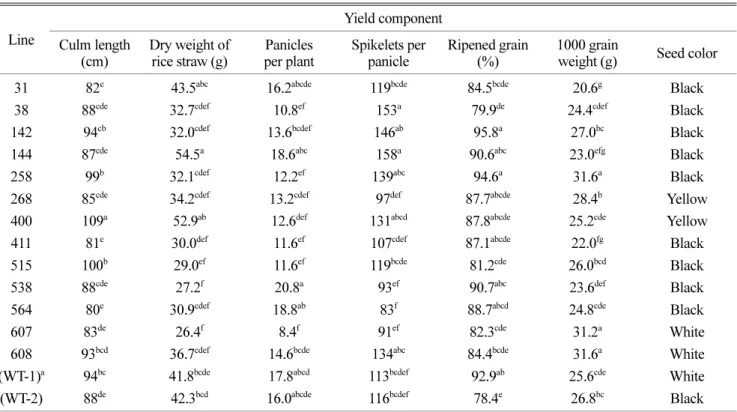
확기에 간장, 고건중 및 수량구성요소를 조사한 결과는 Table 6과 같다. 형질전환벼 계통과 비형질전환벼의 간장 은 80~109 cm(비형질전환벼 88~94 cm)을 그리고 고건중 은 26~55 g(비형질전환벼 41~42 g)으로 나타났다. 또한 형 질전환벼 계통과 비형질전환벼의 수량구성요소중 이삭수 는 8.4~18.6개(비형질전환벼 16.0~17.8개), 영화수는 83~158 개(비형질전환벼 113~116개), 등숙율은 80~96%(비형질전 환벼 78~93%) 그리고 천립중은 20.6~31.6 g(비형질전환벼 25.6~26.8 g)을 보였다. 일부 형질전환벼 계통은 비형질전 환벼에 비해 간장, 고건중 및 수량구성요소에서 우수한 계 통이 있고 특히 144 계통은 고건중, 이삭수 및 영화수가 많아 수량이 형질전환벼 계통중 가장 많았다.
제초제 저항성인 bar 유전자를 형질전환한 벼는 작물학 적인 여러 가지 특성에서 원품종과 다른 변이를 나타내고 일정한 경향을 보이지 않았다고 보고하였다(Oard et al., 1996; Park et al., 2007). 또한 bar 유전자를 동진벼에 형 질전환하여 제초제 저항성 벼를 양성하고 이 벼에 단간 내도복 양질인 주남벼를 인공교배하여 약배양하여 우량계 통을 선발하고 밀양 204호로 계통명 부여하고 수량관련 특성을 조사한 결과, 밀양 204호는 주당수수는 주남벼나 동진벼보다 많고 수당립수는 적었다. 또한 주남벼나 동진 벼에 비해 간장이 작고 이삭길이가 짧아 개체간 생육량이 적고 지역별로도 다른 것으로 나타났다(Jeong et al., 2005).
Table 5. Changes in leaf injury (visual rate: 0-100; 0: complete death) in wild type and transgenic rice plants during chilling and recovery. The plants were exposed to 5oC for 24hrs and allowed to recover for 96hrs.
Line Chilling stress Recovery 6 h 12 h 24 h 24 h 72 h 96 h 31 36e 35fg 15gh 52ed 51cde 66bc
38 33e 34g 18defgh 34fg 39fg 54cd
142 39de 38fg 21bcdef 23gh 30gh 28f
144 51c 39fg 19cdefg 47e 45ef 54cd
258 67b 72a 32a 60bcd 60abc 78ab 268 53c 35fg 26b 61bcd 47def 54cd 400 56c 44ef 24bc 53cde 51cdef 64bc 411 86a 53de 25bc 65abc 55bcde 66bc 515 47cd 43fg 16efgh 30fgh 26h 44de 538 54c 39fg 13h 22h 20h 26f 564 53c 42fg 15fgh 36f 30gh 32ef 607 57c 57cd 23bcd 63bcd 64ab 78ab 608 48cd 53de 21bcde 62bcd 58abcd 70ab (WT-1)a 67b 63bc 23bcd 66ab 65ab 74ab (WT-2) 77ab 70ab 23bcd 76a 69a 82a
a WT-1: Dongjinbyeo; WT-2: Sanghehyanghyeolra
b Means within columns followed by the same letter were not significantly different at P = 0.05.
Table 6. Comparison of growth parameters and yield in wild type and transgenic rice plants under pot conditions.
Line
Yield component Culm length
(cm)
Dry weight of rice straw (g)
Panicles per plant
Spikelets per panicle
Ripened grain (%)
1000 grain
weight (g) Seed color
31 82e 43.5abc 16.2abcde 119bcde 84.5bcde 20.6g Black
38 88cde 32.7cdef 10.8ef 153a 79.9de 24.4cdef Black
142 94cb 32.0cdef 13.6bcdef 146ab 95.8a 27.0bc Black
144 87cde 54.5a 18.6abc 158a 90.6abc 23.0efg Black
258 99b 32.1cdef 12.2ef 139abc 94.6a 31.6a Black
268 85cde 34.2cdef 13.2cdef 97def 87.7abcde 28.4b Yellow
400 109a 52.9ab 12.6def 131abcd 87.8abcde 25.2cde Yellow
411 81e 30.0def 11.6ef 107cdef 87.1abcde 22.0fg Black
515 100b 29.0ef 11.6ef 119bcde 81.2cde 26.0bcd Black
538 88cde 27.2f 20.8a 93ef 90.7abc 23.6def Black
564 80e 30.9cdef 18.8ab 83f 88.7abcd 24.8cde Black
607 83de 26.4f 8.4f 91ef 82.3cde 31.2a White
608 93bcd 36.7cdef 14.6bcde 134abc 84.4bcde 31.6a White (WT-1)a 94bc 41.8bcde 17.8abcd 113bcdef 92.9ab 25.6cde White (WT-2) 88de 42.3bcd 16.0abcde 116bcdef 78.4e 26.8bc Black
a WT-1: Dongjinbyeo; WT-2: Sanghehyanghyeolra
b Means within columns followed by the same letter were not significantly different at P = 0.05.
하지만 본 연구에서는 대비품종에 비해 수량이 높은 계통 이 있어 이러한 계통을 선발하여 추후 포장조건하에서 작 물학적 특성에 대한 조사를 수행해야 할 것으로 판단된다.
한편 본 연구의 형질전환벼 계통 중 흑미는 9계통(31, 38, 142, 144, 258, 411, 515, 538, 564), 황색미는 2계통(268, 400) 그리고 백미는 2계통(607, 608)으로 나타났다. 본 연 구에서 우수한 계통은 제초제 저항성, 양질미 및 고생산 성 형질전환벼 육성을 위해 중간모본으로 활용될 수 있을 것으로 기대된다.
요 약
본 연구의 목적은 bar 유전자를 발현한 형질전환벼에 대한 글루타민 합성효소 저해제인 glufosinate-ammonium, L-metionine sulfoximine과 광합성저해제인 paraquat에 저 항성 수준과 형질전환벼와 비형질전환벼의 암모늄 축적량, 저온반응 및 수량을 비교하는데 있다. 형질전환벼 계통은 비형질전환벼에 비해 glufosinate-ammonium에 45~95배 높 은 저항성을 보였다. 한편 형질전환벼 계통은 L-metionine sulfoximine을 처리했을 때도 형질전환벼 계통이 비형질전 환벼에 비해 18배 이상의 저항성을 보여 교차저항성이 있 음을 확인할 수 있었다. 그러나 glufosinate-ammonium과 작용기작이 다른 제초제인 paraquat에 대한 다중저항성은 없었다. Glufosinate-ammonium 처리에 의해 ammonium 축 적은 비형질전환벼에서 증가하였으나 모든 형질전환벼의 계통에서는 적거나 효과가 없었다. 형질전환벼 계통 258, 411, 607 및 608을 제외한 계통은 비형질전환벼에 비해 저온 내성 및 저온 후 회복정도가 유의적으로 낮은 경향 을 보였다. 형질전환벼 계통 142, 144, 258 및 608의 수 량은 비형질전환벼와 유사하거나 높았다.
주요어: 글루포시네이트암모늄, 제초제, 형질전환벼
References
Cao, M.X., Huang, J.Q., Wei, Z.M., Yao, Q.H., Wan, C.Z. and Lu, J.A. 2004. Engineering higher yield and herbicide resistance in rice by Agrobacterium-mediated multiple gene transformation.
Crop Sci. 44:2206-2213.
Coetzer, E. and Al-Khatib, K. 2001. Photosynthetic inhibition and ammonium accumulation in Palmer amaranth after glufosinate application. Weed Sci. 49:454-459.
D'Halluin, K., De Block, M., Janssens, J., Leemans, J., Reynaerts, A. and Botterman, J. 1992. The bar gene as a selectable marker in plant engineering. Method. Enzymol. 216:415-441.
De Block, M., Botterman, J., Vandewiele, M., Dockx, J., Thoen, C.,
Gosselé, V., Rao Mowa, N., Thompson, C., Van Montaqu, M and Leemans, J. 1987. Engineering herbicide resistance in plants by expression of a detoxifying enzyme. EMBO J. 6:2513-2518.
De Block, M., De Brouwer, D. and Tenning, P. 1989. Transformation of Brassica napus and Brassica oleracea using Agrobacterium tumefaciens and the expression of the bar and neo genes in the transgenic plants. Plant Physiol. 91:694-701.
Jeong, E.G., Yi, G.H., Won, Y.J., Park, H.M., Cheon, N.S., et al.
2005. Agronomic characteristics of transgenic japonica rice
“Milyang 204” with herbicide resistance gene (bar). Korean J.
Plant Biotechnol. 32(2):85-90. (In Korean)
Krausz, R.F., Kapusta, G., Matthews, J.L., Baldwin, J.L. and Maschoff, J. 1999. Evaluation of glufosinate-resistant corn (Zea mays) and glufosinate: Efficacy on annual weeds. Weed Tech.
13:691-696.
Kuk Y.I., Kim, K.H., Kwon, O.D., Lee, D.J., Burgos, N.R., Jung.
S. and Guh, J.O. 2003. Cross-resistance pattern and alternative herbicides for Cyperus difformis resistant to sulfonylurea herbicides in Korea. Pest Manag. Sci. 60:85-94.
Kuk, Y.I., Burgos, N.R. and Shivrain, V.K. 2008. Natural tolerance to imazethapyr in red rice (Oryza sativa). Weed Sci. 56:1-11.
Manderscheid, R. and Wild, A. 1986. Studies on the mechanism of inhibition by phosphinothricin of glutamine synthetase isolated form Triticum aestivum L. J. Plant Physiol. 123:135-142.
Manickavasagam, M., Ganapathi, A., Anbazhagan, V.R., Sudhakar, B., Selvaraj, N., Vasudevan, A. and Kasthurirengan, S. 2004.
Agrobacterium-mediated genetic transformation and develop- ment of herbicide-resistant sugarcane (Saccharum species hybrids) using axillary buds. Plant Cell Rep. 23:134-143.
Oard, J.H., Linscombe, S.D., Braverman, M.P., Jodari, F., Blousin, D.C., Leech, M., Kohli, A., Vain, P., Cooley, J.C. and Christou, P. 1996. Development, field evaluation, and agronomic performance of transgenic herbicide resistant rice. Mol. Breed.
2:359-368.
Park, H.M., Kim, Y.H., Suh, J.P., Choi, M.S., Kim, K.J., Shin, D.B., Park, C.H. and Lee,J.Y. 2007. Evaluation of agronomic and molecular biological characteristics of the herbicide resistance transgenic rice. Korean J. Breed. Sci. 39(2):148-154. (In Korean) Pesticide Use Manual. 2012. Korea Crop Protection Association.
p. 1308. (In Korean)
Petersen, J. and Hurle, K. 2001. Influence of climatic conditions and plant physiology on glufosinate-ammonium efficacy. Weed Res. 41:31-39.
Shelp, B.J., Swanton, C.J., Mersey, B.G. and Hall, J.C. 1992.
Glufosinate (phosphinothricin) inhibition of nitrogen metabolism in barley and greenfoxtail plants. J. Plant Physiol. 139:605-610.
Singh, R.J. and Khush, G.S. 2000. Cytogenetics of rice. In: Nanda,
J.S. (Ed.), Rice Breeding and Genetics-Research Priorities and Challenges. Enfield, NH: Science Publishers, pp. 287-311.
Strauch, E., Wohlleben, W. and Pühler, A. 1988. Cloning of a phosphinothricin N-acetyltransferase gene from Streptomyces viridochromogenes TU494 and its expression in Streptomyces lividans and Escherichia coli. Gene 63:65-74.
Wild, A. and Manderscheid, R. 1984. The effect of phosphinothricin
on the assimilation of ammonia in plants. Z. Naturforsch. 39c:500- 504.
Wild, A. and Wendler, C. 1993. Inhibitory action of glufosinate on photosynthesis. Z. Naturforsch. 48c:367-373.
Yi, G., Shin, Y.M., Choe, G., Shin, B., Kim, Y.S. and Kim, K.M.
2007. Production of herbicide-resistant sweet potato plants transformed with the bar gene. Biotechnol. Lett. 29:669-675.