Article
http://dx.doi.org/10.4217/OPR.2015.37.1.023
동남극 윌크스랜드 대륙대의 마이오세 중-후기 동안 생물기원 오팔 생산과 고기후 변화(IODP Exp 318 Site U1359)
송부한 · 김부근*
부산대학교 자연과학대학 해양학과
(609-735) 부산광역시 금정구 부산대학로 63번길 2
Biogenic Opal Production and Paleoclimate Change in the Wilkes Land Continental Rise (East Antarctica) during the Mid-to-late Miocene
(IODP Exp 318 Site U1359)
Buhan Song and Boo-Keun Khim*
Department of Oceanography, College of Natural Sciences, Pusan National University Busan 609-735, Korea
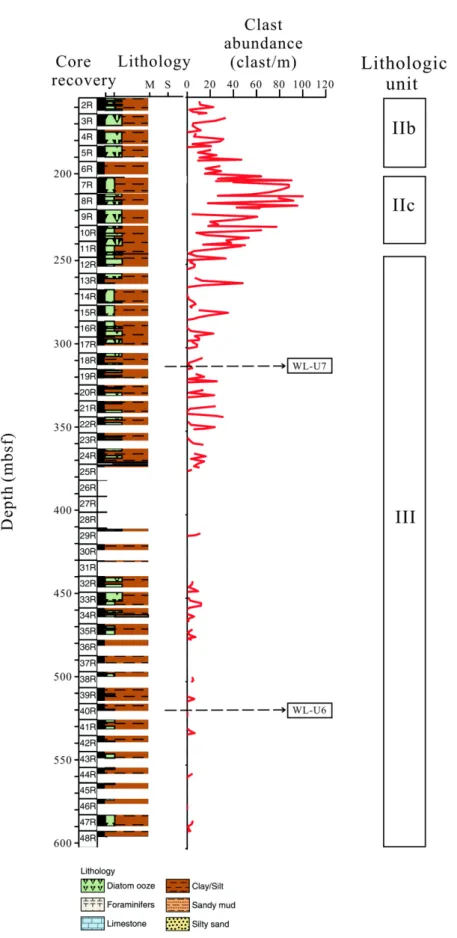
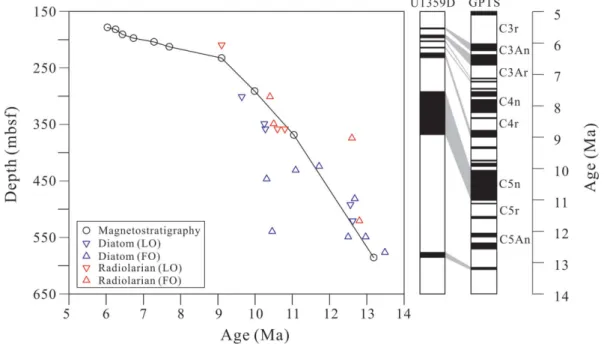
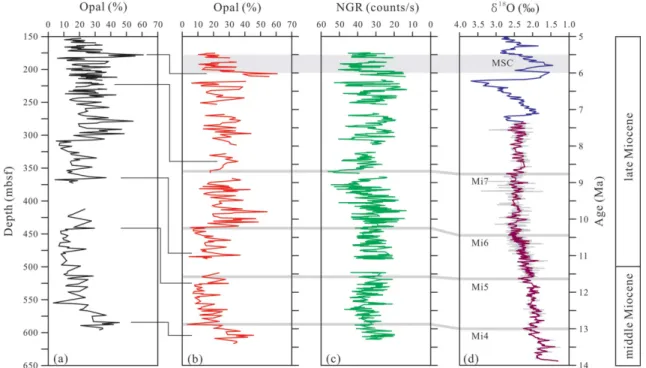
Abstract : A 450 m-long sediment section was recovered from Hole U1359D located at the eastern levee of the Jussieau submarine channel on the Wilkes Land continental rise (East Antarctica) during IODP Expedition 318. The age model for Hole U1359D was established by paleomagnetic stratigraphy and biostratigraphy, and the ages of core-top and core-bottom were estimated to be about 5 Ma and 13 Ma, respectively. Biogenic opal content during this period varied between 3% and 60%. In the Southern Ocean, high biogenic opal content generally represents warm climate characterized by the increased light availability due to the decrease of sea-ice distribution. The surface water productivity change in terms of biogenic opal content at about 10.2 Ma in the Wilkes Land continental rise was related to the development of Northern Component Water. After about 10.2 Ma, more production of Northern Component Water in the North Atlantic caused to increase heat transport to the Southern Ocean, resulting in the enhanced diatom production. Miocene isotope events (Mi4~Mi7), which are intermittent cooling intervals during the Miocene, appeared to be correlated to the low biogenic opal contents, but further refinement was required for precise correlation. Biogenic opal content decreased abruptly during 6 Ma to 5.5 Ma, which most likely corresponds to the Messinian salinity crisis. Short-term variation of biogenic opal content was related to the extent of sea-ice distribution associated with the location of Antarctic Polar Front that was controlled by glacial-interglacial paleoclimate change, although more precise dating and correlation will be necessary.
Diatom production in the Wilkes Land continental rise increased during the interglacial periods because of the reduced sea-ice distribution and the southward movement of Antarctic Polar Front.
Key words : biogenic opal, surface water productivity, sea-ice distribution, Northern Component Water, paleoclimate, Wilkes Land, East Antarctica
*Corresponding author. E-mail : [email protected]