• 검색 결과가 없습니다.

A Study on Policy and System Improvement Plan of Geo-Spatial Big Data Services in Korea

N/A
N/A
Protected

Academic year: 2021

Share "A Study on Policy and System Improvement Plan of Geo-Spatial Big Data Services in Korea"

Copied!
11
0
0

로드 중.... (전체 텍스트 보기)

전체 글

(1)

https://doi.org/10.7848/ksgpc.2016.34.6.579

A Study on Policy and System Improvement Plan of Geo-Spatial Big Data Services in Korea

Park, Joon Min

1)

ㆍYu, Seon Cheol

2)

ㆍAhn, Jong Wook

3)

ㆍShin, Dong Bin

4)

Abstract

This research focuses on accomplishing analysis problems and issues by examining the policies and systems related to geo-spatial big data which have recently arisen, and suggests political and systemic improvement plan for service activation. To do this, problems and probable issues concerning geo-spatial big data service activation should be analyzed through the examination of precedent studies, policies and planning, pilot projects, the current legislative situation regarding geo-spatial big data, both domestic and abroad. Therefore, eight political and systematical improvement plan proposals are suggested for geo-spatial big data service activation:

legislative-related issues regarding geo-spatial big data, establishing an exclusive organization in charge of geo- spatial big data, setting up systems for cooperative governance, establishing subsequent systems, preparing non-identifying standards for personal information, providing measures for activating civil information, data standardization on geo-spatial big data analysis, developing analysis techniques for geo-spatial big data, etc.

Consistent governmental problem-solving approaches should be required to make these suggestions effectively proceed.

Keywords : Geo-Spatial Big Data Service, Policy and System, Improvement Plan

Original article

Received 2016. 11. 24, Revised 2016. 12. 20, Accepted 2016. 12. 31

1) Dept. of Urban Information Engineering, Anyang University, Korea(E-mail:[email protected]) 2) Research Professor of Smart Urban Space Institute, Anyang University, Korea(E-mail:[email protected]) 3) Member, Dept. of Urban Information Engineering, Anyang University, Korea(E-mail:[email protected])

4) Corresponding Author, Member, Dept. of Urban Information Engineering, Anyang University, Korea(E-mail:[email protected])

This is an Open Access article distributed under the terms of the Creative Commons Attribution Non-Commercial License (http://

1. Introduction

After the inauguration of the Park Geun-Hye administration, Government 3.0 was announced as the nation’s growth directive. A government operating paradigm for smart government, Government 3.0 aims at the creative economy through the utilization of big data and securing new growth engines. The government is pushing forward with various policies for fostering big data-related industries including the activation of the utilization of public big data in the private sector, fostering manpower, developing

technology, implementing demonstration projects, etc.

Therefore, higher value-added business models are expected to be created, such as the analysis of future trends through big data, supporting the establishment of policies that look forward, and supporting the establishment of scientific policy.

In particular, demand on technology and services for each

sector directly related to public life, including traffic, public

order, crime prevention, medical care, disaster management

systems, real estate, etc. coming from special-information

combined big data will be expected to increase. (Ahn et al.,

2013; Kim, 2014).

(2)

Research on geo-spatial big data has not been implemented much until recently, so this study concentrates primarily upon the subject of geo-spatial services, legal legislation on geo-spatial utilization, etc. Jang et al.(2013) noted the primary policies on convergent big data services through the scoping of the value of big data service industry and the cases created from convergent big data services. Shin (2012) analyzed the relationship between implementing big data in the public sector and personal information protection, and then suggested ways to improve laws/systems so that personal information could be safely distributed into cloud computing services. Kim (2014) studied opening data to the public and analyzed big data-related policy implementation with personal information protection in the US, EU, and Japan.

Bok et al. (2014) researched policies on big data activation and related cases in the UK, Singapore, Japan, and the US.

Besides, there are other studies, such as privacy laws (regulation for personal information protection) and privacy rights, implemented at the state level in the US (Jun et al., 2012c), newly enacted Systems and institutions related to personal information, and guidelines related to THE EU personal information protection which went into effect after the THE EU became a legal entity uniting nations that include the UK, France, Germany, the Netherlands, Sweden, etc. (Jun et al., 2012a), and studies on Systems and institutions and their implementation situations related to personal information in Japan and China, when compared with domestic privacy law((Jun et al., 2012b).

As shown above, there are some ancillary cases regarding big data and geo-spatial big data research, both domestic and abroad. However there were few analysis on improvement plans for activating services. Therefore, this study is differentiated from others insofar as it suggests specific institutional improvement plans as well as political improvement plans for geo-spatial services activation based on previous research.

Therefore, this study focuses on analyzing the current situation of policies and laws/systems, both domestic and abroad, and suggests political and systematic improvement plans for activating geo-spatial services. By examining previous research, all sorts of policies and planning enforced by both the central government and local governments, and

big data related policies and systems abroad, we deduced the implications and analyzed the problems and issues related to the subject.

Based on the problems and issues mentioned, we set up a basic direction for policy/system improvement plans and suggested ways to improve policy/system for activation of geo-spatial big data.

The study method of this study is as follows. Firstly, we examined measuring policies and planning on geo-spatial big data, the implementation of pilot projects, and current situations in the legal landscape by dividing central and local governments, and then analyzed problems and issuess through policies and systems related to big data abroad. After that, we set up the basic direction according to that analysis, extracting corresponding tasks and suggesting the proposal for political and systematic improvement plans for service activation.

2. Policies and System Related to Domestic Geo-Spatial Big Data

2.1 The central government

The central government is pursuing big data utilization policies to create new growth engines and provide customized services. Government ministries, including Ministry of Land, Infrastructure and Transport, the Ministry of Science, ICT and Future Planning, and the Ministry of Government Administration and Home Affairs, etc. are primarily implementing policies and projects which utilize big data, as shown in Table 1 below. Through the examination of the current situation on central government ministries’ policies and planning, business management and operation cases, and the current situation of big data systems, we deducted the following implications.

Foremost, even though creating new industries by

utilizing big data as a government project is suggested,

separate organizational compositions among the Ministry of

Government Administration and Home Affairs and Ministry

of Science, ICT and Future Planning, and Ministry of

Land, Infrastructure makes cooperation and understanding

insufficient. Transport in charge of managing and operating

spacial information does not have an exclusive department

for geo-spatial big data. It is concluded that political and

(3)

systematic measurements should be provided by integrating all public data from each department for geo-spatial big data.

Based on the current situation of business promotion related to big data, existing big data businesses were piloted as test projects utilizing public data, it was not intended to reflect the users’ demand in private sector, as presented in policies and plans. Therefore, establishing integrated geo- spatial big data between the public and private sector and ancillary businesses which are fully considerate of user demand seem to be needed.

By examining the current legislative system related to geo-spatial big data, current laws do not have appropriate, clear definitions of geo-spatial big data, nor establish related plans, so creating a department in charge and establishing

long-term strategies is difficult to prepare. So the next step to provide a legislative basis will be implemented with the amending of the existing space information related laws, organizing new laws for geo-spatial big data, and integrating laws on big data utilization and industrial development, etc.

Moreover, to activate geo-spatial big data, amendments to related laws and guidelines for privacy protection among various kinds of data is needed. Especially in the current law systems which are strongly regulated against privacy laws should be improved across all sorts of data types. Present issues with n- should be improved through examining related laws, such as the Personal Act and Acts on Big Data Utilization and Industrial Promotion, etc.

2.2 Local government

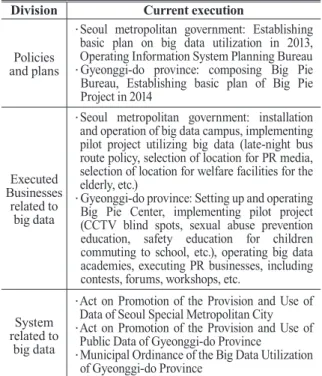
Among local governments, the Seoul metropolitan government, in Gyeonggi-do province, seems to conduct its own plans and promotes its system for big data utilization according to its own environmental condition. So we deducted the implications, shown below, after examining the current situation of policies and plans, the execution of business, and law systems in and around Seoul and Gyeonggi-do.

Division Current situation of implementation

Policy planning and

· The Park Geun-Hye administration task:

providing customized, public-centered services by creating new industries through the utilization of science and technology

· Government 3.0 basic plan for implementation:

establishing future strategies utilizing public data and strengthening industrial competence related to big data within ministries including the Ministry of Land, Infrastructure and Transport, the Ministry of Science, ICT and Future Planning, the Ministry of Government Administration and Home Affairs

Businesses related to

big data

· Ministry of Land, Infrastructure and Transport: implementation of the 2015 project on geo-spatial big data system

· Ministry of Science, ICT and Future Planning:

operating K-ICT big data center, fostering big data industry businesses, and selecting/

developing smart pilot projects based on big data utilization

· Ministry of Government Administration and Home Affairs: operating government integrated computing centers, opening data to the public and operating portals, operating big data academies

Big data related law

system

· Act on the Big Data Utilization and Industrial Promotion act, etc.

· Act on Promotion of the Provision and Use of Public Data

· Personal Information Protection Act

· Act on Promotion of Information and Communications Network Utilization and Information Protection, etc.

· Credit Information Use and Protection Act

· Act on the Protection, Use, etc. of Location Information

Table 1. Status of the central government

Table 2. Status of local government

Division Current execution

Policies and plans

· Seoul metropolitan government: Establishing basic plan on big data utilization in 2013, Operating Information System Planning Bureau

· Gyeonggi-do province: composing Big Pie Bureau, Establishing basic plan of Big Pie Project in 2014

Executed Businesses

related to big data

· Seoul metropolitan government: installation and operation of big data campus, implementing pilot project utilizing big data (late-night bus route policy, selection of location for PR media, selection of location for welfare facilities for the elderly, etc.)

· Gyeonggi-do province: Setting up and operating Big Pie Center, implementing pilot project (CCTV blind spots, sexual abuse prevention education, safety education for children commuting to school, etc.), operating big data academies, executing PR businesses, including contests, forums, workshops, etc.

System related to

big data

· Act on Promotion of the Provision and Use of Data of Seoul Special Metropolitan City

· Act on Promotion of the Provision and Use of Public Data of Gyeonggi-do Province

· Municipal Ordinance of the Big Data Utilization

of Gyeonggi-do Province

(4)

In the field of policy and planning, the private sector’s utilization is induced through establishing data and openness with the public to increase the availability of big data.

However, related policies seem to be too insufficient to be utilized compared to the public sector. It is noted that local governments formulate and operate their own policies and businesses regardless of policy compatibility and consistency with the central government. Systematic establishment and utilization of private data coming from telecommunications, credit cards, public transportation, etc. seem to be lacking.

For these reasons, the volume of data in the private sector is being created significantly in real time, which could be very useful for big data analysis. Related policy making seems to be unprepared because of legislative limitations, including dealing with personal information problems, data privatization, etc.

Big data-related local government business is consistently developing utilizable services in and around service models, and it is also being made through the operation of big data- related institutions for other kinds of services, such as providing analysis platforms, ancillary pilot projects, finding new businesses, and educating professional staff. However, before making these services, establishing geo-spatial big data integrated both public and private information and found businesses reflecting user demand would be needed.

Moreover, standardization between public and private data should be prepared to first analyze and utilize geo-spatial big data

As a reminder of big data related systems, enactment doesn’t seem to be sufficient for geo-spatial big data, which makes long-term planning and policy making difficult, so complementation of related laws for privacy protection and personal information made in the public and private sector, or creating guidelines, is needed. It is believed that problem solving for personal information and system preparation for increasing utilization is needed.

3. Policies and Systems Related to Abroad Geo-Spatial Big Data

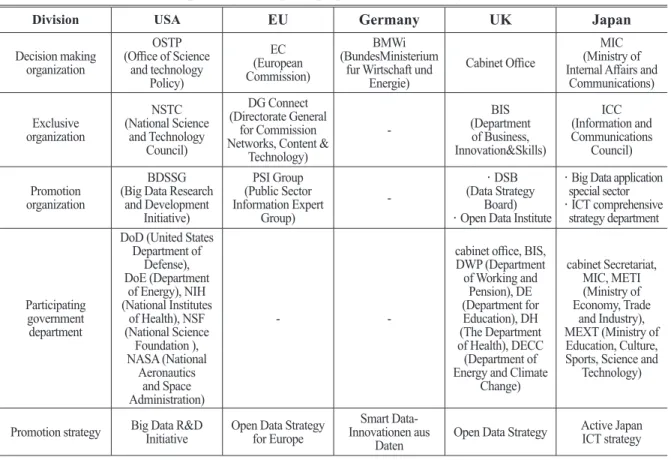
3.1 Propulsion system and policy for big data Major countries including the US, the EU, Germany,

the UK, Japan, etc., recognized the importance of big data and strategically crafted various policies for creating new industries and strengthening national competitiveness.

The features of each country are different, however they share various strategies and policies for activating big data as their core task for the future. To proceed, related to policies and business efficiency, those countries have their own exclusive institutions, such as the Office of Science and Technology Policy in the US, the Directorate-General of the European Commissions in the EU, the Federal Ministry of Economics and Department for Business, Innovation

& Skillsinthe UK, and the Ministry of Internal Affairs and Communications in Japan.

Policies about sharing public data and promoting utilization is the first priority for big data utilization and policy activation.

Countries including the US, the UK, France, China, etc.

are establishing and operating data sharing homepages for data sharing and utilization. New policies and systems related to personal information such as privacy laws and copyright are being enacted and improved. Moreover, new policies and systems are being prepared, in accordance with features of each country, such as licensing systems, reuse of data, handling of expenses for rights, etc.

3.2 Laws related to big data

According to big data utilization policies, opening data and personal information protection is a significant step.

Major countries do not have general laws about big data, in line with Korea, however they are implementing policies by preparing systems which consider national traits. They promoted opening public data to the public to enable big data utilization country by country, which might result in problems with personal information protection, so laws were newly enacted and related laws amended.

There are no general laws or fundamental personal

information protection laws, and there is no exclusive

institution which is in charge of personal information

protection policies. Japan, with a System considerably similar

to Korea’s, recognized the infringement risk of privacy on

big data utilization, so they amended the existing personal

information protection act to address individual privacy

(5)

protection. However, discussions have been maintained about rights to ownership of private data, and a clear resolution does not exist within the current System.

Whereas in the case of the EU, the UK and Germany, they rapidly recognized the importance of personal information protection, and are thus proceeding to enact related laws and building an exclusive institution which pursues strengthening policies regarding personal information protection.

Therefore, preparing a systems infrastructure is needed for big data utilization by maintaining a balance between data utilization and personal information protection.

4. Improvement Plans for Policies and System for Activating Geo-Spatial Big Data

Service

4.1 Basic direction

Through examination of all sorts of policies and plans,

business execution, related laws, and cases abroad about geo- spatial big data thus far, we deducted the implications for each sector and then made conclusions on these issues about activating geo-spatial big data as follows.

Insufficient co-operating systems between exclusive institutions related to geo-spatial big data and central/local governments, and inadequate policies for establishing and utilizing data in private sector are analyzed in policies and planning section. Finding businesses which put the focus on user demand, setting up canons for public/private data standardization with big data utilization were shown in the business implementation part. Enacting related laws and guidelines for personal information protection seems to be needed in related legislative section. Ancillary policies of activating big data through cooperation between the public and private sectors and setting up exclusive institutions, right to ownership for private data, preparing personal information protection guidelines need to be analyzed.

Table 3. Comparison about Big Data propulsion system of foreign major countries

Division USA EU Germany UK Japan

Decision making organization

(Office of Science OSTP and technology

Policy)

(European EC Commission)

BMWi (BundesMinisterium

fur Wirtschaft und Energie)

Cabinet Office

(Ministry of MIC Internal Affairs and

Communications) Exclusive

organization

(National Science NSTC and Technology

Council)

DG Connect (Directorate General

for Commission Networks, Content &

Technology)

-

(Department BIS of Business, Innovation&Skills)

(Information and ICC Communications

Council) Promotion

organization

BDSSG (Big Data Research

and Development Initiative)

PSI Group (Public Sector Information Expert

Group)

-

·DSB (Data Strategy

Board)

·Open Data Institute

·Big Data application special sector

·ICT comprehensive strategy department

Participating government department

DoD (United States Department of

Defense), DoE (Department

of Energy), NIH (National Institutes

of Health), NSF (National Science

Foundation ), NASA (National

Aeronautics and Space Administration)

- -

cabinet office, BIS, DWP (Department of Working and

Pension), DE (Department for Education), DH (The Department of Health), DECC (Department of Energy and Climate

Change)

cabinet Secretariat, MIC, METI (Ministry of Economy, Trade

and Industry), MEXT (Ministry of

Education, Culture, Sports, Science and

Technology)

Promotion strategy Big Data R&D

Initiative Open Data Strategy for Europe

Smart Data- Innovationen aus

Daten Open Data Strategy Active Japan

ICT strategy

(6)

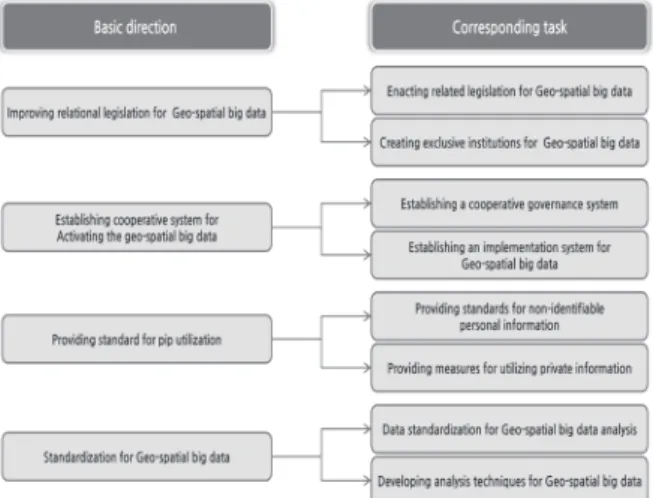
As described above, the problems and issues of each domestic and foreign geo-spatial big data policy system are derived and the 4 basic directions for improving the activation of the geo-spatial big data service are set as follows.

First, improvements must be made to related legislation for geo-spatial big data. It is needed to improve legislation considering the correlation between various laws, including three of existing special information laws, the personal Table 4. Problems and issues on policy and System

Section Central government Implication Local government Problems and issues

Policies and planning

· Establishing and proceeding basic policies to resolve social problems by creating new businesses to use newly developed ICT technology by governments.

· Implementing policies for increasing utilization in the private sector by opening public data to the public

· Utilizing public information including big data for strengthening national strategies and industrial competitiveness

· Establishing operational institutions for each department and building up a long-term plan for big data utilization

· Preparing an implementation system and exclusive organization for big data and establishing long- term plans and proceeding with phased in policy implementation

· Inducing business creation in the private sector by opening public information

· Encouraging big data utilization and nurturing professional staff by setting and operating related institutions (Seoul metropolitan city: Big Data Campus, Gyeonggi- do province: Big Pie Center)

· Insufficient cooperation between central/local governmental systems and exclusive institutions on geo- spatial big data

· Insufficient related policies for establishing data and utilization in private sector compared to public sector

Implementing businesses

· Preparing foundation by fostering big data industry (Ministry of Science, ICT and Future Planning) and opening/operating data (Ministry of Government)

· Supporting big data analysis and nurturing professional staff by setting up related institutions including the Ministry of Government ( National Computing and Information Service), the Ministry of Science, ICT and Future Planning (K-ICT big data center)

· Implementing big data pilot project by expanding big data services and finding new growth engines

· Implementing businesses consistently to solve social issues through public-private cooperation

· Implementing pilot projects centered on current issues through cooperation with the central government

· Composing and operating various programs for nurturing professionals in big data

· Needs to cooperate between public-private sectors and to find new business centered on user demand which reflects user requests

· Establishing standardized canon of public/private data for geo-spatial big data utilization

Related laws

· Preparing acts for big data utilization and industrial promotion

· Preparing systematic foundation to establish and utilize public information

· Preparing systematic foundation to activate the local economy, utilize big data, open public data to the public, and expand utilization

· Enacting and implementing municipal ordinances for big data utilization and the operation of related institutions

· Need to establish related laws about geo-spatial big data

· Need to have guidelines for personal information protection (non-identifiable personal information)

Cases abroad

· Establishing and proceeding with big data policies for creating new industries in the public/private sector and strengthening national competitiveness

· Preparing exclusive institutions and proceeding with activation policies through public/private cooperation

· Discussing the usage rights and privatization of data coming from private sector

· Enacting laws for data sharing and personal information protection

· Implementing industrial activation of big data through the cooperation of the public and private sectors and preparing exclusive institutions

· Providing rules on the

subject of rights and personal

information protection for

utilizing private data

(7)

information protection act, and the public data act, etc. to activate geo-spatial big data.

Second, establishing cooperative system for activating geo-spatial big data must occur. Nurturing big data industries and data opening must come from the Ministry of Science, ICT and Future Planning and the Ministry of Government Administration and Home Affairs Administration and Home Affairs. The Ministry of Land, Infrastructure and Transport sets up public information based on spatial information.

Therefore a cooperative system should be made to integrate private information in the private sector. Especially central/

local governments should discuss the role allocations through cooperation among smaller local governments as well as the Seoul metropolitan city and Gyeonggi-do governments.

Third, providing standardization for exploiting personal information and protection must occur. One of the most important issues in the policies and systems section is that there are not appropriate policies for establishing private sector data. So, a clear standard should be provided first for utilizing personal information and protection to activate private information coming from telecommunications, transportation, credit cards, etc.

Fourth, standardization for goe-spatial big data must occur. Many businesses related to big data are implemented in central/local governments, however it’s a problem that there is no unit consistency in analyzing, and no uniformity for the format of information coming from the public/private sector. Therefore, endeavors should be made to standardize analyzing various formatted information from the public and private sectors.

4.2 Improvement plan for policies and systems We identified eight tasks corresponding to improvement service activation of geo-spatial big data based on the four basic directions mentioned before.

First, the enactment of related laws for geo-spatial big data is needed. Korea does not have any legislative foundation for geo-spatial big data at present, no other clear suggestions are provided about a clear definition, range, data establishment, national strategy and planning, and related organization, etc.

Therefore new legislature could be suggested tentatively named “act on the promotion and the use of geo-spatial big data”, which could be divided in 4 ways for its purposes and necessities. General provisions in Chapter 1 should comprise of the purpose of the law, definition of the terms related to geo-spatial big data, obligations for the country, and its relation to other acts. Chapter 2, which supports the foundation for geo-spatial big data development, a should prescribe the information including a national strategy and committee formation, the establishment of basic planning and its implementation, and the main agents related to each.

Chapter 3 should include the promotion and use of geo- spatial big data and should prescribe establishing geo-spatial big data utilizing public and private information and the items of management, R&D, pilot projects and support plans.

Chapter 4 should refer to the Enhancement of Credibility and Information Protection on geo-spatial big data and should Fig. 1. Establishing basic directions for problems and issues

Fig. 2. Corresponding tasks for activating geo-spatial big

data services

(8)

prescribe the standardization for establishing data to enhance credibility of geo-spatial big data and non-identifiable personal information protection, etc.

Second, the foundation of an exclusive organization for geo-spatial big data is needed. Big data-related tasks are scattered among each departments, which makes it difficult for cooperation between departments to occur and to set up the related systematic policies. It should create upper levels of exclusive institutions for cooperation among departments, which could make possible cooperation among institutions and implementation of integrated policies. By constituting prime minister-affiliated “the committee for national geo- spatial big data” public and private members of which would be composed of from each sector, it would be in charge of establishing national strategy and planning, directing policies and planning for national geo-spatial big data, making cooperation between central and local governments possible, nurturing industries and developing related technologies, educating and publicizing professional staff, discussing personal information protection, etc.

Third, establishing cooperative governance system is needed. There is some difficulty for implementing balanced and harmonious policies between central/local governments because of this gap. Cooperative governance should be improved from a top-down system of central-local-citizen to discussion-oriented systems within the central-local- citizen system. The central government should set a long- term strategy for establishing geo-spatial big data, build up data in the public sector through the cooperation with local governments, and establish data in the private sector ultimately through cooperation with citizens and private businesses.

Fourth, establishing a geo-spatial big data implementation system is needed. Defining each role for the public (central/local governments) principle agents to establish geo-spatial big data and private (private companies), and providing a cooperative system should be done. The central government should be in charge of establishing a system of public information and related planning, introducing Fig. 3. Suggestion for creating exclusive institutions on geo-spatial big data

Fig. 4. Build-up plan for cooperative governance between central/local governments

Fig. 5. Planning for implementing geo-spatial big data

systems

(9)

various policies, etc. Local governments should establish the data environment through cooperating with the central government, and then finding various services and providing them to citizens. Private companies should aim to create jobs through developing technology and industrialization.

Fifth, providing non-identifiable personal information protection is needed. To make meaningful information from geo-spatial big data, various information, including personal information, is required. However infringement on personal information is a concern. So there could be two measures to approach how to use both the utilization of geo-spatial big data and heightening its utilization while protecting personal information at the same time: one is providing non-identifiable standards and other standards requires deregulation of information provisions and utilization to make full use of the information. Non identifiable technology for personal information protection needs standards such as full deletion of identifiable personal information, filtering of personal information, etc. To do this, a standard of non- identifiable personal information should be mandatory in Article 22 (Methods of Obtaining Consent) of Personal Information Protection Act in Chapter III Management of Personal Information, and in the case of non-identifiable information, it should be possible to processed without personal permission. Then, it is expected that the establishing of information and sharing systems could be provided through deregulation of standards of personal information processing and non-identifiable personal information.

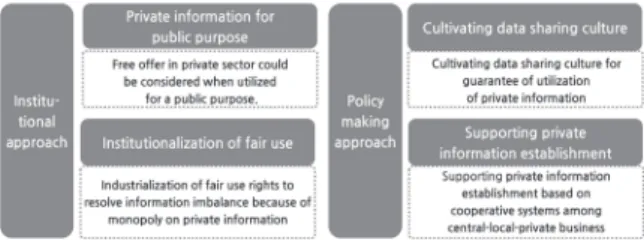
Sixth, providing private information activation is needed.

Geo-Spatial big data could be activated when it is based on public/private information to resolve the problem of social issues and could be utilized by businesses. Whereas

public information is established and shared systematically according to related laws (act on promotion of the provision and use of public data), private information is not shared because of legislative problems related to personal information and profit-related confidential business information. Therefore, measures are urgently needed to open it to the public in order to share private information, which is the primary concern of geo-spatial big data activation. An institutional approach is that free offers and fair use rights in the private sector could be considered when utilized for a public purpose.

Policy making approaches could be to build up a data sharing culture, support for companies to establish data in private sector.

Seventh, data standardization for geo-spatial big data analysis is needed. It’s a problem that there is no uniformity for the format of each type of information from the public/

private sector. Profiles in the unit of Blocks would be an analysis alternative, which is non-identifiable and able to process the information needed for policy making and implementation. This concept comes from the basic unit of census data in the national statistics office, which has been developed with various standards of Block techniques.

Subject data for each Block are connected with the Reporting Fig. 6. Plan to activate private information

Fig. 7. Improvement plan of standardization and system connect

(10)

Tool so that it can be overlapped on GIS, cross analyzed, and then clearly represented in a visual language. EO data sources might analyze Dimension and Measure in accordance with the condition of some common Field (Join Key) like Block.

Multi-layered analysis, which considers many perspectives simultaneously, could be possible, measuring flash and time series analysis for validity.

The data of the existing national geographic information system is being actively used according to the public data sharing policy. However, the name, format, and so on are different for each organization that manages data. Therefore, as shown in the figure below (Fig. 7), standardization work after data collection is needed to improve the completeness and integration of data, and it should be used for data storage, analysis. service through this process.

Eighth, developing a geo-spatial big data analysis technique is needed. There should be a way of integrating geo-spatial information, differentiated from the other kinds of big data, because geo-spatial big data should utilize a combined data methodology. Research on spatialization of Unstructured data and blending skills with spatial information is needed. NLP (natural language processing) and geocoding, automatization which utilizes machine learning, developing algorithms about various kinds of sorting and grouping techniques as a way to spatialize Unstructured data and blending those skills with spatial information. NLP (natural language processing) and geocoding can track GPS and location information through SNS analysis, which is Unstructured data information, so specific research should be needed in order to deduce implication by analyzing the location information through geocoding.

Machine learning can enhance hit ratios by extracting test- typed SNS information through machine learning algorithm, and analyze speed through automatization, so various kinds of algorithm about sorting and grouping should be developed.

5. Conclusion

The goal of this study is to examine geo-spatial big data policies and plans, both domestic and abroad, analyze problems and issues and then suggest political and systematic improvement plans in the service of utilizing geo-spatial big

data. So we examined the related policies and planning in central and local governments domestically, implementing businesses, related laws and implemented businesses for big data in major countries including the US, the UK, the EU and Japan. Four basic directions have been set by extracting the problems and issues, through implications deduction and analysis, of the current situation. So eight proposals have been suggested: enactment of related laws for geo- spatial big data, the foundation of an exclusive organization for geo-spatial big data, the establishment of a cooperative governance system, the establishment of a geo-spatial big data implementation system, the provisioning of non- identifiable personal information protection, the provisioning of private information activation, and data standardization for geo-spatial big data analysis.

Through these improvements, in terms of policy, it is possible to establish a systematic national strategy and plan by clarifying the subjects and contents through the new legislation related to spatial data of national level. In addition, we will establish and implement a systematic national geo-spatial big data policy through the establishment and implementation system of the Geo-Spatial Big Data Task Force. By establishing cooperative governance between central and local governments, we can provide high-quality spatial data services and build high-quality information in the public / private sector to activate new industries.

In terms of data, non - discrimination standards for personal information protection and the relaxation of personal information processing standards can be used to establish information sharing and sharing system, and to expand and utilize the geo-spatial big data market through revitalization of private information. In addition, we can expect the quality improvement and activation of geo-spatial big data through standardization of data block. Through the spatialization technique of unstructured data, it is expected that it will be easy to construct geo-spatial big data through fusion with spatial information, and utilization will be improved.

To implement those suggestions effectively, various

kinds of implementation strategies, such as executing long-

term strategies about the corresponding tasks, fostering

professional staff for geo-spatial big data, institutionalizing

geo-spatial big data analysis experts, etc. it is expected that

(11)

all kinds of infrastructure should be provided first to lay the foundation for future proposals.

Acknowledgements

This research, 'Geo-Spatial Big Data Management, Analysis and Service Platform Technology Development', was supported by the MOLIT(The Ministry of Land, Infrastructure and Transport), Korea, under the national spatial information research program supervised by the KAIA(Korea Agency for Infrastructure Technology Advan cement)"(16NSIP-B081011-03)

References

Ahn, J. W., Yi, M. S, and Shin, D. B. (2013), Study for geo- spatial big data concept and system building, Journal of Korea Spatial Information Society, Vol. 21, No. 5, pp. 43- 51. (in Korean with English abstract)

Bok, K. S. and Yoo, J. S. (2014), Activate policy and applied case of big data, Journal of Korean Institute of Communication Sciences, Vol. 31, No. 11, pp. 3-11. (in Korean with English abstract)

Jang, B. Y., Kim, Y. D., and Choi, J. S (2013), Big Data-based Convergence Service Industry Creation, ISBN 978-89- 6112-259-7, Science&Technology Evaluation and Policy Institute, Seoul, pp. 161-195.

Jun, E. J., Kim, H. B., and Youm, H. Y. (2012a), Privacy laws and system trends in the europe, Korea Institute of Information Security and Cryptology, Vol. 22, No. 2, pp.

58-72. (in Korean)

Jun, E. J., Kim, H. B., and Youm, H. Y. (2012b), Privacy laws and system trends in the Japan and China, Korea Institute of Information Security and Cryptology, Vol. 22, No. 5, pp.

90-105. (in Korean)

Jun, E. J., Kim, H. B., and Youm, H. Y. (2012c), Privacy laws and system trends in the United States, Korea Institute of Information Security and Cryptology, Vol. 22, No. 1, pp.

47-57. (in Korean)

Kim, B. H. (2014), Recent trend of big data policy abroad, Journal of Korea Contents Society, Vol. 12, No. 2, pp. 38-

40. (in Korean with English abstract)

Kim, T. J. (2012), A Study on the construction of desirable model of the national spatial data infrastructure policy promotion system, Journal of Korea Spatial Information Society, Vol. 20, No. 6, pp. 91-98. (in Korean with English abstract)

Lee, M. H., Park, J. M., Shin, D. B., and Ahn, J. W. (2015), A study on the selection of core service for geo-spatial big data, Journal of Korean Society of Surveying, Geodesy, Photogrammetry and Cartography, Vol. 33, No. 5, pp. 385- 396. (in Korean with English abstract)

Shin, Y. J. (2012), A study on the personal information protection and progress of big data in public sector: focused on the provisions and issues of personal information protection act, Internet and Information Security, Vol. 3, No. 3, pp. 90-105. (in Korean with English Abstract) Yu, S. C., Choi, W. W., Shin, D. B., and Ahn, J. W. (2014), A

study on concept and services framework of geo-spatial

big data, Journal of Korea Spatial Information Society,

Vol. 22, No. 6, pp. 13-21. (in Korean with English abstract)

수치

Table 1. Status of the central government
Table 3. Comparison about Big Data propulsion system of foreign major countries
Fig. 2. Corresponding tasks for activating geo-spatial big  data services
Fig. 4. Build-up plan for cooperative governance between  central/local governments
+2

참조

관련 문서