Abstract
Associations between Mother and Child Temperament and Parenting Attitude
Yu Gyung
1․Kim Lakhyung
2*1
Balgeun Speech and Language Clinic
2
Dept. of Neuropsychiatry, College of Korean Medicine, Woosuk University
Objectives
The purpose of this study was to investigate the relations between mother’s temperament and child’s and parenting attitude.
Methods
One hundred twenty healthy mothers (above 20 ys) who has a child (7-11 ys) participated after informed consent. The temperament of the children was analyzed by the Junior Temperament and Character Inventory 7-11 (JTCI 7-11) by their mothers. The temperament of the mothers was analyzed by the Temperament and Character Inventory-Revised Short (TCI-RS) and the parenting attitude of the mothers was analyzed by the Parenting Attitude Test (PAT). The relations between mother and child temperament and parenting attitude were assessed using the Pearson correlation coefficient.
Results
There were some significant correlations between maternal temperaments and child's temperaments and maternal parenting attitude.
Maternal temperament and parenting attitude: Novelty seeking (NS) of mother had low positive correlations with punishment, high expectation and inconsistency. Harm avoidance (HA) had low positive correlations with high involvement and high expectation, and had weak negative correlations with supportive expression and rational explanation. Reward dependence (RD) had low positive correlation with rational explanation. Persistence (P) had low positive correlations with supportive expression, rational explanation and superintendence, and weak negative correlation with high expectation. Child's temperament and parenting attitude: NS of child had low positive correlations with achievement press, high involvement, punishment, high expectation and inconsistency. Low positive correlations were found in many sets such as HA and high expectation, RD and supportive expression and rational explanation, P and supportive expression and rational explanation.
Conclusions
These results suggest that there are significant relations between mother and child temperament and parenting attitude the temperament of mother and child.
Key words : Parenting Attitude, Temperament, TCI, PAT
Received: October 26, 2012 ∙ Revised: November 20, 2012 ∙ Accepted: November 21, 2012 Corresponding Author: Kim Lakhyung
Department of Neuropsychiatry, College of Korean Medicine, Woosuk University, 352, 46, Eoeun-ro, Wansan-gu, Jeonju-si, Jeollabuk-do, 560-833, Republic of Korea
Tel: +82-63-220-8617 Fax: +82-63-227-6234 E-mail: [email protected]
ⓒ The Association of Korean Oriental Pediatrics. All rights reserved. This is an open-access article distributed under the tenus of the Creative Commons Attribution Non-Commercial License (http://creativecommons.org/licenses/by-nc/3.0/), which permits unrestricted non-commercial use, distribution, and reproduction in any medium, provided the original work is properly cited.
어머니와 아동의 기질과 양육태도 관계 연구
유 경1․김락형2*
1 밝은언어심리센터․2 우석대학교 한의과대학 한방신경정신과
ISSN 1226-8038, http://dx.doi.org/10.7778/jpkm.2012.26.4.038
Ⅰ. Introduction
부모와 아동의 조화로운 관계는 아동의 이상적 발 달의 중요한 조건이며, 사고, 정서, 행동 등 발달의 전 반적 영역에서 중요한 역할을 차지한다
1,2). 부모의 양 육태도는 자녀가 자신의 삶에 책임감을 가지고 스스로 행동조절력을 가지며, 원만한 대인관계를 형성하고 자 아존중감을 가지는데 직접적으로 작용하는 중요한 변 인이 된다
3,4).
부모의 부정적 양육은 아동의 우울 및 품행장애와 관련되며
5), 또한 내재화 및 외현화 문제와 관련되고
6), 특정한 양육 태도와 아동의 정신병리와 관련되고
7)아 동의 성격강점에 영향을 미치게 된다
4).
양육의 방식은 부모의 아동에 대한 수용 반응성의 차원과 요구 통제의 차원의 조합에 의해 독재적, 권위 적, 허용적, 방임적 양육으로 구분될 수 있으며, 절제되 고 합리적인 부모의 통제와 연합된 따뜻한 양육방식이 긍정적 발달과 가장 일관되게 연합된 양육방식이라 할 수 있다
8).
기질이란 자극에 대한 자동적으로 일어나는 정서적 반응 성향이며, 다분히 유전적으로 타고난 것으로 일 생동안 비교적 안정된 속성을 보이며 성격발달의 기초 가 된다. C. R. Cloninger (1987)는 기질 및 성격검사 (Temperament and Character Inventory: TCI)를 통해 인 성 (Personality)을 이루는 두 개의 큰 구조로서 기질 (Temperament)과 성격 (Character)을 구분하여 측정함으 로써 인성 발달에 영향을 미친 유전적 영향과 환경적 영향을 구분하여 인성발달과정을 이해하고자 하였다
9,10)
.
아동과 부모의 상호작용에서 나타나는 양육방식은 아동의 특성, 부모의 특성, 그리고 환경적 영향의 상호 작용에 의해 영향을 받을 것이라 생각해볼 수 있으며, 아동의 특성과 부모의 특성에서 기질이 주요하게 작용 할 것이다. 최근 자녀 양육에 대한 관심이 증가하면서 아동의 성격, 기질, 체질 등에 따른 양육방법의 적용이 강조되고 있다
11-13).
본 연구에서는 어머니와 아동에서 기질 및 성격검 사 (TCI)와
14,15)부모양육태도검사 (Parenting attitude test : PAT)를
16)통해 어머니와 아동의 기질과 양육태도의 관계에 대해 살펴보고자 하였다.
Ⅱ. Materials and methods
1. 연구대상 및 자료의 수집
만 7-11세 아동을 자녀로 둔 만 20세 이상의 어머니 를 대상으로 2012년 3월부터 8월까지 조사를 시행하 였으며, 120명이 연구에 참여하였다. 자녀를 둔 어머니 의 이동이 많은 장소에 공고문을 통해 모집하였고, 연 구의 개요에 대한 설명을 듣고 참여 동의서에 서명한 사람을 대상으로 하였다. 설문작성의 대상이 되는 만 7-11세 아동의 생물학적 어머니가 아닌 경우, 설문지를 읽고 답하는데 어려움이 있는 경우 연구대상에서 제외 하였다. 자녀중 만 7-11세 아동이 2명 이상인 경우에는 미리 준비된 무작위배정표에 의해 정하였다. 연구의 진행은 우석대학교 부속한방병원 임상시험심사위원회 의 승인 후에 진행되었다.
2. 측정도구
1) 기질 및 성격검사 (Temperament and Character Inventory: TCI)
14,15)C.R. Cloninger의 심리생물학적 인성 모델에 기초하 여 개발된 검사로 한 개인의 기질 및 성격을 측정하기 위한 검사이다. 기질을 측정하는 자극추구 (novelty seeking), 위험회피 (harm avoidance), 사회적 민감성 (reward dependence), 인내력 (persistence)의 4개의 차원 과 성격을 측정하는 자율성 (self directedness), 연대감 (cooperation), 자기초월 (self transcendence)의 3개의 차 원를 포함하여 모두 7개로 이루어진 검사이다. 어머니 에 대해 본인이 TCI 성인용 (TCI-RS)을 작성하였으며, 아동에 대해서는 Junior Temperament and Character Inventory 7-11 (TCI 7-11)을 어머니가 작성하였다.
2) 부모양육태도검사(Parenting Attitude Test)
16)부모양육태도검사 PAT (마인드프레스)는 임호찬
(2008)이 개발하였으며, 부모의 양육태도에 대한 43문
항에 대해 자신의 경험에 비추어 1에서 5점으로 답하
게 되며, 지지표현, 합리적 설명, 성취압력, 간섭, 처벌,
감독, 과잉기대, 비일관성의 8가지 항목으로 나누어 점
수화하여 백분위로 평가하며, 각 항목의 이상적 백분
율을 제시하고 있다. 어머니가 대상 아동에 대해 상호
작용이나 생활경험을 기억하며 작성토록 하였다.
Mother Child
NS HA RD P NS HA RD P
Mother NS
HA 0.01
RD -0.063 -.209*
P .305** -.465** -0.062
Child
NS .399** 0.125 -.252** .206*
HA .229* .250** -0.032 -0.1 0.163
RD 0.121 -.236** 0.168 .241** 0.103 -.191*
P 0.113 -.249** 0.02 .317** -0.168 -.191* .205*
NS: novelty seeking, HA: harm avoidance, RD: reward dependence, P: persistence, * P < 0.05, ** P < 0.01 Table 2. Correlations between Mother and Child Temperament
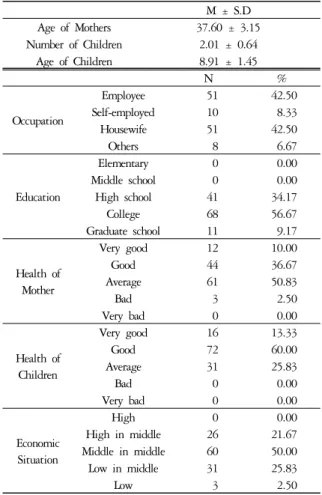
M ± S.D Age of Mothers 37.60 ± 3.15 Number of Children 2.01 ± 0.64
Age of Children 8.91 ± 1.45
N %
Occupation
Employee 51 42.50
Self-employed 10 8.33
Housewife 51 42.50
Others 8 6.67
Education
Elementary 0 0.00
Middle school 0 0.00
High school 41 34.17
College 68 56.67
Graduate school 11 9.17
Health of Mother
Very good 12 10.00
Good 44 36.67
Average 61 50.83
Bad 3 2.50
Very bad 0 0.00
Health of Children
Very good 16 13.33
Good 72 60.00
Average 31 25.83
Bad 0 0.00
Very bad 0 0.00
Economic Situation
High 0 0.00
High in middle 26 21.67
Middle in middle 60 50.00
Low in middle 31 25.83
Low 3 2.50
Table 1. General Characteristics of Participants
3. 자료의 분석
SPSS 20.0 for windows를 사용하여 어머니와 아동의 TCI 검사의 기질 4가지 차원의 T 점수와 부모양육태도 검사 8가지 항목의 원점수에 대해 Pearson의 상관분석 을 실시하여 관계를 살펴보았다.
Ⅲ. Results
1. 어머니 기질과 아동 기질의 관계
어머니의 기질척도 각 차원간의 상관분석 결과, 자 극추구는 인내력과 낮은 정적 상관을, 위험회피는 사 회적 민감성과 낮은 부적 상관 및 인내력과 다소 높은 부적 상관을 나타내었다. 아동의 기질척도 각 차원간 의 상관분석 결과, 사회적 민감성은 인내력과 낮은 정 적 상관을 나타내었다.
어머니와 아동의 기질 척도 각 차원간 상관 분석 결 과, 어머니의 자극추구는 아동의 자극추구와 다소 높 은 정적 상관을, 위험회피와 낮은 정적 상관을 나타내 었다. 어머니의 위험회피는 아동의 위험회피와 낮은 정적 상관을, 사회적 민감성 및 인내력과 낮은 부적 상 관을 나타내었고, 어머니의 사회적 민감성은 아동의 자극추구와 낮은 부적 상관을 나타내었으며, 어머니의 인내는 아동의 자극추구, 사회적 민감성, 인내력과 낮 은 정적 상관을 나타내었다.
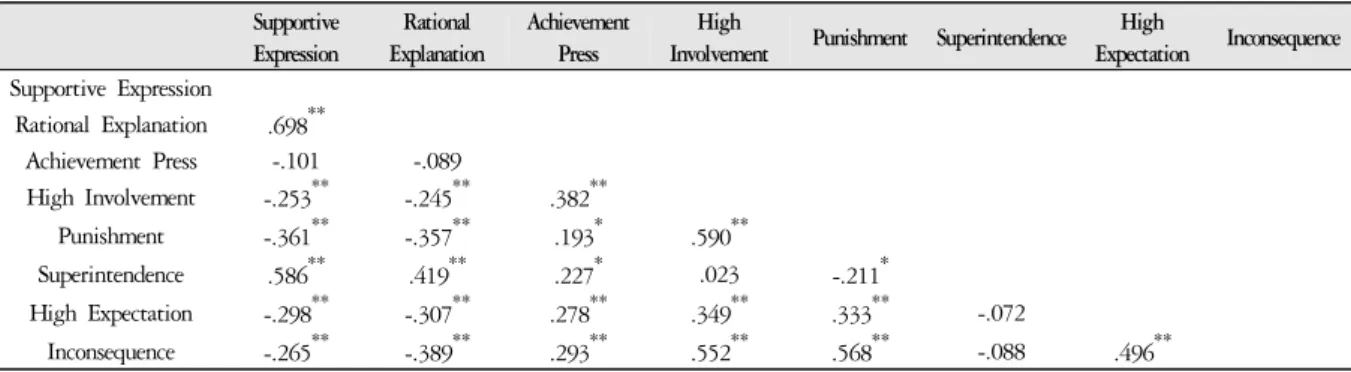
2. 부모양육태도 각 항목의 관계
지지표현과 합리적 설명, 지지표현과 감독, 합리적
설명과 감독, 간섭과 처벌, 간섭과 비일관성, 처벌과 비
일관성, 과잉기대와 비일관성 항목 간에 다소 높은 정
적 상관을 나타내었다. 또한, 지지표현과 합리적 설명
은 간섭, 처벌, 과잉기대, 비일관성과 낮은 부적 상관을
나타내었다. 성취압력은 간섭, 감독, 과잉기대, 비일관
성과 낮은 정적 상관을 나타내었으며, 과잉기대는 간
섭, 처벌과 낮은 정적 상관을, 감독은 처벌과 낮은 부적
상관을 나타내었다.
Supportive Expression
Rational Expression
Achievement Press
High
Involvement Punishment Superintendence High
Expectation Inconsequence
Mother
NS -.016 -.144 .121 .100 .226* -.138 .237** .196*
HA -.324** -.339** -.032 .260** .136 -.133 .333** .165
RD .188* .201* -.082 .041 -.136 .131 -.010 .021
P .318** .271** .193* -.012 .129 .229* -.225* -.087
Child
NS -.135 -.170 .226* .234* .382** -.127 .293** .271**
HA -.130 -.033 .068 .133 .099 -.194* .372** .174
RD .255** .272** .054 .015 .084 .191* -.164 -.065
P .330** .274** .077 -.058 -.070 .205* -.295** -.125
NS: novelty seeking, HA: harm avoidance, RD: reward dependence, P: persistence, * P < 0.05, ** P < 0.01 Table 4. Correlations between Child, Mother Temperament and Parenting Attitude Assessment
Supportive
Expression
Rational Explanation
Achievement Press
High
Involvement Punishment Superintendence High
Expectation Inconsequence
Supportive Expression
Rational Explanation .698**
Achievement Press -.101 -.089
High Involvement -.253** -.245** .382**
Punishment -.361** -.357** .193* .590**
Superintendence .586** .419** .227* .023 -.211*
High Expectation -.298** -.307** .278** .349** .333** -.072
Inconsequence -.265** -.389** .293** .552** .568** -.088 .496**
* P < 0.05, ** P < 0.01
Table 3. Correlations between Each Items of Parenting Attitude Assessment