수변구조물 재해 위험에 대응하기 위한 피해 평가 인벤토리 개념 설계*
조윤원1·최형욱2·최수영2·조명희3※
Conceptual Design of Damage Assessment Inventory in Response to Disaster Risk for Infrastructures
Close to River*
Yun-Won JO1·Hyeoung-Wook CHOI2·Soo-Young CHOI3·Myung-Hee JO3※
1)
요 약
본 연구에서는 자연재해에 따른 수변구조물 재해 Risk 발생 시 효율적 대응을 위한 피해 평가 인벤토리 구축에 대한 개념적 설계를 제시하였다. 인벤토리 개념 설계를 수행하기 위해선 재해에 따른 수변 구조물 Risk 발생 시 피해 시설물에 대한 구분 및 분류가 이루어져야한다. 하지만 재난 관리가 수행되어야 하는 시설물·건축물의 정보가 정부 여러 기관에서 각기 다른 형태의 정보로 관리되어짐으로써 재난관리 업무의 효율적 운영에 대한 문제가 제기되어 왔다. 따라서 본 연구에 서는 미국의 HAZUS-MH를 기반으로 피해 시설물 및 자산 분류 방식을 분석하고 국내 시설물 분류, 건축법규 및 자산 가치 산정 정보를 활용하여 수변구조물 Risk 대응 재해 피해 평가 인벤토 리 개념 모형을 제시하였다. 본 연구에서 제시한 인벤토리 개념 모형은 재해 대응 제내지 피해 평 가를 위한 기반 자료로써 활용할 수 있으며, 현행 자연재난조사 및 복구계획수립 지침에 의해 산 정되는 자연재해에 대한 사유재산 피해 평가의 단점을 보완함으로써 정밀한 피해액 평가의 효율성 을 높일 수 있다.
주요어 : 인벤토리, 피해평가, 재해대응, 수변구조물
ABSTRACT
This research presented a conceptual design of damage assessment inventory for
2014년 2월 4일 접수 Received on February 4, 2014 / 2014년 3월 17일 수정 Revised on March 17, 2014 / 2014년 3월 21일 심사완료 Accepted on March 21, 2014
* 본 연구는 국토교통부 / 국토교통과학기술진흥원 건설기술연구사업(13건설기술연구S01)에 의해 수행되었음.
1 (주)유앤지아이티 U&GIT Co., Ltd.
2 (주)지오씨엔아이 공간정보기술연구소 Institute of Spatial Information Technology Research, GEO C&I Co., Ltd.
3 경북대학교 융·복합시스템공학부 School of Convergence & Fusion System Engineering, Kyunpook National University
※ Corresponding Author E-mail : [email protected]
efficient response to natural disaster damage of infrastructure close to the river. It consists of classification and categorization of facilities for accomplishing the conceptual design of inventory for damage of infrastructure close to the river.
However, there are arising problems of efficient management on disaster, such as poor management of data facilities and constructions which is managed by the different types of government departments. Therefore, this research presented conceptual models of damage assessment inventory on risks of damage infrastructure close to the river using the United states’HAZUS-MH to analyze damage facilities, type of asset classification, classification of domestic facilities and guidelines for computing the value of assets. Conceptual models of inventory this research presented is to be used on the data for damage response on protected inland damage assessment and to increase efficiency for evaluating detailed damage amount of private property by natural disaster and to establish a restoration plan.
KEYWORDS : Inventory, Damage Assessment, Disaster Response, Infrastructures Close to River
서 론
최근 지구 온난화에 의한 이상기후는 복합적 자연재해를 유발하여 SOC(Social Overhead Capital) 구조물의 안전을 위협하고 있다. 국내 의 경우도 기후패턴의 변화가 가속화 되면서 엘리뇨(El Nino) 영향권에 포함되었다. 그 결 과, 국지성 집중호우가 증가하고 태풍이 내습하 는 현상이 빈번해지고 있어 자연재해에 따른 SOC 구조물 방재 대책에 관심이 집중되고 있 다(Jo et al., 2013). 기후변화로 인한 집중강 우와 태풍, 홍수 등은 수문학적 변화를 가져오 고 기존 도시내 배수시설, 상하수도시설의 용량 에 압력을 가하게 된다. 또한 주자장, 건물, 도 로 등의 불투수층의 급격한 증가로 인해 땅속 으로 우수가 흡수되어 저장될 수 있는 능력이 상실되어 표면유출이 크게 증가하거나 유출이 하천에 도달하는 시간이 짧아져 홍수발생가능 성이 크게 증가한다(Kang and Lee, 2012).
복합적 자연재해에 따른 SOC 시설물의 피해는 구조물 자체의 경제적 손실뿐만 아니라 설치 목적에 따라 주변지역 혹은 국가 전체에 직·
간접적 영향을 미친다. 소방방재청 자료에 따르
면 최근 3년(2010~2012)동안 태풍에 의해 피 해를 입은 하천의 연장은 약 302Km 이며, 이 로 인해 약 1,200억원의 경제적 손실이 발생하 였다(NEMA, 2013). 또한 이러한 하천 재해는 하천 시설물 즉, 수변구조물의 손상으로 이어져 제내지 주변 건물, 공공시설, 농경지 및 농작물 등의 피해를 발생시켰다. 특히, 대규모 태풍, 집 중호우는 댐, 제방 등 수변구조물의 월류 및 붕 괴, 배수시스템의 배수 불량 등을 유발하여 비 상상황을 초래할 수 있다. 실제로 국내에서는 2002년 태풍 루사로 인해 낙동강 유역 및 낙 동강 주변 제방이 붕괴가 발생하였고, 충주댐 수위가 계획홍수위까지 이르러 댐 월류 직전의 위험한 상황을 맞기도 하였고, 2010년과 2011 년 여름기간에 서울과 인천, 대구 노곡동 등에 서 갑작스러운 집중호우로 인한 내수배제 불량 으로 많은 침수가 발생하기도 하였다. 이렇듯 수재해로 인한 수변구조물(댐/보, 제방, 사면, 옹벽, 교량)의 손상은 하천 범람 등의 현상을 유발하여 제내지 민간 건축물 및 공공 시설물 의 막대한 손실을 유발한다. 또한, 대부분의 수 변구조물의 경우 주거 및 생산 지역과 인접하 고 있어 파괴 및 붕괴로 인한 2차 피해의 범위 는 상당한 수준으로 파악된다.
도시지역에서는 인구와 건축물을 포함한 각종 시설물 등이 밀집되어 있기 때문에 대규모 재해 가 발생하는 경우 엄청난 대규모의 피해가 발생 할 수 있으므로 재난에 대한 사후처리뿐 아니라 위험지역을 사전에 파악하고 위험을 저감하기 위한 대책 수립이 필요하다(Yeo et al., 2011).
일찍이 자연재해 방재분야 선진국인 미국은 HAZUS-MH 재난 모델을 개발하여 재난관리 정책과 보험요율 산정 등에 활용하고 있다.
HAZUS-MH는 1990년대 초 지진 손실 평 가 시스템으로 개발된 이후 지속적으로 발전하 여 현재 지진 이외에도 허리케인, 홍수로 인한 손실을 예측하는데 활용되고 있으며, 개발 초부 터 국제 사회의 관심을 받아 범세계적인 활용 법이 강구되었다(NIMS, 2012). HAZUS-MH 는 GIS(Geographic Information System) 기 술을 토대로 구축된 시스템으로 그 성능이 꾸 준히 향상되고 있으며 미국의 재해위험예측과 피해저감계획을 위한 의사결정 지원수단으로서 사용이 점차적으로 증가하고 있다(Kang et al., 2007). 국내에서는 지역별 안전도 평가시스템 을 개발하여 지역별 재난위험 및 피해규모를 분 석하고 있다. 지역별 안전도 평가시스템은 시설 물 진단 지표를 선정하여 유형별 재난피해 저감 능력과 대비시켜 재난 위험 강도를 정량적·정 성적으로 진단한다. 이러한 결과에 의해 지역별 안전도 등급을 부여하여 재난발생확률과 예상피 해규모를 종합적으로 진단하고 있다. 또한, 태풍 피해예측, 홍수재해대응시스템 등을 통합하고, NDMS(National Disaster Management System)과 연계한 재해상황 분석·판단시스템 을 개발하여 신속한 의사결정 및 대처 등에 활 용하고 있다. 재해상황 분석·판단시스템은 GIS 프로그램 기반으로 태풍·호우 예상 시 과거 피해유사성, 기상정보, 수문자료 등을 종 합 분석하여 피해우려지역을 사전에 예측하는 시스템이다. 국내재난관리시스템의 경우 재난관 리정보DB센터를 통해 업무시스템별로 분산·관 리되고 있는 재난정보의 표준화 및 통합관리 및 축적된 재난정보를 바탕으로 분석·예측을 통한 의사결정을 지원하고 있다.
하지만 기존의 재해정보관리시스템은 과거 자료를 통한 조회 및 분석에 대한 기능적 한계 점을 가지고 있고 NDMS 역시 실시간적인 재 해정보의 업데이트는 가능하지만 해당지점의 좌표 등 제반 위치에 관한 정보의 부재로 많은 한계점을 가지고 있다(Kim et al., 2008). 또 한, 재난관리가 수행되어야 하는 시설물·건축 물의 정보가 정부 여러 기관에서 각기 다른 형 태의 정보로 관리되어짐으로써 재난관리 업무 의 효율적 운영에 대한 문제가 제기되어 왔으 며, 관리정보로서의 부적합성, 전문성이 부족한 안전관리·시설물 점검절차 등 시설물 관리와 관련되어 발생되는 여러 문제들이 꾸준히 지적 되어 왔다(Hong et al., 2005). 또한, HAZUS-MH의 경우 국내에서도 지진, 태풍, 홍수, 풍수해 추정법으로 검토된 바 있으나 HAZUS-MH가 미국 영토에 특화된 이후로는 기술 부족과 DB(Database) 부족으로 모델 도 입을 위한 후속 연구가 없어진 상태이다(Yu and An, 2013). 따라서 본 연구에서는 복합적 자연재해에 따른 수변구조물 Risk 발생 시 제 내지 시설물의 효과적 피해 평가를 위해 시설 물을 분류하고 특성에 따른 중요도 및 자산가 치를 산정할 수 있는 인벤토리 개념 설계를 제 시하고자 한다. 이를 위해 미국의 HAZUS-MH를 기반으로 피해 시설물 및 자산 분류 방식을 분석하고 국내 시설물 분류, 건축 법규 및 자산 가치 산정 정보를 활용하여 수변 구조물 Risk 대응 재해 피해 평가 인벤토리 구 축 모형을 제시하였다.
국내 수재해 피해산정 기술
국내의 자연재난 피해추정 기술은 홍수피해 분야에서 지속적으로 연구되어 왔다. 국내에서 의 홍수피해 추정 방법론은 하천사업 계획 시 치수경제성분석을 위한 국토교통부의 하천설계 기준 및 공공사업 예비타당성조사를 위한 기획 재정부의 수자원타당성조사지침을 중심으로 발 달해 왔다.
Category Standard application Major Over one million people(metropolitan city)
Medium Under one million people(city)
Garden city The town was raised to status of a city(city)
Rural area Population : over 500 people/㎢, Forest/Fields area : under 70%
Mountainous territory Town(except in rural areas)
TABLE 1. Classified by type of cities(MLIT, 2004) 1. 간편법하천시설기준(MLIT, 1993)의 하천경제조사 편에서는 치수사업에 의한 경제적 효과를 파악 하는 것을 목적으로 하였으며, 간접편익은 조사 방법이 확립되지 않았기 때문에 직접편익을 위 주로 치수경제성분석방법을 제시하였다(MLIT, 2001). 농업피해를 원단위로 산정한 후 다른 피해항목들을 모두 농업피해에 계수를 곱하여 산정하였는데 이는 농업위주로 피해를 산정하 여 편익이 과소 추정되는 단점을 내재하고 있 다. 이 기준에서는 연평균 피해경감 기대액을 산정할 때 세부적인 자료부족으로 계산이 불가 능 할 경우 간편법으로 산정한다고 명시하고 있다. 간편법에서 홍수 피해액 는 다음과 같 이 산정한다(식 1).
=
(1)여기서, 는 연평균 인명피해액, 는 연평균 농작물 피해액, 는 연평균 가옥피해액, 는 연평균 농경지 피해액, 는 연평균 공공시설물 피해액, 는 연평균 기타 피해액, 는 연평균 간접피해액이다.
2. 개선법
간편법의 문제를 개선하기 위해 과거의 침수 면적과 피해자료로부터 피해추정 방법을 제시 하였다. 이 방법은 과거의 피해자료를 통계처리 한 회귀식을 사용하는 방법으로 침수면적-피해 액 회귀식을 5가지 특성으로 분류된 도시유형 별로 유도 하였다.
개선법에서 피해액 상관관계를 도출하기 위
해서는 10년간의 재해연보를 이용하여 침수면 적-피해액의 관계를 도출한다. 그러나 이재민 피해, 인명피해, 농작물피해의 경우 간편법에서 사용하던 원단위를 계속 이용하였다(MLIT, 2004). 개선법은 기존 간편법이 농업피해액 위 주의 피해산정을 해오던 것을 개선하여 도시유 형과 피해항목을 다양화 했다는 데에 상당한 진전을 이루었으나, 재해연보상의 침수면적과 홍수피해 자료로부터 단순히 도시유형 분류에 따라 유도한 회귀식을 제시함으로써 홍수피해 대상지역의 정확한 자산피해를 산정하기 어렵 고, 침수면적과 피해액의 단순관계로는 홍수의 강도에 따른 피해특성을 고려할 수 없는 단점 이 있다.
3. 다차원법
다차원법은 하천설계기준(MLIT, 2009) 및 예비타당성조사지침(KDI, 2008)에서 채택되어 치수사업 경제성 분석에 실무적으로 활용되는 다차원홍수피해산정법의 약칭이다. 기존보다 정 밀한 홍수피해 산정을 위해 개발된 다차원법은 통계자료를 조사하여 산정되는 일반자산 피해 5개 항목과 간편법의 원단위를 이용한 인명/이 재민피해, 일반자산 피해에 비율계수를 곱하여 계산하는 공공시설피해 등 총 7가지 피해항목 으로 구성되어 있다. 이중에서 일반자산 침수피 해 5개 항목은 실제 행정구역별 자산조사에 의 해 평가된 경제적 가치에 백분율 형태의 피해 손실함수를 적용하여 추정하는데 국내 자료의 부족으로 피해손실함수는 일본의 치수경제조사 매뉴얼을 차용하고 있다. 또한, 공공시설물은 과거 피해 자료로부터 일반자산 피해액과 관계 를 도출하여 공공토목시설물 피해액, 일반자산
Area characteristics Target assets Residential area Building : residential building
Contents of the building : household items of residential building
Rural area Agricultural : paddy/grove
Crops : representative crops
Industrial area Tangible/Inventory assets : except in land
TABLE 2. Damaged items of general assets by MD-FDA(MLIT, 2004)Simple method Improved method MD-FDA
Main points
ᆞDepends on the whole agricultural loss ᆞUse simple statistics ᆞUse Korean currency ᆞComputes damage cost by flood frequency
ᆞUses regression to identify trends in flooded area and damage costs
ᆞCalculates damage costs in 5 cities by categories ᆞNo definition for flood frequency
ᆞComputes potential damage cost for flood interpretation and asset investigation ᆞConsiders spatial extents using GIS analysis
ᆞComputes damage costs by flood frequency, flood depth, administrative boundary
Damage and loss functions
ᆞApplies depth-damage functions on damaged houses
ᆞApplies flood-damage function by city types and damaged items
ᆞQuantifies actual damages based on disaster reports
ᆞApplies flood -damage function to buildings, building contents, industry, farm production, farm land ᆞJapanese function is used mostly(except farm loss)
Damage items
ᆞ7 items
ᆞHouse, farm production, farm land, public facilities, life, others, indirect damages
ᆞ6 items
ᆞBuildings, farm production, farm land, public facilities, life, others
ᆞ7 items
ᆞBuildings, building contents, industry, farm production, farm land, public facilities
Asset investigation techniques
ᆞSimple survey on some asset items
ᆞSimple method-based survey is used only on farm production loss
ᆞAsset investigation in 5 direct damage items using population, industry, and economy data
Advantages
ᆞUnresponsive to
socio-economic changes due to simple investigation
ᆞEasy to compute damage cost by flooded area
ᆞMake an accurate estimation on asset investigation using GIS tools
Disadvantages
ᆞDamage are underestimated due to its dependence on farm damage
ᆞDamage are overestimated due to regression parameters
ᆞRequires hard work of collecting big data (GIS, statistics)
ᆞComplicated computing process
Level of
difficulty ᆞEasy but can be specific ᆞVery easy and fast ᆞTake much time and people, and professional skills
TABLE 3. Comparison with elements of domestic existing flood damage analysismethodology
피해액에 대한 비율을 산정하여 적용하고 있다.
그러나 이 역시 국내 자료의 신뢰도 부족으로 일본에서 제시한 값을 활용하고 있다(MLIT, 2004).
HAZUS-MH 피해 평가 시설물 및 자산 분류
HAZUS-MH는 재난모듈, 자산정보모듈, 취 약성모듈, 손실모듈 등 재난모델 요소로 구성되
Code Occupancy class Code Occupancy class
Residential COM8 Entertainment & recreation
RES1 Single family dwelling COM9 Theaters
RES2 Mobil home COM10 Parking
RES3A Multi family dwelling(Duplex) Industrial
RES3B Multi family dwelling(3-4 Units) IND1 Heavy RES3C Multi family dwelling(5-9 Units) IND2 Light
RES3D Multi family dwelling(10-19 Units) IND3 Food/Drugs/Chemicals RES3E Multi family dwelling(20-49 Units) IND4 Metals/Minerals processing RES3F Multi family dwelling(50↑ Units) IND5 High technology
RES4 Temporary IND6 Construction
RES5 Institutional dormitory Agriculture
RES6 Nursing home ARG1 Agriculture
Commercial Religion
COM1 Retail trade REL1 Church
COM2 Wholesale trade Government
COM3 Personal and repair service GOV1 General service
COM4 Technical services GOV1 Emergency response
COM5 Depository institutions Education
COM6 Hospital EDU1 School/Libraries
COM7 Medical office/clinic EDU1 Colleges/Universities
TABLE 4. Classified by general buildings of HAZUS-MH(DHSEP and RD, 2003) 어있다. 또한, 재난 평가를 위해 위험도를 직접
이력하거나 평가할 수 있으며, 재난 평가 결과 를 담고 있는 외부 파일을 불러들일 수도 있다.
특히, 자산정보모듈은 최근 실시된 인구조사 자 료를 바탕으로 구성되며, 건축물, 공공시설물, 인구분포, 대피소 등의 정보를 포함한다. 기초 자산정보는 주(state)를 기준으로 저장되며, 이 외에도 사용자는 정확한 손실 평가를 위해 HAZUS-MH 인벤토리 메뉴에서 직접자산정보 를 추가할 수 있다.
취약성모듈과 손실모듈은 각각 특정 강도의 재난에 대한 자산의 취약성과 직접적, 간접적 피해 규모를 평가하는 단계로 HAZUS-MH는 Analysis 메뉴에서 취약성 정보를 손상 함수로 표현하여 다루고 있으며, 직접적 및 간접적 경 제 손실을 추정하기 위해 기업자산, 복구시간, 소득손실자료 등의 인자를 고려하고 있다 (DHSEP and RD, 2003).
1. 일반건축물의 분류
일반건축물은 주거, 상업, 공업, 농업, 종교, 정보, 교육과 관련한 건축물을 나타낸다. 수재 해 시 피해율을 결정하기 위해 필요한 수집 정 보는 특정 자산 분류와 건축물 형태 관계에 의 해 제공된다.
HAZUS-MH는 기본적으로 33 종류의 분류 항목을 사용한다(표 4). 또한, 건축물의 형식에 따른 구분과 관련하여 Wood, Concrete, Masonry, Steel, Manufactured의 5 종류로 분류하였다. 이러한 건축물 구분의 주요 목적은 유사한 건축물의 가치 및 피해 특성을 사전 정 의된 그룹으로 구분하기 위해서이다.
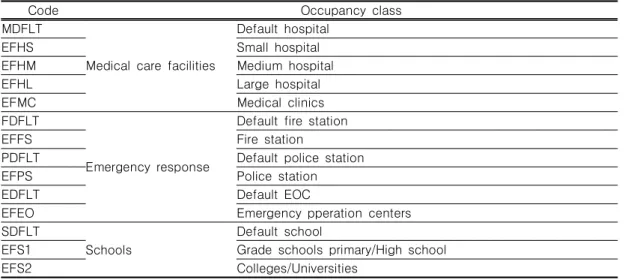
2. 필수 시설물의 분류
필수 시설의 분류는 건물의 종류와 사용되는 시설의 종류에 기초하고 있다. 필수 시설에 대 한 건축물 종류는 일반건축물과 동일하며, 시설 의 분류는 일반시설과 특정시설로 구분된다. 또 한 일반시설은 다시 의료, 응급, 교육 시설로 구분된다. 특정시설은 일반시설의 분류 내에서
Code Occupancy class MDFLT
Medical care facilities
Default hospital
EFHS Small hospital
EFHM Medium hospital
EFHL Large hospital
EFMC Medical clinics
FDFLT
Emergency response
Default fire station
EFFS Fire station
PDFLT Default police station
EFPS Police station
EDFLT Default EOC
EFEO Emergency pperation centers
SDFLT
Schools
Default school
EFS1 Grade schools primary/High school
EFS2 Colleges/Universities
TABLE 5. Classified by essential facilities(DHSEP and RD, 2003)
Damage assets Class Damage assets Class
Transportation system
Highway system
Lifeline utility system
Potable water system
Railway system Wastewater systems
Bus system Oil systems
Port and harbors Natural gas systems
Ferry transportation system Electric power systems
Airports Communication systems
Agricultural products Agricultural products Vehicle Vehicle
TABLE 6. Classified by direct damage assets(DHSEP and RD, 2003) 세부적으로 이루어지며, 의료시설에 5, 응급시설에 6, 교육시설에 3, 총 14 종류로 구분된다 (표 5).
3. 직접적 피해 자산의 분류
직접적 피해 자산은 재해발생 시 직접적으로 피해를 입을 수 있는 자산을 의미하며, HAZUS-MH에서는 교통, 생활기초시설, 농업, 자동차로 구분하고 있으며, 직접적인 경제 사회 적 손실을 추정하기 위해 인구통계 및 건물 DB 를 사용한다. 교통시스템의 경우 고속도로, 철 도, 버스, 항만, 페리, 공항으로 구분하고 있으 며, 라이프라인 시스템은 상수, 하수, 유류, 천 연가스, 전력, 통신시스템으로 구분하고 있다 (표 6). 또한 농작물의 종류 별 단위가격, 생산
비용, 평균 생산량을 기초자료로 활용하여 피해 를 추정하기위해 농작물관련 자산을 따로 분류 하고 있으며, 더욱더 정밀한 피해 추정을 위해 자동차를 별도로 분류하여 차량의 위치, 가치 등을 고려하여 피해 추정을 하고 있다.
4. 높은 잠재적 손실 시설의 분류
높은 잠재적 손실(High Potential Loss) 시 설은 재해가 발생하는 경우 심각한 손실을 야 기할 수 있는 시설로써 핵 발전소, 댐, 군사시 설 등이 포함된다. HPL 시설물에 대해 요구되 는 정보는 위치기반 정보를 포함하는 특징을 가진다.
Code Class Type Code Class Type
Dams Military installations
DDFLT Dam default Default MDFLT Military
default Default
HPDA Dams Arch
HPMI1
Military installations
Barracks/Group quarters
HPDB Dams Buttress
HPMI2 Barracks/Group quarters-unit
HPDC Dams Concrete
HPDE Dams Earth
HPMI3 Officer/Enlisted
Quarters-detached
HPDG Dams Gravity
HPMI4 Maintenance/operations shops
HPDM Dams Masonry
HPMI5 Administrative offices
HPDR Dams Rock fill
HPMI6 Mess halls
DPDS Dams Stone
HPDT Dams Timber crib HPMI7 Officer/Enlisted clubs
HPMI8 Gymnasiums/Armory
HPDU Dams Multi-arch
HPDZ Dams Miscellaneous HPMI9 Gas/Services stations
Nuclear power plants HPMI10 PX/Retail stores
NDFLT Nuclear plants default Default HPMI11 Arsenals
HPNP Nuclear power facilities
Nuclear power
facilities HPMI12 Other
TABLE 7. Classified by HPL(DHSEP and RD, 2003)
Category Division Category Division
Vehicle facilities Vehicle facilities
Commercial facilities
Sales facilities Sport facilities
Industrial facilities
Transportation facilities
Lodging facilities Storage facilities
Dormitory Plant
Hazardous materials facilities
Education or welfare facilities
Medical facilities
Educational/Research facilities Waste disposal facilities
Old/Child facilities Cemetery facilities
Training facilities Funeral hall
Electric power
·Communication facilities
Communication facilities
Neighborhood facilities
Neighborhood facilities(type 1) Neighborhood facilities(type 2) Electric power facilities
Religion·Convocation facilities
Convocation facilities
Residential·Business facilities
Single family dwelling
Religion facilities Multi family dwelling
Recreation facilities
Business facilities Tourist facilities
The other facilities
Animal/Plants/Livestock
/Crop facilities Military installations
TABLE 8. Facilities, classified by construction act(MGL, 2014a)
국내 시설물 분류 및 자산평가 분류 정보 수집
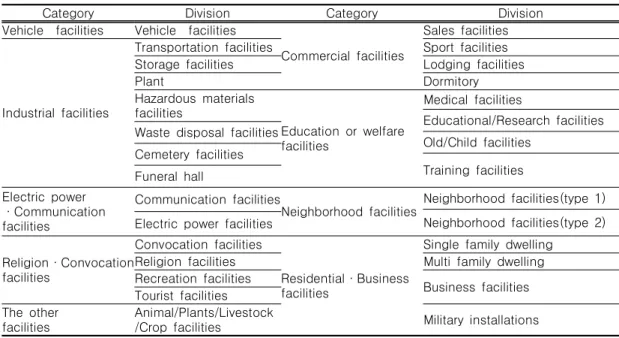
1. 건축법에 따른 시설분류
국내 시설물 분류에 관한 정보 수집을 위해 건축물의 대지·구조·설비기준 및 용도 등을 규정한 건축법(MGL, 2014a)의 정보를 수집하 였다. 국내 건축법은 건축물이란 토지에 정착하 는 공작물 중 지붕과 기둥 또는 벽이 있는 것
Level Use and Scale Factor
Special
ᆞTreatment, storage, and disposal facilities for dangerous objects or government office·foreign official residence·fire station·plants·broadcasting station·
telephone office that are over 1,000㎡.
ᆞGeneral hospitals with enough surgery and emergency seats
1.5
1st
ᆞTreatment, storage, and disposal facilities for dangerous objects or government office·foreign official residence·fire station·plants·broadcasting station·
telephone office that are under 1,000㎡.
ᆞTheaters, meeting halls, exhibition halls, sports facilities, sales facilities, transport facilities(except freight terminals and consolidation facilities) over 5,000㎡
ᆞChild care facilities, elder care facilities, welfare facilities, labor welfare facilities ᆞAccomodations above 5 floors & Office
ᆞDormitories and apartments ᆞSchools
ᆞHospitals with no surgery or emergency seats or medical facilities over 1,000㎡
that does not belong to level(special)
1.2
2nd ᆞBuildings which do not belong to (special), (1), or (3) 1.0 3rd ᆞFarm facilities, small storage
ᆞTemporal structure 1.0
TABLE 9. Importance and necessity factor(MGL, 2014b)
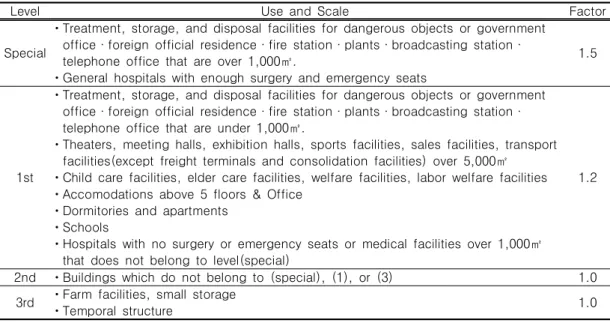
과 이에 딸린 시설물, 지하나 고가의 공작물에 설치하는 사무소·공연장·점포·차고·창고, 그 밖의 대통령령으로 정하는 것이라 정의하고 있다. 또한 건축물의 분류를 위해 유사한 구조, 이용 목적 및 형태별로 자동차, 산업, 전기·통 신, 문화·집회, 영업, 교육·복지, 근린생활, 주 거·업무 및 기타 9개 시설군으로 분류하고 있 으며, 이를 다시 시설군의 용도별로 28개로 구 분하고 있다(표 8). 그리고 건축물의 구조기준 등에 관한 규칙(MGL, 2014b)에서는 건물용도 에 따라 재해 시 기능을 유지해야 할 건물, 위 험물 등을 수장하는 건물 사회적으로 영향이 큰 건물을 대상으로 중요도 등급을 4개로 분류 하여 중요도에 따라 설계하중을 할증하는 계수 를 제시하고 있다(표 9).
2. 시설물정보관리 종합시스템(FMS: Facility Management System)의 시설물 분류 일반적으로 도시지역의 경우 주거, 산업, 농 업 등과 같은 개인의 피해보다 교통, 상하수도, 전력 등 기반시설물과 병원, 학교, 각종 관공서 와 같은 복지시설 등의 공공시설물의 피해가
차지하는 비중이 매우 높다. 따라서 효과적인 수재해 목적별 평가 인벤토리 구축을 위해서는 건축물 분류와 함께 공공시설물에 대한 분류 또한 병행되어야 한다.
특히 공공시설물의 피해와 중요성은 사회 인 프라가 잘 정비된 선진국일수록 높을 수 밖에 없으며, 국내와 같이 국토면적에 비해 인프라 투자 비율이 상대적으로 높다면 더욱 중요하다.
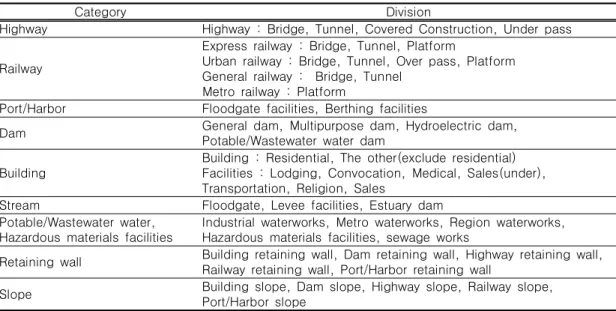
한국시설안전공단 시설물정보관리 종합시스템 운영규정(MLIT, 2009)은 시설물을 건설공사 를 통하여 만들어진 구조물과 그 부대시설로 정의하고 건축법에서 구분하고 있지 않는 라이 프라인 시설 및 기반 시설물 등의 정보를 구분 하고 관리하고 있다. 이에 따라 관리 대상을 도 로, 철도, 항만, 댐, 하천, 상하수도, 폐기물매립 시설, 옹벽, 정토사면 등으로 구분하고 이에 따 라 세부 47개 종류로 분류하고 있다(표 10).
3. 보험가액 및 손해액의 평가기준에 따른 자산 분류
현행 자연재해에 대한 피해는 자연재난조사 및 복구계획수립 지침에 의해 산정된다. 그러나
Category Division
Highway Highway : Bridge, Tunnel, Covered Construction, Under pass
Railway
Express railway : Bridge, Tunnel, Platform
Urban railway : Bridge, Tunnel, Over pass, Platform General railway : Bridge, Tunnel
Metro railway : Platform
Port/Harbor Floodgate facilities, Berthing facilities
Dam General dam, Multipurpose dam, Hydroelectric dam,
Potable/Wastewater water dam
Building
Building : Residential, The other(exclude residential) Facilities : Lodging, Convocation, Medical, Sales(under), Transportation, Religion, Sales
Stream Floodgate, Levee facilities, Estuary dam
Potable/Wastewater water, Hazardous materials facilities
Industrial waterworks, Metro waterworks, Region waterworks, Hazardous materials facilities, sewage works
Retaining wall Building retaining wall, Dam retaining wall, Highway retaining wall, Railway retaining wall, Port/Harbor retaining wall
Slope Building slope, Dam slope, Highway slope, Railway slope, Port/Harbor slope
TABLE 10. Facilities, classified by FMS(MLIT, 2009)
Category Definition
Building Building is an artificial structure with a roof and walls standing permanently on the ground.
Buildings are used as housing, work, assembly, entertainment, and storage.
Structure
The Building Act defines structure as an artificial body or a construction. Structures include railway services, power generations, power transmission and distribution, broadcast and wireless communication, stadiums, amusement parks, roads, and so on. Building is excluded in this definition.
Facility Facility is an installation, contrivance, or other things which facilitates something; a place for doing something: walls, ceilings, floors which do not influence structures when it is rebuilt.
Mechanism
Mechanism is a device which is useful to humans that can transform or transmit an amount of physical quantity. A device is a structure that generates an electric or chemical effect by using mechanical advantages. For example, there are devices such as combustion device, refrigerating device, and electrolytic device.
Machine tool Machine tool is an assistance device for a machine, and a device is either a machine which has a simple structure or a term as a general equipment.
Office items Office items are equipments used by people which locates in offices, stores, and fields.
Household items
Household items are a series of items used for somebody’s living, such as furnitures, clothes, accessories, foods, and fuel
Vehicular contrivance
Vehicular contrivances are defined as rail vehicles, vehicles for special use, vehicles for transportation business, and delivery equipments.
Inventory assets
Inventory assets are defined as raw and sub materials, goods-in-process, half products, products, by-products, goods and storage items.
TABLE 11. Evaluating the value and range of damage amount(GIAK, 1999) 개인적 재산에 대한 피해액 산정부분과 관련하
여 주거용 및 상업용 건물 등의 부착물에 대한 피해와 생활용품, 내장물에 대한 피해가 고려되 지 않으며, 건물면적에 상관없이 획일적으로 동
별 혹은 세대당 피해액으로 산정되고 있다.
특히 상가, 공장 등에 대한 피해액 산정 시 제품피해액과 영업결손 등의 무형적인 피해는 제외되고 있다. 또한 자동차 등은 사유재산 총
Category Division
HAZUS-MH MD-FDA This study
General buildings
Residential, Commercial, Industrial, Agriculture, Religion, Government,
Education
Residential /Industrial
assets
Vehicle, Industrial, Convocation, Commercial, Neighborhood,
Residential·Business Essential facilities Medical care, Emergency
response, Schools Industrial assets Medical, Educational/Research, Old/Child care, Training, Government High potential loss
Facilities
Dams, Nuclear power plants, Military installations
Government facilities
Dams, Stream, Retaining wall, Slope, Highway bridge
Special facilities - - Military Installations, Electric power
·Communication facilities Direct damage
facilities
Transportation system, Lifeline Utility system, Agricultural
products, Vehicle
Government
facilities Highway, Railway, Port/Harbor Lifeline utility
facilities - Government
facilities
Potable/Wastewater water, Hazardous materials facilities Animal/Plants
facilities - Industrial assets Animal/Plants/Livestock/Crop facilities
TABLE 13. Comparison of facility classification
Category Division
General buildings Vehicle, Industrial, Convocation, Commercial, Neighborhood, Residential·Business Essential facilities Medical, Educational/Research, Old/Child care, Training, Government
High potential loss
facilities Dams, Stream, Retaining Wall, Slope, Highway bridge
Special facilities Military installations, Electric power facilities, Communication facilities Direct damage facilities Highway, Railway, Port/Harbor
Lifeline utility facilities Potable/Waste water, Hazardous materials facilities Animal/Plants facilities Animal/Plants/Livestock/Crop facilities
TABLE 12. Facility classification of study 피해에 포함되고 않고 있는 등 이로 인해 실재 개인 재산에 대한 손실 추정 시 실제와 차이가 발생하고 있는 실정이다.
하지만 국내 보험가액 및 손해액의 평가기준 (GIAK, 1999)에 따르면 손해사정 시 경제적 중요도에 따른 보험가액을 정확하게 평가하기 위해 건축물을 정의하고 이에 따른 손해액의 평가 적용 범위를 제시하고 있다(표 11). 보험 가액 및 손해액의 평가 기준에서는 사유재산 및 주거용, 상업용 건물 등의 부착물, 내용물에 대해 건물, 구축물, 시설, 기계장치, 공ᆞ기구, 영업용 집기비품, 가재, 차량용 운반구, 재고자 산으로 분류하여 내용연수 및 감가상각을 고려 해 피해액을 산정하고 있다.
수변구조물 Risk 대응 피해 평가 인벤토리 개념 설계
HAZUS-MH는 국내 MD-FDA에서 고려하지 않는 상세한 Inventory Data를 구분하고 있다.
국내 실정을 고려할 때 HAZUS-MH에서 구분 한 기본 프레임은 참고하되 구분체계는 사용가능 한 국내 자료를 활용하여 결정되어야 한다.
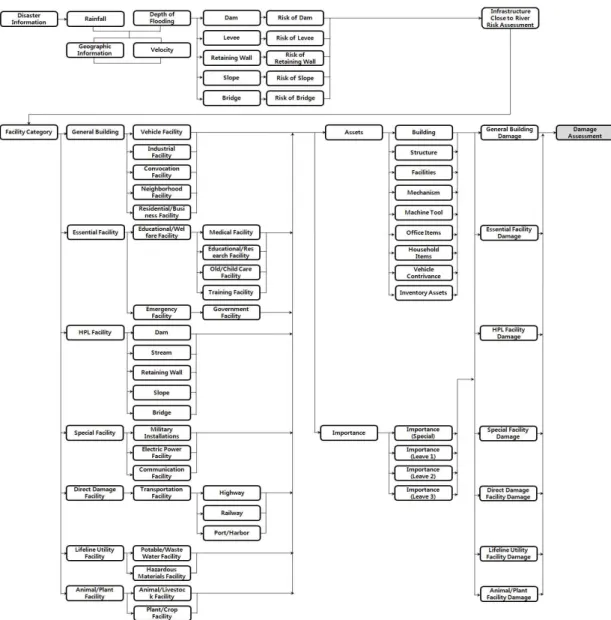
따라서 본 연구에서는 수변구조물 Risk 대응 피해 평가 인벤토리 개념 설계를 위하여 건축 법 및 한국시설안전공단 FMS의 분류에 따라 제내지 시설물을 일반건축물, 필수 시설물, 잠 재적 손실시설물, 특수시설물, 직접적 피해 시 설물, 생활기초시설물, 동·식물관련 시설물로
FIGURE 1. Conceptual design of damage assessment in response to disaster risks of infrastructures close to river
분류하였다(표 12).
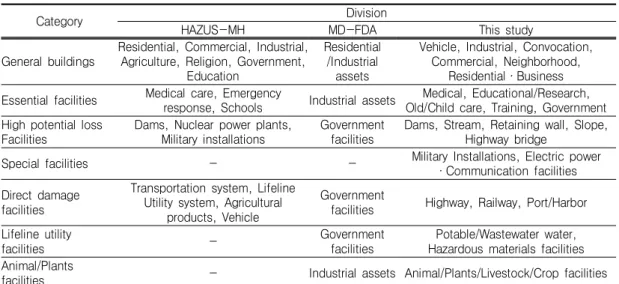
특히 국내 건축법상의 이용목적 및 형태별 분류에 따라 미국 HAZUS-MH와 달리 농업 및 축산 관련 시설물을 동·식물 관련 시설로 별도 분리하였으며, 교정 및 군사시설, 전기·
통신시설, 발전시설을 특수 시설물로 구분하여 제시하였다. 또한 상업시설은 용도 구분에 따라
근린생활시설에 포함하였다(표 13). 더욱이 건 축법의 분류 기준을 적용함으로써 시설물 용도 및 목적에 따른 중복성을 피하고, 국내 실정에 적합한 인벤토리 개념 모형을 제시하였다. 본 연구에서 제시한 인벤토리 개념 모형은 시설군 분류에 따른 DB 구축 시 현재 운영 중인 건물 정보통합시스템, 도로명주소안내시스템 등의 정
보를 적합한 시설군 분류에 적용할 수 있어 효 율적인 DB 구축이 실현 될 수 있다.
또한, 분류된 시설물의 피해도 및 중요도 산 정을 위해 건축물의 구조기준 등에 관한 규칙 에서의 건물용도에 따른 중요도 등급을 부여 하였을 뿐만 아니라 현행 피해액 산정 시 제외 되었던 무형적인 피해액 산정을 위해 보험가액 및 손해액의 평가기준의 적용범위를 활용하여 인벤토리 모형을 구축하였다(그림 1).
이와 같은 분류에 의해 구축된 피해 평가 인 벤토리 모형은 그룹화된 시설물 체계와 용도별 중요도 평가 및 주거용, 상업용 건물 등의 부착 물 피해, 생활용품, 내장물 피해, 상가, 공장 등 에 대한 재고자산 피해 및 영업결손 등의 무형 적인 피해가 고려된 자산평가를 가능케 하여 수변구조물 재해에 따른 제내지의 효율적 피해 평가를 지원 할 수 있을 것이다.
결 론
본 연구에서는 복합적 자연재해로 인한 수변 구조물 Risk 대응 제내지 시설물의 피해 평가 를 위한 인벤토리 개념 설계를 제시하였다. 이 를 위해 HAZUS-MH의 피해 시설분류를 기반 으로 국내 건축법 및 시설물정보관리 종합시스 템의 정보를 활용하여 시설물을 구분하였다. 또 한, 국내 보험가액 및 손해액의 평가기준의 정 보를 활용하여 분류 시설물의 자산가치를 평가 하고 최종적으로 이를 종합하여 피해도를 추정 할 수 있는 인벤토리 개념 모형을 구축하였다.
본 연구에서 제안하는 시설물 분류와 이에 따 른 피해 평가 모형은 다음과 같다.
첫째, 제안된 인벤토리 모형에서 피해도를 산 정하기 위한 시설물의 분류는 건축법 및 시설 물정보관리 종합시스템의 분류체계를 활용하여 일반건축물, 필수 시설물, 잠재적 손실시설물, 특수 시설물, 직접적 피해시설물, 생활기초 시 설물, 동·식물 관련 시설물로 구분하였다. 이 와 같은 그룹화를 통해 유사성을 갖는 시설물 을 분류함으로써 평가 대상의 중복성을 방지할 수 있다. 둘째, 분류된 시설물을 대상으로 사회
적 영향을 고려한 중요도 산정을 위해 건축물 의 구조기준 등에 관한 규칙에서의 건물용도에 따른 중요도 등급을 부여 하였다. 이를 통해 재 난 시 용도에 따른 중요도를 평가 할 수 있다.
셋째, 자산 피해도 평가를 위해 대한손해보험협 회에서 제시하는 보험가액 및 손해액의 평가기 준을 적용해 현행 자연재난조사 및 복구계획수 립 지침에 의해 산정되는 자연재해에 대한 사 유재산 피해의 단점을 보완하였다. 이를 통해 정밀한 피해액 평가의 효율성을 높일 수 있다.
본 연구에서 제시한 수변구조물 재해 Risk 대 응 피해 평가 인벤토리 모형의 시설물 분류 및 이에 따른 피해산정 항목이 완벽하다고 볼 수 는 없다. 이의 보완을 위해 향후 추가 연구가 필요할 것이다. 먼저 인명에 대한 피해손실 항 목이다. 이를 위해 지역별, 행정단위별 인구통 계 및 인명손실로 인한 간접적 손실에 대한 모 형이 별도로 구축되어야 하며, 또한 모형 구축 에 따른 피해평가 함수의 정의 및 관련 데이터 베이스의 구축 또한 필수적이다.
본 연구는 단지 수변구조물 재해 Risk 대 응 피해 평가 인벤토리의 개념적 설계이다. 향 후 본 연구에서 제시한 모형을 통해 신뢰성 있 는 피해도 추정을 하기 위해선 관련 데이터베 이스의 구축 및 평가함수 정의에 대한 연구가 추진되어야 할 것이다. 이러한 연구를 통해 수 재해 대응 피해평가 시스템의 구축이 가능하며, 방재 업무 타당성 평가의 효과적인 도구로서 사용이 가능할 것이다.
REFERENCES